

Parking Meter History
The History of Parking Meters in Baltimore City
From 1937 to the Present
Introduction
Parking meters have long been a fixture of urban life, designed to manage congestion, encourage turnover of spaces, and generate revenue for cities. Invented in the 1930s as a response to growing automobile use, they first appeared in Oklahoma City in 1935, where the "Black Maria" meter charged a nickel for an hour of parking. Baltimore, like many American cities, grappled with traffic issues in the post-Depression era, leading to proposals for meters as early as 1937. However, implementation was delayed by opposition and bureaucratic hurdles, with the first meters not installed until 1955. Over the decades, Baltimore's parking meter system has evolved from simple coin-operated devices to sophisticated digital networks integrated with mobile apps. This article traces that history, drawing on key events, technological shifts, and administrative changes up to the present day in 2026.
Early Proposals and Opposition (1937–1954)
The story of parking meters in Baltimore begins in the summer of 1937, when the City Council first considered installing them to address mounting traffic congestion in business districts. Inspired by successes in other cities—such as Oklahoma City's pioneering use of meters from the Magee-Hale Park-O-Meter Company—the proposal aimed to regulate curb parking and improve traffic flow. However, it faced immediate resistance. Police Commissioner Charles D. Gaither opposed the idea, arguing that meters would exacerbate downtown traffic problems rather than solve them.
In 1938, an ordinance was introduced requesting just 56 meters, but it failed amid vociferous opposition from the Police Department and the American Automobile Association (AAA). Mayor Howard Jackson's administration shelved the plan, and the debate simmered for years. Proposals resurfaced annually, often tied to broader traffic reforms, but were repeatedly stalled by concerns over enforcement, costs, and public backlash. By the early 1950s, Baltimore remained one of the few major U.S. cities without parking meters, a point highlighted by traffic experts.
The turning point came in 1954 under the influence of Henry A. Barnes, Baltimore's innovative but controversial traffic director. Barnes, known for his aggressive urban planning, requested 1,177 meters with varying time limits: 12-minute, 24-minute, one-hour, and two-hour options, all at a rate of 1 cent per 12 minutes. His goal was to combat "squatters"—drivers who parked all day in prime spots—and promote quicker turnover for shoppers and visitors.
Installation and Early Expansion (1955–1960s)
On March 5, 1955, the bill authorizing nearly 3,000 meters on about 40 business streets was signed into law by Mayor Thomas D'Alesandro Jr. By August, the City Board of Estimates awarded contracts to the Duncan-Miller Parking Meter Corporation of Chicago for 2,490 mechanical meters at a cost of $114,237, with later automatic models from the Dual Parking Meter Company. The first meter was installed on North Avenue on November 1, 1955, followed quickly by others on Charles Street. Rates were set at a nickel per hour for private vehicles, with higher fees for commercial trucks, such as 25 cents for two hours for semi-trailers in areas like Sam Smith Park near the waterfront.
Expansion was swift under Barnes' direction. By 1956, meters reached Eastern and Pennsylvania Avenues, near Cross Street Market, and business districts in Waverly and Highlandtown. Enforcement initially fell to the Baltimore Police Department's Traffic Enforcement unit. In 1958, tensions arose when the U.S. Marshal refused to fund meters on federal property near the Battle Monument, citing unreserved spaces for government vehicles.
By 1961, a dedicated "Meter Maid" unit was formed, consisting of 10 female officers and a sergeant, to handle violations more efficiently. This period marked meters as a major downtown feature, with their revenue helping fund traffic improvements. By the early 1990s, the city boasted 11,700 meters, generating $5.3 million annually.
Technological Advancements and the Parking Authority Era (1970s–2000s)
The 1970s and 1980s saw incremental updates, but significant modernization began with the establishment of the Parking Authority of Baltimore City (PABC). In 1979, the City Council passed an ordinance creating a Parking Enterprise Fund, laying groundwork for more professional management. However, city-owned garages and lots were often criticized as dark, dirty, and underutilized.
In 2000, Ordinance 2000-71 formally created the PABC as a quasi-governmental agency to oversee planning, development, and operations of parking infrastructure. Operations began in 2001, shifting enforcement from police to Parking Control Agents under the PABC. This marked a professionalization of the system, with the PABC managing 13 garages, 20 lots, and thousands of meters.
A key upgrade came in 2004 with the introduction of "pay and display" meters (also called EZ Park Meters), which required drivers to print and display receipts on their dashboards. These multi-space machines replaced many single-space coin-operated ones, allowing for credit card payments and easier rate adjustments. By the mid-2010s, the PABC celebrated its 15th anniversary in 2016, highlighting improvements in meter technology and garage maintenance.
Recent Developments and Current System (2010s–2026)
The 2020s brought further digitization. In 2021, the PABC completed replacing all pay-and-display meters with "pay by license plate" systems from vendors like IPS and Flowbird. This eliminated the need for dashboard receipts; instead, enforcement officers scan plates to check payment status via a central database. Rates vary by location, typically $0.40 to $3.25 per hour, with meters active from 8 a.m. to 6 p.m., Monday to Saturday (some on Sundays). Mobile apps like ParkMobile allow users to pay and extend time remotely.
The COVID-19 pandemic disrupted enforcement, with rules suspended for much of 2020–2021, leading to a drop in tickets. In March 2025, the city reinstated 24-hour enforcement to address illegal parking, resulting in a surge of citations—primarily for expired tags—and boosting revenue. As of 2026, the PABC oversees over 900 multi-space and 4,000 single-space meters, plus 3,600 reserved residential disabled spots and 50 Residential Permit Parking areas issuing over 30,000 permits yearly. Meters are free on holidays like New Year's Day, Independence Day, Labor Day, Thanksgiving, and Christmas.
In late 2025, Mayor Brandon Scott signed zoning reforms eliminating parking minimums for new developments to encourage housing and reduce car dependency, potentially impacting future meter demand. The PABC continues to focus on data-driven strategies, including mobile payments and garage renovations, to enhance equity and efficiency. Revenue from meters supports broader transportation initiatives, reflecting their enduring role in Baltimore's urban fabric.
Conclusion
From a contentious proposal in 1937 to a digitized network in 2026, Baltimore's parking meters illustrate the city's adaptation to automotive growth and technological progress. What began as a simple tool for traffic control has become integral to revenue generation and urban planning. As Baltimore evolves, so too will its parking systems, balancing convenience, enforcement, and sustainability.

The first working fully coin operated operational parking meter was designed in 1935 by an engineering professor at Oklahoma Agricultural and Mechanical College (now Oklahoma State University), Holger George Thuesen, and former engineering student and 1927 OSU graduate, Gerald A. Hale. The parking meter was dubbed the “Black Maria.”
Work began on the parking meter in 1933 at the request of Oklahoma City lawyer and newspaper editor Carlton C. Magee (January 1872 – February 1946).
Why would anyone, anywhere, place the scourge of parking meters upon the globe, you ask? Who was Carlton C. Magee? We, too, asked the same questions.
As history goes, in the pre-1930s, there was free, unregulated reign on downtown parking in Anywhere, USA. There wasn’t any regulated parking in Oklahoma City either, as it turns out. Since retail employees occupied most of the available parking spaces, there was no room for customers to park. Traffic back-ups were a persistent problem, clogged streets added to the congestion, and shoppers/motorists impatiently honked their horns for mercy and a place to park. But most of all, businesses were losing revenue as shoppers went elsewhere. It was high time that someone launched a way to regulate parking.
Enter Carlton C. Magee, who recently moved from New Mexico to Oklahoma City, Oklahoma, in 1927. That’s just before the opening of the Oklahoma City Oil Field in 1928. The enormous oilfield added security to the state’s economy during the Great Depression and produced some 7.3 million oil barrels over the next 40 years.
With big business comes people, and with people comes cars. (Statistics reveal that between 1913 and 1930, the number of vehicles registered in Oklahoma shot up from 3,000 to an astronomical 500,000. Great balls of fire, that’s a lot of cars.)
Anyways, Carlton had previously worked as a reporter for an Albuquerque newspaper and exposed the Teapot Dome scandal and testified against Secretary of the Interior Albert B. Fall. Keeping all this in mind, it’s safe to say Carlton must’ve been a bulldog for solving pressing issues.
As January 1933 approached, the parking problem was well out of hand and then some. Downtown Oklahoma City retailers, local government, and Chamber of Commerce, all feeling the pinch of revenue losses and searching for a resolution, launched a traffic committee with Magee as its chairman. As it turns out, Carlton was in the right place at the right time–he was the perfect individual to chair the parking committee.
 Magee felt the best resolution to the parking dilemma was to assess a charge for parking. But how? Magee explained that employing a mechanical timer in each space would solve the City’s headaches. To further demonstrate his idea, Magee developed a rudimentary prototype. He also applied for its’ patent on December 21, 1932, and established the Magee-Hale Park-O-Meter Company.
Aware that his prototype wasn’t hitting on all cylinders, Magee launched a design competition with prize money of $160 for the winning design and $240 for the submission of a working model. The contest ran from February 17 through May 6, 1933. open to the Oklahoma Agricultural and Mechanical College students to design a working prototype. Though a variety of designs were presented, students weren’t able to assemble a working model.
Thuesen and Hale stepped up to the plate (parking meter) when all hope seemed lost and created Magee’s prototype. The prototype withstood the test of durability and time–cost-efficient, weather-resistant, and security proof. They hit paydirt.
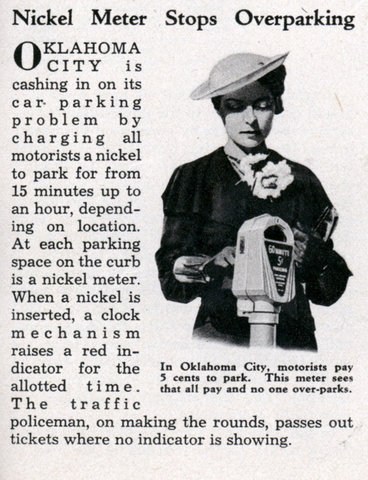
Anxious to test the meter’s effectiveness, they were installed on one side of the street in Oklahoma City for a test run. The initial cost for the meters was 5 cents an hour. The meters seemed to be the answer the city retailers, local government, and the Chamber of Commerce was seeking. Three days after their installation, retailers across the street appealed to the local government to install meters on their side of the street. Oklahoma City’s traffic movement improved, and the traffic jams were resolved.
Industrial production started on the parking meter in 1936. Magee received a patent for the improved parking meter apparatus on May 24, 1938. (In the fairness of history, it’s important to note that the first patent for a parking meter was filed by Roger W. Babson ten years earlier, on August 30, 1928. The parking meter’s power was derived from a parked vehicle’s battery-thus necessitating a unique connection from the vehicle to the meter.)
The parking meter models were based on a coin acceptor, a dial to employ the device, and an obvious indicator to register the paid session’s termination. The metered model endured for more than 40 years, with a few minor changes to its exterior design–the double-headed design for incorporating two adjoining parking spaces alongside the inclusion of new materials and production procedures.
Interesting facts:
The world’s first installed parking meter was installed at the corner of First Street and Robinson Avenue in downtown Oklahoma City on July 16, 1935.
Reverend CH North of Oklahoma City was given the first ticket ever issued for a parking meter violation in 1935. North took the parking meter company to court. He lost his case.
In 1936, M.H. Rhodes Inc. of Hartford, Connecticut, started making meters for the Mark-Time Parking Meter Company of Miami. Rhodes meters were distinctly different from Magee’s design because only the driver’s action of turning a handle was needed to keep the spring-wound. In contrast, Magee’s meters required a specialist to wind the spring occasionally.
The Magee-Hale Park-O-Meter Company later changed its name to POM (the initials of Park-O-Meter) and is still active in producing parking meters today.
In 1960, New York City retained its first crew of “meter maids”; all were women. In 1967 the first man was hired as a ‘meter maid.”
In the mid-1980s, a digital version parking meter was introduced, transitioning the mechanical components with electronic components: boards, keyboards, and displays.
By the beginning of the 1990s, millions of parking meter units were marketed around the world. Today, new solutions, including collective pay and display machines and new payment forms, are developed along with electronic money and communication technologies.
References:
History Lesson: https://www.parking-net.com/parking-industry-blog/history-lesson-the-first-parking-meter
Oklahoma Historical Society
Parking meter – Wikipedia. https://en.wikipedia.org/wiki/Parking_meter
POLICE INFORMATION
If you have copies of: your Baltimore Police Department Class Photo, Pictures of our Officers, Vehicles, Equipment, Newspaper Articles relating to our department and or officers, Old Departmental Newsletters, Lookouts, Wanted Posters, and or Brochures. Information on Deceased Officers and anything that may help Preserve the History and Proud Traditions of this agency. Please contact Retired Detective Kenny Driscoll.

NOTICE
How to Dispose of Old Police Items
Please contact Det. Ret. Kenny Driscoll if you have any pictures of you or your family members and wish them remembered here on this tribute site to Honor the fine men and women who have served with Honor and Distinction at the Baltimore Police Department. Anyone with information, photographs, memorabilia, or other "Baltimore City Police" items can contact Ret. Det. Kenny Driscoll at
Copyright © 2002 Baltimore City Police History - Ret Det Kenny Driscoll
