Police Patrol

Police Patrol

EVER EVER EVER Motto Divder

Baltimore Police Patrol

The First Vehicles in The Baltimore Police Department for use in patrol came along beginning in 1909 based on a newspaper article dated 1911 which gave us the following count; Auto Patrol vehicles have been added to the department subsequently as follows: The first vehicle ever came in May 1909, the second in May 1910, the third in June 1910, followed by the fourth in Aug 1910, fifth In July 1911, the sixth, seventh, and eighth all came in November 1911. In addition to these first eight auto patrol units there was a vehicle known as “Black Maria”, a truck, and a machine (auto) each for Marshal Farnan and Deputy Marshal Manning, making a total of 11 automobiles purchased for the entire department from 1909 to 1911.

DeviderThe Baltimore Sun Mon Apr 15 1946

1-MAN PATROL CAR OPPOSED

Apr 15, 1946

The Sun (1837-1989); Apr 15, 1946; pg.7

1- PATROL - CAR OPPOSED MAN

Atkinson Says Two Are Needed / For Each Machine
Police patrol cars in Baltimore, could not adequately serve I the public interest if operated by one man instead of two, Hamilton R. Atkinson, Commissioner of Police, declared yesterday.

Mr. Atkinson, who is asking for 212 additional patrolmen, had been questioned about relieving the need for extra police personnel by taking a man from each or the radio cars and using him elsewhere. Two men in each car usually are necessary to handle such emergencies as a fight, house-breaking or disturbance involving several persons, the commissioner explained.

Major Problem Cited
Moreover, if only one man were in the car, the machine often would have to be left unprotected, and a less continuous check could be kept on reports coming over the radio, he added. He said, also, that two-man operation facilitated the handling of school traffic, a major problem of the day shift or the department. Foot patrolmen are far from adequate to cover the school traffic, Mr. Atkinson declared, and patrol cars are called into use, as well as traffic officers on motorcycles. One patrolman in the car will take charge at one school, and the second man will move on to another traffic-congested areas nearby.

Child Fatality Low
"The child fatality record has been very low, and I intend to keep it that way." he asserted. The day shift has to devote approximately five and a half hours to taking care of school traffic, he added. "We have never used one man in radio cars. I have gone into the matter thoroughly with the inspector of the department and the captains or the district,” Mr. Atkinson said. "None of my predecessors thought it feasible, and neither do I. "Mr. Atkinson insisted on the need for more men to protect the city, particularly in outlying districts. He said there were about 231 men on each shift serving the entire city-wide area, 91 square miles.

Devider
The Baltimore Police Department uses "
Districts", Sectors and Posts to form what is known as Patrol. Where many departments use "Precincts," our department uses Districts, Districts numbered 1, thru 9. Starting with Central District (#1) from there we go to Southeast District (#2), and then going counter clockwise around the cities districts to Eastern (#3)Northeast (#4)Northern (#5)Northwestern (#6)Western (#7)Southwestern (#8) and finally Southern (#9). Their phone numbers by the way also use the numbers 1 thru 9, CD being 396-2411SE 396-2422E 396-2433NE 396-2444N 396-2455NW 396-2466W 396-2477 SW 396-2488 and S 396-2499.

Reports also go by these numbers, all Central District reports start with the number 1 followed by a letter indicating the month 1 thru 12 Jan thru Dec, and then the number sequentially of the report so the first report would be 1A0001, and so on, making it easy to file and find reports based on District and Date of occurrence.

The following are links to the district pages on this site


1. Central - 1826 -  Central/Middle District History - 03-09-1826  Central District was first known as the Middle District and was first located at Holiday and Saratoga Streets, it was established on 03-09-1826, the building that housed Central was built in 1802 and was in use by the police until 1870. From there they moved to 202 N. Guilford Avenue, (North Street) that building was brand new built in 1870 and used until 1908. On March 4 1908 Central moved to Saratoga and St. Paul Streets, a renovated school house. That location was used until 09-12-1926 when they went to Fallsway and Fayette St. sharing the Headquarters building built in 1926 and used until 09-12-1977 when they moved to 500 E. Baltimore St. 


2. Southeast - 1858/59 - Southeastern District History - 1958/59 - The Southeastern District is the youngest of all of our districts, it was first built in 1958/59 at it's present location of 5710 Eastern Ave.


3. Eastern - 1826 - Eastern District History - 03-09-1826 - The Eastern District was first located at 1621 Bank Street a building that was built around 1822, and still stands to this day. It remained at the Bank Street location until the summer of 1959, when the station was moved to the old Northeastern station at Ashland and Chew St. (Durham) in the Summer of 1959 where they stayed until 1960. In December 1960 they moved to their current location at 1620 Edison Highway.


4. Northeast - 1874 - Northeasten District History - 1874 - The Northeastern District was first opened at Ashland and Chew Streets (Durham) in 1874 where it remained until 1958/9 when they moved to their present district at 1900 Argonne Drive.

5. Northern - 1900 - Northern District History -  1900 The Northern District was first opened at Keswick and 34th Street (Cedar & Second Streets) on 1 Feb 1900 at 8am ran by Capt. Gittings, Lieutenants Henry and Dempsey; Round Sergeants will be, Warden for Day Duty, and Moxley for Night Duty. At the time they began with 50 officers. It remained at the Keswick location until 2001 when it moved to it's current location at 2201 W Coldspring Lane.

6. Northwest - 1874 Northwestern District History - 1874 - The Northwestern District was first opened at Pennsylvania Ave and Lambert Street in 1874 where it remained until 1958/9 when they moved to their present district on Reisterstown Rd. 

7. Western - 1826 - Western District History - The Western District was first located at Green St between Baltimore St, and Belvidere St. Used from 1826 until 1876 when they moved to their new location, Pine Street, (still stands to day and is used by the Maryland University Police) Baltimore Police used it from 1876 until 1958/9 when they built their new station house at 1034 N Mount St, which is the current site on the Western District. 

8. Southwest - 1884 - Southwestern District History - 17 July 1884  The Southwestern District was first opened at Calhoun and Pratt Streets (200 S Calhoun St) where it remained until 11 July 1958 when they moved to their present location at 424 Font Hill Ave.

9. Southern 1845 - Southern District History - The Southern District was first located at Montgomery and Sharp Streets, where it sat from 1845 until 1896 when they moved to Ostend Street. Ostend Street and Patapsco Street, remained in use from 1896 until 1985/86, when it moved to 10 Cherry Hill Road where it remains in use to present.

Devider

Patrol Vehicles had an Interesting History of Their Own

17 Nov 1968

Police Limit Car Sirens

The Sun (1837-1987); Nov 17, 1968;pg. 17

Police Limit 

Car Sirens

Action Taken To Eliminate - False Sense Of Security

The city's Police Department is putting sirens on fewer and fewer of its cars. The number of cars bearing sirens is being reduced in an effort to eliminate a false sense of security which they tend to give patrolmen who are racing to answer a call, William R. Morrissey, the department's public relations man, said yesterday.

Mr. Morrissey acknowledged that "there is no solid, professional thinking ... as to whether police vehicles should or should not be equipped with sirens" but he pointed to experiences several years ago when all cruisers had sirens and the accident rate among police cars was so high that use of sirens was curtailed.

Report Asked

Currently, Mr. Morrissey said, sirens are installed on several cars in each of the nine police districts, some cars used by detectives, traffic patrol cars and some specialized vehicles. The lack of sirens on police cars has prompted city Councilman Emerson R. Julian D., 4th) to ask the department for a report on the use of sirens on police vehicles. If that information shows that sirens are needed, to help protect the public, Dr. Julian said, he will introduce a bill to require sirens on all police vehicles.

Mr. Morrissey pointed out that in some emergency situations, use of a siren could alert a criminal that the police are coming. And, he said, the driver or an emergency vehicle is still required to drive "with due regard for the safety of all persons using a public street." Even if he has both his siren and his flashing light in operation.

Dr. Julian said that he became interested in the siren question after several near-collisions with police cars and a minor collision involving a patrol car on an emergency call and a car in which he was a passenger.

Devider


RADIO CAR 19311931 Radio-car Gets its Start


Click Here for more Information

Police Department driving failed to improve in 71 – 72

21 February 1972

The Baltimore city Police Department driving record showed little improvement last year over its performance in 1970 – department statistics show.

City policeman were involved in 922 traffic mishaps while on duty last year – only one less than the number of accidents in 1970.

The department’s problem is not new. Donald D Pomerleau the police Commissioner, angered by the high accident rate two years ago – then nearly double the nation average – said in a departmental publication that the driving record was nothing short of “horrendous.”

For every million miles of driving by policeman last year, there were 55.35 accidents, according to departmental statistics.

Of the 922 mishaps last year, policeman were found at fault in 400 – including 315 accidents the department felt were “preventable.”

Disciplinary measures were taken again 334 policemen involved in accidents last year depriving the men of the total of 709 leave days

the department in the past was resorted to placing poor drivers on permit for patrol, suspending their police driving licenses and giving them oral reprimands.

A requirement that policeman contribute part of the cost of repairs to mangle patrol cars was eliminated several years ago when the city assumed care of the fleet.

Particularly alarming to the department is the number of policeman injured in traffic accidents. The 146 injured policeman were on medical leave for over 1500 days because of the mishaps.

In 1970, a driver – research firm spent several months studying the driving characteristics of city policeman, but failed to find and the explanation for the high rate of accidents.

Policeman as a group are somehow “unique” and that they “do not match any known driving population on record,” a spokesman for the firm reported.


Removed Sirens

a few years back, the department remove the sirens from most patrol cars in an attempt to reduce accidents. A department spokesman said the sirens were “distracting” and made the drivers reckless and overconfident.

The sirens were believed partially responsible for the police men crashing into each other’s patrol cars while answering the same calls.

But department records show most accidents – more than 430 last year – occurred while policeman were on routine patrol. A majority also occurred during peak traffic hours in the morning and evening.


Ran Into Pedestrians

Department taxes last year included 30 in which policeman ran into pedestrians and nearly 200 and which police vehicles were struck by civilian cars.

Other’s happened in police parking lots and garages.

Lieut. Col. William Harris, chief of the traffic division, has proposed a defensive driving program that would be required for policeman involved in accidents.

The program would include movies of other traffic accidents – film similar to those used by the motor vehicle administration and its driver rehab program. State Agency Faults


Devider

City for Lack of Police Sirens

Jun 29, 1972

The Sun (1837-1987); Jun 29, 1972;

pg. D24 State Agency Faults City for Lack of Police Sirens

The city Police Department is violating state law by not equipping two thirds of its vehicles with sirens, whistles or bells, a motor vehicle administration official said yesterday

William T. S. Bricker, deputy administrator for the agency. Said Donald Pomerleau the police Commissioner, was “clearly wrong” to ordered audible signal devices removed from most departmental vehicles several years ago.

It was done because Mr. Pomerleau “didn’t want to let the bank robbers know the police were coming.” Said Mr. Bricker. Formerly an assistant state’s attorney general and an assistant state attorney.

But the consequence is that ordinary citizens receive inadequate warning of approaching police cars. Mr. Bricker added.

The motor vehicle administration has no plans, however, to make the Police Department comply with the law. Spokesman said they wanted to avoid a “hassle” with the police.

The police spokesman said the department was aware of what the law calls for, but has made a “judgment not to equip more cars with sirens at this time.”

300 of 900 department vehicles have sirens, said Dennis S Hill, the police departments public information director. And the 300 can handle the volume of emergency calls, he said.

“There is no question in my mind that the Baltimore city Police Department is in violation of the motor vehicle code,” contended Mr. Bricker.

In the event of a collision involving a police vehicle not equipped with a warning device, “the city is liable,” he said.

A section of the vehicle code covering the “rights and liability” of drivers says that emergency vehicles are not entitled to automatic right-of-way unless they are equipped with “audible warning” devices.

The law on this point is “overwhelming,” Mr. Bricker proclaimed.

Another section of the code says that drivers of emergency vehicles may disregard “traffic signals and speed limits” only if their vehicles are equipped with sirens.

Police officials said that they removed audible warning devices for most of their vehicles to reduce department accidents. Sirens allegedly were “distracting” and may drivers reckless and overconfident. In some instances, police cars with blaring sirens were said to have collided with each other.

But department records show that most police accidents more than 430 last year – occur while policeman are one routine patrol – not on emergency runs. Also, there were 922 traffic mishaps involving policeman last year, only one less than the number of accidents in 1970.

City police cars and trucks were involved in 168 accidents during the first quarter of 1972. In only five other cities – of 54 surveyed recently by the national safety Council – the police cars and trucks have higher accident rates during the four-month period.

During the same time span, the Baltimore department ranked the fourth highest among 21 city police departments survived by the safety Council for frequency of accidents among two wheeled police motorcycles. But for three wheelers, the local department had no accident – ranking it first among 13 city department surveyed during the quarter, the safety Council reported.

10730094 10202936326120392 6079935337652739902 n


Brian Kuebler wrote BALTIMORE - Citing efficiency and safety, the Baltimore Police Department is making yet another visible change in its patrol division by eventually decreasing the use of prisoner transport vans. This information comes as a surprise to many of the members of Baltimore’s Patrol division, as they fear the safety issues are not at the root of this change. Having worked patrol myself, I happen to know if ever there was a concern for officer safety it is not while the prisoner is in a wagon behind, or in front of an officer's vehicle, so much as it is with the prisoner in the vehicle a little less than 2ft behind the officer. There are instances of prisoners vomiting, urinating, and or defecating on themselves in the vehicle, or having concealed weapons that could be used to stab, or shoot the officer from behind. So this could be, and most likely is more than an officer safety issue, and is most likely an issue of budget. Either way, safety or budget, it is not about, nor will it affect (in a positive light) officer morale. He went to say The cage equipped vans, or wagons as they are commonly referred, are used to transport suspects from the scene of a crime or an arrest. Often Baltimore Police would process and handcuff suspects before calling and waiting on a transport vehicle. They are more commonly known as “paddy wagons” by the public, a derogatory term aimed at the Irish dating back to the 1800s in New York. While there is some truth to this, in that is was aimed at the police most of whom were Irish, and from the time period of the 1800's, but the location is off, it was Boston, not New York, and at the time we pretty much all used "Horse Drawn Wagons", hence the term "Wagon" of course the police at the times were mostly Irish, so yes, it was a "Paddy Wagon". When I was on in the late 80's to early 2000, we still called it a "Wagon", we used a box truck type wagon, muck like an ambo, and we called it Wagon, short for "Paddy Wagon" also as an Irishman, I don't think it is derogatory, in fact as a retired Officer, of Irish decent, I am proud to have come from a background of Strong Irish Law enforcement officers, known for fighting crime. The article continued with - But that is not why modern day Baltimore Police are doing away with their frequent use. In Brian's investigation into this story he learned from Lt. Eric Kowolczyk the patrol cars, will all become PTV's (Prisoner Transport Vehicles) something we used to call "Cage Cars" talk about derogatory, it was called this because the first cage cars, were made up simply by putting a thin cage between the officer's and their prisoners. Often spit would fly between the cage, and toward the officers, so the cage was replaced with Plexiglas to prevent anything, spit, blood or other bodily fluids from being thrown at, or on the police. So when Lt. Kowolczyk said, “In our new vehicles we have made a number of changes and upgrades regarding equipment and tools that will assist our officers in the crime fight. One of those changes will be partitions in the vehicles.  These partitions will assist in ensuring the safety of those involved in the arrest, as well in expediting the event itself. They will still allow for complete mobility within the vehicle,”  We learn this is more about economics than safety, this is nothing new, it is more of the same old "Cage Car" prisoner transport of the late 80's early 90's - Which is confirmed with the final line  - Prisoner transport instead will be done more with individual patrol cars.

Devider

Foot Patrol

Sep 30, 1981

Catherine D Gunther
The Sun (1837-1989); Sep 30, 1981; pg. D1

Except for their name, Stephen W. Quinter, 37, and even F. McNutt, 25, don’t seem to have much in common. The older man – an East Baltimore native – is broad and dark; the younger, who comes from Central California, is slim and blonde.

Yet if you saw them on the street, you might think them indistinguishable. For as Baltimore city police officers, they are too many only a collection of things: a gun, a nightstick, a bad and a radio.

Officers Quinter and McNutt, who work overtime on the recently instituted patrol squad, are aware of that, and they say it’s an ordinance thing to remember. As officer Quinter put it: “you know that sometimes, when people give you a hard time, it’s the uniform, not you, that they are mad at.”

Police Commissioner Frank J Battaglia recent decision to beef up foot patrols 50 to 60 more officers has been greeted favorably by those living and working in a 25 areas targeted for extra help, according to police spokesman Dennis S. Hill.

Though it is too early to tell whether the patrols will affect street crime, Mr. Hill said, “what we’re seeing, we like.”

If officers Quinter and McNutt are any indication, the foot patrol themselves seem to believe in the effectiveness of their work – work that so depends on visibility and the symbol will of the uniform.

Says officer McNutt: “the idea is to at least darken the possibility of crime. If they do criminals see you at every corner, they might think twice.”

This is a story about the foot patrols, about two men behind the uniform

The 23-year-old man sways gently in his own a Mac phrase outside the alley that bisects the company department store on Howard Street. He and his older friend have been trying to get a net in for at least 15; they haven’t been successful, and a younger drinker is not pleased.

“Hey officer, what you like a real criminals;” he demands.

His friend nervously tells of the Haas. “The man ask you for some ID,” he

“I had no criminal; only thing you’ll catch me doing his drinking,” the other continues, “let the man who shot that guy in the head for nothing,” he adds, handing over a driver’s license. “Why don’t you mess with people like that, those punks I read about in the news American?”

Officer McNutt says nothing, just copy the information from the licenses onto a small index card. Older drinker tries to reason with his friend.

“Demands giving you a chance, be cool,” he bags.

Also McKnight looks up. “The best thing for you to do is go home,” he says. “I know it’s early” – is 7:30 PM – “but I caught you in my alley once, and I don’t want to catch you again.”

The older drinker nods vigorously, grabs his friend by the arm and hurries up the street toward North and Howard. Officer McNutt looks the index card in his breast pocket.

Being in Baltimore and being a police officer are almost one in the same for officer McNutt: a two-year veteran of the force, he joined six months after he and his wife moved here from the West.

An Army veteran and a father of an 11 week old son, also McNutt says he isn’t really sure why he joined the city police force. He does say he’s happy with the job, having so for work several radio car and foot patrol beats downtown.

Also McNutt’s post tonight runs straight up W. Fayette St. from the Hilton Hotel to the town theater and includes assorted alleys and byways in between. The patrolman says robbery, all kinds, is the big crime in the area.

But during rush hour, around 6 PM it seems that people are more likely to get killed in a traffic accident that a hold up.

Pedestrians cross the intersection or halfway down the block; with the light or against. Motorist, too, and gold’s in numerous creative maneuvers, and officer McNutt makes a point of letting the drivers know that he sees what’s going on. Often, a hand signal is enough.

The rush-hour action isn’t confined to traffic; also McNutt keeps an eye on the bus stop crowd outside the turf bar and lounge in the 2000 block of W. Fayette St.

“About a year, year and a half ago, we got a call on most every night about something going on there,” he says with a gesture toward the bar. “Now we haven’t been up there in a while.”

The Lodge door swings open for a second, and the sidewalk crowd is treated to a few verses of Smokey Robinson’s “being with you,” late on a Friday afternoon the brightly lit bar is packed with customers.

Officer McNutt, who says he lives on Baltimore’s ‘south side’, won’t say straight out what he thinks of charm city.

“I’m basically a country boy… In a town half the size of Pikesville,” he explains.

Swinging south on Howard Street, he passes “Tony Dante’s the place for ribs” he catches the eye of the toddler sitting on the steps in front of the restaurant, and smiles at her, she gasps, wheels “police” then, she smiles back, and waves.

Also McKnight stops at the Trailways station and heads downstairs to the restroom. He walks the length of the hallway to the door marked “beauty salon.” It leads to a narrow, damn, smelly core door with many doors.

There’s a sinister quiet, the place is so remote, and it seems dangerous. “It’s called crime prevention,” also McNutt says with a smile. He checks the boiler room and heads up another flight of stairs. “I really don’t know where I’m going here,” he says with a laugh, then more soberly; “you try to find the cubbyhole the Crooks use when they try to give you the slip you know where to find them.”

The next stop, house restaurant on Eutaw Street. Also McNutt motions to the bartender. “Just checking in to see if everything’s okay,” he says. I don’t know, I feel kind of strange,” the barkeep replies with a smile

“Well,” also McNutt shoots back, “you’re in the right neighborhood.”

It’s a soft fall night with the promise of rain and early dust, signaling the end of summer. Officer of Quinter is strolling through the northern branch of the four Mount Vernon Parks that encircled the Washington Monument, talking about winos.

“I’d rather they just for it out,” he says. “If I have to arrest them, it takes too much time away from the patrol.” Officer Quinter turns left, heading into the park across from the Peabody Conservatory of music. Two men on a bench sheer drink for paper bag while two other snooze.

The drinkers look up and see the uniform. Almost no words are spoken; the booze Goebbels gently out onto the pavement and they move on. Officer Quinter awakens the Sweepers, London’s to their feet and swiftly.

Officer Quinter South, to another park. He walks slowly and have the, his weight on the cooking almost, but watching and listening. But the Mount Vernon post is my night.

A 13 year veteran of the horse and the father of two teenagers, Officer Quinter became a policeman for a specific reason.

“I like outside work” he said. “And when you’re on the streets, you’re your own boss.

“Inside jobs I don’t like. Same place same people, day in, day out… Rush to get the work, rush to get home, Friday go to the bank cashed the check Saturday mode of dress, Sunday go for a ride and get back in time city adult ones “60 Minutes”

“The kids watch Walt Disney,” he adds with a laugh.

So in 1965, after a short stint as a stock clerk in a department store, Officer Quinter joined the Army. He got into a pretty fair line of work for someone who hates routine and loves the outdoors; jumping out of airplanes.

After serving three years in West Germany, Officer Quinter returned to Baltimore and signed up with the city police.

It was a wild time to be a policeman; officer quarter started in the late spring of 1968, shortly after the riots that followed the assassination of the Rev. Martin Luther King Jr.

From the beginning, he patrolled the downtown area. In the late 1960s, this meant covering peace demonstrations in war Memorial Plaza, assisting the detailed and guarded George C. Wallace at the Holiday Inn, and watching the street and flower power people who flourish in the downtown Parks and classes.

Everybody was working 12 hours shifts; all hell was going on,” he says of that time.

He pauses then as: “I guess I just looked out [the station of your while in the Army]... I knew people who got killed over there [in Vietnam].”

Officer Quinter’s new assignment two years later was a continued reflection of the time; he was placed in a spectacular narcotics unit, working out of the uniform and specialized in marijuana and LSD busts.

The Mount Vernon then was a hippie haven, and hallucinogens were the drug of choice. Officer Quinter points with a nightstick to grouper row houses and 800 block of N. Charles St., “I remember reading a couple of these places up here,” he says. “I never had any trouble making arrests.” He adds.

It was more difficult on lower Pennsylvania Avenue – another area then in Officer Quinter’s purview – where hair when was King. “They [the dealers] knew what day you are off, what hours you worked... I used to keep up a little with the nicknames, I had a notebook with all the nicknames next to their real name and addresses.”

He laughs and recalls a few handles; “Huckabuck, mojo – they used to call me Mr. Quint.”

After two years of requests, and got, a reassignment as a foot patrol officer, working in downtowns Charles center complex. He says he’s been happy there ever since, have finally found an outdoor job it’s different every day of the week.

“Some people say they would never be a policeman, because the work is too dangerous,” Officer Quinter says. He pauses at the corner of North Charles and center streets, where two cabbies have stopped for coffee at the white tower, and shrugs. “I would be a cab driver, a bus driver, or anything. More citizens get killed out there than police.”

It’s getting close to 11 PM quitting time. Nearby young man swerves down the sidewalk, announcing that the kingdom of God is at hand. The patrolman’s miles in sighs.

“Once, I stopped the woman right near that drugstore there” – MacGilivray’s at read and Charles – “because I got a vagrancy complaint.

“I said, “Are you begging for money?” And she said. “Not today.”

Officer Quinter laughs and adds; “other officers see all these crazies; they say I attract them.

“But I think they’re interesting people; I don’t mind, sometimes, you just have to know the language.”

And with another laugh and a wink, Officer Quinter strolls off into the night, radioing for a patrol car to take it back to the station.

NOTE.. We recently [28 July 2020] received an article written by a local Baltimore writer by the name of Bill Hughes about Baltimore's Footmen and they're having become a dying breed in our communities. To read the article click on the following link -  A Lost Tradition in Baltimore - A Cop Walking His Beat

Devider

Each of our Districts have a rich history in the number of sacrifices made by our police for the citizens of Baltimore. Throughout this site you will find some amazing stories of the men and women that have served this city. If you know anyone that has, you should thank them for their service. Anyone with information, photographs, memorabilia, or other "Baltimore City Police" items can contact Ret. Det. Kenny Driscoll at This email address is being protected from spambots. You need JavaScript enabled to view it.">This email address is being protected from spambots. You need JavaScript enabled to view it. follow us on Twitter @BaltoPoliceHist or like us on Facebook by clicking HERE pics can be mailed to Baltimore City Police History - 8138 Dundalk Ave. Baltimore Md. 21222
 
Devider
 

POLICE INFORMATION

Copies of: Your Baltimore Police Department Class Photo, Pictures of our Officers, Vehicles, Equipment, Newspaper Articles relating to our department and or officers, Old Departmental Newsletters, Lookouts, Wanted Posters, and or Brochures. Information on Deceased Officers and anything that may help Preserve the History and Proud Traditions of this agency. Please contact Retired Detective Kenny Driscoll. This email address is being protected from spambots. You need JavaScript enabled to view it.  

Devider color with motto

NOTICE

How to Dispose of Old Police Items

If you come into possession of Police items from an Estate or Death of a Police Officer Family Member and do not know how to properly dispose of these items please contact: Retired Detective Ken Driscoll - Please dispose of POLICE Items: Badges, Guns, Uniforms, Documents, PROPERLY so they won’t be used IMPROPERLY.

This email address is being protected from spambots. You need JavaScript enabled to view it.

Please contact Det. Ret. Kenny Driscoll if you have any pictures of you or your family members and wish them remembered here on this tribute site to Honor the fine men and women who have served with Honor and Distinction at the Baltimore Police Department.

Anyone with information, photographs, memorabilia, or other "Baltimore City Police" items can contact Ret. Det. Kenny Driscoll at  This email address is being protected from spambots. You need JavaScript enabled to view it. follow us on Twitter @BaltoPoliceHist or like us on Facebook or mail pics to 8138 Dundalk Ave. Baltimore Md. 21222


Copyright © 2002 Baltimore City Police History - Ret Det Kenny Driscoll 
James Moog

James Moog

EVER EVER EVER Motto Divder

29img042

Sergeant James Robert Moog

28 February 1931

Sergeant Moog, City’s Oldest Officers, Dies

On Active Duty Until 10 Days Ago, He Was Policeman Nearly 50 Years

Sergeant James Robert Moog, the senior of all men in the Baltimore Police Department, a Morgan Cavalryman [**] during the Civil War, and founder of Baltimore Police Department's Mounted Police Unit circa 1888 died in Mercy Hospital late last night [27 February 1931] following an operation for appendicitis. In rare cases, a blunt trauma of the abdomen (BTA) can be a direct cause of appendicitis. Seeing as how this happened more than 85 years ago it would be hard to tell if this due to some kind of trauma at the stables, or from illness, all we know is it occurred while working and on a streetcar he began to suffer from what he thought was an attack of bronchial asthma but was later found to be or brought on a case of an acute appendicitis.  

Note: Animals are a common trigger of asthma symptoms. One might be allergic to just one animal or more than one. Often, it's cats, dogs or horses. This means that even if the sergeant had a horse he was younger and did not react to it, he could be allergic to horses now. Sometimes, even if one has been around an animal for their entire life without developing allergies, it's possible to become allergic in their later years. There are also studies that show active asthma could be an unrecognized risk factor for appendicitis, it has been noted with children and the elderly. I don't know if this is a line of duty or not, but given the fact that he served 50 years, he fought in the civil war, and after losing a foot, that they took off while he was awake and watching. After having his foot removed, he got a prosthetic and continued to work. I think it would be great to continue to remember Sgt Moog, I mean what an inspiration to hear of the toughness and dedication of this kind of police.  

The asthma to appendicitis study can be found HERE

If he had lived until April 11th of 1931 he would have completed 50 years in the police department, one of the very few men at the time to have accomplished that.  Detective Lieutenant Thomas F.  Login, died a year earlier, was one such a man.  Sergeant Moog was 86 years old when he died.

Became Ill on a Streetcar

He was on active duty until 10 days prior to his death and was in charge of the stables for the Mounted Division on South Frederick Street.  On the day he was stricken by an attack of bronchial asthma he was on a streetcar, he was taken from the streetcar on Eutaw Street and Druid Hill Avenue by an ambulance from the No. 7 Engine House to the hospital.  There his asthma developed into an acute case of appendicitis.

A widower, Sergeant Moog lived with his daughter, Miss Catherine Moog, head of the department of English of the Eastern High School, at 3807 Bonner road

Funeral on Monday

The funeral services took place from his home that following Monday afternoon.  His son was a member of the faculty of a Boston School of Music.  He also had a second daughter, Mrs. Augustine Patterson, that also lived in Bolton.

Sergeant Moog’s service with the department began in early 1886 where he was assigned to work the Northwest District.  He spent the greater part of half a century on horseback as a member of the Mounted Division patrolling it outlying sections, chiefly in the Northwest District.  A love of horses was a marked characteristic of him throughout his life.

Always Wore Uniform

He always wore his uniform, with a yellow marking of the Cavalry Division. (In early BPD history, uniformed officers wore their uniforms both on and off duty) For years he led the police platoon which rode at the head of processions, from those to honor visiting celebrities to the military processions which marked the participation of this country in the world war and the return of the troops from France.

A real trooper, he knew the nature of the horse, he was at ease in the saddle no matter how great the blaring of the band’s behind him or nervousness of his mount.

Foot Is Amputated

At the battle of Gettysburg, a bullet struck him in the foot.  Two years ago, (1929) after the passing of 60 some odd years, an infection developed in that foot and he was taken to Union Memorial Hospital.  There it was found to be necessary to have the foot amputated.

A survivor of the civil war, when anesthesia was not as common as they were in 1931, the Sergeant told the surgeons that he did not need an anesthetic, and to go ahead and take his foot off; in fact, he wanted to see it, anyway.  He was given a local anesthetic and the operation performed.

Since that time, he had not ridden a horse but remained in charge of the stables.  He had an artificial foot made and his short, strong figure, of the Sergeant walking with a cane, continued to be seen about the police building as he appeared there to make his daily reports, but since he could no longer ride, he was forced to use streetcars to get around the city.

1 black devider 800 8 72

moogPossibly taken in 1912 during the democratic convention here in Baltimore
The rider second from the left appears to me Sgt James Moog

Morgan Cavalryman Refers to John Hunt Morgan

1 Jun 1825 - 4 Sep 1864

John Hunt Morgan (June 1, 1825 – September 4, 1864) was a Confederate general in the American Civil War. In April 1862, he raised the 2nd Kentucky Cavalry Regiment, fought at Shiloh, and then launched a costly raid in Kentucky, which encouraged Braxton Bragg's invasion of that state. He also attacked the supply-lines of General William Rosecrans. In July 1863, he set out on a 1,000-mile raid into Indiana and Ohio, taking hundreds of prisoners. But after most of his men had been intercepted by Union gunboats, Morgan surrendered at Salineville, Ohio, the northernmost point ever reached by uniformed Confederates. The legendary "Morgan's Raid", which had been carried out against orders, gained no tactical advantage for the Confederacy, while the loss of his regiment proved a serious setback. Morgan escaped from his Union prison but his credibility was low, and he was restricted to minor operations. He was killed at Greeneville, Tennessee, in September 1864. Morgan was the brother-in-law of Confederate general A. P. Hill.

Like most Kentuckians, Morgan did not initially support secession. Immediately after Lincoln's election in November 1860, he wrote to his brother, Thomas Hunt Morgan, then a student at Kenyon College in northern Ohio, "Our State will not I hope secede I have no doubt but Lincoln will make a good President, at least we ought to give him a fair trial & then if he commits some overt act all the South will be a unit." By the following spring, Tom Morgan (who also had opposed Kentucky's secession) had transferred home to the Kentucky Military Institute and there began to support the Confederacy. Just before the Fourth of July, by way of a steamer from Louisville, he quietly left for Camp Boone, just across the Tennessee border, to enlist in the Kentucky State Guard. John stayed at home in Lexington to tend to his troubled business and his ailing wife. Becky Morgan finally died on July 21, 1861.

In September, Captain Morgan and his militia company went to Tennessee and joined the Confederate States Army. Morgan soon raised the 2nd Kentucky Cavalry Regiment and became its colonel on April 4, 1862.

Morgan and his cavalrymen fought at the Battle of Shiloh in April 1862, and he soon became a symbol to secessionists in their hopes for obtaining Kentucky for the Confederacy. A Louisiana writer, Robert D. Patrick, compared Morgan to Francis Marion and wrote that "a few thousands of such men as his would regain us Kentucky and Tennessee."

In his first Kentucky raid, Morgan left Knoxville on July 4, 1862, with almost 900 men and in three weeks swept through Kentucky, deep in the rear of Major General Don Carlos Buell's army. He reported the capture of 1,200 Federal soldiers, whom he paroled, acquired several hundred horses, and destroyed massive quantities of supplies. He unnerved Kentucky's Union military government, and President Abraham Lincoln received so many frantic appeals for help that he complained that "they are having a stampede in Kentucky." Historian Kenneth W. Noe wrote that Morgan's feat "in many ways surpassed J. E. B. Stuart's celebrated 'Ride around McClellan' and the Army of the Potomac the previous spring." The success of Morgan's raid was one of the key reasons that the Confederate Heartland Offensive of Braxton Bragg and Edmund Kirby Smith was launched later that fall, assuming that tens of thousands of Kentuckians would enlist in the Confederate Army if they invaded the state.

As a colonel, he was presented with a Palmetto Armory pistol by the widow of Brigadier General Barnard Elliott Bee Jr. That pistol is now owned by the Museum of the American Civil War.

Morgan was promoted to brigadier general (his highest rank) on December 11, 1862, though the Promotion Orders were not signed by President Davis until December 14, 1862. He received the thanks of the Confederate Congress on May 1, 1863, for his raids on the supply lines of Union Major General William S. Rosecrans in December and January, most notably his victory at the Battle of Hartsville on December 7.

On December 14, 1862, Morgan married Martha "Mattie" Ready, the daughter of Tennessee United States Representative Charles Ready and a cousin of William T. Haskell, another former U.S. representative from Tennessee.

Morgan's Raid

Hoping to divert Union troops and resources in conjunction with the twin Confederate operations of Vicksburg and Gettysburg in the summer of 1863, Morgan set off on the campaign that would become known as "Morgan's Raid". Morgan crossed the Ohio River and raided across southern Indiana and Ohio. At Corydon, Indiana, the raiders met 450 local Home Guard in a battle that resulted in eleven Confederates killed and five Home Guard killed.

In July, at Versailles, IN, while soldiers raided nearby militia and looted county and city treasuries, the jewels of the local masonic lodge were stolen. When Morgan, a Freemason, learned of the theft he recovered the jewels and returned them to the lodge the following day.

After several more skirmishes, during which he captured and paroled thousands of Union soldiers[citation needed], Morgan's raid almost ended on July 19, 1863, at Buffington Island, Ohio, when approximately 700 of his men were captured while trying to cross the Ohio River into West Virginia. Intercepted by Union gunboats, less than 200 of his men succeeded in crossing. Most of Morgan's men captured that day spent the rest of the war in the infamous Camp Douglas Prisoner of War camp in Chicago, which had a very high death rate. On July 26, near Salineville, Ohio, Morgan and his exhausted, hungry and saddle-sore soldiers were finally forced to surrender. It was the farthest north that any uniformed Confederate troops would penetrate during the war.

On November 27, Morgan and six of his officers, most notably Thomas Hines, escaped from their cells in the Ohio Penitentiary by digging a tunnel from Hines' cell into the inner yard and then ascending a wall with a rope made from bunk coverlets and a bent poker iron. Morgan and three of his officers, shortly after midnight, boarded a train from the nearby Columbus train station and arrived in Cincinnati that morning. Morgan and Hines jumped from the train before reaching the depot and escaped into Kentucky by hiring a skiff to take them across the Ohio River. Through the assistance of sympathizers, they eventually made it to safety in the South. Coincidentally, the same day Morgan escaped, his wife gave birth to a daughter, who died shortly afterward before Morgan returned home.

Though Morgan's Raid was breathlessly followed by the Northern and Southern press and caused the Union leadership considerable concern, it is now regarded as little more than a showy but ultimately futile sidelight to the war. Furthermore, it was done in direct violation of his orders from General Braxton Bragg not to cross the river. Despite the raiders' best efforts, Union forces had amassed nearly 110,000 militia in Illinois, Indiana, and Ohio; dozens of United States Navy gunboats along the Ohio River ; and strong Federal cavalry forces, which doomed the raid from the beginning. The cost of the raid to the Federals was extensive, with claims for compensation still being filed against the U.S. government well into the early 20th century. However, the Confederacy's loss of Morgan's light cavalry far outweighed the benefits.

The Baltimore Sun Thu Aug 27 1903 72

Click to Open a Full Size Pic of This File

The Evening Sun Sat Feb 28 1931 72

Click to Open a Full Size Pic of This File

Moog

Sergeant Jams R. Moog

Click on any of the following articles about Sergeant Moog

Exciting Runaway – 12 July 1895

"Finest" Really Fine?   16 May 1905  

Policeman’s Pocket Picked – 30 July 1915

Old Mounted Policeman Sees Horse Still Useful  10 April 1925

Department “Youngsters” Top Service Age Records   2 Dec 1927

Band Honoring Police Vets – 29 June 1930

James R. Moog – 28 Feb 1931

Police Department’s Oldest Member Dies – 1 May 1931  

Police Horse Live In Shadow of the Block – 30 Aug 1962


1 black devider 800 8 72

POLICE INFORMATION

Copies of: Your Baltimore Police Department Class Photo, Pictures of our Officers, Vehicles, Equipment, Newspaper Articles relating to our department and or officers, Old Departmental Newsletters, Lookouts, Wanted Posters, and or Brochures. Information on Deceased Officers and anything that may help Preserve the History and Proud Traditions of this agency. Please contact Retired Detective Kenny Driscoll.

This email address is being protected from spambots. You need JavaScript enabled to view it.

Devider color with motto

NOTICE

How to Dispose of Old Police Items

Please contact Det. Ret. Kenny Driscoll if you have any pictures of you or your family members and wish them remembered here on this tribute site to Honor the fine men and women who have served with Honor and Distinction at the Baltimore Police Department.

Anyone with information, photographs, memorabilia, or other "Baltimore City Police" items can contact Ret. Det. Kenny Driscoll at This email address is being protected from spambots. You need JavaScript enabled to view it. follow us on Twitter @BaltoPoliceHist or like us on Facebook or mail pics to 8138 Dundalk Ave. Baltimore Md. 21222


Copyright © 2002 Baltimore City Police History - Ret Det Kenny Driscoll 

Mary Harvey

Mary Harvey

Patrolwoman Mary S. Harvey

The first Women Officer was hired under the title of Policewomen was Mary S. Harvey, EOD of June 19, 1912, her hiring was followed by that of Margaret B. Eagleston July 22, 1912


ACC 138 BS 72

The First Women Officers
Mary S. Harvey, and Margaret B. Eagleston

1912 - 19 June 1912 - The first Women Officer was hired under the title of Policewomen was
Mary S. Harvey, EOD of June 19, 1912 her hiring was followed by that of
Margaret B. Eagleston July 22, 1912
1912 - 4 April 1912 John B A Wheltle,  Peter E Tome,  and Morris A Soper 
1912- 6 May 1912 Morris A Soper,  Daniel C Ammidon, and Alfred S Niles 
1912 - Morris A. Soper, was one of our Baltimore City Police Commissioner from 1912-1913 
1912/13 - The Baltimore police goes from Horse Draw "Patty" Wagons to motorized wagons. Oddly enough our first motorized wagons were manufactured by the same builder. 
1913 - December 1913 - The Police Academy was established. - What later became known as our Police Academy, was first called “The Baltimore Police Department - School or Instruction” - It was house in the Northern District - From a 1934 newspaper article referencing this "School of Instruction", it talks about the effect on its young police, initially they wrote, "It's not long, this eight-week course that they put the newcomers through, upon the fifth floor of the Police Building at Fallsway and Fayette, but it is both thorough, and exacting. And since its founding fourteen years ago [an indication that it was moved from its initial location to the new headquarters in 1920] by Commissioner Gaither; the school has served as something of a guide, and model for virtually every big city in the country," Departmental officials said. 
1913 - 31 December 1913 James McEvoy, Daniel C Ammidon, and Alfred S Niles 
1913 - James McEvoy, was one of our Baltimore City Police Commissioner from 1913-1914 
1914 - 29 May 1914 - The Motor Unit was organized on May 29, 1914 - It began with just five members, Officers, Schleigh, Bateman, Pepersack, Vocke and Louis. 
1914 - 17 October 1914 - The first female officer shot in the line of duty was Policewoman Elizabeth Faber. As she and her partner, Patrolman George W. Popp were attempting to arrest a pick-pocket on the Edmondson Avenue Bridge they were both shot. (An interesting side note, The first woman police hired by the Baltimore Police department were hired two years earlier in June and July of 1912, and none of the women hired received firearms training until 1925) 
1925 - As an interesting side note on March 28, 1925 the Baltimore Sun reports - Two female members of department given first lesson in pistol shooting. They were Miss Margaret B. Eagleston and Mrs. Mary J. Bruff - A few days later Mrs. Mary HarveyMiss Eva Aldridge and Ms. Mildred Campbell were also trained. So basically the first two woman officers hired by the BPD weren't trained in firearms until they had been on the force for 13 years!)  


1 black devider 800 8 72

POLICE INFORMATION

Copies of: Your Baltimore Police Department Class Photo, Pictures of our Officers, Vehicles, Equipment, Newspaper Articles relating to our department and or officers, Old Departmental Newsletters, Lookouts, Wanted Posters, and or Brochures. Information on Deceased Officers and anything that may help Preserve the History and Proud Traditions of this agency. Please contact Retired Detective Kenny Driscoll.

This email address is being protected from spambots. You need JavaScript enabled to view it.

Devider color with motto

NOTICE

How to Dispose of Old Police Items

Please contact Det. Ret. Kenny Driscoll if you have any pictures of you or your family members and wish them remembered here on this tribute site to Honor the fine men and women who have served with Honor and Distinction at the Baltimore Police Department.

Anyone with information, photographs, memorabilia, or other "Baltimore City Police" items can contact Ret. Det. Kenny Driscoll at This email address is being protected from spambots. You need JavaScript enabled to view it. follow us on Twitter @BaltoPoliceHist or like us on Facebook or mail pics to 8138 Dundalk Ave. Baltimore Md. 21222


Copyright © 2002 Baltimore City Police History - Ret Det Kenny Driscoll 

Margaret Eagleston

Margaret Eagleston

Patrolwoman Margaret B. Eagleston

The first Women Officer was hired under the title of Policewomen was Mary S. Harvey, EOD of June 19, 1912, her hiring was followed by that of Margaret B. Eagleston July 22, 1912

ACC 138 BS 72

The First Women Officers
Mary S. Harvey, and Margaret B. Eagleston

1912 - 19 June 1912 - The first Women Officer was hired under the title of Policewomen was
Mary S. Harvey, EOD of June 19, 1912 her hiring was followed by that of
Margaret B. Eagleston July 22, 1912
1912 - 4 April 1912 John B A Wheltle,  Peter E Tome,  and Morris A Soper 
1912- 6 May 1912 Morris A Soper,  Daniel C Ammidon, and Alfred S Niles 
1912 - Morris A. Soper, was one of our Baltimore City Police Commissioner from 1912-1913 
1912/13 - The Baltimore police goes from Horse Draw "Patty" Wagons to motorized wagons. Oddly enough our first motorized wagons were manufactured by the same builder. 
1913 December 1913 - The Police Academy was established. - What later became known as our Police Academy, was first called “The Baltimore Police Department - School or Instruction” - It was house in the Northern District - From a 1934 newspaper article referencing this "School of Instruction", it talks about the effect on its young police, initially they wrote, "It's not long, this eight-week course that they put the newcomers through, upon the fifth floor of the Police Building at Fallsway and Fayette, but it is both thorough, and exacting. And since its founding fourteen years ago [an indication that it was moved from its initial location to the new headquarters in 1920] by Commissioner Gaither; the school has served as something of a guide, and model for virtually every big city in the country," Departmental officials said. 
1913 - 31 December 1913 James McEvoy, Daniel C Ammidon, and Alfred S Niles 
1913 - James McEvoy, was one of our Baltimore City Police Commissioner from 1913-1914 
1914 - 29 May 1914 - The Motor Unit was organized on May 29, 1914 - It began with just five members, Officers, Schleigh, Bateman, Pepersack, Vocke and Louis. 
1914 - 17 October 1914 - The first female officer shot in the line of duty was Policewoman Elizabeth Faber. As she and her partner, Patrolman George W. Popp were attempting to arrest a pick-pocket on the Edmondson Avenue Bridge they were both shot. (An interesting side note, The first woman police hired by the Baltimore Police department were hired two years earlier in June and July of 1912, and none of the women hired received firearms training until 1925) 
1925 - As an interesting side note on March 28, 1925 the Baltimore Sun reports - Two female members of department given first lesson in pistol shooting. They were Miss Margaret B. Eagleston and Mrs. Mary J. Bruff - A few days later Mrs. Mary HarveyMiss Eva Aldridge and Ms. Mildred Campbell were also trained. So basically the first two woman officers hired by the BPD weren't trained in firearms until they had been on the force for 13 years!)  

 1 black devider 800 8 72

POLICE INFORMATION

Copies of: Your Baltimore Police Department Class Photo, Pictures of our Officers, Vehicles, Equipment, Newspaper Articles relating to our department and or officers, Old Departmental Newsletters, Lookouts, Wanted Posters, and or Brochures. Information on Deceased Officers and anything that may help Preserve the History and Proud Traditions of this agency. Please contact Retired Detective Kenny Driscoll.

This email address is being protected from spambots. You need JavaScript enabled to view it.

1 black devider 800 8 72

NOTICE

How to Dispose of Old Police Items

Please contact Det. Ret. Kenny Driscoll if you have any pictures of you or your family members and wish them remembered here on this tribute site to Honor the fine men and women who have served with Honor and Distinction at the Baltimore Police Department.

Anyone with information, photographs, memorabilia, or other "Baltimore City Police" items can contact Ret. Det. Kenny Driscoll at This email address is being protected from spambots. You need JavaScript enabled to view it. follow us on Twitter @BaltoPoliceHist or like us on Facebook or mail pics to 8138 Dundalk Ave. Baltimore Md. 21222


Copyright © 2002 Baltimore City Police History - Ret Det Kenny Driscoll

Edward Chaney

Edward Chaney

Retired Detective Edward Chaney

ed

We are hoping to help keep Ed's Police family and friends updated in one place. We appreciate any support in the form of donations or kind words, so Ed's family can have closure, and a better understanding about who ed was when he was not with them. Monetary donations should go straight to Cindy Chaney.

Those of us that know Ed, know he has spent a lifetime helping others. He taught adults and children how to defend themselves through the discipline of karate. 


He served his community as a police detective in Baltimore for twenty years helping victims get justice and safety from those that had at one time or another harmed them. And he’s helped so many friends and neighbors with whatever they needed. 

After retiring from the Baltimore Police department Ed and his wife Cindy laid out a plan to relocate to sunny Florida. Within months of relocating he was diagnosed with metastatic head and neck cancer that started as a HPV- tonsil cancer. 


The original diagnosis was explained as a horrendous treatment but with excellent odds at beating the disease. That was more than two years ago at the time of this writing. While they briefly thought he was cancer free, it re-emerged in the lymphatic system, liver & bones.  Ed was receiving a new research treatment trial at the Moffitt Center in Tampa. 

Ed and Cindy have tried to do this financially on their own, but could use help from their families and friends.  But this fight has been longer, harder and more expensive than any they had ever imagined. Ed passed away, but the bills didn't end. The Police pension system cut in half when he passed, so now Cindy is left with the bills and only half the income she was used to whit ed by her side. This site is not about raising funds, it is about remembering Ed, but while we think of him, we can't help but think of his wife and her need for our help. So if you can give, please do we'll add a link to a PayPal where you can donate directly to Cindy. If you have nothing to give, share a story send it to us via email and we;ll add it to this page. Also share this link, so others can share stories, give donations, or pass the link on to their friends. In the end if we can think of ed keep his memory alive, give a little to help Cindy, share your memories of ed, and again share this link so others may do the same.


I know many friends and family have asked them how they can help. 

Send Pictures and stories so we can add them to this page.

ed2

ed3

ed c 2ed c

1 black devider 800 8 72

POLICE INFORMATION

If you have copies of: your Baltimore Police Department Class Photo, Pictures of our Officers, Vehicles, Equipment, Newspaper Articles relating to our department and or officers, Old Departmental Newsletters, Lookouts, Wanted Posters, and or Brochures. Information on Deceased Officers and anything that may help Preserve the History and Proud Traditions of this agency. Please contact Retired Detective Kenny Driscoll.

This email address is being protected from spambots. You need JavaScript enabled to view it.

Devider color with motto

NOTICE

How to Dispose of Old Police Items

Please contact Det. Ret. Kenny Driscoll if you have any pictures of you or your family members and wish them remembered here on this tribute site to Honor the fine men and women who have served with Honor and Distinction at the Baltimore Police Department. Anyone with information, photographs, memorabilia, or other "Baltimore City Police" items can contact Ret. Det. Kenny Driscoll at This email address is being protected from spambots. You need JavaScript enabled to view it. follow us on Twitter @BaltoPoliceHist or like us on Facebook or mail pics to 8138 Dundalk Ave. Baltimore Md. 21222


Copyright © 2002 Baltimore City Police History - Ret Det Kenny Driscoll 

Black Police

Black Police

There are a lot of things within the Baltimore Police Department that make those of us that have served a a city patrolman quite proud. But, then, we find something like the following newspaper article, and we are completely embarrassed that our agency could have ever been like that. As embarrassed, as I can get, I find myself looking for signs that it is no longer the case, and that we have come a long way. I am thankful that in today's age we all work together, race wasn't an issue, when we got a call we went, when an officer was in need of help we went, no one ever asked the race of the officer needing help. We all ate together, played together, we had a brotherhood that made race something that was not an issue I spoke with some guys from back before black and white officers worked together, and then worked together, and they all describe it the same, and while it didn't start off good, it didn't take long for both men to realize the similarities

Bertillon System

Bertillon System

Mr. G. M. Porteous, the agent of the Bertillon system of measuring criminals, appeared before Baltimore’s Board of commissioners yesterday and said he would begin in a few days to put up the apparatus for the introduction of this system in the police department for this city [Baltimore]. The apparatus and the photo gallery for taking the portraits for the Rogues Gallery will be in the room now occupied by the city Commissioner, located on the northwest corner of City Hall, on the first floor. Mr. Harry Bruff, the newly appointed assistant secretary to the board, will be in charge of the apparatus.

Leo Kelly Jr.

Leo Kelly Jr.

Capt. Kelly, the director, is a 45-year-old veteran of 19 years in the department, and a graduate of the national police Academy conducted by the Federal Bureau of investigations in Washington - Capt. Kelly was in uniform for more than seven years, and then in 1939 went to the detective bureau. In 1943 he was assigned to the homicide division, and during 1949 – 1950 he headed this. Then last September he was appointed to take over at the Academy. He was promoted to his captaincy last January - He was also part of the Baltimore Police Band

Paul Levinson

Paul Levinson

The late Officer Paul Levinson of the Baltimore City Police, formerly of the Northern District Station who, as a historian and collector of Baltimore Police badges, was unequaled in the field; and as such, I credit him as a contributor to this project. That we owe the greatest debt of gratitude to quench, the thirst of knowledge, he Is missed by his brother officers in the role of the thin, blue line. Something else most don't know, if Paul pretty much wrote the book on Baltimore City Police Badge History, he contacted manufactures, talked about who owns the rights to the Baltimore Police badge, What various changes meant. He had similar findings when it comes to our Patch, pointing out things we should have seen but many of us didn't, thinks like, the meaning of the blue field on the background of the patch, the gold boarder, The shape of the Maryland Flag that is embedded into the design, it might be more obvious had we still been using the 4th issue badge, or when they changed badges in 1976, they would have also changed the badge on the patch, but they didn't so it may have to be pointed out to some, that the shape of our 4th issue badge is cut into the patch. He covered why we had the word CITY on the patch and where it went, or more important why... He also covered the Rocker patch, first issued in 1952, prior to the 1952 shoulder patch, we had no patch, but once we got the patch is was soley to be worn on the left sleeve of the coat, we didn't have a shirt patch, that said we learned from newspaper articles, that there were plans to have a second shoulder patch, it would have been white, with blue stitching. See our Patch history under the History drop down in the top menu. 

Row Homes

Row Homes

The History of our Baltimore Row-Homes

 Updated on January 13, 2017

This is an unofficial page, we are trying to get permission from the author and if not given soon this page will be removed.. we are thankful for the information gathered, and wanted to share it. But it is important to give credit where credit is due and let people know we did not write this it was brought to our attention by another reader of this page who thought we would be interested as he knows just how much we love the City of Baltimore

Dolores Monet

A lifelong resident of Baltimore, Dolores shares her interest in the historic spots of her beautiful and quirky home town.


Row House Style
Bill Bolten
Look at the varied facades, the arched window embellishments, and balconies. | Source

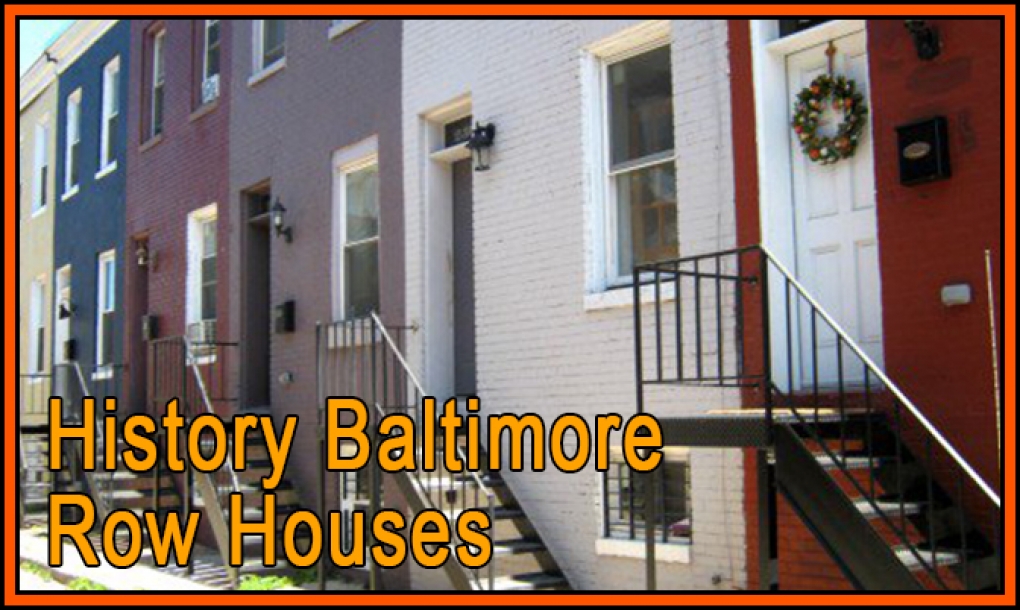
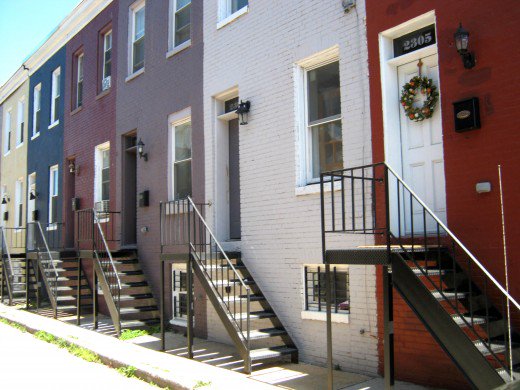
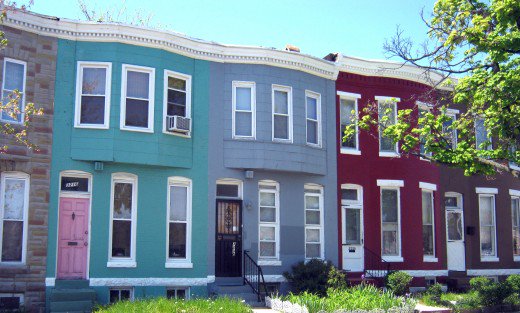
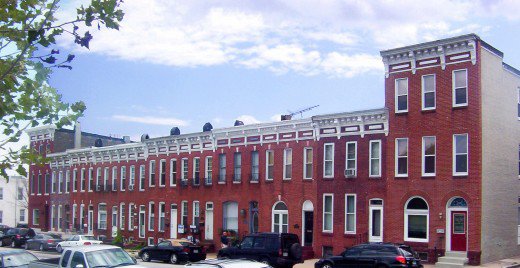
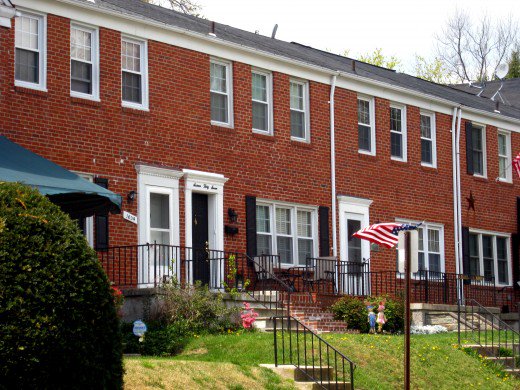
Baltimore has more rowhouses than any other city in the United States. The long rows of brick catch the sun and seem to glow with that warmth we associate with home. Basement windows hold little dioramas with personal or religious themes, and painted screens turn narrow streets into outdoor art galleries.

A row house is much more than a line of attached homes. Before the advent of real estate speculation and planned developments, many homes were attached, forming rows. But a real rowhouse describes a large group of similar homes built at the same time by the same builder. The early 1900s saw large developments of these homes when builders created entire new neighborhoods.

The proliferation of these dwelling made Baltimore a city of homeowners. In the late 19th century, 70% of the population of the city-owned their own homes. Practical, cozy, and attractive, these old homes are fuel-efficient.

When I was a girl growing up in the late 1950s, my auntie's row house still had a coal bin and a basement kitchen that was warm in the winter and cool in the summer. The large end group house had a corner store in its high basement. Step over the marble lintel and into a small shop where the owner knows the names of all his costumers, and the favorite ice cream flavors of the children.

Listen to the twitter of sparrows and the call of the grabber, the fruit seller with his horse and cart clattering up the alley, bells tinkling, the soft chatter of neighbors out on their stoops, the laughter of children as they run up the alley. You're in Bawlmer, hon!

 
Dream homes
Painted Screens


Painted screens helped homeowners to see out while passersby couldn't see in. | Source

In the summer of 1913, the corner grocer at Collington and Ashland Avenues in the heart of Northeast Baltimore's Bohemian (Czech) community, was the first person to introduce colorful scenes on the woven wire. William Oktavec painted the front doors of his shop with images of the meat and produce he sold inside. 

A neighbor admired his artwork and its practical bonus of preventing passersby from seeing inside his store, while she could see outside. Wishing to maintain privacy in her rowhouse, she asked Oktavec to paint a screen for her front window and presented him with a colorful scene from a calendar. Each of her neighbors demanded their own - for every window and door of the house. Adjacent communities, in turn, had at least one enterprising painter eager to imitate the new trend, accommodate clamoring residents, and make some easy cash.Artists and dabblers have continued the tradition ever since. 

In 1922, Oktavec opened The Art Shop at 2409 East Monument Street where he sold painted screens by the thousands and taught art classes to neighbors of all ages. This was in addition to his church restoration and retail framing and art supply businesses. One of his students, Johnny Eck assisted three generations of Oktavecs when business was especially brisk. In the heyday of painted screens in the 1940s and 50s, resourceful men and women plied the streets of Baltimore by foot, by car, and from modest storefronts, supplying as many as 100,000 screens to eager homeowners. Over the years the popularity of painted screens ebbed and flowed. First, the World Wars dealt a blow, then air conditioners, then changing demographics and changing definitions of modernity. Today, renovation, replacement windows and the rising costs of custom art work add to the toll. At the same time, a revolution in crafting and entrepreneurship has found an eager audience of artists and admirers to take the art form into the 21st century as its popularity spreads far beyond Baltimore. 

Screen Painting Pioneers - Johnny Eck, Alonzo Parks, Ben Richardson, Ted Richardson, Richard Oktavec, Al Oktavec, Frank Cipolloni, Leroy Bennett, Greg Reillo, Charles Bowman, and my grandfather Leo Smith, My grandfather used to take a blank window screen sit up on an easel and sketch what he saw through the screen, then paint the screen in bright colors. Years after he stopped doing house screens, he bought an old Green Hornet an ugly little car, but he used to set up at flea markets and sell antiques and junk, not wanting to have to unload his car after each show, (we called them shows LOL I guess because we showed our junk) anyway, getting up in years he was tired of unloading after each show, so he painted the side windows from inside the car and painted a screen for the back window, he could see through to use his rearview mirror, but no one could see all the valuable antiques he left in that old Hornet between "shows!" During that time his house had a screen that matched views from his own property out in the county, and his car had a picture of his dog, "Poncho," a grouchy little Chihuahua.  

Stained glassAffordable Housing-Ground Rent

Baltimore was laid out in 1729 as a shipping point for tobacco, and later grain products. Shipbuilding, grain mills, and associated mercantile attracted ship builders, carpenters, sea captains, sailors, and craftsmen. Those industries later brought in workers for packing houses, iron and steel works, and factories. Everyone needed housing. The wealthy, the middle class, and the working class all lived in rowhouses.

Some were elegant large homes with fan lighted doorways and elaborate interior details, while others were simple 4 room, two bay wide homes.

A system called ground rent made home ownership affordable. The concept of ground rent (as well as the row house style itself) came from England. When the eldest son of a noble class family inherited his father's land, they could not, by law, sell the property. The estate earned income from tenant farmers. As cities grew larger, land owners realized they could make more money by building and selling homes, but renting the land under the homes.

Today, the arcane system is still in place. Ground rents earned land owners a dependable 6% on their investment. The low annual payments were (and still are) easily affordable for homeowners.

Bowed front row house with columns | Source These simple homes are on a very narrow street, once an alley. | Source
 
Mini Masions
1790-1800

In 1796, flour merchants Thomas McElderry and Cumberland Dugan built long wharves in the area now known as the Inner Harbor. Row houses built right on the wharves stood 3 1/2 stories and featured hip roofs, dormer windows, and high English basements. The upper stories were residential while the high basement provided commercial space.

Builders and speculators began to erect similar rows of elegant homes with commercial space below and residential space in the upper stories. Many of these homes were quite grand, three bays wide with an entry hall, and two rooms deep with a kitchen wing or back building and pantry.

Up until 1799, nearly half of these buildings were made of wood until brick was stipulated by law. Very few of the old wooden homes survive.

From 1790-1800, the population of Baltimore doubled. Housing was needed for new arrivals in the prosperous shipping town. Houses built for workers and the lower classes rose to 2 1/2 stories and were 2 bays wide without the side hall featured in more upscale housing.

Grand homes were built along main thoroughfares while middle-class homes were built on side streets. The smallest houses were built on alleys with fanciful names like Happy Alley, Strawberry Alley, and Whiskey Alley. These smaller units were 17' wide with basement kitchens. Some 1 1/2 story houses were as small as 10 1/2' to 12' wide.

The smaller houses were often homes for Baltimore's large African American population which included freemen and slaves. At the time, rural slave owners hired out slaves to businessmen. Urban slaves had greater freedom than their rural counterparts as they lived without a master. Frederick Douglas claimed that the density of population prevented the abuse that rural isolation made more possible. Freemen hired out slaves, and white laborers of similar professions and economic station lived on the small integrated blocks or alleys. Simple yet attractive 3 bay wide, 2 story row-houses Double basements

 
Kitchen Extension in Back
Utilities in Early Dwellings

Fireplaces stood in most rooms of the grander row houses. It was not until the late 18th century that cast iron stoves provided heat. The large heating surface of stoves provided greater warmth than fireplaces. Coal replaced wood as an economical and efficient fuel.

Water came from hand pumps stationed along the streets. Upscale rows featured hand pumps in the back yards, thanks to a new reservoir created in 1807.

Before 1840, indoor plumbing was nonexistent. People used chamber pots. Night soil carters carried off the waste. Foul odors and disease, including typhoid and cholera, were common. In the mid-1800s, piped water became available by subscription, and water closets (a small room with a toilet) flushed into the harbor.

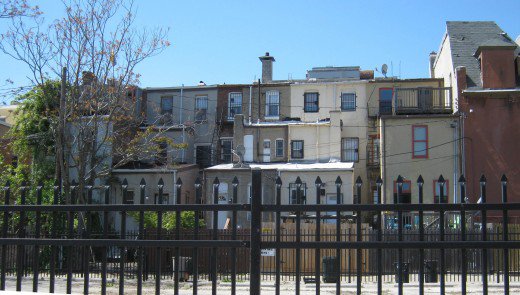
front of backs

Mount Vernon Greek Revival Row Houses

Greek Revival and Neoclassical

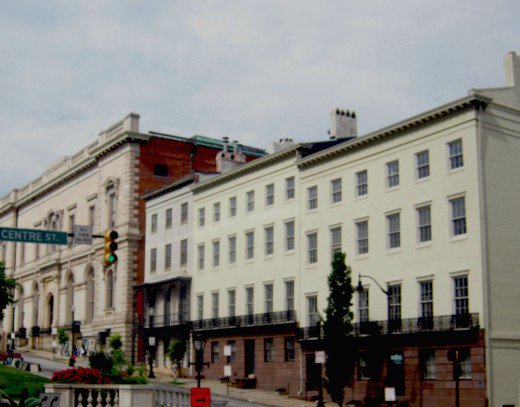
After the War of 1812, a new prosperity encouraged a building boom. The city became a manufacturing center and in 1827, the Baltimore and Ohio Rail Road created new markets for manufacturers. Baltimore became a city of foundries, lumber mills, glass makers, machine works, and by the 1840s, steam engine manufacturers.

Mount Vernon Place was built around the Washington Monument, built to memorialize George Washington. The beautiful monument based on a Greek Doric column design influenced the construction of homes in the area.

Fashionable row houses built around small parks reflected simple, elegant Greek and neoclassical designs.

These beautiful old tiles once lined a row house entryway or vestibule. | Source


Italianate
Back of fronts

After the plain facades of neoclassical designs, a new interest in ornamentation followed Victorian styles. Rowhouses in the mid-1800s featured elaborate designs including bold projecting cornices, tall narrow windows, and exterior ornamentation.

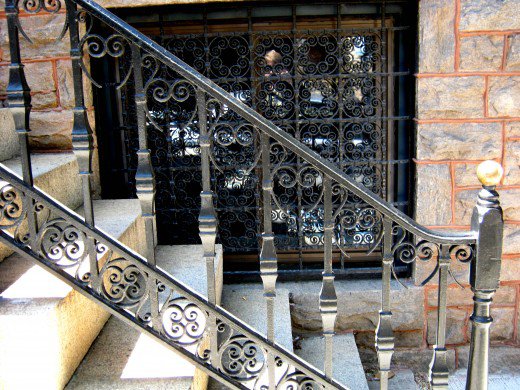
Romantic sensibilities and new building technologies introduced beautiful new designs. Cast iron structured frames allowed for taller buildings. Decorative cast iron embellishments including columns, capitals, and window treatments could be assembled at a factory and carted to the construction site.

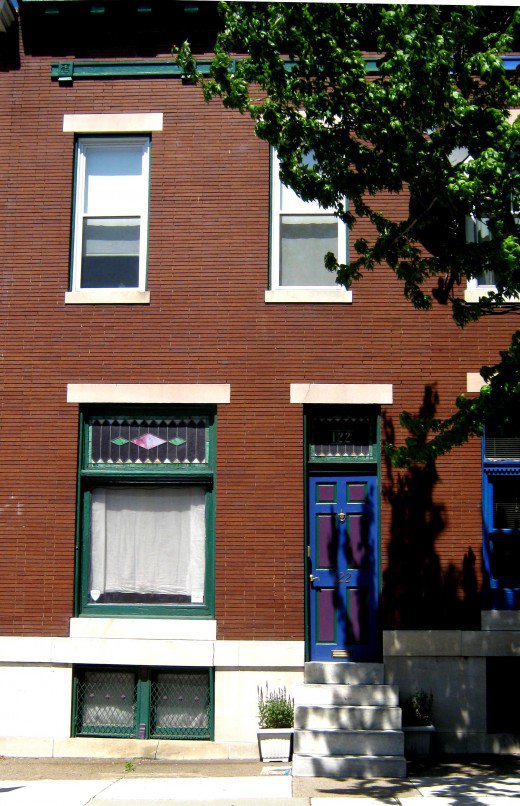
Even smaller ones employed the newer, more fashionable styles with tiled entry halls and vestibules. Average row houses featured stained glass door surrounds and transoms, stamped metal cornices, and tin ceilings in the kitchen. Edward Gallagher built modest versions of the finer Italianate homes in brown or red brick. The flat-roofed homes featured stamped designs on cornices.


Italianate Circa 1875

Center and left of CenterEdward Gallagher built these modest versions of Italianate style homes so that people of average means could afford to live in style. | Source

Queen Ann

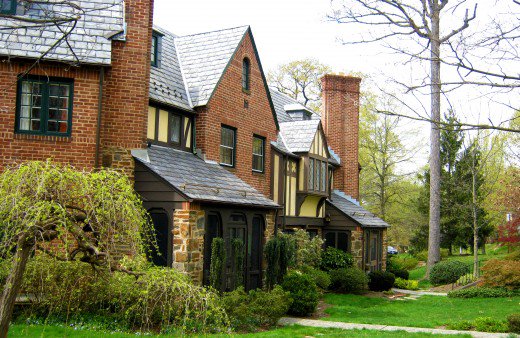
Queen Anne style mixed architectural styles of the past and incorporated ideals of the Aesthetic Movement, a concept that rejected the mass production of the Industrial Revolution and Victorian tastes. From 16th and 17th century English styles, builders borrowed cottage style forms including partial stucco, 1/2 timbering along with red brick.

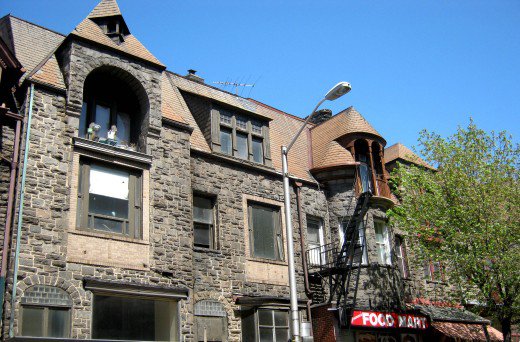
The picturesque Gothic style featured asymmetrical facades and windows, along with natural trim or first-floor facades made of rock.

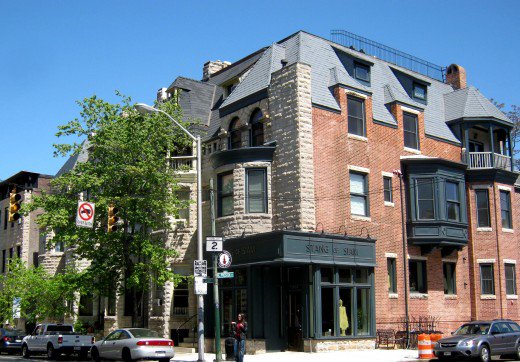
Belvedere Terrace and Eutaw Place employed the concepts of craftsmanship and an appreciation of nature by using molded brick, colored glass, terra-cotta panels, brownstone trim, and arched windows and doors. Undulating bow fronts and turrets reflected the aesthetics interest in medieval history. 

Large homes offered a back garden that could be seen from a large dining room window.

The mixing of styles - Queen Anne Style
 
A picturesque look at the varied roof line, windows, and facade of these beautiful homes. | SourceTiles and Grouts
Large porches and second story bow front windows make these row homes very attractive.Source

Renaissance Revival

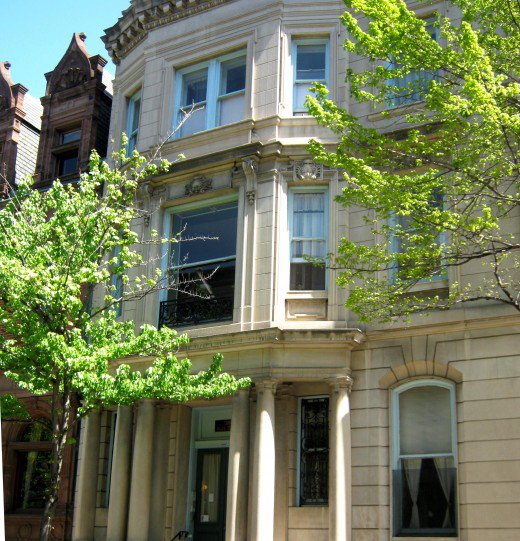
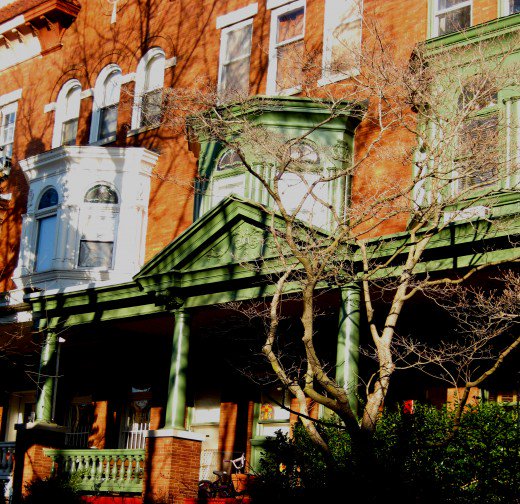
The Renaissance Revival of the late 19th century saw row houses with flat roof lines and white marble lintels and sills. Iron cornices decorated the roofs with swags of leaves and rosettes. Some swell fronts were interspersed with flat fronts, all with white marble steps from a nearby quarry.

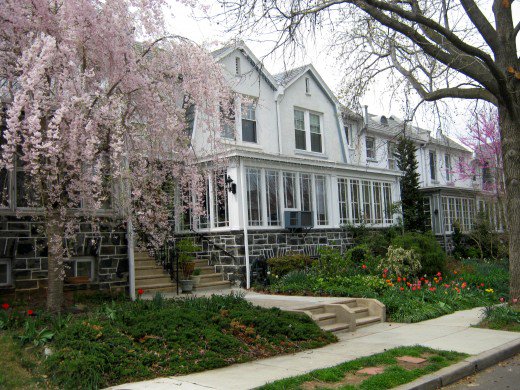
In 1905, open porches were added to the front of the better row homes. As the elite moved out to single homes in suburban areas, builders attempted to offer owners similar options like the large, columned front porch with small front yards. Second story bay windows with swags and decorated cornices made these homes beautiful.


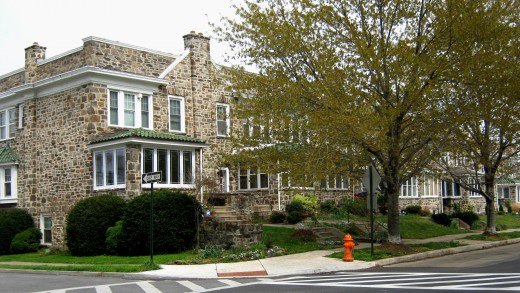
English Cottage Style Grate and RailsSlate roofs and varied building materials including half timbering in a beautifully landscaped setting. | Ednor Gardens all stone row houses with slate roof and sun porch. | Source

Early 20th Century

In the early 20th century, daylight row houses were 2 rooms wide so that all rooms but the bathroom had windows. As the middle and upper classes left the congestion of the city for suburban cottages, a new interest in natural beauty encouraged builders to compete by creating new styles.

English style groups of row houses offered to landscape, wide covered porches, steep slate roofs, Tudor half-timbered stucco second stories, dormers, and varied entryways. Some of the cottage styles offered houses built out of several materials and included stucco, brick, and rock.

Edward Gallagher Jr opened his new development called Ednor Gardens and used rock blasted from the building site in house designs. Picturesque roof lines, sun porches, and varied windows gave each home an individual look. During the housing boom of the 1920s, Gallagher and his sons offered homes with built-in garages.

Unlike row house developments of the past, corner houses no longer featured commercial space for a store or bar. New zoning regulations and development covenants ruled against commerce, additions, or changes made to outdoor trim color. Some covenants had racial restrictions in the deeds.

The Great Depression of the 1930s created a decline in-home sales. Real estate values and housing development plummeted.

By the early 1940s, World War II brought new jobs to large Baltimore employers like Bethlehem Steel and Glenn L. Martin. A new American neoclassical style based on colonial Williamsburg offered simple, inexpensive home designs with bay windows and wide end units.

After World War II, the housing demand and the GI Bill's home loan program encouraged large-scale row house building in the suburbs in places like Loch Raven Village and Edmonson Avenue.

The middle class moved to single homes outside the city while inner city high-rise housing projects crowded low-income people into large prison-like structures that warehoused the poor. A declining industrial base caused large-scale job loss for the working class in Baltimore.

Baltimore Rowhouse in Ednor Gardens

Ed Gallager


Late 20th Century Re-Hab

As Baltimore's oldest neighborhoods deteriorated due to age, overcrowding, and absentee landlords who neglected their properties, large areas of the city became derelict. The oldest neighborhoods, like the 120-170-year-old row houses in Federal Hill and Fells Point, became slums. By the late 1960s, some of the oldest houses near the waterfront were condemned in order to provide space for an extension to I-95. But a visionary group of preservationists petitioned the government for historical status and, in 1967, had Federal Hill and Fells Point listed on the National Register of Historic Places. It took 10 years to dissuade the government to move the path of the highway, but the movement drew attention to the historic Baltimore water-front and sparked an urban renaissance for older city row homes.

Mayor William Donald Shaefer and Housing Commissioner Robert C. Embry offered up 5,000 abandoned houses for $1.00 a piece. A city development office offered technical and financial help with a city backed loan program for the restoration of older homes.

Today, many of Baltimore's historic row house neighborhoods have become enclaves of young professionals. Real estate values in areas close to the water escalated and have remained high, even during the recent economic downturn. Other row house neighborhoods around the city remain affordable, comfortable, and efficient choices in a variety of communities.

Parker Edwards

Bob Bows

Edner Gardenfront of backsMini MasionsParker EdwardsPaul ManningSam SladeStained glassUncle Leo

© 2012 Dolores Monet

How to Dispose of Old Police Items

logo

Please contact Det. Ret. Kenny Driscoll if you have any pictures of you or your family members and wish them remembered here on this tribute site to Honor the fine men and women who have served with Honor and Distinction at the Baltimore Police Department. Anyone with information, photographs, memorabilia, or other "Baltimore City Police" items can contact Ret. Det. Kenny Driscoll at   Kenny@BaltimoreCityPoliceHistory.com follow us on Twitter @BaltoPoliceHist or like us on Facebook or mail pics to 8138 Dundalk Ave. Baltimore Md. 21222.

NEWSLETTER

Subscribe now to get 100 exclusive photo & two newsletters per month