Short Numbers / Sequence Numbers

No photo description available.

Short Numbers / Sequence Numbers

2323   58-1 Ellis S Baldwin 

55168 Josephine Blondell, Police Woman 33

61992 Gary Provenzano P/O 614

81599 Bernard L.Wehage Sgt. 26 

82464 63-3  Ray Wheatley 

A003 John Scales

A060 Emmett Jones

A256 1958 Nick Caprinolo

A334 Whitford Tress

A511 Edward Mattson

A549. Earl Kratsch

A795 64-2 John Schaefer  

A854 703234 Robert Becker  

A894 Ed Bossle 06262

A942 1967 Greg Lysakoski

A995 Sonny Lawson

A997 75716 William Stone

B??? 75-1 Michael J. Mulligan 

B046 Marvin Froneberger

B101 68-6 Bob Wilson

B183 69-11 Robert H Cooper

B210 68-11 Howard Stansbury

B229 Robert Shafer

B255 70-1 Shannon Lewis  

B270 70-1 Wayne Garrity  

B290 69-5 William Bertazon

B341 69-9 Jay Baker 

B343 69-9 Buford Viars  

B352 69-10 Wilbur Bartels

B366 69-11 Tom Douglas

B439 70-2 Earle Eagan 

B483 Mike Eilerman

B504 59993 Norbert Pazdersky 

B576 71-3 Tim Markland Sr.

B634 Michael Hires, 25 - 8-30-71

B639 Andrew Giordano

B646 71-8 Gary Starkey

B656 71-9 George Fugate 

B701 72-3   Richard Price II 

B731 75-5 Jim Shelley

B753 Richard Thompson Jr

B760 72-7 Bernie Lowry  

B762 72-7 Thomas J. Niemiera

B774 72-8 David Eastman

B776 72-8 Richard James

B778 72- 8 George Mitchell 

B815 73-1 Robert Oros

B836 73-3 John Cree

B849 73-3 Charles Block

B865 78530 77-1 George Trainor

B878 76-1 Kim Koerber

B885 73-6 Tom Bailey

B887 73-6 Gene O'Sullivan

B901 74-8 Alan Small  

B917 73-9 Gary Budny

B926 75-9 Pete Baker

B941 Robert Stanton

B955 74-1 Gabe Bittner

B997 74-5 Matthew Bauler 

C012 74-6 Christopher Kirhagis

C049 74-11 Dennis Boyer

C058 74-9 Edwin Schillo

C087 74-10 Melvin Pumphrey

C122 75-2 Albert Marcus

C126 78-2 Lou Compton

C140 75-3 Sam Taylor

C149 Joseph Hands

C157 Paul Scardina

C206 15185 75-5 Tom Cutler 

C228 75-7 Lee Lilly

C232 75-7 Max Pagelsen

C257 75-7 Deb Fox  

C266 75-7 Martin Seltzer 

C285 76-1 Bob Frisch

C291 76-1 Joe Adams

C294 79-1 Sam Suter

C298 Joe Kleinota   

C338 77-2 Robert Maglia

C345 77-3 Mark Keller  

C346 77-3 Sgt Charles Megibow CD

C363 77-3 Kevin Barnard

C368 41305 Charles Klein

C389 Ross Griffin

C404 78-1 Rick Rutledge

C419 79-1 Paul Sheppard

C420 80-11 Mark Lucas Tomlin

C422 81-2 Chuck McQuay

C432 80-3 Gary Cichowicz Sr.

C443 79-1 John Gerard Groncki

C480 79-1 Chris Streett

C506 - John Kowalczuk

C547 79-7 John Boyd 

C573 Joseph Wyatt  

C581 Michael Morreale 

C599 Patricia Cochrane EOD 9/17/79   

C602 79-9 Richard Youngbar

C603 79-10 Larry Gardner

C675 80-11 Frank Wagner

C688 80-3 Neil Huber

C716 80-4 Charles Butch Stahm

C718 80-7 Jack Patterson

C725 80-5 Donna Watson

C739 80-5 Carol Opher 

C757 80-8 Michael P. Tomczak

C766 80-7 Conrad Hendrichs

C771 80-7 James Ryan

C783 80-8 Darryl Moore

C799 80-9 Jay Wiley 

C807 80-9 Steve McMahon 

C810 80-10 Bobbie Magness

C839. 80-11 Tom Joyce

C844 80-11 Steve Martin

C848 81-1 Russ Pomrenke

C858 81-1 Jon Pease

C912 81-3 John Emminizer

C951 - Susan Reitz

C956 81-5 Richard Smith

C977 82-4 Michael Vaughn Sr 

C991 Lt. Vernell Shaheed 

C995 83-3 Charles Holthaus

D018 83-1 James Kirkpatrick   

D033 81-9 Larry Bazzle

D089 81-6 George Jones

D090 81-6 Terry Hendrickson  

D103 Donna Stauffer EOD 8/31/1981

D164 81-8 Patrick Conley

D184 81-9 David Jones

D202 81-9 John Hall

D233 81-10 Michael Hessler

D256 82-1 Harold “Frosty” Wertz

D275 82-2 Joe Dugan

D284 82-2 Michael Stefanowitz

D300 82-2 Arthur Nixon 

D340 Nancy Buyers

D365 John Dodson

D372 81-10 Mary Phelan Eilerman

D383 82-5 Victor Gearhart   

D428 82-6A Michael Fisher 

D439 82-6-B Darryl Osborne    

D446 Detective Brenda May EOD 11/5/82 

D448 Denise C. Dietz-McElroy EOD 15 Sept 1982

D484 83-1 Ron Pettie

D485 83-1 Larry Sanders

D510 Larry Davis

D519 Ralph Archibald

D530 Rick Petrey

D588 85-2 Charles Koonce Jr

D603 83-4 JoAnn Oliphant Voelker

D616 80-2 Richard Phillips

D635 84-1 Bruce Neill  

D644 84-1 David Qualls

D648 David Garrett P/O ND  

D658 85-3 Kim R. Brown 

D669 Sandra Kracke 

D679 84-2 Medrick Norrington

D681 84-2 Bernie Clasing  

D690 85-3 Jeffrey A. McCleese

D705 85-2 Clifton Macer

D718 James Bossi P/O 2951

D730 85-2 Tim Gardner 

D744 85-3 Ronald Fleming Sr

D755 85-3 Howard Smith

D761 87-1 Kathy Irwin Conrad

D770 85-3 Rob Furlong  

D777 Bryan Bosley

D796 85-4 Lonnie Luedtke

D831 87-4 John Peranio

D840 86-2 Craig Hartman

D844 86-1 Steve Sturm

D856 86-1 Cynthia McCrea

D868 Charles Rykiel

D891 Eddie Mack  

D915 86-3 Sonny Dickson

D931 86-3 Sylvia M Forrester 

D949 86-3 Barbara Halpern Schlereth 

D953 86-3 Russell Gayle Sgt 

D959 Oskar Dirlewanger

D961 86-4 Denise Lazzara Thompson

D969 86-4 Barbara Sloan

D971 86-4 John Calpin

D974 86-4 Donald Kincaid

D986 87-2 Georgiann Sault 

E006 87-5 Tammy Hensley 

E055 89-1 Maxx Anderson

E057 87-4 Mike DeBord

E086 87-3 Kenny Driscoll

E115 87-4 Edward Scott

E116 87-4 Mack Smith

E137 87-4 Mike Regan

E144 90-2 Patti Mitchell-Waugh 

E152 87-5 Jeffrey Redd

E154 87-5 Warren Smith 

E167 87-5 Michael Broll

E180 87-5 William Hotz, Jr

E189 90-1 Donna L. White

E230 88-5 Chuck Connolly

E251 88-1 Steven Histon

E288 89-1 Lavon'De Alston

E298 89-2 Shonda Gooch-Williams 

E299 89-2 Ricky Mayfield  

E300 88-3 Bryan Donahue 

E308 88-2 Chet Norton

E313 88-2 Lewis Ely 

E322 - Michael Morey 

E339 88-3 Michael Johnson

E394 88-5 George McClaskey

E397 88-5 Virginia Amos   

E399 88-5 Carl Eric Stambaugh

E414 89-1 Bertram Brown

E428 89-1 Gary Yamin

E435 89-1 Jackie Folio  

E436 89-1 Tony Hrica

E455 89-2 Robert Downs

E460 89-2 Cara Williams

E483 90-3 Duane Dixon  

E518 Det. Cindy Root Weinstein Osborne Sobotka 1/1990 

E529 90-1 Anthony Jobst

E546 Teresa Adams Sgt 5/14/90

E560 90-2 Thomas W. Schaeffer

E561 90-2 Jon Walter

E569 Terry Graham 

E571 90-2 David Molinaro

E572 90-2 Joseph Mueller

E586 90-3 Michael Mcgilicutty

E587 90-3 Kathleen Ryan Clasing

E602 90-3 Kevin Ruth

E606 90-3 Jake Guy Bell

E610 90-3 LaMonte Brown 

E658 90-4 Kevin Archer 

E666 93-4 Adam Christopher  

E681 91-4 Corey Jennings  

E689 91-1 Dianna Ckyyou 

E713 91-2 Robert Sharpley 

E756 Joseph Pietro Comma Jr.

E775 91-3 Roosevelt Hammett Jr. 

E797 91-4 Barry Lester 

E800 92-1 Kevin Forrester   

E821 92-1 Robert Gordon

E831 92-2 Karen Hendricks Manns P/O 778  

E835 92-2 Dave Raugh 

E911 Jim Rhoden - Major

E913 92-4 Kevin Carvell

E914 92-4 Tommy Linton

E934 92-5 Wayne Early

E941 92-5 Lee Esworthy

E945 92-5 Tracy Geho

E957 92-5 Robert D. Taylor

E962 92-5 Tony Schadt  

E964 Melissa Brown-Edick 10-06-1992 

E983 92-6 James McCartin Jr. 

F055 93-4 Garrett Keene

F099 David Blumberg P/O 2432 
F109
 93-3 R.D. Everett
F120
 Tyrone "Troy" Tillery  

F123 Tony Tone 

F130 93-3 Frank Jarrell

F143 93-4 David Yost

F147 93-4 John M Washkevich

F164 93-4 William Washington

F180 93-5 Rocco O'jalei

F189 93-5 Larry Fasano

F193 96-1 Freddie Bruce DeGraffinried

F197 93-5 Karla Ruhl  

F201 95-1 Gina Herndon

F213 93-5 Jerry Scott Turpin

F226 93-6 Louis Holley

F230 93-6 Charles Alfred Seward Jr. 

F257 93-6 Deidre Booker-Eames  

F306 94-1 Scott Dickson

F315 94-2 Joseph Peters  

F324 Brian Dayton EOD 1-31-94
F332
 94-3 Carlos Vila 

F342 94-2 Kebin Mclean

F379 94-3 Mike Baker

F394 94-4 Brian Righter

F419 94-4 Michael Lang 

F420 94-4 Stephen Montgomery 

F422 94-5 Patrick Sellers

F459 94-6 Joseph Samuels 

F469 94-6 Thomas Waugh 

F471 94-6 Danni Epps

F475 94-6 JR Fyffe   

F486 94-6 Brian Lee

F488 94-6 Gregory Robinson

F498 94-6 Edward Teach  

F517 94-7 Joel Heiss

F533 94-7 Joe Donato 

F541 94-7 Gwen Marshall

F546 94-7 Frank Madden

F568 90-2 Patti Mitchell-Waugh

F584 94-8 Thomas Stoner

F634 95-1 Sibille Cook 

F733 95-3 Shirley Disney 

F755 95-3 Gina Pugliano 

F797 95-4 Mike Smiff

F803 95-4 Kurt Roepcke

F806 95-5 Donta Booker

F808 95-5 Donavan Dyon Cox

F809 95-5 Hamilton Sr. Lolando

F820 95-5 L.C. Greenhill III

F840 95-5 Troy Black

F853 96-1 Kevin Walker

F891 96 2 Mike Harren

F912 96-2 Angelo Colletti Jr.

F918 96-2 David Greene

F925 96-2 Joe Jackson

F941 96-3 John Yeager

F946 96-3 Ray Johnson 

G029 97-1 Timothy Crowther

G050 97-1 June Hall

G076 97-2 Michael Lind

G105 97-3 Scott DeMario 

G234 98-1 JC Carlson SWD

G240 98-1 Jeff Soule

G244 98-1 Brian Ralph

G294 98-2 EL Simon 

G299 98-2 Rodney James SD

G388 99-2 Tashawna Gaines

G425.99-2 Malik A. Jenkins-Bey

G437 99-4 Pedro Vargas

G476 - Joseph Bannerman 

G504 - Sidney Cutchin 

G534 99-5 Rob Dolly

G584 00-2 Chris Kelly

G615 00-3 Markson Fraser

G654 00-4 Tim Haefner

G662        Robert Himes

G818 00-8 Lisa Marie   

G892 01-1 Jason Jones

G961 01-2 Craig Jester

G981 01-2 Anabel Jason Rivera

G987 95-4 Milton Lynn

H055 02-3 Antonio Green

H058 01-4 Rob Faison

H117 02-2 Aaron Mike Kane

H222 02-2 Milton Dean

H384 03-1 Jeffrey Rodriguez  

H442 03-3 Paul Dziwanowski

H485 03-3 Valencia Renee

H543 Bradley Simmonds 

H608 88-1 Ron Carrigan

H643 04-2 Carl Cicchetti

H804 05-3 Jason Shreves

H923 06-1 Steven Slack

H948 06-2 Becca Small

I155 07-2 Michael Pusloskie

I177 07-2 Nick De Jesus

I451 08-2 Todd Murphy  

I504 08-3 Rob Mullin

I567 08-4 Brian Joseph

I629 08-5 Robert Trimper

I800 09-4 George Parker  

I995 11-1 David Kinkade

J102 11-4 James Stephen

J136 11-5 Hannah Smith

J322 12-4 Cathal A Luddy

J403 15-1 Emily Jones  

J447 13-1 Christopher Joseph

J538 13-4 Jimmy Conway

J703 14-4 Semaj Yelnoc 

J712 14-4 Morgan Clasing

K137 John Amato 

K400 Charles Block

K449 20-1 Mason Coursey P/O 481

K505 Calos M King

K529 Loulinda House


 If your name is not on the list and you want it added, please send an email to Kenny or Patricia Driscoll at This email address is being protected from spambots. You need JavaScript enabled to view it.

1 black devider 800 8 72

Donations

Donations help with web hosting, stamps and materials and the cost of keeping the website online. Thank you so much for helping BCPH. 

Paypal History Donations

1 black devider 800 8 72

POLICE INFORMATION

Copies of: Your Baltimore Police Department Class Photo, Pictures of our Officers, Vehicles, Equipment, Newspaper Articles relating to our department and or officers, Old Departmental Newsletters, Lookouts, Wanted Posters, and or Brochures. Information on Deceased Officers and anything that may help Preserve the History and Proud Traditions of this agency. Please contact Retired Detective Kenny Driscoll.

This email address is being protected from spambots. You need JavaScript enabled to view it.

Devider color with motto

NOTICE

How to Dispose of Old Police Items

Please contact Det. Ret. Kenny Driscoll if you have any pictures of you or your family members and wish them remembered here on this tribute site to Honor the fine men and women who have served with Honor and Distinction at the Baltimore Police Department.

Anyone with information, photographs, memorabilia, or other "Baltimore City Police" items can contact Ret. Det. Kenny Driscoll at This email address is being protected from spambots. You need JavaScript enabled to view it. follow us on Twitter @BaltoPoliceHist or like us on Facebook or mail pics to 8138 Dundalk Ave. Baltimore Md. 21222


Copyright © 2002 Baltimore City Police History - Ret Det Kenny Driscoll 

Line of Duty and On Duty Deaths

Officers that have died in the line of duty or while working as well as officers that have died as a result of line of duty injuries, or line of duty illness. Not every fallen officer will, or should receive the Medal of Honor, not all will be considered a hero, but anyone that dies as a result of a line of duty injury, or illness did make the ultimate sacrifice and does deserve to be remembered for that sacrifice to the communities they served. The following is a list of 205 sworn Baltimore Police Officers that gave their lives for the job. Added to the list bringing it up to 206 is one honorary police officer, he was a tailor that risked his life to save the life of a police officer under attack, for his efforts he was shot and paralyzed, after several years he died as a result of complications brought on from the bullet left in him. This list also contains officers that were infected with viruses, sufferer heart attacks, and suffered other illness brought on by the job as well as other injuries that took them from us way too soon. May they all be remembered for their sacrifices, as they continue to Rest In Peace. 


1808 - 15 March 1808 - We lost our Brother Night Watchman George Workner.

1844 - 19 June 1844 - We lost our Brother Night Watchman Alexander McIntosh 

1856 - 13 November, 1856 - We lost our Brother Night Watchman John O'Mayer

1857 - 14 October 1857 - We lost our Brother Sergeant William Jourdan   

1858 - 27 Jun 1858 - We lost our Brother Patrolman Henry Wilcox 

1858 - 22 September, 1858 - We lost our Brother Police Officer Benjamin Benton

1858 - 5 November, 1858 - We lost our Brother Police Officer Robert M. Rigdon

1863 - 18 Feb 1863 - We lost our Brother Sergeant William Wright 

1870 - 5 July, 1870 - We lost our Brother Police Officer James Murphy  

1870 - 17 Aug 1870 - We lost our Brother Lieutenant Richard Chanowith

1871 - 12 January, 1871 - We lost our Brother Police Officer Charles J Walsh *

1871 - 22 May, 1871 - We lost our Brother Police Officer Joseph Clark

1871 - 14 September, 1871 - We lost our Brother Detective John H. Richards

1872 - 18 August 1872 - We lost our Brother Police Officer John Christopher  

1872 - 22 Nov 1872 - We lost our Brother Patrolman Franklin Fullum *

1873 - 12 January 1873 - We lost our Brother Patrolman John H. Dames * 

1873 - 12 January 1873 - We lost our Brother Patrolman James T. Harvey * 

1873 -  6 October 1873 - We lost our Brother Patrolman Thomas Baldwin *

1873 - 11 November 1873 - We lost our Brother Patrolman William H Healy * 

1875 - 27 Nov 1875 - We lost our Brother Patrolman Robert Wright  

1877 - 4 Aug 1877 - We lost our Brother Patrolman Henry Schaper   

1883 - 27 September 1883 - We lost our Brother Captain Benjamin Franklin Kenney

1884 - 6 January, 1884 - We lost our Brother Police Officer Charles W. Fisher   

1884 - 12 Jan 1884 - We lost our Brother Patrolman George Pumphrey  

1885 - 20 March, 1885 - We lost our Brother Police Officer August Harting

1889 -4 July, 1889 - We lost our Brother Police Officer John T. Lloyd

1891 - 15 July, 1891 - We lost our Brother Police Officer Jacob Zapp

1894 - 20 June, 1894 - We lost our Brother Police Officer James T. Dunn 

1894 - 20 June, 1894 - We lost our Brother Police Officer Michael Neary

1895 - 16 June, 1895 - We lost our Brother Sergeant Benjamin Graham

1895 - 17 October, 1895 - We lost our Brother Police Officer John J. Dailey

1898 - 11 February 1898 - We lost our Brother Police Lieutenant Michael F Black

1899 -  3 July 1899 - We lost our Brother Police Detective John S. Pontier  

1899 - 29 August, 1899 - We lost our Brother Police Officer Alonzo B. Bishop

1900 11 June 1900 - We lost our Brother Patrolman Michael W. Ryan  

1902 - 20 May 1902 - We lost our Brother Police Officer John a McIntyre *

1902 - 30 July 1902 - We lost our Brother Police Officer Charles J. Donohue 

1905 - 26 January 1905 - We lost our Brother Police Officer Mathew Boone * (1) 

1905 - 25 December 1905 - We lost our Brother Police Officer Charles Spitznagle * 

1909 - 4 March 1909 - We lost our Brother Police Officer Thomas H. Worthington * (2) 

1910 - 16 Sept1910 - We lost our Brother Police Officer John T. Tuohy

1911 - 16 September 1911 - We lost our Brother Sergeant Joseph Smyth 

1912 - 25 November 1912 - We lost our Brother Officer John McGrain * 

1915 - 18 April 1915 - We lost our Brother Police Officer George C. Sauer  

1915 - 8 July 1915 We lost our Brother Police Sergeant William F. Higgins  

1915 - 21 September 1915 - We lost our Brother Police Officer Herbert Bitzel  * (3)

1915 - 25 December 1915 - We lost our Brother Sergeant Paul Meeks

1917 - 22 January 1917 - We lost our Brother Patrolman Michael Burns * (4) 

1918 - 13 February 1918 - We lost our Brother Police Officer Joseph Daniel Benedict

1918 - 19 March 1918 - We lost our Sister Police Matron Teresa Foll *  

1918 -   6 July 1918 - We lost our Brother Patrolman George Kessler 

1918 -   8 July 1918 - We lost our Brother Lieutenant Charles H McClean

1919 - 16 Feb 1919 - We lost our Brother Police Officer Albert L. Borrell  

1919 -   3 July 1919 - We lost our Brother Police Officer John J. Lanahan 

1920 - 2 October 1920 - We lost our Brother Police Officer Michael J Egan * (5) 

1921 - 1 May 1921 - We lost our Brother Patrolman Edgar Shellito *

1923 - We lost our Brother Police Officer John Edward Swift *

1924 - 2 March 1924 - We lost our Brother Police Officer Frank L. Latham 

1924 - 20 June 1924 - We lost our Brother Police Officer Charles S. Frank *

1925 - 2 January 1925 - We lost our Brother Police Officer George D. Hart * (6)

1925 - 18 May 1925 - We lost our Brother Police Officer Patrick J Coniffee * (7)

1925 -1 November 1925 - We lost our Brother Police Officer Leroy L. Mitchell  

1925 - 3 July 1925 - We lost our Brother Patrolman John E. Harris * (8) 

1926 - 9 February 1926 We lost our Brother Police Officer Milton Heckwolf

1926 - 29 June 1926 - We lost our Brother Police Officer Webster E. Schumann

1926 - 12 July 1926 - We lost our Brother Police Clerk Thomas J. Dillon 

1926 - 31 Oct 1926 - We lost our Brother Police Officer Charles W. Robb

1927 - 7 Dec 1927 - We lost our Brother Patrolman Harry Sullivan

1927 - 5 August 1927 - We lost our Brother Police Officer William F. Doehler

1928 - 12 February 1928 - We lost our Brother Sergeant George M. J. May  

1928 - 19 November 1928 - We lost our Brother Sergeant Joseph F. Carroll 

1929 - 26 July 1929 - We lost our Brother Patrolman James M. Moore   

1930 - 7 May 1930 - We lost our Brother Patrolman Robert L. Osborne 

1931 - 7 January 1931 - We lost our Brother Police Officer John P. Burns   

1931 - 10 Nov, 1931 - We lost our Brother Captain Edward J Carey 

1931 - 6 Dec, 1931 - We lost our Brother Police Officer Howard Pitts

1932 - 2 January 1932 - We lost our Brother Police Officer William A. Bell 

1932 - 5 March 1932 - We lost our Brother Patrolman Charles R. Bozman 

1932 - 4 October 1932 - We lost our Brother Police Officer Thomas F. Steinacker 

1933 - 21 April 1933 - We lost our Brother Police Officer John R. J. Block  

1933 - 7 March 1933 - We lost our Brother Police Lt. Cornelius J. Roche  

1933 -  9 March 1933 - We lost our Brother Police Capt. Charles H. Burns

1934 - 12 February 1934 - We lost our Brother Police Officer John Blank  

1934 -   5 September 1934 - We lost our Brother Serge Michael McSweeny

1934 -  2 November 1934 - We lost our Brother Police Officer John A. Stapf

1934 - 20 December 1934 - We lost our Brother Police Officer Henry W. Sudmeier

1935 - 14 February 1935 - We lost our Brother Police Officer Max Hirsh

1935 - 31 Oct 1935 - We lost our Brother Police Officer Arthur H. Malinofski

1935 - 22 Nov 1935 - We lost our Brother Patrolman James P. Lennon

1936 - 16 February 1936 - We lost our Brother Patrolman Arthur R. Cornthwaite  

1936 - 9 October 1936 - We lost our Brother Police Officer Leo Bacon

1936 - 29 October 1936 - We lost our Brother Police Officer Carroll Hanley

1936 - 28 December 1936 -  We lost our Brother Police Officer John T. King, Jr.

1937 - 31 December 1937 - We lost our Brother Police Officer Thomas J. Barlow

1937 - 17 November 1937 - We lost our Brother Capt. Charles A. Kahler *

1938 - 25 Mar 1938 - We lost our Brother Patrolman Henry E. Auld 

1938 -  1 Nov 1938 -  We lost our Brother Chief Engineer Joseph Edward Keene 

1939 - 5 May 1939 - We lost our Brother Patrolman Charles W. Frizzell 

1940 - 13 June 1940 - We lost our Brother Police Officer William L. Ryan 

1941 - 11 January 1941 - We lost our Brother Capt. Havey Von Harten 

1943 - 13 June 1943 - We lost our Brother Police Officer William J. Woodcock 

1943 - 7 November 1943 - We lost our Brother Police Officer William S. Knight 

1943 - 16 November 1943 - We lost our Brother Detective Patrolman Charles H. Reid 

1944 - 29 January 1944 - We lost our Brother Police Officer Joseph Waldsachs * (9) 

1945 - 17 August 1945 - We lost our Brother Police Officer John J. Burns  

1945 - 10 September 1945 - We lost our Brother Police Officer John B. Bealefeld  

1946 - 1 March 1946, We lost our Brother Patrolman George H. Weichert *  

1946 - 27 June 1946 - We lost our Brother Patrolman James M Shamer *  

1946 - 20 November 1946 - We lost our Brother Police Officer Elmer A. Noon  

1947 - 13 January 1947 - We lost our Brother Police Officer Fred R. Unger 

1947 - 13 October 1947 - We lost our Brother Police Officer Charles Hart * 

1948 - 13 February 1948 - We lost our Brother Police Officer Joseph Daniel Benedict 

1948 - 1 October 1948 - We lost our Brother Police Officer Thomas J. Burns 

1948 - 30 December 1948 - We lost our Brother Police Officer John W. Arnold

1949 - 4 April 1949 - We lost our Brother Police Officer James L. Joyce

1949 - 16 October 1949 - We lost our Brother Police Officer Thomas J. O'Neill

1950 - 4 August 1950 - We lost our Brother Police Officer Charles M. Hilbert 

1951 - 6 January 1951 - We lost our Brother Police Officer Roland W. Morgan

1951 - 23 June 1951 - We lost our Brother Patrolman Arthur Weiss

1953 - 1 August 1953 - We lost our Brother Police Officer James L. Scholl 

1954 - 14 February 1954 - We lost our Brother Police Officer Alfred P. Bobelis 

1954 - 19 April 1954 - We lost our Brother Police Officer Aubrey L. Lowman 

1954 - 1 July 1954 - We lost our Brother Police Officer Walter D. Davis  

1955 - 24 October 1955 - We lost our Brother Sergeant James J. Purcell

1956 - 6 Feb 1956 - - We lost our Brother Patrolman John Neill

1956 - 27 May 1956 - We lost our Brother Police Lieutenant William P. Thompson  

1956 - 29 September 1956 - We lost our Brother Police Officer John R. Phelan 

1957 - 9 October 1957 - We lost our Brother Police Officer John F. Andrews 

1958 - 19 September 1958 - We lost our Brother Police Officer Robert K. Nelson

1959 - 11 January 1959 - We lost our Brother Police Officer Richard H. Duvall, Jr.

1960 - 16 November 1960 - We lost our Brother Police Officer Warren V. Eckert 

1961 - 8 Oct 1961 - We lost our Brother Patrolman John R Falconer 

1962 - 7 April, 1962 - We lost our Brother Police Officer Henry Smith, Jr. 

1962 - 26 May 1962 - We lost our Brother Police Officer Richard D. Seebo 

1962 - 2 July 1962 - We lost our Brother Police Officer Edward J. Kowalewski 

1964 - 10 January 1964 - We lost our Brother Police Officer Francis R. Stransky 

1964 - 6 February 1964 - We lost our Brother Police Officer Claude J. Profili  

1964 - 11 September 1964 - We lost our Brother Police Officer Walter Patrick Matthys  

1964 - 15 October 1964 - We lost our Brother Police Officer Teddy L. Bafford 

1964 - 25 December 1964 - We lost our Brother Sergeant Jack Lee Cooper 

1965 - 20 January 1965 - We lost our Brother Police Officer Charles R. Ernest 

1965 - 22 July 1965 - We lost our Brother Police Officer Robert Henry Kuhn

1966 - 24 August 1946 - We lost our Brother Honorary Police Officer Simon Fried * 1*

1967 - 25 January 1967 - We lost our Brother Police Officer William J. Baumer 

1967 - 10 February 1967 - We lost our Brother Police Officer Frederick K. Kontner

1967 - 21 August 1967 - We lost our Brother Police Officer John C. Williams

1968 - 18 April 1968 - We lost our Brother Detective Richard F. Bosak

1968 - 12 November 1968 We lost our Brother Sergeant Frant Ankrom *

1969 - 20 June 1969 - We lost our Brother William Wilder

1970 - 16 January 1970 - We lost our Brother Police Officer George F. Heim

1970 - 24 March 1970 - We lost our Brother Police Officer Henry M. Mickey

1970 - 24 April 1970 - We lost our Brother Police Officer Donald W. Sager

1971 - 12 June 1971 - We lost our Brother Police Officer Carl Peterson, Jr. 

1971 - 1 August 1971 - We lost our Brother Lieutenant Martin Webb

1972 - 26 July 1972 - We lost our Brother Police Officer Lorenzo Arnest Gray 

1973 - 1 December 1973 - We lost our Brother Detective Wiley M. Owens  

1973 - 29 March 1973 - We lost our Brother Police Officer Robert M. Hurley  

1973 - 6 April 1973 - We lost our Brother Police Officer Norman Frederick Buchman  

1973 - 22 September 1973 - We lost our Brother Police Officer Calvin M. Rodwell  

1974 - 5 May 1974 - We lost our Brother Police Officer Frank Warren Whitby, Jr. 

1974 - 1 August 1974 - We lost our Brother Det Sgt Frank William Grunder, Jr. 

1974 - 15 August 1974 - We lost our Brother Police Officer Milton I. Spell  

1974 - 10 December 1974 - We lost our Brother Police Officer Martin Joseph Greiner  

1975 - 13 September 1975 - We lost our Brother Police Officer Edward S. Sherman 

1975 - 27 October 1975 - We lost our Brother Police Officer Timothy B. Ridenour 

1976 - 16 April 1976 - We lost our Brother Police Officer Jimmy Dale Halcomb 

1978 - 15 February 1978 - We lost our Brother Police Officer Edgar J. Rumpf 

1978 - 23 April 1978 - We lost our Brother Sergeant Robert John Barlow 

1978 - 27 October 1978 - We lost our Brother Police Officer Nelson F. Bell, Jr.

1979 - 2 March 1979 - We lost our Brother Police Officer John H. Spencer 

1979 - 19 August 1979 - We lost our Brother Police Officer William D. Albers 

1981 - 20 July 1981 - We lost our Brother Police Officer Ronald L. Tracey 

1984 - 28 June 1984 - We lost our Brother Police Officer Johnny LaGrone 

1984 - 3 December 1984 - We lost our Brother Detective Marcellus Ward 

1985 - 8 October 1985 - We lost our Brother Police Officer Richard J. Lear 

1985 - 18 November 1985 - We lost our Brother Police Officer Vincent J. Adolfo 

1986 - 21 July 1986 - We lost our Brother Police Officer Richard Thomas Miller 

1986 - 20 September 1986 - We lost our Brother Police Officer Robert Alexander 

1989 - 10 October 1989 - We lost our Brother Police Officer William J. Martin 

1992 - 21 September 1992 - We lost our Brother Police Officer Ira Neil Weiner

1993 - 26 May 1993 - We lost our Brother Police Officer Herman A. Jones, Sr. 

1994 - 24 June 1994 - We lost our Brother Police Officer Gerald M. Arminger 

1994 - 14 October 1994 - We lost our Brother Sergeant Richard Harris  

1997 - 7 May 1997 - We lost our Brother Lieutenant Owen Eugene Sweeney, Jr. 

1998 - 30 October 1998 - We lost our Brother Police Officer Harold Jerome Carey 

1998 - 4 November 1998 - We lost our Brother Flight Officer Barry Winston Wood 

2000 - 8 March, 2000 - We lost our Brother Police Officer Jamie Allen Roussey 

2000 - 21 April, 2000 - We lost our Brother Police Officer Kevon Malik Gavin 

2000 - 14 October, 2000 - We lost our Brother Sergeant John  David Platt 

2000 - 14 October, 2000 - We lost our Brother Police Officer Kevin Joseph McCarthy 

2001 - 12 March, 2001 - We lost our Brother Agent Michael Joseph Cowdery, Jr.

2002 - 22 August, 2002 - We lost our Sister Police Officer Crystal Deneen Sheffield

2002 - 23 November, 2002 - We lost our Brother Detective Thomas G. Newman

2003 - 17 April 2003 - We lost our Brother Police Officer Walter A Taylor Jr 

2004 - 3 July 2004 - We lost our Brother Police Officer Brian Donte Winder  

2006 - 19 May, 2006 - We lost our Brother Police Officer Anthony A. Byrd

2007 - 9 January 2007 - We lost our Brother Detective Troy Lamont Chesley, Sr.

2009 - 19 Nov 2009 - We lost our Brother Special Agent Samuel Hicks  

2010 - 27 September 2010 - We lost our Brother Police Officer James Earl Fowler, III  

2010 - 16 October 2010 - We lost our Brother Detective Brian Stevenson  

2010 - 20 October 2010 - We lost our Brother Police Officer Thomas Russell Portz, Jr. 

2011 - 9 January 2011 - We lost our Brother Police Officer William Henry Torbit, Jr. 

2012 - 29 August 2012 - We lost our Brother Police Officer Forrest "Dino" Taylor 

2013 - 10 July 2013 - We lost our Brother Police Officer Shane Volk

2015 - 9 January, 2015 - We lost our Brother Police Officer Craig Chandler  

2017 - 16 November 2017 - We lost our Brother Police Detective Sean M. Suiter 


1 black devider 800 8 72

Donations

Donations help with web hosting, stamps and materials and the cost of keeping the website online. Thank you so much for helping BCPH. 

Paypal History Donations

1 black devider 800 8 72

POLICE INFORMATION

Copies of: Your Baltimore Police Department Class Photo, Pictures of our Officers, Vehicles, Equipment, Newspaper Articles relating to our department and or officers, Old Departmental Newsletters, Lookouts, Wanted Posters, and or Brochures. Information on Deceased Officers and anything that may help Preserve the History and Proud Traditions of this agency. Please contact Retired Detective Kenny Driscoll.

This email address is being protected from spambots. You need JavaScript enabled to view it.

Devider color with motto

NOTICE

How to Dispose of Old Police Items

Please contact Det. Ret. Kenny Driscoll if you have any pictures of you or your family members and wish them remembered here on this tribute site to Honor the fine men and women who have served with Honor and Distinction at the Baltimore Police Department.

Anyone with information, photographs, memorabilia, or other "Baltimore City Police" items can contact Ret. Det. Kenny Driscoll at This email address is being protected from spambots. You need JavaScript enabled to view it. follow us on Twitter @BaltoPoliceHist or like us on Facebook or mail pics to 8138 Dundalk Ave. Baltimore Md. 21222


Copyright © 2002 Baltimore City Police History - Ret Det Kenny Driscoll 

Button Challenge Coin

Button Challenge Coin

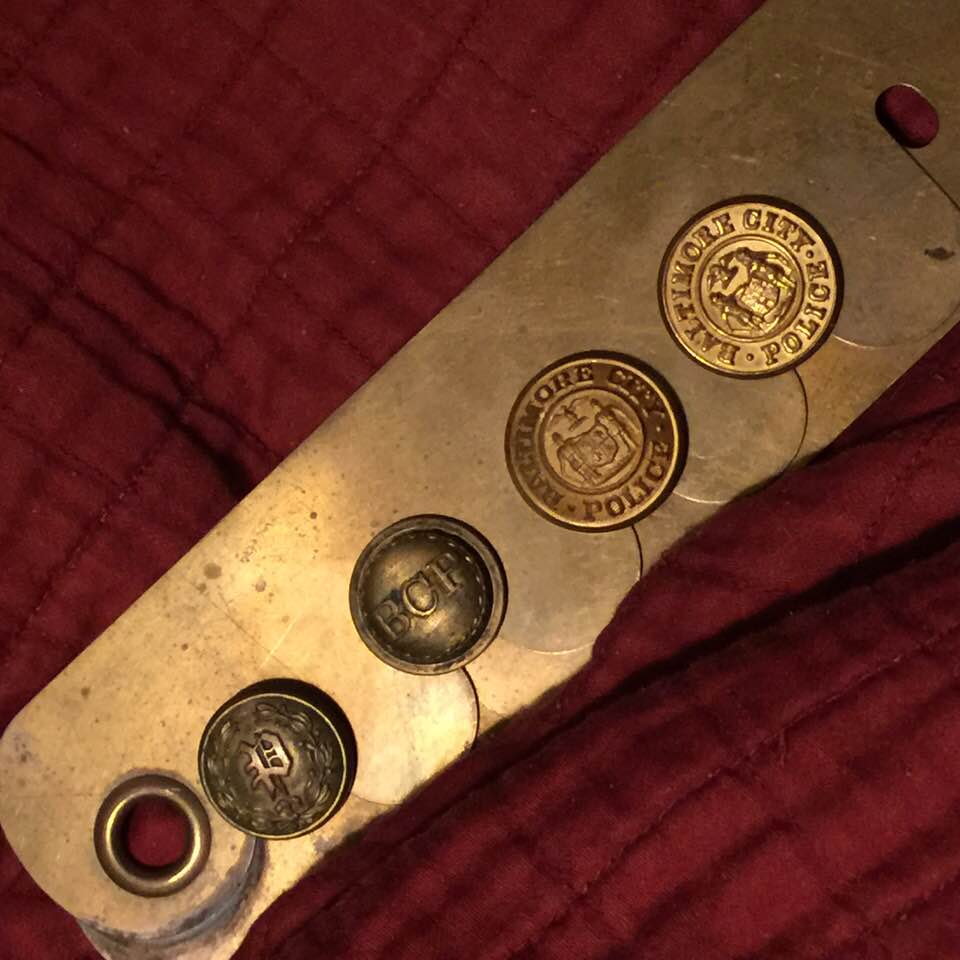
Gold Button

Help support the Baltimore City Police History website, and our research with the purchase of one of our newest Baltimore City Police Challenge Coins. Our latest Baltimore City Police Coat Button Coin will be done with a polished brass look. We did a version of these in 2018 with an antique finish and some collectors missed out on them because when we listed them on eBay a lot of guys and girls thought they were an ad for an old police coat button and skipped over them. We didn't get a lot of attention on eBay until after they were all sold on Facebook, and this site. So we weren't contacted by a lot of collectors until they were all gone. So now we are offering them exclusively through the site with some adverts on Facebook.

The order for these was just places, and to be fair to those that bought the first version of these we changed the coating on these from an antique finish to a polished gold/brass look. This means the design has already been approved, we won't have a lot of going around with designers like we had with patches before finding our new patch makers. So, you can either pre-order now by paying for them via PayPal, or you can send us a message through the below email address, and ask that we hold one or more for you. Just keep in mind we will only hold the unpaid orders for a little while, we will try to get in touch with everyone when the coins come in, preorders will have addressed envelopes on stand by so we can get your coin out as soon as possible.  

The coins will be $25.00 each and $4.00 shipping for the first coin, then .50 cents for each coin after one.  


No photo description available.

This years coin has a shiny gold/brass finish

Button Display

Hand backHeld button front

This style with the antique finish is out of stock and no longer being made 

1 black devider 800 8 72

button 1

Baltimore Police Button History Click HERE 

1 black devider 800 8 72

Our email is This email address is being protected from spambots. You need JavaScript enabled to view it.  
PayPal is This email address is being protected from spambots. You need JavaScript enabled to view it. 

1 black devider 800 8 72


POLICE INFORMATION

Copies of: Your Baltimore Police Department Class Photo, Pictures of our Officers, Vehicles, Equipment, Newspaper Articles relating to our department and or officers, Old Departmental Newsletters, Lookouts, Wanted Posters, and or Brochures. Information on Deceased Officers and anything that may help Preserve the History and Proud Traditions of this agency. Please contact Retired Detective Kenny Driscoll.

This email address is being protected from spambots. You need JavaScript enabled to view it.

Devider color with motto

NOTICE

How to Dispose of Old Police Items

Please contact Det. Ret. Kenny Driscoll if you have any pictures of you or your family members and wish them remembered here on this tribute site to Honor the fine men and women who have served with Honor and Distinction at the Baltimore Police Department.  Anyone with information, photographs, memorabilia, or other "Baltimore City Police" items can contact Ret. Det. Kenny Driscoll at This email address is being protected from spambots. You need JavaScript enabled to view it. follow us on Twitter @BaltoPoliceHist or like us on Facebook or mail pics to 8138 Dundalk Ave. Baltimore Md. 21222


Copyright © 2002 Baltimore City Police History - Ret Det Kenny Driscoll 

Anatomy of a Crime Wave

Baltimore City skyline red

Anatomy of a Crime Wave

Baltimore’s experiment with de-policing has been disastrous—and deadly.

May 5, 2021 

Cities
Public safety
 

A decade ago, Baltimoreans became lab rats in a fateful experiment: their elected officials decided to treat the city’s long-running crime problem with many fewer cops. In effect, Baltimore began to defund its police and engage in de-policing long before those terms gained popular currency.

This experiment has been an abject failure. Since 2011, nearly 3,000 Baltimoreans have been murdered—one of every 200 city residents over that period. The annual homicide rate has climbed from 31 per 100,000 residents to 56—ten times the national rate. And 93 percent of the homicide victims of known race over this period were black.

Remarkably, Baltimore is reinforcing its de-policing strategy. State’s Attorney for Baltimore Marilyn Mosby no longer intends to prosecute various “low-level” crimes. Newly elected mayor Brandon Scott promises a five-year plan to cut the police budget. Both justify their policies by asserting that the bloodbath on city streets proves that policing itself “hasn’t worked”; they sell their acceleration of de-policing as a “fresh approach” and “re-imagining” of law enforcement.

The motivation for de-policing traces to the city’s botched response to an earlier crime epidemic in the 1990s, when it averaged 45 homicides per 100,000 population, up 55 percent from the previous decade. So in 1999 Baltimoreans elected a mayor, Martin O’Malley, who promised to apply New York’s successful crime-fighting approach, where homicides had plunged by two-thirds over the decade (to one-ninth Baltimore’s rate) thanks to an expanded police force and innovative, proactive policing strategies.

O’Malley’s first commissioner, NYPD veteran Ed Norris, initially showed promise. By 2002, Baltimore’s homicide rate was 20 percent below its 1999 level. As O’Malley pressed for more, however, relations soured, and Norris departed (and some financial shenanigans eventually earned him a stint in federal prison). His successor, Kevin Clark, another NYPD import, also became embroiled in personal and professional controversy; he was fired and succeeded by a Baltimore PD holdover. By the time O’Malley moved to the Maryland governor’s mansion in 2007, Baltimore’s homicide rate was back to its 1990s average.

The problem was not just turmoil among BPD leadership and meddling (or worse) by O’Malley, but a fatal misunderstanding of what had worked in New York. There, the broad spectrum of criminal activity was addressed efficiently and with community engagement. Detailed data helped guide resources to crime hot spots. Chief William J. Bratton implemented the Broken Windows theory-inspired community-policing methods pioneered by social scientists George Kelling and James Q. Wilson, who understood how small manifestations of disorder could grow to larger ones. Minor offenses that made residents feel unsafe or hinted at acceptance of violence were addressed in order to improve quality of life, strengthen communities, and prevent serious crime.

In Baltimore, however, Broken Windows was misunderstood and misapplied. It mutated into a malignant variant, “zero tolerance” policing—and BPD conduct became not just intolerant but unfocused and excessive. As David Simon, a veteran Baltimore crime reporter and creator of HBO’s The Wiresummed things up, O’Malley “tossed the Fourth Amendment out a window and began using the police department to sweep the corners and rowhouse stoops and [per Norris] ‘lock up damn near everyone.’” That sometimes even included Wire crew members on their way home from a long day of filming.

True Broken Windows policing, in Kelling’s words, creates “a negotiated sense of order in a community” and involves collaboration between cops and residents. As one BPD vet put it, “You go to a community—before we come in, [we should ask], ‘What are the main things you all can’t stand?’ Everybody playing music at 11:30 at night, kids sitting on the corner, the prostitutes using the little park over there to work their trade. Now, ‘What don’t you care about?’ See the old guys sitting down at the corner playing cards every night? They could stay there all they want. . . . Then the police come in and do what the neighborhood wants. You just don’t go out and lock everybody up.” But, he concluded, “we went overboard.”

Kelling had warned that “If you tell your cops, ‘We are going to go in and practice zero tolerance for all minor crimes,’ you are inviting a mess of trouble.” That’s exactly what Baltimore got: stratospheric arrest rates (over 110,000 in 2005, in a city of 600,000), no meaningful reduction in homicides, an ACLU lawsuit, and an erroneous but widely shared feeling that Broken Windows was bunk and policing was not the answer to the city’s crime problems.

Then came a respite. O’Malley’s successor, Sheila Dixon (the city’s first female and third black mayor), defied her staff’s recommendations and named as commissioner Frederick Bealefeld, a BPD lifer with no college pedigree. “It was something in my gut that felt he was the best person,” Dixon explained. “I could just feel his passion.”

Bealefeld understood community policing better than the New York imports, addressing disorder and crime efficiently. He attended community meetings tirelessly to find out what residents wanted done; got cops out of their cars and walking patrols more often; invested in better training; and supported cops’ work with kids. Partnering with a savvy federal prosecutor, Rod Rosenstein, he targeted known dealers and shooters, emphasizing quality arrests—including of cops on the take. It worked. Even as arrest totals fell (to 70,000 by 2010), so did the homicide rate, to a low of 31 per 100,000 residents by 2011.

But that’s when progress stopped and the de-policing experiment began.

Dixon had embezzled gift cards meant for the poor—petty corruption is a Baltimore tradition—and in 2010 was succeeded by Stephanie Rawlings-Blake. The Oberlin-educated former public defender was more liberal than Dixon, personally lukewarm to Bealefeld, and sympathetic to those embittered by O’Malley’s “zero tolerance” policies. And she faced budget problems. De-policing, then, seemed to tick all the right boxes—and, with the homicide rate at a 23-year low (though still almost seven times the national average), there would be little outcry against it.

First came some defunding, with a 2 percent pay cut to help address a recession-related budget pinch; cops’ contributions to their pension funds also were raised to help address shortfalls there. The new mayor’s first proposed budget actually cut the BPD’s request by 10 percent, though the difference eventually was split. Demoralized, experienced cops started retiring in numbers.

Rawlings-Blake did not replace them, and she trimmed staffed aggressively. BPD budgets had consistently authorized about 3,900 positions through the O’Malley and Dixon years. Rawlings-Blake took that down by 5 percent in her 2012 budget and another 6 percent in 2013. Bealefeld called the cuts “unconscionable” and retired. As he’d told the head of the police union at one point, “you can only beat down your horses for so long before they give up.”

So even before Freddie Gray died in police custody in 2015 and Baltimoreans rioted, the BPD had 460 fewer budgeted “horses” than under Mayor Dixon—with 300 fewer on patrol, conducting investigations, or targeting violent criminals. Not surprisingly, the homicide rate surged 20 percent by 2013. And after the city’s newly elected prosecutor, Mosby, criminally charged six uniformed officers in Gray’s death—though she failed to convict any—proactive policing essentially ceased. The city’s annual body count jumped and has remained tragically high since.

Criticized for her handling of the riots—somewhat unfairly—Rawlings-Blake decided not to run for reelection, but in her last two budgets she shaved another 345 personnel from BPD’s budget, nearly halving its investigative staff. (Real BPD expenditures, however, grew about 4.5 percent per year in her term because of mandated pension contributions and ballooning overtime outlays.)

Today, then, the BPD patrols the city’s 81 square miles with 18 percent fewer staff than a decade ago. Post-Ferguson, of course, it has become common to point to intuitively plausible but difficult-to-quantify reductions in the level of police effort to explain localized surges in crime; the evidence for this claim, though tentative, is supportive. In Baltimore, the “Ferguson Effect” has intensified an established pattern of diminished policing resources contributing to rising bloodshed.

And now Baltimore is among the national vanguard in a new trend: de-prosecution. While it was widely perceived that early in her tenure Mosby put the brakes on prosecution of many “low-level” crimes, once the pandemic began she made that policy explicit (nominally to ensure that overcrowded prisons not become Covid spreaders). She dismissed over 1,400 pending criminal cases and quashed as many warrants for possession or “attempted distribution” of controlled dangerous substances, prostitution, trespassing, public urination or defecation, minor traffic offenses, and more.

A year later, she revealed that this policy was not just a Covid palliative but an experiment with human subjects; declaring it a big success, she proclaimed that “the era of ‘tough on crime’ prosecutors is over in Baltimore.” She pointed to a 20 percent reduction in violent crime and a 35 percent decline in property crime in the first quarter of 2021 compared with the same period last year. With all the confounding variables at work during the pandemic, of course, no social scientist worth her salt would proclaim such a complex experiment complete—much less successful—with just a year’s worth of data (or a subsample thereof).

When you’ve got data you like, however, “the science” or logic can be overlooked. So Mosby claimed that a 33 percent decline in 911 calls mentioning drugs and a 50 percent decline in calls mentioning sex work during her experiment proves that “there is no public safety value in prosecuting these offenses.” To the contrary: with drug use and prostitution de facto legal in Baltimore, many residents still wasted their time calling the cops about the dealers, junkies, hookers, or johns on their block.

Then there is Mosby’s spin that focusing “the limited law enforcement resources we have” on murder, armed robbery, and carjacking will magically lead to a safer Baltimore. Yet it is Mosby who has been running the State’s Attorney’s office for over six years, during which time her staff has grown by 14 percent (with 50 added positions) and her real budget by 27 percent. A cynic might suggest that the resource limits she imagines are a byproduct of her active travel schedule or other distractions.

A simpler explanation is that Mosby is just not very good at her job. Pre-pandemic, violent crime surged on her watch; homicides (averaging 55 per 100,000 residents) have run one-fifth higher than in any prior administration. Conviction rates fell as soon as she took office. According to Sean Kennedy of the Maryland Public Policy Institute, in 2017 only 12 percent of murder, attempted murder, or conspiracy-to-commit-murder cases resulted in a guilty plea or verdict for the murder charge. In 2018, only 18 percent of gun-crime defendants were found guilty.

It’s true, of course, that BPD resources—measured in actual boots on the ground—have been increasingly scarce in recent years. Mosby ignores the rather obvious implications of that trend while drawing dubious conclusions from her own too-brief, badly designed test. A dispassionate look at Baltimore’s decade-long experiment with de-policing seems fairly clear: people die.

De-prosecution is likely to amplify this tragic tendency. Now that sellers and buyers of drugs and sex face lower risk (or no risk) of prosecution in Baltimore, these markets will expand and become more profitable. The gangs that supply these products often compete for market share by violent means; their customers sometimes fund their habits with muggings and assaults.

As Kelling and Wilson taught and many cities’ histories have demonstrated, disorder and crime can be contagious, but policing these problems efficiently and with community involvement can yield major improvements in public safety and quality of life. Baltimore is simply ignoring these lessons. Other cities should not follow suit.

 1 black devider 800 8 72

The above article comes to us from the City Journal  Click HERE for original ArticleCity Journal is a publication of the Manhattan Institute for Policy Research (MI), a leading free-market think tank. Are you interested in supporting the magazine? As a 501(c)(3) nonprofit, donations in support of MI and City Journal are fully tax-deductible as provided by law (EIN #13-2912529).

1 black devider 800 8 72

Donations

Donations help with web hosting, stamps and materials and the cost of keeping the website online. Thank you so much for helping BCPH. 

Paypal History Donations

1 black devider 800 8 72

POLICE INFORMATION

Copies of: Your Baltimore Police Department Class Photo, Pictures of our Officers, Vehicles, Equipment, Newspaper Articles relating to our department and or officers, Old Departmental Newsletters, Lookouts, Wanted Posters, and or Brochures. Information on Deceased Officers and anything that may help Preserve the History and Proud Traditions of this agency. Please contact Retired Detective Kenny Driscoll.

This email address is being protected from spambots. You need JavaScript enabled to view it.

Devider color with motto

NOTICE

How to Dispose of Old Police Items

Please contact Det. Ret. Kenny Driscoll if you have any pictures of you or your family members and wish them remembered here on this tribute site to Honor the fine men and women who have served with Honor and Distinction at the Baltimore Police Department.

Anyone with information, photographs, memorabilia, or other "Baltimore City Police" items can contact Ret. Det. Kenny Driscoll at This email address is being protected from spambots. You need JavaScript enabled to view it. follow us on Twitter @BaltoPoliceHist or like us on Facebook or mail pics to 8138 Dundalk Ave. Baltimore Md. 21222


Copyright © 2002 Baltimore City Police History - Ret Det Kenny Driscoll 

Violating Romans 13

EVER EVER EVER Motto Divder

The beginning of Romans 13 describes the protection-design God gave societies when He instituted government. Right now, there are some in Baltimore (in government leadership and in the normal populace), who are in violation of this design. If individuals would understand, then act on the truth in this passage, the problems they are facing right now would take a major step in the right direction. But as it stands now, people don’t feel safe and (without the backing of superiors) the police don’t feel authorized to keep people safe.


baltimore policeWhat follows are the phrases you’ll read in the first four verses of Romans 13. (Keep in mind, if you believe your governmental leaders don’t deserve your submission and obedience, that Paul’s first-century government was the Roman Empire, led by Nero – not exactly a friend to the Christian or Jewish communities.)

Let every person be subject to the governing authorities. For there is no authority except God, and those that exist have been instituted by God. – This is true of 

Baltimore and any other municipality. Governments are established by God for His purposes of safety and flourishing of the people. For that to happen, governmental leaders have to understand their God-given responsibility to keep order, rewarding and punishing depending on people’s behavior.

Therefore whoever resists the authorities resists what God has appointed, and those who resist will incur judgment. – There may have been abuses of authority by some Baltimore law enforcement officials, but mostly in America, we should be grateful for those who risk their very lives to keep us safe. To watch the news or hear interviews of some citizens of Baltimore, the police are to be defied. There is judgment promised to those who defy God-appointed authority; one of those judgments should be consequences for such rebellious behavior. The problem for Baltimore right now is that the police are not arresting folks at the same rate as before, an unintended consequence for not supporting law enforcement as it should be. The mayor, police chief and state’s attorney bear responsibility for this judgment. During the riots, they coddled those who would destroy and terrorize.  

For rulers are not a terror to good conduct, but too bad. Would you have no fear of the one who is in authority? Then do what is good, and you will receive his approval, for he is God’s servant for your good. – If you’re not doing anything wrong, you shouldn’t have to fear any reprisals from law enforcement. Police need to keep this in mind as they serve. 

But if you do wrong, be afraid, for he does not bear the sword in vain. – There’s a good and right reason police carry tasers, nightsticks, and sidearms. It’s not in vain and has the sanction of the One who ordained governmental authority in the first place. If you get in a police officer’s face and/or try to take away said weapon, you might get hurt. That’s common sense and is a given. No monument needs to be erected to commemorate the life and death of one who foolishly violated this simple principle.

For he is the servant of God, an avenger who carries out God’s wrath on the wrongdoer. – Government leaders and law enforcement officials should be God’s representatives to us for our good, keeping us safe by carrying out judgment on wrongdoers. That can only happen as their authority is properly recognized, respected and obeyed.

Police who respond to calls are being surrounded by mobs of 30 – 50 people threatening them. Political leaders have sided with criminals. The result? The very protectors of Baltimore’s safety that God has provided have been reduced to unrecognized authorities. You have negated God’s very instruments of your peace and now you can’t leave home without fear of being shot. When those in your communities embraced near anarchy, fueled by perceived injustice, what did you expect?

Baltimore – leaders, and citizens – need to quit treating Romans 13 like it is something you can just take or leave. Right now, many are walking away from following its principles, and that is proving to everybody that it’s a disastrous decision.

1 black devider 800 8 72

Law Enforcement

GospelVMoralism


Pick a news story from this week. A strange and unprecedented presidential campaign? Disagreement over a possible Clinton indictment? The murder of policemen in Dallas? Police shootings in Baton Rouge and Minneapolis? The threat of terrorism here and overseas? Twisted analysis of our problems by our leaders – those who should know how to fix problems?  These issues and a hundred more vie for our attention each day, uniting most Americans to agree on this: we need change.

For some reason, we think the problems of this summer are the worst in history. But our current state just continues the path men have followed for millennia with the same core problem that we’ve always had. But lately, people are talking about change more than before. There seems to be a lot of us thinking that we could do better. We can. But we have to know what kind of change is really needed.

If the apostle Paul could speak to America and America’s leaders today, his message would be the same as the one he had for King Agrippa in Acts 26. And since Paul can’t speak to Americans today, those who follow Christ have to be the ones to speak. So, what did he say?

  1. He told his story – Quoting Jesus, Paul related, “But rise and stand upon your feet, for I have appeared to you for this purpose, to appoint you as a servant and witness to the things in which you have seen me and to those in which I will appear to you,” (Acts 26:16). Paul had a great testimony of coming to faith in Christ and if you have been changed by the power of Jesus, then you have a story you can tell, too. Nobody can refute your story, so tell it and give glory to God.
  2. He made the gospel clear – Again remembering Christ’s words calling him to minister, “to open their eyes, so that they may turn from darkness to light and from the power of Satan to God, that they may receive forgiveness of sins and a place among those who are sanctified by faith in me” (Acts 26:18). This should be the heart of our message to the world – the gospel of Christ is the only power that can truly change hearts through forgiveness and sanctification. No other plan or shortcut will work.
  3. When he was commanded, he obeyed – “Therefore, O King Agrippa, I was not disobedient to the heavenly vision…” (Acts 26:19). None of this matters if the Church won’t obey.
  4. He presented true change – Obeying God’s call he “declared first to those in Damascus, then in Jerusalem and throughout all the region of Judea, and also to the Gentiles, that they should repent and turn to God, performing deeds in keeping with their repentance.” (Acts 26:20) Here’s where lives head in the right direction, families, and communities heal, then nations are strengthened. Deeds that flow from repentance. Hearts, then behavior, changed by the gospel.

If the Church prays only for better behavior in our world, if we are content merely with better laws and less immorality, we have missed Paul’s message from Christ. Moralism never solves what the gospel does. As we pray for our broken nation and increasingly godless society led by many blind guides, a prayer for the spread and reception of the gospel is our only true hope. And the only way that hope becomes a reality is if individual Christians share it with individuals who don’t follow Christ yet.

Agrippa thought Paul was crazy, by the way, and didn’t believe the message. But the root of our world’s problems (and the solution) remains unchanged 2100 years later.


1 black devider 800 8 72

Donations help with web hosting, stamps and materials and the cost of keeping the website online. Thank you so much for helping BCPH. 

Paypal History Donations

Donations

1 black devider 800 8 72

POLICE INFORMATION

Copies of: Your Baltimore Police Department Class Photo, Pictures of our Officers, Vehicles, Equipment, Newspaper Articles relating to our department and or officers, Old Departmental Newsletters, Lookouts, Wanted Posters, and or Brochures. Information on Deceased Officers and anything that may help Preserve the History and Proud Traditions of this agency. Please contact Retired Detective Kenny Driscoll.

This email address is being protected from spambots. You need JavaScript enabled to view it.

Devider color with motto

NOTICE

How to Dispose of Old Police Items

Please contact Det. Ret. Kenny Driscoll if you have any pictures of you or your family members and wish them remembered here on this tribute site to Honor the fine men and women who have served with Honor and Distinction at the Baltimore Police Department. Anyone with information, photographs, memorabilia, or other "Baltimore City Police" items can contact Ret. Det. Kenny Driscoll at This email address is being protected from spambots. You need JavaScript enabled to view it. follow us on Twitter @BaltoPoliceHist or like us on Facebook or mail pics to 8138 Dundalk Ave. Baltimore Md. 21222


Copyright © 2002 Baltimore City Police History - Ret Det Kenny Driscoll 

QR Codes

 EVER EVER EVER Motto Divder


QR Codes 


Museum

BPD Patch History

PayPal Donations

Carl Hagen

Ed Bremer

Joe Hlafka

Espantoon

Dime Store Novel

Fingerprints

Fingerprints Audio

Polygraph

Streetlights

Radio Car

Liberator Pistol


1 black devider 800 8 72

POLICE INFORMATION

If you have copies of: your Baltimore Police Department class photo, pictures of our officers, vehicles, equipment, newspaper articles relating to our department and/or officers, old departmental newsletters, lookouts, wanted posters, or brochures, information on deceased officers, and anything else that may help preserve the history and proud traditions of this agency, please contact retired detective Kenny Driscoll.

This email address is being protected from spambots. You need JavaScript enabled to view it.

Devider color with motto

NOTICE

How to Dispose of Old Police Items

Please contact Det. Ret. Kenny Driscoll if you have any pictures of you or your family members and wish them remembered here on this tribute site to honor the fine men and women who have served with honor and distinction at the Baltimore Police Department. Anyone with information, photographs, memorabilia, or other "Baltimore City Police" items can contact Ret. Det. Kenny Driscoll at This email address is being protected from spambots. You need JavaScript enabled to view it.Follow Follow us on Twitter @BaltoPoliceHist, like us on Facebook or mail pictures to 8138 Dundalk Ave., Baltimore, Md. 21222


Copyright © 2002 Baltimore City Police History: Ret Det. Kenny Driscoll 

Police Guard Baltimore Prison

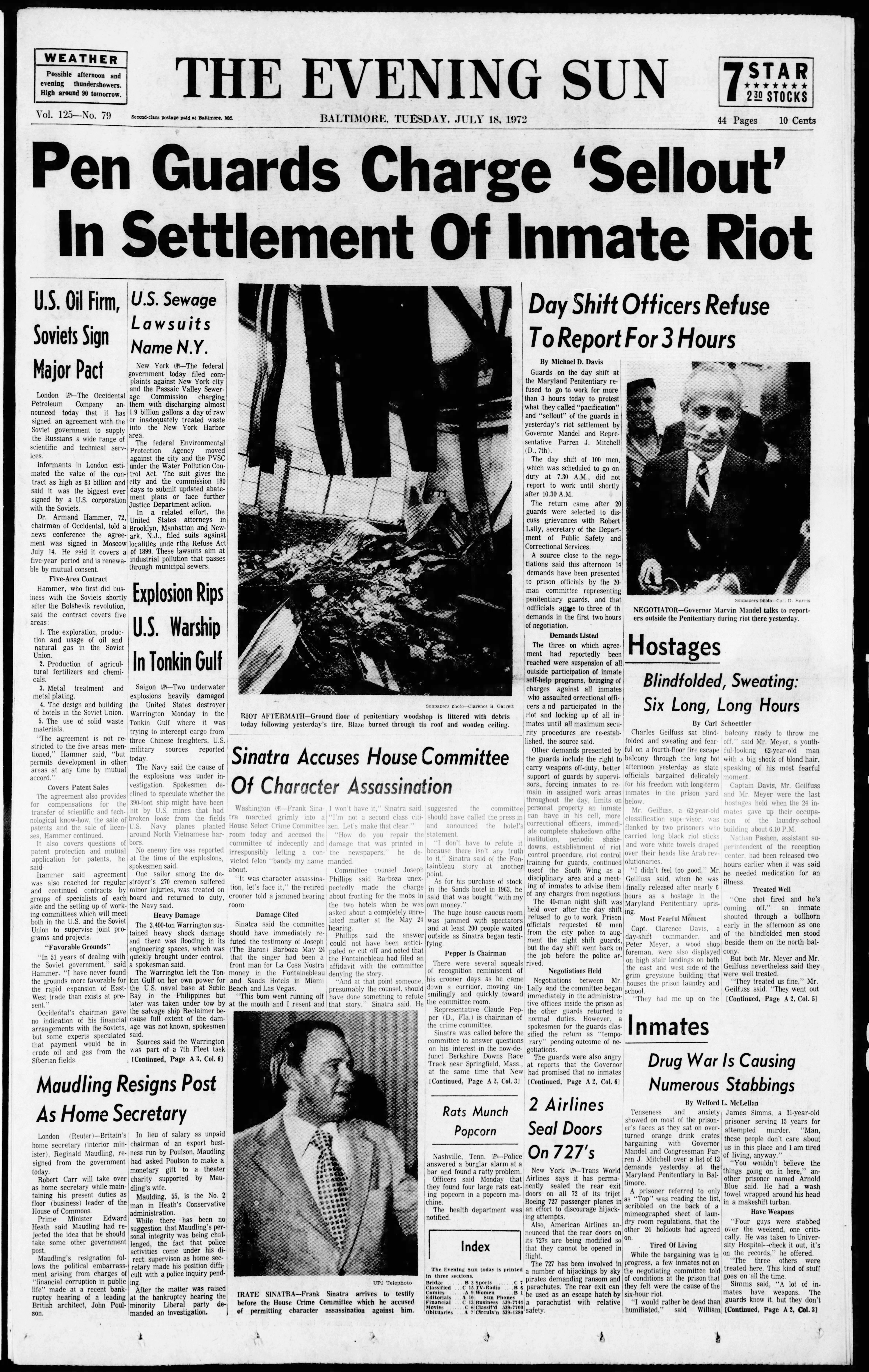
17 July 1972

This is an original press photo. Baltimore, Maryland. A police tactical squad and city firemen stand in the courtyard of the Maryland State Penitentiary as prisoners on a fourth floor fire escape hold several hostages. The burning building in the foreground houses the prison vocational shops. Penitentiary officials made no initial attempt to rush the prisoners, fearing for the safety of the hostages. Three guards and a prison employee were injured in the outbreak. Prisons and prisoners.

1972 Press Photo Police guard Baltimore prison while prisoners take hostages copy

The Evening Sun Tue Jul 18 1972 pg 1 72Click HERE or the Article Above to See Full Size Article

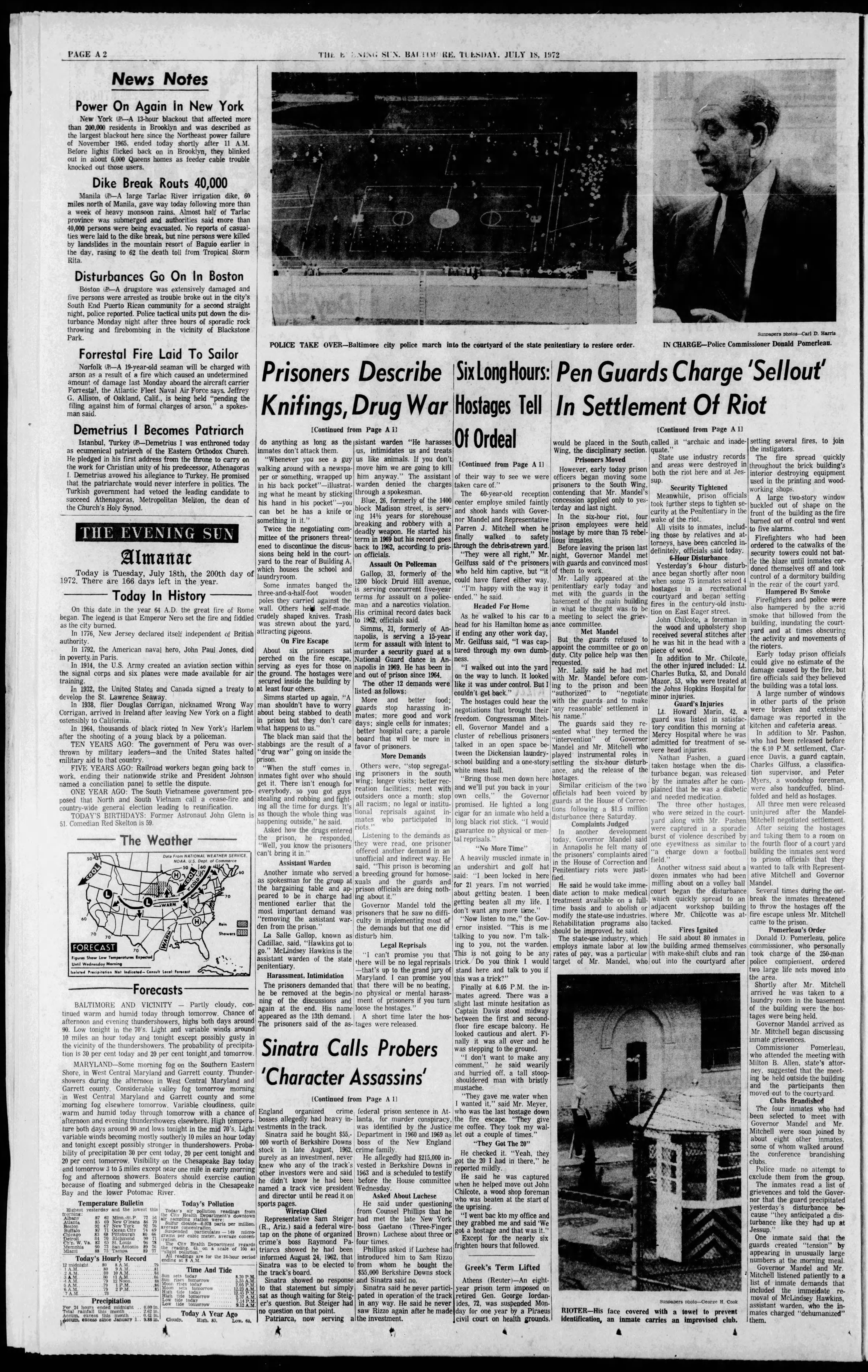
The Evening Sun Tue Jul 18 1972 pg 2 72

Click HERE or the Article Above to See Full Size Article


1 black devider 800 8 72

Donations

Donations help with web hosting, stamps and materials and the cost of keeping the website online. Thank you so much for helping BCPH. 

Paypal History Donations

1 black devider 800 8 72

POLICE INFORMATION

Copies of: Your Baltimore Police Department Class Photo, Pictures of our Officers, Vehicles, Equipment, Newspaper Articles relating to our department and or officers, Old Departmental Newsletters, Lookouts, Wanted Posters, and or Brochures. Information on Deceased Officers and anything that may help Preserve the History and Proud Traditions of this agency. Please contact Retired Detective Kenny Driscoll.

This email address is being protected from spambots. You need JavaScript enabled to view it.

Devider color with motto

NOTICE

How to Dispose of Old Police Items

Please contact Det. Ret. Kenny Driscoll if you have any pictures of you or your family members and wish them remembered here on this tribute site to Honor the fine men and women who have served with Honor and Distinction at the Baltimore Police Department. Anyone with information, photographs, memorabilia, or other "Baltimore City Police" items can contact Ret. Det. Kenny Driscoll at This email address is being protected from spambots. You need JavaScript enabled to view it. follow us on Twitter @BaltoPoliceHist or like us on Facebook or mail pics to 8138 Dundalk Ave. Baltimore Md. 21222


Copyright © 2002 Baltimore City Police History - Ret Det Kenny Driscoll 

The Coldest of Cases

The Coldest of Cases

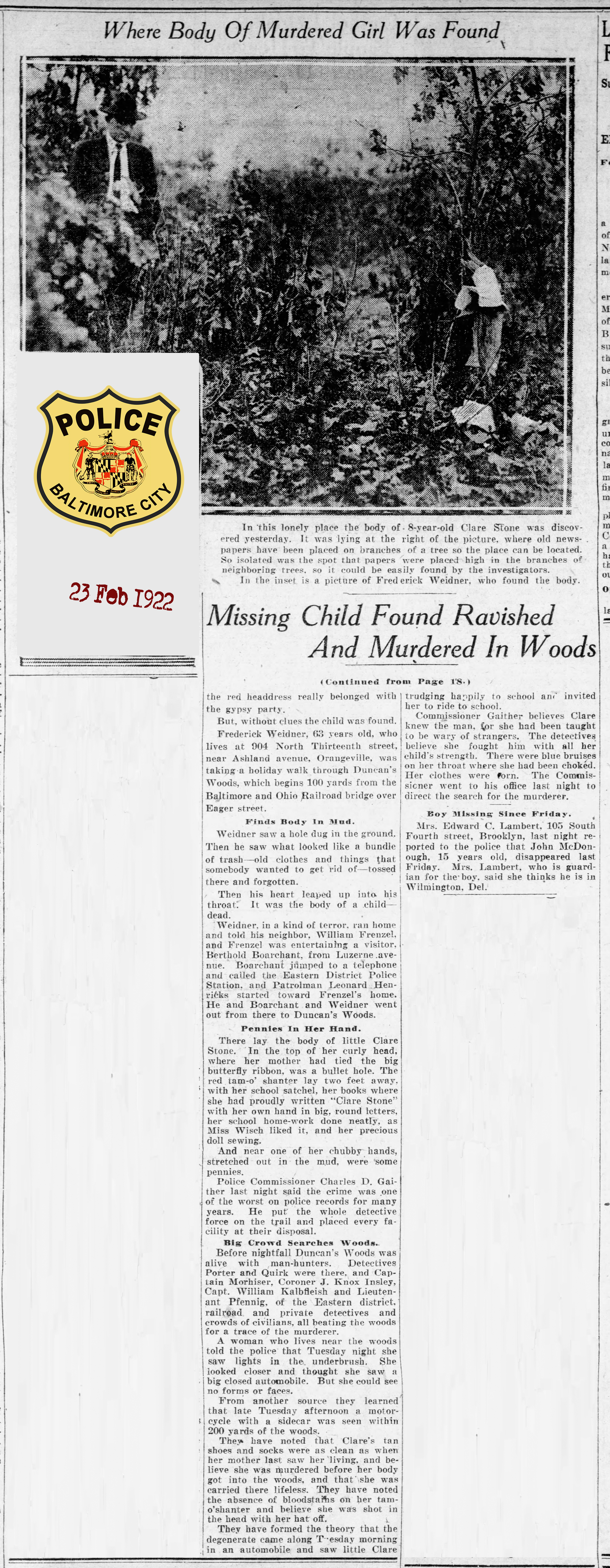
The Coldest of Cases: Was the Case of the Murder of Little Clare Stone Solved at Last?
By Laura Cadden - submitted to Kenny Driscoll, Baltimore City Police Museum

06/27/2021


My father, James J. Cadden, was a Detective Captain with the BPD in the 1970’s. I’m recording everything here as I recall my father relating it to me in the 80’s. I apologize for any errors of memory on my part and the somewhat rambling story-telling. Again, I may have many facts incorrect. The following is simply what I remember of the case and is not fact-checked. My Dad kept copies of cases that interested him and showed me old articles and police reports related to Clare Stone. All this said, here’s the story as I know it...

When 7 year old (or perhaps 8 year old) Myra Clare Stone (known by “Clare” or “Clara” Stone) was found dead on February 22, 1922, it caused a sensation in Baltimore. 

She lived at 3163 Elmora Ave in what I believe we now call the Belair-Edison for Four-by-Four neighborhood. The little girl had been missing for a few days and was eventually discovered in “Duncan woods” in nearby Orangeville. 

A massive investigation took place, but no murderer was identified. This resulted in great frustration and greater fear among residents. 

The child had been shot in the head and though her skirts were flipped up, my father said that the autopsy indicated she had not “been interfered with”. Near her body were tire marks from a bicycle. 

And the bullet that killed her was from a specific type of revolver. 

Those who were born in the years following (including my father) were warned by their parents not to wander alone in secluded areas, or they’d “end up like poor little Clara Stone”. Her name and frightening end was forever seared into the memories of those children. 

Fast forward to 1974, I believe it was, when my father was Captain of the Central District at the time and was shifted overnight to this new role. My father had spent most of his time with the BPD as a homicide detective. 

In the days following his new appointment, my father reviewed files that had been left in the Captain’s desk. 

One of the papers he came across was a letter from the Los Angeles Police Homicide Unit. The letter stated that an elderly dying man (my father believed he had something to do with the film industry out there), had contacted them with information related to an old murder case. He wanted them to pass it along to the BPD.

The letter had been sent a year or two prior and apparently had not been followed up on. My father was shocked to see that the victim in this case was Clare Stone. My father pulled the files for the cold case and reviewed the man’s letter for details. 

His story went something like this…

The man told the LAPD that his father was a brutal and uncommunicative man. He owned a bicycle and a gun.

Around the time of Clare’s death, his father was behaving particularly oddly and secretively. He put his bike in the basement and never rode it again.

I don’t recall where the man lived, but it seemed my father felt it was close enough to the murder site to be of interest. 

The bike the name described was of a type that either matched or could well have matched the tire marks that were found at the crime scene. 

More importantly, the bullet was of the type used in the gun the man described. The man stated that when his father died, his older brother - or was it he? - took the old gun and threw it into a river (he stated where in the letter). 

The man said he felt certain all these years that his father was responsible for the murder of Clare Stone and now that he was dying, he had to speak. 

My father called the LAPD and asked to speak to the Captain of Homicide regarding this matter. 

He was connected to the gentlemen who explained that he had recently taken over the position, just as my father had. And would have to look into the matter. When he asked my father for his name, he said… “I met a Cadden from the BPD some years ago on a train.”

Forgive the following aside here…

In one of those quirks of fate, the two had indeed met. 

My father and a female detective had gone to California on extradition in the 1950’s (or early 1960’s). The homicide suspect was a young African-American woman.

My father and the other detective returned to Baltimore via a train. On the ride home, my father was seated with the two women. 

A man approached my father, opened his wallet to show his badge and said something like, “My name is XXX (wish I could recall this!) and I’m a detective with the LAPD. I’m sorry to bother you, but are you by chance officers transporting a suspect?”

My father stood and shook his hand and said indeed they were and said, “My name’s Cadden. I’m a detective with the Baltimore Police.”

The LAPD detective asked my father if he wouldn’t mind, to come a few rows back with him to meet his wife. He said his wife had pointed out my father and the two women to her husband and said how sweet it was to see a young couple traveling with “their maid”.  

The Californian detective told her that he’d wager they were detectives on extradition with a suspect. His wife then chided him for being so cynical. His response was to tell his wife he’d just ask the “couple” and see. My father confirmed his suspicions to the wife and they had a good laugh over it. 

That very Los Angeles detective had been appointed around the same time as my father, as Captain.  

Now back to the point of this story...

I believe the old gentlemen who’d provided the information had not yet died, but refused to speak any further on the topic. 

My father had detectives look up the initial interviews conducted by the BPD in 1922 and returned to those addresses, trying to find anyone who may have more information on the case and this “new” suspect. They didn’t find any new information. As I recall when viewing the copies of reports my father kept, most had notated something like “interviewee deceased, no further information available from current resident or family.”

My father then had the area of the waterway the gentlemen had described dredged for the gun. With no results. 

I’m not sure of all the details, but in the end, my father believed the information in the letter to be true… and that he now knew who had killed Little Clare.

Though I don’t believe he ever knew what motivated the man to commit the crime (more on this below!). 

Fast-forward to the 1990’s...

In the mid-90’s, the TV series Homicide: Life on the Street was airing. I was a fan of the series and had read Dave Simon’s book on which it was based. He wrote about many detectives that had worked with my father. 

I was impressed with Dave Simon, but when I mentioned him to my Dad, he scowled deeply. He said something about knowing him to be a hippy reporter who was always looking to attack the BPD. He would not watch the show or read his book. In fact, the only cop show he did watch was Barney Miller

It was during that time that Dave Simon called my house (I lived with my parents) asking for my father. I suppose he’d heard from someone about the letter. He said he was hoping my Dad would speak with him about Clare Stone. I took the phone message, knowing that my father wouldn’t be enthusiastic to speak with him.

I believed the story should be heard and known by others who’d wondered about it all these years. After much cajoling on my part, he called Simon back and I believe he sent along to him his files and info related to the case.

Eventually, there was an episode related to it (episode 21 of the 6th season of Homicide: Life on the Street). It was called “Finnegan’s Wake”. The episode was directed by Steve Buscemi. According to Wikipedia, ‘An old man (and former BPD detective) wanders into the homicide squadroom, claiming to have information on the 1932 death of an eight-year-old girl named Clara Slone.’ As you can see, he amended the year and name slightly.

Addendum… 

In looking for articles on this crime on newspapers.com, I came across a story from a Virginia newspaper from September of 1922 about a man who claimed to have helped kidnap Clare for ransom with a man named “Red”. Basically, according to him, things didn’t work out and “Red” killed her. I hadn’t heard about this before, and can’t say if my father knew of this either. 

Perhaps the man’s story was true and this was the motive. I guess we’ll never know, dernit.

I believe there was an earlier article from one of the Baltimore newspapers - perhaps from the 70’s - in my father’s file. I can’t seem to find it online. It showed a portrait of the girl and an evidence photo of her small button up shoes. 

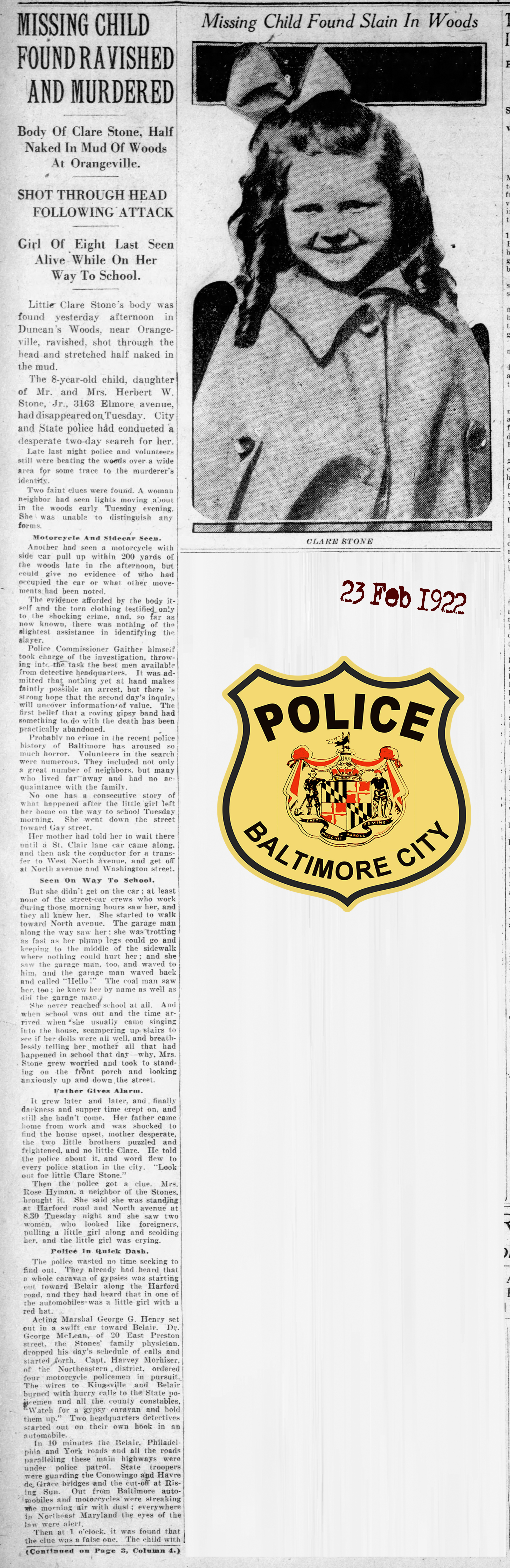
Below is Clare’s “Find a Grave” entry, a link to a 2019 Baltimore very brief Jacques Kelly article about the case, and a photo of the 1922 article I’ve mentioned.

My thanks to Kenny Driscoll for finding a 1972 article stating that the earlier BPD captain, John C. Barnold, decided not to follow up on the lead from a 61 year old man in California. You’ll find that below, as well. 

Feb 23 1922 Clare stone pg 2

 Click HERE or the above article to see full size article

Feb 23 1922 Clare stone pg 2

  Click HERE or the above article to see full size article

1 black devider 800 8 72

2019 Baltimore Sun article re the case: https://www.baltimoresun.com/maryland/baltimore-city/bs-md-ci-kelly-column-clare-20190222-story.html 

Possible motive? Article from Sep 8, 1922 - maybe you can do more digging, Kenny?


Sep 8 1922 Article murder of Clare Stone


Kenny found the following article from March, 1972: 

1 black devider 800 8 72

Donations

Donations help with web hosting, stamps and materials and the cost of keeping the website online. Thank you so much for helping BCPH. 

Paypal History Donations

1 black devider 800 8 72

POLICE INFORMATION

Copies of: Your Baltimore Police Department Class Photo, Pictures of our Officers, Vehicles, Equipment, Newspaper Articles relating to our department and or officers, Old Departmental Newsletters, Lookouts, Wanted Posters, and or Brochures. Information on Deceased Officers and anything that may help Preserve the History and Proud Traditions of this agency. Please contact Retired Detective Kenny Driscoll.

This email address is being protected from spambots. You need JavaScript enabled to view it.

Devider color with motto

NOTICE

How to Dispose of Old Police Items

Please contact Det. Ret. Kenny Driscoll if you have any pictures of you or your family members and wish them remembered here on this tribute site to Honor the fine men and women who have served with Honor and Distinction at the Baltimore Police Department. Anyone with information, photographs, memorabilia, or other "Baltimore City Police" items can contact Ret. Det. Kenny Driscoll at This email address is being protected from spambots. You need JavaScript enabled to view it. follow us on Twitter @BaltoPoliceHist or like us on Facebook or mail pics to 8138 Dundalk Ave. Baltimore Md. 21222


Copyright © 2002 Baltimore City Police History - Ret Det Kenny Driscoll 

Stinkin' Badge

Stinkin' Badges

"Badges? We don't need no stinkin' badges!" is a widely quoted paraphrase of a line of dialogue from the 1948 film The Treasure of the Sierra Madre. That line was in turn derived from dialogue in the 1927 novel of the same name, which was the basis for the film.

Gold Hat portrayed by Alfonso Bedoya

In 2005, the full quote from the film was chosen as #36 on the American Film Institute list, AFI's 100 Years...100 Movie Quotes. The shorter, better-known version of the quote was first heard in the 1967 episode of the TV series The Monkees "It's a Nice Place to Visit". It was also included in the 1974 Mel Brooks film Blazing Saddles, and has since been included in many other films and television shows.

History

The original version of the line appeared in B. Traven's novel The Treasure of the Sierra Madre (1927):

"All right," Curtin shouted back. "If you are the police, where are your badges? Let's see them."
"Badges, to god-damned hell with badges! We have no badges. In fact, we don't need badges. I don't have to show you any stinking badges, you god-damned cabrón and chinga tu madre!"

The line was popularized by John Huston's 1948 film adaptation of the novel, which was altered from its content in the novel to meet the Motion Picture Production Code regulations severely limiting profanity in film. In one scene, a Mexican bandit leader named "Gold Hat" (portrayed by Alfonso Bedoya) tries to convince Fred C. Dobbs (Humphrey Bogart) that he and his company are Federales:

Dobbs: "If you're the police, where are your badges?"
Gold Hat: "Badges? We ain't got no badges. We don't need no badges. I don't have to show you any Stinkin' badges!"

Comics

  • In one issue of the Teenage Mutant Ninja Turtles Archie comics, the Malignoid drones Scul and Bean meet with the nihilistic industrian Null to discuss the contract between him and the Malignoid queen Maligna. When Null insists on consolidating the contract through his lawyers, either Scul or Bean yells out: "Lawyers?! We don't need no stinkin' lawyers!!"
  • In the Teenage Mutant Ninja Turtles series from Image Comics, Donatello paraphrases a variation of that sentence ("Plans?! I don't need no stinking plans!") whilst using his cyborg systems to restore a stripped-down aircar

Film

  • In Mel Brooks's Western Blazing Saddles (1974), the line was delivered as "Badges? We don't need no stinking badges."
  • In Charles Swenson's animated film Down and Dirty Duck (1974), a stereotypical Mexican mouse character, wearing a sombrero and a bandolier (probably in a parody of Speedy Gonzales), speaks the line as "I don't want your stinkin' badges!"
  • In the film The Ninth Configuration (1980), when the asylum patients are quoting lines from movies, one quotes "Badges? We don't need no stinking badges."
  • In the sketch-comedy film Elephant Parts (1981), one of the fake ad sequences portrays "an authentic Mexican bandito in a Mexican-American restaurant," whose sole line is "Nachos? We don't need no stinkin' nachos!"
  • In the movie Gotcha! (1985), the character Manolo says "Don't show me your badges; we don't know nothing about no stinking badges."
  • The movie Troop Beverly Hills (1989) contains the line "We don't need no stinkin' patches."
  • In the "Weird Al" Yankovic film UHF (1989), when animal show host Raul (Trinidad Silva) is asked to take a consignment of badgers, he says "Badgers? Badgers?! We don't need no stinking badgers!"
  • In the film Flashback (1990), as the hooker is undressing the FBI agent, she discards his badge saying "We don't need no stinkin' badges."
  • In the Ron Howard film Backdraft (1991), William Baldwin's character tries to refresh his nephew's memory by using a hand puppet to exclaim, "Spinach? We don't need no stinkin' spinach!"
  • In the film No Code of Conduct (1998) Paul Gleason's character says in a bad Mexican accent "Badges? We don't need no stinkin' badges!", then goes on to sheepishly mention that he was quoting from the 1974 film Blazing Saddles.
  • In the film Bubble Boy (2001), when Jimmy offers Danny Trejo's character Slim patches for his motorcycle's flat tire he responds, "Patches? I could use some stinking patches."
  • In the film Zombie Strippers (2008), when Paco (Joey Medina) is told to obtain some wild animals to dispose of the bodies, he says, "Badgers? Badgers? We don't need no stinking badgers."
  • In the film 6 Underground (2019), Three says the line while breaking into the enemy stronghold and going past the security desk.
  • In Spike Lee's American war drama film Da 5 Bloods (2020), when Desroche's gunmen first try to dispossess the Bloods of the recovered gold bars, the leader of the gunmen tells Paul, "We don't need no stinking official badges."

stinkin badge

Ken's Stinkin' Badge Baltimore Police Style

Ken wanted this as a joke to carry in his wallet so none of his issued badges would be lost, stolen or damaged He had it made using his badge number 550 from when he was a Detective with the Baltimore Police Department To see more novelty badges, most with Ken's badge number click HERE If you order one tell them Ken sent ya. Note: He only sells to active, or retired police. 

1 black devider 800 8 72

POLICE INFORMATION

If you have copies of: your Baltimore Police Department Class Photo, Pictures of our Officers, Vehicles, Equipment, Newspaper Articles relating to our department and or officers, Old Departmental Newsletters, Lookouts, Wanted Posters, and or Brochures. Information on Deceased Officers and anything that may help Preserve the History and Proud Traditions of this agency. Please contact Retired Detective Kenny Driscoll.

This email address is being protected from spambots. You need JavaScript enabled to view it.

Devider color with motto

NOTICE

How to Dispose of Old Police Items

Please contact Det. Ret. Kenny Driscoll if you have any pictures of you or your family members and wish them remembered here on this tribute site to Honor the fine men and women who have served with Honor and Distinction at the Baltimore Police Department. Anyone with information, photographs, memorabilia, or other "Baltimore City Police" items can contact Ret. Det. Kenny Driscoll at This email address is being protected from spambots. You need JavaScript enabled to view it. follow us on Twitter @BaltoPoliceHist or like us on Facebook or mail pics to 8138 Dundalk Ave. Baltimore Md. 21222


Copyright © 2002 Baltimore City Police History - Ret Det Kenny Driscoll 

Like a Gang or Something

“Like A Gang Or Something”
Dispatches from week two of the Gun Trace Task Force trial

The second week in the trial of Daniel Hersl and Marcus Taylor brought to light a series of shocking revelations as a growing list of witnesses testified to the depravity and devastation shown by the elite Gun Trace Task Force (GTTF), which moved with reckless impunity throughout the city dealing drugs and committing robbery, extortion, theft, and over-time fraud. Six other members of the operational unit that was charged with getting guns off the street have pleaded guilty. Hersl and Taylor, who are charged with robbery, extortion, using a firearm to commit a violent crime, and fraud charges relating to overtime theft have pleaded not guilty.

Callous cops and structural inequity: On Aug. 31, 2016, two cars full of Gun Trace Task Force officers watched in the distance as two cars that had just collided sat on the sidewalk badly damaged, with the state of the passengers unknown.

Det. Jemell Rayam suggested they get out and help, but aiding the injured drivers was not an option because Sgt. Wayne Jenkins—who was described by those he commanded in the GTTF as both a “prince” in the Baltimore Police Department and as “crazy”—told them not to do anything.

He had also told them to initiate the chase that led to this moment.

So they listened to the radio, waiting for a concerned citizen to call in the crash or for other cops to come to the scene.

This is all according to Rayam, who pleaded guilty along with all of the officers except for Daniel Hersl and Marcus Taylor, and seemed visibly shaken and sometimes confused on Jan. 30, his second day testifying in the ongoing federal corruption trial of the GTTF.

And though Taylor’s defense relied solely on presenting the witnesses as liars, what Rayam said was corroborated by audio from a bug the FBI had planted in the car of GTTF Detective Momodu Gondo.

Rayam explained it all began that day when Jenkins saw a car he wanted to stop at a gas station. The car fled and both Jenkins and Gondo, each driving an unmarked car, drove after it in pursuit. The car they were pursuing ran a red light and, in Rayam’s words, was “pretty much T-boned,” by another car.

“It was bad, real bad,” Rayam said. “Both of the cars collided with each other.”

Briefly, he couldn’t answer follow up questions—a crying Rayam wasn’t sure which crash they were asking about.

“There were so many car accidents,” he said.

Intead of checking on the victims of the accident, the members of the GTTF sat tight and waited, worrying that their role in the event may have been discovered.

“None of us stopped to render aid or to see if anyone was hurt,” Rayam said.

On the tape, Hersl suggested covering it up: “We could go stop the slips at 10:30 before that happened. ‘Hey I was in this car just driving home,’” he said, and laughed.

The trial, now in its second week, has presented a tremendous amount of evidence showing that the officers claimed overtime for hours they did not work.

Hersl laughed again on the tape and wondered what was in the car.

Jenkins and others worried that Citiwatch may have it all recorded—they hoped the rain that night would make them hard to see—and worried the pursued may be able to mention he was chased.

“That dude is unconscious. He ain’t saying shit,” Taylor said.

“These car chases. That’s what happens. It’s a crapshoot, you know?” Hersl said.

This was an extraordinary statement to hear coming from Hersl as his family sat in the courtroom. In 2013, a driver—who was being followed, but not chased, by a state trooper—killed Hersl’s brother Matthew in front of City Hall in downtown Baltimore. WBAL said that Stephen, Herl’s other brother, told them Matthew “didn’t drive because he didn’t like traffic and thought drivers were dangerous.”

This incident wherein a chase led to a car crash echoes other events in this case. In 2010, Jenkins, Officer Ryan Guinn, and Det. Sean Suiter initiated a chase that also ended in a crash—one that was fatal. According to the federal indictment, the officers had a sergeant come and bring an ounce of heroin to plant in the back of the car they were pursuing, before giving first aid to the man, who ultimately died. Umar Burley, who was driving the car they chased, was recently freed from federal prison. Det. Suiter was murdered a day before testifying in the case—and the police car bringing him to Shock Trauma crashed on the way there. Guinn was reinstated to BPD after a two-week suspension and, last week in court, another GTTF member Maurice Ward testified that Jenkins told him that Guinn had informed the squad that they were under investigation.

Hersl has admitted to stealing money, but his lawyers argue that because he had probable cause he did not rob his targets—and did not use violence to take the money. He glared at Rayam as he testified about the wreck and various thefts. Rayam has confessed to dealing drugs, stealing drugs, and strong-arm robbery. In court, he suggested that Gondo, with whom he worked closely, had discussed other serious crimes, including a possible murder. Rayam alluded on several occasions to the numerous internal affairs complaints against Hersl, but the judge shut him down—that information was not admissible in court. On another occasion, federal prosecutors asked Rayam if Hersl gave him money for selling cocaine. Hersl’s lawyer objected and the judge sustained the objection.

But the overall sense is that, for the GTTF—and especially Jenkins, who has pleaded guilty but is not expected to testify—Baltimore City was at once a killing field and playground.

It is too easy to see Jenkins and Gondo and Rayam as sociopathic exceptions who are especially depraved. More testimony later the same day showed how this behavior stems from creating a city which criminalizes—or at best contains—a large part of its population. This structural disdain for life became clear in testimony from Herbert Tate, one of the witnesses against Hersl, who was treated like a criminal by defense attorneys.

Tate said he was on Robb Street in the Midway neighborhood on Nov. 27, 2015 to see old friends. A few days earlier, he said, Hersl had stopped him on Robb Street, searched him, and given him a slip of paper—not a proper citation, just a piece of paper—called it a warning, and said, “Next time I see you, you’re going to jail.”

It was about 5 p.m., Tate said, when he was walking up the street with an alcoholic beverage—he couldn’t remember if it was beer or wine—when Hersl, Officer Kevin Fassl, and Sgt. John Burns pulled up on him. Tate says that Hersl told Fassl to grab him. Fassl searched him, including searching his waistband and putting their fingers in his mouth, and then sat him down in handcuffs. In his pockets, they found $530 in cash, some receipts, and pay stubs—but no drugs. Hersl, Tate testified, dug around in vacants and on stoops looking for drugs. He went around a corner for about 10 minutes, Tate said, and came back with “blue and whites.”

Tate testified that he did not know what “blue and whites” were at the time but later learned it was heroin. Hersl sat beside his lawyer, William Purpura, glowering as Tate testified that Fassl asked Hersl what to do with the money and Hersl said, “Keep it.”

When Tate asked them to count it, he says that Burns got angry and bragged about how much money he made. According to a 2016 spreadsheet of Baltimore City employee salary data, Burns brought in a little more than $86,000, but with overtime—one of the main issues at stake in the case—he made nearly double that, bringing in $164,403 in 2016. On Feb. 21, 2017—just over a week before the Gun Trace Task Force indictments came down, Burns took medical leave and began raising funds with a GoFundMe account that claimed he was diagnosed with Guillain-Barre syndrome triggered, the fundraiser says, from “inhaling fecal matter during a search warrant.”

By the time the money made its way into evidence, the $530 had become $216. When Tate was released from jail, he was given 91 cents back. He never saw the rest of the money.

Defense lawyers made a different issue out of the money. Christopher Nieto, who is representing Marcus Taylor (who was not involved in Tate’s arrest at all), made a point of mentioning that some of the money submitted as evidence was in small bills like singles, fives, and tens.

“Dollar bills suggest drug distribution,” Nieto said.

“Everybody has dollar bills,” Tate responded.

The claim was odd in the context of a trial in which it had been repeatedly stated that large sums of cash also indicated drug dealing. Whatever amount of money African-Americans have in Baltimore City can indicate criminal activity, apparently: Tate had a 2003 charge tied to possession and distribution of narcotics, for which he took probation before judgement and admitted on the stand that when he was in high school he “did some things”—meaning small-time dealing—but had never been arrested back then.

Nieto repeatedly referred to Robb Street as “an open air drug market,” “a drug neighborhood,” and a “not a great neighborhood.” A perception encouraged, in part, because these neighborhoods are criminalized.

“That’s what y’all label it as, but that’s not what it is to me,” said Tate, who testified that he had grown up in the area and had friends and family there and coached a children’s basketball team in the area. Nieto also said that Tate had a black ski mask when he was arrested, though Tate said he had it on him because it was cold and that he was wearing it as “a winter hat.”

This attitude displayed in the questioning of Tate (that certain people are inherently criminal) is the animating force behind the GTTF criminal enterprise, but it isn’t that far from the assumptions of our criminal justice system, which, in 21st century American cities, is based on an almost Calvinist view of crime: If some people are criminal, nothing you do to them can be criminal.

Because of the 2015 arrest, Tate said, he lost his job because he was in jail for four days, then he lost his car because he couldn’t pay for it and couldn’t get another job because of the narcotics charge—and to this day, he owes a friend for the bail.

“I’m still paying them back,” Tate said.

In March of 2016, the state dismissed Hersl’s charges against Tate—a common occurrence in Baltimore. After the charges were dismissed, Tate was able to get another job as an HVAC technician, which he has to this day. He also said that after the arrest, he moved away from Baltimore to Anne Arundel County.

“I got out of the city,” he said. (Baynard Woods & Brandon Soderberg)

dirty cops

The ruined lives and emotional wreckage caused by GTTF: It was toward the end of the day on Jan. 31 at the Gun Trace Task Force trial of Daniel Hersl and Marcus Taylor when Ronald Hamilton, whose home was raided without a warrant by the GTTF in July 2016, finally had enough.

On the stand, he received too many nagging, loaded questions about where and how he got his money and not enough about what he believed to be the real issue at hand: the full extent of the GTTF’s reign of terror. So, when Christopher Nieto, the defense attorney for Taylor, asked one more time about the $17,000 in cash he put down for his half-a-million dollar home in Westminster, Hamilton blew up.

“I put $17,000 down on the house. You wanna know it right? I put $17,000 down,” he said.

Then he got loud: “THIS RIGHT HERE DESTROYED MY WHOLE FUCKING FAMILY MAN. . . . EVERYBODY’S LIFE IS DESTROYED, MAN. . . . THEY CAME IN MY HOUSE AND DESTROYED MY FAMILY. . . . I’M GETTING DIVORCED BECAUSE OF THIS.”

He added that his kids are afraid to go in their own house now, his wife waits at the nearby Wal-Mart if she gets home from work before Hamilton because she doesn’t like to enter the house alone, and she’s taking medication for stress caused by the raid.

“You want the facts?” he asked Nieto. “Is this what you want?”

Hamilton’s invective was aimed at the pack of federally-indicted cops, along with their defense lawyers, whose entire argument, time and time again, implied drug dealers are not only entirely untrustworthy but hardly even allowed to have grievances (or carry cash).

Attorneys went over nearly every transaction Hamilton made over a period of years, pouring over his receipts, gambling records, and properties. But it was the questioning about his home—which, prosecutors allege, was invaded by the rogue cops who had followed him and his wife to a Home Depot —that set him over the edge.

Hamilton’s outburst may have been one of the pivotal moments in the case, voicing the fear and rage that all of the day’s witnesses seemed to feel.

In March 2016, Oreese Stevenson was arrested by Sgt. Wayne Jenkins’ pre-GTTF special unit (consisting that night of Taylor, Ward, and Evodio Hendrix) after a friend entered Stevenson’s car with a backpack for a cocaine deal. Jenkins and Ward told Stevenson they approached because his windows were tinted too dark—Stevenson said they weren’t tinted “at all”—and Jenkins jumped in the car, grabbed the backpack of money (which Stevenson said he expected to have contained $21,500), and later took Stevenson’s house keys.

Soon after, Keona Holloway, Stevenson’s girlfriend who also testified, got a call from her 12-year-old son that cops were at the house, so she left her nursing job early. Inside the house, Jenkins showed her a piece of paper and claimed it was a warrant. She also said he recorded video of them entering the house, recreating their entry (when GTTF’s Maurice Ward testified at trial the first week, he said that during that same incident they recreated discovery of a safe in the basement).

Stevenson later spotted discrepancies between what he had when he was arrested and what was seized. He said there would have been $21,500 in the car but police said they seized $15,000; he said he had $300,000 in a safe but police said they seized $100,000; and he said he had 10 kilograms of cocaine in a safe but police said they seized 8 kilograms.

“I’ve never seen them stop a car and run right into the house that way,” Stevenson said, reflecting on how the arrest began.

In August 2016, Dennis Armstrong was pulled over by GTTF’s Hersl, Jenkins, and Momodu Gondo but sped off, lobbing cocaine out of his van and onto the street to destroy the evidence. When cops nabbed him after he drove down a dead end street and ran off on foot, they drove his van to a storage facility where he kept his coke, they had learned. He never consented to them accessing the storage unit.

Armstrong was charged with possession, possession with intent to distribute, driving without a seatbelt, and driving with a minor in the car without a seatbelt (he did not have a minor in the car). When he got out of jail, he got his watch, belt, and a bunch of lottery tickets back. He also learned GTTF had claimed they had only seized $2,800 when he said he had $8,000 in his van. And the two kilograms of coke he said he had were not inside his storage locker, which had been wrecked.

The possession charge—for which he received two years probation—was for what amounted to a few “crumbs” of coke, Armstrong said.

In September 2016, Sergio Summerville, who was experiencing homelessness at the time, had his friend Fats drive him to his storage facility near the Horseshoe Casino where he kept his belongings and the “small amounts” of cocaine and heroin he was selling. On the way out of the facility, two unmarked police cars pulled up to Fats’ car. Jenkins claimed they were DEA and had a warrant, and Hersl said they knew Summerville was a big deal drug dealer “from the Avenue.”

Summerville said that he was offered “freedom” if he gave up information on other dealers, and that when they finally let his friend Fats go, Summerville shouted out the code so he could exit the storage facility and that Hersl saved the code in his phone. When Summerville tried to look at Hersl saving the info on his phone, Hersl elbowed him. Summerville was eventually let go too and never charged with a crime. He said GTTF stole $4800 out of a sock in his storage unit where he hid his money.

“They came at me like a gang or something,” Summerville said.

This lineup of witnesses—all of whom had immunity—showed the extent of the GTTF’s targets: big time and small time dealers, current and former, some charged with crimes and some not at all.

But this cast of characters also illustrates the specific nature of drug dealing in a deindustrialized city like Baltimore—dealing as a dependable, dangerous side hustle that is hardly glamorous even if you’re shipping out plenty of product. Stevenson is currently a truck driver and had the job on and off again while dealing. He was using money he earned to start an Assisted Living service with his girlfriend Holloway. Armstrong’s day job was a maintenance worker for public housing and Summerville sold while he was homeless—now he works as a caterer.

GTTF didn’t confine their abuse to those who dabbled in dealing though. Gregory Thompson, a maintenance man for the storage facility near the casino, is about as “square” as you can get and testified that Jenkins and Hersl intimidated him the night of the September 2016 incident with Summerville.

The commotion caused by the GTTF stopping Summerville and Fats caused Thompson to come out to see what was going on. Jenkins and Hersl—he had a hard time remembering who said what—asked to see the facility’s security cameras and he told him they would need a warrant for that. They didn’t like that answer, got “about a foot and a half” away from him, and threatened him.

“You look like someone who needs to get robbed,” Thompson said Jenkins or Hersl told him—he couldn’t remember which one had said it.

“As far as I’m concerned, they both said it to me,” Thompson added.

Thompson’s life wasn’t destroyed by the encounter that night, but he was clearly shaken and angry, more than a year later. (Brandon Soderberg)

Marques Johnson Photo by Brandon Soderberg

Marques Johnson / Photo by Brandon Soderberg

One man in front of BPD headquarters demands police disband: Outside of Baltimore Police headquarters downtown about a half hour before the Gun Trace Task Force trials began a few blocks west, Wu Tang Clan-affiliated rapper and organizer Marques Johnson stood quietly, seething with an announcement to make.

“I want to speak Darryl DeSousa, the police chief, and I basically want to let him know that at this point, the police are charged with protecting the community from threats and as of right now, they are the threat,” Johnson, who raps as Andre Roxx, said.

He was there alone but he said already had his own “officers” for his new organization, Protecting Our Own Community (P.O.O.C.), established in response to the GTTF and the BPD.

“When the revelation came out that they were planting firearms I was like, ‘Somebody’s got to do something,’” Johnson said. “It’s an ongoing epidemic—police misconduct—that has resulted in the death of countless black men, women, and children.”

Stories such at those recounted during the GTTF trials are similar to what he heard from his father and grandfather, who grew up in North Philadelphia.

“P.O.O.C. will protect our own community, even against the police,” he said. “We’ll protect ourselves against the police using up to and including deadly force if necessary. Hopefully, they’ll pull out of our communities and we can accomplish this without bloodshed. But I am prepared if necessary to rally the troops and defend ourselves. I mean they’re using lethal force against us, I’m prepared to rally the troops and if necessary in order to defend ourselves, for self protection.”

Then Johnson trudged inside BPD HQ and requested a meeting with the commissioner. He was informed he’d need to make an appointment and introduced himself again.

“My name is Andre Roxx of the Wu Tang Clan, please let him know I’d like to speak to him,” he said. “It’s important.”

After about five minutes, two BPD representatives rather than the commissioner greeted Johnson.

“You have become a threat to this community,” Johnson told the two detectives. “As a representative of the black community as a whole I am requesting that the police leave our community until you get your acts together. I’m letting you know we’re putting this organization together. This organization will be armed. It will be in the streets. And we will protect ourselves.”

BPD representatives nodded, wished him luck, and Johnson left.

“I wasn’t looking for a response so it went exactly how I wanted it to go,” he said back outside in front of BPD HQ. “Now, I’m headed out and I’m starting to recruit.”

In the federal court house, as Johnson drove around the city recruiting, a coke-slinging bail bondsman named Donald Stepp testified that GTTF had a hand in spreading drugs stolen from pharmacies during the April 27, 2015 rioting. (Brandon Soderberg)

Wayne Jenkins receiving the Bronze Star for helping fellow officers during the 27 Apr 2015 rioting

Wayne Jenkins receiving the Bronze Star for helping fellow officers during the 27 Apr 2015 rioting

GTTF sold drugs stolen from pharmacies during Baltimore Uprising: “I got an entire pharmacy,” former bail bondsman Donald Stepp said from the witness stand in federal court on Feb. 1. He was quoting former police sergeant Wayne Jenkins, the center of the ongoing corruption trial of two members of the Gun Trace Task Force.

In a trial full of dramatic revelations of corruption, Stepp’s claim was especially significant in this beleaguered city that was about to embark on a third citizen-led ceasefire campaign attempting to halt the brutal pace of near-daily murders from Feb. 2 through Feb. 4.

In June 2015, after what was then Baltimore’s deadliest month in decades, then-Commissioner Anthony Batts blamed the spike in murders on drugs looted from pharmacies during the unrest following the death of Freddie Gray in police custody in April of that year. Headlines blared: “Baltimore police commissioner: looted drugs during riots causing spike in violence.”

Others have claimed that the murders arose from the “Ferguson Effect,” which argues that police “stood down” for fear of being “the next viral video.”

But Stepp’s claims complicate both of those narratives. According to Stepp, early in the morning on April 28, 2015 as Baltimore police struggled to regain some control after weeks of protest had turned to a day of rioting, Jenkins had his own agenda.

“During the riots of Freddie Gray, he called me again, woke me up, said I needed to open the garage door,” Stepp said.

When Jenkins pulled up, Stepp said, he got out of the car, opened the trunk and took out two large trash bags.

“I got people coming out of these pharmacies,” Stepp, who estimated making a million dollars off of selling drugs Jenkins stole, recalled his old friend saying.

Deborah Katz Levi, the head of the Baltimore City Public Defender Special Litigation Section, calls it callous: “There’s some argument that these guys robbed drug dealers, some people say that, right, and that these guys, you know, committed crimes against other alleged criminals—but when you’re taking prescription medication that the citizens of Baltimore, and in impoverished neighborhoods, really needed, that shows a level of callousness that rises all the way to the top,” she said outside the courthouse Thursday.

But in addition to taking medicine away from citizens, according to then-Commissioner Batts’ logic, Jenkins and Stepp contributed to “turf wars,” which he said were “leading to violence and shootings in our city.”

Batts said 27 pharmacies were looted. And while most people think of the burning CVS at the heart of the unrest in Penn North, the DEA claimed that most of the pharmacies were targeted by organized gangs.

“You see the economic value for these gangs in targeting these pharmacies,” Special Agent Gary Tuggle told WBAL back in 2015, comparing the price of Oxycontin—which he said could go for $30 a pill—to heroin, which was selling for $10-$15 a bag.

Wayne Jenkins Daniel Herls and Donald SteppStepp testified that he and Jenkins regularly burgled buildings—and that he bought a wide variety of equipment used in such burglaries, including grappling hooks, crowbars, sledgehammers, and tracking devices for Jenkins and other police officers, whom he did not name.

He described Jenkins as a man in control of the city: “It was easy for him to be able to steal because he had access, incredible access because of his position,” Stepp said.

While the exact role GTTF and other rogue officers played in the looting of drugs and the rise of violence is unknown, it is clear that the task force, which was described by prosecutors as “both cops and robbers at the same time,” profited from it.

Wayne Jenkins, Daniel Herls, and Donald Stepp

Cooperating co-defendants testified that, as the murder rate rose in 2015, then-Commissioner Kevin Davis asked Jenkins how he was keeping his squad motivated. According to Evodio Hendrix, Jenkins told the commissioner he was using overtime to keep his crew happy and getting guns off the streets. Davis allegedly told Jenkins to “keep up the good work.”

Jenkins received a bronze star for his conduct in the unrest. Davis was fired two days before the beginning of the GTTF trial.

The worse the crime, the more easily the GTTF could claim fraudulent overtime. In 2015, Daniel Hersl, one of the defendants who has not pleaded guilty and standing trial, made a salary of $77,591 in 2015, and made an additional $86,880 in overtime that year. Hersl claimed that he worked 1,692.9 hours of overtime in 2015—roughly 28 hours of overtime every single week of the year. And yet, according to another GTTF member, Jemell Rayam, Hersl went as long as a month without coming to work at all as he worked on his new home. Stepp testified that Jenkins called Hersl “one of the most corrupt cops in Baltimore City.”

Hersl was working on May 2, the night after State’s Attorney Marilyn Mosby announced charges against six officers for their roles in Freddie Gray’s death. He is currently being sued for throwing down a credentialed reporter that night. Sgt. Keith Gladstone, who has been described by someone in law enforcement who knows both men as a “mentor” to Jenkins, and Lt. Christopher O’Ree, a GTTF supervisor who approved some of the fraudulent overtime, were both found guilty of using excessive force on the same night in a recent civil case, in which Larry Lomax was awarded $75,000.

Increased violence did not only offer more opportunities for overtime fraud, but it gave the officers a wider latitude in further criminal activity—creating a viciously circular logic of profit.

“This is not a normal police department,” Stepp said on the stand. He also said Jenkins described the GTTF as “a front for a criminal enterprise.”

Rayam testified, for instance, that on at least two occasions, he sold guns back onto the street and that he helped one drug crew rob another. Other testimony has alleged that Jenkins wanted to rob a drug dealer who shorted a friend of his on a cocaine deal.

Stepp said he had known the Jenkins family for 40 years and that Jenkins sent drugs to Stepp through his older brother for eight years before they began working together directly in 2012. After that, Jenkins dropped off drugs almost nightly.

“It was just over the top. Everything and anything that could be imagined,” Stepp said.

But Stepp’s testimony also showed that Jenkins used him to get around his own squad. In the case of Oreese Stevenson, which other officers had testified about at length, Jenkins called Stepp and tried to get him to break into Stevenson’s house before the squad got there.

Stepp testified that Marcus Taylor, the other officer who has pleaded not guilty and is standing trial, and Sgt. Thomas E. Wilson III accompanied him and Jenkins to Scores strip club and acted as security for a visiting drug dealer.

Wilson, who had previously been charged with perjury and was said to be Jenkins’ former partner, has been placed on administrative duty. As more officers are named in connection with the case, many in the city wonder where it will end.

“The only thought I have racing through my mind every day all day is: Where does it stop, how many officers, how many people’s convictions are called into question by these officers’ brazen and really egregious and horrible criminal conduct,” said public defender Levi, who is charged with reviewing the cases.

She said that testimony earlier in the week pushed the number of tainted cases up to somewhere around 3,000.

“We don’t know who’s involved in this kind of criminality,” Levi said. “And there’s really no increased transparency based on these trials. I don’t see anybody from the police department committing openly to get to the bottom of it; I don’t see anyone from the State’s Attorney’s Office saying ‘come look at our files and we’ll show you what we’ve got’ so we can all be in this together and try to undo it.” (Baynard Woods)

Photo by Brandon Soderberg

Photo by Brandon Soderberg

Lawyers claim Marilyn Mosby’s office “encouraged” GTTF crimes: The Gun Trace Task Force trial, which wrapped up its second week on Feb. 1, has already provided numerous allegations of police misconduct. But a press conference on Friday, Feb. 2 held by attorney Ivan Bates called attention to even more allegations and seemed to connect the dots between the GTTF and the State’s Attorney’s Office headed by Marilyn Mosby.

Flanked by fellow attorneys Natalie Finegar and Josh Insley and a number of clients who encountered GTTF, Bates, who is running for state’s attorney, detailed what led him on a “seven year battle with Wayne Jenkins and members of that gang called the Gun Trace Task Force.”

Jenkins, Evodio Hendrix, Momodu Gondo, Jemell Rayam, Marcus Taylor, and Maurice Ward are all involved in the incidents detailed during the press conference—although, the victims made clear, the misconduct was not limited to these officers.

“They were together. If you see one police officer breaking the law, you just as guilty as them if you allow it,” said Shawn Whiting, who was arrested by Taylor and Ward of GTTF, and another officer, Eduardo Pinto, in 2014.

“Here are just a few of the faces that have been terrorized by those criminals called the Gun Trace Task Force and we view them as a gang,” Bates said. “It’s important that we recognize that these few faces that you see are the individuals that you’ve been hearing about in the courtroom but there are so many more people that have been terrorized by these criminals.”

In November 2010, Jamal Walker was pulled over in his car by then-Detective Jenkins, who claimed Walker smelled like weed, searched him, and found no weed but did find cash ($40,000 according to Walker), and then headed to Walker’s home and tried to break in. Walker’s wife Jovonne set off their silent burglary alarm during the break-in, which brought police to the residence. Jenkins sent them away and then searched the home himself. Jenkins said he found two guns and reported $20,000 seized.

In January 2014, Whiting, who testified at the GTTF trial on Jan. 25, had money stolen from him after GTTF members pulled him over, claiming he ran five stop signs.

“This case is bigger than you’ve ever seen,” Whiting told the Beat and The Real News Network after the press conference. “I already know it—through experience.”

In September 2016, Andre Crowder was pulled over and hit with a number of gun charges, which were eventually dropped, but Crowder spent three days in jail, he said during the press conference. His experience demonstrated how devastating even a short stint can be.

“When this occurred I was took away from my family for three days and within those three days I lost my 3-year-old son,” Crowder said. “I’m not a doctor but maybe I could have saved my son or whatever—but the three days I was gone I lost him. So it’s bigger than the charge they put on me.”

The officers involved in his arrest were GTTF’s Ward, Gondo, Hendrix, and Taylor.

Finegar focused on the SAO and stated out loud what she said had been murmurs among lawyers, police, and city insiders for years: The SAO had known about GTTF for years and did nothing to stop it.

“The current State’s Attorney’s Office completely dropped the ball in this situation. They not only turned their back on the possibility that these officers were doing horrible things and violating the law themselves,” Finegar said. “They actually encouraged it by letting these officers get away with things time and time again. Between 2015 and 2017 the current state’s attorney knew these officers weren’t showing up for court. Fifty to 60 percent of the time these cases were being dismissed.”

Finegar, who was until recently a public defender, passed out a Jan. 21, 2016 memo about GTTF’s Det. Jemell Rayam. The memo was from Stacy Ann Llewellyn, chief of the SAO’s Public Trust and Police Integrity Unit, and addressed to Major Ian Dombroski in BPD’s Internal Affairs Section. It informed the police department that the SAO would be disclosing the results of a Franks hearing (a hearing held to determine if an officer lied to get a warrant) in which Judge Barry Williams—the judge in the case against the officers charged with Freddie Gray’s death—ruled that Rayam had not given credible testimony when he claimed to have seen drugs in plain view in the apartment of Gary Clayton. The charges were dropped. During Clayton’s arrest, Rayam was with Gondo and John Clewell, the only GTTF officer not to face charges though he has been suspended.

Dombrowski, who received the letter, was mentioned in the GTTF trials, when it was alleged that he came up with the overtime or slash days as rewards for getting guns off the street.

Finegar said that even though the “front office” of the SAO got the memo, “they continued to prosecute cases, they continued to fight the disclosure of records again and again and again.” She then pointed out that there is a state’s attorney who “tipped the officers off about the investigation” and that the SAO has made no comment on whether anything happened to that state’s attorney or not.

Insley detailed an arrest of one of his clients, Avon Allen, whose arrest reflected the approach heard by those who testified during the GTTF trial—“that they rolled up, they popped the doors, and when he flinched, they ran right after him.”

“The statement with the benefit of hindsight is so unbelievable,” Insley said. “It says that [Allen]’s running, they’re running after him, and they grab him by the legs and as he’s falling down, the gun goes flying and it skids right into a sewer. No fingerprints, no DNA because it went into a sewer.”

What happened to Allen illustrates the SAO’s troubling approach to prosecution and echoes the trials of Keith Davis Jr., who activists have said is being unfairly and doggedly pursued by Mosby’s office. When Allen went to trial, Insley said, the cop’s testimony didn’t convince a jury and Allen wasn’t charged. The SAO referred Allen’s case to the U.S. Attorney’s Office, who then indicted Allen. But when a U.S. Attorney looked at the file and saw the officers involved, they dismissed the indictment.

“What happens next shows how broken our system is,” Insley said, continuing to describe how the deputy state’s attorney got a warrant for Allen under a new indictment. Eventually, Judge Charles Peters released Allen. Not long after, Insley said, the federal indictments came down. Insley pointed out that as a U.S. attorney, Peters had famously prosecuted dirty cops William King and Antonio Murray in 2006, calling them “urban predators.”

According to court records, the officers involved in Allen’s case were Jenkins, Ward, Hendrix, and Taylor.

In a statement to The Baltimore Sun, Mosby downplayed the press conference: “I realize this is campaign season for those seeking elected office and over the next few months, I fully understand that my administration will be attacked; and while people are entitled to their own opinion, they are certainly not entitled to their own facts,” she said.

The press conference was, in part, a campaign event to be sure. But it also provided important context about the lives that have been disrupted or shattered by GTTF. (Brandon Soderberg & Baynard Woods)

At the end of the week, a video surfaced showing former Commissioner Kevin Davis pinning a bronze star on Wayne Jenkins, the GTTF sergeant whom even Rayam and Gondo thought was “over the top” and “too much,” for his service to other officers during the “riots” following Gray’s death. The moment captures the circularity of the GTTF. The detectives played a major role in creating the animosity toward police that exploded during the uprising. Then they exploited that chaos—resulting in both overtime, accolades, greater latitude, and illegal profit from selling the stolen drugs. If nothing else, the trial reveals that everything most people have thought about the city over the last few years may be false.

Coverage of the Gun Trace Task Force trial is a collaboration between the Baltimore Beat and the Real News Network. Visit therealnews.com for more independent local, national, and international journalism that examines the underlying causes of chronic problems and searches for effective solutions.

How to Dispose of Old Police Items

logo

Please contact Det. Ret. Kenny Driscoll if you have any pictures of you or your family members and wish them remembered here on this tribute site to Honor the fine men and women who have served with Honor and Distinction at the Baltimore Police Department. Anyone with information, photographs, memorabilia, or other "Baltimore City Police" items can contact Ret. Det. Kenny Driscoll at   Kenny@BaltimoreCityPoliceHistory.com follow us on Twitter @BaltoPoliceHist or like us on Facebook or mail pics to 8138 Dundalk Ave. Baltimore Md. 21222.

NEWSLETTER

Subscribe now to get 100 exclusive photo & two newsletters per month