Baltimore Police Historical Society

Baltimore Police Historical Society

 This oath officers in the Baltimore Police Department took, was a reminder of our duty to uphold the law and protect the public. It is a solemn promise to maintain high ethical standards and uphold the values of their community and agency  "On my honor, I will never betray my badge, my integrity, my character, or the public trust. I will always have the courage to hold myself and others accountable for our actions. I will always uphold the Constitution, my community, and the agency I serve.

1 black devider 800 8 72

For far too many it is difficult to comprehend and or appreciate that Baltimore Police Officers have been patrolling Baltimore city's streets since 1784 and doing so with pride, loyalty, and dedication. It is one of the oldest police departments in the country. During these nearly 250 years of their service, the department has experienced major changes that have been negative, positive, and tragic.

Because of this, in 2014, the Baltimore Police Historical Society was founded. The men and women who comprise the society are volunteers who recognize the significance of our past, which is steeped in dignity, honor, pride, and tradition. More than 200 of Baltimore’s police officers have lost their lives while working or in the line of duty. Until the society began its research, most of them had been completely forgotten. It was in their memory, and the memory of every officer who has served this department, that the Baltimore Police Museum was rebuilt in 2016. The society continues to research the department's proud history and locate and display police memorabilia in the museum and on this site.

The Baltimore City Police Department (BPD) has a rich and storied history dating back to its formation in 1784. Initially established to maintain peace and order in the burgeoning town, the department has evolved significantly over the centuries. The early days saw the creation of a night watch and day constables, a rudimentary form of policing that laid the groundwork for more structured law enforcement.

In 1853, the Maryland state legislature formally organized the BPD, providing it with uniforms and firearms to enhance its effectiveness. This period marked the beginning of a more professional and organized police force, tasked with ensuring the security of life and property in Baltimore. Over the years, the department has faced numerous challenges, including political conflicts and the need for modernization, but it has continually adapted to meet the needs of the city’s residents.

1 black devider 800 8 72

The BPD has been instrumental in addressing various social issues and maintaining public safety through its specialized units and community engagement initiatives. From the introduction of the first female officers to the establishment of advanced crime-fighting techniques, the department has been at the forefront of law enforcement innovation.

Retired Detective Kenny Driscoll recalls talking our history over with Bill Hackley back in 2008 and offering to help Bill with his website, a site dedicated to Baltimore Police history but geared more toward remembering our fallen and injured police. Ken made several suggestions, such as adding a page for Baltimore’s Women in Blue, Baltimore African American Police, and several others. Bill refused, saying we had worked too long to desegregate our department for us to separate everyone. Ken understood Bill's view but also felt it was part of our history and something that needed to be done. In other talks with Bill, it was decided that Ken could work on the site’s photos. Ken had been using Photoshop and was able to clean up many of the old photos as well as make banners. The site had 90 pages. In 2012, Bill called Ken; he used to make a post on Facebook on the days our police had passed, giving the name of the fallen officer, and asking that he be remembered. He asked Ken if he was ill and if he would take over making these posts. Within a week, Bill passed away. Ken received an email asking him to contact Bill’s wife as Bill was handing Ken the website. They drove to someplace near the Pennsylvania state line to pick up the passwords to the site. Ken tried paying the monthly hosting fees, but Bill’s wife refused. Then Ken started adding to the site, and before long he received a message from the hosting company that he had reached the limit and that it would cost an extra $40 a month to get more space. Ken offered to pay the difference, but again, Bill’s wife refused. Ken asked if she would mind him moving the site to a professional hosting company, and Ken would take over all payments. She agreed, and Ken got started. It took two months, but the site was done, going from 90 pages to more than 300 pages. The site has been rebuilt five times. One of the sites called for making duplicate pages or very similar pages and had nearly 1200 pages; most of them were due to the site’s calendar. In Ken's last build, he had everything the old site had, including a calendar, and the site was right under 600 pages. The calendar mentioned is important and often visited by city leaders as it has "This Day in Baltimore Police History on it, telling when officers had fallen in the line of duty, when various units began, and when certain tools and equipment was introduced, or ended use within the agency. The site is one of the most viewed police history sites in the country; it is used by city hall, departmental commissioners, education and training as well as other top brass, local media, authors, playwrights, movie and TV scriptwriters looking to gather historical data as technical support. With the historical society, the police newsletters took notice, and our agency’s historical interest picked up. The police academy started having trainees do reports on fallen officers, and they added a timeline to a wall in the police school so young officers could learn about the footsteps they would be following. The department is rich with talent, accomplishment, and pride, all of which are built on a tradition of excellent service to the community. Not everyone can work as a police officer. It is a special calling that requires unique attributes not found in the civilian sector. In particular, officers must have the courage to face injury and the possibility of death every day and constantly deal with society at its worst. Once accepted, an officer becomes part of something special. It is hard to explain, but those who have worn the badge of a Baltimore City Police Officer will tell you that it is a unique experience. The Baltimore Police Historical Society is dedicated to ensuring that the service of all the officers who have proudly served or are currently serving our city will always be remembered. Being a police officer is not an easy job, it requires a great deal of courage and strength to face the things they do, which can be emotionally draining. However, for those who are accepted into the force, it is a truly special experience. The camaraderie and sense of purpose that come with being part of our department are hard to explain, but they are something that all Baltimore City Police Officers understand. That's why the Baltimore Police Historical Society is so important—it ensures that the service of all officers, past, present, and future, will always be remembered. By preserving our stories and honoring our sacrifices, we can continue to appreciate the vital role Baltimore’s Police Officers play in the communities. 

They are no longer a 501(c)(3) non-profit because they never wanted to bring in enough funds that they would have a surplus of funds. They never wanted to pay anyone to be part of their group. They want people who are interested enough in the department's history to want to contribute their help because they know what they have to offer is needed and would improve or add to our already known information. They do take donations, but not like most people would think. Donations are used to pay for, or partially pay for, domain names, web storage, and sun archives which is used for research, etc.  Essentially, donations are just chipping in to help cover the bills. They receive so few donations that maintaining a 501(c)(3) was costing them more than they were bringing in, and while some people said they could have made what the society had a profitable business, they don't want to get into having a historical society that has the purpose of making money. As a result, in most cases, Ken pays for everything out of his pocket, amounting to around $1500 a year, just over $100 a month for the site's servers, and about $300 a year for domain names (they have a few), archive experiences, and a few other necessary needs to keep things up and running. So if you would like to contribute to one of the bills, use one of the donation buttons found on most of the pages.

1 black devider 800 8 72Using The Site

Using the site, obviously, you could use the top drop down menu to find most of what you are looking for, but remember that we also have what are known as "hidden articles." These are pages that are linked to from other pages and not found in the drop down, photo banners, or side menus. You could also use the search engine; just type in what you are looking for, click on one of the links provided in the search results. Once you get to that page, we recommend hitting CTRL F and again typing a key word as to what it is you are looking for; it should highlight the word searched, but you could also use the down arrow in the search box to skip from word to word until you find what you are looking for. Ken built the site and uses the search engine anytime he is researching something on the site; first always using the search box just under the calendar on the top right side of the page, then CTRL F to find what he is looking for on a specific page.

Speaking of the calendar, any day of the year you can look at the calendar and if it has a color or black underline, click the date and you will see what happened on that day in history. The calendar is often used by mayors, commissioners, and deans of Baltimore's universities; it is a wealth of information.  In addition to the calendar, the site also features a section dedicated to other historical information from Baltimore's past. The site is regularly updated and provides information on Baltimore's police, good or bad. Visitors are invited to join us on Facebook to stay up-to-date on our latest historical findings or memorabilia purchases.

If you have something to add to the site, it would be best to contact Ken at, This email address is being protected from spambots. You need JavaScript enabled to view it. 

1 black devider 800 8 72
About the Baltimore Police Museum

The Baltimore Police Museum was re-established in 2016 by retired Detective Kenny Driscoll and Officer Bobby Brown, who are also the department’s volunteer historians. The exhibits on display began in large part with Ken's personal collection and has since grown through the donations made by family members of former Baltimore officers. In most cases, items are given to Ken, or Ken will offer to buy them from family members, so the item's ownership is maintained by Ken. This is done so if the museum is ever shut down for any reason, the exhibits would be kept together so they could be shown at another location. This is done because in the 1990s we lost a 20 year old museum when the department decided to close it down and rededicate that space as office space, and storage. At the time, several exhibits were lost and have not been recovered. When exhibits have ownership, if anything were to happen to the museum, the department would give the owners time to remove their exhibits and they would be safely preserved. The museum is presently located in Police Headquarters Building, 601 E. Fayette St. Where the museum offers visitors a unique look back in time, into our department from its inception and on to present time through the use of police artifacts such as old uniforms, vehicles, handguns, shotgun, badges, espantoons, handcuffs, patches, a wagon, a large archive of photos, and other police related memorabilia.

The museum is maintained and operated by the Baltimore Police Historical Society a non-profit organization dedicated to preserving the memory of our fallen, our injured and all those who have faithfully served the Baltimore City community over the years. Currently, funding to maintain the exhibit is acquired exclusively through "private donations," and donations are made to pay operating costs and expenses directly.

The Baltimore Police Museum is open for viewing to individuals or groups by appointment only and has become a valuable asset to help the Baltimore Police Department educate the citizens of Baltimore, potential recruits, trainees, and others about police work in our city. It can be arranged to have one of the department historians come to your tour and verbally guide visitors from 1784 to the present, emphasizing the proud history of the men and women of the Baltimore Police Department.

1 black devider 800 8 72

The History of the Baltimore City Police Department

The Baltimore City Police Department (BPD) has a rich and storied history that dates back to the late 18th century. Established in 1784, the BPD was one of the earliest organized police forces in the United States, created to maintain peace and order in the growing city of Baltimore.

Early Beginnings

In its infancy, the BPD consisted of night watchmen and day constables who were tasked with enforcing local laws and protecting the community. The first significant reorganization occurred in 1853 when the Maryland state legislature formally established the police department in its current form, complete with uniforms and firearms. This move was aimed at providing better security for life and property in the city.

Growth and Development

Throughout the 19th and early 20th centuries, the BPD underwent numerous changes and expansions. The department faced various challenges, including political conflicts and the need to adapt to the city’s rapid growth. By the mid-20th century, the BPD had become a well-established institution, known for its commitment to public safety and community service.

Modern Era

In recent decades, the BPD has continued to evolve, embracing new technologies and methodologies to enhance its effectiveness. The department has also faced significant scrutiny and calls for reform, particularly in the wake of high-profile incidents and the broader national conversation about policing practices.

Detective Kenny Driscoll

One of the notable figures in the BPD’s recent history is Detective Kenny Driscoll. Sworn into the department in 1987, Driscoll quickly distinguished himself as a dedicated and skilled officer. Over his nearly 16-year career, he was instrumental in over 2,500 arrests and conducted more than 4,000 interviews and interrogations. His exceptional ability to elicit confessions and connect seemingly unrelated pieces of evidence earned him numerous commendations and the respect of his peers.

After retiring due to a line-of-duty injury, Driscoll continued to contribute to the department by preserving its history. He played a key role in establishing the Baltimore Police Museum, ensuring that the stories of the city’s officers, past and present, are remembered and honored. His dedication to both his work and the preservation of the department’s legacy makes him a significant figure in the history of the Baltimore City Police Department.

1 black devider 800 8 72POLICE INFORMATION

If you have copies of: your Baltimore Police Department Class Photo, Pictures of our Officers, Vehicles, Equipment, Newspaper Articles relating to our department and or officers, Old Departmental Newsletters, Lookouts, Wanted Posters, and or Brochures. Information on Deceased Officers and anything that may help Preserve the History and Proud Traditions of this agency. Please contact Retired Detective Kenny Driscoll.

This email address is being protected from spambots. You need JavaScript enabled to view it.

Devider color with motto

NOTICE

How to Dispose of Old Police Items

Please contact Det. Ret. Kenny Driscoll if you have any pictures of you or your family members and wish them remembered here on this tribute site to Honor the fine men and women who have served with Honor and Distinction at the Baltimore Police Department. Anyone with information, photographs, memorabilia, or other "Baltimore City Police" items can contact Ret. Det. Kenny Driscoll at This email address is being protected from spambots. You need JavaScript enabled to view it. follow us on Twitter @BaltoPoliceHist or like us on Facebook or mail pics to 8138 Dundalk Ave. Baltimore Md. 21222


Copyright © 2002 Baltimore City Police History - Ret Det Kenny Driscoll 

What the Law Says About Police Impersonation

What are the Consequences of Impersonating a Police Officer?

Citizens have to put a lot of trust in law enforcement. Police officers are employed to ensure that citizens follow the laws of the state, and as such, wield a great deal of power over everyday people. 

Unfortunately, sometimes wrongdoers attempt to capitalize on this power and abuse it. Impersonating a police officer is illegal in all fifty states, but cases of police impersonation still happen.

What could happen to an individual if they were charged with the crime of impersonating a member of the police force? Read on and we’ll walk you through everything you should be aware of. 

What the Law Says About Police Impersonation

The exact language of the law in each state of the US may vary slightly in terms of how they define the impersonation of a police officer. In a broad sense, however, the laws all work in mostly the same way. 

A ‘police officer’ in the context of this criminal act could be any figure of authority similar to an officer of the law. This includes posing as plainclothes officers of the FBI, DEA, secret service, or some other arm of the law. 

A person can be convicted of this crime if they verbally identify themselves to another person as an officer of the law. False representation as an officer is completely illegal, no matter the context. 

An individual who wears police articles of clothing, including uniforms, IDs, patches, or buttons as a form of impersonation can be convicted of this crime as well. It doesn’t matter whether these items are true portions of an official uniform or simply imitations. It is the intent that matters. 

Similarly, any actions taken to indicate one’s vehicle is a police vehicle are strictly prohibited by law as well. That would include putting any sort of similar light atop a vehicle or to use a siren sound. Using these tools to pull a person over or to force them to yield is considered against the law.

The state of North Carolina also outlines the specific actions that a person might be convicted for ordering people to move from one location to another, detaining individuals, and searching a vehicle or premises while impersonating as a police officer.

What About Costumes?

People often wonder about the legality of dressing up like an officer for entertainment purposes, such as a costume party.

An individual should ensure that their outfit is not authentic enough to have someone truly believe they are an officer. They should also not use their outfit to take advantage of any individual or claim authority. A person should not verbally identify themselves to anyone as a real officer. 

If a person avoids these things, threat of an impersonation charge should be non-existent.

Potential Punishments for Impersonation

In most states including North Carolina, the act of impersonating a police officer is considered a misdemeanor. There are some serious consequences that one might face if they are charged with this misdemeanor crime.

According to the statutes and codes in most states, a person convicted of this sort of crime could spend up to two years behind bars. That’s quite a lengthy amount of time. The individual in question might also have to face a penalty which could be as high as $2,000.

In certain situations, an individual charged will have to do both of these things. In other cases, if a situation was particularly ill-minded, the law might see the case under the guise of a felony charge as opposed to a misdemeanor. 

For example, if any weapons were involved in one’s actions during impersonation, you can expect an upgrade to a felony charge. Felony charges could force someone to spend up to five years behind bars and face even more severe penalty fees.

These penalties can be quite harsh depending on a judge’s verdict. It’s important for a person convicted of this sort of crime to find an attorney to help mitigate potential charges.

In order to better work with an attorney, it can be equally essential to ensure you can pay the bail amount and work freely leading up to your trial date.

Defenses for Police Impersonation

It is important that the citizens of the United States can put trust in the authority of state law enforcement officials. As such, this kind of crime can be taken very seriously. If one hopes to avoid charges, it’s important to have a very good defense prepared.

One element that is strongly considered when determining the severity of charges is the purpose of the person’s impersonation. If a person impersonated an officer with no intent to manipulate or deceive another person, it’s likely that their charges will be fairly lenient.

Those who impersonated an officer in order to abuse, threaten, steal, or take any number of other advantageous actions have a much more difficult legal road ahead of themselves.

Most defenses then usually center around the idea of the individual having a lack of intent to deceive or gain an advantage. It’s important that an individual give themselves time to talk to and properly plan with an attorney before trial so that a good defense can be landed on.

Penalities for Impersonating a Police Officer

No matter where in the U.S. you live, impersonating a police officer is considered a very serious crime. The above information can break down what penalties one might face for this kind of action.


Baltimore Police Officers

Baltimore Police Officers
 
Salary (from)
$53,000
Salary (to)
$93,000
Description

The Baltimore Police Department is the 8th largest municipal police force in the United States, staffed by nearly 3,100 civilian and sworn personnel. The Department's jurisdiction covers Maryland's largest city, with a population of 611,648. Members will strive ardently to adhere to the following mission statement:
The Baltimore Police Department is dedicated to upholding the Constitution and enforcing laws in a fair, impartial, and ethical manner. We are committed to creating and maintaining a culture of service that builds trust and legitimacy in all communities, values the sanctity of human life, and provides for the safety and well-being of all.
Baltimore Police Officers are sworn members who are twenty-one years of age or older. As a uniformed Baltimore Police Officer, you are assigned to patrol a neighborhood by vehicle or on foot. Employees in this class work rotating shifts including evening, weekends and holiday hours. In this capacity, you respond to emergency and non-emergency calls for service and promote the safety of the public and of fellow police officers. You will be a proactive member of our Department, engaging in community-oriented policing, traffic enforcement and, on occasion, special details.
After serving in the Patrol Division, officers are afforded numerous opportunities to expand their law enforcement career in one of the many specialized units that the Baltimore Police Department offers: Narcotics, K-9, SWAT, Criminal and Gang Intelligence, Community Collaboration Division, Family Crimes, Child Abuse, Sex Offense, Cyber and Electronic Crimes, Homicide, Robbery, Mounted, Traffic, and many more.
Retirement - Pension after 25 years of service is 60% of sworn member’s salary.
Excellent Health Insurance to include prescription, dental and vision.
Paid, entry-level, academy training and field training
Tuition Reimbursement.
Pay incentives for Bachelor’s Degrees.
Equipment provided at no cost.
Option to participate in tax-deferred, 457-B retirement plan (Deferred Compensation), which can be used to supplement income upon retirement.
Additional vacation leave is available to members who do not use medical leave.
After completing 3 years of service, officers are eligible to take the Sergeant’s examination. Sergeants are eligible to take the Lieutenant’s examination after completing 2 years of service as a Sergeant.
• Sergeants’ yearly salary ranges from $79,115.00 to $100,228.00
• Lieutenants’ yearly salary ranges from $91,533.00 to $113,936.00.
The Baltimore Police Department appreciates the service performed by members of the United States military. Veterans and service members are eligible for the following benefits:
Military Veterans who have served 3 years of active duty can retire at (22) years at 60%.
15 days of paid annual military leave for members of the Active Reserves and National Guard.
Eligible to receive full Montgomery G.I. Bill benefits while completing the 26-week academy.
Applicants must have at the least the following qualifications to begin the process:
Must be a U.S. citizen
Possess a valid driver’s full license
Must be 20 years of age and 9 months upon beginning the academy
Must have a high school diploma or GED.
Must possess English language proficiency.
Must be able to pass an extensive background check.
Applicants do not need to be a Maryland resident.
Needed Documents for Background Investigation
* Applicants will need the following documents for the background investigation.
* All documents must be in English or translated to English by a certified replicable company.
* Applicants should ensure they have original documents as well as copies. These forms include:
Birth certificate or naturalization papers (If applicable)
High school diploma, GED, college diploma, or official letter from the school verifying graduation date*
Official high school transcripts and/or college transcripts *
Selective service registration (males only)
Form DD214 from the military *
Marriage license and/or divorce decree (If applicable)
Valid Driver’s license, Vehicle Registration, and Driver’s Insurance
Current certified driving record
Social security card
Credit Report
Court documents
Pay stub (If applicable)
Certificates (If Applicable)
*APPLICANTS SHOULD START OBTAINING THESE PARTICULAR DOCUMENTS FIRST BECAUSE THEY SOMETIMES TAKE THE LONGEST TO OBTAIN.
Disqualifiers (Not all inclusive)
Driving Record: not to exceed five (5) points
Poor Driver’s Record
DWI/DUI conviction within the last 2 Years
*Military Record: Separation less than Honorable
Arrest Record: Any Felony Convictions
Currently on Parole or Probation. All misdemeanor charges must be expunged
Applicants are ineligible if they have illegally used a controlled dangerous substance, narcotic drug, or marijuana for any purpose within 3 years (36 months).
Medical History: Must be mentally and physically qualified
Integrity: Being truthful is utmost important; telling a lie or altering the truth at any stage of the process will disqualify your current and any future applications
Job Type: Full-time
Salary: $53,000.00 to $93,000.00 /year

Requirements

Applicants must have at the least the following qualifications to begin the process:
Must be a U.S. citizen
Possess a valid driver’s full license
Must be 20 years of age and 9 months upon beginning the academy
Must have a high school diploma or GED.
Must possess English language proficiency.
Must be able to pass an extensive background check.
Applicants do not need to be a Maryland resident.

Qualifications

Needed Documents for Background Investigation
* Applicants will need the following documents for the background investigation.
* All documents must be in English or translated to English by a certified replicable company.
* Applicants should ensure they have original documents as well as copies. These forms include:
Birth certificate or naturalization papers (If applicable)
High school diploma, GED, college diploma, or official letter from the school verifying graduation date*
Official high school transcripts and/or college transcripts *
Selective service registration (males only)
Form DD214 from the military *
Marriage license and/or divorce decree (If applicable)
Valid Driver’s license, Vehicle Registration, and Driver’s Insurance
Current certified driving record
Social security card
Credit Report
Court documents
Pay stub (If applicable)
Certificates (If Applicable)
*APPLICANTS SHOULD START OBTAINING THESE PARTICULAR DOCUMENTS FIRST BECAUSE THEY SOMETIMES TAKE THE LONGEST TO OBTAIN.
Disqualifiers (Not all inclusive)
Driving Record: not to exceed five (5) points
Poor Driver’s Record
DWI/DUI conviction within the last 2 Years
*Military Record: Separation less than Honorable
Arrest Record: Any Felony Convictions
Currently on Parole or Probation. All misdemeanor charges must be expunged
Applicants are ineligible if they have illegally used a controlled dangerous substance, narcotic drug, or marijuana for any purpose within 3 years (36 months).
Medical History: Must be mentally and physically qualified
Integrity: Being truthful is utmost important; telling a lie or altering the truth at any stage of the process will disqualify your current and any future applications

Location

242 W. 29th Street
Recruitment Section
BaltimoreMD 21211
United States

Employer
Baltimore Police Department
Contact
Kevin Brown
Telephone
4103962340
E-mail
This email address is being protected from spambots. You need JavaScript enabled to view it.

Cozy relationships and shadowy disclosures behind Baltimore’s police consent decree

The cozy relationships and shadowy disclosures behind Baltimore’s $8,000,000.00 police consent decree


Six years after the Baltimore Police Department entered a federal consent decree, courtroom relationships have gotten closer, while community input remains sparse

Published 6/5/2023 5:30 a.m. EDTUpdated 6/5/2023 8:16 a.m. EDT

Photo college showing head shot of man in suit taped on left side, close up photo of woman taped on right side, with image of Baltimore Police embroidered patch in between them in background.
 
Our nonprofit news organization is made possible by subscribers and donors who value storytelling that impacts and uplifts communities. Thank you for supporting our journalism.

Last November, as Mayor Brandon Scott prepared to announce his former chief of staff as the city’s new top attorney, the head of the Baltimore Police Department’s consent decree monitoring team quietly notified the federal court of a familial relationship.

Ebony Thompson, Scott’s choice for acting city solicitor, is the great-niece of Ken Thompson, the head of the independent group responsible for measuring the police department’s compliance with reforms.

Though Ken Thompson and city officials saw the relationship as significant enough to disclose to the judge overseeing the decree, they never made it public. The move to appoint Ebony Thompson came five years after Venable LLP, her former employer and the largest law firm in Maryland, was chosen to lead the monitoring team. That decision was made despite community objections that the firm, a mainstay of Baltimore politics, would not be an impartial monitor because it had done legal work for the city.

Venable’s selection surprised community activists, and even insiders. Then-Mayor Catherine Pugh initially picked a different group for the role, but she was ultimately swayed by a last-minute push for Venable that was promoted by the federal judge overseeing the consent decree, according to an email reviewed by The Baltimore Banner and several people with direct knowledge of the selection process.

Venable did not respond to multiple requests for comment.


In a cash-strapped city, monitoring the consent decree has come at a significant cost. Through January of this year, the monitoring team has billed the city nearly $8 million, with $1.3 million of that total billed to Venable by Ken Thompson.

Though it came to fruition several years later, the Thompsons’ relationship underscores those community concerns expressed in 2017 over the independence of Venable and its ties to City Hall. And, while city officials said the Thompsons’ relationship doesn’t violate their ethics codes, legal experts who study consent decrees found it odd and problematic.

“In a nutshell, I think it’s very unusual,” said Samuel Walker, an emeritus professor of criminal justice at the University of Nebraska Omaha who has long studied police consent decrees. “For a family relationship, the real question is the appearance. It’s the appearance of the kind of connection that could water down the implementation of consent decree reforms.”

A similar issue played out quite differently in New Orleans in 2013, when the U.S. Department of Justice argued that a federal judge should reject the mayor’s choice for its police department consent decree monitoring team, citing community concerns about political alliances. Eventually, the judge sided with DOJ attorneys and its preferred law firm was appointed.

Christy Lopez, who was one of those DOJ attorneys in New Orleans and now works as a professor at Georgetown Law, said the independence of the monitoring team is a critical component of any police consent decree.

Perceptions of close relationships, whether political or familial, have the potential to undermine the entire process in the eyes of the public, Lopez said. City officials, she added, should have recognized that when they appointed the younger Thompson as acting city solicitor.


“We need to get to a point where monitors and cities understand the importance of assuring the public as a whole of the integrity of the process, and understanding that that is as important as assuring the judge overseeing the consent decree that the process has integrity,” Lopez said. “The same level of concern and forthrightness should be part of the communication with the public, not just the judge.”

The city’s ethics codes state that someone should recuse themself due to a disqualifying relationship only for immediate relatives such as a spouse, parent, child or sibling. The Thompsons’ relationship “does not meet those requirements,” the mayor’s office said in a statement.

“Since Ms. Thompson became acting solicitor, all of the parties involved, including the mayor and the federal judge that the monitor reports to, have been well aware of the relationship between the acting solicitor and Mr. Thompson, and have expressed no concern whatsoever as to any conflict, whether real or perceived,” the statement said. “Acting Solicitor Thompson will continue to work with BPD, the DOJ and the monitoring team to finish the historic turnaround of the police department.”

Responding to questions from The Banner, Ken Thompson said Ebony Thompson is the granddaughter of his half-brother and that “such a relationship is too attenuated to have any legal significance under the applicable rules of conduct and does not create a conflict of interest.”

As for the selection of Venable, Ebony Thompson, the acting city solicitor, said in a statement that the firm had represented the city on “a number of matters” before being selected to lead the monitoring team, including representing the Department of Public Works in negotiations with the Environmental Protection Agency and other environmental matters. Though the law department did not provide a definitive list of the legal work Venable had done for the city, it said “there has never been any conflict with respect to the important oversight work of the Department of Justice or any other work related to the decree.”

To construct Baltimore’s “hybrid” monitoring team, Ken Thompson of Venable was joined by members of other contending groups, namely Exiger LLP and 21st Century Policing, which were well stocked with consultants who had expertise on police practices.

The origin of Venable’s fusion into that team remains murky and is not fully articulated in public records. U.S. Judge James K. Bredar, who oversees the consent decree, took credit in court filings for the idea of combining two teams, but specifically stated he did not dictate which teams should be chosen. Bredar declined to answer questions for this article.

But Andre Davis, who was city solicitor when Venable was elevated to the position, said the push for Venable did not come from the law department. He described it as an “iterative process that involved the law department, the DOJ, and most importantly of all, the federal court.”

“We had ideas; the DOJ had ideas,” Davis said.

He added, referring to Bredar: “The most important ideas were the federal court’s ideas.”


Closed-door meetings and Venable’s comeback

The tangled relationships of Baltimore’s police consent decree were a concern from the beginning.

In the summer of 2017, city officials held town halls to solicit community feedback on selecting an “independent monitoring team” that would impartially observe the agency’s progress and submit detailed reports to the judge.

At the town halls, advocates bristled at Venable’s political ties to City Hall, said Ray Kelly, a longtime police reform advocate who helped the DOJ with its Baltimore investigation.

Community activist group Baltimore Action Legal Team formally quizzed Venable over its ties to the city during the selection process. In a recent email, BALT said it never received a response from Venable.

Venable is one of the city’s most prolific law firms, having done work for an array of clients, including The Baltimore Banner. And the firm’s political connections in Baltimore are notable.

Jim Shea, the former managing partner of the law firm, ran for governor with Scott, the current Baltimore mayor, as his running mate. He then served as Scott’s first city solicitor, before his protege Ebony Thompson took over.

Ken Thompson served on the transition teams for former mayors Stephanie Rawlings-Blake and Pugh. Two relatives of former Baltimore Mayor Martin O’Malley work at the firm. Ralph S. Tyler, who was the Baltimore city solicitor from 2004 to 2007, joined Venable in 2011.

Though Venable’s candidacy for monitor was met with blowback, community members rallied behind two other teams: one led by a notable civil rights attorney, Susan Burke, and another led by former Maryland State Police trooper and FBI agent Tyrone Powers, who had also served on Pugh’s transition team.

Soon after the town halls, the finalists had been chosen – and Venable was not a front-runner, according to people who participated in the selection process. And yet, for reasons not articulated in public records, the law firm was brought back into the fray.

“They went behind closed doors and decided,” Kelly said. “We didn’t get to select a monitoring team. … We knew that the powers that be put Venable in that place, whoever those powers were back then.”

Kelly is not the only one close to the selection process who suspected that a closed-door meeting revived Venable’s bid to be monitor.

Sen. Jill Carter, a Baltimore Democrat who was the head of the city’s Office of Equity and Civil Rights at the time, said that then-mayor Pugh had decided to back Powers. But sometime after that there was a telephone conference involving the DOJ, the city solicitor’s office, the police department and Bredar, Carter said.

Carter said she didn’t know what was discussed during the meeting, which she did not attend, but that the decision to appoint the hybrid team came shortly after.

Having participated in several discussions about the consent decree with the law department and the police department back then, Carter noted their defensiveness when it came to discussing the DOJ findings. She suspects the selection process was skewed from the beginning.

“The fix was always in,” Carter said.

WKZIKWPS75EHJDPKBGCSCILD6E


There is no record in the court docket of a telephone conference. Bredar’s office declined to fulfill a records request for a calendar entry that might have documented it, citing its exemption from federal public records law. The city solicitor’s office has not provided records of any calendar entries noting the meeting. The Banner first requested those records in mid-April.

Bredar similarly declined to answer questions about the selection process, with a spokesperson saying a judge’s role is to comment only on matters brought before the court.

In an interview, Powers, the runner-up, said the selection process was “corrupted.” He recalled being told by Pugh that he was her preferred candidate, but that “there were some other forces that changed my decision.”

“That’s how she said it to me directly,” Powers said. “No embellishment, no enhancement.”

The Banner’s attempts to reach Pugh were unsuccessful.

Though Powers had won over the mayor, he appeared to be outfoxed by other power players in city government. Looking back to 2017, Powers said he came to the conclusion that city leaders and Bredar made their decision “based on relationships rather than based on effectiveness, and we couldn’t compete with that.”

Shortly before the announcement of the monitoring team, Davis, the city solicitor, sent Powers an email, saying the parties had “followed the judge’s lead” in assembling the monitoring team.

“As an aside, I also want to alert you to the fact that, as you well know, you have many vocal supporters in the Baltimore community. That significant support speaks highly of your reputation in the city,” Davis wrote. ”Some of the rumbling I have heard, however, has seemed to convert support for you into opposition to the city’s efforts. This is regrettable. I know that it is not what you hope for.”

The city solicitor asked Powers to issue a statement of support for the monitoring team and express a “positive outlook for the city’s likely success in striving to achieve reform.”

Powers declined to do so.

Bredar celebrated the appointment of the hybrid monitoring team in a court order but did not take credit for it outright. Instead, he emphasized his deference to the “involved parties,” i.e., city leadership and the DOJ.

ELMICQ5R6BAC5MXDWECE4L4ICE


Unlike in New Orleans, the DOJ made no public argument against the selection of Venable, despite its connections to City Hall. In fact, led by then-Attorney General Jeff Sessions, the DOJ was uninterested in moving forward with the consent decree at all, according to court records and media reports.

In April that year, just days after Sessions instructed the DOJ to review all police consent decrees, the DOJ asked for a 30-day delay, expressing “grave concerns” whether federal involvement was necessary. Residents of the city, meanwhile, pushed back forcefully against the proposed delay.

A spokesperson for the DOJ declined to comment on the selection process or the relationship between the Thompsons.

The ‘narrowly constrained role’ of the public

In court filings, Bredar acknowledged the concerns raised by citizens of Baltimore on the selection of the monitoring team by describing the “narrowly constrained role that the public has been afforded in the parties’ dispute.”

But over the years what was once a fervor from citizens over the consent decree has all but dried up.

In a Baltimore courtroom in January, DOJ attorney Tim Mygatt seemed to concede that, at their core, police-community relations hadn’t changed as much as federal officials had hoped they would.

Responding to a line of questioning from Bredar about how attitudes have changed toward the Baltimore Police Department at the neighborhood level, Mygatt said, “I think the short answer to that, your honor, is, not as much as we would like to see.

“People continue to say, ‘We don’t see it yet. We don’t feel it yet,’” Mygatt said.

For criminal justice reformers, part of the blame for the evaporated enthusiasm lies with the monitoring team.

Members of the team are rarely if ever seen walking the streets of Baltimore, said Powers, the runner-up. And Kelly, the police reform advocate who was once a member of the monitoring team as a community liaison, said he was often the only one arguing for more community involvement.

“I wasn’t just going to represent the community voice in the court proceedings,” Kelly said. “I wanted to actually make sure that the community was getting educated and informed, so a lot of what you saw me do as an organizer didn’t happen before I got there.”

As the police department enters its seventh year under federal oversight, the monitoring team has solicited community feedback on a large scale only once: in the form of a survey with Morgan State University released in early 2020.

Polling the residents returned dismal results: 3 out of 5 participants said they were dissatisfied with policing in Baltimore, and nearly half of those polled said they feel nervous when they see a Baltimore Police Department officer or cruiser.

The monitoring team hasn’t released another poll, though it indicated in a monthly statement last year that it is in talks with the university to do another round of surveys in the near future.

Although the police department has made considerable progress on training and policies, several of the prescribed reforms are yet to be implemented in practice, a shortcoming that department leaders attribute to low staffing levels.

That led Bredar to call recruitment and staffing the single biggest impediment keeping the department from exiting the decree.

Police reform advocates, meanwhile, have grown increasingly frustrated with the way Bredar has handled the consent decree. They cite a relentless focus on staffing levels and the collegial environment of the consent decree’s quarterly court hearings.

Heather Warnken, executive director of the Center for Criminal Justice Reform at the University of Baltimore School of Law, said the focus on staffing ignores that Baltimore spends among the most per resident on policing of any major U.S. city.

“It hides the ball from the far more important questions,” Warnken said.

Aside from the moment of candor from Mygatt, the DOJ attorney, in January, community attitudes around police are rarely the centerpiece of discussion in the court hearings. But Warnken said that is the metric that matters most.

“If we act like that’s peripheral to the consent decree,” she said, “we’re blowing it.”

Learn more about our analysis, reproduce our findings and download an electronic copy of the consent decree billing database by visiting our GitHub page.

Data reporter Ryan Little and reporter Adam Willis contributed to this report.

 Find the original article HERE
 

1 black devider 800 8 72

POLICE INFORMATION

If you have copies of: your Baltimore Police Department Class Photo, Pictures of our Officers, Vehicles, Equipment, Newspaper Articles relating to our department and or officers, Old Departmental Newsletters, Lookouts, Wanted Posters, and or Brochures. Information on Deceased Officers and anything that may help Preserve the History and Proud Traditions of this agency. Please contact Retired Detective Kenny Driscoll.

This email address is being protected from spambots. You need JavaScript enabled to view it.

Devider color with motto

NOTICE

How to Dispose of Old Police Items

Please contact Det. Ret. Kenny Driscoll if you have any pictures of you or your family members and wish them remembered here on this tribute site to Honor the fine men and women who have served with Honor and Distinction at the Baltimore Police Department. Anyone with information, photographs, memorabilia, or other "Baltimore City Police" items can contact Ret. Det. Kenny Driscoll at This email address is being protected from spambots. You need JavaScript enabled to view it. follow us on Twitter @BaltoPoliceHist or like us on Facebook or mail pics to 8138 Dundalk Ave. Baltimore Md. 21222


Copyright © 2002 Baltimore City Police History - Ret Det Kenny Driscoll 

Historical Books

Historical Books we think you'll like

Northern Duty, Southern Heart: George Proctor Kane's Civil War Paperback – May 10, 2023  HERE 


HERE

Agent Edward William Eldridge

 Officer E W Eldridge 1

Agent Edward William Eldridge, Jr

To the men and women in blue. Thursday last, at 0914hrs. retired Baltimore City Police Officer Edward William Eldridge Jr. passed from this earth. Edward was 62 yrs. old and had been retired 10 years. The very tragic sad part of this is that Edward took his own life. It seems that following his retirement in 1998, Edward lost touch with his brothers and sisters in blue. To the point, that it appears that he did not have anyone to call for life’s emergencies. On the day of his death, he was to undergo arthroscopy surgery on his knee. At the Hospitals request, Edward needed to be accompanied to the Hospital by someone who would stay until his release. Edward apparently did not have anyone to call. Edward did make arrangements with the NE District where he lived for a ride to and from the Hospital. However, he was concerned that the Hospital might not be satisfied with that arrangement. Unfortunately, he opted to take his life instead. Edward never married, had no children, no siblings and his parents were deceased. Edward lived alone and died alone. Edward was brought up Catholic. A neighbor of his for the last 20yrs. expressed her dismay and recounted the following: When her children were youngsters, Mr. Ed would fix all the kids bikes in the neighborhood and would give them money to buy candy. Records were located that showed that each Halloween, Edward would spend as much as $ 153.00 in his purchase of candy and would keep track each year how many children came to trick or treat. At the height of his records, 61 children would knock at Mr. Ed’s door. Your thoughts and prayers for the departed would be much appreciated. Edward Eldrige will be buried next week at Rucks Funeral Home in Towson Md. The only family Edward has to attend his interment and memorial service are his brothers and sisters in blue. I know we all have hectic lives these days. However, if you knew Edward or not, he served 26 years in our uniform and deserves an abundant showing from the Baltimore City Police Department.
To those who read this, I personally thank you for your time. Edward was a Central District wagon man for a number of years.
Entered BPD 1972.---------- Retired 1998. Date of death 29 January 2009, 0914hrs. - Det. Randy Wynn Homicide

Let his death be a reminder that we are family, renew a friendship of a past side partner

 Officer E W Eldridge 2

 Courtesy Lt. Tom Douglas
 Agent Edward William Eldridge, Jr.

SUN PAPER ARTICLE:

By Peter Hermann

February 9, 2009

Edward William Eldridge Jr. took his own life at the age of 62. He lived alone in a small semidetached, red-brick house on Daywalt Avenue in Northeast Baltimore. He had no wife, no known children, no brothers, no sisters, and his parents died years ago. He listed his only aunt as a beneficiary, but she, too, had passed away. He had no friends, at least none close enough or willing enough to stay with him at the hospital for a few hours so he could undergo the arthroscopic knee surgery he was scheduled to have on the day he died. He had nobody he could talk to or who could help him when he lost $100,000 of his retirement savings to the faltering stock market. Now Eldridge's body lies at Ruck Funeral Home in Towson - a viewing is scheduled for 6 p.m. to 8 p.m. tomorrow, memorial service at 11 a.m. Wednesday - his earthly remains saved from becoming a ward of the state and from a pauper's grave by the Baltimore homicide detective who got the case, went to the house and recognized the dead man as a colleague and an old acquaintance. He had "shot the breeze" with Eldridge years ago when the detective walked a foot post and the now-dead officer was the Police Department's Central District wagon man. His name, with rank attached, was Agent Edward William Eldridge Jr. He joined the Baltimore Police Department on Aug. 4, 1972, and retired Aug. 6, 1998. He had earned a degree in business and public administration from the University of Maryland, was drafted into the Army and sent to Okinawa to guard underground missile silos. "He served his country for two years and he served this city for 26 years," Detective Randy Wynn said after he claimed the body at the morgue. "At the very least he deserves a proper send-off." The detective is trying to get current and retired police officers to come to services for Eldridge, and he plans to display nearly two dozen certificates and commendations he found after spending days digging through boxes and bags at the house where Eldridge grew up and died. Wynn found a neighbor who told him Eldridge fixed bicycles for the kids - there were parts scattered in his basement - and gave them money for candy. There were 40 names in Eldridge's address book, and Wynn called them all. Every single number went to a business where people had dealt with Eldridge but didn't really know him. Only his retired accountant thought Eldridge's demeanor had soured - "that he didn't seem the way he used to be," Wynn said. He had lost contact with the cops he had worked with, most recently in the Northeast District. He was so alone that he worried nobody would find his body after he died - maybe they wouldn't care enough to even look. It was Jan. 29, a Thursday, at 9:09 in the morning, the day his surgery was scheduled, that he called 911 and told an operator, "Ma'am, I'm planning to shoot myself." His voice was as steady and cavalier as someone ordering a pizza. He was polite, not a trace of urgency or hesitation. "I don't want the body to stink up the neighbor's house," he said into the phone. The operator asked whether he had any weapons, and he said he had two. She asked where he was, and he told her he was in his upstairs back bedroom, and that he had left the front door unlocked so officers could get inside. He had a .40-caliber Glock and a .38 Smith & Wesson revolver. Eldridge chose the Glock - the kind of gun carried by city police - to end his life. The operator was still on the line when he pulled the trigger. It's hard to imagine being so alone, and the extent and reason for whatever emotions caused him to take his life may never be fully known or understood. For Detective Wynn, who gets paid to immerse himself in this city's overabundance of death and despair, this case is a stark reminder that people need to help each other and ask for help for themselves. Wynn could have shoved this file aside, written a perfunctory report and moved on. But he is driven to get others to care about a man who should not have been allowed to die as he lived - without family, without friends, without someone knowing even a little about him. For the detective, who has spent 40 years on the city force, it's a lesson to get friends outside the job. "When you're in uniform, everybody knows who you are," he said. "Then all of a sudden you retire, and nobody knows who you are. After being in his house and reading his stuff for 12 hours, I realized he didn't have a friend in the world." Eldridge was born June 27, 1946, at Union Memorial Hospital and grew up on Daywalt Avenue. His parents were both from Philadelphia; his father worked as a clerk at Sparrows Point. He graduated from Polytechnic Institute in 1964 and headed off to the University of Maryland. Wynn made a list of Eldridge's varied and prodigious studies: introduction to business; introduction to philosophy; public speaking; introduction to world literature; general chemistry; Western civilization; social psychology; principles of government and politics; accounting; marketing principles and organization; auditing theory; income tax accounting; business statistics; and civil rights law. The Army drafted him the year he graduated, 1968, but he was spared Vietnam and sent to train for a year at Fort Bragg in North Carolina and the Redstone Arsenal in Alabama, where he earned a marksman's badge for the M-16 before heading off to Japan. While on duty there, he had a security clearance, studied the Japanese language, attended a law enforcement program and rose to the rank of sergeant. Wynn found Eldridge's honorable discharge papers, dated June 14, 1971, along with two letters of appreciation signed by President Richard M. Nixon and Army Gen. William C. Westmoreland.

He returned to Baltimore, bought a house on Homestead Street in Better Waverly and joined the police force. Eight years ago, he moved back to Daywalt Avenue to take care of his sick mother. Neighbors said they rarely saw him and that he kept his windows covered. Wynn found piles of books, Western movies and boxes filled with documents that shed some light on Eldridge's personality, and how he kept meticulous records of the most mundane chores. There was a log of "every gallon of gas he ever bought," Wynn said. Curiously, it appears that Eldridge kept the records for records' sake and not to track mileage. He kept a similar list of visits for Halloween and how much money he spent on the small candy bars he handed out. In 2000, 52 kids came to his door; in 2001 it was 18, a year later 31 and a year after that 52. It topped 61 in 2005 and dropped to "only eight children" last year. He spent between $94 and $159 on candy each year. Why he compiled these lists might remain as mysterious as to why he took his life. In a suicide note found at the foot of his bed, neatly written in cursive and taking up a full page of notebook paper, Eldridge went on at length about his surgery, scheduled for that day at 2 p.m. at Franklin Square Hospital Center. He had saved the doctor's instructions reminding him not to eat that day and had written notes to himself about what time to call a taxi to take him to the hospital. He had later made arrangements with officers at the Northeastern District to give him a ride to and from Franklin Square, but he had nobody to stay with him during the procedure, a requirement. He wrote that he was afraid he would be sent home and that doctors might learn his backup plan was suicide. He was afraid of being committed. Eldridge, fully clothed, lay on his back on his bed and called 911. The final sound on the tape is a gunshot followed by the operator's scream. Wynn said Eldridge actually shot himself twice, the first time through his right jaw, then in a split second he turned his head and shot himself above the left ear. His Glock was still in his right hand when police arrived. The detective has played the tape for his colleagues. "Everyone up here who has heard it has never heard anything like that," he said. "Ever." Regarding the viewing Lt. Tom Douglas arrived at 6:00 PM and there were uniformed police leaving. As he entered the second floor, the room was large and occupied by uninformed, plain clothed, young and retired officers. He said he would venture to say at one point there were over 200 police on that floor and in the room. Retired Police Commissioners Bishop Robinson and Ed Woods and current police commissioner Fred Bealefeld also came. The Northeastern District Commander came as did other Officers, Agents, Detectives, Sergeants, and Lieutenants. Several motor officers were out front and also saw retired Deputy Commissioner John Gaverelis was there as well. It was the general consensus Detective Wynn did an outstanding job on making the arrangements and getting the word out. There were photos of Ed and his family around the room, his Army duffel bag, and uniform, his badge was in the coffin with a lone bouquet of flowers. There were a couple flower arrangements besides the unpretentious casket which was closed. Many officers would approach, kneel by its side and either say a prayer or their goodbyes. Detective Wynn did an outstanding service for this officer, our department and for the men and women that were now afforded a chance to say their goodbye to this kind, yet lonely, an officer that was too lonely to call for help.

GOODBYE EDDIE, if you had only known.

KGA 161........ KGA to 161..........161 is 10-7

An outstanding piece of Police work by Detective Randy Wynn. His dedication to duty is only outweighed by his compassion. Detective Wynn’s handling of this incident exemplifies what it means to be a COP and especially a BALTIMORE COP. We are family and he took his “Brother” to his maker in the manor any family member would do. Thanks, Detective Randy Wynn for bringing this tragedy to light and may this never ever happen to another one of our own. MESSAGE FROM BRPBA CHAPLAIN TIM RABBIT:

Greetings B.R.P.B.A. Members,
 
I write to you with a concerned heart about the recent death of Retired Officer Edward William Eldridge. Many of you know
that Edward took his own life on 1/29/09. This is a tragedy that touched many lives. Not just the lives of those who knew him, but the lives of every man and woman that wear a badge.
 
Edward lived by himself, had no known living family members, and didn't leave the house much. We can all speculate why he took his own life, but we don't really know. The tragedy is that he did. I want every member to know that somebody cares about you. First and foremost God cares about you and He Knows what you're going through. You're are important to each one of us. The bottom line is you're a somebody and not a nobody. We all get physically sick, lonely, and depressed at times. You're not out there by yourself. If you need a friend or just someone to talk to, please call me or one of the other members. Remember were family and family sticks together and takes care of each other. The problems of life can be huge when you take them on by yourself. Please let someone else walk with you in your time of difficulty. Life is given by God and is Sacred.
 
Below is my contact information call me, I care !!!
 
Rev. Tim Rabbitt
Chaplain- B.R.P.B.A
Member- B.R.P.B.A

1 black devider 800 8 72

POLICE INFORMATION

If you have copies of: your Baltimore Police Department Class Photo, Pictures of our Officers, Vehicles, Equipment, Newspaper Articles relating to our department and or officers, Old Departmental Newsletters, Lookouts, Wanted Posters, and or Brochures. Information on Deceased Officers and anything that may help Preserve the History and Proud Traditions of this agency. Please contact Retired Detective Kenny Driscoll.

This email address is being protected from spambots. You need JavaScript enabled to view it.

Devider color with motto

NOTICE

How to Dispose of Old Police Items

Please contact Det. Ret. Kenny Driscoll if you have any pictures of you or your family members and wish them remembered here on this tribute site to Honor the fine men and women who have served with Honor and Distinction at the Baltimore Police Department. Anyone with information, photographs, memorabilia, or other "Baltimore City Police" items can contact Ret. Det. Kenny Driscoll at This email address is being protected from spambots. You need JavaScript enabled to view it. follow us on Twitter @BaltoPoliceHist or like us on Facebook or mail pics to 8138 Dundalk Ave. Baltimore Md. 21222


Copyright © 2002 Baltimore City Police History - Ret Det Kenny Driscoll 

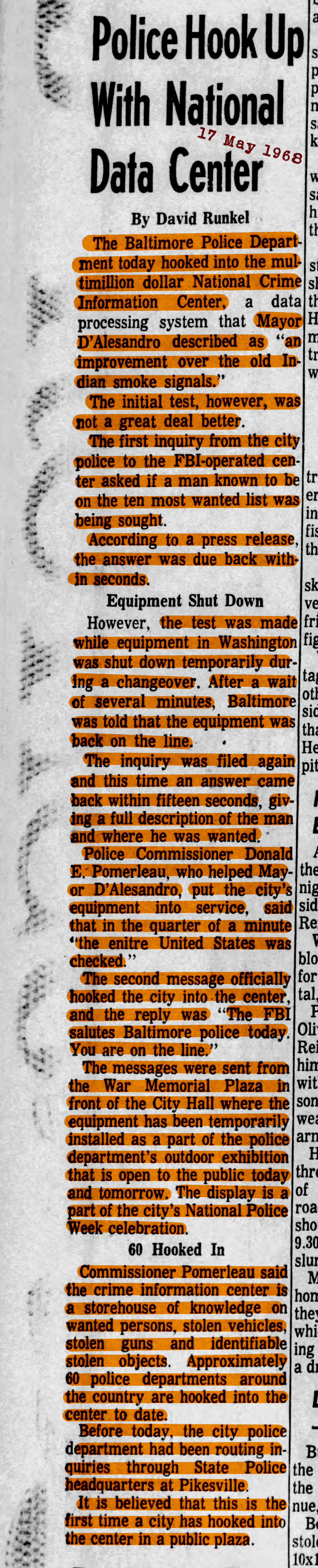
National Crime Information Center - NCIC

National Crime Information Center (NCIC)

The Evening Sun Fri May 17 1968 72

First day for NCIC click HERE

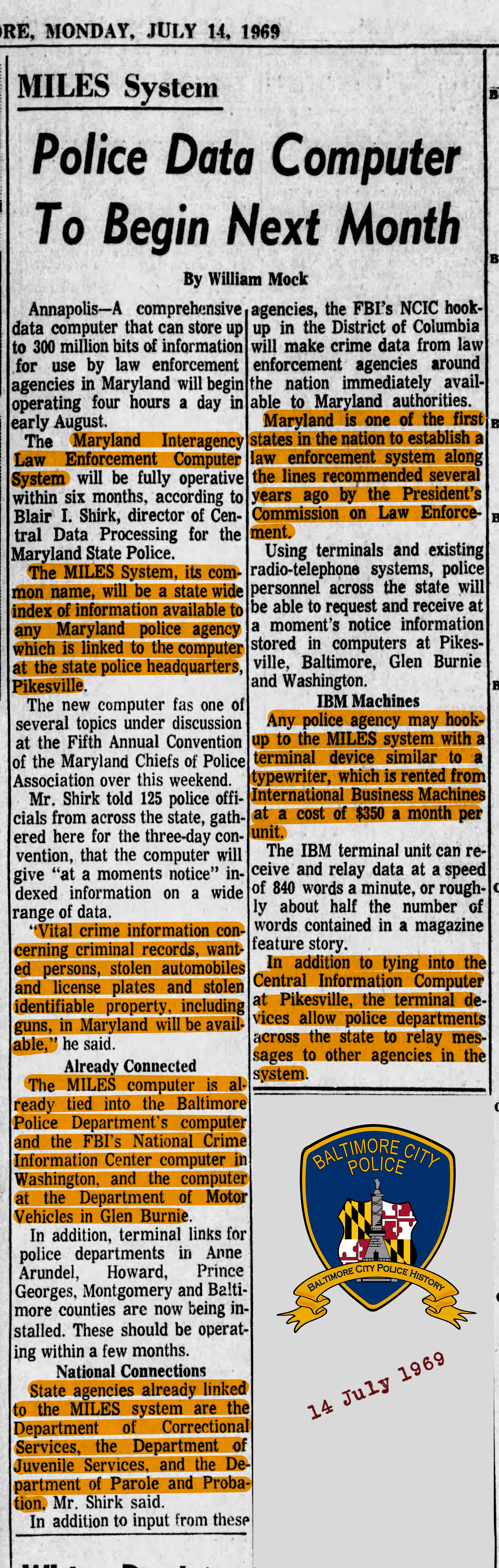
The Evening Sun Mon Jul 14 1969 Highlighted 72

First Day for MILES click HERE


1 black devider 800 8 72

POLICE INFORMATION

If you have copies of: your Baltimore Police Department Class Photo, Pictures of our Officers, Vehicles, Equipment, Newspaper Articles relating to our department and or officers, Old Departmental Newsletters, Lookouts, Wanted Posters, and or Brochures. Information on Deceased Officers and anything that may help Preserve the History and Proud Traditions of this agency. Please contact Retired Detective Kenny Driscoll.

This email address is being protected from spambots. You need JavaScript enabled to view it.

Devider color with motto

NOTICE

How to Dispose of Old Police Items

Please contact Det. Ret. Kenny Driscoll if you have any pictures of you or your family members and wish them remembered here on this tribute site to Honor the fine men and women who have served with Honor and Distinction at the Baltimore Police Department. Anyone with information, photographs, memorabilia, or other "Baltimore City Police" items can contact Ret. Det. Kenny Driscoll at This email address is being protected from spambots. You need JavaScript enabled to view it. follow us on Twitter @BaltoPoliceHist or like us on Facebook or mail pics to 8138 Dundalk Ave. Baltimore Md. 21222


Copyright © 2002 Baltimore City Police History - Ret Det Kenny Driscoll 

Police Jargon/Slang

Jargon imagePolice Jargon/Slang

Law enforcement use  of Red Ball aka Redball

  • Red ball, a term used by the US Air Force, typically on the flight line, to identify aircraft maintenance issues that could prevent an on-time launch of aircraft. This is usually when aircrew are present, and thus given highest priority.
  • Red ball or Redball, jargon for a high-profile police case that draws media and political attention, often used in the book Homicide: A Year on the Killing Streets and the television shows based on it: Homicide: Life on the Street and The Wire. In Baltimore Redball is as common a word/term as Espantoon. 
  • The Red Ball Express was a truck convoy system that supplied Allied forces in World War II.

1 black devider 800 8 72 

10-30

10-44 lunch

10-7

10-7 detailed...going on vacation leaving early

30-1

42.50 on the hoof

5-0

6 on the whistle

801 10-18

9:01 Club (Stet's attorney, early court leave) 

95

Actor

Adam Henry

ADSTW SFE BSU. Arrived dead, stayed that way. Shit flying everywhere. Busting shit up

All the ones I wrote were from a police department long since gone.

All told

Alley Apple = brick, bottle, rock

Answer the box dummy

As a rookie, my sergeant was describing how to write a note on the back of a warrant that you attempt to serve, so it wouldn't keep coming back to try to serve, and he said you knock on the door and ask if he or she is there, ask the name of the person, Joe shit the ragman said, he doesn't live here. go to the next house, Joe shit the rag man said they are already in jail, and he did this with about a half dozen examples all Joe shit the ragman, then he asked if I understood, Sonny Dickson was sitting in on my lesson, and when asked if I understood, Sonny answered up, he said, "yes sir, that joe shit the ragman is everywhere, that guy really gets around!"

Attitude adjustment

Baby bookin

Back up

Bailout

Baliwick 3

Bam-ba-lance and Hoot-an-holler. (Ambulance and fire truck)

Banked me

Beat n release

Beatem up boys

Billy Club

Brilliant, I love the explanations as much as the jargon...

Brookfield Boogie. (Dance we did to keep roaches off of you)

B's and H's. Bitches and Whores!

Burner

Call 2100

Canvas

Chalker

Check his dip

Choir practice

Choir Practice at PPR - Pimlico Park & Ride

Choke slam

Circus court

Contempt of cop.

Correctol

Cruising patrol

Dead Right There

DFO. Done fell out.

DFQ = Dumb Fucking Question.

Dick dance

Dirt bag

Dirt nap

Dirty

DOA

Don’t eyeball me

Don’t piss down my leg and tell me it’s raining.

Dope Fein Lean

DRT = Dead Right There

Eager street hotel

Endless walk to nowhere

Espantoon

Eye fuck

Five Oh or Time Out!

Five Ring

Five-O

Floatter

FNG=Fucking New Guy

Fox trot

Get six.

GOA

Gorked

Got a creeper!

Gotta a pack of them ! Large group

Grab em N slab em boys...medical examiner

Ground Rent (crap game money left behind after the players fled)

GSW = Gun Shot Wound

Hack.. I was Driving down 3700 W. Belvedere this lady kept waving at me, after several times I stopped she was like I don’t want you.. 

Had a lady tell me she was Raised & Simonized

Hair weave

half a brick

Here’s an oldie…. An over nighter

Hog tie

Hold me on A pr

Hold me out...

Hoodle head

Hot list

Hot sheet

House Cat

House got ramshacked “ransacked”

House mouse

Humble

Hump

I got some scrimp

I knew it as mopery with the intent to creep.

I lived with that one all my career

I'm old, everybody was a knuckle head. I heard one of my younger trainees call a guy a knuckle head one day and I laughed all day. Lol

I'm only conversating on the corner not selling

In the summertime in some districts, some of the older women used to put their money in their bras. When they went to buy something in the corner grocery or liquor stores, they would take the money out, which was damp with sweat and pay the storekeeper. In some of the stores, you would hear the storekeeper refer to as Titty money.

Indict a corner

Is it Murder or Homicide

it’s when you pull up to a dirty dealer and it looks like he has to go to the bathroom lmao

Jacked

Jackpot

Joe Shit the rag man

Jon Pease - "You split em, you git em"  or "WRONG!!" 
 
Jumbos
 

jump out boys

Junkie lean

Kilt. Rant Over. DRT Dead right there. Trifling. Preparation for a forest. Fruckus

Knock & talk

Knockers

Knotty-head

Knuckle head

Lemon heads (motor cops)

Look out book

Mad Dog 20/20

Midnight shift ( Siesta Fiesta) my first year or so it was put on the radio lol

Mill about smartly

Mopery either, with the intent to gape, or a felony on the high seas

Motengainer (whole bunch of Mfers)

Mother told me to be careful with her son as he just came back from the doctors. Said he was being psycho laminized. When inquired what for mom stated he was having hilarious delusions 

Murder Po-lice

My crib---meaning house

My daughter thinks Stand By is police Jason, but I disagree. I use it all the time. Don't civilians? Hhmmmm. Gotta start listening to civilians.

My father called me my brother knuckle head so much we thought it was our names, as Irish twins we figure huh, we share clothes and toys and a name... it beat our older brother's name... we still call him dumb ass. ROTFL

My good friend, (He'll know who he is, but i won't mention names) he was on a beach and a young lady wearing a yellow bikini was taking a survey asked him to sign, then asked if he was staring at her bikini top, or the parts sticking out from behind. he confessed and told me he was caught "eye sucking" LOL He can tell us who he is if he wants.. but I had to laugh at the way he spun the old "Eye F'ing" jargon.

No bail.

No, where be the judge?

Notify 2100

NRN

Off to the Bat Cave

Officer, where go the coat room?

Old radio cars were called scout cars

On a midnight shift I once called out for a 10-44 nap... I also had dispatch asked me my status, i said I am married with children...

On the arm

Paper (Warrant)

Patty Wagon

Pecker trail in fact I am not sure if it was a prank on a rookie, but I was told you could write "Pecker trail" in a report. I never did but damn he made it sound like maybe, its a good thing we didn't see any or it may have been in that report lol

Perp

Po-lice

Post integrity.

Post officer

Priceless that you said “hump”! 

Rabbit!

Rack up.

Radio car

Rapsed = raped 

Red Ball aka Redball 

Robo-Cops = Housing Authority Police

Rolled a 7

Rollin stolen

Rookie Mistake and OT Nut

Running through the Cut

Selling wolf tickets

Shift Change Party

Shock-A-Rama

Short change over

Shorty

Shorty Big Head = kids

Side partner

Silver bracelets

Sir, you have to keep your jacket with you

Skrimp = Shrimp

Slap jack

Squirrel

stinker

Suicide by cop

Tale tells

Tell tails

The 3C's.thatvwill get you fired. Booze Cooze and Snooze!

The claw

The cut

The hill.." (cherry hill)

The Hole

The hood

The lean

The ole Tell Tale - placing a small rock on the business door midnight shift for those villains trying doors at 3AM

These ain’t my pants

Titty money

Top knot= your head

Top of Form

Trapping

Trying up

Tumble weeds

Tune up

Turn key

Turn-up

Un-ass the area

Union meeting

Up the screet

Visit to the Mezzanine!

We all worked with a “HUMP”

We'd hit the bars and put and wait for them to move. That would get most of them to move. Next came the spotlights. Some would "signify" and then move. There'd always be some idiot that would dance when the light hit them. He was the one who got locked up.

When I was a welder my boss came to me, he said his kids friend told him he was banked in the head with an alley apple. LOL It didn't take a genius to figure he was hit in the head with a rock or bottle.

When I was new I asked the complainant what the problem was. He kept yelling "They banked me". I said "They banged you?" He got pissed and yelled "No white boy, they took my money. They banked me!"

Whip. Describing a car.

Who? Me?

Wood shampoo

Yoked me

Yoking

You can't get there from here

You know what time it is.

You wanna take a ride


1 black devider 800 8 72

POLICE INFORMATION

If you have copies of: your Baltimore Police Department Class Photo, Pictures of our Officers, Vehicles, Equipment, Newspaper Articles relating to our department and or officers, Old Departmental Newsletters, Lookouts, Wanted Posters, and or Brochures. Information on Deceased Officers and anything that may help Preserve the History and Proud Traditions of this agency. Please contact Retired Detective Kenny Driscoll.

This email address is being protected from spambots. You need JavaScript enabled to view it.

Devider color with motto

NOTICE

How to Dispose of Old Police Items

Please contact Det. Ret. Kenny Driscoll if you have any pictures of you or your family members and wish them remembered here on this tribute site to Honor the fine men and women who have served with Honor and Distinction at the Baltimore Police Department. Anyone with information, photographs, memorabilia, or other "Baltimore City Police" items can contact Ret. Det. Kenny Driscoll at This email address is being protected from spambots. You need JavaScript enabled to view it. follow us on Twitter @BaltoPoliceHist or like us on Facebook or mail pics to 8138 Dundalk Ave. Baltimore Md. 21222


Copyright © 2002 Baltimore City Police History - Ret Det Kenny Driscoll 

Sergeant Charles E. Gross

Sergeant Charles E. Gross

Fallen Hero

Sergeant Charles E. Gross

The Baltimore Sun Wed Oct 2 1957 pg1

Page 1 to see full size article click HERE

The Baltimore Sun Wed Oct 2 1957 pg2

Page 1 to see full size article click HERE

On this day 27 Sept 1957 Sergeant Charles E Gross took his life reportedly out of fear or intimadation see the above newspaper article for the story, we will add more as it becomes available. 


1 black devider 800 8 72

POLICE INFORMATION

If you have copies of: your Baltimore Police Department Class Photo, Pictures of our Officers, Vehicles, Equipment, Newspaper Articles relating to our department and or officers, Old Departmental Newsletters, Lookouts, Wanted Posters, and or Brochures. Information on Deceased Officers and anything that may help Preserve the History and Proud Traditions of this agency. Please contact Retired Detective Kenny Driscoll.

This email address is being protected from spambots. You need JavaScript enabled to view it.

Devider color with motto

NOTICE

How to Dispose of Old Police Items

Please contact Det. Ret. Kenny Driscoll if you have any pictures of you or your family members and wish them remembered here on this tribute site to Honor the fine men and women who have served with Honor and Distinction at the Baltimore Police Department. Anyone with information, photographs, memorabilia, or other "Baltimore City Police" items can contact Ret. Det. Kenny Driscoll at This email address is being protected from spambots. You need JavaScript enabled to view it. follow us on Twitter @BaltoPoliceHist or like us on Facebook or mail pics to 8138 Dundalk Ave. Baltimore Md. 21222


Copyright © 2002 Baltimore City Police History - Ret Det Kenny Driscoll 

Sergeant William Nicholson

Sergeant William Nicholson

Fallen HeroSergeant William Nicholson

The Baltimore Sun Thu Feb 9 1939

28 June 1928 We lost our Brother Sergeant William Nicholson to a line of duty infection caused from an irritation from a colored sweatband inside his issued service hat. The material used in the makeup of the sweatband caused and infection, that lead to his loss of life, it took his widow nearly ten years to prove her case. I am not sure of how things were handled but it should seem obvious, if something from the equipment caused this sergeant his loss of life, it should have been called a line of duty or work-related death a lot sooner. May he continue to rest in peace as keep him and his wife in our thoughts on this day in Baltimore Police history.

1 black devider 800 8 72

POLICE INFORMATION

If you have copies of: your Baltimore Police Department Class Photo, Pictures of our Officers, Vehicles, Equipment, Newspaper Articles relating to our department and or officers, Old Departmental Newsletters, Lookouts, Wanted Posters, and or Brochures. Information on Deceased Officers and anything that may help Preserve the History and Proud Traditions of this agency. Please contact Retired Detective Kenny Driscoll.

This email address is being protected from spambots. You need JavaScript enabled to view it.

Devider color with motto

NOTICE

How to Dispose of Old Police Items

Please contact Det. Ret. Kenny Driscoll if you have any pictures of you or your family members and wish them remembered here on this tribute site to Honor the fine men and women who have served with Honor and Distinction at the Baltimore Police Department. Anyone with information, photographs, memorabilia, or other "Baltimore City Police" items can contact Ret. Det. Kenny Driscoll at This email address is being protected from spambots. You need JavaScript enabled to view it. follow us on Twitter @BaltoPoliceHist or like us on Facebook or mail pics to 8138 Dundalk Ave. Baltimore Md. 21222


Copyright © 2002 Baltimore City Police History - Ret Det Kenny Driscoll 

How to Dispose of Old Police Items

logo

Please contact Det. Ret. Kenny Driscoll if you have any pictures of you or your family members and wish them remembered here on this tribute site to Honor the fine men and women who have served with Honor and Distinction at the Baltimore Police Department. Anyone with information, photographs, memorabilia, or other "Baltimore City Police" items can contact Ret. Det. Kenny Driscoll at   Kenny@BaltimoreCityPoliceHistory.com follow us on Twitter @BaltoPoliceHist or like us on Facebook or mail pics to 8138 Dundalk Ave. Baltimore Md. 21222.

NEWSLETTER

Subscribe now to get 100 exclusive photo & two newsletters per month