Police Boys Club

Police Boys Club

boys club

Baltimore City Police Boys Club
History if Baltimore City Police Boy's Club

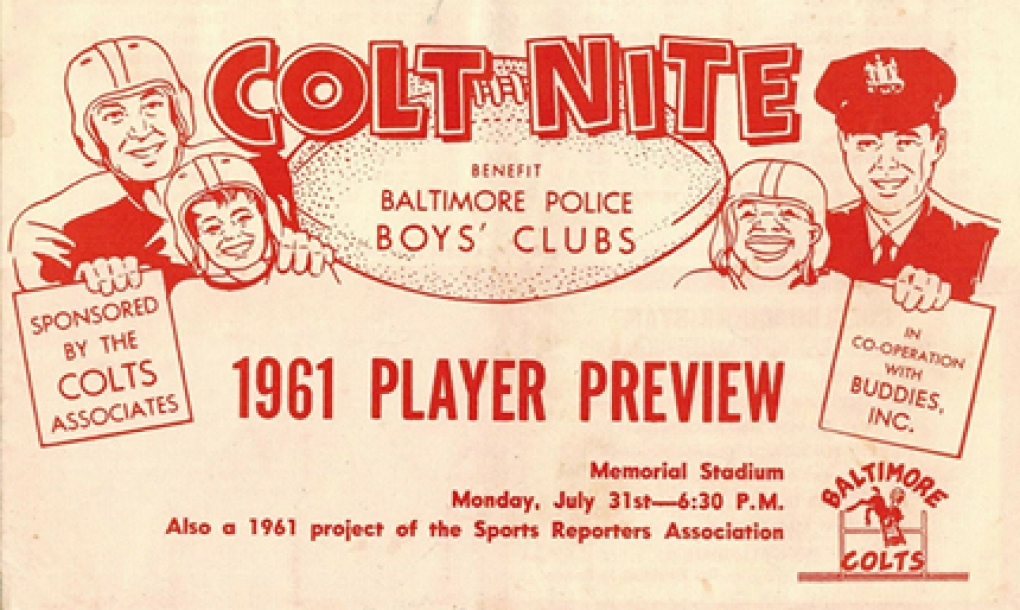
Starting in 1944 and continuing through the 1980s, the Baltimore Police sponsored a Boys’ Clubs throughout the city with financial help from Buddies Inc. and a Baltimore Businessmen’s Organization. Policemen chipped in to buy sports equipment, and gave an abundance of personal time and attention teaching games, and giving talks about citizenship, civic responsibility, community relation, and police work. Buddies Inc. raised funds for events like Baltimore Colts Night, and a series of shows Called Up With The People and Baltimore Orioles games. The Shiners of the Bowie Temple in Baltimore joined in supporting the Boys Club in 1977 with a share of the proceeds from the annual Shrine Circus. The First Club was started by Southwestern District. All of the club’s numbering from 2 to 4 at various times were led by Police Officers and Police Cadets. Some boys went one to become cadets. In the late seventies, the department experimented with expanding the club to include girls the name was changed to Youth Clubs, but the idea proved unfeasible and was soon abandoned. Today the club said been replaced by the activities of the Police Athletic League or PAL.

Summer camps for hundreds of inner-city youngsters under 16, who otherwise would have spent their summers idly and devastated or dangerous neighborhoods, began in 1945  NWD Police Boys Club basketball team 1950son land provided by the U. S Army at Fort Ritchie in Catoctin Maryland’s Mountains. The camps were extensions of the department’s work with the Boys Club. The founder of the camps was Captain William Heart, the first Commander of the Department’s Youth Division. When the Army Land was needed for military purposes in 1974 Commissioner Donald Pomerleau and the Buddies Inc. raised funds to buy an alternative site one route 23 at Deer Run in Harford County. The new location was named, Camp Walter Perkins for the founder of Buddies Inc.

Sarah Callan worked for the department for 47 years before retiring in 1970, kept the books and handled administrative detail for the club and camps. Other key figures were in the league Vance, who helped with whatever needed doing in the early days, Major Patricia A. Mullen, who directed Police Youth Services in the 70’s and 80’s, and Sergeant Don Farley supervisor of the club and camp activities in the same., Period.

As a police and the Baltimore aerial council of the boy scouts of America have cooperated since 19681 programs presented by the scouts one law enforcement day. Each of the nine police districts as sponsored an explorer scout troop since 1944.

The department joined Federal, state, and county law enforcement agencies and hosting all day in March 1980. The event held at the inner harbor, featured a variety of law enforcement as if it’s, explanations of fingerprinting and its value, continuous motion pictures of the crime prevention, a helicopter demonstration, and rolls by the department’s mount unit, always a favorite of the public. Erik Estrada then starring in the television series ships up here did rash field to support the event.

A successful youth division program was created in 1978 by the department’s youth services division now if they use bureau. Teenagers who committed minor crimes like shoplifting join in 90 days of mandatory counseling with a use officer, who attempts to discover the youngsters' interests and a way to pursue those interest as a substitute for idle hands and idle time. The program provides a great deal more in just a warning and in it and I’m conditional release. It can, however, in appropriate cases and with a miscreants cooperation, of the lead the severity of juvenile court.

The southwest district commander of community relations section added A theatrical talks to its work in 1971 police Officer Charles L. Clayton Sr. Better known as buck Clayton with the support of district Commander Richard G. Francis became Charley the magic cop. Clean a recognize professional magician, began making appearances before school children, using is sliding and showmanship to teach safety, brotherhood, patriotism, added dangers of narcotic. The Baltimore police department participated through the 1970s and 1980s in annual Baltimore City fairs as both guardians of the peace and exhibitor of the law enforcement information.
Untitled-1

Baltimore Police Boys Club members left to right Sonny Augustyniak, Butch Kotowski, Jim Galloway, and John Randle the Colts Allen “The Horse” Ameche and Claude “Buddy” Young in a training camp visit.

1 black devider 800 8 72

Police Boys club72

The Police Boys Club of Baltimore

The Police Boys Club of Baltimore is making valuable contributions in the struggle against juvenile delinquency. Calculated to meet the recreational needs of 8 to 18-year-old, club activities include athletics, sports, crafts, woodworking, and scouting. Each club is equipped with a library, recreation room, game rooms, and wood workshops.

boys club
The clubs are located at the following:
Eastern, Police Boys Club - 1619 Bank St.,
Northwestern, Police Club - Calhoun and Gold Street
Southern, Police Boys Club - Patapsco and Olmsted
Southwestern, Police Boys Club - Calhoun and Pratt Street

  SW boys club

First Police Boys Club Formed in Southwestern District
Proves Success
9 June 1944


Applying as a gauge the boys 

Enthusiasm for the club and their readiness to become members. The Southwestern Police Boys' Club. the first of several similar clubs to be established in various sections of the city under the direction of the Baltimore Police Department. is already a success far beyond the hopes of its founders. The club's memberships large enough at its beginning a scant two weeks ago. is growing by leaps and bounds. With facilities to comfortably accommodate approximately 100 boys more than 400 were signed members on the opening night. That list has grown to over 550 and more applications are pouring in each day. Officials in charge of the organization said. 


Fills Need for Fun 

Originally founded by the department as a weapon in its fight on juvenile delinquency, the club. which is installed in the specially renovated third floor of the station house at Pratt and Calhoun streets. has a fertile field in which to work. since that, thickly populated section of town has no recreation for its hundreds of children other than the streets. The clubs' plans. of course, are still in the formative stage. but its athletic program. which is under the direction of Officer.Joseph Epplier a former football player and bicycle racer. is ample proof of the need of such a work for boys of that area.

Except for baseball. which l guess every kid knows a little something about."Epplier  savs." We practically have to teach nearly every lad who comes to us how to play. For the most part, these kids don’t even know the rudiments of even the simplest games like, say ping pong 


Boys Are Willing

"But they are more than willing and are taking the sports like ducks to water. I took a batch of our new baseball equipment to Carroll Park the other day and the gang nearly mobbed me grabbing the gloves and bats in their eagerness to get a game going Epplier got the same reaction When he called for volunteers to man a track team which would represent the club in its first taste of outside competition in the All-For-Glory track meet held by the Department of Public Recreation at Carroll Park last Tuesday. Seventy-five boys showed up for the tryouts the Saturday previous to the Fourth. Epplier ran them through several qualifying heats and whipped some 65 of them together as entrants for Southwestern. 


Win First Meet 

Not only did the lads of the club practically make the meet-they had the largest single entry list but they also ran off with the majority of the honors. placing more firsts seconds and thirds than any of the other groups entered. Donald Bokman stepped off the 100-yard dash for 10-11 Years for the club in 14 seconds and Phillip Weinreich and Rollins Johnson placing second and third. Added points to the club's final record. Little Bill Cammarata in the 12-13 age group covered the same distance for the club in one second less than Rokman and again club members in Bob Peed and Bob May followed him in the next two positions. 

Bill Reis Donald Blurb and Bill Rawlings. all three clubbers captured The 14-15 group lOO·yard dash in that order. The boys of the club chalked up the honors in the 60-yard dash for 7-8 and 9 years as well. Eddie Grap hit the tape first, followed by Larry Smith and Roy Singletary. 


Plans For Winter 

While Lieut. Fred Glock. Who heads the club. and his assistants have their hands Full at the present getting the club moving smoothly. they are not too busy to think of the future. When the summer months are over the club expects to turn to basketball and boxing and wrestling For these latter sports Glock hopes to find sufficient talent in the department but if it isn't available there outside experts will be asked to help out. For purposes of competition, the boys of the club are divided into four groups. the midgets for boys from 8 to 10 junior, 11·12. Intermediates 13·16 and the seniors 16·18 The station resounds with The voices of about 125 boys each night. In addition to its outside athletics, the club contains pool tables. ping pong tables and games of a wide assortment for the boy. Other facilities include a well-stocked library, paneled in knotty pine and constructed by the policemen and a wood-working shop. equipped with power-driven tools. The club is open daily from 4 pm to 9 pm  
1 black devider 800 8 72


Inspector John Schueler Sr 72

Inspector John R Schueler
Heads Project
 

The overall program of the department is under the direction of Inspector John R. Schueler as chief of the Juvenile Protection Bureau William L. Hartung who has been serving in the Bureau of identification and who has been connected with local athletics for many years, is assistant to Schueler. Other officers in charge of special phases of the club are Fred Elgert who does most of the paperwork and Charles B. Gerick. The entire cost of equipping the club which amounted to $1500 was donated to the Southwestern by the Variety Club of Baltimore, Tent No. 9.


1 black devider 800 8 72

police boys club
George D. Gilbert, 23 Years
Northwest Baltimore Police Clubs

George and the Gilbert of the Baltimore police department, who gave 23 years of service as club’s director, athletic director, club driver and rifle instructor of the western police boys club were eulogized at services 5 March as sharp street memorial United Methodist church. He was a 76 and died suddenly on February 28 new paragraph Robert Johnson, president of Douglass high school class of 1937 recalled fond memories of the deal when they attended the school’s 60 if reading in last June and Hal he was a good citizen and love helping youth. A resolution by Frank Ballston from the Maryland house of delegates also attested to his years of community service.

Jordan D. Gilbert was born January 20, 1920, at Johns Hopkins hospital the oldest of three children of Harry beacon Gilbert and Janie Jenkins. He was the grandson of Harriet Murphy Gilbert, one of five daughters of John H Murphy a senior founder of the African American newspaper and Harry Dion Gilbert. That’s an Afro printer he was responsible for an opening presses from the early flatbed press to the later Goss presses.

Harriet Gilbert Matthews, daughter of gymnastic Gilbert lane, gave in the family tribute to her uncle citing him as a father, brother, husband, grandfather, protector, and lover of children.

Gilbert is a graduate of Douglass high school and attended Morgan state college before world war two interrupted his schooling. His army service started in 1941 and closing service at camp Claiborne Ft Belvidere and Camp Gruber. After discharge in 1953, he worked and Social Security taking accounting and economics at Cortez Peters business school

He sort of service to the Baltimore police department in 1953 and worked the western district police boys club to 1958 and tools retirement in 1976. Poll web. Department of Recreation and Parks recall Officer Gilbert improve the lives of the young boys she came into contact with one gold street in the sand town area and Hauser sports and personal sacrifices proved to be a positive influence in many lives

The Rev. Dr. Bruce Haskins delivered the message of hope and Morse Queen, minister of music a Sharp Street gave an organ solo, “you’ll never walk alone”

He is survived by his wife, Ruth and order deal sister semester three stepchildren, six grandchildren. Pallbearers include Henry David’s Michael Robert and Matthew its and it wasn’t Woodlawn cemetery with funeral arrangements by march funeral homes west


1 black devider 800 8 72

Bring Back Police-Sponsored Boys Clubs 


When my brother, Frank, and I were growing up in Baltimore City on South Calhoun Street we were both charter members of the Southwestern Police Boys Club on the third floor of the police station at Pratt and Calhoun streets. The club was run by full-time policemen and had an indoor basketball court, boxing ring, pool tables, ping-pong tables, a woodworking shop, a Boy Scout troop, and a TV room. I believe it was open six days a week and closed at about 9 p.m. In the summer, we would go away to Camp Ritchie for one or two weeks. I believe the cost was about $6 per week. We also had baseball teams and football teams.

As I look back on those happy times spent with my friends at the Boys Club and the devotion those policemen gave to helping us boys, I feel that that experience was a major factor in our growing up the process. I wouldn't trade it for anything. Back then, my brother and a friend of his got interested in ham radio and crystal sets while participating at the Boys Club. He eventually became an electrical engineer and a valuable employee at Bell Labs. He is now 81 years old and lives in Massachusetts. I loved to play pool and ping-pong and leaned toward the business side and became a Certified Public Accountant. I am 77 years old and live in Nottingham.

It baffles me as to why we don't have similar clubs to help the youngsters today. When we came home from school, we headed right for the Boys Club until supper time. Our parents knew where we were and that we were in good hands. I realize these are different times in which we live but the basic principles are still there. With a few adjustments, we could do it again. Our father was a retired police sergeant in Baltimore City, and I want to thank the policemen who devoted their time and talent in molding us kids during the early years of our youth. We respected them and they were our friends. I hope this might encourage officials in Baltimore and Baltimore County to rethink the idea of closing the Police Boys Clubs. They did and do make a difference.

Bob Witt, Nottingham

  SD Boys club

 Retired cop defends Baltimore police Athletic League

As the Baltimore Police Athletic League prepares to end because of budget cuts and transfer centers to the city's Department of Recreation and Parks, community activists, residents and others are starting to rise up. I got this e-mail from retired Baltimore police Lt. Osborne B. McCarter:

It has been quite some time since I talked to someone from the media, but after reading your article and reflecting on my 32.5 years as a public servant with the Baltimore Police Department, connecting with the present situations that are occurring, I can only conclude that the powers to be, has finally gotten their wish.

Peter, as the last Operation Lieutenant running The PAL program and in furtherance of my professional career I elected to become a commander as a Deputy Mayor, I have been either directly or indirectly involved in four youth programs that have met some form of demised because of politics within the City of Baltimore.

First was the Boys Club, then The Explorer Program, followed by the Walbrook Academy, now the P.A.L.  Each program fostered a partnership between cops and kids, it was an investment being made in our youth and the feature of our city. I challenge anyone who has been involved with any of the youth programs to state differently.

For example, let's look at the Northeast District. But first let look back to the inner parts of the city where thousands of residents were displaced, like the construction of a highway to nowhere, built from Pulaski Street to M L K Blvd. so that workers at SS building could get into the city faster and get out at the end of the tour of duty quickly, then there was the implosion of the High Rises all of those residents were displaced throughout the city some into areas we officers used to call "Country Club Districts."

But as the displacement occurred so did the crime, crimes such as vandalism and graffiti, were all too common in areas once consider crime free, compared to some districts where a part one crime was expected at least one per day if not one per shift per sector.

The Goodnow area of the Northeast soon fell victim of the vandalism and graffiti followed by street robbers, gang and drug activities. The Goodnow PAL center which started off being a 7-Eleven closed not too long after opening, because of the crime in and around the store. Mrs. Army Mock, Sgt. R. Gibbson, Officers Lorie & Creg dedications and support from the community soon turned that area around from one of Blight to being one of the premier centers in the city. Thanks to the partnership between Mrs. Mock, Police Commissioner Thomas Frazier, Officer Lorie, and Officer Craig.

But who really benefited from what when on at the center? first were the kids from the community, then the community, its citizens, and the city benefited from the partnership that had been fostered between kids and cops. Well, O'Malley finally got his wish. Hermann, I pray that the youth of the city become enlighten as to the overall goals of the political official who are eliminating avenues for kids to avoid at-risk behavior and that voters see that as programs are being eliminated for the youth that there are more detention facilities being build and slated to be built. One can only conclude that the youth of the city are being targeted. I am thankful for having touched thousand of lives positively in one way or another over the 32 1/2 years of service within the Police department.

In Memory of Police Officer Troy Lewis Jr. who was a true and dedicated PAL officer died March 28, 2009. 

Retired
Ob-X-50


SD Boys club

1 black devider 800 8 72

Baltimore Police Honor Retiree
Sgt. James Dixon a Former Member of Montford Marines
Receives Congressional Gold Medal


BALTIMORE —A 33-year veteran of the Baltimore City Police Department brought home the highest civilian honor that can be awarded to an individual -- the Congressional Gold Medal. Sgt. James Dixon was a member of the Montford Marines, the first African-Americans in the U.S. Marine Corps. Between 1942 and 1949, about 20,000 black Marines were trained at Montford Point, N.C. In June, they were honored with the Congressional Gold Medal. On Tuesday, Dixon, who is now retired, was one of those honored. He brought his medal to the Baltimore City Police Department. "I wanted to say thank you for all you've done for the city of Baltimore and the United States of America," BCPD Acting Commissioner Anthony Barksdale said. Dixon's friends and fellow officers were also there to say thank you. "I really just love the guy. He was so intelligent, told great stories. He was just a tremendous police officer, a tremendous sergeant. Everybody loved him," retired BCPD Sgt. Alan Yeater said. "Sgt. Dixon was like a father-figure to us. It was a home away from home at the Western Police Boys Club," friend Terry Hall said. "He just treated everybody so well. He made you want to come to work. He didn't want to leave. He hated to take a day off," said retired BCPD Lt. Fred Roussey said. "He was just a terrific supervisor, a terrific man." Dixon served with the BCPD from 1954 to 1987, and he's seen a lot of changes over the years. "It's been an honor being in the Corps. It's been an honor being in the Police Department. I did 33 years in this Police Department. Trials and tribulations we've been through, but we've succeeded, and I see the results of our work," Dixon said. Do you know a local policeman, firefighter or military member that's being honored?

Colts Baltimore Police Boys Club 1960 72

Baltimore Police honor sergeant who served amid segregation

Dixon remembered as a trailblazer for blacks in the police force

July 17, 2012, |By Nick Cafferky, The Baltimore Sun

James Dixon joined the Baltimore Police Department in 1954 as a black officer in an era of widespread racial prejudice. Police posts were segregated and blacks were not allowed in patrol cars

On Tuesday, a quarter-century after he retired as a sergeant, Dixon returned to the department for a ceremony to honor his service and thank him for his role in helping the department through a time of social change. Dixon, 77, was given a BPD hat and coffee mug.

"I think today was really good for him because I don't think he realized how far the Police Department has come," said Derrick Dixon, James' son. "So for him to come out here and see a lot of Afro-American officers and commissioners, I think it blew his mind.

"I think now he realizes a lot of the things he did for the Police Department and a lot of first-time things he did for blacks and realizes what it led to," Derrick Dixon said.

The segregation in the police wasn't anything new for James Dixon, after his service in the military.

He was one of the hundreds of Marines from Montford Point, an all-black boot camp in North Carolina, to receive a Congressional Gold Medal last month.

"This was something I never expected, although the Tuskegee Airmen got theirs, so we shouldn't have been very far behind them," James Dixon said. "This is something I will cherish for the few days I have left in my life. But this is something I'm going to have framed and hung on the wall."

Dixon served in the Marines from 1944 until 1946, but his placement there was itself a stroke of luck. Drafted by the Navy, Dixon was willing to go to prison rather than join a unit where he was forced to serve food or swab decks like other blacks who were in the Navy during that era.

"I [said] that if I was put in the Navy, I was going AWOL because I wasn't going to serve any food or scrub any decks," Dixon said, teary-eyed. "Had I been put in the Navy, I would be in jail now. I'm not a servant."

Much has changed since then, but the department has not forgotten Dixon's contributions, said Acting Commissioner Anthony E. Barksdale.

"He's stood strong through all of it. And look at him. Still shining; still standing strong," said Barksdale. "He's giving me advice and telling me stories that are making me happy that I'm wearing the same uniform that he used to wear."

This email address is being protected from spambots. You need JavaScript enabled to view it. 

1 black devider 800 8 72

Old Southwestern District Police Station


Since the doors opened at the former Southwestern District Police Station house on July 17, 1884, the square brick building at Pratt and Calhoun Streets has served the city in many different ways. When construction on the new building began in the fall of 1883, the Baltimore Sun claimed the new Southwestern district police station would "surpass in size, elegance and completely of arrangement any police building now in the city, and, indeed, it will have few equals in the country."

Builders Philip Walsh & Son and architect Frank E. Davis completed the three-story building with room for 47 officers. The men had been reassigned from the southern and eastern districts to serve under of veteran police officer Captain Daniel Lepson who led the brand-new district.

In the summer of 1944, Baltimore's first police boys' club moved into the upper floors, serving around 120 boys from 8 to 18 years old every day during the first few weeks after they opened. With donations from a local social club, the officers converted the station's third floor gymnasium into a  "big clubroom," described by the Sun as, "filled with tousle-haired boys noisily pushing at billiard balls, fashioning B-17's out of wood, nailing magazine racks together and eying each other craftily over checker games." The city started four boys' clubs in the 1940s, with a segregated facility for black children at the Northwestern District Police Station on Gold Street.

Both the officers and the Boys' Club departed in 1958 when the Southwestern District Police Station relocated to a modern, air-conditioned facility at Fonthill and Hurley Avenues. Following close on their tails, however, were the men and dogs of the department's K-9 Corps who moved their official headquarters from the Northern District station to Pratt Street.

Unfortunately, by the late 1970s, the building fell vacant. The Maryland Department of Social Services renovated the former police station in the early 1980s. When they left, the building fell vacant again. Today, the structure is deteriorating and remains at risk until a new use for this often reinvented building can be found. 

Original found here


Colts Baltimore Police Boys Club 1961 72


Bring back police-sponsored boys clubs

July 11, 2013

When my brother, Frank, and I were growing up in Baltimore City on South Calhoun Street we were both charter members of the Southwestern Police Boys Club on the third floor of the police station at Pratt and Calhoun streets. The club was run by full-time policemen and had an indoor basketball court, boxing ring, pool tables, ping-pong tables, a woodworking shop, a Boy Scout troop, and a TV room. I believe it was open six days a week and closed at about 9 p.m. In the summer, we would go away to Camp Ritchie for one or two weeks. I believe the cost was about $6 per week. We also had baseball teams and football teams.

As I look back on those happy times spent with my friends at the Boys Club and the devotion those policemen gave to helping us boys, I feel that that experience was a major factor in our growing up the process. I wouldn't trade it for anything. Back then, my brother and a friend of his got interested in ham radio and crystal sets while participating at the Boys Club. He eventually became an electrical engineer and a valuable employee at Bell Labs. He is now 81 years old and lives in Massachusetts. I loved to play pool and ping-pong and leaned toward the business side and became a Certified Public Accountant. I am 77 years old and live in Nottingham.

It baffles me as to why we don't have similar clubs to help the youngsters today. When we came home from school, we headed right for the Boys Club until supper time. Our parents knew where we were and that we were in good hands. I realize these are different times in which we live but the basic principles are still there. With a few adjustments, we could do it again. Our father was a retired police sergeant in Baltimore City, and I want to thank the policemen who devoted their time and talent in molding us kids during the early years of our youth. We respected them and they were our friends. I hope this might encourage officials in Baltimore and Baltimore County to rethink the idea of closing the Police Boys Clubs. They did and do make a difference.

Bob Witt, Nottingham

Colts Baltimore Police Boys Club 1955 72


Devider color with motto 

Please contact Det. Ret. Kenny Driscoll if you have any pictures of you or your family members and wish them remembered here on this tribute site to Honor the fine men and women who have served with Honor and Distinction at the Baltimore Police Department.

Anyone with information, photographs, memorabilia, or other "Baltimore City Police" items can contact Ret. Det. Kenny Driscoll at  This email address is being protected from spambots. You need JavaScript enabled to view it. follow us on Twitter @BaltoPoliceHist or like us on Facebook or mail pics to 8138 Dundalk Ave. Baltimore Md. 21222


Copyright © 2002 Baltimore City Police History - Ret Det Kenny Driscoll

Meter Maid History

Meter Maid History

A Meter Maid unit began on 8 May of 1961 with 10 Meter Maids and a Sergeant. Prior to that on 1 November 1955, The Baltimore Police department Traffic Enforcement unit enforced parking meter violations. The first Meters went up on North Ave. after 48 days the meters had made a profit of a little more than $29K. $29K in 1955 would be around $275,000.00 in 2019

BPD News

BPD News

Good Cop - Bad Cop - We all know as in any profession we have some great police, some really really good police, some good police, some average police, some hump cops, bad cops and dirty dirty no good cops. What most might not understand is no one hates a dirty cop worse than Americas good police, When your life depends on your back-up, do you think police want unreliable dirty cops behind them? 

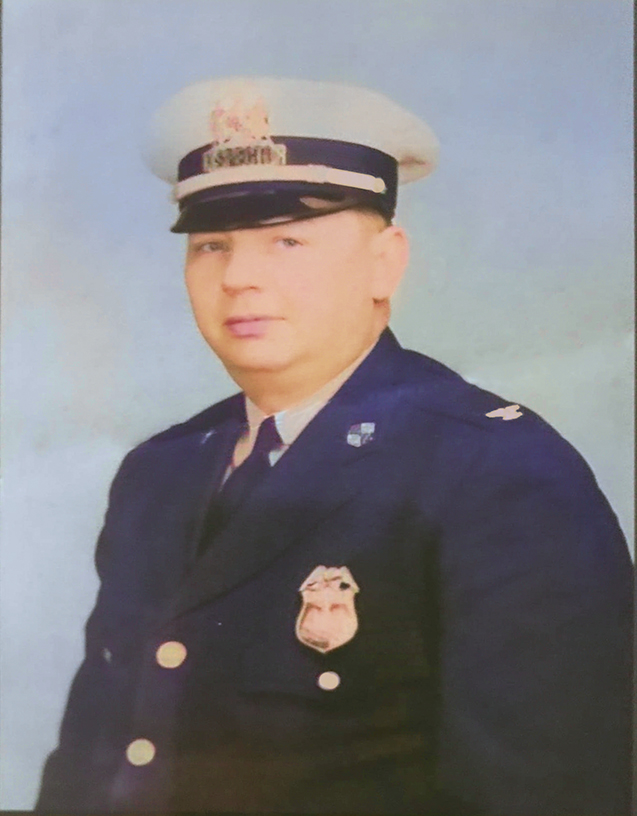
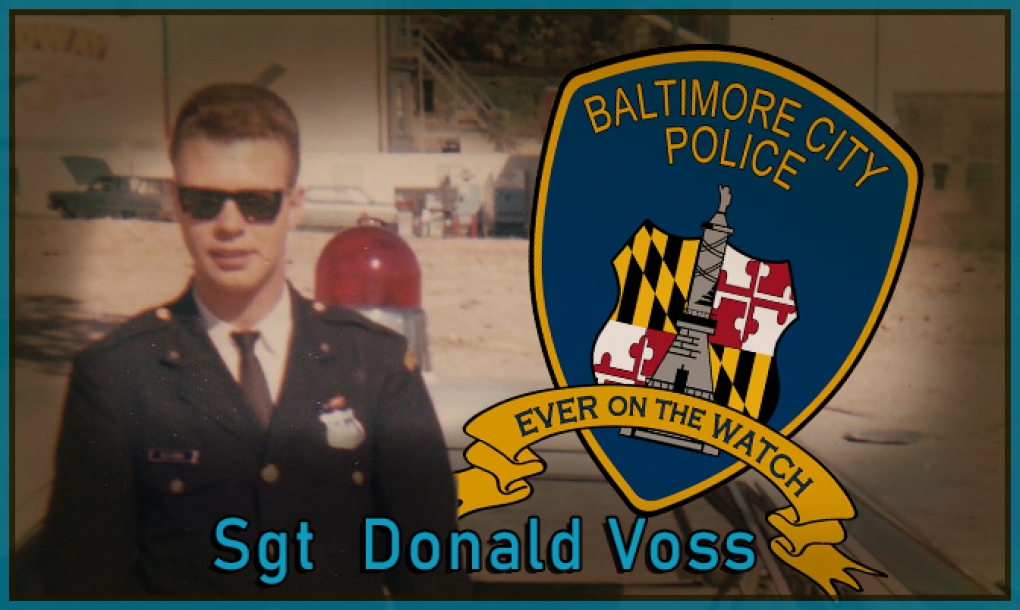
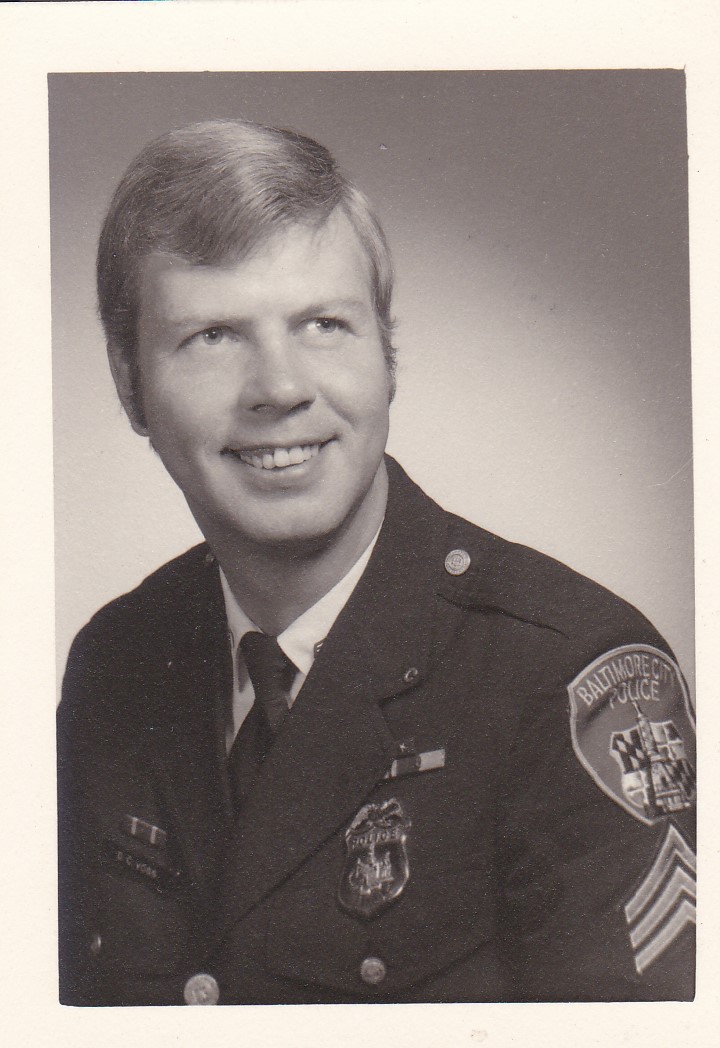
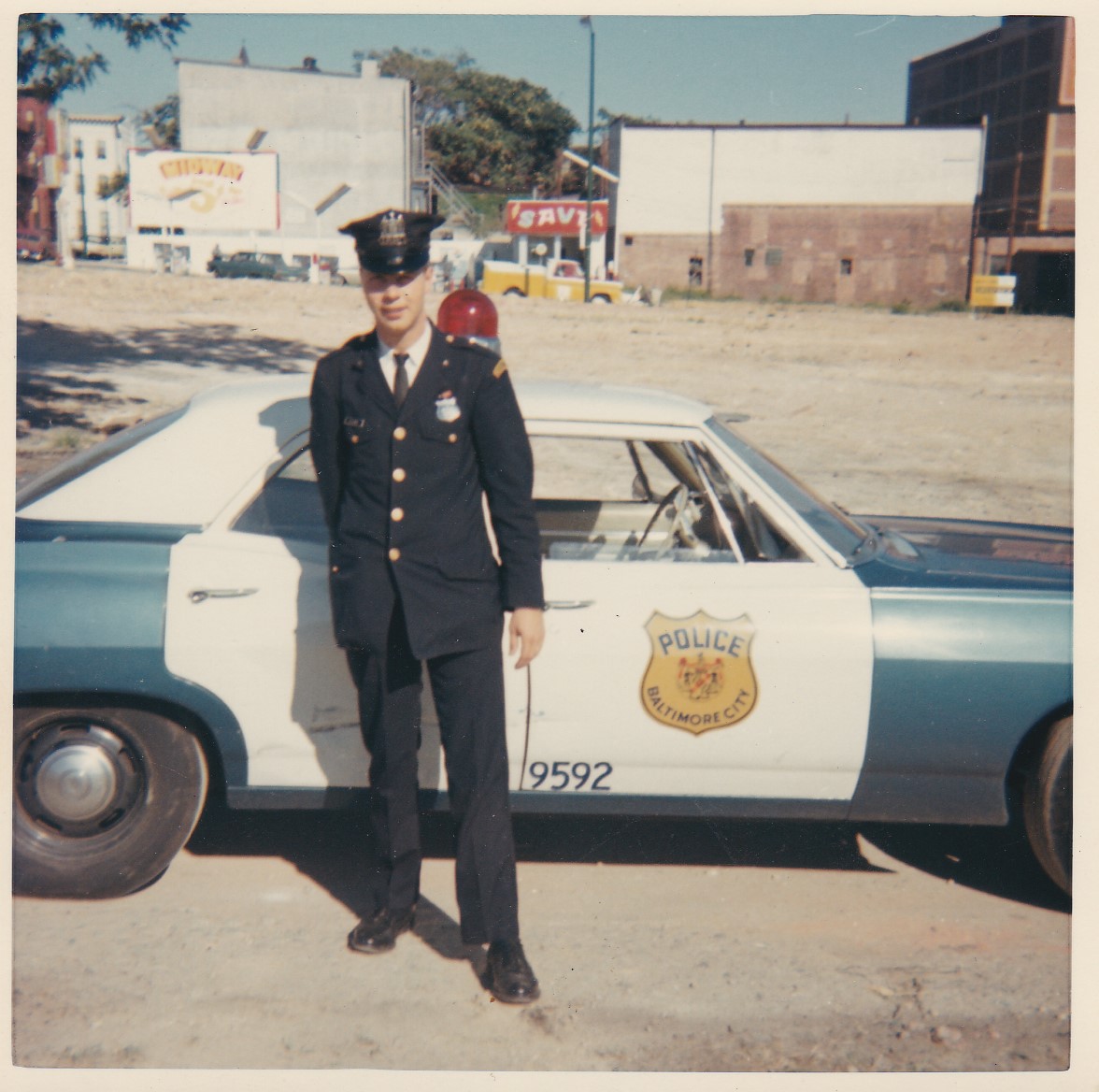
Sgt Donald Voss

Sgt Donald Voss

Sergeant Donald Voss

IMG 20160705 0009IMG 20160705 0007

IMG 20160705 0008


1 black devider 800 8 72

Three police injured in melee


Jun 19, 1972

Three police injured in melee Crowd of 300 in Cherry Hill Hurls Rocks
A police officer was knocked unconscious, and two others were injured yesterday (18 June 1972) in a stone-throwing melee that resulted in two arrests. The incident occurred at 7:20 P.M. when a crowd of about 300 persons gathered in the 2500 block Norfolk Street, Cherry Hill.

As police officers attempted to capture a handcuffed escaped from the Maryland Training School for Boys. Fifty police officers were summoned to deal with the crowd, which dispersed about 8:30

Taunted Officer
During the melee persons in the crowd taunted the officers and threw rocks at them. Most seriously injured was Sgt. Donald Voss, of the Southern district,
who was beaten and kicked unconscious as he attempted to aid another officer who had handcuffed two girls. The handcuffed girls fled during the struggle.

Also injured were Patrolman Edward Eilerman and Patrolman Richard Curley. All three officers were taken to Mercy Hospital where Patrolmen Eilerman and Curley were reported, in satisfactory condition and Sergeant Voss in fair condition.

Two juveniles were arrested. A police spokesman said the incident, the second major attack on police in as many weeks, was unprovoked and apparently spontaneous.


TO BE CONTINUED...

  Devider color with motto

 NOTICE

How to Dispose of Old Police Items


If you come into possession of Police items from an Estate or Death of a Police Officer Family Member and do not know how to properly dispose of these items please contact: Retired Detective Ken Driscoll - Please dispose of POLICE Items: Badges, Guns, Uniforms, Documents, PROPERLY so they won’t be used IMPROPERLY. This email address is being protected from spambots. You need JavaScript enabled to view it. 
Please contact Det. Ret. Kenny Driscoll if you have any pictures of you or your family members and wish them remembered here on this tribute site to Honor the fine men and women who have served with Honor and Distinction at the Baltimore Police Department. 

Anyone with information, photographs, memorabilia, or other "Baltimore City Police" items can contact Ret. Det. Kenny Driscoll at This email address is being protected from spambots. You need JavaScript enabled to view it. follow us on Twitter @BaltoPoliceHist or like us on Facebook or mail pics to 8138 Dundalk Ave. Baltimore Md. 21222


Copyright © 2002 Baltimore City Police History - Ret Det Kenny Driscoll

Liberator Pistol

Liberator Pistol

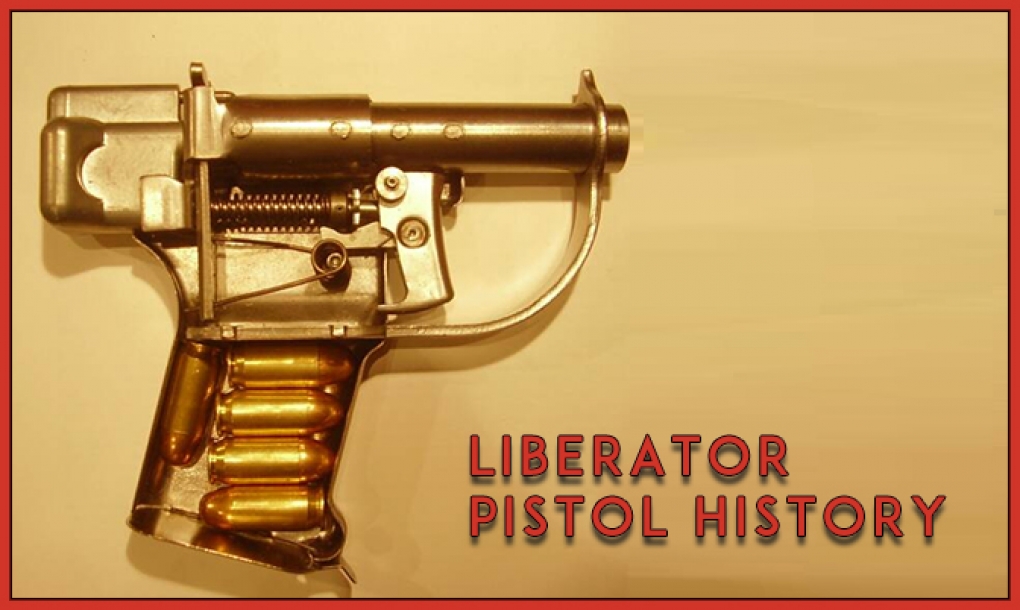
Liberator Pistol History

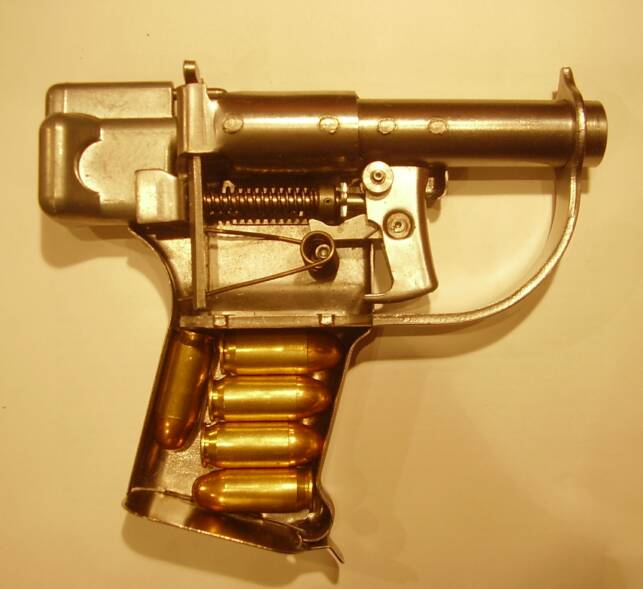
It was crudely made from sheet metal and steel tube. It held only one shot at a time. According to some magazines, it took longer to load it than it did to manufacture it. But the Allies in World War II hoped that the Liberator Pistol would help defeat the Nazis. That said it was not solely made to defeat Nazis


libpist


By 1940, Nazi forces had overrun nearly all of Europe. Britain itself faced invasion across the Channel and was short of troops and weapons. In desperation, the British military designed a crude sub-machine gun, known as the Sten, that could be manufactured quickly and cheaply from stamped parts and steel tubes. The gun was manufactured by the thousands and was widely distributed to be used in the defense of the island.

As it turned out, the Nazis lost the air Battle of Britain and their planned invasion never happened.

In 1942, a Polish military officer had an idea, inspired by the Sten--why not produce a cheaply stamped pistol that could be easily produced in large numbers and dropped behind the enemy lines to arm the various Resistance networks that had been formed in the occupied territories?

The idea appealed to some officers in the American Joint Psychological Committee, in charge of psychological warfare. They concluded that not only would a mass drop of thousands of weapons be of practical use in arming the Resistance fighters, but it would also hurt German morale by making the occupation troops fearful. They assigned the task to a team lead by George Hyde from the Inland Manufacturing Division of General Motors, and within a few weeks he had produced a design for a crude single-shot pistol dubbed the FP-45 Liberator.

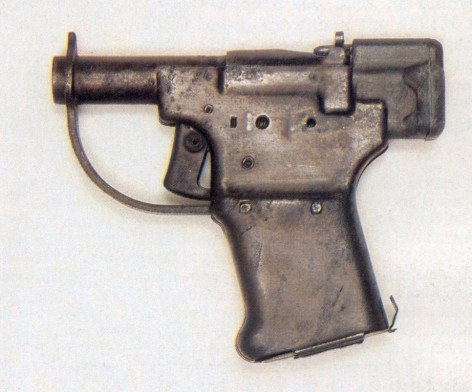
Disguising the project as a flare projector (FP) to hide it from Nazi spies, the gun was deliberately designed to be as cheap and easily made as possible. There were only 23 parts: the barrel was a simple four-inch unrifled steel tube, and the rest of the gun was made from stamped pieces of sheet metal. It used the same .45 caliber ammunition as the Colt .45 automatic pistol. Each Liberator cost about $2.10 to make (about $35 in today's dollars). Some wags dubbed it the "Two-Buck Gun", or the "Woolworth Gun", after the five-and-dime store.

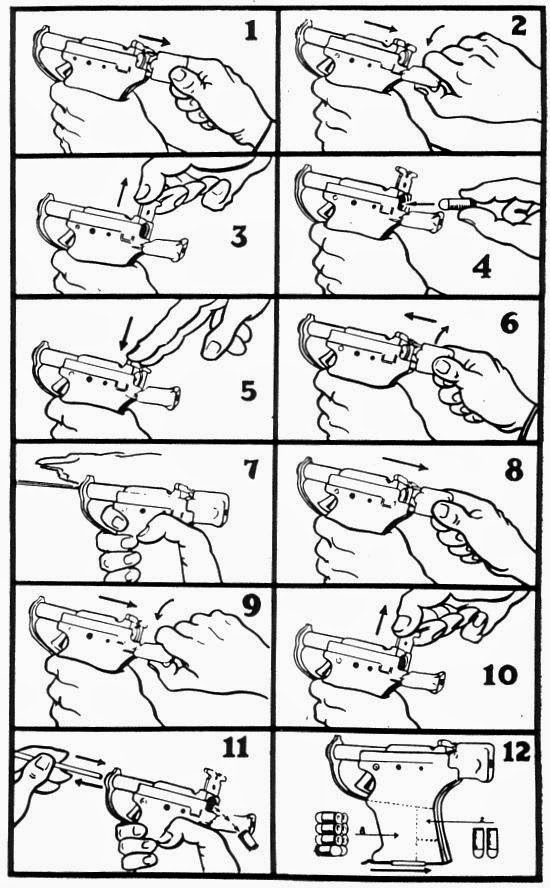
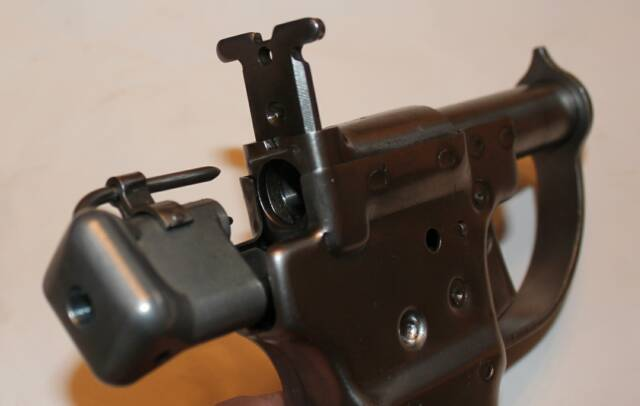
To load the weapon, the user had to twist the breech-block at the back of the pistol open and insert a single .45-caliber cartridge into the firing chamber, then close the block. Squeezing the sheet-metal trigger fired the pistol. After firing, the pistol could be reloaded by opening the block, pulling out the spent cartridge case (it often wouldn't come out, so the pistol came with a wooden dowel that was poked down the barrel to push the cartridge case out the back), inserting a fresh cartridge, and closing the block again. Testing done with the prototypes showed that the welded seams would often start splitting after just 10 rounds had been fired through the gun--and none of the tested pistols were still usable after 50 rounds. In humid conditions such as the Pacific islands, the unfinished metal in the guns often rusted and corroded within a few weeks.

But the Liberator was not intended as a combat weapon: rather, it was intended to be single-use and disposable. The idea was that a Resistance fighter could hide the Liberator in his pocket, walk up to an unsuspecting German trooper, pull the pistol and shoot him at close range, and then take his weapons and ammunition. The unrifled barrel gave the Liberator an effective range of fewer than ten feet, and the big .45 caliber cartridge was chosen because it was likely to kill or disable its target with just one shot.

Because the Inland Division was already busy producing M-1 rifles for the Army, the manufacture of the Liberator pistol was assigned to the Guide Lamp Division in Anderson, Illinois, a division of General Motors which in peacetime had been making automobile headlights and turn signals. About 300 GM workers were assigned to the task, and over a period of 11 weeks, they produced over a million Liberators. The finished pistols were packed in waxed-cardboard boxes with ten rounds of .45 caliber ammunition (which could be stored inside a hollow compartment in the pistol grip), a wooden dowel (for reloading), and a cartoon-illustrated instruction sheet showing how to load and use it (because the cartoon did not use verbal instructions, it could be dropped anywhere for any language group). The entire process, from design to manufacture, had taken about six months. Each gun had taken an average of 6.6 seconds to make.

Once manufactured, the Army, under both General Eisenhower and General MacArthur, declared that they saw no use for them, and the Liberators were turned over to the Office of Strategic Services (OSS), the American forerunner of the CIA which was in charge of Resistance activities in the occupied territories. Unlike the Army Psychological Warfare guys, however, the OSS never saw any real practicality in the weapon either, and never made any large-scale effort to distribute it to Resistance fighters, though about 100,000 Liberators were sent to guerrilla forces fighting the Japanese in the Philippines and China. Only about 25,000 pistols were dropped to Resistance groups in Europe. There are no documented instances of any Japanese or Nazi occupation trooper actually being killed by a Resistance fighter or guerrilla armed with a Liberator pistol. Most Resistance forces were supplied with the more-effective Sten instead.

At the end of the war, most of the Liberators sat unused in their boxes. To save storage space, they were ordered destroyed. As a result, today authentic Liberators are very rare and are highly prized by military collectors. A WW2 Liberator in good condition (and with the rare original box and equipment) can sell for over $2000. 

Although the Liberator was not exactly a military success, during the Vietnam War in the 1960's the CIA resurrected the idea, and produced another single-shot disposable pistol called the "Deer Gun", intended to be dropped in behind enemy areas. The Deer Gun was made from cast aluminum with a short steel barrel and fired the 9mm Parabellum cartridge. It was loaded by unscrewing the barrel, inserting the cartridge, then screwing the barrel back on. About 1,000 Deer Guns were made in 1964, at a cost of about $3.95 each. After some field testing, it was never mass-produced, and the originals were destroyed.

  libpist

libpist

The Liberator pistol has to rank as one of the most unusual firearms ever designed. First conceived as a way to equip resistance forces in World War II, today most reside behind glass at museums or in the hands of collectors. Fame ultimately escaped it, but it’s safe to say it served its purpose despite no records existing of it ever being used, mainly because the recipients were too busy moving, or fighting to stay alive.

libpist


Its concept began in March 1942, when a Polish military attaché suggested a simple, effective pistol that could be mass-produced and air -dropped by the hundreds or thousands in to waiting insurgents. The thought was that so many weapons delivered at once could instantly arm practically everybody in a local guerrilla group. Plus, it would do wonders for morale if everybody carried a weapon, and it would have a detrimental effect on occupying troops who might be led to believe that there was now a way for populations to massively resist them.

The U.S. Army’s Joint Psychological Warfare Committee accepted the proposal, and two months later George Hyde of General Motors Inland Manufacturing Division produced a design that met the specifications. To ensure its secrecy, it was given the designation Flare Projector-45 to conceal its real function.

GM’s Guide Lamp division was assigned the contract, and in 11 weeks with 300 workers, they assembled a million guns. Those who looked at the contraption had to imagine these were some sort of last-ditch device intended for one-time use. They were right.

Intended for people who may not be familiar with firearms, the Liberator was simplicity in itself.  Of 45 caliber, 5.5 inches long and weighing one pound, it featured 23 stamped steel parts for a total cost of $2.40 per gun.  Five rounds could be stored in the grip, which did not feed into the barrel. To do this, one manually inserted a .45 caliber cartridge at the rear, and then the chamber was hand-closed by a metal part. The round was then shot down a 4-inch, un-rifled barrel for an effective range of 25 feet. To clear the empty case, a wooden dowel was supplied to push it out the back and another round could be loaded.

In reality, the range was wishful thinking. This gun was intended to be placed the person that is to be killed so their weapon could be taken. It could then be discarded, passed on or saved for a final stand.

FP-45 Model 2 Right-rear view of the open action

Liberators were packed in boxes that included 10 rounds of .45 ammunition, the wooden dowel, and a comic strip type instruction sheet.  A million shipped off to both Great Britain and the Pacific, where they were stored and ready to be loaded into containers on aircraft. There they met their greatest obstacles, the General Staffs of the United States Army.

In Europe, Eisenhower’s men saw no practical purpose for the gun and only 25,000 were dropped to the French resistance. In the Pacific, MacArthur was also sour about the idea and the Army ended up turning the remaining lot over to the Office of Strategic Service to be dropped in both theaters when necessary.

Enhanced FP-45 Liberator Study Model 1

Small drops commenced in 1943 over Europe, while that same year 100,000 ended up being sent to China and smaller numbers dropped in the Philippines. In 1944, another European drop occurred in Greece to supply a few thousand to the resistance. By this time, it had a nickname derived from its cheap looks: The ‘Woolworth’ Gun.

How many were actually used will never be known, but it is safe to say some Axis soldiers met their end with the Liberator, as well as having their weapon stolen. There was never an attempt to round them up after the war, figuring most had been thrown away by then. Those that remained, the still hundreds of thousands of unused copies in warehouses, were melted down. Today, the Liberator is written about sparingly as its success is unknown. Its new life is that of a collectible, with excellent specimens in original box complete with accessories fetching up to $2,000 or more.

Inland Guide Lamp Liberator .45 ACP caliber pistol. Made by Inland Guide Lamp manufacturing. Over 1 million of these were made in a 3 month period. These were used as an insurgency weapon during WWII and most of these were distributed to the Philippines. Despite the fact that a million were made there are not too many in the USA as the only ones that made it back were from the GI’S.

U.S. FP-45 Liberator Pistol, manufactured by G.M. Guide Lamp Division, serial # None, cal. 45 ACP, 4" barrel with an excellent bore. The barrel has a smooth grind mark with an "F "inside a" C" stamp on the right side front of the chamber. The metal surfaces are gunmetal gray retaining about 99% original corrosion resistant finish with scattered light handling marks and minor freckling. The cocking knob is in excellent condition with cavity mold number 37. This fully functional model three pistol that has three holes, no breach marking, floor plate is present. The overall condition is it’s in Collectors Grade Condition. {C&R} Inv.: # 1-1301


Because of its crude construction, minimal parts, and unusual reloading method, the pistol often caused confusion—civilians and even some law enforcement officers mistook recovered examples for toys or non-functional replicas. At a glance, it resembled a toy ray gun more than an actual firearm, its stamped-metal construction and lack of recognizable features giving it the appearance of a novelty item rather than a functional weapon.

1 black devider 800 8 72

Donations

Donations help with web hosting, stamps and materials and the cost of keeping the website online. Thank you so much for helping BCPH. 

Paypal History Donations

1 black devider 800 8 72

POLICE INFORMATION

Copies of: Your Baltimore Police Department Class Photo, Pictures of our Officers, Vehicles, Equipment, Newspaper Articles relating to our department and or officers, Old Departmental Newsletters, Lookouts, Wanted Posters, and or Brochures. Information on Deceased Officers and anything that may help Preserve the History and Proud Traditions of this agency. Please contact Retired Detective Kenny Driscoll.

This email address is being protected from spambots. You need JavaScript enabled to view it.

Devider color with motto

NOTICE

How to Dispose of Old Police Items

Please contact Det. Ret. Kenny Driscoll if you have any pictures of you or your family members and wish them remembered here on this tribute site to Honor the fine men and women who have served with Honor and Distinction at the Baltimore Police Department.

Anyone with information, photographs, memorabilia, or other "Baltimore City Police" items can contact Ret. Det. Kenny Driscoll at This email address is being protected from spambots. You need JavaScript enabled to view it. follow us on Twitter @BaltoPoliceHist or like us on Facebook or mail pics to 8138 Dundalk Ave. Baltimore Md. 21222


Copyright © 2002 Baltimore City Police History - Ret Det Kenny Driscoll 
Taxi

Taxi

Baltimore Police & Taxicabs


1943 - 12 Aug 1943 - Baltimore Police Department's Taxicab Bureau began late in the week of 12 Aug 1943, with the issuance of a new type of badge and identification card to Approx 1400 cab drivers in Baltimore City. It was announced on the 12th of Aug 1943 by William Monaghan, supervisor of the newly organized branch in Baltimore City's Police Department. This unit was the brainchild of Police Commissioner Hamilton Atkinson. Of the 1450 Cab drivers in Baltimore 1943, only 990 had applied for their licenses, of those 990, 45 were denied the right to a Baltimore Police Taxicab License, due to their past criminal records. 

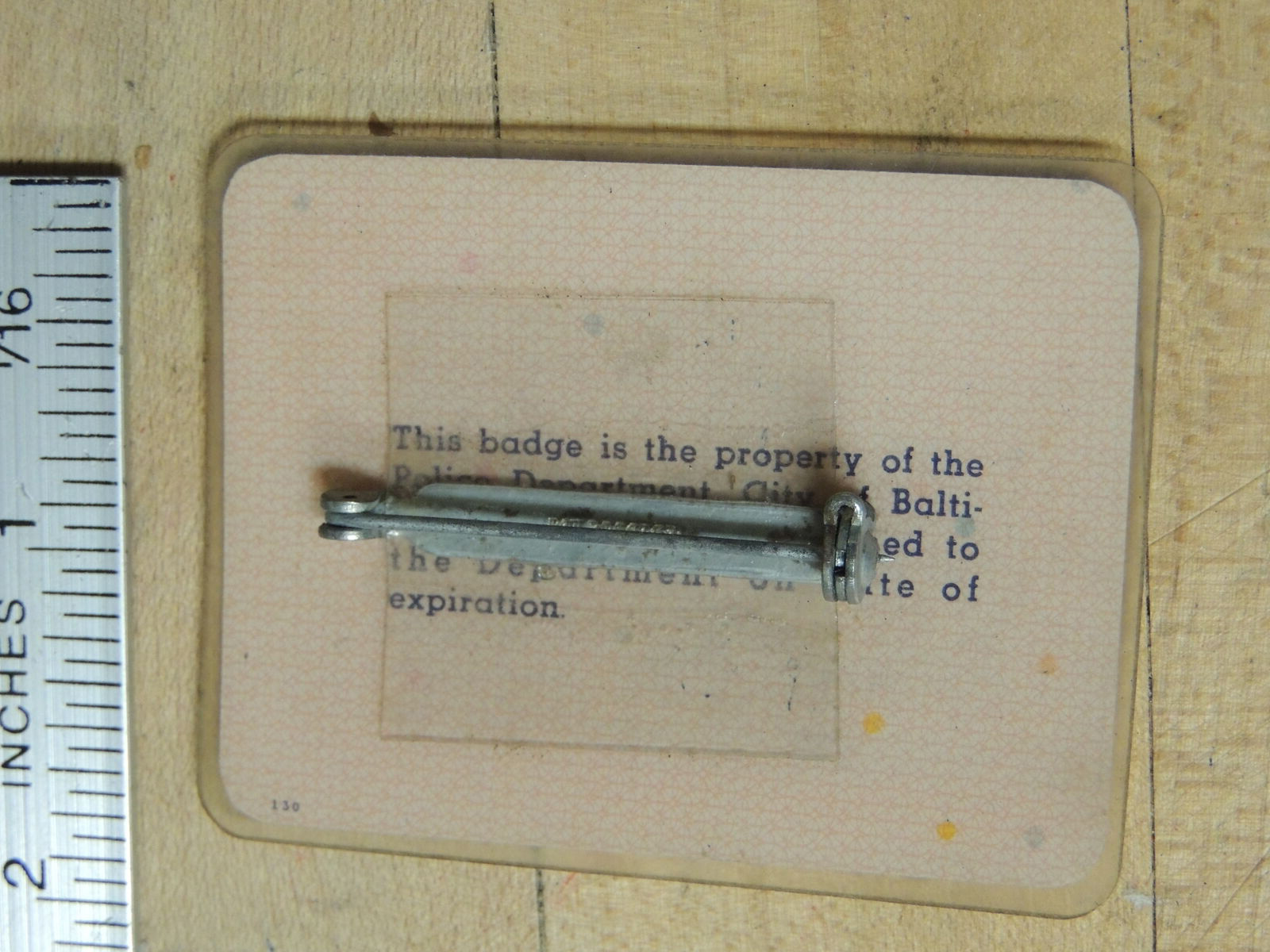
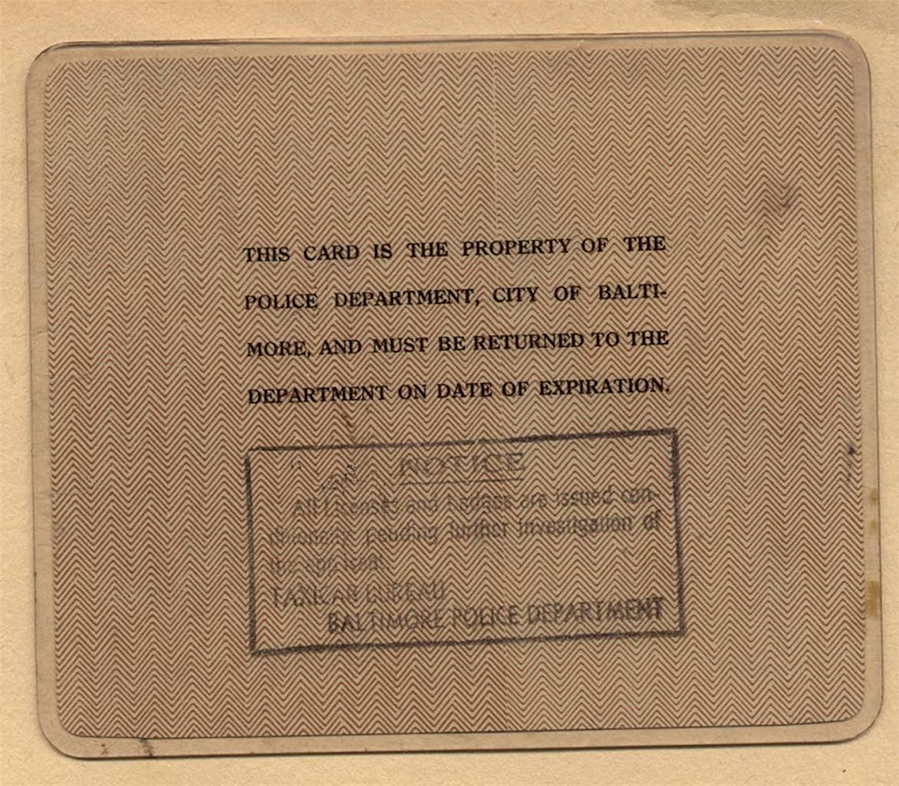
The Identification Card and Badge issued by the Police at the time were described as having been, "hermetically" sealed between two transparent sheets of plastic to prevent their having being tampered with. This was an interesting line as if we look at the pics below we'll see a set of license and badge, and how it was just plastic covered ID cards and buttons... 

Taxi badge 10The Baltimore Sun Thu Mar 22 2001 72

22 March 2001

Taxi badge 91975 - 19 September 1975the department in cooperation with the State's Attorney's Office and various taxicab companies became part of the "Civilian Radio Taxi Patrol" in an effort to increase police service to the citizens of Baltimore. If, while on duty, a cab driver, whose vehicle is identified by a "Civilian Radio Taxi Patrol" shield on the right and left rear-quarter panels, obaerve1 anything demanding immediate police attention, he notifies his dispatcher, who in turn calls the Communication Division via a special Hotline. This program is another example of the department's efforts to involve the citizens of Baltimore in a united fight against crime. 

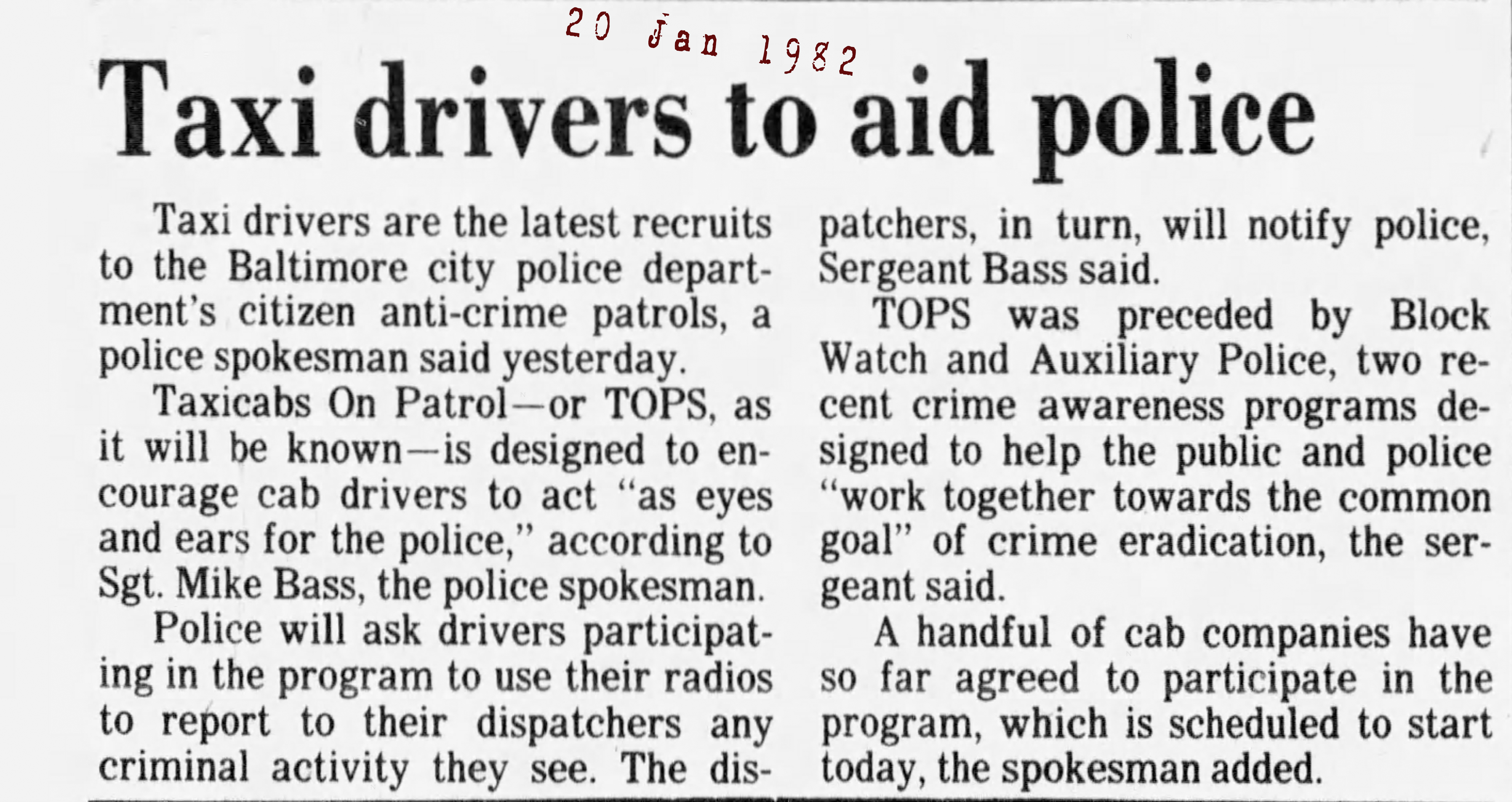
1982 - 20 January 1982 - The Baltimore Police Department work side by side and hand in hand with the Checker Cab Company on a project to form the TOP - Taxi On Patrol program. What began here in Baltimore went on to become a national program, to report and solve crimes all over the country 

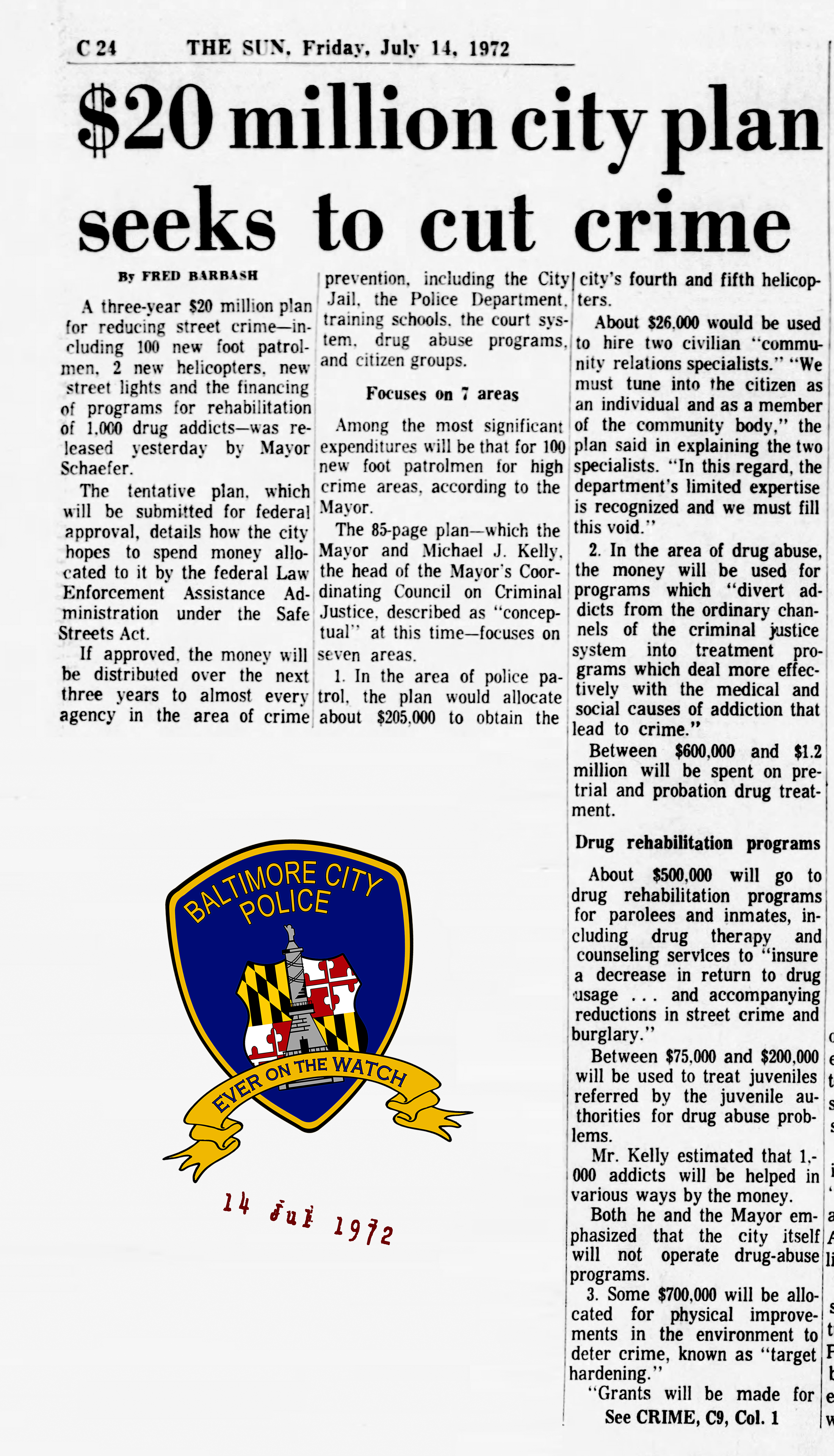
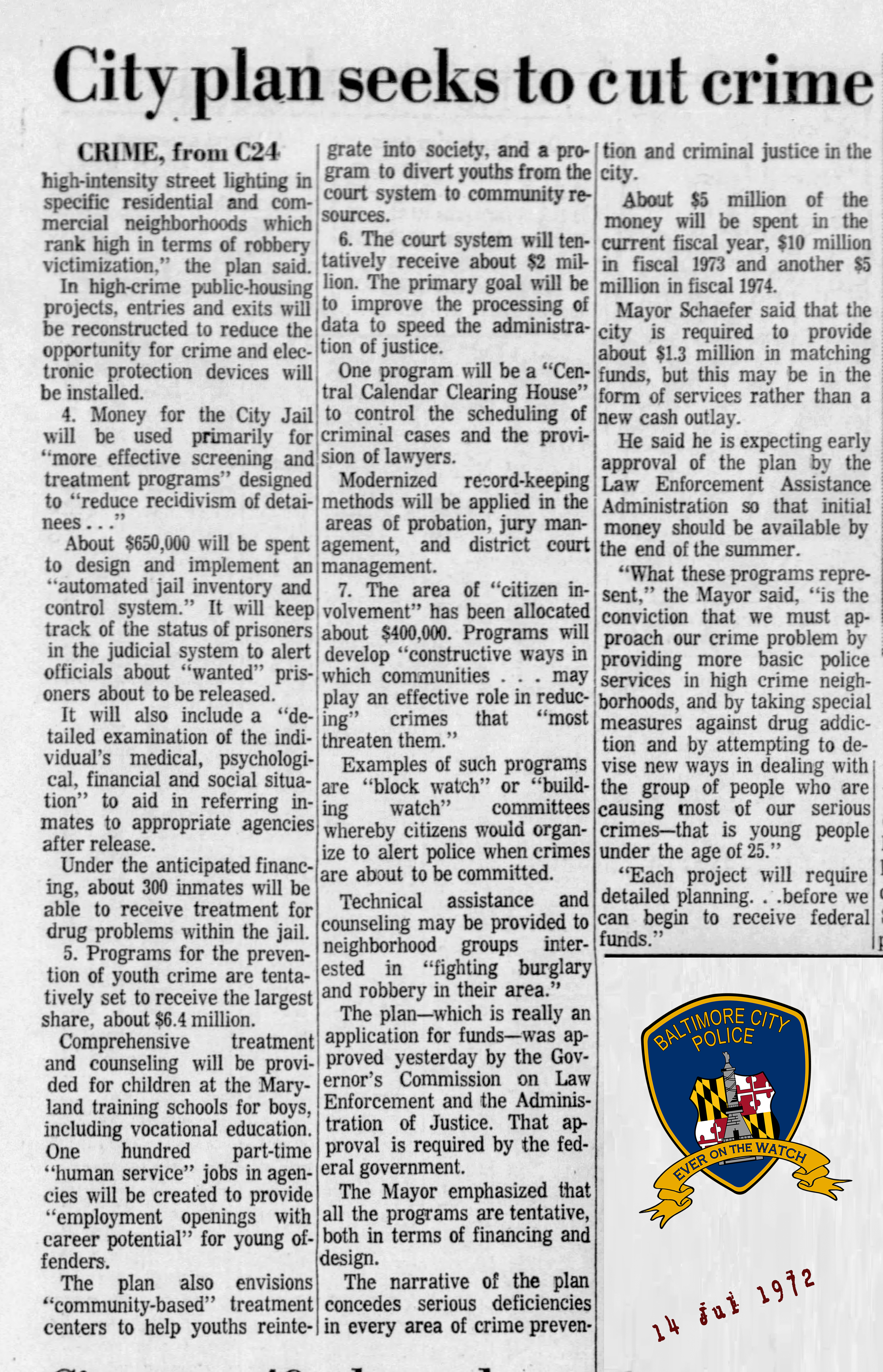
The Baltimore Sun Fri Jul 14 1972 TAXI72iIf the article is too small to read, click it to open a full size article

Taxi badge 1

Taxi badge 2

Aside from issuing Taxi Licenses, the also worked as drivers as a way to make extra money and protect cab drivers, and some programs that had cab drivers acting like a second set of eyes for our police.

Taxi badge 8Taxi badge 8If the article is too small to read, click it to open a full size article

Taxi badge 5

Taxi badge 4

The Baltimore Sun Wed Nov 26 1975 TAXi72If the article is too small to read, click it to open a full size article

taxi tops pg1taxi tops pg1taxi tops pg2

Taxi badge 6

A Taxi Meter with Matching Taxi Drivers License and Button. Number 5923 expires 1963 also seen with the Taxi Meter is a Round Taxicab Tag-Plate, Dark Green with White letters. Number 313 Expires 1958

Taxi badge 10

The Baltimore Sun Wed Jan 20 1982 TAXI72 If the article is too small to read, click it to open a full size article

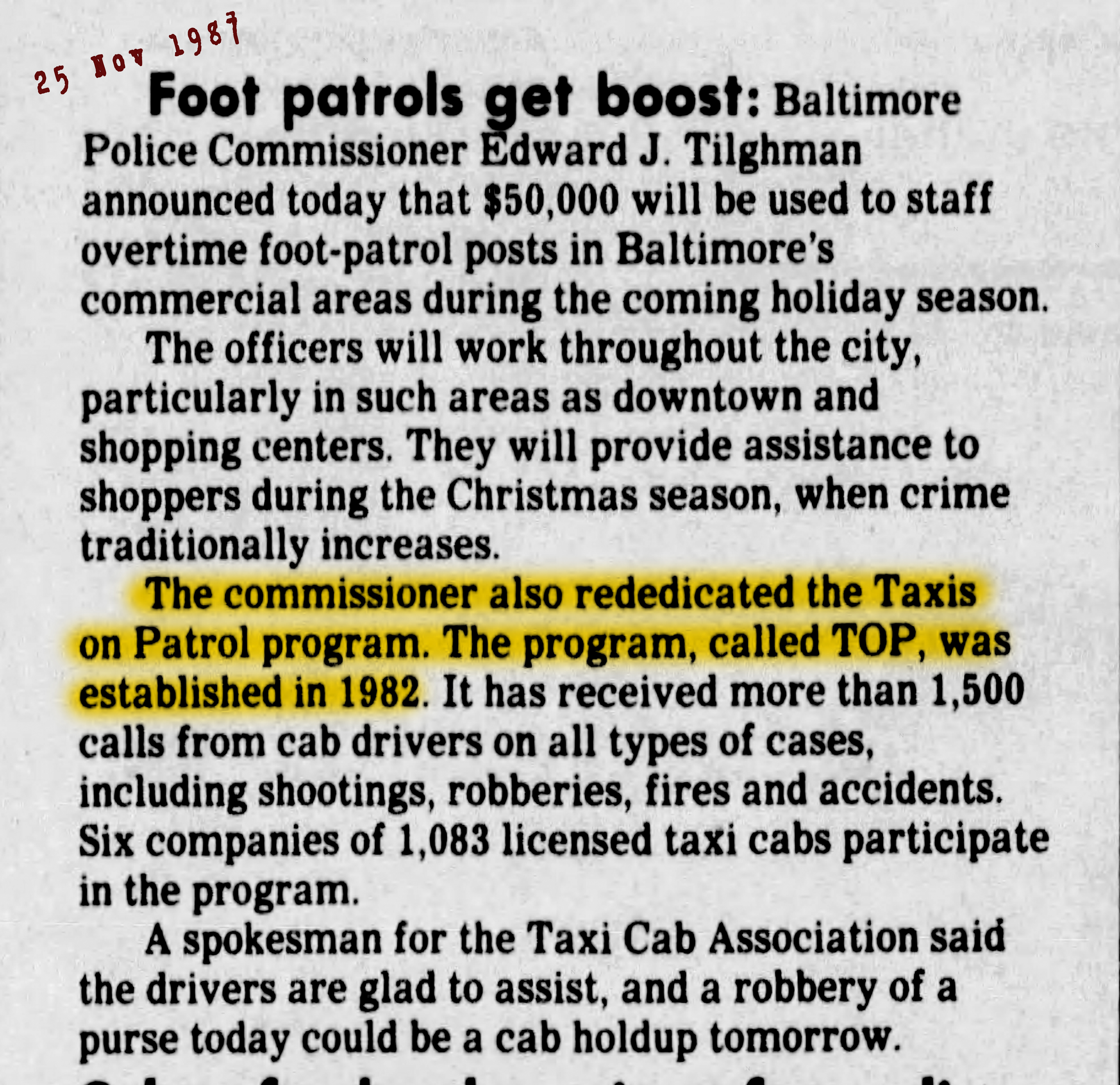
Taxi badge 11The Evening Sun Wed Nov 25 1987 TAXI72If the article is too small to read, click it to open a full size article

The Evening Sun Wed Nov 25 1987 TAXI72

My Favorite County Cab Driver

Devider color with motto

 Anyone with information, photographs, memorabilia, or other "Baltimore City Police" items can contact Ret. Det. Kenny Driscoll at  This email address is being protected from spambots. You need JavaScript enabled to view it. follow us on Twitter @BaltoPoliceHist or like us on Facebook or mail pics to 8138 Dundalk Ave. Baltimore Md. 21222 - Rolland Fullen


Copyright © 2002 Baltimore City Police History - Ret Det Kenny Driscoll
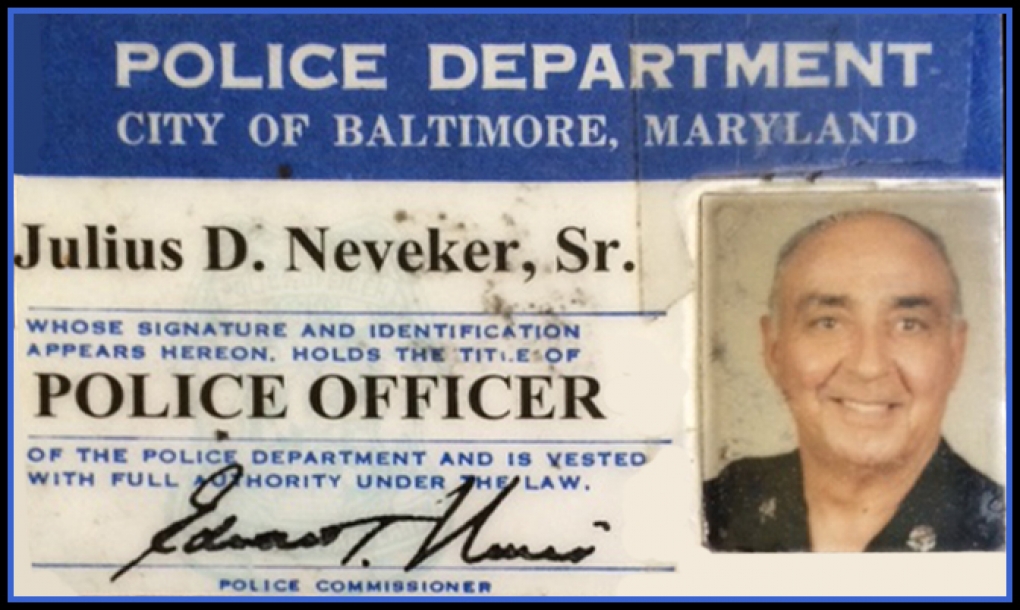
Det Julius Neveker

Det Julius Neveker

EVER EVER EVER Motto Divder

Detective Julius Neveker

Jules NevCourtesy Walt Neveker
Jules Nev 2Courtesy Walt Neveker
1 RED devider 800 8 72


Earning His Badge of Service

February 07, 2004

City police detective ends 50 years on force

February 07, 2004|By Jamie Stiehm | Jamie Stiehm,SUN STAFF

On a wintry January day in 1954, an 18-year-old from South Baltimore started his first day on the job as a telephone clerk in the city's Southern Police District. In those days, that was the place where kids who wanted to be police officers grew into the job. Over the next 50 years, Julius O. Neveker Sr. saw a bit of everything when it came to the seamy sides of the city. He saw bloody stabbing scenes. He saw the damage done during the street riots of 1968. He saw commissioners and mayors come and go. And, on one memorable night some 30 years ago, while he was a member of the city vice squad, he helped round up more than 100 female impersonators on prostitution charges. "The good old days are gone forever," Neveker, the longest-serving officer on the city police force, said wryly yesterday at a retirement celebration attended by many dignitaries, including Baltimore police Commissioner Kevin P. Clark. "What can I say?"  His friends came out in force to say goodbye yesterday at police headquarters on East Fayette Street, and laughter filled the auditorium as 150 officers enjoyed the 68-year-old detective's trademark memories and salty humor. Matt Jablow, the city police spokesman, said yesterday that Neveker might be a record-holder beyond Baltimore. "It is believed 50 years is a record for the longest time anyone has served continuously in a police agency," he said. "We're checking the Guinness Book of World Records." Neveker's last post was keeping watch inside City Hall. When Neveker was promoted to patrolman at 21, the Southern High School graduate felt home free. Clad in a pinstripe suit yesterday, Neveker waved a newspaper clipping from 1957 about himself as a telephone clerk. The article noted, "His most cherished ambition is to don the blue as a regular member of the force." During his early patrol days, Neveker walked and covered familiar turf, the South Baltimore streets he knew from boyhood. "In South Baltimore, the men were men and the women knew it," he said half-jokingly. "People in the neighborhood knew you. I miss some of the old-timers." Neveker, known as Jules, clearly hails from the city's old school himself, by the way he says "po-lice," stressing the first syllable. He and his wife Nancy have lived in Eldersburg in Carroll County for many years, but his Baltimore street syntax has not worn off. Other tours of duty included the Southwestern District, the Criminal Investigation Division, the auto theft and vice squad divisions. One night while working on the vice squad, Neveker recalled, he and others arrested 119 "female impersonators," as he put it, near Pennsylvania Avenue to face a judge in District Court the next morning. When he worked downtown, Neveker became known as the "Fish Man" throughout police headquarters because he always stopped at Baltimore's fresh-fish market by the waterfront and brought seafood to colleagues who placed orders. "Word got around that I had fish in my briefcase," Neveker said. In the late 1960s or early 1970s, that practice temporarily came to a stop when a colonel told him he shouldn't transport fish in his squad car. When the colonel found he was delivering fish to the commissioner, the ruling was reversed. Not intimidated by authority in a rigidly rank-conscious organization of 3,300 uniformed officers, Neveker delighted in telling small tales of defiance yesterday.  When a colonel caught him dozing at his desk, he rebounded by telling him he was praying. As he told it, he added with comedic timing: "I was praying that you wouldn't catch me sleeping." On another occasion, when his boss wouldn't give him a day off, he appealed to the boss' wife. Nancy Neveker said even when her husband was sick with a temperature of 103 or 104 degrees, she could not stop him from going to work. "It was my life," Neveker told the audience of officers. "Every one of you is my brother and sister."


TO BE CONTINUED...


1 black devider 800 8 72

Donations

Donations help with web hosting, stamps and materials and the cost of keeping the website online. Thank you so much for helping BCPH. 

Paypal History Donations

1 black devider 800 8 72

POLICE INFORMATION

Copies of: Your Baltimore Police Department Class Photo, Pictures of our Officers, Vehicles, Equipment, Newspaper Articles relating to our department and or officers, Old Departmental Newsletters, Lookouts, Wanted Posters, and or Brochures. Information on Deceased Officers and anything that may help Preserve the History and Proud Traditions of this agency. Please contact Retired Detective Kenny Driscoll.

This email address is being protected from spambots. You need JavaScript enabled to view it.

Devider color with motto

NOTICE

How to Dispose of Old Police Items

Please contact Det. Ret. Kenny Driscoll if you have any pictures of you or your family members and wish them remembered here on this tribute site to Honor the fine men and women who have served with Honor and Distinction at the Baltimore Police Department. Anyone with information, photographs, memorabilia, or other "Baltimore City Police" items can contact Ret. Det. Kenny Driscoll at This email address is being protected from spambots. You need JavaScript enabled to view it. follow us on Twitter @BaltoPoliceHist or like us on Facebook or mail pics to 8138 Dundalk Ave. Baltimore Md. 21222


Copyright © 2002 Baltimore City Police History - Ret Det Kenny Driscoll 
Baltimore Blue Bloods

Baltimore Blue Bloods


Baltimore Blue Bloods

The Families within our Family

This page is dedicated to the Fathers and Sons, Brothers and Sisters, Husbands, Wives; Aunts, Uncles, and Nieces and Nephews, any relatives in and of the Baltimore Police Department, it will take time to build this list, and eventually we will have to alphabetize the list, but for now, it is too few to really begin putting in any order.

Devider


A B C D E F G H I J K L M N O P Q R S T U V W X Y Z 

A


William Ackiss (Husband)
Deana Ackiss (Wife)


Sgt. William George Adams Jr. (Grandfather)

P/O Raymond C Eibner (Uncle)
P/O Louis H Eibner (Great Uncle)
P/O Lynne Eibner Brown (Cousin)
P/O Todd W Eibner


Ernie Anderson (Husband)

Dawn Anderson (Wife)


Sgt. Tobias Airey 1851

Cpt. Charles LeBon 1817 to 1837
P/O Earl LeBon


A B C D E F G H I J K L M N O P Q R S T U V W X Y Z 

B


Lt. Brennen (father)
P/O Barbara Brennen (daughter)


Sgt. Edwin B. Bullock (Great Grandfather)
Lt. Edmund Bossle (Great Grandson)


Joe Breitenbach (Brother)
Tim Breitenbach (Brothers)


Det Danny Boone (Father)
P/O Dante Boone (Son)


James J Brokus Jr. Sgt  (Father/Grandfather)
James J Brokus Sr. Sgt  (Son/Father)
James J Brokus III P/O (Son/Grandson)


Capt. Elmer Bowen (father)

Lieut. William Bowen (son)
Officer Jack Heaps (uncle)
Officer Melvin Rose (brother-in-law)
Officer Charles Nethken (cousin)


Commissioner Frederick H. Bealefeld III
P/O Charles Bealefeld
P/O Barney Bealefeld
P/O John B. Bealefeld
P/O Frederick Henry Bealefeld Sr


Col. Joseph Bolesta (Brother)
Bruce Bolesta (Brother)
William Bolesta


P/O Paul Boone (Joe's Uncle)

P/O Donald Burns  (Joe's Cousin)
Lt Joe Peters (Husband)
Det Janice Peters (Wife)

P/O John Edward Swift (Joe's Great Grandfather)
P/O Adam Smith (Janice's Great Grandfather)


Robert L. Brown Sr. (Father)

Robert L. Brown Jr. (Son)
Melissa Edick ( Daughter)


P/O Lynne Eibner Brown (Cousin)
P/O Raymond C Eibner (Uncle)
P/O Louis H Eibner (Great Uncle)
P/O Todd W Eibner (nephew)
Sgt. William George Adams Jr. (Grandfather)


Dr. Frank Barranco (cousin)

Col. Tim Longo (uncle)
Det. Steve Longo (nephew)
Ofc. Joseph Longo (cousin)


A B C D E F G H I J K L M N O P Q R S T U V W X Y Z

C


Sgt Augustus Chaillou
Sgt Louis Chaillou  (Brother of Sgt Augustus)
Lt Charles Thompson (gg-grandson of Sgt Louis)


Roger Carrol

Sandy Carrol


Sergeant Carroll (Father)

Colonel Joseph Carroll (Son)
Sergeant Frederick W. Carroll


Dan Calhoun (Husband)
Cathy Calhoun (Wife)


Morgan Clasing - Daughter
Kathleen Ryan Clasing - Mother
Bernard Clasing, Jr. - Dad
Mark Clasing - Uncle
David Clasing - Uncle
Steven Fischer - Cousin/Father
Melissa Fischer -Cousin/Daughter


P/A David Cheuvront
Sgt. Bill Cheuvront
P/O Dawn Cheuvront


P/O William J. Chubb - Father
Sgt Kevin Chubb - Son


Major William Colburn (Father)

Lieutenant William Colburn (Son)


Gary Cichowicz (brother)

Mike Cichowicz (brother)
Albert Markiewitz (uncle)
Robert Clifford Sgt. (great uncle)


Nick Constantine

Gene Constantine


P/O Dianna L. Ckyyou (sister)
P/O Joseph B. Johnson (brother)


George J.Chriest 3rd ( Father)

Jason T. Chriest (son)


A B C D E F G H I J K L M N O P Q R S T U V W X Y Z

D


Officer Mike Driscoll (Uncle to Kenny Driscoll - 2nd Uncle to Jamie Driscoll)
Det Kenny Driscoll (Nephew to Mike Driscoll, and Leo Smith – Cousin to Gary Smith, Father to Jamie Driscoll)
Det Leo Smith (Father to Gary, Uncle to Kenny Driscoll - 2nd Uncle to Jamie Driscoll)
Officer Gary Smith (Son to Leo Smith, Cousin to Kenny Driscoll - 2nd Cousin to Jamie Driscoll)
Cadet Jamie Driscoll (Daughter to Kenny Driscoll, 2nd Niece to Mike Driscoll and Leo Smith - 2nd Cousin to Gary Smith)
Mike Wolferman (2nd cousin-in-law to Kenny on Patty’s side 3rd cousin to Jamie Driscoll)


Sgt Charles R. Daugherty
Sgt Donald F. Daugherty
P/O Robert L Daugherty


Kenny Dickstein  (Father)
Ryan Dickstein   (Son)


P/O Patrick Deachilla (Son)  
P/O William "Bill" Martin (Father)


Det. Shirley Disney
Det. Marty Disney


Edward Dunn (Father)
Michael Dunn (Son)
Paul Dunn, (Son)
Capt. John Dunn (Grandfather to Dick Ellwood JR. & John Ellwood)

Lt. Ed Dunn (Uncle to Dick Ellwood & John Ellwood)
P/O Dick Ellwood Sr. (Father to Dick Ellwood Jr. & John Ellwood)
Sgt. John Ellwood (Brother of Dick Ellwood Sr. - Son/Dick Ellwood Jr.)
Sgt. Dick Ellwood Jr.(son of Dick Ellwood Sr./brother to John Ellwood)
Det. David Ellwood (son of Dick Ellwood Jr.) 
Officer James T. Dunn (HERE


Major Robert Distefano (Brother)
P/O John Distefano (Brother)


P/O Frank DeManss

Lt. Jerry DeManss
Sgt Louis DeManss
 Jordan DeManss


Dep Com Errol Dutton
Major Diane Dutton (sister)


Roderick Dotson Sr

Roderick Dotson Jr


A B C D E F G H I J K L M N O P Q R S T U V W X Y Z

E


P/O Raymond C Eibner (Uncle)
P/O Louis H Eibner (Great Uncle)
P/O Lynne Eibner Brown (Cousin)
P/O Todd W Eibner
Sgt. William George Adams Jr. (Grandfather)  


Robert Ewing (Brother)
Patrick Ewing (Brother)
Robert Ewing (Cousin) 


Efren Edwards Sr (Father)
Efren Edwards Jr (Son) 


Melissa Edick ( Daughter)
Robert L. Brown Sr. (Father)
Robert L. Brown Jr.(Son) 


LT Errol Etting, Sr (Retired) 
P/O Errol Etting, Jr (Son) 
P/O Jamison Etting (Nephew)


P/O Dick Ellwood Sr. (Father to Dick Ellwood Jr. & John Ellwood)
Sgt. John Ellwood (Brother of Dick Ellwood Sr. - Son/Dick Ellwood Jr.)
Sgt. Dick Ellwood Jr.(son of Dick Ellwood Sr./brother to John Ellwood)
Det. David Ellwood (son of Dick Ellwood Jr.)
Capt. John Dunn (Grandfather to Dick Ellwood JR. & John Ellwood)
Lt. Ed Dunn (Uncle to Dick Ellwood & John Ellwood)
Edward Dunn (Father)
Michael Dunn (Son)
Paul Dunn, (Son) 
Officer James T. Dunn (HERE)


A B C D E F G H I J K L M N O P Q R S T U V W X Y Z
  

F


Sgt Wm. Forrest
Capt. William J. Forrest


P/O Toni Furlong
P/O Bill Furlong
P/O Rob Furlong Jr


Sgt. Kirk Fleet (Brother)
P/O Karen Fleet (Sister)


William Feeley (Mark's Cousin, Howard, and Charles' Nephew)
Mark Lindsay (William's Cousin)
Howard Lindsay (Mark's Father)
Charles Lindsay (Mark's Uncle, and Howard's Brother)
James Stein (Mark's Uncle, and Howard's brother-in-law)


Steven Fischer - Cousin/Father
Melissa Fischer -Cousin/Daughter

Morgan Clasing - Daughter
Kathleen Ryan Clasing - Mother
Bernard Clasing, Jr. - Dad
Mark Clasing - Uncle
David Clasing - Uncle


A B C D E F G H I J K L M N O P Q R S T U V W X Y Z 

G


Col. Joeseph “Carl” Gutberlet
Det. Laurie Zuromski (Guterlet) 3rd wife
Sgt. Donna Gutberlet 2nd wife


Lt. Frank Grunder (father)
Sgt. Frank Grunder (son)

P/O Herbert Glover (Grandfather)
P/O Harry Glover (Brother)
Major Anton Glover (Son)
Det. Sgt. Michael Stefanowitz (Grandson) 


John Groncki (brother)
Det Robert Groncki (brother)


A B C D E F G H I J K L M N O P Q R S T U V W X Y Z 

H


Charles Heiderman P/O (Great Grandfather)
Walter Heiderman P/O (Grand Father)
John Heiderman P/O (Grandson / Great-Grandson / Cousin) 
Fred Heiderman Lt. (Cousin)


Major Sidney R. Hyatt (father)
Lieutenant Colonel Melissa R. Hyatt (daughter)


Gary Hoover (brother)
Louis Hoover (brother)


Drew Hall (Husband)
Eileen Hall (Wife)
Sgt. Norman Jacobs (father)


Officer Jack Heaps (uncle)
Capt. Elmer Bowen (father)
Lieut. William Bowen (son)
Officer Melvin Rose (brother-in-law)
Officer Charles Nethken (cousin)


A B C D E F G H I J K L M N O P Q R S T U V W X Y Z 

I


Thomas Irwin (Great, Great Great Uncle)
Robert L. Irwin (Uncle)
Kathy Irwin (Niece)


A B C D E F G H I J K L M N O P Q R S T U V W X Y Z 

J


Sgt. Walter Johnson (Uncle)
Det. Ray Johnson (Nephew)


P/O Joseph B. Johnson (brother)
P/O Dianna L. Ckyyou (sister)


Sgt. Norman Jacobs (father)
Drew Hall (Husband)
Eileen Hall (Wife)


A B C D E F G H I J K L M N O P Q R S T U V W X Y Z 

K


Sgt. Chris Kirhagis
P/O Adam Kirhagis


John Keil (Step-father),
Autumn L. Gibert-Macareno (Step-daughter)


P/O Harry Koffenberger (Father)
Maj. Harry Koffenberger, Jr. (Son) 


Sgt. Stephen Kolackovsky (Brother)
P/O Dean Kolackovsky (Brother)


Lt. William Ireton Kearney
P/O Frank Ignatius Kearney (Father)
Lt. Charles Edward Kearney (Brother)
P/O Andrew Joseph Kearney (Great Great Uncle)


Lt. Det. Louis Phillip Kotmair, (Grandfather) HQ 
P/O Joseph Casper Kotmair. (His brother) Northern 
P/O John Baptist Kotmair (His other brother) Mounted 
P/O Frank Kotmair, (his other brother) Northwestern and
P/O John Baptist Kotmair, Jr. (his grandson) Southern District


The Kincaid family has a long history of law enforcement with the Baltimore City Police Dept. and the City of Baltimore.


Robert F. Kincaid - Was a Hostler with the Baltimore City Police Dept. (Husband to Dorothy, father to William F. Kincaid, Donald L. Kincaid Sr., Kenneth K. Kincaid, Grandfather to James, Jack, William Jr. and Donald Jr. Great Grandfather to David Jr.) 

Dorothy Kincaid - Was a School Crossing Guard (wife to Robert F. Kincaid, mother to William F Kincaid, Donald L. Kincaid Sr., and Kenneth K. Kincaid, Grandmother to James, Jack, William Jr., and Donald Jr., Great Grandmother to David Jr.) 

William F. Kincaid - ( son of Robert and Dorothy, brother to Donald Sr and Kenneth Kincaid, father to William F. Kincaid Jr, Uncle to James, Jack and Donald Kincaid and Great uncle to David R. Kincaid ) 

Donald L. Kincaid Sr. - ( son of Robert and Dorothy, brother to William and Kenny Kincaid, father to Donald L Kincaid Jr., Uncle to James and Jack Kincaid and grandfather to David R Kincaid Jr. 

Kenneth K. Kincaid - ( son of Robert and Dorothy, brother to William and Kenny Kincaid, father to Donald L Kincaid Jr., Uncle to James and Jack Kincaid and Great Uncle to David R Kincaid Jr.) 

James L. Kincaid - ( Grandson to Robert and Dorothy, Nephew to William, Donald Sr and Kenneth, Cousin to Jack, William Jr and Donald Jr, 2nd Cousin to David Jr. )  

Jack W. Kincaid - (Grandson to Robert and Dorothy, Nephew to William, Donald Sr and Kenneth, Cousin to James, William Jr and Donald Jr, 2nd Cousin to David Jr. ) 

William Kincaid Jr. - (Grandson to Robert and Dorothy, Son of William, Nephew to Donald Sr and Kenneth, Cousin to James. Jack and Donald Jr, 2nd Cousin to David Jr. ) 

Donald L. Kincaid Jr. - ( Grandson to Robert and Dorothy, Son of Donald L. Kincaid Sr., Nephew of William and Kenneth, Cousin to James, Jack, William Jr and Uncle to David Jr. ) 

David R. Kincaid Jr. - ( Great Grandson to Robert and Dorothy, Grandson to Donald L. Kincaid Sr., Nephew to Donald L. Kincaid Jr., Great Nephew to William and Kenneth and 2nd cousin to James, Jack and William Jr. )


A B C D E F G H I J K L M N O P Q R S T U V W X Y Z 

L


P/O Bernie Lowery
P/O BJ Lowery – son


Det. Vincent M. Lash. G545 SES (twin)
Det. Michael V. Lash G544 sex offense unit. (Twin)


George Washington Lamar
Thomas C. Wade Sr
Thomas C. Wade Jr
Joe Wade
Timmy Wade


Col. Tim Longo (uncle)
Det. Steve Longo (nephew)
Ofc. Joseph Longo (cousin)
Dr. Frank Barranco (cousin)


Det./Sgt. Steve Lehmann (Great Grandson)
Sgt. James McCloskey (Great Grandfather)


Dan Lioi (father)

Sergeant Lioi (son)


Robert Lewandowski (brother)
John Lewandowski (brother)


Det Mark Lindsay 
Officer Howard Lindsay (Father)
Officer Charles Lindsay (Uncle)
Officer James Stein (Uncle)
Officer William Feeley (cousin)


Lt Raymond Landsman-Father
Lt Jerry Landsman-Son
Sgt Jay Landsman-Son
P/o Jack Landsman-Son
Maj Regis Raffensberger-Son-in-law


A B C D E F G H I J K L M N O P Q R S T U V W X Y Z 

M


Sgt James Magness. (Husband)
Deputy Major Barbara Magness (Wife)
Crystal Sheffield (Sister)


Deputy Commissioner Melvin McQuay  (father)
P/O Charles McQuay (son)
P/O Carolyn McQuay (Chuck's wife)


P/O Peggy Mullen
P/O Jim "Moon" Mullen


Albert Markiewitz (uncle)
Gary Cichowicz (brother)
Mike Cichowicz (brother)
Robert Clifford Sgt. (great uncle)


P/O Howard L. Mills (Grandfather)
Sgt. Donald Voss (Grandson)
P/O Edwin Duke (Brother-in-law)


Dep Com Ron Mullen
Col. Patricia Mullen


P/O William "Bill" Martin (Father)
P/O Patrick Deachilla (Son) 


P/O John Mckinley (Father)
P/O John Mckinley (Son)
P/O Deborah Mckinley (Daughter)
P/O James Mckinley (Grandson)


P/O Jacob Mainster (3rd great grandfather)
Sgt. Thomas Wahlen (Father)
P/O Brian Wahlen (Son)


Captain Dennis P Mello (Grandfather)
P/O Mello (Granddaughter)


Officer David Mills
Officer Maxine Mills


Casper (Joe) Miller
David Miller
Thomas Miller


Edward Mendez Jr (Husband)
Terry Watkins Mendez (Wife)


Sgt. James McCloskey (Great Grandfather)
Det./Sgt. Steve Lehmann (Great Grandson)


P/O Raymond Graf (Great Great Grandfather) 
Sgt Ed Mattson (Great Great Grandson)


A B C D E F G H I J K L M N O P Q R S T U V W X Y Z 

N


Bunny Nevins
Richard Nevins


P/O Charles T. Neill (father)
P/O Bruce C. Neill (son)


Officer Charles Nethken (cousin)
Capt. Elmer Bowen (father)
Lieut. William Bowen (son)
Officer Jack Heaps (uncle)
Officer Melvin Rose (brother-in-law)


Sgt. Patrick Newman (Father)
Colonel Joesph Newman (Son)


Officer Bernard Newberger (Husband)

Officer Lola Newberger (Wife)


A B C D E F G H I J K L M N O P Q R S T U V W X Y Z 

O


A B C D E F G H I J K L M N O P Q R S T U V W X Y Z 

P


Det Cecil Patterson Jr (father)
Det Gilbert Wankmiller (uncle)
P/O Jack L. Patterson (son)


Col Margaret W. Patten
Sgt Bruce Patten


LT. Col Kathleen Patek
Sgt Patek


Lieutenant Kenny Peach
Captain John Peach


Lt Joe Peters (Husband)
Det Janice Peters (Wife)
P/O Paul Boone (Joe's Uncle)
P/O Donald Burns  (Joe's Cousin)
P/O John Edward Swift (Joe's Great Grandfather)
P/O Adam Smith (Janice's Great Grandfather)


P/O Anthony James Panowitz (Father)
P/O Edward A Panowitz, Sr (Son)
P/O Edward A James Panowitz Jr. aka Skip (Grandson)
P/O Edmund Panowicz (Nephew)
P/O Gregory Panowicz (Nephew – Brother of Edmund)
P/O Raphael Panowicz (Nephew – Brother of Edmund)
Sergeant  Walter James Panowicz (Nephew – Brother of Edmund)


A B C D E F G H I J K L M N O P Q R S T U V W X Y Z 

Q


A B C D E F G H I J K L M N O P Q R S T U V W X Y Z 

R


Lt Juan Rodriguez (Husband)
Linda  Rodriguez (Wife)
Major Antonio Rodriguez (Lt Juan Rodriguez's brother)
P/O Kristopher Rodriguez (Maj Antonio Rodriguez’s son)
P/O Louie Renteria (Lt Juan Rodriguez's Son)


P/O David Reitz (husband)
P/O Suzan Reitz (wife)


Lt. Col David Reitz
P/O Susan Reitz


Fred Roussey
Vince Roussey
Fred Jr. Roussey
Jamie Roussey


Officer Charles Nethken (cousin)
Capt. Elmer Bowen (father)
Lieut. William Bowen (son)
Officer Jack Heaps (uncle)
Officer Melvin Rose (brother-in-law)


Maj Regis Raffensberger-Son-in-law
Lt Raymond Landsman-Father
Lt Jerry Landsman-Son
Sgt Jay Landsman-Son
P/o Jack Landsman-Son


A B C D E F G H I J K L M N O P Q R S T U V W X Y Z 

S


P/O Les Stickles Sr. (Father)
Lt. Les Stickles Jr. (Son)


Brian Schwaab (brother)
Doug Schwaab (brother)


Det. Sgt. Michael Stefanowitz (Grandson) 
P/O Herbert Glover (Grandfather)
P/O Harry Glover (Brother)
Major Anton Glover (Son)

Patrick Sellers (brother)
John Sellers (brother)


P/O Paul W. Sharpley,Sr. ( Father )
P/O Robert G. Sharpley ( Son )


Ralph Stansbury (Grandfather)
Sergeant Howard Stansbury Sr. (Father)
Detective Howard Stansbury Jr. (Grandson/son)


Det Leo Smith (Father to Gary, Uncle to Kenny Driscoll)
Officer Gary Smith (Son to Leo Smith Cousin to Kenny Driscoll)
Officer Mike Driscoll (Uncle to Kenny Driscoll)
Det Kenny Driscoll (Nephew to Mike Driscoll, and Leo Smith – Cousin to Gary Smith father to Jamie)
Cadet Jamie Driscoll (Daughter to Kenny Driscoll, Niece to Mike Driscoll and Leo Smith)


Alan E. Small Agent (Father)
Timothy M. Small Officer (Son)


P/O John Edward Swift (Joe's Great Grandfather)

P/O Adam Smith (Janice's Great Grandfather)
P/O Paul Boone (Joe's Uncle)
P/O Donald Burns  (Joe's Cousin)
Lt Joe Peters (Husband)
Det Janice Peters (Wife)


Tom Shillenn
Kevin Shillenn
Darryl Shillenn


Crystal Sheffield (Sister)
Sgt James Magness. (Husband)
Deputy Major Barbara Magness (Wife)


James Stein (Marks Uncle, Howard's Brother-in-law)
Mark Lindsay (James’ Nephew)
Howard Lindsay (Mark's Father)
Charles Lindsay (Mark's Uncle, and Howard's Brother)
William Feeley (Mark's Cousin, Howard, and Charles' Nephew)


Edward Stefankiewicz P/O  (Father) Here
Andy Stefankiewicz P/O (Son) 


John Sharp (Cousin)
Sgt. Chris Grant  (Cousin)


Barbara Schlereth  (Mother)
Rick Schlereth (Son)


A B C D E F G H I J K L M N O P Q R S T U V W X Y Z 

T


P/O Richard Thompson Sr. (Father)
P/O Richard Thompson Jr. (Son)


Col. Leon Tomlin (Father)
Det. Sgt. Mark Tomlin (son)
Det. Nick Tomlin (son)


P/O Charles Trainor (Father to Shannon, Grandfather George)
P/O Shannon Lee Trainor (Son to Charles, father George)

Sgt George Trainor Grandson (Grandson to Charles, son to Shannon)


Joanne Tutor (Wife)

George Tutor (Husband)


Lt Charles Thompson (GG-Grandson of Sgt Louis)
Sgt Augustus Chaillou
Sgt Louis Chaillou  (Brother of Sgt Augustus)


A B C D E F G H I J K L M N O P Q R S T U V W X Y Z 

U


A B C D E F G H I J K L M N O P Q R S T U V W X Y Z
 

V


Lt. JoAnn Oliphant Voelker
P/O Everett Voelker


Sgt. Donald Voss (Great-Grandson)
P/O Edwin Duke (Brother-in-law)
P/O Howard L. Mills (Great-Grandfather)


Det Glenn Valis ( Father -Retired )
P/O Corey A. Valis (Active - son)

P/O Christopher G. Valis ( Active - son )


A B C D E F G H I J K L M N O P Q R S T U V W X Y Z 

W


Sgt. Edward Thomas Weitzel (Father)
P/O Robert D Weitzel (Son)


August T. Waldsachs (Brother) 
Joseph C. Waldsachs (Brother)


Thomas C. Wade Sr
Thomas C. Wade Jr
Joe Wade
Timmy Wade
George Washington Lamar


Sgt. Thomas Wahlen (Father)
P/O Brian Wahlen (Son)
P/O Jacob Mainster (3rd great grandfather)


Det Gilbert Wankmiller (uncle)

Det Cecil Patterson Jr (father)
P/O Jack L. Patterson (son)


A B C D E F G H I J K L M N O P Q R S T U V W X Y Z 

X


A B C D E F G H I J K L M N O P Q R S T U V W X Y Z 

Y


P/O Robert Yamin (Uncle)
Detective Sergeant L.Gary Yamin (Nephew)


A B C D E F G H I J K L M N O P Q R S T U V W X Y Z 

Z


Det. Laurie Zuromski (Guterlet) 3rd wife
Col. Joeseph “Carl” Gutberlet
Sgt. Donna Gutberlet 2nd wife


Balt Blue Bloods Motto 72


1 black devider 800 8 72

Donations

Donations help with web hosting, stamps and materials and the cost of keeping the website online. Thank you so much for helping BCPH. 

Paypal History Donations

1 black devider 800 8 72

POLICE INFORMATION

Copies of: Your Baltimore Police Department Class Photo, Pictures of our Officers, Vehicles, Equipment, Newspaper Articles relating to our department and or officers, Old Departmental Newsletters, Lookouts, Wanted Posters, and or Brochures. Information on Deceased Officers and anything that may help Preserve the History and Proud Traditions of this agency. Please contact Retired Detective Kenny Driscoll.

This email address is being protected from spambots. You need JavaScript enabled to view it.

Devider color with motto

NOTICE

How to Dispose of Old Police Items

Please contact Det. Ret. Kenny Driscoll if you have any pictures of you or your family members and wish them remembered here on this tribute site to Honor the fine men and women who have served with Honor and Distinction at the Baltimore Police Department.

Anyone with information, photographs, memorabilia, or other "Baltimore City Police" items can contact Ret. Det. Kenny Driscoll at This email address is being protected from spambots. You need JavaScript enabled to view it. follow us on Twitter @BaltoPoliceHist or like us on Facebook or mail pics to 8138 Dundalk Ave. Baltimore Md. 21222


Copyright © 2002 Baltimore City Police History - Ret Det Kenny Driscoll 
Vice Squad

Vice Squad

Baltimore City Police Vice Squad

5 July, 1938

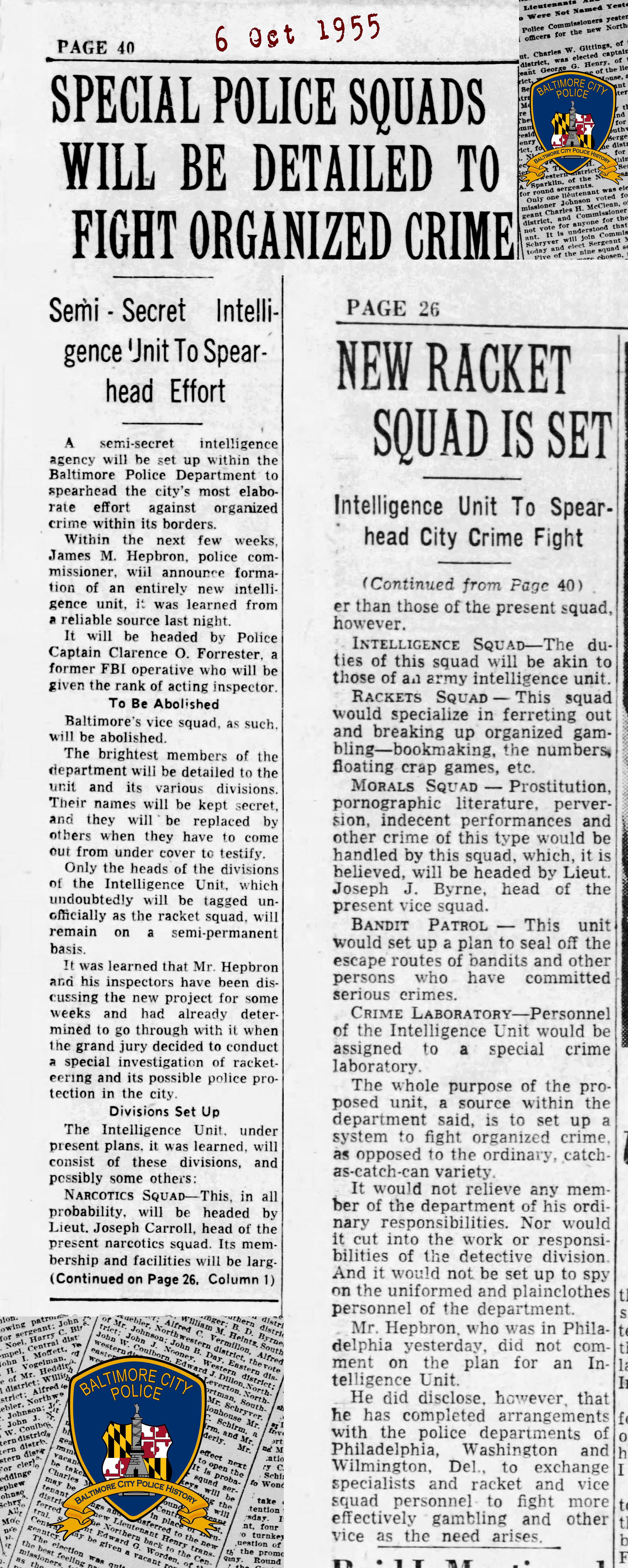
LAWSON PLANS SPECIAL SQUAD TO BATTLE VICE
Newspaper reports of the Times; 5 July, 1938

Lawson will name his new group this week to attack prostitution, and gambling

20 members of forceful face medical tests on fitness for duty

A special cleanup squad of police whose sole duty will be to ferret out vice and gambling in all forms will be appointed this week by police Commissioner William P Lawson.

The Commissioner announced this yesterday [4 July, 1938], and at the same time disclosed that about 20 members of the department will appear shortly before medical examiners to determine their fitness to continue on duty.

The Commissioner statement came 24 hours after Jay. Bernard Wells, states attorney, had made public a report showing that vice is widespread in this city, and which indicated a close association between vice activities and some members of the Police Department.

There was no definite evidence of police protection of vice was obtained, however, by the investigators who compiled the report for the American social hygiene Association. Copies of the report, which was made for a citizen committee headed by Dr. J. M. T. Finney, Senior, were given to Commissioner Lawson and Mr. Wells on Friday.

Dr. Finney last night said he was delighted to hear that Commissioner Lawson had decided to set up a cleanup squad

“But the citizens committee are not reformers.” Dr. Finney said

“They are an interested group of citizens trying to cooperate with the police to make Baltimore a better place to live in. We are not after anybody’s scalp. A report was made in that report was submitted to the proper authorities.”

Commissioner Lawson declined to say how large the new cleanup squad would be or how it would be recruited. He explained it would be under his direct supervision, and that the personnel would include some of the most efficient men in the department. The squad, he added, would be on duty 24 hours a day.

Moreover, Commissioner Lawson insisted that the medical examinations should not be interrupted as a general shakeup in the department. Such examinations, he said, are held, periodically. Any vacancies caused by those examinations must be filled, he added, and this may cause some changes in assignments.

Commissioner Lawson disclosed that he is carefully studying the report submitted by the Finney committee. Although the copy of the report released by Mr. Wells abbreviated names and locations, the copies given to Mr. Wells, and Commissioner Lawson were accompanied by a key.

This key gave the full names of nightclub, tavern, grill and saloon proprietors investigated; the names of their employees; what the employees earn in salaries and commissions; what many waitresses earn by “sitting” and soliciting; the names of prostitutes, their ages, addresses and other details about them, including places a visit; taxicab drivers names, Numbers and their interests in certain parts of the vice racket; perverts and where they practice; the names and addresses of hotels and apartments were prostitutes and perverts live or went temporary quarters, and many other details.

Commissioner Lawson’s announcement was a surprise to executive officers of the police department. No mention of the creation of such a squad, it was said, was made by the Commissioner when he conferenced yesterday morning with the inspectors and captains at police headquarters.

The move has been urged lately on several occasions by representatives of the criminal justice commission and others.

Devider

THE VICE REPORT

Jul 5, 1938

Newspaper reports of the Times; Jul 5, 1938;

Judging by the published summary of the vice report prepared at the behest of a committee of citizens, the most disturbing feature of the whole business is the hint, repeated constantly, that open prostitution is possible in Baltimore because the police themselves “protect” it.

Prostitution is an evil that has existed in all communities. No effort to eradicate it has ever been successful. None of the laws passed against it, some harsh and inhumane, some wiser and more intelligently framed, has ever more than temporarily driven it to cover. In all probability, the most that can be hoped for is to keep it in reasonable bounds and to prevent it from flaunting itself to the shame of honest men and women.

But even this most modest result cannot be attained if there is any sort of alliance between prostitution and its beneficiaries on one hand and the police force on the other. That such alliance do tend to grow up we know by recent experience. That the existence of the alliance breaks down the morale of the force is self-evident. That a lowered morale in the force, is in invitation to gangsters, and racketeers, to practice their trade is proved by recent outbreak in Baltimore of bombings and other violent crimes.

Baltimore’s problem at the present time arises out of the fact that it’s police force is headed by a man is clearly unfit for his job. An invasive, ambiguous man, willing to leave the public in general doubt as to his connection with the whiskey business, cannot by any means persuade either the people of the city or the policeman serving under him that he knows how to attack his problem and how to solve it.

For this particular point of view, the vice report may serve a good purpose. Mr. Wells, the State’s Attorney, who made the decision which resulted in the publication of the report, will doubtless lay its findings before the grand jury. Indeed, considering its implication, he could hardly do less. If Commissioner Lawson himself cannot see how important it is for Baltimore city to have the police commissioner who has the confidence of the police and of the community, then perhaps the jury, using this report as a basis, may be able to make the point clearer to him.

One thing is certain; the people of Baltimore will not long indoor a condition which is so ominous as to have brought some of our reputable citizens to believe that the police force, far from being engaged in an active war against vice and crime, is actually in partnership with these evils.

Devider

NEW VICE SQUAD ACTS SWIFTLY; MAKES 2 RAIDS

Jul 6, 1938

Newspaper reports of the Times; Jul 6, 1938; pg. 20

Itzel strikes 12 hours after appointment and Arrests Three Grand Jury here’s Finney, who had a group sponsoring inquiry the Police Department and the grand jury yesterday swung action on the recently revised vice report.

Less than 12 hours after Commissioner William Lawson, had named the new vice squad the squad made two raids and three arrests.

Capt. Joseph H. Itzel, temporarily detached from command of the central district, sent his hand-picked squad of seven men to do places during the evening, and disorderly house charges resulted in each instance.

The Grand Jury, in the meantime, interrupted its inquiry into the Whitelock Street bombing case the year Dr. Finney, Senior, chairman of the citizens committee responsible for the vice investigation.

Caring to bulky envelopes, Dr. Finney went before the jury and emerge 15 minutes later without the papers. One package was said to contain an all-important “key” to the names of persons figuring in the vice report.

The cases of law violations described by investigators for the American social hygiene society, which conducted the vice survey, identified persons only by initials, and it is said that their true identity is contained in this “key.”

The vice situation was called to the attention of the jury by Jay. Bernard Wells, states attorney. After Dr. Finney had been before the body, Mr. Wells carried into the chamber a copy of the report.

In the first grade last night missed Jeanette Allen, 37 was taken in the custody in a house in the first block of E. Biddle St. Patrolman and Owen Smallwood gained admission to the apartment and shortly advised the woman she was under arrest.

Then, he said, she resisted him and called a large dog. After a scuffle with both the woman and the dog, Smallwood reported, he admitted to the other policeman.

The dog also was taken to the central police station.

In the second grade, patrolman Henry Seybold, a rookie policeman, went to the second floor of the house in the 800 block of Utah Street and told the woman she was under arrest and admitted the other patrolman.

Miss Louise B. Cole, 34, and Wilbert Smith, 65, were docketed at the police station on charges of conducting a disorderly house.

The bombing inquiry was resumed last night, at the first night session of the grand jury since the 1937 investigation into vice conditions, Julius [blanky] Fink is held in $10,000 bail on charges arising from the bombing.

The jurors met at 6:30 PM and interrogated about a dozen witnesses in the bombing case until a few minutes before 11 o’clock.

It was reported last night that routine matters would be discussed before the last of the witnesses in the bombing case was heard today. There was little likelihood, it was said, that the jurors would call witnesses in connection with the vice report, although it was thought that they would continue their joint study of it for part of the day.

Mr. Lawson’s actions in naming a vice squad to work out of his office coincided with his decision to call before the board of police physicians and surgeons 17 policemen who are over the age of 70.

The officers will be examined for their fitness to continue on active duty. The move was said at police headquarters to be the first of several contemplated by the Commissioner, all looking toward the greater efficiency of the department.

In Capt. Itzel’s absence the central district will be commanded by three lieutenants, James Kane, Michael McKew, and Albert Hanssen.

Capt. Itzel revealed yesterday that he might enlist the aid of the public service commission and the liquor license board in his activities, the first to revoke licenses of taxicab drivers involved in vice and the second to do the same in the case of tavern owners.

The liquor license board will meet at 11 AM today, it was learned last night, for a thorough discussion of the entire tavern situation.

Dr. John J. McGinity, chairman, and his colleagues, Louise well field and Harry Lay Duer, will study a report on the raid conducted Saturday night by central district police, it was said.

Devider

VICE -SQUAD HISTORY

Jul 6, 1938

Newspaper reports of the Times; Jul 6, 1938

Baltimore is to have a vice squad a certain number of policemen will be told to check up on reports about prostitution and gambling, keep the Commissioner informed as to the activities of those engaged in these pursuits and, when possible, to make court cases against them.

The project has an engaging sound, and, if it were new and untried, it might be possible to await the outcome with some hope. But the vice squad idea is not new. As a matter of fact the appointment of such a squad is almost a regular step in police departments in the process of demoralization.

They used to have a vice squad in Chicago in the days of big rackets. Public opinion finally forced its abandonment. They had a vice squad in New York for years. What investigation finally showed was that the vice squad was an integral part of the vice racket. The police were working not for the public but for the racketeers. Like the pimps and procurers, they were supposed to track down the lived off the women of the streets. Lucky Luciano, the head of the vice ring in New York, never showed up in the record as cool, or callous, or sadistic as some of the policemen on the NYPD's vice squad.

The reason for this development is not hard to seek. Your ordinary policeman is very much like your ordinary citizen in other walks of life. He knows that vice prostitution exists and he has little hope that it can ever be eradicated. His duty as an officer of the law makes it a comment upon him, however, to see that they are kept in balance, and usually, when the morale of the Police Department is good, he is willing to do his bit toward that end. On the whole, he would rather be catching burglars or tripping up pickpockets. The idea of spending his life spying on starlet women is repulsive to him. Given his choice he would almost certainly decline the assignment.

But in police departments, as in other departments of life, some men do enjoy pursuing women, and all too often, these men because of the reluctance of their betters, tend to get the vice squad appointments. That is what happened in Chicago; and it is what happened in New York.

It may be that Baltimore is going to be luckier than these cities. It may be that the original squad will do its distasteful work that it will never be possible to level against it the charge that it is persecuting its victims and getting some sort of perverse pleasure out of hounding them about it when they don’t pay up. But that outcome is not likely. In all probability what we are going to see will be the usual recourse of a politically minded police Commissioner anxious to silence public outcry.

The vice squad idea is an exploited idea. A way to get good policing, which means not only keeping vice within bounds but also the suppression of rackets and the prevention of major crimes - a way to raise the morale of the whole department. For the men who take pride in their work and who have a wholesome respect for their commanders, the new vice squads will be good work for them.

Devider

Tavern Blast Feared Sign of Racket Raid

Jun 14, 1938

Newspaper reports of the TimesJun 14, 1938; pg. 22

Bombing is regarded as effort to extract tribute from operator

Magistrate old suspect on the urgent plea by officers

Bomb terrorism, similar to that used by big-time racketeers in other cities, apparently as invaded Baltimore, it was feared last night by police.

One of the strongest theories on which police were working yesterday was that at least one of the two bombs which exploded over the weekend was heavy property damage into widely separate sections of the city was used in an effort to force a tavern keeper to pay tribute.

Such a method was well known in the pre-repeal days of Chicago were business firms, reluctant to pay slices of profits to gangsters, were bombed into submission. Such a method, with accompanying gunplay, was well known in New York and was the main strong-armed persuasion used in the Rackets exposed by the present district attorney, Thomas Dewey

That such methods would be attempted in this city has been predicted several times by those conversant with criminal trends. Just how deep the racketeer intrusion has penetrated in this city, the police don’t know, but they are inclined to view the present situation with concern.

There have been other bombings in Baltimore-six since 1907. No one ever was convicted for placing them. Of the six, two bombs were aimed at the homes of incumbent Mayor’s Broening, in 1927, and Jackson two years ago in 1936. Another bomb exploded at the city’s sewage pumping station at East Falls and Eastern Avenues. The remaining bombing cases apparently were the result of individual hatred. No reasons ever were assigned to the bombings of the mayor's homes.

More Than Revenge

In each of the previous instances to early Sunday morning, there was nothing to lead police to attribute the bombings to organize crime. The bombing of the Whitelock Street and Druid Hill Avenue (Sugar Hill) Tavern, on the other hand, had earmarks of more than individual revenge.

After hearing yesterday afternoon in the Northern Police Court, Julius Fink, 42, of the 400 block of Andrus Street, was held by magistrate Harry Allers, for a further hearing Thursday morning on a charge of “assault with intent to murder one William Adams, by placing a bomb on premises at 2340 Druid Hill Avenue…”

Police were so much concerned about the bombing that they asked for an extension of time in which to follow up several angles. Fink was held at the Northern Police Station instead of being sent to City Jail, as is the usual practice in similar cases. Police would not comment on rumors that there was fear of possible attack if the prisoner were sent to jail.

Testimony Meager

Testimony giving at the here was so meager that magistrate Allers had to request additional information. Detective Lieut. William Feehly, one of the police assigned to the case, inform the magistrate that the case might be injured if extensive testimony were given.

Counsel for Fink C. Morton Goldstein. Associate judge of the people’s court and all associate of Harry O. Levin, chairman of the state tax commission, told the magistrate that his client would deny any connection with the bombing. Lieut. Feehly informed the magistrate that there was a possibility of connection between the Tavern bombing and the one in the 300 block of wood your street. Magistrate Allers was asked, despite the reluctance of the police to testify, to hold Fink.

“We have reason to believe that the same people did both jobs and we need a postponement of the case in order to further investigate the job on wood your street.” Lieut. Feehly said. “This man’s freedom will jeopardize our investigation, we believe.”

Held At Police Station

Magistrate Allers then ordered Fink held, not jailed, but held in Northern District Police Station.

Meanwhile, city officials entered the probe, at least by recognizing its importance. Mayor Jackson conferred with Commissioner Lawson. One result was an order by the Commissioner that every available man be placed on the case under supervision of chief inspector Stephen G. Nelson.

J. Bernard Wells states attorney, as far as any official action was concerned left the matter in the hands of the police.

Fink was arrested by Sgt. Wilbur Martindale and patrolman Edgar F. Wilson as a result of what they called a “lucky break.” A short time before the Tavern bombing, the two were cruising in that vicinity when they saw an automobile, without lights, pulled away from the curb and drive past the Boulevard stop sign.

Actions Recalled

The officers gave Chase, caught the car and gave the driver traffic ticket. It was not long before the bomb exploded. After the explosion, the officers recalled the action of the driver and went to his home. They said the driver was Fink.

Damage done by the Tavern bomb was much more extensive than that of the  one that went off on Woodyear street. In the latter section, numerous windows were shattered, metal slugs were driven through shutters, ceilings, and floors, but the effect was scattered along both sides of the street and was spread over a wide area.

The Tavern, [Druid Hill Ave. and Whitelock St.] however, took the brunt of the second bombing. Placed by a side door, the bomb tore it from its hinges and shattered the sill, the brick frame, and the stone doorstep. The interior of the Tavern was also extensively damaged by flying debris and metal slugs. The bombs were similar in that they were more than just explosive, they were each filled with metal debris and washers.

EMERSON CAPTAIN BYRNE LIEUTPhoto courtesy Patrick J Byrne

Captain Alexander Emerson welcomes Lieutenant Joseph J. Byrne to the Vice Unit
He was promoted 6 Sept, 1951 to be the field commander and to lead gambling raids
 
Stripper Ad a
 
Photo courtesy Detective Melvin Howell
1 black devider 800 8 72
 
CALLED RUN-OF-THE-MINE

Strip-Tease Act Lands Dancer In Police Court

December 1952

It was just a "run-of-the-mine strip-tease act," according to Defense Attorney Joseph F. DiDomenico.

But to a policewoman and four policemen it was something more than that--enough, in fact, to justify a charge of presenting an indecent show against Mrs. Carmen Benton, thirty-three, Mrs. Benton, who lives in the 700 block Reservoir street, was arraigned Wednesday before Magistrate William F. Laukaitis in Central Police Court. She let Attorney DiDomenico do the talking for her. THE VARIOUS policemen did some talking too. Patrolman George Fink of the police vice squad testified that Policewoman Miss Betty Riha and Patrolman Kenneth Runge dropped in at a cabaret In the 600 block East Baltimore street Tuesday night and were much intrigued by a dance presented by Mrs. Benton. They were so interested, in fact, that after seeing only part of the show they phoned for Patrolmen Fink, John Livesey and Melvin Howell to join them. The three vice squad men lost no time in hurrying over from headquarters. AFTER THE dance, Mrs. Benton was arrested, and Mrs. Catherine Darrell, forty-six, one of the proprietors of the club, also was charged with permitting an indecent show to be presented. There was some testimony about a brassiere Mrs. Benton wore or didn't wear, but Defense Attorney DiDomenico denied it had been removed. Magistrate Laukaitis postponed the case until Saturday morning to permit the defendants to produce witnesses who would say Mrs. Benton's dance wasn't indecent----that it was just of run-of- the-mine strip act, as Mr. DiDomenico.

Devider

VICE SQUAD RAID TRAPS NINE IN NET

4 Charged With Gambling, 5 With Disorderly Conduct

1950's

Nine men were arrested yesterday morning in a vice squad raid in the 600 block West North Avenue. Police, led by Lieutenant Joseph Byrne, took them to the Northern station where four were charged with gambling and the others were charged with disorderly conduct. Gambling charges were placed against Isadore Miller, of the 5400 block Price Avenue; Jack P. Rosen, of the 4200 block Graceland Avenue; Charles F. Vopalecky, of the 1200 block West North Avenue, and Isadore Abrams, of the 600 blocks West North Avenue. Police Ask Postponement Charged with disorderly conduct were Frank G. Gaston, of the 1800 block Eutaw place; Emanuel Smith, of the 2400 Block Linden Avenue; Joseph Lewis, of the 2000 Block Bolton street; Henry Schwartz, of the 2900 Block Freeway, and Louis Jonas, of the 600 block West North Avenue. Police asked for a postponement of the hearing because they wanted some of the paraphernalia seized in the raid examined at the Crime Laboratory.

Devider

3 ARE ARRESTED IN BOOKIE RAID

Vice Squad Team Breaks Up Operation At Tavern

1950's

An eleven-man team broke up a bookmaking operation yesterday afternoon at a tavern in the 1200 block William street and arrested the tavern owner, a bartender and, a third man. Sergeant Arthur McGee said it was a “right good-sized operation." Paraphernalia seized as evidence included a list of bets tossed from a second-story window. Some of the bets ran as high as $80, Sergeant McGee reported. The vice squad had had the place under surveillance several days. When Patrolman Philip Farace reported he had seen bets placed and heard talk of horses as he mingled with patrons at the bar, Sergeant William Hogan obtained a search warrant. Raid .time was 3:50 P.M. Three vice squad members, Sergeant Hyman Goldstein and Patrolmen George Fink and John Huemmer, took stations at the three entrances to the building. Patrolmen Robert Byrne, Charles Richter, and Edgar Kirby entered and posed as customers. Five minutes later Lieutenant Joseph Byrne, Sergeant McGee, 'Sergeant Hogan, Patrolman Farace and Patrolman Melvin Howell walked in, went to the back of the tavern and, with a crowbar, forced a door leading upstairs. They got no answer when they banged on a second-floor door, and Sergeant Hogan sprung the lock with a firm kick. Inside they saw a man run to a window and throw a wad of paper through it. Outside, Sergeant Goldstein picked the paper up. From the desk at which the man had been sitting by a telephone, Sergeant McGee recovered a payoff sheet, a scratch sheet, and other bookmaking paraphernalia. Charged with bookmaking after the raid were Anthony Lindung, 43, owner of the tavern, who was arrested at his home; Edward Reitz, 50, of the 800 block Woodward Street, and Charles L. Eid, 44, bartender, of the 5700 Block Second Avenue. Each was released in $2,500 bail pending a hearing this morning in Southern Police Court.

Devider


Stripper Ad2a

Photo courtesy Detective Melvin Howell

Devider

 capone mug shot E

Al Scarface Capone's visit to Baltimore

 1 black devider 800 8 72

 Stripper Ad2a
To see the full-size article, Click HERE or on the article above
1 black devider 800 8 72

Donations

Donations help with web hosting, stamps and materials, and the cost of keeping the website online. Thank you so much for helping BCPH. 

Paypal History Donations

1 black devider 800 8 72

POLICE INFORMATION

Copies of: Your Baltimore Police Department Class Photo, Pictures of our Officers, Vehicles, Equipment, Newspaper Articles relating to our department and or officers, Old Departmental Newsletters, Lookouts, Wanted Posters, and or Brochures. Information on Deceased Officers and anything that may help Preserve the History and Proud Traditions of this agency. Please contact Retired Detective Kenny Driscoll.

This email address is being protected from spambots. You need JavaScript enabled to view it.

Devider color with motto

NOTICE

How to Dispose of Old Police Items

Please contact Det. Ret. Kenny Driscoll if you have any pictures of you or your family members and wish them remembered here on this tribute site to Honor the fine men and women who have served with Honor and Distinction at the Baltimore Police Department. Anyone with information, photographs, memorabilia, or other "Baltimore City Police" items can contact Ret. Det. Kenny Driscoll at This email address is being protected from spambots. You need JavaScript enabled to view it. follow us on Twitter @BaltoPoliceHist or like us on Facebook or mail pics to 8138 Dundalk Ave. Baltimore Md. 21222


Copyright © 2002 Baltimore City Police History - Ret Det Kenny Driscoll 

Drunk-o-Meter and Breathalyzer

Drunk-o-Meter and Breathalyzer

Drunk-o-meter and Breathalyzer

Alco-Sensor III

drunkometer 2
 
 Drunk-O-Meter
  

a080157

 Drunk-O-Meter

In the United States, the first laws against operating a motor vehicle while under the influence of alcohol went into effect in New York in 1910. In 1936, Dr. Rolla Harger, a professor of biochemistry and toxicology, patented the Drunkometer, a balloon-like device into which people would breathe to determine whether they were inebriated. In 1953, Robert Borkenstein, a former Indiana state police captain and university professor who had collaborated with Harger on the Drunkometer, invented the Breathalyzer. Easier-to-use and more accurate than the Drunkometer, the Breathalyzer was the first practical device and scientific test available to police officers to establish whether someone had too much to drink. A person would blow into the Breathalyzer and it would gauge the proportion of alcohol vapors in the exhaled breath, which reflected the level of alcohol in the blood.

  
2 Drunkometer
Drunk-O-Meter

The two what appear to be glass beakers stack on top on of another in the right hand side of this picture are called "Gasometers" Kinda reminds me of how everything at McDonalds is called a Mc something or other.. with Dr. Harger everything was an, "-o-meter" or "ometer" Drunk-o-meter or Drunkometer, Gas-o-meter or Gasometer.  Anyway, we are on the lookout for a Gasometer to add to our Drunkometer for the Museum-o-meter or museumometer. So if you happen to come across one in your travels, or someone that can duplicate one for display purposes. Please let us know or send them our way.
 
3 Drunkometer
 
Drunkometer
 
6 Rolla N.Harger Drunkometer
Dr. Rolla N. Harger

Dr. Rolla N. Harger, invented the Drunkometer in 1931 to test intoxicated drivers. Dr. Harger was a professor emeritus of biochemistry and toxicology at Indiana University and a consultant on toxicology to the university's School of Medicine since. The Drunkometer, which used a balloon that was inflated by persons suspected of having been drinking before or while driving. This became was the first practical breath test to measure whether a driver was intoxicated, or as he and the bulk of our country call it, Drunk. After all, it is called a Drunk-o-meter, not an Intoxicate-o-meter. The device was patented in 1936. It would become replaced in the early 1960's by the more streamlined, less science lab looking Breathalyzer. 

In 1938 Dr. Harger was one of five members on a subcommittee of the National Safety Council that drafted a model act to legalize the use of evidence from chemical tests for intoxication and to set limits of body alcohol concentration for motorists.

The act was incorporated into drunken driving laws nationwide. Dr. Harger was chairman of the Indiana University School of Medicine's department of biochemistry and pharmacology from 1933 to 1956 and worked as a professor of biochemistry and toxicology from 1922 to 1960. 

breathalyzer 2
 
Breathalyzer 
Model 900 or 900A
 
Despite the invention of the Breathalyzer and other developments, it was not until the late 1970s and early 1980s that public awareness about the dangers of drinking and driving increased and lawmakers and police officers began to get tougher on offenders. In 1980, a Californian named Candy Lightner founded Mothers Against Drunk Driving, or MADD, after her 13-year-old daughter Cari was killed by a drunk driver while walking home from a school carnival. The driver had three previous drunk-driving convictions and was out on bail from a hit-and-run arrest two days earlier. Lightner and MADD were instrumental in helping to change attitudes about drunk driving and pushed for legislation that increased the penalties for driving under the influence of alcohol and/or drugs. MADD also helped get the minimum drinking age raised in many states. Today, the legal drinking age is 21 everywhere in the United States and convicted drunk drivers face everything from jail time and fines to the loss of their driver's licenses and increased car insurance rates. Some drunk drivers are ordered to have ignition interlock devices installed in their vehicles. These devices require a driver to breathe into a sensor attached to the dashboard; the car won't start if the driver's blood alcohol concentration is above a certain limit.
1 blue devider 800 8 72

 Drunkometer 1937

 Dr. Rolla Neil Harger
Mechanical Smeller
Drunkometer
circa 1937 Chicago Times

13 May 1937

Tells How Drunk You Are

Dr. R. A. Harger, Prof. of biochemistry and toxicology at Indiana University, using Mr. Kirk Kregan as a subject in a demonstration of his “Mechanical Smeller” at the Midwest safety conference in Chicago. It records the amount of alcohol on the breath, given index to the amount that is in the breather’s body. It was suggested for use by police on auto drivers suspected of intoxication. As it gives a reading that is much more certain than mere suspicion on the part of the policeman and tells the degree of intoxication. 


1 black devider 800 8 72

Rolla Neil Harger (January 14, 1890 – August 8, 1983) invented an early breathalyzer, called the Drunkometer to test for driving under the influence in 1931 and he was awarded the patent in 1936. He was biochemistry and pharmacology department chairman of the Indiana University School of Medicine from 1933 to 1956 and worked as a professor in the department of biochemistry and toxicology from 1922 to 1960.

Harger was born on January 14, 1890, in Nebraska or in Decatur County, Kansas. He graduated from Yale University in 1922 and was hired as an assistant professor at Indiana University School of Medicine in the newly formed department of biochemistry and pharmacology.

In 1931 invented the Drunkometer to test for driving under the influence. In 1938 he was one of the five people chosen to be on the subcommittee of the National Safety Council that drafted the model legislation that set the blood alcohol content for driving under the influence.

He died on August 8, 1983

1 black devider 800 8 72

31 Dec. 1938

First “Drunkometer”

Thanks to the end of Prohibition and a boom in car sales, drunk driving had become a fast-growing problem in America in the 1930s. But on this New Year’s Eve, police in Indianapolis, Indiana went out armed with a new weapon to fight against people who had gotten behind the wheel after having too much to drink.

It’s a contraption called a “Drunkometer”  and it’s the invention of an Indiana University chemist named Rolla Harger. He had been working on the device since the early 1930s and had patented it two years earlier. The concept behind the Drunkometer was pretty basic. Drivers suspected of being drunk were asked to breathe into a rubber balloon, which was attached to a tube of purple liquid—a  weak solution of potassium permanganate in sulphuric acid. 

If there was alcohol on their breath, the chemical solution changed color–the darker it got, the more alcohol they had in their system.  From the shade of the liquid, the cops could use a simple equation to estimate the alcohol level in a person’s bloodstream.  Previously, the only way police could check a driver’s alcohol level was to get a blood or urine sample; Neither was a very practical option on the roadside.  While the Drunkometer looked a bit like a mini-chemistry set, it was portable, able to fit into a small suitcase.

Harger made the device as simple as possible so that judges and juries would understand how it worked and police officers could easily be trained to use it. He also made the Drunkometer hard to beat. Experiments showed that no illness affected the result and that nothing a person might eat - garlic, cloves, strong onions - would make any difference. Once police started using it, the Drunkometer was found to have another advantage. A dramatic change in the color of the liquid could often make people admit how much they had drunk.

Sometimes Harger would ride along with the police to see how his invention was being used.  What he discovered was that a lot more people were driving drunk than he ever imagined. 

The Drunk-O-Meter was used by police departments all over the country until the 1950s when it was replaced by the breathalyzer, invented by another Indiana University professor, Robert Borkenstein. The breathalyzer is a much smaller and more sophisticated device that uses infrared spectroscopy to measure blood alcohol levels.

According to the Centers for Disease Control and Prevention (CDC), the average drunk driver has driven drunk 80 times before his first arrest. 

1 black devider 800 8 72


breathalyzer Model 900A
Stevenson Breathalyzer 

Evolution of the Breathalyzer

The Breathalyzer, as created by Borkenstein, continued to be updated with later models, including Models 900, 900A, 900B, and the Model 2000 described as microprocessor-controlled and using infrared absorption to measure alcohol. The Model 2000 was never marketed but made it possible for Borkenstein to help make a prototype for a similar machine which became the precursor to the breath testing devices called the BAC Verifier and later the BAC Datamaster.

All in all, between 1955 and 1999, more than 30,000 of Borkenstein’s various Breathalyzer models were produced and sold. They were used in almost every U. S. state as well as all provinces of Canada and in Australia where it became the standard breath-testing instrument for years. In Canada, when legislation was enacted regarding DUI law, it was called the “Breathalyzer law.”

The Breathalyzer impacted more than just law enforcement but was used as well in research studies into the effects of alcohol on driving in both the U. S. and Canada. It undoubtedly played an important role in the DUI legislation which prescribed specific blood alcohol concentration limits for drivers in all states as well as in Canada. The National Highway Traffic Safety Administration put the Breathalyzer on its 1974 Approved Products Lists as one of the first of its kind.

The “Breathalyzer” Today

Since Borkenstein’s original Breathalyzer, modern technology has advanced this machine. Today there are personal as well as professional breathalyzers and various types of devices based on different technologies. One of these is the electrochemical fuel cell Breathalyzer. The Alcosensor III and IV are fuel-cell devices which use an electrode system. Through a chemical reaction which occurs on the electrode system surface, an electrical current is created. This electrical current is produced by the alcohol on a person’s breath which will result in a digital readout or some other indicator.

These types of devices are small and handheld, thus useful to law enforcement. They are known for their accuracy but are expensive to manufacture.

Another type of modern Breathalyzer is the infrared optical sensor device, the latest version in what Borkenstein started with his Model 2000 Breathalyzer. An Intoxilyzer is an example of this type of device. The technology it uses is called infrared spectroscopy, which pinpoints molecules according to the way they absorb light. When ethanol in the breath absorbs the light, an electrical impulse is created which measures this which is then processed by a microprocessor into a BAC level. These types of devices are generally too large to be used as handheld devices.

Dual sensor breathalyzers are another type of device which use both infrared and electrochemical sensors combined into one device to give a very accurate measure of blood alcohol concentration.

Personal Breathalyzers

Finally, semiconductor breathalyzers are now available for private use by individuals. These small, handheld devices can be found online and in convenience stores; they are inexpensive because they are cheap to make. They also produce an electrical current when alcohol comes into contact with the surface of the semiconductor. These portable devices are not, however, as reliable as the more sophisticated types mentioned above used by law enforcement. That is because they vary in quality and can be affected by the atmosphere in which they are used. Their use is also dependent on correct operation.

Substances in the air around personal breathalyzers, such as cigarette smoke, carbon monoxide, and other fumes and gases can influence their readings as well as fluctuations in the humidity and temperature of the air. Changes in the patterns of the user’s breath flow can also influence readings as well as residual mouth alcohol. Artificially high as well as artificially low readings may result when used by consumers who do not fully understand how these factors can impinge on results. A further caution lies in the fact that the test results of a device used by law enforcement are the defining results which will be used in court as evidence for a DUI conviction. If used correctly, personal breathalyzers may be beneficial to responsible drivers concerning their driving ability but they should not be totally relied up to prevent a drunk driving conviction.

The Use of Breathalyzers

The Breathalyzer device has come a long way from its inception in the early 1950s. Accepted as a standard basis for most DUI convictions, it has led to changing laws concerning drunk driving restrictions throughout the U.S. In connection with DUI convictions, it has led to the ignition interlock device, a type of Breathalyzer wired into a convicted driver’s vehicle’s ignition which prevents it from starting if the user fails the breath test. The installation of this device is becoming increasingly popular as a court-ordered action for mostly repeat offenders in many states.

Beyond this, however, the Breathalyzer can now be used by more than just law enforcement as it finds its way into such areas as the workplace, in research studies, medical clinics, alcohol treatment programs, probation programs, halfway houses, and more. As technology advances, the Breathalyzer will likely become even more refined and widely applied, although its continued use now is assured.


1 black devider 800 8 72Model 900A
Stevenson Breathalyzer

15 Oct 1959

Policeman's Lot Happy One Testing Drunkenness Gauge

ALBERT SEHLSTEDT JR  - pg. 40

STEADY, STEADY - These police officers are taking tests to demonstrate effects on their reflexes of too much alcohol. Sgt. Lemuel Porter reaches for coins and walks a straight line, and Sgt. Preston Rowland tries to touch the tip of his nose.

Policeman's Lot Happy One Testing Drunkenness Gauge

When policemen have too much to drink, they giggle, perform the simplest tasks with. Heavy-handed concentration and, in general, act the same way other people do. This may seem humorous to the average citizen but all that follows will be bad news for motorists not averse to getting behind the wheels of their cars with a few on board. Yesterday, three policemen at the State Police Headquarters in Pikesville did have a bit too much, but it was to demonstrate a new device that will make it much more difficult for drinking drivers to escape convictions in the courts.

Plastic Tube Used

The device is called a Breathalyzer. It analyzes the alcoholic content in the blood simply by having a driver blow into a plastic tube. The Breathalyzer will be used by State Police and Baltimore City Police after the first of the year.

Approximately 100 policemen from various Maryland jurisdictions assembled at Pikeville yesterday to learn how to use the machine. Naturally. somebody had to do a little drinking before the demonstration could be made. Three volunteers were Lt. Hugh Kavanaugh, Sgt. Preston Rowland and Sgt. Lemuel Porter.

Lieutenant Kavanaugh had 13 ounces of 86-proof whiskey. Sgt Rowland eight bottles of beer, and Sgt Porter 10 ounces of whiskey. The Breathalyzer showed that there was .163 percent of alcohol in Lieutenant Kavanaugh’s blood; .13 percent in Sgt Rowland’s blood and .148 recent in Sgt Porter’s. Had the test been real Lieutenant Kavanaugh would have stood a good chance of going to jail, and the two sergeants would have had considerable explaining to do before a magistrate or judge. According to standards established by the American Medical Association and the National Safety Council, anybody with .15 percent of alcohol in his blood is unfit to drive.

Figure Called Liberal

Hugh G. Boyd, a representative of the Stephenson Corporation of Red Bank, New Jersey, the company selling the Breathalyzers to our State and City Police at $650 each, told the two agencies yesterday that the .15 percent figure is a liberal number, a number that gives the driver a break.

People with .05 percent are generally not considered under the influence of alcohol. Person’s falling between these two figures are in a sort of a no-man’s land where other evidence of drunkenness, or sobriety, must supplement the machine’s findings’

Other Evidence Needed

Indeed, the findings of the Breathalyzer will not be used exclusively by police in prosecuting a case in court. Other evidence, such as observation of the driver while they walk a chalk line or lean over to pick up some coins from the ground, as the three officers did (or attempted to do) yesterday will also be taken into consideration

Col. Carey. Jarman, Superintendent of the State Police, emphasized that the new device is “no panacea” for the drinking-driving problem. “However,” Colonel Jarman said. "it is a distinct help. It is a tool in the hands of enforcement agencies.” Clayton A. Dietrich, an assistant attorney general of Maryland, said he considered the Breathalyzer a “double-edged sword” for the prosecution.

Mr. Dietrich said the device could corroborate the policeman’s testimony and also undermine the position of the defense in drinking-driver cases 


Alco Sensor II

Alco-Sensor III

A law enforcement grade Breathalyzer, specifically an Alco-Sensor IV - A breathalyzer or breathalyzer (a portmanteau of breath and analyzer/ analyzer) is a device for estimating blood alcohol content (BAC) from a breath sample. The breathalyzer is the brand name (a genericized trademark) for the instrument that tests the alcohol level developed by inventor Robert Frank Borkenstein. It was registered as a trademark on May 13, 1954, but many people use the term to refer to any generic device for estimating blood alcohol content.

Widely used, the Alco-Sensor III (ASIII) is a pocket-sized, handheld breath alcohol tester.  This NHTSA approved Evidential Breath Alcohol Testing Device provides a simple, accurate and economical method of determining a subject’s breath alcohol concentration. 

Features:

The Alco-Sensor III offers last test recall, mouthpiece ejector, internal temperature sensor with software controlled temperature compensation and automated calibration. The unit has a large, bright, three-digit display that captures and holds the results without the need to press and hold the READ button.

Alco-Sensor III Law Enforcement

Trusted by Law Enforcement agencies worldwide, the Alco-Sensor III evidential breathalyzer is widely used for the following reasons:

  • Approved by the U.S. DOT as an evidential breath testing device
  • Approved for use by law enforcement agencies in almost every state as a PBT (Preliminary Breath Tester)
  • Evidential Accuracy to +/- .005 BAC.
  • Displays breath alcohol results to three decimal places
  • Fuel cell sensor detects and reads alcohol only
  • Easy two-button operation
  • The display prompts the operator through a test sequence, greatly reducing operator error
  • When pressed, the READ button captures a breath sample for analysis
  • Displays test results within seconds
  • Able to re-display results by pressing the READ button a second time
  • Mouthpiece ejector button
  • GSA Pricing available for Federal Agencies
  • Secure Calibration Procedure eliminates accidental  tampering or unauthorized calibration adjustments

Alco Sensor III Mouthpiece

Alco-Sensor III Mouthpiece


The standard Alco-Sensor and Alco-Sensor III mouthpiece. With no restriction, back pressure is minimal and samples provided produce consistent and accurate results. All Intoximeters mouthpieces come individually wrapped for maximum hygiene. 

1 black devider 800 8 72

 Breathalyzer

HISTORY - A 1927 paper produced by Emil Bogen, who collected air in a football bladder and then tested this air for traces of alcohol, discovered that the alcohol content of 2 liters of expired air was a little greater than that of 1 cc of urine. However, research into the possibilities of using breath to test for alcohol in a person's body dates as far back as 1874, when Francis E. Anstie made the observation that small amounts of alcohol were excreted in breath.
 
 
Also, in 1927 a Chicago chemist, William Duncan McNally, invented a breathalyzer in which the breath moving through chemicals in water would change color. One use for his invention was for housewives to test whether their husbands had been drinking.
 
 
In late 1927, in a case in Marlborough, England, a Dr. Gorsky, Police Surgeon, asked a suspect to inflate a football bladder with his breath. Since the 2 liters of the man's breath contained 1.5 ml of ethanol,[dubious – discuss] Dr. Gorsky testified before the court that the defendant was "50% drunk".
 
 
In 1931 the first practical roadside breath-testing device was the Drunkometer developed by Rolla Neil Harger of the Indiana University School of Medicine. The Drunkometer collected a motorist's breath sample directly into a balloon inside the machine. The breath sample was then pumped through an acidified potassium permanganate solution. If there was alcohol in the breath sample, the solution changed color. The greater the color change, the more alcohol there was present in the breath. The Drunkometer was manufactured and sold by Stephenson Corporation of Red Bank, New Jersey.
 
 
In 1954 Robert Frank Borkenstein (1912–2002) was a captain with the Indiana State Police and later a professor at Indiana University Bloomington. His Breathalyzer used chemical oxidation and photometry to determine alcohol concentrations. Subsequent breath analyzers have converted primarily to infrared spectroscopy, though this method is subject to invalid results depending on ambient air temperature, the temperature of the device, and the body temperature of the subject, depending on the specificity of the readings and how they correlate with one's BAC measured via a voluntary blood draw. The invention of the Breathalyzer provided law enforcement with an orally-invasive test providing immediate results to determine an individual's breath alcohol concentration at the time of testing, based on, according to this article, consistently faulty samples.
 
 
In 1967 in Britain, Bill Ducie and Tom Parry Jones developed and marketed the first electronic breathalyzer. They established Lion Laboratories in Cardiff. Ducie was a chartered electrical engineer, and Tom Parry Jones was a lecturer at UWIST. The Road Safety Act 1967 introduced the first legally enforceable maximum blood alcohol level for drivers in the UK, above which it became an offense to be in charge of a motor vehicle; and introduced the roadside breathalyzer, made available to police forces across the country. In 1979, Lion Laboratories' version of the breathalyzer, known as the Alcolyzer and incorporating crystal-filled tubes that changed color above a certain level of alcohol in the breath, was approved for police use. Lion Laboratories won the Queen's Award for Technological Achievement for the product in 1980, and it began to be marketed worldwide. The Alcolyzer was superseded by the Lion Intoximeter 3000 in 1983, and later by the Lion Alcolmeter and Lion Intoxilyzer. These later models used a fuel cell alcohol sensor rather than crystals, providing a more reliable curbside test and removing the need for blood or urine samples to be taken at a police station. In 1991, Lion Laboratories was sold to the American company MPD, Inc.
 
1 black devider 800 8 72

CHEMISTRY - When the user exhales into a breath analyzer, any ethanol present in their breath is oxidized to acetic acid at the anode: 
CH3CH2OH(g) + H2O(l) → CH3CO2H(l) + 4H+(aq) + 4e

At the cathode, atmospheric oxygen is reduced: 
O2(g) + 4H+(aq) + 4e → 2H2O(l)

The overall reaction is the oxidation of ethanol to acetic acid and water. 
CH3CH2OH(l) + O2(g) → CH3COOH(aq) + H2O(l)

The electric current produced by this reaction is measured by a microcontroller and displayed as an approximation of overall blood alcohol content (BAC) by the Alcosensor.

1 black devider 800 8 72
LAW ENFORCEMENT - Breath analyzers do not directly measure blood alcohol content or concentration, which requires the analysis of a blood sample. Instead, they estimate BAC indirectly by measuring the amount of alcohol in one's breath. In general, two types of breathalyzer are used. Small hand-held breathalyzers are not reliable enough to provide evidence in court but reliable enough to justify an arrest. Larger breathalyzer devices found in police stations can then be used to produce court evidence.
 
 
Two breathalyzer technologies are most prevalent. Desktop analyzers generally use infrared spectrophotometer technology, electrochemical fuel cell technology, or a combination of the two. Hand-held field testing devices are generally based on electrochemical platinum fuel cell analysis and, depending upon jurisdiction, may be used by officers in the field as a form of "field sobriety test" commonly called PBT (preliminary breath test) or PAS (preliminary alcohol screening) or as evidential devices in POA (point of arrest) testing.
 
 
In Canada, a preliminary non-evidentiary screening device can be approved by Parliament as an approved screening device, and an evidentiary breath instrument can be similarly designated as an approved instrument. The US National Highway Traffic Safety Administration maintains a Conforming Products List of breath alcohol devices approved for evidentiary use, as well as for preliminary screening use. In order to demand a person produce a breathalyzer sample, an officer must have "reasonable suspicion" that the person drove with more than 80 mg alcohol per 100 mL of blood. The demand must be within three hours of driving. Any driver that refuses can be charged under s.254 of the Criminal Code. Most states, including California and Michigan, have implied consent laws, which means that by applying for a driver's license, drivers are agreeing to take any breathalyzer test under suspicion of a DUI. However, if the officer lacks reasonable suspicion and the person refuses there is no crime since the demand was not lawful and without the breathalyzer readings there is usually not probable grounds for arrest on the above driving over 80 charges.
 
1 black devider 800 8 72
DONT DRUNK AND DRIVE 2 72

Standardized Field Sobriety Test

Definition: The Standardized Field Sobriety Test (SFST) is a battery of 3 tests performed during a traffic stop in order to determine if a driver is impaired. The 3 tests that make up the SFST are the horizontal gaze nystagmus (HGN), the walk-and-turn, and the one-leg stand tests. Developed in the 1970s, these tests are scientifically validated, and are admissible as evidence in court in a majority of states.

Executive SummaryAccording to researchers, officers trained to conduct SFSTs correctly identified alcohol-impaired drivers over 90% of the time using the results of SFSTs (Burns and Anderson 1995; Stuster and Burns 1998). The SFST consists of three tests administered and evaluated during a traffic stop to determine impairment and probable cause for arrest. The HGN test is performed to observe whether the driver’s eyes involuntarily jerk as a stimulus is moved side to side. Both the walk-and-turn and one-leg stand tests are “divided attention” tests that are easily performed by most sober drivers. They require a subject to listen and follow instructions while performing simple physical movements. Impaired persons have difficulty with tasks requiring their attention be divided between simple mental and physical tasks.

More Detail: The National Highway Traffic Safety Administration (NHTSA) defines the three parts of the SFST as follows (see NHTSA Highway Safety Desk Book):

The horizontal gaze nystagmus (HGN) test: Horizontal gaze nystagmus is an involuntary jerking of the eyeball which occurs as the eyes gaze to the side. Under normal circumstances, nystagmus occurs when the eyes are rotated at high peripheral angles. However, when a person is impaired by alcohol, nystagmus is exaggerated and may occur at lesser angles. An alcohol-impaired person will also often have difficulty smoothly tracking a moving object. In the HGN test, the officer observes the eyes of a suspect as the suspect follows a slowly moving object such as a pen or small flashlight, horizontally with his eyes. The examiner looks for three indicators of impairment in each eye: if the eye cannot follow a moving object smoothly, if jerking is distinct and sustained nystagmus when the eye is at maximum deviation, or if the angle of onset of jerking is prior to 45 degrees of center. The subject is likely to have a BAC of 0.08 or greater if, between the two eyes, four or more clues appear. A 1998 validation study found that this test allows proper classification of approximately 88 percent of subjects. HGN may also indicate consumption of seizure medications, phencyclidine, a variety of inhalants, barbiturates, and other depressants.

In the walk-and-turn test, the subject is directed to take nine steps, touching heel-to-toe, along with a straight line. After taking the steps, the suspect must turn on one foot and return in the same manner in the opposite direction. The examiner looks for eight indicators of impairment: if the suspect cannot keep balance while listening to the instructions, begins before the instructions are finished, stops while walking to regain balance, does not touch heel-to-toe, uses arms to balance, steps off the line, takes an incorrect number of steps, or makes an improper turn. A 1998 validation study found that 79 percent of individuals who exhibit two or more indicators in the performance of the test will have a BAC of 0.08 or greater.

In the one-leg stand test, the subject is instructed to stand with one foot approximately six inches off the ground and count aloud by ones beginning with one thousand (one-thousand-one, one thousand-two, etc.) until told to put the foot down. The officer times the subject for 30 seconds. The officer looks for four indicators of impairment including swaying while balancing, using arms to balance, hoping to maintain balance, and putting the foot down. A 1998 validation study found that 83 percent of individuals who exhibit two or more such indicators in the performance of the test will have a BAC of 0.10 or greater.

There are many factors that might render a person unable to successfully complete one or more of the SFSTs. For instance, regarding the HGN test, the person asked to consent to such a test might be suffering from an eye disease or condition that affects his/her ability to see and consequently confound the test and results. Age, injury or disease could also affect the ability of a person to perform the one-leg stand test or the walk and turn test. As a general rule, an officer should ask the DUI suspect whether they can give any reason why they cannot perform the test and their answer should be carefully noted in the officer’s report. Other disabilities, such as deafness, should be taken into consideration and noted as well.

Admissibility of Standardized Field Sobriety Test Results

In 1981 NHTSA promulgated a federal standard for field sobriety testing procedures. States are not required to adhere to this federal standard. Although some states do not employ the exact procedures, others replicate NHTSA procedures as closely as possible. In Ohio v. Homan, 732 N.E.2d 952 (Ohio, 2000), Ohio became the only state where courts ruled that evidence is “inherently unreliable” and inadmissible when gathered from field sobriety tests that deviate from NHTSA standards. However, this “strict compliance” standard has since softened to a “substantial compliance” standard, as confirmed by the Ohio State Supreme Court in Ohio v. Boczar, 863 N.E.2d 155, 160 (Ohio, 2007).

Furthermore, according to NHTSA, courts in several states have reviewed the admissibility of field sobriety tests and have held that deviations from the administration of simple dexterity tests (one-leg stand and walk-and-turn tests) should not result in the suppression of test results. However, admissibility of the HGN test may be treated differently due to its “scientific nature.” For this reason, HGN results are vulnerable to challenge and likely to be excluded by the court if the test was not administered in strict compliance with established protocols. Appellate courts generally require that, before an opinion can be expressed by an officer who administered an HGN test, the officer must be qualified as an expert or skilled witness for the purpose of administering the test as well as expressing an opinion as to the results. For example see Robinson v. State 982 So.2d 1260, 1261 Fla. App. 1 Dist., 2008.

4 Drunkometer

We have come along way since the days of these tests, the handheld tests over the Drunk-O-Meter and Breathalyzer are accurate, they save time, money and ultimately lives. Many of them still require some probably cause more than swerving while driving, or a scent of alcohol coming from the vehicle being driven, there were a series of roadside sobriety test. The one most recognized is in the picture below, walking a straight line.

5 Drunkowalker

Today reporting a drunk driver can be easier than ever before, but doing so has to be done with as much caution and care as possible. As with the invention of the cellphone, we have created a device that can be as reckless as drinking while driving. So unless you have someone in the car with you to call a potential drunk driver in, you should either wait until you reach a red light or stop sign intersection, or pull over to the side of the road before making that very important call. Once you have made the call, be prepared to give the operator with a tag number (or partial tag) and direction of travel or flag down an officer should you see one in the area. As for remembering a tag number, if you have a poor memory, remember as much as you can, three letters three numbers.. when you call 911, before saying anything just say the number, they will get it, then give details about your reason for calling. Some jurisdictions will ask if you need, police fire or medical assistance, you can quickly say police and give your tag number, if the operator asks you can repeat the tag number and and and ask if they got it before giving your narration.  I think it is important to report things like this as you might save a life. Keep in mind from time to time, the drunk driver you see driving reckless, might not be a drunk driver at all. I once followed a drunk driver throughout our neighborhood, witnessed it striking parked cars, and traffic devices, such as stop signs, one-way signs, curbs and other stationary objects. I would say my wife and followed this driver for more than 5 miles before we were able to lead police to the vehicle. Once it was stopped they found the driver was having a diabetic seizure, so aside from saving the public, you might also save the driver.  

1 black devider 800 8 72

5 Drunkowalker

Stevenson Breathalyzer 

The following might help us to better give information to the police when calling in either a drunk driver or ill driver. 

What Does a Diabetic Seizure Look Like?

Managing diabetes effectively requires knowledge of the condition and the steps necessary to avoid complications. Blood glucose levels that are too high or too low for prolonged periods have detrimental effects on overall health and can lead to death. A diabetic seizure is a serious complication of this disease. Patients and caregivers must know how to avoid seizures and to recognize their signs so that proper immediate assistance is provided.

Identification

According to the American Diabetes Association, a diabetic seizure can occur when you become hypoglycemic, which means blood sugar levels have dropped too low. This happens if you take too much insulin, exercise vigorously without eating properly, skip meals, drink too much alcohol or have a metabolic disease. It can also occur as a reaction to medications, such as heart medicines and those that cause the pancreas to release more insulin. Hyperglycemia, or levels of blood sugar that are too high, can also lead to a diabetic seizure.

Initial Signs and Symptoms of a Diabetic Seizure

Initial symptoms of a diabetic seizure include sweating, feeling cold or clammy, shakiness and feeling faint, sleepy or confused. Additional seizure signs are feeling anxious, muscle weakness or a loss of muscle control, loss of ability to speak clearly and changes in vision. You may hallucinate, be unaware of your surroundings, cry without control or have other unexplained emotional behaviors.

Severe Seizure Symptoms

If a seizure is untreated you may become unconscious, fall and have convulsions that cause muscles to contract involuntarily, making the body move and jerk out of control; this can be mild or severe. Patients may also appear to be in a trance and unable to respond, with eyes blinking rapidly or staring into space.

Treatment

The best treatment is prevention. Check blood sugar levels often and eat a proper diet. Immediate attention is needed if you do have a seizure and become unconscious. It is important to wear a medical ID bracelet specifying diabetes so that responders can provide appropriate care. The usual course of treatment is an injection of glucagon to quickly bring blood sugar levels back to normal. A diabetic seizure can be life-threatening if not treated quickly.

 
1 black devider 800 8 72

Donations

Donations help with web hosting, stamps and materials and the cost of keeping the website online. Thank you so much for helping BCPH. 

Paypal History Donations

1 black devider 800 8 72

POLICE INFORMATION

Copies of: Your Baltimore Police Department Class Photo, Pictures of our Officers, Vehicles, Equipment, Newspaper Articles relating to our department and or officers, Old Departmental Newsletters, Lookouts, Wanted Posters, and or Brochures. Information on Deceased Officers and anything that may help Preserve the History and Proud Traditions of this agency. Please contact Retired Detective Kenny Driscoll.

This email address is being protected from spambots. You need JavaScript enabled to view it.

Devider color with motto

NOTICE

How to Dispose of Old Police Items

Please contact Det. Ret. Kenny Driscoll if you have any pictures of you or your family members and wish them remembered here on this tribute site to Honor the fine men and women who have served with Honor and Distinction at the Baltimore Police Department. Anyone with information, photographs, memorabilia, or other "Baltimore City Police" items can contact Ret. Det. Kenny Driscoll at This email address is being protected from spambots. You need JavaScript enabled to view it. follow us on Twitter @BaltoPoliceHist or like us on Facebook or mail pics to 8138 Dundalk Ave. Baltimore Md. 21222


Copyright © 2002 Baltimore City Police History - Ret Det Kenny Driscoll 

How to Dispose of Old Police Items

logo

Please contact Det. Ret. Kenny Driscoll if you have any pictures of you or your family members and wish them remembered here on this tribute site to Honor the fine men and women who have served with Honor and Distinction at the Baltimore Police Department. Anyone with information, photographs, memorabilia, or other "Baltimore City Police" items can contact Ret. Det. Kenny Driscoll at   Kenny@BaltimoreCityPoliceHistory.com follow us on Twitter @BaltoPoliceHist or like us on Facebook or mail pics to 8138 Dundalk Ave. Baltimore Md. 21222.
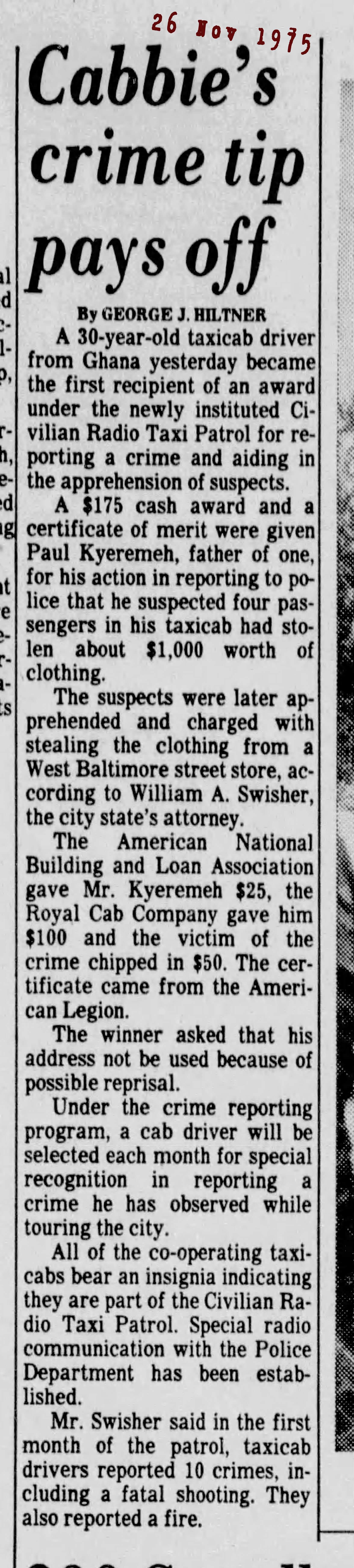
NEWSLETTER

Subscribe now to get 100 exclusive photo & two newsletters per month