Weapons

Weapons


Baltimore Police Weapons

Pistols - Slap Jack - Espantoon - CS Mace - Pepper Spray

We are hoping to provide as much info, and as many photos as we can on/of the weapons, and means of restraint used by the members of the Baltimore Police Department over the years from 1729 to present day. Weapons and means of restraint to include, Pistols, Shot Guns, Rifles, Black-Jacks, Slap-Jacks, Sap-Gloves, Espantoon, CS-Mace, Pepper-Spray, Iron-Claw, Come-Along, Etc

 1 black devider 800 8 72

Excerpts from - Proceeding of City Council 11 Dec 1856

(During this December 11th session in 1856) Mr. Boyd moved to strike out all of the section providing for arming the police with revolvers and other suitable weapons and placing muskets at the station-houses. Mr. Boyd said the cost of arming the police with revolvers would alone amount to $516l; that there were men in the police not fitted to trust with arms, and if the amendment was not adopted he feared he should be compelled to vote it was necessary to arm the police, as long as rowdies were armed with revolvers and other weapons. In New York and Philadelphia where there is a penalty for carrying concealed weapons, the police are armed by the city authorities. The muskets at the stations houses were to be kept there under the charge of the Mayor, to be used only in case of riot, where such arms were necessary to compete with armed mobs Mr. Boyd replied that only a few weeks since one of the police bad drawn his revolver at Carroll Hall on one of the night police - he reiterated that there were men not fit to be trusted with such arms. The time was when twenty-six men kept this city quiet and in good order without being armed. As to giving the police muskets, we might as well have a standing army. If muskets are necessary at any time, the military are always ready to obey any call of the Mayor. Mr. Pinkney again urged that it was necessary to arm the police - you must arm them to have any effect at all. If the military were called out at the present state of feeling in the public mind, instead of preventing or suppressing a riot, it would lead to one of the bloodiest riots on record. Mr. Howard opposed the amendment - he believed that it was necessary to arm the police in order to protect the citizens - to put down the riots that had so often of late violated the law and shot down peaceable persons. We may have seen outrages heretofore, but we have not seen orderly citizens shot down at their own doors - men driven from the polls when only seeking their right of exercising the elective franchise – polls obstructed and men leading on armed mobs with apparent impunity - Mr. Boyd was willing to judge the present by the past - If we are to have no better men on the police than for time past, he was not willing to place arms in their hands. If the police are armed, no man is safe in this community. The question being taken on Mr. Boyd's proposed amendment, it was rejected by yeas 3, (Messrs. Boyd, Tidy, and Carroll,) and nays 16. Mr. Nalls moved to strike out that portion of the ordinance placing muskets at the station houses rejected by yeas 6, (Messrs Daiger, Boyd, Green, Tidy, Carroll and Nalls,) and nays 13. Section 8 was reconsidered, on motion of Mr. Handy, who moved to amend it by making our police officers be confirmed/sworn by the city council, as other city officers are; which was adopted with but one dissenting voice.

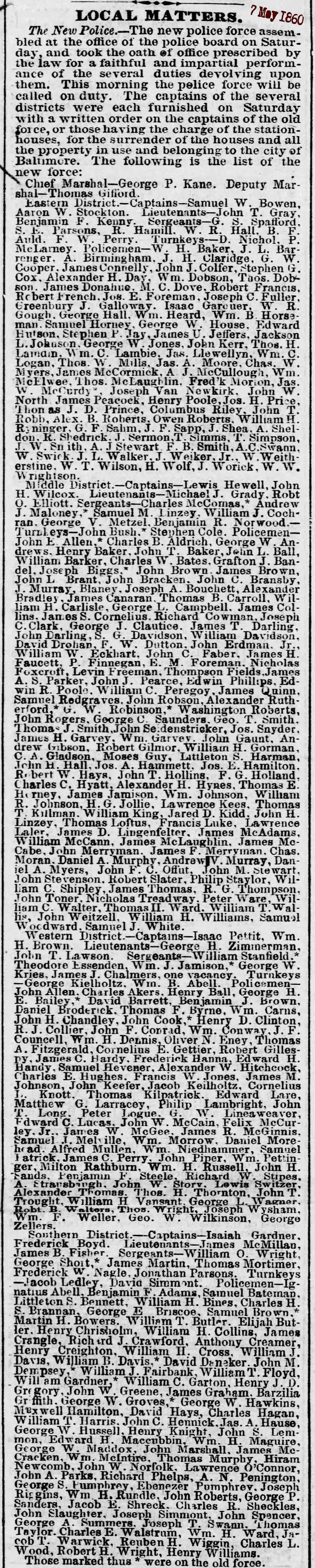
During the times the city was nearly taken over by several gangs involved in politics, they would travel the various wards making it nearly impossible for honest voters to vote. As such elections were not fair, the same people won every time. I wouldn't be surprised to hear Mr. Boyd was benefiting more by having the Know Nothings, Plug Uglies, Bloody Tubs, Etc. ruling the city with an unarmed, or under armed police force, at the time police carried their own weapons, usually single shot pistols, or some other small pocket pistol, ill-equipped to fight these gangs. We lost several officers at the times. Still arming police, wasn't as much to help, or protect the police, so much as it was to allow politicians to receive fair votes. It may also be worth reminding readers of the Know-Nothing Riot of 1856, in which some of the worst rioting of the Know-Nothing era in the United States, had occurred in Baltimore. It was the fall of 1856, street tensions had escalated sharply over the preceding six-dozen years as neighborhood gangs, most of them operating out of local firehouses, became increasingly involved in party politics. Know-Nothing candidate Thomas Swann was elected Mayor of Baltimore in 1856 amidst violence and a heavily disputed ballot. Police Commissioner Kane was also involved in this, and in fact testified in open court for the defense in a trial against a Know-Nothing that was charged with killing one of Kane’s Officers, Kane was more dedicated to his party than he was his own men. Based on what these gangs were doing, it is obvious what some politicians wouldn’t want to fight it. The point being, City Council wasn't interested in Officer Safety, or even Public Safety at the time, as much as they were in getting voters to the polls.


range

Courtesy Robert Lee Keene
Baltimore's Pistol Range

GLOCK 17 72

The primary service weapon today is the Glock 22 .40 caliber pistol. Officers are also provided with a Monadnock expandable straight baton, Taser X26, and pepper spray. Remington 870 shotguns are available as well as a less lethal model of the 870. In heavy situations, SWAT officers may employ the use of the G36, which fires the 5.56 NATO round, the H&K UMP40, and M4 variants.

The Espantoon is a type of wooden police baton that is distinct to the city of Baltimore and has been in use for generations. It is an ornate wood straight baton equipped with a swiveled leather strap with which it can be twirled. Between 1994 and 2000, the Espantoon was banned in favor of the Koga stick due to police commissioner Thomas Frazier's perception that its twirling intimidated the citizenry. In 2000, Edward T. Norris assumed the office of Police Commissioner and lifted the ban on the Espantoon, although he did not mandate its use or resume issuing the weapon. The move was made as part of a general effort to boost morale and instill a more aggressive approach to policing in Baltimore. Norris stated, "When I found out what they meant to the rank and file, I said, 'Bring them back.' ... It is a tremendous part of the history of this Police Department." While the move did not make the Espantoon an issued item by the department as it once was, it remains to this day an optional piece of carrying equipment.

1857 1876 Colt .Caplock .31 Cal. Pocket Model revolver

1857-1876 - Colt Caplock .31 Cal. Pocket Model revolver.1 black devider 800 8 72

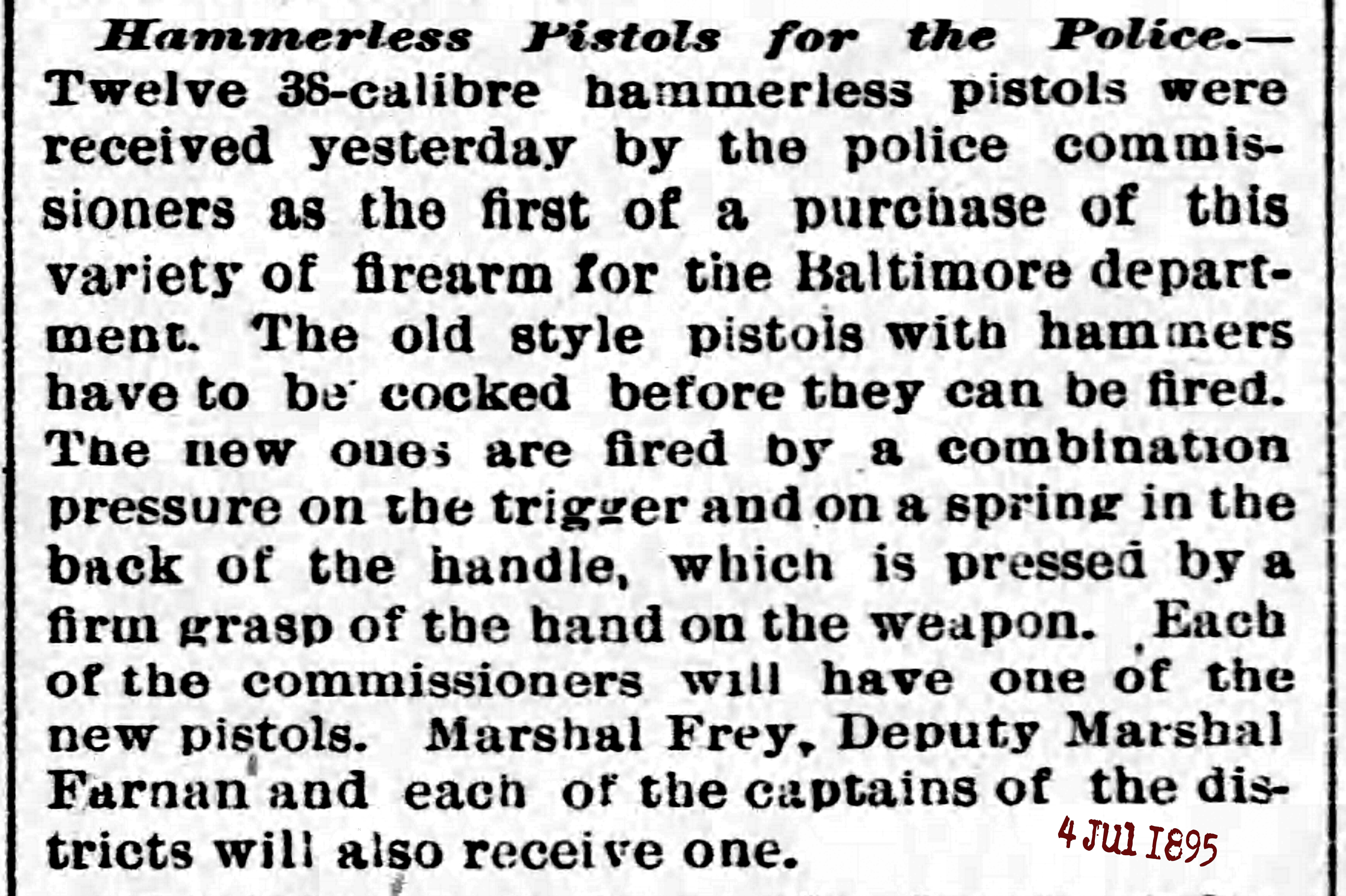
Sun Thu Jul 4 1895 hammerless pistol debut 72Baltimore Sun 4 July 1895

On 3 July 1895, one dozen Smith & Wesson .38 Cal Hammerless revolvers were purchased by the Baltimore Police Department, These were double action, and as things have always gone they issued these to the bosses first. Good thing, the brass could remained safe behind their desks, while the men in the field continued to carry the single action crap that also as things have always gone in Baltimore, the criminals had the better guns, and the police began playing a game of catch up It would be 1990 before The Baltimore Police would stop carrying the old wheel-gun, and finally get a 9mm semi-automatic pistol.

SW 38 Single Action First Model

1876-1917 - S&W .38 Single Action First Model (4”) revolver.

1 black devider 800 8 72

SW .38 Single Action Third Model

1916-1924 - S&W .38 Single Action Third Model (4”) revolver.1 black devider 800 8 72

Colt .38 Police Positive Special

1922-1970 - Colt .38 Police Positive Special (4”) revolver.1 black devider 800 8 72

Colt .38 Official Police

195?-197? - Colt .38 Official Police (4”) revolver.1 black devider 800 8 72

Colt .38 Detective Special

195?-197? - Colt .38 Detective Special (2”) revolver.1 black devider 800 8 72

SW Model 10HB Military Police

197?-1990 - S&W Model 10 Military & Police (4”)
Our Issued Model 10s had the heavy barrle as pictured below on the Model 64
More important than the Barrles issued were the grips, our guns were purchased

from Smith and Wesson with the oversized, "Target Grips." Photos will be added later1 black devider 800 8 72SW Model 64 Military Police

197?-1990 - S&W Model 64HB Military & Police (4”) Revolver.

The model 64 and model 10 are essentially the same gun. The model 10 is a blued, steel, the model 64 is made of stainless steel, both guns are sold with the smaller "magna" grips. The magna grips are the grips that just fit the frame. These guns are typically numbered in one place, and that is on the base of the pistols butt on the pistol's frame. Baltimore specifically ordered the oversize wooden grips. This was better for our shooters, but caused and issue where the serial number on the butt was covered. With this, in order to see the serial numbers, we had to remove the grips. To solve this problem, the BPD had to request a special order from Smith and Wesson, and that was in addition to the number on the butt, there would be a second serial number stamped on the gun that could be seen without taking the grips off. To do this, the put that second number on the frame under the Yoke Assembly.

Now this is an absolute 100% true story. This was going on while I was on the job. A lot of guys had the ammo webbing either built into their duty belt, or they had the slide on ammo webbing, some of these webbings held 6 rounds, others held 12 rounds. What a lot of officers were doing was taking issued ammo to a player to have them silver plated. Other officers that had been involved in a line of duty shooting were cutting notches in their grips. Sometimes on the street if they were trying to show some neighborhood tough guy what a thought guy the officer was, he'd use his thumbnail to "flick" at the notch or notches.

Word got back to old Donald D Pomerleau and he was not happy. He said the Department had paid extra for those oversize grips and he didn't like anyone messing them up. Word went out to all the Districts and down to all the Sergeants - "Check your guys guns. Anyone that has "notches" on their grips was to report to the range for replacements." No names were ever recorded. Those were the days. We have several of the silver plated .38 cal. rounds, I think there are only 5 of the Long Ranger rounds in there, we are not sure if the officer, carried a five shot revolver and used them in the webbing of a shoulder holster on his belt, or what the deal was, he may also have had a 6 shot but gave a round to a kid on his post. We will try to grab the rounds and webbing we have and add a picture to the site soon. The information pertaining to the serial numbers comes to us from a former Baltimore Police Officer named Gary Provenzano1 black devider 800 8 72


SW Model 10 Military Police

197?-1990 - S&W Model 10 Military & Police (2”) Revolver.1 black devider 800 8 72

SW Model 10 Military Police 2197?-1990 - S&W Model 64 Military & Police (2”) Revolver.1 black devider 800 8 72

Glock 17 9mm pistol

1990-2001 - Glock 17 - 9mm pistol.1 black devider 800 8 72

Auto Ordnance Model 1921 Thompson submachine gun

1922-1931 - Auto-Ordnance Model 1921 Thompson sub-machine gun.
Auto Ordnance Model 1921 Thompson submachine gun

Click HERE or on the above article to see full size article

1 black devider 800 8 72

Colt R80 Monitor automatic rifle

1931-19?? - Colt R80 Monitor automatic rifle.1 black devider 800 8 72

Winchester Model 670 bolt action rifle

19??-19?? Winchester Model 670 bolt-action rifle.1 black devider 800 8 72

Glock 22 40 cal. pistol

2001 - Glock 22 - 40 cal. pistol.1 black devider 800 8 72

1897

Winchester Model 1897

The Model 1897 was a superior slide-action exposed hammer shotgun that was specifically designed for the new smokeless powder.  Winchester manufactured just shy of one million Model 1897 shotguns, with the production taking place from July 1897 to September 1957.  The Model 1897 was an improved redesign of the older Model 1893.  Serial numbers were a continuation of the Model 1893 and began in the 34150 range, and continued through 1024701.

The Model 1897 was originally offered in solid frame 12 gauge only with a 2 ¾ chamber until April of 1898 when the Take Down was introduced.  The new 16 gauge with a 2 9/16” chamber was introduced in 1899, Take Down only.

The Model 1897 was offered in a variety of grades: standard Field; Fancy; Standard Trap; Special Trap; Pigeon; Tournament; Brush; Riot and Trench Gun.  The 20” barrel Riot and Trench Guns were especially desirable for Military and Law enforcement use. The Law enforcement Riot and Trench Guns may have police or prison unit markings.  The WW II military Riot and Trench guns will have “U.S” and flaming ordnance bomb markings.  Trench guns differed from Riot guns in that they have a ventilated heat shield and a bayonet stud attachment.  All Trench Guns and the military Riot Guns were equipped with sling swivels. The WW I Trench and Riot Guns were made in solid frame only, then for WW II, they were all Take Downs.

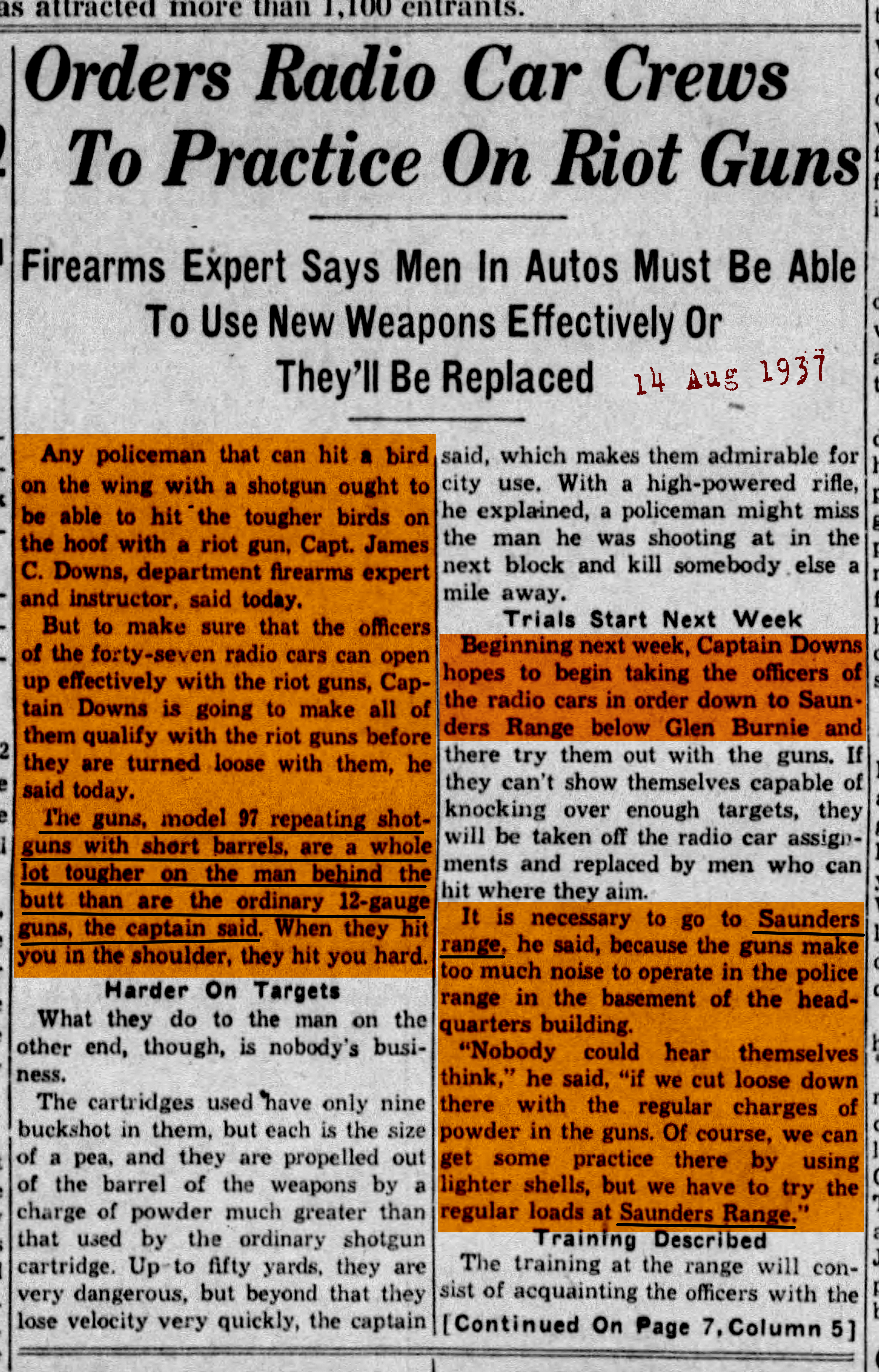
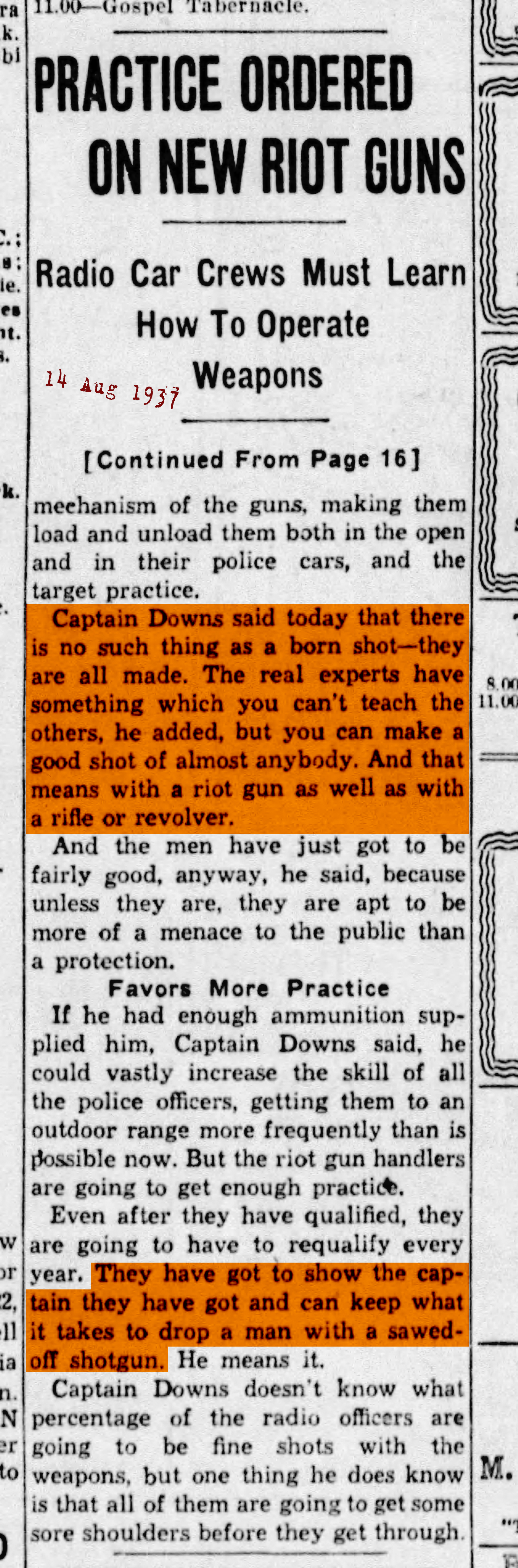
Shotguns were first put in radio patrol cars in 1937 the shotgun used at the time was the Winchester 1897. They only had 47 radio cars citywide at the time, training for the shotgun was done at Saunders Range in Glen Burnie. If officers couldn't qualify, they would be sent back to foot patrol and someone else would be given a chance. Training for qualification began on 21 Aug 1937

May be an image of text

To read the above article in full size click HERE or on the article

May be an image of book

To read the above article in full size click HERE or on the article. 

Saunders Range, named for Adjutant General of the Maryland National Guard, John S. Saunders, opened in 1904 on the property now known as Harundale. It was established for the training of army, navy and guard personnel in shooting and marksmanship. Men were assigned by company to spend two or three days at the site gaining proficiency with rifles and revolvers, aiming at targets set 200, 400, 800 and 1000 yards away. The training season ran from May 1 to about mid-August after which the site closed for the winter.

Practice began at 8:15 a.m. and ended at 6:00 p.m. with a one-hour break for lunch. Men lived in tents on the ground with few amenities at first. The year after the range was established, a canteen was added with a “No Intoxicants” policy strictly enforced. Emil E. Vanous and his brother, William, local residents were awarded the contract to run the establishment. In the following years an administration building was erected, and a sewage system was installed in 1910.

The site was ideally located in open country with sandy soil providing good drainage and a plentiful artesian water supply. It was close to the B&A Short Line Railroad which provided transportation and to Furnace Branch Creek which provided recreation for the men. Even at the time, “open country” was a debatable term. Mr. Osborn S. Pumphrey who owned a large farm in Marley, complained vociferously that bullets from the range were striking his house and he could not hire laborers for the fields since they feared being shot. Changes to target siting seems to have remedied the situation.

While the nearby railroad offered easy transportation to both Annapolis and Baltimore, few passes were given to the soldiers for fear of their bringing back “diseases contracted in the city.” Instead, evening entertainments were supplied within the camp. Shows with singing, music and “moving pictures” were offered along with boxing matches between companies. Shooting competitions were also held with medals and cups awarded to the best marksman.

In 1915, as the World War loomed, mobilization of civilians began. Classes of recruits were sent to Saunders Range for an introduction to military regulations, physical drills and shooting practice.

Saunders Range closed in 1926 and the Maryland National Guard put the property up for sale. In 1939, a proposal to build a “Negro housing development” on the site was met by spirited local opposition and soon abandoned. Finally, in 1946, the property was acquired by Byrne Communities, Inc. and in 1947 ads began to appear in local newspapers offering homes for sale in the new development of Harundale.

Information on Saunders Range came to us from Ann Arrundell County Historical Society 

1 black devider 800 8 72

1897Federal Gas Riot Gun

Description:
1.5 cal Federal Laboratories Inc. Pittsburgh, PA. Gun, a single shot has, flare, rubber ball or Buckshot with adapter. Steel barrel receiver with wood furniture. 1-1/2” bore; barrel is 12”,27-1/2” overall. Blue finish on all meta, varnish on all wood. Plastic butt plate. Break open action latch for opening, includes a sight set for 50 yards.

Considered to be a very early model; 4 types were produced. Used by police and prisons for crowd control. Mfg 1933. When fired for training, gas round went through both sides of house! Not an NFA controlled item unless you have buckshot adapter. No FFL or C&R required.

The Winchester Model 1897 became the most popular exposed-hammer, slide-action shotgun in history. Special features include fancy checkered walnut stocks, Damascus barrels, and engraving. According to a 1916 catalog, the plain-finish example sold for $25, while an engraved receiver with checkered and finer wood sold for $100.

Original Winchester factory records are available for this model from the Cody Firearms Museum in Cody, Wyoming, from serial number 1 thru 377999.  Polishing Room serialization records are available for all serial numbers. In Baltimore these guns were altered when they cut the barrel down the 20" barrel so they could maneuver in tight spaces, like Baltimore Row-home hallways, and staircases.

1956

18 Sep 1956 
The start of the agency's Riot Squad, and introduction of the Federal Gas Riot Gun

1 black devider 800 8 72

Remington Model 870 Police Magnum pump action shotgun

1964 - Remington Model 870 Police Magnum pump-action shotgun.

On 24 March 1964, the department announced the addition of 18 New Repeater Shotguns. Chief Inspector George Murphy reported that these guns were issued to 18 Police Radio-Cars, two in each of the nine districts. The Remington 12-gauge Pump Action Shotguns were issued primarily to the two cars in each of the nine districts that were designated as two-man cars. There were additional shotguns of this make and model purchased Some went into the armory, while others were assigned to the Department's Detective Bureau.

It is hoped that with the addition of these new guns we will have a further deterrent in the combat against violent crimes. While speaking of the department's former shotgun, a Winchester 12-gauge, "If they do not deter an attack on our officers, they will undoubtedly not defend an attack on our citizens." In 1964 Chief Inspector George Murphy said, of these new Remington shotguns, "They will pretty definitely, be effective."

The five-shot repeater has an "effective" range of 45 to 50 yards," said Serge. James Freeman, the department's firearms instructor. "Over 50 yards the nine .38 cal. Buckshot pellets fired from each shell will spread out to about four feet broad." Serge. Freeman said as he continued, by saying, "Effective Means Fatal!" An answer to what his Chief Inspector may have meant earlier when he said, "They will pretty definitely, be effective." In short, The Sergeant was saying, "These weapons are pretty brutal." He feels the weapon's killing power is about 10 times that of the .38 Cal. revolvers being carried by the officers patrolling our streets in the 1960s. The Chief Inspector said the shotguns have been issued for the use mostly in combating bank robberies, and commercial as well as residential, and highway or street robberies.

Two Baltimore City Police Officers, Francis R. Stransky and
Claude J. Profili had been killed up to this point in 1964. However, there would be three more Baltimore Police Officers killed before the year ended, they were Officers, Walter Patrick Matthys, Teddy L. Bafford, and Sergeant Jack Lee Cooper. Another of our officers was seriously injured in 1964 after being shot as he sought to capture a hold-up suspect.

If a criminal was thinking of bringing harm to a business owner, or a pedestrian walking down the street in Baltimore, and one of our officers came upon the scene with one of the new Remington pump-action Shotguns, we can assure you a reasonable and prudent man staring down the barrel of one of these weapons, it would stop them!" Inspector Murphy said at the time, "If they shoot at any of our officers, you can bet the officers will return fire."

Serge. Freeman said, "98 of the new guns have been purchased as replacements for the 1897- model Winchester Shotguns that were taken out of use in the late 1940s. Those old guns were basically modified hunting guns that we had the barrels machined down to 20 inches."

Each of the officers that will have access to these weapons will receive 12 hours of instruction to assure they were adequately indoctrinated and trained, in the use of this weapon." said Chief Inspector Murphy. Murphy was followed by Serge. Freeman who said, "During the Department's 12-hour course, officers are trained in the handling of the shotgun, the disassembly, reassembly, cleaning, and general maintenance of the shotgun. Following that, they are trained in, loading and unloading the shotgun. This is all before anyone would be taken to our range where they will first learn to hold, carry and aim, the loaded shotgun. But, they will not fire any of the weapons until they qualify with safely handling the weapon; to include breaking it down, cleaning it, and rebuilding the weapon. When they successfully qualify for this portion of the training, they move on.

Once an officer is completely trained in how to safely handle the weapon in public situations, whereas they prove their knowledge as to how the weapon is broken down, cleaned, oiled and reassembled within a timed examination. Once our officer satisfactorily meets the requirements of the first portion of this training, (Knowing the Weapon) they can move on.

The last parts of their training involve more than just aiming at a target, but knowing what's behind a target as we visualize a practicum in which we are confronted by an armed suspect [the target], and then using risk assessment of taking, or not taking the shot. Officers being reminded, "Not" taking the shot, can make an officer as liable for suit as taking the shot and hitting a bystander. If a suspect brings harm to someone and as officers, we fail to protect them. The Sergeant went on to say, all the training in the world is good, but it is pretty much up to a man's common sense." Serge. Freeman agreed with the Chief Inspectors assessment in that the shotguns will be effective in reducing, if not stopping certain crimes." - "A lot of people will throw down their weapons at the crime scene, or give themselves up rather than face down a shotgun." he, continued, "Criminals know what a shotgun can do to a person, and so they more often than not will do the smart and prudent thing!!!"

The issued 870 had 20" barrels, rifle sights and were equipped with leather slings. Every sector in every District had a 2 man "Shotgun Unit" that was also a regular Sector Car. The shotguns were kept in a wooden case/box in the trunk of the radio car.  The original weapons issued to QRT, besides the standard Model 10, were Remington 870 Shotguns, Universal M1 .30 caliber carbines (which they thought would be ideal for penetration), M-16's (which were to be kept on semi-auto unless otherwise authorized by a "Superior Officer"), and a Winchester Model 70 bolt action sniper rifle in .243 caliber.

1 black devider 800 8 72


Springfield M14 semiautomatic rifle

200? - Springfield M14 semiautomatic rifle.1 black devider 800 8 72

Baltimore City Police Department

1975 Quick Response Team (QRT) - 2006 Special Weapons And Tactics (SWAT)
QRT/SWAT in 1975 when they started working on forming the SWAT team, the team name SWAT was rejected,  after serious consideration, QRT (Quick Response team) was chosen. It wouldn't be until 2006 that the Baltimore Police Department would accept the name change, and replace QRT with the name SWAT1 black devider 800 8 72

Glock 17 9mm pistol

1990-2001 - Glock 17 - 9mm pistol.1 black devider 800 8 72

Beretta Mod 12S submachine gun

1986-???? - Beretta Mod 12S submachine gun.1 black devider 800 8 72

HK UMP submachine gun

200? - (.40 S&W) H&K UMP sub-machine gun.1 black devider 800 8 72

HK G36K assault carbine

200? - H&K G36K assault carbine.

1 black devider 800 8 72

Baby Russian 1Baltimore City Police Baby Russian

Man and Arms Magazine
Volume 1 - Number 5

September/October 1979

The Baltimore City Police Baby Russians

By Major Charles W. Pate

One can say with considerable confidence that the most widely known single-action Smith & Wesson used in police service is the “Nashville Police” American Model. Several factors combine to make the Nashville Police a highly sought-after collector’s item. The guns were all First Model Americans, which in itself makes them quite desirable. They had special order 6-inch barrels. There were only 32 ordered. And, last of all, they are distinctively marked on the grip backstrap.

Much less well known is a Smith & Wesson which also saw law enforcement service, a .38 single-action First Model, better known as the “Baby Russian.” While the model is in itself a very interesting one to study, the specimen illustrated here has additional significance and that it was one of an apparently small number used by the Baltimore City Police Department.

The Baby Russian (properly called open, .36 single-action First Model” or “Model Number Two First Model”) was the direct predecessor to .38 caliber revolver that became the standard for the world. During the early 1870’s there was growing demand for a modern, automatic injector revolver was stopping power but without the weight, size, and inconvenience of the .44 or .45 pistols. “Texas Jack” Omohundro wrote to Smith & Wesson inquiring as to the availability of a .38 caliber pistol using the Smith & Wesson .44 style action. He stated, “I have been requested by many friends to get them one but have been unable to find them in sale stores. Weight seems to be the objection to the larger.” Regardless of how he was convinced as to the demand for such a pistol, D. B. Wesson soon had one to fill the bill.

The Baby Russian was to be the first in a long line of revolvers which, perhaps more than any other, has served to make Smith & Wesson successful and famous. Interestingly enough, Mr. Wesson chose first to design the cartridge rather than the revolver: the .38 Smith & Wesson – a centerfire, reloadable cartridge which has an actual bullet diameter of .36 rather than .38. The revolver designed to use the new cartridge was essentially a scaled down version of the new model Russian – hence the term “Baby Russian” the most obvious difference between the two, other than size, is the spur trigger guard in place of the boat type with finger spur used on the larger pistol.

The Baby Russian was made for only a little over a year. It was first commercially available in March/April 1876 and was replaced by the .38 SA Second Model in July 1877. Serial numbers run from one to approximately 25,548. There are several variations of the revolver which, together with the relatively small number produce, enhance its collectors interest. There were two barrel lengths – 3 ¼” and 4”. Standard finish was nickel and only 6502 were produced in blue. Of the blue guns 6333 had wood grips; the remainder were finished with rubber, pearl, or ivory grips. Only the very early nickel guns had wood grips. Hard rubber grips were introduced with this model and were the standard grips for the nickel pistols. There are other variations, however they are of little significance except to the advanced Smith & Wesson collector.

pistol6

The Baby Russian and its immediate successor, the .38 SA Second Model, enjoyed considerable success. Between 1876 and 1891 a total of 133,803 of these guns were made. Also, during and after this period, the same .38 Smith & Wesson cartridge was being used in the .38 Smith & Wesson double-action and Safety Hammerless Models. However, the utility of the .38 SA Smith & Wesson was demonstrated not only by the number of guns sold but also by who was buying it.

Jacob Wagner, a Federal Revenue Agent, bought several for his fellow agents to supplement the Schofield’s with which they were armed. Max L. Gumpert a Military Taylor, requested price quotations for five dozen for resale to St. Louis Policeman. Without a doubt, many such men bought these guns for personal use as pocket pistols. While individual purchases were a common occurrence, the only group of .38 SA’s known to the author which show evidence of purchase by a police organization is the “Baltimore City Police.”

Over the past few years several of the Smith & Wesson Baby Russian revolvers with “Balto. City Police” engraved on their back straps have been noted, all in the Baltimore, Maryland, area. Six complete revolvers and parts of two others have been studied in detail. A close-up photo illustrates the most distinctive aspect of the revolvers are a number 6702. Revolvers 4746 – 5052 – and 5154 all have identical back strap markings. Unfortunately, frames of the other revolvers listed in the accompanying chart were not available for study.

Reportedly other styles of marking exist on Balto. City Police Baby Russians. Sgt. Bruce Green, and Unofficial Historian of the Baltimore Police Department, has observed three styles of markings: a script style of a priceless same size illustrated, the block style of the above gun, and a block style with smaller letters. All are engraved as opposed to being stamped, and all read the same “Balto. City Police,”. The illustrated markings are 1 3/8 inches long, “Balto. City Police,” and are centered on the backstrap.

BPD Revolver 1875 3

At this date little or no documentary evidence links these guns to the Baltimore Police Department. Sgt. Greene has done considerable research of existing records of both the Police Department and appropriate city offices. He reports that few records now exist, and those that do lack organization and proper care. The only documents found so far which probably concerned these revolvers refer to the “.38 caliber” weapons in use. No other .38 caliber weapons of this vintage are known to exist with similar markings. While they may be the case, the lack of hard documentary evidence is frustrating. It appears that we are not as fortunate as the researchers of the Nashville Police American Model, since they found significant references to the purchase of those firearms.

The Baltimore area people seem unconcerned about documentary evidence. To them it is a commonly accepted “fact” that these guns were used by the Baltimore Police Department. Several of the recent or current owners of the known specimens are active or retired members of that force. Additionally, examples of a peculiar holster are known to exist which was used with the Baby Russian. This also reportedly was secured by uniform buttons instead of belt or straps.

Sgt. Greene estimates the period of use for these revolvers was between 1876 and 1917. Prior to 1876, and perhaps for some time afterward, Percussion Colt Pocket Model were in use. Several such revolvers are in Baltimore area collections and have back strap markings the same as or similar to those on the Baby Russian. In approximate 1917 the Baltimore Police Department switched to the Smith & Wesson Perfected Model. Two examples of this model, again marked in a similar manner – were manufactured in 1917. The Baby Russians period of use is a matter of speculation, with only the shipping dates of marked weapons and a very limited documentation providing evidence upon which assumptions can be based. While this is true, the weapons themselves to provide some very convincing evidence that the guns were at least used by that organization.

The accompanying chart depicts the common characteristics of the guns. Note that all were shipped to the same dealer at about the end of July 1876, all undoubtably part of the same order. The dealer, Trimble and Kleibacker, was a gunsmith firm located at 200 West Baltimore St. in Baltimore. This partnership was formed after a previous partnership [1860 to 1876] between Thomas Poultney and David B. Trimble dissolved. The earlier partnership was apparently successful considering its duration and the fact that the Federal Government purchased 30,362 Smith carbines from the firm during the Civil War. Trimble Association with C. B. Kleibacker lasted until 1880, after which the firm is listed only under the Trimble name.

The revolvers all appear to be the same configuration: 4” barrel, hard rubber grip, nickel finish. At least three of the listed guns are re-nickeled and suitable characteristics of non-factory refinishing. One gun is not obviously refinished but has nickel plating in the engraving, an indication that the weapon was nickeled after the engraving was done. The other guns which appeared to have original finish have no plating in the engraving. Most probably the markings were added after the guns left the factory.

In summary, the evidence, while somewhat circumstantial, is consistent an extensive. We have what is probably a satisfactorily significant number of marked examples (considering age and typical survival rate, the modest number of revolvers made with this exact configuration, and a reasonable geographic distribution of all those that were made in this configuration.) All the marked guns, for which serial numbers information exists, were shipped to the same dealer (in Baltimore) on or about the same date (suggesting a single quarter.) The dealer (or at least the Trimble half of it) was an established firm – the type from which a Police Department might buy guns. The guns have commonality of marking and share this common feature with other guns purported to have seen service with the police department. All the revolvers have seen extensive use and the refinished guns so that considerable use occurred after the refinish work. This would be consistent with a long period of use by the police. The numbered parts of the given revolvers may be present on one or more revolver from the same group (a common occurrence with military or police guns.) The markings are obsolete very old as evidenced by the presence of nickel plating in the engraving all well-used re-plated revolvers. And, lastly, all the known examples have come from the Baltimore area. This would also support the estimated long period of police use. Almost all of the Balto. City Police Baby Russians have been or are in Baltimore police officer’s collections. They have been, until now, virtually unknown or ignored by other collectors – even Smith & Wesson collectors.

While the evidence seems convincing – that the Baltimore Police Department did, in fact, by and use these revolvers – exactly how many did they buy? Were there other variations? How many still exist? Sgt. Greene states that he has seen a total of perhaps 10 – 15 of these revolvers. Reportedly the revolvers with the smaller block letters are from a considerably higher serial number range. However, the author has not yet been able to see any of these revolvers nor has he any data other than what is presented here. Any further information would be greatly appreciated by is website.

Note: In 1893, one Mr. William de Courcy Prideaux, a subject of Queen Victoria, patented a device he referred to as a ‘cartridge-packet holder’. This device was a circular disc through which 12 spring-steel fingers protruded in six pairs. Each pair held one .455 caliber round for the British Webley style revolver. A later 1914 improved design added a bridge-like handle to the rear of the plate. We know this device as the Speedloader -

Click HERE for more on the Speedloader

The Smith & Wesson Model 2

The Smith & Wesson Model 2, also referred to as the Smith & Wesson .38 Single Action, was a .38 caliber revolver produced in both single and double action by Smith & Wesson. The manufacturer's first of that caliber, its 5-shot cylinder was chambered in .38 S&W. The single-action was produced in three varieties from 1876 through 1911, with total production exceeding 223,000 units: the double-action in three variants from 1880 to 1913, with total sales somewhat under one-million guns.

The Model 2 fired a black powder cartridge. It was a "top-break" weapon, with the barrel release catch located on the top of the frame, just in front of the hammer. It was a larger caliber version of the third model of the Smith & Wesson Model 1 1/2.

Single Action -  In 1876, Smith & Wesson Model 2 debuted in a single-action format, meaning the hammer had to be cocked manually to set the trigger in order to fire the revolver. These revolvers fired black powder cartridges and were available in nickel or blued finishes.

1st Model -   The first model of the .38 Single Action can be identified by its smooth barrel (lacking fluting), and the long extractor shroud similar to the Smith & Wesson Model 3 Russian pistol, which lent it the nickname "Baby Russian". It had a spur trigger and lacked a trigger guard. Models were available in blued or nickel-plated finishes, and the majority were produced with 3+1⁄2-inch or 4-inch barrels, although barrels as long as 7 inches were sold.

Serial numbers range from 1 through to 25,548 between 1876 and 1877. This pistol was used by the Baltimore Police Department from 1876 to 1917 and such revolvers are marked "City of Baltimore".

2nd Model -  The second model of the 38 Single Action used a shorter and more efficient ejection and extraction system and lacked the shroud of the 1st model. It was produced in blued steel and nickel-plated versions, with most models having a 3+1⁄2-inch or 4+1⁄2-inch barrel. Rare versions had barrels of 6, 8 and 10 inches in length.

These revolvers had a spur trigger, lacked a trigger guard and were serial numbered consecutively from 1 through 108,255. at least one second model was produced with a 5 in barrel, with last three numbers of SN "007".

3rd Model -  The third model of the 38 Single Action was made from 1891 to 1911 and is often known as the 1891 Model, Model 01 or the Model of 91 as the latter is stamped on the top of the barrel. This version used a standard trigger and a trigger guard, but 2000 of these revolvers were made for the Mexican government with the spur trigger and no guard and are referred to as the "Mexican Model".

1 black devider 800 8 72

 bpd tac vehicle

Uses the Lenco Bear-Cat 4×4 armored car.

Devider

BPD Espantoon WHITE 72

The espantoon is a wooden police baton equipped with a long leather strap for twirling. It originated, and is still strongly associated, with the Baltimore Police Department in the city of Baltimore, Maryland. The term is considered distinctly Baltimorean. The word itself derives from that of a pole weapon, a spontoon, which was carried by infantry officers of the British Army during the Revolutionary period. Since the espantoon has been considered a symbol of the "policeman's office and dignity". Before the advent of wireless communications, the espantoon was reportedly used by Baltimore policemen to call for assistance where its user would bang it on the curb or a drainpipe. In 1994, Thomas C. Frazier took over as Baltimore's police commissioner and banned the espantoon. Frazier, a Californian, believed that the device, and the policemen's twirling of it, was intimidating to the civilian populace. He attempted to replace it with another weapon, the Koga. Many officers, however, felt that the Koga was cumbersome, difficult to master, and even more dangerous than the espantoon. In 2000, Edward T. Norris assumed the office of Police Commissioner and lifted the ban on the espantoon, although he did not mandate its use. The move was made as part of a general effort to boost morale and install a more aggressive approach to policing in Baltimore. Norris stated, "When I found out what they meant to the rank and file, I said, 'Bring them back.' ... It is a tremendous part of the history of this Police Department."

sap gloves

Sap Gloves - Weighted-knuckle gloves, also called sap gloves, are a type of weapon used in hand to hand combat. They consist of a pair of ordinary looking gloves usually made of leather or a synthetic material, with powdered lead or steel sewn into a special pouch covering the knuckles, and often the backs of the fingers and the back of the hand. In some designs, this distinctive feature is obvious, while in others it is almost completely indistinguishable from an ordinary glove, allowing the gloves to be worn in plain sight without suspicion. They are primarily used by security guards, and by bouncers and other security professionals where physical combat is expected. The purpose of these gloves in combat is both offensive and defensive. Offensively, the weight of the metal powder adds mass and therefore kinetic energy to punches, backhands and other hand strikes. The weighting also distributes the impact in a manner similar to a blackjack, transferring concussive force in the case of a head-strike to cause a knockout. This is the opposite of brass knuckles, which are designed to concentrate the force of a blow in a smaller area to cause more tissue damage. However, the primary aim of the gloves is actually defensive. Normally, punches with the unprotected hand against an opponent’s head or face will painfully injure the hand in the process, and strikes to the mouth can often result in severe lacerations from the opponent’s teeth. The layer of powdered metal serves to protect the hand against these injuries, without compromising the effectiveness of the strike. Properly executed, a person wearing weighted knuckle gloves can even punch glass or concrete without injury or even pain. The gloves also protect the hand from blows inflicted by the opponent, allowing the user to block minor strikes from blunt weapons such as sticks. This is especially important in maintaining one’s grip on the opponent should they try to dislodge the grip using strikes to the back of the hand. Some designs include a Kevlar lining to add further protection against lacerations. Unlike brass knuckles, weighted knuckle gloves are legal in most areas, as they are generally considered “less-lethal weapons", due to their defensive nature. In some jurisdictions, including Australia, they may be restricted under more general "dangerous weapons" laws. In the United States, weighted knuckle gloves are illegal in the states of Massachusetts and California. In New York, sap gloves are not specifically denominated as unlawful weapons by state law. However, they may be unlawful to possess with intent to use them unlawfully against another. In the United Kingdom, weighted knuckle gloves are legal to buy, sell and own. However, possession in a public place without a reasonable excuse or lawful authority is illegal. Like anything, it is best to check and double check your local laws… Contact the Baltimore Stares Attorneys offices, Maryland State Police, and the Police department in your area (Don’t rely on a single answer – Double check your facts and get a name)

slapjack and blackjack 

Blackjack/Slap Jack - A blackjack (American English), or cosh (British English), is a small, easily concealed club consisting of a leather-wrapped lead weight attached to the end of a leather-wrapped coil spring or rigid shaft, with a lanyard or strap on the end opposite the weight. Materials other than lead and leather are sometimes used to construct these weapons, but the design principle (a soft covering over a dense weighted core) stays the same. Some were weighted with a heavy lead ball wrapped in woven or plaited sailor's line (marline or codline) and then varnished over. Some carefully made examples were likely to have been used by a boatswain or ship's master-at-arms or ship's mate as a badge of office and discipline-enforcer. This weapon works by creating kinetic energy in the dense core, via the spring handle, during the swing. When directed at the head, it works by concussing the brain without cutting the scalp. This is meant to stun or knock out the subject, although head strikes from blackjacks are regularly fatal. Blackjacks were popular among law enforcement for a time due to their low profile, small size, and their suitability for knocking a suspect unconscious. Coshes have also been used by the military for example by Special Forces such as the British Special Operations Executive during the Second World War. Currently, however, they are all but prohibited in most municipalities due to liability issues stemming from their potential lethality when used as a compliance device. A blackjack is sometimes wrongly referred to as a sap. "Blackjack" is also American English slang referring to an improvised weapon composed of a heavy object placed inside a sock. The same improvised weapon is referred to in British English slang as a "Slungshot" or a "Cosh."  

Jan 1995 newsleter16 November 1994 - The department ended the authorized use of the Slapjack

Devider

Slung-shot [slúng shòt]
Noun - A weight or weight attached to the end of a cord and used as a weapon

Cosh[käSH]
Noun - a thick heavy stick or bar used as a weapon; a bludgeon.
Verb - hit (someone) on the head with a cosh

Devider

$70,000 Awarded in Police Assault Case

July 19, 1994


By Norris P. West | Norris P. West, Sun Staff Writer

A Baltimore Circuit Court jury has awarded $70,000 to an East Baltimore man who said he was assaulted by two city police officers who mistakenly came to his home while searching for a suspect who lived nearby. The jury awarded $50,000 in compensatory damages and $20,000 in punitive damages to Eddie J. Duncan, 45. The panel found that Officers Michael Johnson and Vincent McCoy assaulted the man, violated his constitutional rights and falsely imprisoned him on Aug. 1, 1992. The jury's verdict came late Friday before Visiting Judge Donald G. Gilmore. Mr. Duncan filed the lawsuit on May 6, 1993, claiming the officers, acting on an arrest warrant, arrived at his home at 1227 E. Oliver St. to look for a man named Terry Williams, whose address was 1727 E. Oliver St. He said the owner of the home identified him as Eddie Duncan and told police there was no Terry Williams at 1227 E. Oliver. Mr. Duncan said the exchange occurred outside, and when he went into the house and tried to shut the door, Officer Johnson reached inside and grabbed his shirt. Mr. Duncan said the officer tackled him and Officer McCoy joined the scrap, which lasted several minutes. During that time, he said, he was beaten on the head with a hard object that resembled a blackjack. He said the officers handcuffed him and placed him in leg irons, charging him with assaulting Officer Johnson. He said he was wrongly jailed for 19 hours. The officers said Mr. Duncan initiated the physical contact by pushing Officer Johnson from the doorway, and that Officer McCoy came to his partner's aid while a fight was underway. Robert C. Verderaime, the attorney for the officers, called the verdict excessive. He said hospital records did not support Mr. Duncan's claims of severe injuries. He said he will ask Judge Gilmore to reduce the judgment.

 Devider

Man Awarded Damages for Police Harassment

[FINAL Edition]

The Sun - Baltimore, Md.
Author: Siegel, Eric


Aug 11, 1994


Start Page  - 1A

In what a federal judge described as a shocking case of misconduct, a Baltimore man who was a key witness in a 1991 police brutality case was himself unconstitutionally harassed by a city officer in retaliation for his testimony. U.S. District Judge Marvin J. Garbis, in a strongly worded written order, said Officer Richard Iglehart acted improperly when he stopped Matthias S. Carter without cause when Mr. Carter was driving in Southeast Baltimore two years ago. Officer Iglehart's action was "planned for months and was intended as a `payback' for Carter's testimony" in the 1991 brutality case, said Judge Garbis, who heard Mr. Carter's civil suit without a jury. "There was, without question, an evil motive for the unconstitutional stop -- the motive of harassing Carter and demonstrating to Carter {and others who would hear about it} that those who have the temerity to testify against Southeastern District police officers are going to regret having done so," Judge Garbis said.

Judge Garbis in May upheld Mr. Carter's claim that his rights were violated and awarded him damages.

Last week, the city's Board of Estimates approved payment of a $28,097 judgment to Mr. Carter -- $15,500 in damages, plus $12,597 in legal fees. Judge Garbis said that the officer's action "strikes at the heart of that part of our legal system designed to protect civil rights and "at the effective functioning of the courts." "There cannot be any toleration of harassment of witnesses testifying in our courts by any person. Even more so, there will be no toleration of police harassment of witnesses," the judge said. Mr. Carter, 53, a former police equipment salesman, spent the night in jail after the stop on charges -- later dismissed -- of illegal possession of handguns and deadly weapons. He said this week that he isn't satisfied with the amount of the award -- or the fact that the officer who violated his constitutional rights is still on the streets. "Fifteen thousand dollars? It should have been a whole lot more," he said. As for Officer Iglehart, then assigned to the Southeastern District and now a patrolman in the Eastern District, Mr. Carter said: "He should have lost his job or been severely punished." Since Judge Garbis issued his order against Officer Iglehart, the Baltimore Police Department has begun its own investigation. "The facts and circumstances are being reviewed to determine whether a departmental disciplinary action is appropriate," said Officer Robert W. Weinhold Jr., a police spokesman. Efforts to reach Officer Iglehart, 34, were unsuccessful. His attorney, Robert C. Verderaime, said he believes his client acted properly but there were no grounds for an appeal. "The court drew inferences from the testimony and resolved them in favor of Mr. Carter," he said. "While we disagree with the findings, that's what litigation is all about." Two other officers who were also used by Mr. Carter for participating in the arrest were found not liable. Matthias Carter's case is rooted in a Nov. 4, 1989, incident. At the time, he was working for Valley Police Supply in Parkville, a job for which he had a permit to carry a gun. He was moonlighting as a cashier at a 7-Eleven store in the 6600 block of Holabird Ave. in Southeast Baltimore. Shortly after midnight, on the street outside the store, Mark Hafner fired a blast from a shotgun in the air and several through his windshield, according to court records. Confronted by officers minutes later, Mr. Hafner dropped his gun and was arrested. Mr. Carter, who went to see what was happening, said he saw Mr. Hafner handcuffed face down on the ground, with "one officer lying across his feet, and another kicking the hell out of him." Mr. Hafner was found not criminally responsible for his behavior and spent two years in state mental hospitals, according to his attorney, Allan Henson, who also came to represent Mr. Carter in his suit against the police. Mr. Hafner filed suit against the officers who arrested him, charging that they used excessive force. Mr. Carter was a key witness in the trial. In September of 1991, Mr. Hafner won a $50,000 judgment against the arresting officers -- who did not include Officer Iglehart. Even before the case was decided, Mr. Carter, who had been friendly with several police officers in the Southeastern District, said he noticed a change in the relationships. "Anytime I saw any of the officers, they avoided me or gave me dirty looks," he said. Not long after the decision in the Hafner case, Mr. Carter quit his job at the 7-Eleven. He also left Valley Police Supply and went to work selling police equipment for the Maryland Troopers Association Store in Pikesville. Because his new job did not require him to sell guns, his gun permit was not renewed. Late on the evening of April 29, 1992, he said, he was returning from a trip to the Eastern Shore making sales calls to police agencies and going target shooting with a friend. When he reached Baltimore, he stopped for coffee at the 7-Eleven where he used to work. While he was in the store, he was spotted by a Southeastern District officer, who radioed Officer Iglehart, according to court records. Officer Iglehart, who had found out months before that Mr. Carter's gun permit had expired, drove to the 7-Eleven and decided to stop Mr. Carter after he left the store, records show. Almost as soon as Mr. Carter drove onto Holabird Avenue, he was pulled over by Officer Iglehart. "Carter's driving was not such as to provide reasonable cause for a stop for any traffic purposes," Judge Garbis wrote. "Iglehart stopped Carter because, and solely because, he wished to harass him." Mr. Carter had a loaded .22 Derringer and an unloaded .357 Magnum in his car, records show. He also had a trunk full of police equipment, including a blackjack. He was charged with various handgun and deadly weapons violations. Officer Iglehart's statement of charges against Mr. Carter included the "false statement" that the officer had seen Mr. Carter drunk on several occasions, apparently to "provide a fabricated justification for the stop of Carter," Judge Garbis noted. The charges against Mr. Carter were dismissed in October 1992, when a Baltimore District judge threw out the evidence, ruling that it had been improperly obtained. Mr. Carter, who left his job at the Maryland Troopers Association Store shortly after his arrest and is currently unemployed, said his experience has changed his attitude toward police. "I don't trust a cop anymore," he said. "I used to consider myself a good friend of a lot of cops. Now I feel a cop's only friend is another cop."

 Devider

Better Training in Use of Force Urged for Police

[FINAL Edition]

The Sun - Baltimore, Md.
Author Hermann, Peters


5 Nov 1994

Section: Metro

Better Training in Use of Force Urged for Police

The Baltimore Police Department needs to better train its officers in the use of force against suspects and should ban two types of long-used, but unsanctioned, weapons, a consultant has concluded. A report, which was released in summary form yesterday, urges the department to adopt a comprehensive policy on the use of force that would consolidate a series of disjointed memos and training guidelines. "To an outside observer, our efforts in {training} would certainly appear to be fragmented and sporadic, at best," Col. Joseph R. Bolesta, chief of the Human Resources Bureau, wrote in a memo responding to the report. "I'm not surprised by what they found," said Police Commissioner Thomas C. Frazier. The report also called for standardized nightsticks to be issued, instead of officers being allowed to buy their own, and for a ban on weapons such as blackjacks -- small leather pouches filled with lead pellets or a steel plate. Mr. Frazier asked for the review in August after West Baltimore resident Jesse Chapman was found dead in the back of a police van after his arrest. Witnesses said officers beat the 30-year-old man, an allegation not supported by a grand jury review. The founder of the institute that prepared the report, Robert K. Koga -- who has known the commissioner since his days in San Jose, Calif. -- and an aide spent 2 1/2 days in Baltimore, at a cost of about $3,000, and are still poring over manuals as they evaluate the department. Mr. Koga founded the training and consultant center in the early 1980s after he retired from the Los Angeles Police Department. It has worked with numerous police agencies nationwide, including those in Denver, San Jose, and Dallas and with the U.S. Secret Service. The Baltimore department declined to release the full report, saying it contained sensitive tactical information, but made public Colonel Bolesta's memo outlining the institute's findings and his responses. William Pelkey, executive director of the Koga Institute, said developing a standard policy on the use of force is essential to ensure a safe department that can be trusted by citizens. "Written policies drive police departments and establish parameters in which officers function," he said. "Everything pertaining to the use of force should be together. You should look in one place and find the philosophy and the practice. When you don't have those together, you might have contradictions." The main problem in Baltimore, Mr. Pelkey said, is that department rules are "so fragmented that officers have no clue on what is authorized or not." Some recommendations by the institute may not be implemented. For example, the report calls for monthly firearms training for each officer, something Colonel Bolesta said is impractical because of a lack of money and training space. Officer Gary McLhinney, president of the Fraternal Order of Police, said he supports the institute's finding in regards to training. Until last year, he said, officers only fired their weapons once a year on a practice range. Now, they train twice a year. "That's inadequate," Officer McLhinney said. "The fact they recognize there is a problem with training is a step in the right direction." Officer McLhinney would not comment on the recommendations to ban certain equipment. Mr. Frazier said he became concerned after the Chapman incident, which is still under internal review when he learned an officer may have hit Mr. Chapman in the back with a blackjack. He said there is a "consensus of the command staff that slapjacks and blackjacks are inappropriate law enforcement tools." They most likely will be banned, Mr. Frazier said. Colonel Bolesta agreed. "We've never trained anyone to carry that equipment," he said. "That concerned us. . . . We don't issue them. But there is tacit approval for that kind of thing." The institute also recommends that the department replace the "espantoon," a 22-inch nightstick with a knurled end, with a 29-inch straight baton. Mr. Pelkey said the longer stick is safer for officers involved in a close struggle with a suspect and its smooth surface avoids unnecessary injuries to people being hit. Also on the way out could be the leather handle on the end of the nightstick, used by officers to twirl their batons. The sight of officers walking down the street swinging the stick can be unsettling to residents, some commanders feel. "The thong serves no useful purpose other than decorative and should not be considered as an addition to any future impact weapon adopted by the department," Colonel Bolesta wrote in his memo.

Devider

Baltimore Police Retire the Twirling Nightstick, ending a Century of Use

March 27, 1995

By Peter Hermann
 Peter Hermann, Sun Staff Writer

Only in Baltimore is it called an Espantoon

Now, after nearly a century of use, the fabled nightstick -- used by city police officers for self-defense and subduing suspects -- is about to become a museum piece, the result of a controversial order by the department's chief. Commissioner Thomas C. Frazier, who has been at the helm just over a year, has chosen a longer baton to replace the stick now seen on the street. The rawhide thong also will become history, ending a time-honored practice of twirling the sticks. Critics say that the city is sacrificing part of its heritage and that training in how to use the new baton returns the department to an era of more violent policing. They also worry about potential conflicts of interest because the organization that recommended the change is connected to a nightstick maker. "There is an unusual amount of criticism from people who have participated in the [training] program," said Officer Gary McLhinney, president of the Fraternal Order of Police Lodge 3.

"I've heard more complaints in the past month on this issue than anything else." Mr. Frazier acknowledges that the change "flies in the face of tradition." But he says the move will standardize the sticks at one weight and length, could help reduce injuries and help officers better defend themselves. Such improvements in equipment and training are "critical in modern-day policing," he says. Of the twirling, he said, "some people find it incredibly offensive and intimidating. It sends the wrong kind of message of what the police officer is doing and what he intends to do with the stick. Would you walk to an officer twirling one of those?" The espantoon first surfaced in Baltimore at the turn of the century, when the police department issued the sticks only to night-shift officers. Before police radios officers communicated by banging their sticks on the sidewalk. And officers have found many uses for the thong -- from tourniquets to pulling drunks from the Inner Harbor. Webster's Third Edition dictionary defines the term: "Espantoon, Baltimore, a policeman's club." The term is derived from the word "spontoon," a weapon carried by officers in the Roman legion, according to a police department training bulletin. Between 22 and 26 inches long and made of seasoned hickory, maple or locust wood, the club -- described in a 1960 Sun headline as "The Policeman's Best Friend" -- has become part of Baltimore lore.

One 1947 Sun article, headlined "Swing Class -- In Blue," explained the intricacies of nightstick twirling. Even then, the article noted, police commanders expressed concern about the image that twirling presented but were reluctant to change. "After all, telling a policeman not to swing his espantoon would be like asking a happy man not to whistle," it said. For decades, Baltimore police officers have bought their own sticks -- most often from other officers who turned them out on basement lathes. Officer Joseph Hlafka, known throughout the department as "Nightstick Joe," started making the sticks early in his career. He charges $30 a stick, some of which are customized with nicknames. Now, after selling more than 22,000 sticks nationwide, he's losing his local market. "If there is an officer out there who is not carrying one of my sticks, he is not a member of the Baltimore Police Department," he boasted. The 27-year veteran, who patrols the Inner Harbor, criticized Mr. Frazier for "not considering the historical aspect in all this. It's just a shame. All this history and he's just throwing it by the wayside."Officer Hlafka defended the thong as a safety device that prevents people from grabbing the stick and taking it away. The twirling, he said, keeps people from sneaking up on an officer. "I think people like to see us twirl the stick," added Officer McLhinney. "Criminals don't like to see us twirl the stick. I have BTC heard that twirling the stick is intimidating. It's supposed to be intimidating. It's a stick." But the commissioner said the change in nightsticks comes from "an analysis of use and injuries and complaints both in terms of internal investigations and image and perception. As we try to become a more community-oriented agency, it's a change I felt necessary to make." He said he also has "serious concerns" about the variable weight of the privately made nightsticks. "The larger the circumference and the heavier that stick is, the more it is like a bat," he said while expressing concerns that grooves in the espantoon's handle can cause injuries. James J. Fyfe, a professor of criminal justice at Temple University and an expert in police use of force, said it is important that departments have standardized equipment. "They should all have the same [nightstick]," said Mr. Fyfe, a former New York City police officer, adding that many departments across the country are going to the straight baton. Last year, after Mr. Frazier found Baltimore's police training to be inconsistent, he turned to the California-based Koga Institute. The institute also is used by the San Jose Police Department, where the commissioner worked before coming to Baltimore. Koga evaluators found that regulations spelling out when Baltimore officers could use force were contained in a series of disjointed memos instead of in uniform guidelines. Koga proposed eliminating officers' "slapjacks" -- hand-held pouches filled with lead -- and changing from the espantoon to the baton. The institute was founded in 1973 by Robert K. Koga, a former Los Angeles police officer who now travels the country overseeing training classes and testifying in trials as an expert witness on police use of force. The Koga method is described in promotional materials as a "complete system" similar to aikido, a martial art with Asian roots that combines jujitsu and Greco-Roman wrestling. The training method has been used by many departments, including the U.S. Secret Service, the Saudi Arabia Royal Guards and the Denver Police Department.

William Pelkey, executive director of the Koga Institute, denied that the training is violent.

"It is specifically designed for police officers for what they need on the street," he said. "It is control, not punishment -- the quickest and safest way for all concerned." But one Baltimore police officer who recently went through the training said instructors emphasize a two-handed strike aimed at the chest or joints. Previous training had officers aiming for large muscle mass or the legs. "This is the most dangerous thing I've seen," said the officer, who spoke on the condition that he not be named. The officer said many Baltimore officers prefer to use pepper spray.

Don Cameron, who once worked for Koga and is now a police training consultant in California, said Mr. Koga has "got some very traditional ideas. A lot of police officers who aren't in the martial arts don't understand him. I think that's where some of the turnoff is."

The city Police Department is authorized to spend up to $60,000 on Koga training, which includes classes in use of the new nightstick and a variety of self-defense and arrest techniques. Officer McLhinney, the police union president, says the relationship between Koga and the department holds the potential for conflicts of interest. He notes that Mr. Koga also runs Sueko Inc., which makes nightsticks. And Koga only will endorse departments that use a nightstick fitting its precise specifications. "Koga came in and recommended training which only it offers, and recommended a nightstick which only it sells," said Officer McLhinney, who is concerned about the bid process. "We had a real hard time trying to get good batons made," said Virginia McAlpine, the office manager for Sueko, which is located in the same building as the Koga Institute.

Other companies can make the baton, she said, but would probably have to do it on special order to fit Koga's requirements. She added that she would "be very surprised" if Baltimore bought the $19 nightsticks that Sueko makes. "I would certainly understand if they would want to buy them from a local vendor." Baltimore purchasing officials, who said the city plans to put the nightstick contract out to bid by the end of the week, have identified 15 to 18 companies that could be interested in making the 3,000 sticks. For example, Brown Wood Products of Northfield, Ill., could make 29-inch straight batons for $7.25 each, said Jini Hubbell, the company's customer service manager. Mr. Pelkey said Mr. Koga hasn't decided whether to bid on Baltimore's contract. It might be seen as a conflict because the institute provided specifications for the city, he added. "I'm not too sure that this kind of a contract would be in the best interest of the institute or Sueko Inc.," he said. "Making money and providing services sometimes need to be kept separately."


Devider

WOUNDED BY OWN PISTOL

Jun 26, 1921


Policeman Says Weapon Exploded as he was Walking on Street

Wounded by his service pistol, Patrolman - George Haas, Central District, was taken to Mercy Hospital yesterday. Haas told Sergeant Stempel that he was walking on Fallsway near Bath street when the weapon suddenly exploded. The bullet entered his right leg Haas was unable to explain how the Cartridge exploded. Several months ago Police Commissioner Gaither issued an order for policemen to keep the firing pin of their pistols on an empty shell. An examination of Haas' pistol revealed four cartridges and one empty shell.

 Devider

The word "Cosh" is sometimes used loosely for any blunt instrument.

 "Nightstick" - For the sludge metal band, see Nightstick (band). For the Transformers character, see Nightstick (Transformers). along with espantoon, blackjacks, slapjacks, we also used non-traditional weapons to strike, most commonly was a flashlight, and then there was Pistol-whipping is the act of using a handgun as a blunt weapon, wielding it as if it were a club or baton. "Pistol-whipping" and "to pistol-whip" were reported as "new words" of American speech in 1955, with cited usages from the 1940s. However, both the term and the practice trace back to the Wild West of the 19th century also known as buffaloing.

 Paul Wellman notes that clubbing an opponent with the butt of a gun held by its barrel, as seen in some Westerns, is problematic. First, guns are designed for shooting, not as a club. Second, the danger of an unintentional discharge could fatally wound the "clubber". Additionally, many handguns, specifically revolvers, lack sufficient structural strength. Striking a target in this manner could cause damage to the weapon. Finally, rotating a gun so that it can be held by its barrel takes extra time. The loss of time may be crucial during a fight.

 Instead, pistol-whipping should be done with the gun held in an ordinary manner, hitting the target with an overhand strike from either the long, heavy barrel of the gun or the side of the gun in the area of the cylinder. It was a fairly common and highly successful way to knock a man unconscious (assisted by the heavy weight of the handguns of the day), and was known as "Buffaloing", with the verb form being "to Buffalo". This form of pistol-whipping with an 1860s-style revolver was tested on the Spike TV television show Deadliest Warrior. Wyatt Earp was known for buffaloing people, in fact, he was quick to buffalo someone. While on the force, we were told not to do it, and you think to yourself, why would I want to do that, it could fracture their skull and kill them, and then the day will come along, when you are in a fight that leaves you in a place, where you can’t put your gun away, you are unsure about shooting them, so you hit them with whatever you can find, I have nailed someone with the butt of my gun, with a flashlight, one time on a ground, running out of wind, fighting for my life, I grabbed something off the ground and hit him with it. It is not a schoolyard fight when people fight police; they are not fighting for a girl or fighting street cred. They want the officer’s gun, and if they get the gun FBI statistics show more than 80% of the time, the officer if shot with it. So when a person is fighting and the officer is alone waiting for backup, he or she and I know I would use whatever I could find to make sure I won that round. The testers showed that using the long barrel of a Colt revolver in a whipping motion produced enough force to fracture a skull and could potentially kill a man with a single blow.

In modern times, pistols are much more compact, typically extending no more than approximately four inches past the trigger, making them much less suitable for pistol-whipping with the barrel than their predecessors. Because of this, pistol-whipping is now mainly performed by hitting a person with the base of the grip while still holding it normally, striking in a downwards motion. This adds the weight of the gun to the force of the blow and allows the metal frame (rather than the barrel) to be the point of impact but deprives the blow of the leverage provided by barrel length.

Pistol whipping may leave unusual lacerations on the body of the injured due to various protruding details of the pistol. Semicircular or triangular lacerations on the skin may be produced by the butt of a pistol. The magazine well and base produce rectangular lacerations on the skin. These lacerations can vary in depth and severity, but if "whipped", fractures are common. Pistol-whipping should not be confused with butt-stroking, a close combat military discipline.

Devider

Old Police Baton

A truncheon or baton (also called a cosh, billy stick, billy club, nightstick, sap, blackjack, stick) is essentially a club of less than arm's length made of wood, plastic, or metal. They are carried for forced compliance and self-defense by law-enforcement officers, correctional staff, security-industry employees and (less often) military personnel. Other uses for truncheons and batons include crowd control or the dispersal of belligerent or non-compliant people.

A truncheon or baton may be used to strike, jab, block, bludgeon and aid in the application of armlocks. The usual striking or bludgeoning action is not produced by a simple and direct hit, as with an ordinary blunt object, but rather by bringing the arm sharply down while allowing the truncheon to pivot nearly freely forward and downward, so moving its tip much faster than its handle - effectively a slingshot action, only without releasing. Sometimes, they also are employed as weapons by criminals and other law-breakers because of their easy concealment. As a consequence, they are illegal for non-authorized civilian use in many jurisdictions around the world. They have a common role to play, too, in the rescuing of trapped individuals—for instance, people caught in blazing cars or buildings—by smashing windows or even doors.

History

19th-century police truncheons in the Edinburgh Police Centre Museum

A modern wooden baton

In the Victorian era, police in London carried truncheons about one-foot long called billy clubs. According to the Online Etymology Dictionary, this name is first recorded in 1848 in American English as slang for a burglars' crowbar. The meaning "policeman's club" is first recorded 1856. The truncheon acted as the policeman's 'Warrant Card' as the Royal Crest attached to it indicated the policeman's authority. This was always removed when the equipment left official service (often with the person who used it). Earlier on the word was used in vulgar Latin (bastο - a stick helping walking, from basta - hold).

The Victorian original has since developed into the several varieties available today. The typical truncheon is a straight stick made from wood or a synthetic material, approximately 1.25 inches (32 mm) in diameter and 18–36 inches (460–910 mm) long, with a fluted handle to aid in gripping. Truncheons are often ornamented with their organizations' coats of arms. Longer truncheons are called "riot batons" because of their use in riot control.

Truncheons probably developed as a marriage between the club or military mace and the staff of office/scepter.

Straight batons of rubber have a softer impact. Some of the kinetic energy bends and compresses the rubber and bounces off when the object is struck. The Russian police standard-issue baton is rubber, except in places such as Siberia, cold enough that the rubber can become brittle and break if struck.

The traffic baton is red to make it more visible as a signaling aid in directing traffic. In Russia, traffic batons are striped in black and white for the same reason.

Until the mid-1990s, British police officers carried traditional wooden truncheons of a sort that had changed little from Victorian times. After the early 1990s, forces replaced truncheons with side-handle and collapsible batons for all but ceremonial duties.

The NYPD used to use two kinds of batons depending on the time. The one for daytime was called a day-stick and was 11 inches in length. Another baton, that was used at night, was 26 inches long and called a night-stick, which is where the word nightstick came from. The night-stick was longer so it could provide extra protection which was thought to be necessary at night.

Strike Zones - Before the 1970s, it was common for law enforcement in the United Kingdom to "brain" suspects (strike their heads) in order to stun them or knock them unconscious. However, this was unreliable and potentially fatal. Civil lawsuits and claims of police brutality resulted in better training for officers. In modern police training, it is not permitted to hit the skull, sternum, spine, or groin unless such an attack is unavoidable. The primary targets now are nerves, such as the common peroneal nerve, and large muscles, such as the quadriceps or biceps.

Devider 

Espantoon – Straight-Stick – Straight-stick LAPD riot officers with straight sticks during a protest in Los Angeles.

A straight, fixed-length baton (also commonly referred to as a "straight stick") is the oldest and simplest police baton design, known as far back as ancient Egypt. It consists of little more than a long cylinder with a molded, turned or wrapped grip, usually with a slightly thicker or tapering shaft and rounded tip. They are often made of hardwood, but in modern times are available in other materials such as aluminum, acrylic, and dense plastics and rubber. They range in size from short clubs less than a foot in length to long 36-inch (91 cm) "riot batons" commonly used in civil disturbances or by officers mounted on horseback. Straight-sticks tend to be heavier and have more weight concentrated in the striking end than other designs. This makes them less maneuverable but theoretically, would deliver more kinetic energy on impact. Most agencies have replaced the straight-stick with other batons because of inconvenience to carry, and a desire for their officers to look less threatening to the community they serve. Despite having been replaced by side-handle and expandable batons in many (if not most) law enforcement agencies, it remains in use by many major departments in the US, such as the Baltimore, Denver, Sacramento, Long Beach, Santa Ana, Philadelphia, San Francisco, and Riverside Police Departments, and are used by NYPD Auxiliary Police officers, as well as many Military Police forces around the world.
 

Devider


USE TWO KINDS OF PISTOLS

Both, Single and Double Action pistols carried by Baltimore Policemen. It’s not generally known that two kinds of revolvers are in use in the Baltimore police department, part of the force carrying the old-time single-action pattern and the others having the modern double action kind. The question has therefore arisen as to which Is. the most serviceable. No one knows better than a police officer that when a revolver is needed in his work, it is needed badly. The weapons are of .38 caliber, and it is said that the single action pattern cannot be used nearly so effectively as the double-action in a struggle with a desperate man. If there is a clinch and the two fall, the officer finds himself forced to use his pistol he will have difficulty in doing it quickly with a single action weapon. With the double-action pattern, he can fire all the cartridges in it as rapidly as he can pull the trigger, and it will be almost impossible for a man to fasten on him so that he cannot shoot. Sergeant Saunders says that ''Ike" Cornish, colored, only succeeded in doing him up because he had a single-action revolver. "The double-action revolver is the best for police duty," said Marshal Hamilton yesterday, and he explained the difference by experimenting with one of each pattern. "You see you can take this double action revolver, handle it one-handed, keep pulling the trigger and empty every chamber. In the shortest time. If firing at short range, you are sure to hit your mark. With the single-action revolver, you must pull back the hammer, aim and then pull the trigger to fire. This takes time that may enable your antagonist to knock the weapon from your hand, maybe overpower you and possible pick up the revolver and use it against you.” – “In our business, we need a revolver like the double-action to use in an Instant," said Captain Barranger, of the Central district. "They are by far the best. All my sergeants and many of the older patrolmen in my district have them. Whenever I get a new man I am furnished with a double-action revolver for him. This I give to an older man because he has more experience in handling a revolver and I give the single-action revolver to the new man." The double-action revolver was adopted by the Police Board seven or eight years ago, with the understanding that It was to be substituted for the single-action as they become rusted and worn and unfit for service. By this method, though a slow one, many members of the force now have double-action revolvers. Secretary Kinsey, of the Police Board, says, however, that he has no record by which he can tell the number of each kind now in service. An officer is furnished with a revolver by the department and by an order passed a few years ago he keeps it except when he goes out of the city on a leave of absence. Then he surrenders it to the captain of his district. If he leaves the department, of course, he gives it up. Each re-order costs about $15. Commissioner Morris and Mr. Kinsey think that the single-action revolver is as good as any for departmental use and will accomplish as good results.

pistol2Courtesy Bruce Green

Devider 

POLICE REVOLVER PRACTICE

10 December 1896

It would possibly be considered a random assertion to state that seven hundred men or so might suddenly take to revolver practice in Baltimore, but there is a possibility that such a state of things will come to pass. If it does, the men will be the Baltimore Police Force, in whom the people of this city have the utmost confidence except when they pull their pistols to aim at a dog or anything. That needs a few holes plunked through it for the general good of the community. Dr. Samuel J. Fort, of Ellicott City, who is one of the expert revolver shots of the country, intends to interview the Police Commissioners about putting the men into practice at targets, and Dr. Fort is enthusiastic enough to agree to instruct the men for a time until he can pick two or three men who will themselves be competent to act as Instructors.

At least one of the commissioners believes that the men should know how to handle the arms with which they are entrusted, and it is possible that the others are equally progressive.

“Every man on the force ought to shoot at least twice a month,” said Dr. Fort yesterday. “That could easily be arranged with the comparatively small force in Baltimore City. If only eighty men shot in one day, and the practice days numbered only two each week. Each man could shoot at least once a month, or twelve times a year, and the improvement would be marketed.” – “I say the comparatively small force In Baltimore because it must be remembered that in New York 4000 men are compelled to practice under the direction of Police Captain Petty the chief instructor and champion shot. There the shooting goes on every day and 150 men are instructed each day. “That a mere knowledge of how to hit what you aim at is not, as some claim. A temptation to use the pistol is proved in New York, and Captain Petty is one of the best marksmen in the world has never had occasion to fire at anybody. In years of service as a patrolman. His prowess is so well known, however, and the fleeing evildoer has such a dread of shot whom he knows can wing his man at will that the pursued throws up his hands and gives himself up."

Dr. Fort thinks that a ten-yard range, at which the men would begin work, could be arranged easily and at a small cost in the central police station gymnasium or another convenient place. The targets made by the men would be recorded, and, after a drilling, they would be surprised that their first targets were so bad. Every target that has been shot up to date in New York has been recorded in books kept for the purpose.

pistol3
Courtesy Bruce Green

Police Pistol Practice


15 Dec 1896

Baltimore’s police force has the reputation of being one of the best in the country and it thoroughly deserves this reputation. Nevertheless, there is one particular in which it might be improved, and that is in the knowledge and use of the revolvers with which Its members are equipped. Fortunately, these weapons have not been often required to enforce obedience to law in Baltimore, and consequently many innocent and unoffending persons are still alive who might have been hurried to untimely graves had our police been called upon to make practical use of their artillery. We say innocent and unoffending persons because It is clear from such experiences as we have had that when the police get their guns out the general public is in greater danger than the object at which they aim. This has been illustrated on several occasions In which these local William Tells were called on to dispatch dogs or other animals which were offending against the peace, dignity, and safety of the city. The wonderful marksmanship displayed in these nerve-trying emergencies has been known to cause a whole neighborhood to close doors and window blinds in precipitate panic, and sections or the town exposed to these alarming skirmishes to suddenly assume the appearance of a dreadful state of siege. The exciting encounter which the force had Saturday with the gay and festive cow from south Baltimore, which has probably by mistake been given Scotch Whiskey instead or water to mix with her milk, illustrates how fearfully and wonderfully some or "the finest" can shoot. The fact that nobody was killed but the cow calls both for an explanation and for a solemn expression of public gratitude. How many patrolmen fired at her as she ran the police gauntlet with mocking, gambols, and jeering remarks in the choicest cow vernacular? We do not undertake to say, but the police commissioners are reported as declaring that another such attack on the city would exhaust all the ammunition in the municipal arsenals. And after a prolonged and exhausting conflict, Which gave rise to rumors of a Spanish invasion, the police, it is said, were about to appeal to the fire department to turn their hose on the hilarious animal when she fell from the exhaustion of protracted victory and was murdered with a common every-day axe by one of her uniformed foemen Seriously, it would really be good thing to teach the young and old policeman something about the pistol which he is required to carry. At present what many of them don't know about the subject would form an entertaining comedy, if it were not for the fact that it is no joke to be handling a loaded revolver which you have only a distant acquaintance with. The suggestion that the police should be given regular instruction in this direction and opportunities for frequent target practice under a competent person is a good one and should be adopted. If it accomplishes nothing else, it will at least prevent the Waste of much good powder and ball on occasions like that of the “Baltimore Cow Battle of 1896”; Saturdays will tend to no longer exist, adding to the protection of the members of the community, and the members of its police force, from the dangers, “incident” to the handling of their own weapons.  


pistol4

Courtesy Bruce Green

 Devider

POLICE and REVOLVERS

29 December 1896

President Edson M Schryver, of the Baltimore Police Board, has received a letter from Police Commissioner Parker, of the New York Police Department in reply to the request for information as to revolver practice among the “Bluecoats”, of New York. The Baltimore Commissioners have o definite action in the matter, but the question of pistol practice is being considered by them. Following is the letter from Commissioner Andrew D Parker: “Our school of pistol practice was established in the fall of 1895, using the rifle range in the armory of the Eighth Regiment, National Guard, of this city. The School was placed under the instruction of Sergeant (Now acting Captain) Wm. E. Petty, who has for many years held the Championship for Pistol Practice of the United States. He was assisted by two or three experts selected from the department, who attended to marking, reloading cartridges, the manufacture of bullets keeping of our records, etc. “We found that the school resulted in a marked improvement in the marksmanship of our men, so much so that in the summer of 1896, on five or six different occasions when it became necessary for our officers to use their pistols against fleeing criminals, they did so with startling success. Four and I think five; escaping criminals were instantly killed as the result of the excellent marksmanship of our officers, and in each case, the officer was absolutely absolved from all blame by the department and the courts. “The general averages comparing the first scores and the later scores show a very marked improvement. This school was preceded by a careful examination into the merits of various revolvers, and the ultimate adopting of a new32 caliber revolver. We found that the men had been very indifferently equipped with old useless and frequently borrowed revolvers. Each man must now own his own revolver, which must be stamped with his shield number (New York term) and must always be available. “I am very much interested in your proposition to establish a school, and if any of our officers can be if service to you I shall be delighted to have them assist you in any way in their power.”  Commissioner Schryver almost lost his breath when he read that part of the letter detailing “startling success” with which five escaping criminals were instantly killed by New Yorkers. He seemed to feel that his marksmanship was just a little too accurate for Baltimore uses, but he has the consolation of knowing that shooters, at any rate, did not do what Baltimore patrolmen on commerce street did some years ago. The man in question aimed at a mule which had a broken leg, the bullet missed the mule, which was lying by the curbstone, and went through the second story window of a liquor house and nearly frightened a porter out of his wits. It was suggested to the commissioner that a man who could shoot so as to instantly kill could also shoot so as to stop a runaway criminal without killing if such were the orders given  

pistol5   Courtesy Bruce Green

pistol6

 Courtesy Bruce Green
BPD Revolver 1875 2

Courtesy Bruce Green

 31 CAL COLT REVOLVER .2
Courtesy Bruce Green

31 CAL COLT REVOLVER 3

Courtesy Bruce Green


ironclaw

Iron Claw

Devider

Police Advances Render Iron Claw Obsolete

Jun 17, 1978;

pg. B20

The iron claw, just like the guillotine, machine gun, shock baton and Billy knife, has outlived its usefulness and has become a dying piece of optional police equipment – unless you happen to be one of the “old veterans.” “We progressed beyond the iron claw,” the president of the local firm to distribute police equipment said recently. “It’s a punishment type of equipment. If anything, it was detrimental to law enforcement.” Robert V. Wantz, president of Maryland police supply, Inc., Said his firm stop supplying the iron claw the law enforcement officers about three years ago after the demand had decreased substantially. “No question they can still be bought.” Mr. Wantz said. The iron claw is a single handcuff that can be snapped onto a person’s wrists and controlled by a T-shaped handle. Once secured to the rest it is “crank” to remove any slack. After that, any sudden voluntary or involuntary movement can cause considerable pain or even a broken wrist. Dennis S. Hill, a police spokesman, said officers are allowed to use the device if they purchase one with their own funds. A salesman for another local supplier of police equipment, who preferred to remain anonymous because of the "adverse publicity the claw draws,” said the item retails for about $30. “We probably sell about three in a six-month period. It takes a special skill to use it properly. It’s quite a vicious device… And an instrument of persuasion,” he added. “Most people are afraid of it. I had one cop who claimed to use it to break a man’s jaw.” However, Millard S. Rubenstein, the Police Department’s legal advisor, said he could not recall a single serious case where departmental charges resulted from improper use of the iron claw. Police agent Michael D. Bass, another police spokesman, said he had seen very few of the Aren’t clause during his six years on the force and cannot himself recall it’s being used in making an arrest. “I would say the radio [walkie-talkie] and radio cars caused the demise of the claw,” agent Beth said. “Most of the guys who will carry it now would be old-timers.” He said the claws were most useful when there were many foot post in the city and no immediate method of summoning either backup help or a patrol wagon. “You had to go to a call box to call for a wagon [after making an arrest].” Agent Bass said, “they [prisoners] would go digging and scratching all the way.” He said that by cranking the device it could easily be used to “secure a prisoner.” But now he said, the Claw is mostly a thing of the past unless you happen to run into one of the older veterans on the force. “It’s just a conversation piece now,” he added. Mr. Wantz said the manufacturers of police equipment have not developed many new items in recent years and the most popular piece of equipment now seems to be a heavy aluminum flashlight that can be used as a nightstick. It can be purchased by law enforcement officers for about $18-$28 he said.

1stiron claw2

iron claw1

Devider


Officer custom-makes nightsticks BALTIMORE CITY

[FINAL Edition]

The Sun - Baltimore, Md.
Author  Hilson, Robert

Apr 9, 1993


Start Page:   4.B
Section: METRO

Document Text

In his first week with the Baltimore Police Department 24 years ago, Officer Joseph Hlafka broke five nightsticks while on duty.

"Four times I was protecting myself from people who refused to leave a corner," Officer Hlafka recently recalled.

The fifth nightstick fell from his hand and broke apart. "So I started to make my own, and I got good at it real good," Officer Hlafka said. "Mine don't break easily like some of the other ones." In making the nightsticks, he uses woodworking skills he learned in the Police Boys Clubs, and stronger wood. His colleagues liked his first models and asked him to make theirs. Since then, Officer Hlafka, known as "Nightstick Joe," has made thousands of nightsticks for fellow officers. "I realized that I would get hurt if I continued to use their {the police department's} equipment," he said. "I just make a better nightstick. Once I made them, they started going like a house on fire." The nightsticks that Officer Hlafka, 55, makes in the crowded basement workshop of his south Baltimore rowhouse are requested by police officers in Baltimore and other cities, and in Canada and France. "They hear about me and get in touch with me and before too long, I can make them a good nightstick," Officer Hlafka said. More than a dozen nightsticks sway from the ceiling of his workshop, waiting to be claimed by officers. Some officers have requested terms such as "Nighty Night," "Ouch," "The Man," "Bye Bye" and "Kiss Me" to be engraved on their nightsticks. Several department-issue nightsticks are also in Officer Hlafka's basement. "This is a piece of junk," he says, grabbing one of the nightsticks that is lighter in weight than his. "I could snap it in a heartbeat." Pine nightsticks, 21 1/2-inches long, are issued to every trainee in the Baltimore Police Department's Education and Training Division for use for self-defense and crowd control. City officers use only wooden nightsticks, which inflict less physical damage than the plastic nightsticks used by some other police departments. Officer Hlafka uses strong Bubinga wood from Brazil and South Africa, meticulously rounding each nightstick on a lathe. Then he sands the weapon -- 24 inches long and 2 inches in diameter -- until it is smooth. It takes him about two hours to make a nightstick, a knocker in police parlance, and he charges $30 for it. He earns about $5 profit on each nightstick. Sgt. Thomas Maly, who works in the education and training division, said it's somewhat of a tradition for new officers to buy nightsticks from Nightstick Joe. "A lot of them seem to like his nightsticks," Sergeant Maly said. "They conform to the same standards but have a different finish. They're more perfect." Officer Hlafka said he never imagined the popularity of his nightsticks. "But I've done pretty well over the years and I guess the nightsticks have, too," he said. "I make it to last because it should last, and I make them any way that they want to have them made. I think that I've known every officer on the {city} force for the last 20 years." A foot patrolman assigned to the tactical section at the Inner Harbor, he works an eight-hour night shift, then puts in four to six hours making the "Hlafka model" nightsticks. When he's in his workshop, he and his wife communicate via an intercom system. "The only thing that changes on each nightstick is the head. The rest of it is the same. People have different grips," he said. "When an officer grabs a piece of wood, it's got to feel comfortable." Officer Hlafka said he's used two nightsticks since he began making them. "The first one I made, I had for almost 10 years until it got stolen. The one I have now I've had for 15 years," he said. Capt. Michael Bass, of the Northern District, said Officer Hlafka is somewhat legendary because of his nightsticks. "You mention his name and everybody says, `Oh yeah, I know him,' " Captain Bass said. He said when he was assigned to the police academy, Officer Hlafka would meet with most trainees, show them his nightsticks and take their orders. "And then a couple of weeks later, he'll pull up and pass them out," Captain Bass said. Reproduced with permission of the copyright owner. Further reproduction or distribution is prohibited without permission.

Devider

Better Training in use of Force Urged for Police

[FINAL Edition]
The Sun - Baltimore, Md.
Author Hermann, Peter

Nov 5, 1994

Start Page: 1.B
Section METRO
Document Text

The Baltimore Police Department needs to better train its officers in the use of force against suspects and should ban two types of long-used, but unsanctioned, weapons, a consultant has concluded. A report, which was released in summary form yesterday, urges the department to adopt a comprehensive policy on the use of force that would consolidate a series of disjointed memos and training guidelines. "To an outside observer, our efforts in {training} would certainly appear to be fragmented and sporadic, at best," Col. Joseph R. Bolesta, chief of the Human Resources Bureau, wrote in a memo responding to the report. "I'm not surprised by what they found," said Police Commissioner Thomas C. Frazier. The report also called for standardized nightsticks to be issued, instead of officers being allowed to buy their own, and for a ban on weapons such as blackjacks -- small leather pouches filled with lead pellets or a steel plate. Mr. Frazier asked for the review in August after West Baltimore resident Jesse Chapman was found dead in the back of a police van after his arrest. Witnesses said officers beat the 30-year-old man, an allegation not supported by a grand jury review. The founder of the institute that prepared the report, Robert K. Koga -- who has known the commissioner since his days in San Jose, Calif. -- and an aide spent 2 1/2 days in Baltimore, at a cost of about $3,000, and are still poring over manuals as they evaluate the department. Mr. Koga founded the training and consultant center in the early 1980s after he retired from the Los Angeles Police Department. It has worked with numerous police agencies nationwide, including those in Denver, San Jose, and Dallas and with the U.S. Secret Service. The Baltimore department declined to release the full report, saying it contained sensitive tactical information, but made public Colonel Bolesta's memo outlining the institute's findings and his responses. William Pelkey, executive director of the Koga Institute, said developing a standard policy on the use of force is essential to ensure a safe department that can be trusted by citizens. "Written policies drive police departments and establish parameters in which officers function," he said. "Everything pertaining to the use of force should be together. You should look in one place and find the philosophy and the practice. When you don't have those together, you might have contradictions." The main problem in Baltimore, Mr. Pelkey said, is that department rules are "so fragmented that officers have no clue on what is authorized or not." Some recommendations by the institute may not be implemented. For example, the report calls for monthly firearms training for each officer, something Colonel Bolesta said is impractical because of a lack of money and training space. Officer Gary McLhinney, president of the Fraternal Order of Police, said he supports the institute's finding in regards to training. Until last year, he said, officers only fired their weapons once a year on a practice range. Now, they train twice a year. "That's inadequate," Officer McLhinney said. "The fact they recognize there is a problem with training is a step in the right direction."  Officer McLhinney would not comment on the recommendations to ban certain equipment. Mr. Frazier said he became concerned after the Chapman incident, which is still under internal review when he learned an officer may have hit Mr. Chapman in the back with a blackjack. He said there is a "consensus of the command staff that slapjacks and blackjacks are inappropriate law enforcement tools." They most likely will be banned, Mr. Frazier said. Colonel Bolesta agreed. "We've never trained anyone to carry that equipment," he said. "That concerned us. . . . We don't issue them. But there is tacit approval for that kind of thing." The institute also recommends that the department replace the "espantoon," a 22-inch nightstick with a knurled end, with a 29-inch straight baton. Mr. Pelkey said the longer stick is safer for officers involved in a close struggle with a suspect and its smooth surface avoids unnecessary injuries to people being hit. Also on the way out could be the leather handle on the end of the nightstick, used by officers to twirl their batons. The sight of officers walking down the street swinging the stick can be unsettling to residents, some commanders feel. "The thong serves no useful purpose other than decorative and should not be considered as an addition to any future impact weapon adopted by the department," Colonel Bolesta wrote in his memo. Reproduced with permission of the copyright owner. Further reproduction or distribution is prohibited without permission. 

Devider

Police Get Rid of an Old Weapon Baton Training Aims to Supplant use of Traditional Nightstick

August 11, 1996

| By PETER HERMANN | PETER HERMANN, SUN STAFF

Bidding farewell to the fabled espantoon, Baltimore police are wielding a new nightstick on city streets and practicing new ways of confronting unruly citizens. The California-based Koga Institute is teaching officers procedures for searching, subduing and arresting people. They are based on martial arts, and the police chief hopes these techniques win minimize injuries to officers and citizens. Officers also are learning several maneuvers with the new stick -- balled a baton -- which is replacing the espantoon, a nightstick used since the turn of the century. Although officers seem to like the training, the program got off to a rocky start. Some police commanders have been reluctant to change, and instructors privately have complained that some district sergeants and lieutenants have tried to steer officers away from becoming Koga trainers. Commissioner Thomas C. Frazier, over the institute's objections, decided to limit how officers use one baton maneuver -- a two-handed jab to the chest -- because he is concerned someone could be killed. Robert K. Koga, a former Los Angeles police officer, founded the institute in 1973. The self-defense techniques he teaches are based on Aikido, a combination of Greco-Roman wrestling and jujitsu.

While the baton may be the most noticeable addition to the police force, officers are learning a wide range of Koga defense techniques. "The Koga Method is a complete system, capable of providing an officer with the tools needed to not only safely control a suspect, but control the officer as well," company brochures say. Frazier concluded more training was needed soon after he arrived in Baltimore in 1994 and spent several nights on the street, watching his officers make arrests. "What I saw frightened me," he said. Standard techniques were lacking, he said, putting suspects and officers in danger.

Then there was the famed espantoon. Frazier thought the time-honored tradition of twirling the stick was intimidating to citizens, and he worried about injuries of people hit by the stick. "There was never any formal espantoon training," said Lt. Gerard G. DeManss, a 25-year veteran who heads the Koga training program in the department. "The department gave you something and didn't tell you how to use it." So far, 500 officers have been trained in the new techniques and given the new baton, which is 29 inches long and has no handle. The espantoon is shorter and thicker and has a grooved handle and strap. Instructors estimate it will take up to five years for all 3,100 department members to complete the program, which has cost the city $118,000 in the past two years.

Devider

Emphasis on technique

This month, about two dozen police officers completed their last day of Koga training on the fifth floor of the old Signet Bank building on Guilford Avenue. Lining up on blue wrestling mats, they practiced how to arrest and search suspects, including having them lie face down on the ground to be handcuffed -- a departure from making suspects line up against a wall. The idea is to keep the suspect off balance, giving the officer leverage in case the prisoner tries to escape.

 Devider

The instructors emphasized the importance of technique.

For example, when searching a suspect for a weapon, seven areas are checked, starting with the waistband, the most common hiding place. "If you start jumping around, you will miss something," Sgt. Ronald Fleming told the group. "You will miss the gun." The officers also went through a series of baton maneuvers, and instructors stressed that the blows are defensive. "It is not used as an offensive tool," DeManss said. Baltimore police do not teach two Koga maneuvers-a controversial chokehold that cuts off the blood supply to the brain and a practice of having officers approach suspects with guns in hand. DeManss teaches the controversial two-handed jab to the chest but tells officers to use it only when they can justify deadly force. In other words, the jab is in the same category as the firearm. Koga argues that the jab can safely be used more liberally because it is not a deadly maneuver. But DeManss says "controlling force" manual is inconsistent with how it should be used. While it recommends against striking near the heart, diagrams clearly show officers striking a suspect's midsection. Making a distinction during a fight is next to impossible, DeManss said. The FBI "Defense Tactics Manual" lists "unacceptable target areas" for a baton, including any area near an internal organ, such as the cardiopulmonary and digestive systems. DeManss said Koga may be able to defend the jab in court, but he doesn't want to take the chance. "I can't find a doctor to sign off on this. It is taught [in Baltimore] as deadly force. Bob's totally against it. He said we just ruined the whole [program]." 

Adding to concerns, a law review article this spring by a University of Baltimore law student Brian L. DeLeonardo, warned that allowing officers wide latitude in using the jab would make the city vulnerable to civil liability. "A misclassification of a baton strike to the chest as nondeadly force provides ample ground for a jury to conclude that such a decision reflects a deliberate indifference to the citizens of Baltimore City," he wrote. After DeManss raised concerns, the commissioner agreed and ordered instructors to tell officers 'that this may be a fatal blow. You can't say go ahead and do a two-handed strike to the chest and not worry it can't be fatal because it can."

 Devider

Maneuver Defended

But Koga strongly defends the baton strike. In a May 28 letter to Frazier, a copy of which was obtained by the Sun, he argues that in order to classify the blow as deadly force, it must be "likely to B] cause death.... In over 40 years of police work and police training, I have yet to hear of a fatality experienced due to blunt trauma to the chest by the baton." Koga also noted resistance 3 within the city Police Department to his program and criticized the way Baltimore is teaching it. "I have become aware that some students are afraid of retribution from some command staff who do not want this method, which seems to be carried on through the lower supervisory ranks," he wrote. "It has been expressed to me that if an instructor voices positive comments in support of the program, they are essentially committing political suicide." Koga wrote that in some cases, lieutenants have "corrected" officers -- on the street who are using his techniques, reverting to the is old ways. "There appears to be no accountability to ensure compliance with the policies of the commissioner's office," the letter says. DeManss said that "supervisors are avoiding this like the plague. Frazier is going to have to s3 put his foot down." Frazier said he had not heard any complaints from the officers who have completed the program, but he acknowledged initial resistance. And he said there is a "lack of understanding on the part of the command staff," leading to some confusion on the street when )) sergeants and lieutenants see their officers handle suspects in what seems unusual ways. "It's different," Frazier said. "We're taking away the espantoon. The batons are longer and lighter and thinner. You can't spin them. All those are issues of tradition. It's just a process of change that we have to work through." Pub Date: 8/11/96

Devider

The Espantoon (is back thanks to Ed Norris)


October 31, 2008


By Peter Hermann

There has been a great response to my postings and those of the Baltimore Sun's Copy Desk Chief John E. McIntyre on old police terms, cliches and the differences in cop lingo between Baltimore and New York.  

One reader reminded me of a New York term I had all but forgotten: "On the job."

Several readers have commented on the Espantoon -- defined in Webster's Third Edition: "In Baltimore, a policeman's stick" -- and one asked for a picture of one. Here are a couple by Sun photographer Amy Davis shot back in 2000 when then Police Commissioner Edward T. Norris reversed a ban and allowed officers to once again carry the sticks. Tradition returned.

Here is "Nightstick Joe" making an Espantoon in the basement of his Federal Hill rowhouse in 2000, and another of him outside with the stick.

What follows is the complete story published on Sept. 23, 2000, that I wrote on the return of the Espantoon. I've been warned against posting long takes from old stories, but so many want to know the history I think some of you might be interested:

Devider

 Nightstick Joe is Back in Business.

To the delight of tradition-minded Baltimore police officers, the city's new commissioner agreed yesterday to allow his troops to carry the once-banned espantoon, a wooden nightstick with an ornately tooled handle and a long leather strap for twirling. Joseph Hlafka, who retired last year after three decades as an officer on the force and is best known by his nickname earned for turning out the sticks on his basement lathe, will once again see his handiwork being used by officers patrolling city streets. Orders for the $30 sticks are coming in. A local police supply store has ordered three dozen to boost its stock. Commissioner Edward T. Norris bought five. Young officers who have never seen one are calling with questions. "They want to know how to twirl it," Hlafka said. Before Norris arrived from New York in January, he had never heard of an "espantoon." He knew the generic "baton," "nightstick" and "billy club," and was well acquainted with New York's technical "PR-24." He challenged his command staff to prove the term belongs solely to Mobtown. And there, in Webster's Third Edition: "Espantoon, Baltimore, a policeman's club." Norris signed the order yesterday, and the espantoon once again became a sanctioned, but optional, piece of police equipment. "When I found out what they meant to the rank and file, I said, `Bring them back,'" said Norris, who is trying to boost morale. "It is a tremendous part of the history of this Police Department." Hlafka is delighted. When the sticks were barred in 1994 by a commissioner who didn't like them, his production dropped from about 70 a month to 30, with most of them going to officers in departments across the country and collectors. They are now made from blocks of Bubinga, a hardwood imported from South Africa that doesn't get brittle in cold weather. Hlafka whittles and sands the wood to remove visible blemishes on the sticks, which measure from 22 inches to 25 inches long. It is art with a purpose. The espantoon recalls the bygone times of Baltimore law enforcement when running afoul of an officer meant trouble. It fits in with the city's new assertive policing strategy of a new department leader who wants "police to be the police again."

It is just what Hlafka, 62, wants to hear. "No one sold drugs on my post," he said while standing outside his William Street rowhouse, twirling an espantoon he had just finished. "They knew they would have to answer to me." Former Commissioner Thomas C. Frazier banned espantoons in 1994, saying that they weren't all the same length and weight and that an officer twirling the stick was too intimidating to the citizenry. In one order, the Californian uprooted decades of Baltimore police history. Espantoons - the word is derived from "spontoon," a weapon carried by members of a Roman legion - were first issued to night shift officers before the age of radio communication. Officers used the sticks to bang on sidewalks or drainpipes to call for help. Twirling the stick became an art. "Telling a policeman not to swing his espantoon would be like asking a happy man not to whistle," The Sun said in a 1947 article. To replace the espantoons, Frazier issued long batons, called Koga sticks, which many officers refused to carry because they were cumbersome. It required hours of training in martial arts self-defense tactics, and some argued that the Koga stick was more dangerous than the espantoon.

Sergeants were reluctant to send officers to Koga classes, and a trainer argued that some of the tactics being taught could be lethal on the street.

Capt. Michael Andrew was among a handful of high-ranking officers who never took Koga training. He still has the espantoon his father gave him when he graduated from the police academy in 1973. His father, George Andrew, bought the espantoon from a West Baltimore Street shop when he joined the city force in 1940. The nightstick has been used ever since, "with the exception of five years when Frazier banned it, and we had to put it in mothballs," the younger Andrew said. In the old days, the espantoon was required equipment. "You better not have got caught without that stick under your arm," he said. "If you ever left it in your car, you'd get yelled at by your sergeant." The Andrews' espantoon started at the Eastern District, where his father began his career at the old station house at East Fayette and North Caroline streets, and then moved with him to a foot patrol on Pennsylvania Avenue, in the Western. The nightstick is now in the hands of his son, and back on the city's east side. The 49-year-old captain addressed a group of younger officers assigned to flood the crime-troubled Eastern and held up the espantoon as an invaluable tool for their jobs. He and other officers say that it can be used to stop threats without resorting to a gun. The elder Andrew, who retired as a lieutenant in 1974, recalled arresting a drunken blacksmith on East Fayette Street who had grabbed his legs. "I tapped him with the stick," the 86-year-old said. "He let go." Police commanders view the nightstick as an important tool that can be used to subdue people without killing them. "Mace is very effective, and it certainly has done its job," said Deputy Commissioner Bert Shirey, who still has the espantoon he was issued at the Academy 34 years ago. "But there are times when Mace doesn't work, and it's nice to have something in between Mace and a gun." There is no doubt that getting hit with an espantoon hurts, and it can cause serious injury. Hlafka, who walked a beat at both the Inner Harbor and Lexington Market during his final years on the force, said he has struck many people with an espantoon over the course of his career. "People used to complain that we would hit them with the stick," Hlfaka said. "But would they rather get hit by a 9 mm bullet? Then, you don't come back." All content herein is © 2008 The Baltimore Sun and may not be republished without permission. 


reatraints.jpg.w300h223

ShacklesCarl Hagen mid to late 60s

Espantoon / Nightstick
Carl Hagen 1960's

 57

Courtesy Kenny Driscoll
1960's Model Carl Hagen Espantoon / Nightstick

10906709 10204200172667989 1278186634 o

Devider 

Before firearms were issued by police agencies - It was not uncommon to see officers carrying
single shot pocket pistols similar to those pictured above.

Possibly the First Line-of-Duty Shooting with issued Firearms 

1857 – Possibly the First Police-Involved Shooting with issued firearms. The officers involved were, Deputy Marshall Manly, and Officers G.H.E., Bailey, Nicholson, Saville, Lee, George Bailey, Andrew, Presto, Chapman, and Englar. Shot was Deputy Marshall Manly, suspect Andrew Hesslinger was killed, and an African American named Ramsey was shot. The shooting took place at a bar called Seager’s Lager Beer Brewery at 7 o’clock on that Sunday, the establishment situated upon the Frederick Road at its intersection with West Pratt Street.

Jan 5, 1858, Baltimore Sun reported the following:

Police Officer Shot – 22 December 1857 Southern District Patrolman John Winkleman, was accidentally shot in his thigh a few evenings back when his revolver exploded in his pocket as a result of an incident in which Patrolman Winkleman was twirling his bludgeon [Espantoon] around between his fingers, [when accidently] the stick struck the hammer of his weapon causing it to discharge its load into his thigh. A police surgeon removed the ball.

Taking into account the information value of the word "Ball" when telling us the doctor removed the projectile; "Ball," not "Bullet" is telling. But we'll focus on two other interesting points of this December 22nd, 1857 shooting.

First, this incident occurred at a time just before firearms were issued to Baltimore police officers. It was on the 11th of December, 1856 that Baltimore’s City Council voted on, and passed a bill to arm all Baltimore Police Officers. By October 11th of the following year, not only would the guns be issued but we face what could potentially be, and most likely was the first line-of-duty police involved shooting in our agency that would have occurred with an issued firearm. This based on the following: 1857 - 11 October 1857, The officers involved were Deputy Marshall Manly, and Officer G. H.B. Bailey, P/O Nicholson Saville, P/O Lee George Bailey, P/O Andrew Presto Chapman, and Officer Englar. Shot was Deputy Marshall Manly, Suspects shot and killed were Andrew Hesslinger, and an African American known only as Ramsey. The shootings took place at a bar called, “Seager’s Lager Beer Brewery” at 7 o’clock on that Sunday, the establishment was situated on Frederick Road at its intersection with West Pratt Street.

It was a time when many line-of-duty injuries and deaths took place This because of firearms safety issues; officers using pocket holsters and the less expensive single shot pistols. It wouldn’t be long after this that the department began issuing firearms to their men. The 2nd noteworthy point here is the description given of the Officer “TWIRLING” his nightstick. This might be the earliest reporting of a Baltimore Police Officer spinning his nightstick.

11 December1856 - The end of the year 1856 City Council votes on, and passes a bill to arm all Baltimore Police Officers - 1857 was a date given by History Channel's "Tales of the Gun" - the "Police Guns" Episode, with an original air date, of April, 2000, in which they reported, "Baltimore as having become the first Department in the nation to issue, and provide each police officer with a firearm." The documentary went on to state The Colt, 1849, Pocket Model, was the weapon of choice, and was 1st issued, and used by the BPD and its Officers. Sometimes information contradicts information and as such, we located two Sun Paper articles; one dated,11 December 1856, entitled "Proceeding of City Council", in which arming the individual City Police Officer was voted into law, then on 25 December 1856 an article titled "The New Police Bill" the bill was released. While none of the actual revolvers would have been provided in 1856, they were approved into law on that 11 December 1856. In most cases when a bill is passed, it can take time to actually obtain the guns, catalog serial numbers, inscribe them, and issue them. Initially, they didn't have training, qualifications etc. The accidental shooting of himself by Officer Winkleman took place in 1857, the shooting of Deputy Marshall Manly took place on 11 October 1857 nearly a year after the gun bill was passed and after the guns having been Purchased on 15 August 1867.


1857invoicetopurchase200revolvers8 15 1857 

We're only providing the aforementioned information about, "Baltimore being first to arm their police" out of respect for the Discovery Channel, and their source, but I suggest, at least for now, that we take it with a grain of salt. Still, I will leave this until we find definitive proof through further research, or others that have read the previously mentioned article(s) from a Sun Paper, dated 11 December 1856, in which a member of City Council at the time trying to pass his bill to arm Baltimore Police in which he was quoted as saying, "In New York and Philadelphia where there is a penalty for carrying concealed weapons, the police are armed by the city authorities." So if this is his argument for the issuance of like equipment for our police here in Baltimore.  This is being taken by us to mean, we wanted what they already have. i.e. we might have been 3rd to have been issued firearms, but by these reports, and the Councilman's argument we were not first. 

W.H. Bell's revolver speedloade

Speedloader History
Click
HERE or on the picture above

1 black devider 800 8 72

POLICE INFORMATION

Copies of: Your Baltimore Police Department Class Photo, Pictures of our Officers, Vehicles, Equipment, Newspaper Articles relating to our department and or officers, Old Departmental Newsletters, Lookouts, Wanted Posters, and or Brochures. Information on Deceased Officers and anything that may help Preserve the History and Proud Traditions of this agency. Please contact Retired Detective Kenny Driscoll.

This email address is being protected from spambots. You need JavaScript enabled to view it.

Devider color with motto

NOTICE

How to Dispose of Old Police Items

Please contact Det. Ret. Kenny Driscoll if you have any pictures of you or your family members and wish them remembered here on this tribute site to Honor the fine men and women who have served with Honor and Distinction at the Baltimore Police Department.

Anyone with information, photographs, memorabilia, or other "Baltimore City Police" items can contact Ret. Det. Kenny Driscoll at This email address is being protected from spambots. You need JavaScript enabled to view it. follow us on Twitter @BaltoPoliceHist or like us on Facebook or mail pics to 8138 Dundalk Ave. Baltimore Md. 21222


Copyright © 2002 Baltimore City Police History - Ret Det Kenny Driscoll 


Badge Collection

Badge Collection

Baltimore Police Badges

The Official Motto of the Department

Established on November 9, 1880
"Semper Paratus, Semper Fideles, Ever on the Watch"

"EVER READY - EVER FAITHFUL"
"EVER ON THE WATCH"

Devider chrome

Our Collection
Through Donations and Purchases at Discounted Prices
The Following is Our Personal Collection to be seen here and at our Museum

71 1

3rd. ISSUE
June 22, 1862, a newly formed Police force appeared in a completely new uniform with a new series of badges. With the same center section of the first badge, and  returning the designation of "City Police" surrounded by twenty small points encircled by a narrow rim.  NOTE: The 20 pointer was replaced by an order from the Commissioner. he said, "too many were in the hands of the citizens."  (Stated in an article in the paper from 1890.) This badge had meaning, as in Baltimore from 1846 o 1887 we had 20 Wards a point for every Ward, and a thin band around to represent the police that protect and hold it all together.

Devider

Below are our Women in police Badges
Three Badges from our Woman Police Officers

19 June, 1912 - The first Women Officer was hired under the title of Policewomen was Mary S. Harvey, EOD of June 19, 1912 her hiring was followed by that of Margaret B. Eagleston July 22, 1912 (interesting side note on March 28, 1925 the Baltimore Sun reports - Two female members of department given first lesson in pistol shooting. They were Miss Margaret B. Eagleston and Mrs. Mary J. Bruff - A few days later Mrs. Mary Harvey, Miss Eva Aldridge and Ms. Mildred Campbell were also trained. So basically the first two woman officers hired by the BPD weren't trained in firearms until they had been on the force for 13 years!)  - 11 June 1973 - The Civil Service Commission authorized the single classification of "Police Officer" to replace the dual designation "Policeman/Patrolman" and "Policewoman/Patrolwoman". This reclassification was a continuation of the department's efforts in the area of equal employment opportunity. (Female "Police Officers" now had the same prerogatives and responsibilities as their male counterparts. Now only one competitive test for promotions is necessary. Thus, a single career ladder was established for all sworn members.) The first female officer came in


72Police Woman 5

 Officer as written above our first female officers came in 1912

17 October, 1914 - The first female officer shot in the line of duty was Policewoman Elizabeth Faber. As she and her partner, Patrolman George W. Popp were attempting to arrest a pick pocket on the Edmondson Avenue Bridge they were both shot. The above Badge was made between 1936 and 1973 (An interesting side note, the first woman police hired by the Baltimore Police department were hired two years earlier in June and July of 1912, and none of the women hired received firearms training until 1925) - In May of 1969, we have our first father/daughter on police department. Officer James F. Stevens and Police woman Patricia A. Loveless.  

4th. ISSUE

These badges were based on the 4th Issue Badge, based on the design and era I would say these were made in the later years closer to 1973 date in which Policemen, and Police Women, was dropped and Police Officer was begun. Still the initial design came about on 7 May, 1890, worn with a new uniform by all members of the force. This is a shield-shaped badge with the word "POLICE" across the top, Maryland seal in the center and a ribbon with the officers number across the bottom. Sergeant's and above had an eagle on top of the shield. Lieutenants and above wore a badge gold in color. The eagle on the badges had a ribbon in its beak denoting the rank of the officer.


72 PO Woman Sgt 2

1937 - For the first time in the history of the Baltimore Police Department, women have been advanced to the rank of Sergeant - Mrs. Bessie C. Cronin, along with Ms. Mae E. Lillie, Ms. Clara Lynch and Ms. Margaret Ryan. were all promoted, The women, four in number, joined the force during, or immediately after the first world war, when there was a shortage of men, and functioned for a time as telephone and signal operators. Under terms of a bill signed Friday (28 may 1937) by Governor Nice, they will hereafter enjoy the rank, and the pay, which is $46.50 a week as against their previous $40 a week. Made between 1936 and 1973

Reference for the question had been raised WWI or WWII
28 July 1914 – 11 November 1918 
1 September 1939 – 2 September 1945

72LT Police Woman


24 October 1978 - Long after the designation of the Policeman and police Women Baltimore Police promotes the first woman Police Major, Lt. Patricia Mullen, elevated two grades as she became Major Patricia Mullen. Promoted from Lieutenant of the Homicide Unit, Major Mullen she skipped the rank of Captain and was put in charge of Youth Section. This badge was made between 1936 and 1973

72IMG 154372bestIMG 1569

Badge Made between 1936 and 1976 

72Deputy Commissioner

 Badge Made between 1936 and 1976

72lt cOL I

 Badge Made between 1936 and 1976

72Major

 Badge Made between 1936 and 1976

72bestIMG 1571

 Badge Made between 1936 and 1976

72LT det 2

Badge Made between 1936 and 1976 

72 det sgt 2

 Badge Made between 1936 and 1976

72BCPD Lineman 5

72BPD 2 Laborer

72BPD Machinist 8

72BPD Machinist 17

72BPD Maintenance 8

72BPD Chauffeur 37i

72C18 hat device

72C 18 badge

Chauffeur Badge Made between 1936 and 1976

72Asst Eng badge

Asst. Engineer Badge made between 1890 and 1936 

72Physn 2 badge

 Physician Badge Made Between 1890 and 1936

72hd3IMG 1533

72best2IMG 1570

72Mini Officer Badge

breast badge

pink detective 550 72

IRISH DETECTIVE BADGE 550

Subdued Detective Badge 550

civil defense badgeThis is an Obsolete Civil Defense Patrolman Badge for the City of Baltimore. The badge is stamped metal with an Eagle over a shield. The center of the shield has an enameled roundel with the Civil Defense emblem on a blue background. Around this is Patrolman and Baltimore. "BASTIAN BROS/CO/ROCHESTER NY". These badges were intended for police personnel acting under Civil Defense authority in an emergency situation and are a neat Cold War memento.  

172Explosives Front

172Highway det forman

172Inspector 13

72 470IMG 1552

72476bvestIMG 1554

72478IMG 155372478IMG 1560

72

72bestIMG 154172bestIMG 154472bestIMG 154572bestIMG 156472bestIMG 157272bestIMG 1575

1997 Bicentennial Badge

72IMG 153872IMG 154272IMG 154672IMG 1547

72bestIMG 1540s l1600Detective Badge number 38

1920 park policeCourtesy Patricia Driscoll


The city’s Park Commission was first granted the right to preserve peace in parkland by the city charter of 1862 the purpose of the power was to police of the new Druid Hill Park, which at the time was wholly beyond the city limits and thus beyond the authority of Baltimore City's Police. The design in the leaves of the hat device would indicate they are from sometime between 1880 and 1896, after these came a more detailed wreath that went from 1896 until 1915. The Badge with the individual soldered number is also from an older time period. That said the Buttons, and Employee Badges are newer sometime between the 1920s until the 1960's - These were purchased by my wife Patty for this collection, and for the public and police to view. It was purchased at a reduced price from Officer Chris Szakolczai


Devider

NOTE
sharp badge block under arm

Above it the 4th Issue badge if you look at the badge you'll see in badge #1 the fisherman's side you'll see he is leaning cleanly against the escutcheon, where in the #2 badge the fisherman appears to be leaning on some sort of box or added ledge This dates the badge, any badge that falls into the group looking like badge #1 was made between 1890 and 1936. - Badge number falls between 1936 and 1976, when they came out with the 5th Issue badge. The ledge was made in 1936 after the mold cracked, and the ledge was added when they made repairs to the mold

Badges made from  1890-1936 and 1936-1940's. The 1890's have a difference in the die, after 1936, there was die change which is quite minute. On the first die, Badge #1 the figure on the right (The Fisherman) of the coat of arms has his elbow resting cleanly on the top corner point of the escutcheon, whereas on the second die Badge #2, everything is the same with the exception of the fisherman's elbow which appears to be leaning on some sort of box, or added ledge below supporting his arm. That ledge/box was added due to a die or mold break/fracture that occurred in 1936. Also on the upper ranking badges, Sgt on up there was an eagle atop the badge, with a ribbon in his bill that revealed his rank. From 1890-1940's, that eagle was applied separately, after the 1840's the badges have a flatter less detailed eagle.   

*Information provided by Police memorabilia collector Steven Rosenstock


1 black devider 800 8 72

POLICE INFORMATION

Copies of: Your Baltimore Police Department Class Photo, Pictures of our Officers, Vehicles, Equipment, Newspaper Articles relating to our department and or officers, Old Departmental Newsletters, Lookouts, Wanted Posters, and or Brochures. Information on Deceased Officers and anything that may help Preserve the History and Proud Traditions of this agency. Please contact Retired Detective Kenny Driscoll.

This email address is being protected from spambots. You need JavaScript enabled to view it.

Devider color with motto

NOTICE

How to Dispose of Old Police Items

Please contact Det. Ret. Kenny Driscoll if you have any pictures of you or your family members and wish them remembered here on this tribute site to Honor the fine men and women who have served with Honor and Distinction at the Baltimore Police Department.

Anyone with information, photographs, memorabilia, or other "Baltimore City Police" items can contact Ret. Det. Kenny Driscoll at This email address is being protected from spambots. You need JavaScript enabled to view it. follow us on Twitter @BaltoPoliceHist or like us on Facebook or mail pics to 8138 Dundalk Ave. Baltimore Md. 21222


Copyright © 2002 Baltimore City Police History - Ret Det Kenny Driscoll 

Awards

Awards

Baltimore Police Department's Award System - Ribbons, where/how to wear them, what they mean, and the General Orders, or Policies related to them

Street Name Changes

Street Name Changes

Baltimore Street Name Changes; ever so often we might read a news article, or have posted something with a street name that makes no sense. This is a list of Street names compiled and transcribed by Joel Weintraub. We are thankful for him and to the person that sent us the list to post and hopefully, better understand the stories on these pages.

Button Chronology

Button Chronology

Baltimore Police Buttons Chronology - Before 1857 the police force in Baltimore, like most other American cities did not wear a standardized uniform or buttons.  As a result, the officers' buttons for the Baltimore police during this time were probably civilian examples.

MOH Recipients

MOH Recipients

Medal of Honor

Medal of HonorPolice Department
Baltimore, Maryland

A list of "Roll of Honor" / "Medal of Honor" Recipients, compiled from departmental records by our very own departmental historian; Police Officer, Robert "Bobby" Brown
* Indicates that they received the "Citation of Valor" as well
** Indicates under review and looking for more information

If you, or your loved one received the medal, but are not listed, it is nothing personal. We don't have information unless it is sent to us. So send us what you want, To speed things up, send documentation so that we know we are updating our records with accurate information without having to first double check that it was the Medal of Honor they received.

Name - Rank - Date of Incident

Jacob Frey - Marshall - 1888

J. H. Kratz - Ptlm - 1889

G.H. Gordon - Ptlm - 1889

Bernard Ward - Sgt - 1889

John B. Dorsey - Ptlm - 1889

Arthur Napier -  Ptlm  - 1889

Matthew Quinn - Sgt - 1889

Joseph Nevins - Ptlm - 1889

Martin Manger - Ptlm - 1890

Joseph Smith - Ptlm - 1890

William J. Scarborough - Ptlm - 1891

Bernard Finnerty - Ptlm - 1893

Thomas P. O’Donnell - Det - 1897

John H. Gooding - Sgt - 1900/01

Charles H. McClean - RSgt - 1900/01

Francis P. Devon - Sgt - 1904

Henry Streib - Sgt  - Unknown 1907 book

Henry Feldpusch - Ptlm - 1905

Maurice C Erdman - Ptlm - 1914

George C. Sauer  - Ptlm (PH) - 1915

Peter Sawecke - Ptlm - 1916

Joseph E. Waechter - Ptlm - 1924

William Hawkins - Ptlm - 1924

Frank L. Latham - Ptlm (PH) - 1924

Joseph Logue -  Ptlm - 1924

Charles S. Frank - Ptlm (PH) - 1924

Claude E. Long - Ptlm - 1924

Thomas J. Dillon - Clerk  (PH) - 1926

Webster E. Schuman - Ptlm (PH) - 1926

Ignatuis M. Benesch - Sgt - 1926

Henry W. Sudmeier - Ptlm (PH) - 1926

William F. Doehler - Ptlm (PH) - 1927

Joseph F. Carroll -  Det Sgt (PH) - 1928

John P. Burns -  Ptlm (PH)  - 1932

John R. J. Block - Ptlm (PH) -1933

John Blank - Ptlm (PH) - 1934

Max Hirsh  - Ptlm  (PH) - 1935

Arthur H. Malinofski  - Ptlm   (PH)  - 1935

Carroll Hanley - Ptlm (PH)  - 1936

William L. Ryan - Ptlm (PH) - 1940

William J. Woodcock  - Ptlm  (PH) - 1943

William S. Knight - Ptlm (PH) - 1943

John B. Bealefeld - Ptlm  (PH) - 1945

Elmer A. Noon - Ptlm (PH) -1946

Fred R. Unger - Ptlm (PH) - 1947

Joseph D. Benedict - Ptlm (PH) - 1948

Thomas J. Burns - Ptlm  (PH) - 1948

John W. Arnold - Ptlm  (PH) - 1948

Elmer W. Weber - Ptlm - 1951

William H. Kraft Jr.  - Ptlm - 1952

James L. Scholl - Ptlm (PH) - 1953

Mary Eileen Hoy - Crossing Guard - 1953

Cecil Patterson Jr.  - Ptlm - 1953

Wilbert J. Elsroad - Ptlm - 1957

Donald L. Hundermark - Ptlm - 1959

Robert L. Taylor - Sgt - (possibly May 1963) 1964

Richard F. Bosak - Det.   (PH) - 1968

Helen Mackall  -  Crossing Guard  - 1970

Henry M. Mickey  - Ptlm    (PH) - 1970

Donald Sager - Ptlm  (PH) - 1970

Stanley Sierakowski   *- Ptlm - 1970

Siegfried Weber - Ptlm - 1971

Raymond Sylvester -  Ptlm - 1971

Kenneth Hayden - Ptlm - 1971

Richard Mioduszewski - Ptlm - 1971

Edward Malecki - Ptlm - 1972

Paul Lioi - Ptlm - 1972

Albert Greaver - Det - 1972

Carmello Curreri - Det - 1972

Norman F. Buchman - Ptlm  (PH) - 1973

Milton I. Spell - Ptlm - 1974 

Gary W. Dresser * - Ptlm - 1975

Jimmy Holcomb * ** - Ptlm - 1976 

Marcellus Ward -  Det - 1984 

Richard T. Miller * - Ptlm (PH) - 1986

Eugene J. Cassidy * - Off - 1987

Jeffrey Wright * - Lt - 1988

Guy E. Gerstel * -  Off - 1988

William J. Martin * - Off (PH) - 1989

Herman L. Brooks  * - Off - 1989

Ira N. Weiner  * - Off   (PH) - 1992

Terry K. Hendrickson - Off - 1992

Gerard G. DeManss -  Sgt - 1992

Frederick Dillon * - Sgt - 1992

Brian D. Bacon - Off - 1996

Owen E. Sweeney Jr. * - Lt  (PH) - 1997

Barry W. Wood - F.O. -(PH)-  1998

Barry Hamilton - Off - 1999

Louis C. Holley  -  Off  - 2000

Jamie A. Roussey - Off   (PH) - 2000

Kevin M. Gavin * - Off PH) - 2000

John D. Platt  - Sgt  (PH) - 2000

Kevin J. McCarthy - Off  (PH) - 2000

Michael J. Cowdery  * - Off  (PH) - 2001

Ronald A. Beverly  * - Off -  2001

Anthony R. Molesky * - Off - 2001

Ralph J. Ciambruschini - Off - 2002

Sean R. Kapfhammer - Sgt - 2002

William P. Hoover - Off - 2002

Crystal D. Sheffield - Off (PH) - 2002

Thomas G. Newman * - Det (PH) - 2002

Gregg B. Boyd - Off  - 2004

Brian D. Winder - Off (PH)  - 2004

Edwin Lane - Off - 2004

Anthony Byrd - Sgt (PH) - 2006

Troy L. Chesley *  - Det (PH) - 2007

Jared E. Stern - Off - 2007

Christopher Timms - Off - 2007

Robert Himes -  Off - 2008

Daniel Harper  * - Off - 2009

Jerome Shaurette  -  Off - 2009

Curtis McMillion - Off - 2009

Keith Romans - Off - 2010

Todd Strohman - Off - 2010

Latosha Tinsley - Off - 2011

Kevin Amy - Off - 2014

Zachary Wein - Off - 2019

Devider color with motto

Departmental Motto


"EVER ON THE WATCH"

Above and Beyond

The Call Of Duty

MOH 1914 FRONTi

ROLL OF HONOR

This Award was the style used by the BPD in 1914

The previous style consisted of 2 chains attaching the “Bars” instead of the ribbon

MEDAL OF HONOR 1

Current style used by the Baltimore Police Department

Medal of Honor2
MEDAL OF HONOR 1A

Medal Of Honor

Police Department

City Of Baltimore, Maryland

Awarded by the Police Commissioner to members who distinguish themselves conspicuously by gallantry and courage at the risk of their own lives, above and beyond the call of duty, in an extraordinary act of heroism and bravery without endangering or jeopardizing the lives of others and without detriment in any way to their sworn oath. A member must perform an act so outstanding that it clearly distinguishes superlative courage, beyond the call of duty, from lesser forms of bravery.

A bronze medallion 1 1/2" in diameter with an eagle above the words "Medal of Honor," star centered above the word "Valor." On the outer border, the words "Baltimore Police Department" are inscribed. The reverse side of the medallion has the words "presented to," "by" and "Police Commissioner," above a leaf cluster.

The medallion is attached to a blue ribbon with gold stars. The uniform ribbon is 1 3/8" long x 3/8" wide, blue in color with a gold star centrally mounted. A rectangular blue collar pin 1/2" long x 1/8" wide, with centered gold star, is also awarded.

Police Department

Baltimore, Maryland

Information was researched by Officer Robert "Bobby" Brown

DET THOMAS ODONNELL2

Detective Thomas P. O’Donnell was awarded the "Roll Of Honor Medal" in 1897 for his capture of the suspect who held up the U.S. Post Office in White Plains, N.Y., and murdered Postmaster Walter Adams, a personal friend of then Governor Theodore Roosevelt.

(See more of this story in the chapter "OUR POLICE 1800-1900)

MOH 1914 FRONTi
MOH 1914 REVERSE Off Maurice Erdman1

INFORMATION COURTESY OF OFFICER ART ERDMAN
Balto. Co. PD

Pictured is the actual Roll of Honor medal awarded to Officer Maurice Erdman for Bravery under the most extreme performance of his duty as a Police Officer. He was the 8th known Baltimore Officer to receive this award. Engraved on the reverse side:

November 9, 1914 - Patrolman Maurice C. Erdman - Bravery - Aug. 3rd  1914

Officer Maurice erdman newspaper article2i

INFORMATION COURTESY OFFICER ART ERDMAN
Baltimore Co. PD

Devider
1942
Baltimore Police Roll of Honor
3 Star Bar....Badge Of Courage

Roll of Honor1

COURTESY OFFICER JAMES McCARTIN

Baltimore Police Roll of Honor 1942
BPD Medal of Honor


Five men above wear a plain little yellow and black bar with three gold stars above their badges. Few outsiders know that the bar signifies the highest reward the Baltimore Police Department can bestow, the inscription of the wearers name upon the department’s ROLL OF HONOR.

So the little yellow and black bar can be seen on the blue uniforms of:

Sergeant Ignatius M. Benesch, Eastern District

Patrolman Peter Sawecke, Eastern District

Patrolman William Hawkins, Central District

Patrolman Maurice C. Erdman, Northwestern District

Patrolman Joseph Logue, Northern District

The names of fifteen other men have been placed upon that roll since 1900, but eleven died violent deaths to merit the reward, and four have retired from the force.

Eleven heroes' names are inscribed posthumously on. the Roll of Honor -all eleven written there with pistol bullets.

There are but four more names on the Roll of Honor. After long and faithful service to the community, they are retired now and their yellow and black bars are their proudest possessions.

Once it was easier to get on the Roll of Honor, which was established in 1888 and which has a total of forty two names. With the. turn of the century, the restrictions were tightened. There are other rewards for bravery of high order or for brilliant police work. There is commendation, with a plain yellow and black bar as the citation, and high commendation with two silver bars as the visible mark. In the last forty-one years there have been 3,961 such citations.

Devider


Sergeant Francis Devon, 1904

Sergeant Francis P. Devon of the Central District won his for removing explosive powder from a burning building at 2 Light Street in 1904.

Patrolman Maurice C. Erdman 1914

On August 3,1914, Patrolman Erdman was almost killed while arresting Lee Estep, Negro criminal. He still has a scar on his neck from ear to ear as testimony of' his courage in the capture. Erdman found the Negro shooting craps with several cronies in Morris street. He collared the Negro and escorted him to a call box at Preston street and Druid Hill avenue. On the I way the Negro stumbled on purpose, drew out a knife and slashed the patrolman from ear to ear. Dizzy and reeling from loss of blood, Erdman fell to his knees, but reached for his revolver and fired five times at the fleeing culprit. Three bullets hit their mark and killed Estep. Erdman was taken to the Maryland General Hospital, where he recovered after thirty-two stitches were taken in his neck

Patrolman Peter Sawecke 1916

Patrolman Sawecke rescued a woman and her two daughters from their burning home at 1603 Lancaster street on March 7, 1916 before the Fire Department could arrive at the scene. He was patrolling his beat when someone called to him that there was a fire in the home. When he arrived the flames which had started in the kitchen had reached the stairway, where the woman’s husband later was found burned to death. Sawecke obtained a ladder, entered the second floor and carried the three women to safety.

Patrolman William Hawkins 1924

Patrolman Hawkins, while walking near the Custom House in 1924, saw three men in an automobile which had been reported stolen. He called to them to stop, but they started off in a hurry. Hawkins hailed a passing motorist and started in pursuit. During the ensuing chase of many blocks more than twenty shots were exchanged. Finally Hawkins captured the trio in an alley off Trinity street. During the pursuit, the car in which he was riding nearly smashed into a pole when the other swerved to the left side of the street.

Patrolman Joseph Logue 1924

In 1924 Patrolman Logue, then of the Eastern district, saw Miss Helen Hartnett fall into the harbor while watching an automobile accident at Eastern avenue and the Fallsway. In full uniform he dived into the icy water and swam about under the surface until he recovered the girl. He then held her head above the surface until a police boat came to the rescue.

Patrolman Charles Frank 1924

Several months later in a similar lease Patrolman Charles Frank, of the Southern District, was called to settle a dispute between Harry C. Jones and his wife at their home, 1619 Marshall street. After she asked the patrolman to arrest her husband, Jones picked up a pistol from under his cap on a table and fired at Frank, killing him.

Patrolman John Blank, 1924

The last name to appear on the Roll or Honor is that of Patrolman John Blank, of the Northeastern District, who, on February 11,1924, was shot and killed while attempting to seize, three bandits who had blown a safe in a building in the 1400 block of North Central Avenue.

Patrolman Joseph Waechter, 1924

In 1924 Patrolman Joseph Waechter, Traffic Division, plunged. into a hole at Gay and. Baltimore Streets and dragged out two men who had been overcome by gas. His rescue completed he toppled into the hole overcome himself.

Patrolman Frank Latham 1924

On February 29, 1924, Patrolman Frank Latham of the Eastern district was called to 511South Collington Avenue to investigate a fight between Leon Schmidt and his wife. Despite the woman’s warning that her husband was in a desperate mood Latham searched the first floor and then went upstairs. He found Schmidt in a rear room and ordered him out Schmidt answered with a pistol, then hurled the mortally wounded officer down the stairs.

Sergeant Ignatius Benesch 1926

On June 28, 1926, Vannie Lee, a crazed Negro, went berserk on Lafayette Avenue and shot nine persons, two of whom, members of the Police Department, were killed and later were placed on the Roll of Honor. These were Station House Clerk Thomas Dillon, Western District and Patrolman Webster E. Schumann, Northwestern District. Sergeant Benesch, then a patrolman in the Northwest District, arrived on the scene late and found the madman in Shields place. The Officer saw other patrolman coming up Fayette Avenue and started for the negro, who began firing from behind a truck. Benesch was able to reach the opposite side of the truck without being hit by one of the negro’s bullets. But as the policeman closed in and grabbed Lee, the madman struck him on the head with his pistol. While they scuffled the other patrolman arrived in time to make the capture.

Patrolman William Doehler 1927

On August 5, 1927 Patrolman William F. Doehler, of the Northwestern District, answered a call from a loan company in the 900 block of Pennsylvania Avenue. A negro was attempting to pawn a watch. Doehler took the watch from the negro and arrested him, taking him to a call box in the 200 block of Pennsylvania Avenue. As the policeman reached up to take the telephone off the hook, the negro drew out a pistol and shot his captor in the chest. Doehler was taken to the University Hospital, where he was pronounced dead.

Sergeant Joseph Carroll 1928

Detective Sergeant Joseph Carroll was killed November 19, 1928 when he went to the assistance of a brother officer, Sergeant Frederick W. Carroll, who was taking a prisoner Henry Peterson, to headquarters. The prisoner had drawn a gun on Frederick Carroll, and Joseph Carroll hastened to the scene to assist him. Peterson later died from wounds received from the bullets of the two officers.

Patrolman John Burns, 1931

On January 6, 1931, Patrolman John Burns, of the Northwestern District, and Sergeant Alfred Plitt were called to 582 St. Mary street, where a Negro was threatening to shoot another man. As the policemen entered the hallway of the house, a shot was fired and Officer Burns clumped to the floor. He died the next day at the University Hospital.

Patrolman William Bell, 1932

Patrolman William A. Bell, of the Northwestern District, accompanied by another officer went to 1709 Madison avenue to arrest Walter Wright, alias Pee-Wee, wanted for burglary. As he entered the house, Wright fired and killed Bell instantly. It occurred January 2, 1932.'

Patrolman John Block, 1933

On April 21, 1933. Patrolman John R. J. Block of the Southern district, stopped a car bearing Florida license tags, the occupants of which were reported to have been wanted in connection with a hold of two busses in Ba1timore. As Block questioned the occupants at Hanover and Jack streets one of them drew a pistol and fire at him.Block, died later a the South Baltimore General Hospital.

Patrolman Henry Sudmeier 1934

Patrolman Sudmeier of the Northern District was shot accidentally by a brother officer while apprehending a burglar in a church in 1926. Sudmeier was using a flash in the dark church and the other officers mistook him for the burglar and shot him. For eight years Sudmeier was paralyzed and finally his vitality became so sapped that he died December 20, 1934.

Patrolman Henry T. Feldpusch

Patrolman Henry Feldpusch of the Southern District, saved a man from "freezing.

Patrolman Claude Long

Patrolman Claude E. Long, Southwestern District, dived in to a Gwynns Falls quarry hole in full uniform to rescue a crippled negro boy who had been deserted by his playmates and left to drown.

Devider

1944

Police Honor Roll

22 Killed on Duty

January 21, 1944

On the Police Department's roll of honor are the names of 22 policemen who were shot and killed or met other violent deaths in the discharge of their duties.

More than 73 years separate the first name from that of the last on the list.

How many other names should be included may never be known, as the Police Department archives disclose no record of such data prior to the year 1870.

However, from a musty old book with pages yellowed from age, on file at police headquarters, one learns that police service began in Baltimore city as a regularly constituted department by authority of a special act of the Legislature in 1784. It was not until February 2, 1860. that the Legislature passed an act to form a Board of Police Commissioners to consist of four members and the Mayor of the city.

Among the recorded slayings one finds but two instances where the identity of the policeman's slayer was never learned. These are the cases of Patrolman John Blank, who early on the morning of February 12,1934, was felled by bullets fired at him by safecrackers whom he surprised at work in a building in the 1400 block of North Central Ave., and Patrolman Arthur H. Malnofski. who was found shot to death on Maine Ave. near Gwynn oak Ave. at 1.20 A. M. on October 31, 1935.

Mistaken Identity

Malinofski's body was found by the driver of a milk wagon, who reported the policeman held his flashlight, which was burning, indicating that he had reason to make an investigation of some character but was killed before his mission had been accomplished.

Another case of unusual interest was that of Patrolman Henry W. Sudmeier, of the Northern district, who died in 1934, more than eight years after he had been accidentally shot by a fellow-policeman who mistook him for a thief who had been robbing poor boxes of a church in Mount Washington.

First On The List

The first name on the roll of honor is that of Patrolman James Murphy, who was beaten to death with a bludgeon while attempting to arrest a gang of rowdies in Lexington Market on July 4, 1870. three of his assailants were later arrested, two receiving sentences of 18 years each and the other 15 years in the Maryland Penitentiary

On the night of May 24,1871, Patrolman Joseph Clark, of the Middle district (now Central district), was shot while attempting to quell a disturbance in a house at Holliday and Centre Sts. Several men were charged with the policeman's murder, but the police records do E lot disclose the final outcome of the case.

On August 18, 1872, Patrolman John Christopher was shot and killed by Bud Ford, a colored man, Frederick Rd. and Caton Ave. Ford was tried in Baltimore county for the crime, but the local record does not show the court's verdict.

Record Of Shootings

Patrolman John T. Lloyd was fatally shot on July 4, 1889, while arresting Samuel Cooper at Light West Sts. The records state that Cooper received an 18-year Penitentiary term, later reduced to 8 years by Governor Lowndes.

On August 26, 1895, Patrolman John J. Dailey was shot at Charles and Conway Sts. while dispersing a disorderly crowd. Three of the mob were later arrested and received 15,year terms in the Penitentiary.

John W. Devine, a colored man, was hanged for the fatal shooting of patrolman Charles J. Donohue, of the Northwestern district on May 19,1902. Officer Donohue, in answer to a woman's cries for help, rushed into a house in the 1300 block Whatcoat St., receiving a bullet through the heart as he entered.

Detective Shooting

Detective Sergeant Joseph F. Carroll was instantly killed by a revolver shot fired at him by Henwich Peterson, wanted for a mail truck robbery in New Jersey. Arrested at a hotel by Detective Fred Carroll early on the morning of November 19, 1928, while near the Fallsway entrance to the police headquarters building, Peterson suddenly drew a revolver and backed his captor against the wall.

When the detective attempted to draw his service revolver, Peterson fired at him, the bullet grazing his left temple. Sergeant Carroll was alighting from a police car to go to the assistance of his fellow officer when Peterson fired at him, the bullet entering his heart. Shots from other policemen's revolvers felled Peterson who died from his wounds a few days later at Mercy Hospital.

On July 6,1931, Patrolman John P. Burns, of the Northwestern district, was fatally shot by a demented colored man who ran amuck in the 500 block St. Mary's St.

Patrolman William A. Bell, of the same district, was shot and killed on January 2, 1932, as he started up a stairway of a house in the 1700 block Madison Ave. to arrest a man wanted on charges of assault and disturbing the peace.

Suicide Follows Killing

Patrolman John R. Block, Southern district, was shot and instantly killed shortly after midnight, April 20, 1933, by Kenneth Lewis, of Orlando, Fla., who with two accomplices had held up and robbed the operator of a bus at Charles and 39th. Sts. The bandits made their escape in an automobile, a description of which was broadcast.

At Hanover and Jack Sts. Patrolman Block stopped the car and was in the act of examining its license tags when shot by Lewis. A week later when police arrived to arrest him at a farmhouse near Brushy Fork, W. Va., Lewis committed suicide by shooting himself.

Troy Boyd, a companion, was later arrested and sentenced to 18 years in prison. The third bandit" was a never apprehended.

On October 29, 1936, Patrolman Carroll Hanley, of the Central district, died of injuries received by falling or being thrown from a moving automobile in the vicinity of Twentieth St. and Hargrove alley. His assailant was convicted of manslaughter and sentenced to the Penitentiary.

Turnkey's Case

Frank Wojniak the murderer of Patrolman John Lanahan, turnkey at the old Central Police Station on Saratoga street near Charles street., only recently escaped from the Penitentiary, where he was serving a life sentence for his crime. Arrested on a minor charge July 3, 1919, Wojniak was ordered searched when brought into the police station. As Lanahan walked toward him, Wojniak whipped out a revolver and shot the turnkey through the heart.

Patrolman Frank Latham, of the Eastern district, was instantly killed by a bullet fired at him by Leon Schmidt when he started up a stairway of a house in the 500 block South Collington Ave. on the night of March 2, 1924. Schmidt was wanted on an assault charge. He is now serving a life term in the Penitentiary.

The records disclose a similar killing in the case of Patrolman Charles Frank, of the Southern district. In response to a woman's cries for assistance he dashed up the front steps of the home of Harry C. Jones, 1600 block Marshall St., on the afternoon of June 20. 1924. Jones slammed the front door in the officer's face and then fired several shots through it. He was convicted of the policeman's murder and is now serving a life sentence for his crime.

Double Shooting

On the morning of August 5, 1927, Patrolman Webster E. Schuman and Clerk Thomas R. Dillon, of the Northwestern District, were felled by bullets fired at them by , Vannie Lee, a crazed colored man, who had previously shot a colored girl at Lafayette and Argyle Aves.

Taking refuge behind a wagon, Lee, armed with a rifle and several revolvers, began firing at every policeman he saw. Schuman, standing in the doorway of a near-by store, was struck in the head by one of the bullets, while Dillon, who was just getting out of a patrol wagon, was shot in the stomach. Police bullets a few minutes later killed Lee.

As he awaited the arrival of the patrol wagon at the call box at Pennsylvania Ave. and Dolphin street. on the afternoon of August 5. 1927, with a colored man whom he had arrested in a near-by pawnshop for s stealing a piece of jewelry. Patrolman William F. Doehler was shot s by his prisoner. The man escaped before the arrival of other policemen. Doehler’s assailant was later identified but was never apprehended.

Butcher Knife Case

Patrolman William L. Ryan, also of the Central district, on June 13,1940, observed a man, later identified as Joseph Abato, standing with a butcher knife against the wall of 4 South Gay St. As Ryan approached, Abato. without warning, plunged the knife several times into the policeman's stomach and chest. Although mortally wounded, the policeman grappled with his assailant until he collapsed and fell to the sidewalk. He died a few minute after his arrival at Mercy Hospital.

Abato was arrested at the scene of the crime and charged with murder, but subsequently was declared not guilty by reason of insanity and was sent to the Spring Grove Hospital.

On June 12, of this year, Patrolman William J. Woodcock, of the Central district, died at the Mercy Hospital from a fractured skull, the result of a beating he received an hour earlier in attempting to arrest several alleged disorderly men in the 1000 block of Brentwood Ave.

Ronald Harris was arrested and charged with causing the policeman's death. but later freed after trial in the Criminal Court.

Recent Killing

The most recent killing of a policeman occurred last November 7 t at 10.10 P.M. when Patrolman William Knight, of the Northeastern district, was found shot in a police radio car parked on McDonogh St. near Broadway. Knight and Patrolman John Bianca, his partner in the radio car, had been searching the neighborhood for a man who was reported to have, fired a pistol in an alley adjoining the East Molting Republican Club, a Negro organization, in the 1100 block Rutland Ave.

As they drew up to the place, a shot rang out from the alley, Patrolman Bianca said, and a man ran across Rutland avenue.

Bianca started on foot after the man and Knight, he said, returned to the radio car, declaring he would drive around on Broadway in hope of apprehending the suspect.

Suspected Assailant Dies

Shortly after Knight left him, Bianca reported, he heard a number of shots fired from the direction of McDonogh St. and Broadway. After Knight had been found shot and unconscious in the radio car, police found a colored man, later identified as Thomas Toler, shot in the chest and unconscious, lying on the sidewalk on McDonogh St He died a few minutes after his arrival at the Johns Hopkins Hospital.

Devider


Mary Hoy BPD Crossing Guard Medal of Honor Recipient

Photo courtesy Sergeant George T. Owens, Sr

Mrs. Mary E. Hoy
Baltimore City Police Crossing Guard
Received the department's highest award
The Medal of Honor
1953

KEN N FLAG 01 19 2012

Largest Mass Homicide in the History of Baltimore City

Gunman Kills 5, and Wounds another

November 23, 1971, Patrolman Kenneth G. Hayden responded to a radio dispatch to investigate a man armed with two rifles. The largest mass homicide in the history of Baltimore City was being perpetrated. The killer used two M14 rifles firing armored piercing ammunition to slaughter five people at random and wound a sixth.  

Upon arrival at the scene, Officer Ken Hayden sighted the suspect wearing military camouflage combat fatigues, a bayonet visible on his cartridge belt, a knapsack filled with 20-round ammunition magazines, two magazine fed M14 semi-automatic rifles, and a crazed blank facial expression.  

Officer Ken Hayden drew his .38 caliber service revolver as he exited the patrol vehicle; aim at the suspect, but a citizen wander onto the scene directly to the rear of the suspect. Fearful for the safety of the citizen being in the line of fire, Officer Ken Hayden aggressively motioned to the citizen to lie down quickly. During these precious seconds, the suspect successfully reloaded the M14 semi-automatic rifle by snapping in another 20-round magazine. The suspect raised the rifle (taking aim at Officer Ken Hayden) just as the citizen quickly ran into a barber shop. The suspect’s first shot burned the right ear of Office Hayden. 

After exchanging several shots with the suspect, Officer Ken Hayden maneuvered himself behind the engine portion of the patrol vehicle for added protection. Several citizens were exiting a building directly to his rear. The Officer (while attempting to reload) stood up to usher the citizens out of harm’s way and back into the building. This act placed the Officer in the gunman’s rifle sights. The gunman fired again penetrating the left rear door of the patrol vehicle, ripped through the front seat, split a nightstick, traveled through an attaché case, continued through the right front wheel panel, penetrating the Officer’s left knee, and embedded itself in a concrete wall. The Officer fired another shot that incapacitated the suspect.  

Officer Ken Hayden was awarded the Baltimore City Police Department’s

“MEDAL OF HONOR" and "CITATION OF VALOR"


Lt Gerard G DeManss

Photo Courtesy of Lt. Gerard G. DeManss

Lieutenant Gerard G. DeManss Medal Of Honor Recipient September 19, 1992

off brian bacon
MEDAL Of HONOR AWARDED
POLICE OFFICER BRIAN D. BACON
Tactical Division/Quick Response Team (QRT)
November 8,1996
 
While attempting to apprehend a suspect , a team member, Sergeant Christopher Streett, was shot with a .357. While under fire, Officer Bacon, a certified EMT, on his own initiative, took a ballistic body bunker, raised it above his head, crossed directly under the fire zone to get the wounded Sergeant and extract him from the room. A true Baltimore Police Hero
 
DSC 0315i72
Kevin Amy Northeast District
 

Responding to a call for an assault by threat, Officer Amy observed two individuals arguing. During the argument one of the two pulled a shotgun and fired at the other striking him in the groin and thigh which caused him to fall to the ground. To protect himself and the victim Officer Amy fired his weapon at the suspect, who was still attempting to cause harm to his victim. The suspect fled, but was captured and surrendered due to the quick actions of Officer Kevin Amy. For his heroic Actions Officer Amy was awarded the Medal of Honor

                  The MEDAL OF HONOR

MEDAL OF HONOR 1


1 black devider 800 8 72

POLICE INFORMATION

Copies of: Your Baltimore Police Department Class Photo, Pictures of our Officers, Vehicles, Equipment, Newspaper Articles relating to our department and or officers, Old Departmental Newsletters, Lookouts, Wanted Posters, and or Brochures. Information on Deceased Officers and anything that may help Preserve the History and Proud Traditions of this agency. Please contact Retired Detective Kenny Driscoll.

This email address is being protected from spambots. You need JavaScript enabled to view it. 

Devider color with motto

NOTICE

How to Dispose of Old Police Items

Please contact Det. Ret. Kenny Driscoll if you have any pictures of you or your family members and wish them remembered here on this tribute site to Honor the fine men and women who have served with Honor and Distinction at the Baltimore Police Department.

Anyone with information, photographs, memorabilia, or other "Baltimore City Police" items can contact Ret. Det. Kenny Driscoll at This email address is being protected from spambots. You need JavaScript enabled to view it. follow us on Twitter @BaltoPoliceHist or like us on Facebook or mail pics to 8138 Dundalk Ave. Baltimore Md. 21222


Copyright © 2002 Baltimore City Police History - Ret Det Kenny Driscoll 

Patch Collection

Patch Collection

Baltimore Police Patch Collection

rockerbpdsm

Baltimore City Police Rocker Patch 1952/1967

1bcpdii

Baltimore CITY Police patch 1968/1974

1bpd

Baltimore Police Patch 1975 Present

1police 1 trainee

Baltimore Police Trainee Patch 1965

1cadet rocker

Baltimore Police Cadet Rocker Patch 1968

The Cadet program was started to help bring better quality police to Baltimore, it gave us a chance to give young men a chance to see if they wanted to be police, but it also gave us a chance to grab them before other agencies did. Another benefit was that it allowed more police to work the streets, while cadets handled some of their work, answering phones, filing or finding reports. The first Cadet hired was Edmund Bossle, he was hired on the day the program was initiated, 17 June 1965, and issued badge number 101. 

1City Cadet

Baltimore CITY Police Cadet Patch 1968/74
1City Cadet

Baltimore Police Cadet Patch 1975 Present

1Black1BPD K9

1sub bpd k9

1k9 1new

1mounted

118881bike unit 1992

1BPD FIX 1971

1Crimelab

1public works a comunications

1Homicide1Homicide1 cold case

1traffic 2
1Riot Squad

1radio1 apatrol

1commissioner patch

1sgt stripes

1sgt 1 stripes red

1BPD CBIF

1bcpd boat 5

1bleeds

1crossing9 guard

1meter maid

100 4942 ds copy 72

1Communications

 1motors

1housing authority

 Baltimore Housing Police 1987 to 2005

mounted unit insignia1Traffic Insignia warn by Traffic Section

As far back as the "Beauty Squad/Traffic Squad" circa 1905 this insignia was worn to represent transportation at a time when horses, wagons etc. were still being used to travel, and at a time when even motor vehicles used a spoke or wood rim. While some of us thought these were limited to the Mounted Police Unit, these were actually used first for those that directed traffic downtown and around the city known as the Beauty Squad. In hindsight, it should have been obvious it was for more than just Mounted, after all Horses don't have wheels LOL. But more than what the officer was using to get around this insignia represents what branch of law enforcement these officers mainly worked and that was transportation, traffic. The insignia was used by Motors, Mounted, Traffic police etc. In 1952 officers sought a different insignia on a fabric patch, of a Wheel inside of a wheel, with Gold Wings, and the words POLICE TRAFFIC an example can be found on this page 21 patches down from the top. 

Devider color with motto

Please contact Det. Ret. Kenny Driscoll if you have any pictures of you or your family members and wish them remembered here on this tribute site to Honor the fine men and women who have served with Honor and Distinction at the Baltimore Police Department.

Anyone with information, photographs, memorabilia, or other "Baltimore City Police" items can contact Ret. Det. Kenny Driscoll at  This email address is being protected from spambots. You need JavaScript enabled to view it." data-mce-href="mailto:This email address is being protected from spambots. You need JavaScript enabled to view it.">This email address is being protected from spambots. You need JavaScript enabled to view it. follow us on Twitter @BaltoPoliceHist or like us on Facebook or mail pics to 8138 Dundalk Ave. Baltimore Md. 21222

Copyright © 2002 Baltimore City Police History - Ret Det Kenny Driscoll


John Miller

John Miller

John Miller
Fallen Hero

Today in BPD History: November 7, 1979

On this date, 7 November 1979, our brother, Officer John Miller, suffered two gunshot wounds during a confrontation with a mentally disturbed individual. The incident occurred in the old Central District parking lot, located on Fayette Street across from the main post office.

Despite being shot, Officer Miller was able to get into his vehicle and drive towards police headquarters to seek help. At the intersection of Fayette and Fallsway, he encountered Officers Carl Broeseker and Billy Anderson, also from the Central District's Operations unit, who were returning to the station near the end of their shift.

Officer Miller stopped his vehicle and informed them of the situation. Officers Broeseker and Anderson quickly transferred him to their patrol car and rushed him to Mercy Hospital.

These officers undoubtedly saved their brother's life that night. While their actions may not have been formally recognized at the time, we will always be grateful to them and to all who participated in the manhunt that led to the arrest of the assailant and the recovery of Officer Miller's weapon.

This incident served as a tough lesson for a young officer.

Thanks again to Billy and Carl!

1 black devider 800 8 72

Baltimore Mourns the Loss of Retired Lieutenant John Miller

Baltimore, MD - The Baltimore Police Department (BPD) mourns the loss of retired Lieutenant John Miller, who passed away on December 27, 2024.

We at Baltimore police historical Society thank Lt Miller for his service, his sacrifice, and his being one of the many who served wth honor

1 black devider 800 8 72

POLICE INFORMATION

Copies of: Your Baltimore Police Department Class Photo, Pictures of our Officers, Vehicles, Equipment, Newspaper Articles relating to our department and/or officers, Old Departmental Newsletters, Lookouts, Wanted Posters, and/or Brochures. Information on deceased officers and anything that may help preserve the history and proud traditions of this agency. Please contact retired Detective Kenny Driscoll.

This email address is being protected from spambots. You need JavaScript enabled to view it. 

Devider color with motto

NOTICE

How to Dispose of Old Police Items

Please contact Det. Ret. Kenny Driscoll if you have any pictures of you or your family members and wish them remembered here on this tribute site to honor the fine men and women who have served with honor and distinction at the Baltimore Police Department.

Anyone with information, photographs, memorabilia, or other "Baltimore City Police" items can contact Ret. Det. Kenny Driscoll at This email address is being protected from spambots. You need JavaScript enabled to view it. follow us on Twitter @BaltoPoliceHist or like us on Facebook or mail pics to 8138 Dundalk Ave. Baltimore Md. 21222


Copyright © 2002 Baltimore City Police History - Ret Det Kenny Driscoll 

War Stories

War Stories

War Stories

want your story

Here is a story which was written in David Simon's book "Homicide A Year on the Killing Streets "In contrast, there is a rare, refreshing moment of civic responsibility displayed by one James M. Baskerville, who flees after shooting his young girlfriend in her Northwest Baltimore home, then calls the crime scene an hour later and asks to talk with the detective.

“Who am I talking to?”

“This is Detective Tomlin.”

“Detective Tomlin?”

“Yeah, who’s this?”

“This is James Baskerville. I’m calling to surrender to you for killing Lucille.”

“Goddammit Constantine, you bald-headed motherfucker, I’m up here trying to do a crime scene and all you can find to do is fuck with me. Either come up here and help or—”

Click. Mark Tomlin listens to a dead phone line for a moment, then turns to a family member. “What did you say was the name of Lucille’s boyfriend?”

“Baskerville. James Baskerville.”

When the second call comes, Tomlin catches it on the first ring. “Mr. Baskerville, listen, I’m really sorry about that. I thought you were someone else … Where are you now?”

Later that night, in the large interrogation room, James Baskerville—who would later agree to life plus twenty years at his arraignment—offers no excuses and readily initials each page of his statement of confession. “I’ve committed a serious crime and I should be punished,” he says.

Mark Lucas Tomlin tells us of the time he and "Mad Dog" were detailed to Vice and were attempting to pick up hookers at the New Motel... They were using Al’s car with the MAD DOG vanity plates. A fine young lass took the duo to her rather opulent room and promptly advised them to drop trowel, saying, “I know if you are cops you are not allowed to take down your pants” Being the dedicated Officers that they were, they immediately “let their pant's hit the floor”. Suddenly the nightingale of the evening pointed to Al as she screamed with laughter. Not wanting to look down at first, Mark's curiosity got the best of him, he had to see what she was laughing at... Looking down he saw that Al was wearing boxer shorts with a "hearts and handcuff" pattern all over them. The three of them broke out laughing until they cried… Our fine officers bid her adieu…. and left her to her business. ROFLMAO We all have our favorite vice story, and this reminds me of the time Delmar Dickson and I were working a plain clothes detail. Our sergeant at the time was Greg Thurston, he loved a good whore arrest, so we figured we'll go out get a hooker, some drugs, and maybe a handgun. We were young full of piss and vinegar and set to rid the world of crime. Within an hour of the shift, we passed this working girl on Calvert Street. She was a real she, and asked if we were dating, Sonny says he is on leave from the military, (he had a high and tight haircut - I always had long hair and a Fu Manchu mustache) so we told her he was on leave, I was a welder and I was brought into town to get him some action. Sonny then extended his hand and introduced us by saying, "I'm John, and this is my Buddy!" she looked at me and said, "What's your name?", I couldn't help but answer, "Buddy". Sonny and I laughed at this quick wit and now had two funny names. Then that hooker reached her arms around my waist and squeezed both butt cheeks as she proceeded to teach me the lessons of her world. She grabbed on, held me real tight, and said, "Have a nice night officer!" She then went on to say, "I like you two, and at first, you had me fooled, so I am going to give you a lesson; only police carry two wallets!" That was the last time I carried two wallets, to this day I still only carry one wallet. And the rest of that night, we were reeling them in like it was a pro bass fishing season. We also made a drug arrest or two.      

police stuff

All Police should have written a book, it would be stranger than fiction, more passionate than a love story, funnier than the best comedy act, a real tear jerker novel, the stories and the lies that were told, and yes the GOOD times we had as cops.

We are just a bunch of old police sitting around with a couple of “CHILLIES” (cold beer) talking trash, war stories, Police stories, and some true confessions. Tell it all…..Brother....... Get it off your chest, we are all waiting... The afore written was written by Bill Hackley and edited by me, I removed the word COP and replaced it with POLICE

From Robert Yamin
We received information around 1968 or 1969 that there was a guy dealing Drugs on the corner of 32nd and Greenmount across from Sweeney's Nite Club, SE corner. We parked about 100 feet south on Greenmount. We were driving a 1968 Plymouth "Diamond Cab" that was donated to us by the Cab Company. Still painted to look like a Cab it was a great Undercover car. While two of us sat in the Cab drinking Coffee. Officer Tom Gummer who was outstanding in Undercover surveillance, Was sitting on the corner leaning against a building. Tom who hadn't shaved for months, needed a haircut, was dressed like a homeless vagrant, filthy dirty holey khaki pants that he had poured water on in the crotch area and down the leg to appear he had wet himself. Dirty shirt, 40-year-old filthy khaki raincoat. Old shoes with holes in them and different colored holey socks. He had dirt on his face and looked as if he hadn't bathed in years. He had bought a pint of really cheap wine and poured some on himself and he had the rest of the bottle in a brown paper bag. He smelled really bad too. He appeared to be highly intoxicated and in a stupor. We had worked out a hand signal if he observed a Drug deal go down and we were going to make the arrest without blowing his cover. After about 5 minutes of watching him and laughing at him - Cruising Patrol 5 pulls up next to him. They hollered at him to move on but, Tom ignored them and figured they would leave. The two Officers got out stood him up and as he was unable to stand without there help, and was mumbling incoherently and drooling they helped him into the back of the Wagon. Meanwhile, we were in the Cab Laughing hysterically as Tom was not going to break his cover. We followed the CP to the ND and watched as they helped him out of the CP and into the Desk Sgt. area. They hung him on the Brass Bar as he was unable to stand. The Turnkey came out and as the Desk Sgt. asked his name all Tom did was Mumble and Drool. The Sgt. told the Turnkey to put him in a Cell and let him sleep it off. As the Turnkey and one of the Wagon Officers started to drag him back to the Cell Block, I walked over to Tom and lifted his shirt and pulled out a 38 Revolver in an inside the pants holster, and set it on the rail of the Desk Sgt. I then pulled up Toms pant leg and removed a 38 snub nose from a leg holster and set it on the rail. The Desk Sgt., Turnkey, and both wagon Officers were starting to perspire. Tom stood up and recovered his weapons and I advised them he was undercover. As we started to leave the Desk Sgt. asked if I was going to "Write It Up"? I answered with "Write What Up?, We Were Never Here!!!". I think everybody learned a good lesson that night about Searching a Person.

The Captain's Corner: Follow the Hole

captainlarryhimselfstyle

If you've ever spent much time in Captain Larry's, you've probably heard about the bullet holes in the ceiling.

They're tough to spot, but if you look hard enough, you'll see them.

In this week's column, the now-retired namesake, Capt. Larry Gross, reveals just how those bullet holes got there in the first place. The helm is yours, Captain!

I would close the bar at 2 a.m. My heart being with the cops, they needed a little release, so we would sit in there late at night and play games like Follow the Hole.

I would put a hole in the ceiling with a 40-caliber Glock, and then they would take their service revolvers -- if they wanted to bet -- and bet they could put a hole on top of the hole. This went on for quite a few years. ...

The only thing I can figure is the place had about four or five subfloors. When we fired, nothing would go completely through. Then I started seeing a few indentations in the bathtub (upstairs), and I said, 'Well, I guess we're through and we'd better stop this because it's going to start going through.'

The apartment upstairs I had just rented to a former city police officer, Ron. He looked just like Doc Holiday in the movies. Ron's a strange sort of guy.

This one particular night -- it was a February night -- and it was about 4 a.m. I had some cops in there after hours. We were half juiced and decided to play follow the hole. Poor Ron is sitting on the toilet (upstairs).

It's snowing outside. And I get this knock on the door. I'm going 'Jesus Christ, it's got to be the police.' The guys all said, 'Well, we are the police.'

I said, 'Yeah, they'll shut me down for three days, but you guys will all get fired.' I peek out the window, and it's Ron in a bathrobe, with nothing on under it.

I said, 'Jesus,' and opened the door. Ron's barefoot. It's snowing. He walks inside. I said, 'Ron, what are you doing? Are you all right? Christ, close that bathrobe. What's the matter?'

He said, 'Captain, who in the (bleep) is shootin'?'

I said, 'Well, we're playing Follow the Hole, Ron. What's the matter?'

He pulls his robe back, and he's got a bullet graze up the back of his (buttocks).

He said, 'You sons of (bleeps) almost killed me.'

That was the last time we played Follow the Hole.

(Baltimore Sun archive photo)

(Note: for anyone upset with the Captain's use of the lord's name, he addressed this with the following: Comments to the readers from The Captain: The picture was taken in front of Captain Larry's before the place was remodeled by the new owner. Ron was shot a couple of times in "Nam" so it really didn't faze him. I use the name of Jesus with reverence and not in a blasphemous nature. I don't find it blasphemous to call on Him in times of difficulty. Do you?) I don't know, but I do know, I won't call judgment, and other then a few war stories, I've never heard him lie...
 
 
Desk (Supervisors) Jokes

Joke 1

Someone took a polaroid picture of Sgt Horner's desk, then removed all the items from atop the desk and removed the file cabinets that held the desk up... they then put the desktop on the floor and used the polaroid to know where to put all the items so the desk would be as it was before they moved it. When the Sergeant came back in, he was expressionless, but being the Marine he is, that didn't hide that fact that he found little to no humor in the prank

Joke 2
Someone took all of the drawers out of Lieutenant Gonyo's desk and then turned the desk upside down and put the drawers back in. They then turned the desk right side up which meant the drawers and all of the contents was upside down. When he came in and opened his desk drawers the contents fell out to the Floor, and if you know Lieutenant Gonyo, you know he didn't care for jokes.
Joke 3 - (no desk, well unless you consider the desk that held the coffee pot, but we do have a supervisor)
Sgt. Steve Lukasik and Sgt. Craig Meier had Officer John Dodson pick-up three goldfish and the three of them were put into Lt Jimmy Henderson's coffee pot while he was on H-Days. Each shift took turns cleaning the water and feeding the fish until The Lieutenants returned. Sgt Meier was on an H-Day so missed Lieutenant's first day back, and missed the expression on his face. 

Nightstick History/Info/Silliness

When I started out, the older officers often had a short, hard-rubber club they carried in the sap pocket on the leg seam of their uniform trousers. They referred to it as a "day billy", harkening back to a time when the day shift on a police department was a fairly quiet affair. When the sun went down and the crazies came out, however, they parked the day Billy and picked up a "nightstick". Most of us also carried a slap-jack, or "convoy" blackjack tucked in a pocket in case we were inadvertently caught somewhere without a stick. Like in a diner during a meal break, or at turn-key downtown. You were expected to always use an impact tool. If you hurt your hand from punching someone and had to go off on injured status, you were forcing someone else to leave their job to cover your beat. Getting injured legitimately was expected, but getting hurt foolishly was considered to be bad form.

Being an avid law enforcement history buff, I learned over my 38-year career that there often is a lot of tradition, and a lot of really fun stories, attached to the various styles and configurations of nightsticks and billies used by the different agencies across this country. I've managed to collect quite a number of 'signature' sticks from various LE departments while I was on the job. It's hard for me now to pick one of them up, and heft it in my hand, and not recall the first time I stepped out of a cruiser at a disturbance call, my new gunbelt creaking stiffly, and remember the first time anyone ever came up to me and said, "There, Officer...it's that blue house with the chain link fence". In time, I got to visit LE agencies in other parts of the country and was always fascinated by their impact weapons, and the local history attached to them.

Sometimes it involved the type of nightstick issued at an agency. Like the espantoon used by the coppers at Baltimore PD. If you aren't aware of it, the espantoon outwardly looks like a standard old-style nightstick. However, it was modified slightly in shape and the design of its leather thong and held in the opposite way a normal nightstick was held. That is, you conked miscreants with what most of us would identify as the knurled "handle" end of the stick, not the "barrel" end. I've heard a couple of different stories as to why the espantoon is employed that way, and how it came by its name. I'm not sure anyone knows for sure, but it's a neat story.

Contrast that with the lance-like 26-inch "Koga" style nightsticks that gained favor on the west coast in the 1970s, supplanting the older style nightsticks with the leather thong that beat cops had used for years. The trim, unadorned "Koga" stick represented a formalized system of close quarters hand-to-hand control over out-of-control troublemakers. The first real martial arts-based system of stick use that I recall being taught to street cops in this country. Most of us had only been taught a few chokes holds and come-along at the academy, along with hours of striking and short-sticking the heavy bag at the gym. Give a determined road-dog copper a dyna-wood Koga-style nightstick, and a modicum of training, and you couldn't find anyone in the county who could whip him in a fight.

At a lot of police departments, either the agency issued a cheap POS nightstick, or it required each officer to procure his own "knocker". If you poke around in the history of those departments, you'll generally come upon the name of one or two officers who, as a sideline back in the day, turned out high-quality nightsticks and made a few bucks selling them to everyone. The makers didn't charge much for a nightstick because their brother officers couldn't afford much on the skinny salaries they made. These were sticks that had an identifiable style of manufacture that soon became the signature tool of that agency, often nearly as identifiable as the agency's badge or shoulder emblem. The stick makers' names are all but lost in the mists of time now. Names like Tony Barsotti at San Francisco PD, Ernie Porter at Cincinnati PD, or Joe Hlafka at Baltimore. You can spot those sticks by their contours just as sure as if the maker's mark had been burned into the wood.

Frankly, I've always thought the real advantage to working in uniform was that you could nonchalantly carry a real club when you were in public and on a job, and no one gave you a second glance. The old cops told me to "take his wind, or take his wheels" when fighting a high-end resister, and I quickly learned the effectiveness of a short-stick jab to the solar plexus, a full-power smash to the short ribs, or well-centered strike at the back of the thigh or calf muscle. The idea was to debilitate and wear down a resister, bring him back under control and get him cuffed up. "Don't cripple him, if you don't have to", one old timer told me, "Just take the starch out of him and bring him in". Damned if it didn't work as well, or better, than anything invented since.

That's what the nightstick represented then. Carried idly in your hand, twirled at the end of a leather thong, or dangling from a gun belt, it was the visible symbol of the restrained presence that characterizes the American police officer. I know that when I started out some of the old sergeants actually discouraged anyone from wearing a baton ring on your gun belt. They believed that stick should always be in your hand or tucked under your arm as you scribbled in your notebook. I rebelled, being a practical sort, and started wearing a baton ring as soon as I got off probation in the spring of 1972. Then, as now, there was a lot of anarchist sentiment in the country and assaults on LEO's were high. Having my stick in a ring on my belt cut down on the chances of some CHUD getting it and getting himself shot for his efforts.

You remember what a CHUD is, right? A "citizen having urban difficulties"?

In time I tried using nightsticks made of polycarbonate plastics, even briefly tried one made out of aluminum. The only one that felt good in my hands was an 18-inch-long "billy" made by Monadnock that I bought about 30 years ago. It had a slightly oversized grip which fit nicely in my oversized hands and was marketed as the "Tuff Boy" model. It sure lived up to its name. It didn't warp out of shape if you left it locked in the car during the summer, was fast-handling and darn near stout enough to hammer fence posts into the ground. But, being a short "billy", it was never as versatile as the 24 or 26-inch hardwood nightsticks were.

Anyway, I enjoy collecting sticks and stories. If you have one, I'd sure like to hear about it. Any "El Kabong" or "Wood Shampoo" stories you have will not be reported... in fact no names will be attached, I will assume some literary freedom was taken, creative writing entered, and in the interests of keeping it fun, would never drop a dime, but I will raise a scorecard 5 thru 10 is how we'll grade them.

Cagney & Lacey

Here's a funny story. Northern District Operations Partner's Brenda May and Wanda Dobbins. We were known by the "area's usual suspects" as "Cagney & Lacey". They were on a detail for burglaries when a call came out for a 10-31 Burglary on Reservoir Lane near Cold Spring Lane. The call came complete with suspect and clothing description. Cagney and Lacey rounded the corner and sure enough, they see a gentleman running away on Cold Spring matching the broadcasted description down the shoestrings. So Lacey bails out and gives chase, she was known for her extremely fast running, and for ALWAYS catching her suspect, so she out on foot, Cagney is their wheel-man.. or wheel-woman...  one on heels the other on wheels, and the chase is on... Cagney re-broadcasting description & giving a direction of travel. She sees the suspect [30-1] running toward one of the underground tunnels along the park at Underwood Rd with my Lacey close behind on his heels.

Knowing there is no room to turn around in those tunnels Cagney drives to the other side of the tunnel, to head him off at the pass... Just as she arrived at the other side of the tunnel ready to wait patiently for 30-1 to come out, she hears him crying out for her help, he comes out of the tunnel with his hands up, crying, "Take me, Cagney, I give up... Take me before Lacey puts a "Mama whippin on me"!! After he was handcuffed & in the car they all had a good laugh. And all these years later, Cagney still can't get the picture of her partner running all balled up like a duck in that small tunnel yelling at 30-1, and somehow he was convinced she would put a "Mama whippin!!" on him... Oh and just to be clear.. he was identified as the suspect wanted for the burglary that was called in. Funny thing with police and war stories. Whenever we hear one, we can instantly think of a similar story. This is no different, we were conducting a field interview, when the guy we were talking to gave a name and address, but couldn't spell his own last name, and his date of birth would have made him about 5 years younger than the age he gave... He was asked if he had anything on him and if we could check, at which time he said yes, and as he turned he broke and ran, we gave chase, and over time we turned a corner he was there not far in front of us, so when we turned a corner and he was gone we knew the chase was oven, and all it would take now, was to find his hiding spot.. which by the way was normally close to the corner where we first lost eyesight of him.. with this I knew he was behind one of two small brick walls in that area. So I went to the wall from a different angle and saw him hiding, I went back around, and announced to others that we lost him, this drew their attention to me and gave me the opportunity to point to the wall and bush he was hiding in. Then when I got closer, I gun faced him and told him to get down on the ground, while keeping his hands out in plain view... He started yelling Mom... Mommy... Mom... Mommy!: over and over... until he was in cuffed... So when all was said and done, and we were down the station, I asked him why did he call for his mommy (the guy was in his mid to late '30s) he said if you call for help, no one will listen, but if you call for mom, or mommy at least half the people will look to see what is going on.  

Free Movie Tickets

I saw this Pic of the Senator Theater on a friend’s Facebook page and it reminded me of an incident, in 1968.

Commissioner Pomerleau made a point of advising the Department he would not tolerate anyone taking any gifts or favors. It would be cause for termination. One night an officer called the manager of the Senator to ask if he could "Badge" his way in with a date to watch the 10:00 PM showing of Bullitt (1968) Steve McQueen is a San Francisco cop assigned to guard a star witness. The officer temporarily working that Post in the Northern District, on a Day shift. Had been told by the manager to call anytime he wanted to get in, the two had become friends as the officer stopped by daily just to say Hi and make sure things were ok.

So that night the officer picks up his date and heads over to the theater. He arrived about 15 minutes before the 8:00 PM show ended, and we walked into the lobby. There was a line around the block of people waiting to buy tickets for the 10:00 PM show.

As the officer entered the Lobby he and his date were greeted by the Manager who advised him that not 10 minutes after the officer called, the Commissioner called and asked if he could get in to watch the 10:00 PM show with his wife. He was standing in the Lobby with his wife. He had arrived a few minutes before the officer. Seems he "BADGED" his way in same as he had ordered the rest of the Department not to do.

The Officer walked by him and said "Good Evening Commissioner". He said "Good Evening". He knew the officer had done the exact same thing he did to get into the show.

What a Lying Dishonest Piece of Shit He Was.


Robert Yamin
Around 1969 I wrote two Search and Seizure Warrants for two Fraternity Houses that sat side by side on Benninghouse Rd near York Road for Drug Parties. Expected a large number of people in the two houses. The Area Two Squad (consisted of 10 Officers from WD, ND, and NWD). We worked Plain Clothes and Undercover. We were sometimes called "The Odd Squad" (I wonder why?). I asked Major Miller for additional Officers for the "Raid". He assigned 10 Officers an a Sergeant from each of the 3 Districts in his Area. We all met at the Western. Not wanting to let the occupants of the two houses be alerted by a large number of Officers arriving in numerous cars. I borrowed a 26 Ft Cargo Truck from Eagle Truck Rental. after loading about 33 Uniforms and 9 Plain Clothes in the Back I drove to the Location. I could hear "Moo's" coming from the back of the truck. When I arrived I opened the Cargo Door and Released the "Hounds". We hit them before they realized what was going on. 48 arrests were made. When I requested 7 Cruising Patrols I had to repeat the request 3 times to the Dispatcher who apparently thought I was pulling his leg. The Turnkey and Desk Sergeant at the Northern both almost suffered Heart Attacks as the Wagons arrived realizing the work they had awaiting them.

Youth rally in '69 suddenly turned into a nightmare of violence MEMORIAL STADIUM: AN UNUSUAL DAY

It was anything but decent.They held a big rally at Memorial Stadium in the spring of 1969, a rally for local youth to come together and show that not all of America's children were drug-crazed hippies intent on dismantling the establishment of the United States. Said one participant: "It was supposed to show that everything wasn't going to hell in a hand-basket." This gig was trouble from the word go. Memorial Stadium has often been used for non-sporting events, and an assortment of oddities have taken place there since 1954 when the ballpark's current configuration was essentially completed. In 1981, Christian evangelist Billy Graham held a ballpark crusade to save souls; fireworks launched from the outfield regularly exploded across the Waverly skyline during Independence Day celebrations; the city held a pep rally for public school teachers there before the 1989-90 school year; and thousands of people show up at the ballpark every winter to buy Christmas trees from Lions' Club volunteers working for the Eye Bank of Maryland. From 1940 until 1976, George Bull and the Hamilton American Legion Post No. 20 sponsored the "March of Champions" drum '' and bugle corps competition that brought marching bands and majorettes to the stadium from up and down the East Coast. Easter Sunday sunrise services have been celebrated at the stadium and, although not in the current structure, the 33rd Street site has been host to rodeos, boxing matches, open-air town meetings, "I Am An American Day" parades and auto races. But nothing -- not even the big lightning storm that forced rock star Eric Clapton to cancel a stadium concert during the Bicentennial summer of 1976 -- rocked the big pile of bricks on 33rd Street like the decency rally. "I don't know what started the trouble," said a local reporter sent to cover it. "But it was quick and ugly." Although it was promoted in every high school throughout the metro area, very few kids knew exactly what it was they were attending. Many youngsters arrived on the rampant rumor that James Brown and his Famous Flames were going to give a free concert. Others believed it would be an arena to protest the war in Vietnam or a forum to push for the right of 18-year-olds to vote. And thousands of naive youngsters from churches and community centers in the suburbs arrived on buses for an afternoon of wholesome music and good clean fun. Altogether, more than 40,000 people showed up at the stadium on April 20 to attend the "Maryland Youth Rally for Decency." By the time police shut the rally down not long after it started, rioting and mugging left 138 people hurt, 142 arrested and seven stabbed. Seven police officers were injured, including one whose kneecap was crushed when someone threw a trash can down a ramp. One girl was nearly raped in the upper deck, 40 transit buses were damaged, seats were torn from the stands and thrown onto the field, a blind kid was punched in the face and robbed of his bus fare, and police got a call for a bomb at the stadium in the middle of everything. "This was supposed to reunite everybody, to get the teenagers together and make everybody happy," said Baltimore police officer Joseph H. Longo, assigned to a traffic detail at the ballpark that day. "It didn't work." Looking for a quick yardstick to measure the difference between Baltimore today and Baltimore 22 years ago? In all the violence and confusion at Memorial Stadium's Decency Rally, no one fired a gun. The rally was patterned after a similar festival that attracted 30,000 young people in Miami several months earlier, an event staged in response to singer Jim Morrison's arrest for exposing himself at a Doors concert in Florida. Others were expected across the nation. Said Baltimore comptroller Hyman A. Pressman, the key adult organizer of the event: "This [will] give youth an opportunity to show that the majority have a love for decency and the respect for morality which is the badge of proper upbringing in their homes." Pressman, in failing health and unavailable for comment for this article, seized on the event, icing it with the kind of buildup he lathered on the March of Dimes Walk-a-Thon for years. He predicted that Baltimore could stage a rally for decency bigger and better than any town in the nation. He was assisted by state Senator Larry Young (D-Baltimore), who was chairman of the Mayor's Youth Advisory Council in 1969. "We got together to counter all the negatives being espoused about young people back then," said Young. "Hyman Pressman was our adult liaison." With his penchant for corn pone and publicity, Pressman immersed himself in the project, calling the shots so far as to exclude the local White Panther anti-war group from a pre-rally parade by saying the decency event was "not for the likes of them." David Franks, a Baltimore writer, was a young teacher at the Maryland Institute College of Art in the spring of 1969 as well as the "Minister of Sound" for the White Panthers. Franks -- convinced that the series of decency rallies were "a vehicle of the Nixon Administration to polarize the youth of America" -- had submitted for approval the text of a hip patriotic speech he wanted to give at the rally. Young organizers of the event voted to allow Franks to address the stadium crowd, but he never made it to the microphone."I was down in the dugout runway waiting for my turn to speak, and when I walked on the field surrounded by a group of Black Panthers, there was a column of 50 police barring me," he remembered. "All I was doing was trying to exercise my right to free speech, trying to point out that there was another version of patriotism and that was to resist the war. I was carrying the flag as we entered the field. The cops broke through the Black Panthers to arrest us and I wasn't going to let Old Glory touch the ground. It was the end of my innocence." And also the end of the decency rally. While the anti-war group was being arrested on the field -- "I remember being asked by a cop: 'Do you want to go to the hospital or to jail?' " said poet Joe Cardarelli -- total hell erupted in the stands. The issue wasn't political. "The blacks were beating up the whites," said the late Major William A. "Box" Harris, a black police lieutenant and the head of the department's community relations at the time. Michael Golden, now the spokesman for the state Department of Health and Mental Hygiene, was on the wrong end of Lieutenant Harris' assessment. Golden was 14 at the time and took a bus to the stadium with a church group from Glen Burnie. From the moment he walked into the stadium, he said: "It just seemed to be mayhem. There was no sense of agenda or order, just a cacophony of people running around and screaming." Golden and his friends found some seats in the right-field bleachers and made the mistake of going inside the lower concourse to get something to eat. "We were in line at a stand when this kid about half my size came up to me and stuck his hands in the front pockets of my jeans, and instinctively I just pulled his hands out. He said he was going to fight me and the next thing I knew someone hit me behind my knees and when I dropped to the floor they kicked me in the face and the head and chest and stomach and groin and I was scared. Really scared," Golden said. "My friends were just standing there in shock, and thank God this girl came up and started telling these guys what animals they were and when they got into an argument with her I ran out of the stadium The stuff those kids witnessed, Officer Joe Longo and the police department's entire night shift -- more than 500 cops dispatched en mass to 33rd Street in riot gear with shotguns -- tried to control. "It was one hectic, terrible day like a bomb exploded and it had racial tones," he said, remembering a trio of young men inside the stadium dressed in African garb and carrying spears. "Fights broke out simultaneously all over the stadium, all at once." As the crowd dispersed through Waverly, violence and robberies continued along 33rd Street, Greenmount Avenue, and side streets in between. The next day, Mayor Thomas D'Alesandro III explained it like this: "There was a hoodlum element of 500 to 1,000 youths that don't represent any segment of the community or any cause. This is a group that is out to disrupt society as we know it." In the end, the thugs accomplished what the anti-war hippies could not. "I took some solace," said David Franks, "that it ended the decency rallies in this country."

Officer Gary Dresser worked 713 car in the Western District he was good Police. Here's a quick and funny story about him, every morning while on day shift Gary would sit in the roll call room, with a large cup of coffee and read the newspaper from cover to cover. Officer Tom Gummer, (who had false teeth) asked Gary if he could have a sip of his coffee. Dresser didn't care, so told him to go ahead, Gummer then dropped his uppers into Gary's coffee cup on purpose as he took his sip. The entire shift, who were in the room knew what Gummer had done and waited for Gary to take the last long drink of his coffee. When he did Gummer's teeth hit Gary's lips, and of course, when Garry looked to see what it was, there were Gummer's, pearly whites grinning at him from within his cup.. and as he looked up he saw Gummer's toothless smile laughing at him from across the room.

Now that is Warped Police humor.

1 black devider 800 8 72

There was a time, not too long ago that we used typewriters in the BPD, a Lieutenant working with a broken typewriter was forced to take the following actions

He wroteI had a typewriter at ND that the letter "F" had broken off. I tried for weeks to get it repaired. I finally typed a lengthy 95, substituting "PH" for the broken "F", and ended with the sentence "Get the Phucking thing Phixed!"

1 black devider 800 8 72

(Taken from a "Thread" on the bpd message board)

When you came on, you had to buy your own shirts. No short sleeves allowed.
You had a long double breasted wool winter coat that had a little leather holster built into the pocket.
You were issued that little Colt .38 that fit in that pocket.
Your first time driving a radio car (after walking for a couple of years) was a Studebaker Lark...three on the tree, no air, no power steering.
You took a part 1 crime report and put it in your hat. If no one asked for it in a week or so, you threw it away...no report, no crime!
You could only write reports with a departmental pen with "special ink"
Your call time was 6 after the hour and on your first day walking a beat you made your call only to find a bottle of Four Roses whiskey in the call box.
You changed shifts and didn't have the same sergeant because they rotated on a different schedule than the patrolman.
Your boss was a captain, his boss was an inspector and his boss was a chief inspector.
Your badge was stamped steel and just said "POLICE"
Your siren was you holding your head out the window and yelling siren noises.
You walked up to Frederick Ave. and took the number 8 streetcar out to your foot post.
You had to tip the station house clerk $5 to get a day off.
A guy in your squad got fired on the spot for cheating on his wife or not paying his bills.
Your sergeant was a marine veteran of the Chosen Reservoir in the Korean War and you were scared to death of him.
Someone even laid a hand on a police officer, he paid the price in spades
Guys in your squad backed you up on almost every call
You were proud to be on the BPD and people respected you
You rode a police motorcycle with no electric start, spark advance and a foot clutch and side shifter that would launch you over the handlebars or break your leg, or you didn't start it correctly.
There were detectives in something called the VIP Squad
You typed all your 95's on an old manual typewriter
You actually tried up your post on the midnight by shaking each and every door and your sergeant made sure you did it
You trembled in fear before the captain when there was a commercial burglary on your post last night
You went to the range and "enhanced" your score with a number 2 pencil. You were thankful that you had a career that you could retire from at age 55 AND
25 years of service+ You were jealous of the "2 %" who had a better pension plan
You went to Virginia Donuts on Ensor St. and picked up some day-olds, met your squad in the park and drank coffee, ate donuts and read Snuffy Smith and Flash Gordon in the Baltimore New Post with everything spread out on the hood of your radio car

Your old timer side partners had been to places called Tarawa or Iwo Jima or the Buldge
You could catch forty winks on the midnight shift in "the hole" and while you were doing it your side partners snuck up on you and let the air out of your tires or stole your badge.
You had to wear your hat at all times, in or out of the car
You turned in your little Colt revolver and got a brand new Smith and Wesson but they still made you carry those little soft lead bullets
The first thing you did after graduating from the police academy, is to have gone down to American Sporting Goods on Baltimore Street and buy an off-duty snub nose for $42 including a holster.
You went to Sweeney's, Judges, Hollywood Park or the Green Dolphin to meet girls
You ate most of your meals at Nate's and Leon's
You made prisoner meal runs to the Busy Bee or the Maryland House
You went to court on your day off and didn't get paid
You went to court later in your career and got $4 for traffic court and $6 for downtown court
You went to traffic court at night at the old CD and the magistrate was drunker than the guy you locked up for drunk driving
The courtroom was in the station house and when you worked midnight, you always made an arrest so you could get paid for an "overnighter".
You locked up that guy for drunk driving and he had to blow a .15 on that old time breathalyzer
The desk sergeant was a God and had a bail sheet on the wall listing the amounts for each crime and "commissioner' was your BIG boss, not someone who worked for the court
You ever left your call box key with all your house and car keys in the call box
You went to a local bar after 4X12 shift and got home in time to take the kids to school
You were handed a pile of warrants to serve on your post...all for unpaid parking tickets
You were issued your very first walkie-talkie and accidentally dropped it in the toilet
Helicopters were something that the army had
Your radio car had a "On Foot Patrol" light on the top and a "STOP" fender light facing backward on the right fender
Your side partner came over from something called the Baltimore City Park Police
As a rookie, you heard eye-popping stories about "the Avenue" or "Brookfield and Whitelock" or "the Block".
You would hear Tac guys talk about something called "the down under" or SD guys meeting at "6 1/2" or some strange number like that.
You would fill out a car stop sheet from a motor officer's ticket book.
You were having a really good day until you were told to go to Howard Uniform to get measured.
You went over to Erdman Leather and saw Miss Mary (all 400 lbs. of her) get a new handcuff case.
You ate a "death" ball" at Cimino's on Gay St. and felt sick for three days.
You ate a "big bag" at the Little Tavern and felt great.
You ate a "floating" hamburger from Harley's Sub Shops that had been floating in grease for a day or two then stunk up your two man car
Your tie had grease on it from all the above-mentioned food joints plus the Double T diner in Baltimore County.
You were expected to solve all the problems in your neighborhood because you were "a cop".
You dreaded working a school corner because the crossing guard was sick again.
You were assigned a "snow corner" and you were supposed to keep traffic moving while you froze to death in that cloth reefer.
Your parents were very proud of you for being a cop, but your mom worried herself sick over it but never let you know it.
You cried your eyes out when a fellow officer was killed but did it in private where no one, not even your wife would see you.
You have lived long enough to remember all these things plus all the wonderful times you had with some of the most unique, strange, funny, weird and fantastic people on earth. _________________ "Life is tough....it's even tougher if you're stupid." John Wayne

1 black devider 800 8 72

I remember having a couple placing their hands on a cold badge asking to be divorced. The badge was cold as you said you walked a foot post for a couple of years. Some Sgt's would set up tell tales just to make sure you "tried" up a business location. God forbid if someone got in on you on the Midnight shift. Some were all rumored now to have carried a snub nose 5 shot off-duty revolver in the old reefer jacket pockets. Not that I or anyone else I know of ever did that. Some Sgt's would have you place your written reports in a call box. He would pick them up @ his leisure. My first Sgt said to call for unit---. Don't call me for anything unless you have a Homicide or you are involved in the Police involved shooting! And yes unlike today where standards have been lowered. You had better have A Credit rating. None of this as I have seen guys have their personal cars towed off the station house lot for being reposed. Johnny Wilbanks the walking man's friend. Located on Harford Rd & Southern Avenue. He would give cops a fair price on a nice looking used car. But God helps you if you ever missed one payment. He would repo it in a flash. Then you paid him a towing/storage fee to get it back. He had a very nice all Stone house on Old Harford Road just inside the County. I understand from a family relative he not only lost his car sales business but lost his house as well. The merry go syndrome. What goes around comes around!

1 black devider 800 8 72

I remember when the police cars were black and white and fire engines were red and open cabs - ambulances were meat wagons with the driver and "attendant" have no training other than basic first aid. I remember calls boxes and also fire alarm boxes - not only do I remember seeing foot patrol on Greenmount Avenue and the firefighters brought their wooden chairs and sat outside - got a call - they left the doors open -yeah I'm old but it's OK - Oh and I also remember when they went with the baby blue police cars and fluorescent pink/orange fire engines.

1 black devider 800 8 72

MIKE ANDREW

I don't know too much about all the young" whipper-snappers" you people are talking about except Mike Andrew. Mike has most likely forgotten more about Policing then most of the people at Headquarters will ever know! I worked for Mikes father Sgt Pop-Pop Andrew on Pennsylvania Ave (old number two bailiwick) for many years and he was one of the old hard nose cops. He later made Lt and ran the Vice Squad downtown. To be sure a lot of knowledge was passed on from father to son that helped Mike survive all the flack that was to come later. Damn I; am getting OLD

1 black devider 800 8 72

8charlie14
I can remember when I came on we didn't have 911 yet. If a phone call was made to the BPD it was 222-3333 if I remember correctly. We also still had call boxes which were great. You could put your raincoat in the call box if you were walking a foot post and expecting rain during your shift. We had traffic court at 211 E. Madison Street and if you were working the midnight shift it was not uncommon to get an 11 AM or 2 PM summons. All in all, it was fun times for me as a rookie, and I learned a lot from the guys who had time on, they taught you the proper way to do things. You really didn't want to bother your Sgt unless it was important. I also forgot to add we were measured for summer and winter pants by Howard Uniform and were issued the "Refer Coats" the first few years I was on. There are a number of fine folks on this board who came on the job before I did, but I was lucky enough to experience some of the old school ways of the job. It was very helpful to me during my career.

1 black devider 800 8 72

No Prisoners you mentioned the Park Police. What a gravy do-nothing gig. They drove as I recall green & white Plymouth's. Then it all ended when they were merged into the Baltimore City Police Department. Those guys were not happy campers about that. One, in particular, lived in the Belair Edison area. When it was a safe & very nice area to live in. After the merge, he was assigned to the Eastern District, and retired from there. I run into him once every once in a while. now a very old man. Who still plays golf a couple of times a week. I remember Gus @ the old dog house. A lot of Motor men would go there. Gus gave a little bit of a price break. Not the cleanest place though to eat. Vaguely recall Nate & Leons. But you certainly got backed by most Sergeants & so forth. Unlike today they see how many they can burn.

1 black devider 800 8 72

FAIRY TAIL vs. POLICE WAR STORY

The difference between a fairy tale and a Police war story: The Fairy Tail starts off: "Once upon a time" The Police War Story starts off: "You guys ain't going to believe this CRAP"

1 black devider 800 8 72

We had a homicide on Auchantroley terrace and nobody could spell that street so they took the body to Liberty Heights Ave. An old piece of BPD history.

1 black devider 800 8 72

 
HOW TO BE PROMOTED WITHIN THE BPD

Lt. Tim O'Connell and I had heard of a story from some of the older police who believed in tradition and the passing down of a story and ritual from the past. It concerned one of the three "police commissioners" from the late 1860s and 1870s. The department had three police commissioners commanding it at this time. One was Harry Gilmor. Harry Gilmor fought under John Singleton Mosby as an "irregular" in the Civil War.

Harry, because he knew the Maryland area, participated in numerous destructive raids for the Confederacy in and around Baltimore. After the war, Harry became a police commissioner of the Baltimore Police Department. When he died in 1872, he was buried on Confederate Hill with other confederates, in SW Baltimore. Though Harry was a confederate, he chose, in his last will and testament, to be buried in his Baltimore Police uniform. But, because of his confederate past, the state would not allow his body to be buried in Maryland soil with the Maryland seal.

It is still found on our uniform buttons to this day. His buttons were ordered to be cut off of his uniform by the state. The story and legend handed down to police through the years were that if you were on a promotional list and really wanted to be promoted, you went to Harry Gilmor's grave and placed a brass BPD uniform button on his grave. I have heard of some officers who pursued this course and were, in fact, promoted. In late 1998, Tim O'Connell and I wanted to see if the legend was still true. There was a Sergeant; we'll call Sergeant P, who was on a promotional list for Lieutenant and the list was soon to run out. The sergeant had an open IID number and he himself thought he would never make it and was very sad. So, Tim and I took Sergeant P to Confederate Hill to place the button. It was raining. I instructed Sergeant P to place the uniform button on a ledge on Harry's grave. He did. I then told him to get on his knees in the mud and "ask for Harry's help in being promoted". He did.

Within a week the IID number was cleared and he was promoted to Lieutenant. Harry still has the power.

Ret. Lt Jerry DeManss BPD


Devider

Reasons to Carry a Gun Today

My old grandpa said to me son, 'there comes a time in every mans life when he stops bustin' knuckles and starts bustin' caps and usually it's when he becomes too old to take an ass-whoopin'. I don't carry a gun to kill people. I carry a gun to keep from being killed. I don't carry a gun to scare people. I carry a gun because sometimes this world can be a scary place. I don't carry a gun because I'm paranoid. I carry a gun because there are real threats in the world. I don't carry a gun because I'm evil. I carry a gun because I have lived long enough to see the evil in the world. I don't carry a gun because I hate the government. I carry a gun because I understand the limitations of government. I don't carry a gun because I'm angry. I carry a gun so that I don't have to spend the rest of my life hating myself for failing to be prepared.

I don't carry a gun because I want to shoot someone. I carry a gun because I want to die at a ripe old age in my bed, and not on a sidewalk somewhere tomorrow afternoon. I don't carry a gun because I'm a cowboy. I carry a gun because, when I die and go to heaven, I want to be a cowboy. I don't carry a gun to make me feel like a man. I carry a gun because men know how to take care of themselves and the ones they love. I don't carry a gun because I feel inadequate. I carry a gun because unarmed and facing three armed thugs, I am inadequate. I don't carry a gun because I love it. I carry a gun because I love life and the people who make it meaningful to me. Police Protection is an oxymoron. Free citizens must protect themselves. Police do not protect you from crime, they usually just investigate the crime after it happens and then call someone in to clean up the mess. Personally, I carry a gun because I'm too young to die and too old to take an ass-whoopin'. 'Be who you are and say what you feel...Because those that matter...don't mind...And those that mind... don't matter

Actual stories furnish by some of Baltimore’s Finest.

Enjoy, I hope the statute of limitations has expired on some of these incidents.

Devider

 STORY 1

While working a midnight shift an officer was caught by one of his side partners sleeping in the wee hours of the morning. Several squad members were gathered to watch as Bernie Sullivan, God rest his soul, was about to be lit up, LITERALLY.

One of the guys sneaked up on Bernie and poured lighter fluid across his windshield, torched it and then began hollering and screaming and banging on the car doors for Bernie to wake up. Imagine waking up to a wall of fire!!!!

It’s a wonder Bernie did not have a heart attack.

Bernie was fine, the car was fine, and Burnie from then on slept with one eye open.

Devider

STORY 2

Sundays were traditionally slow, especially on day shift.

After roll call, several of us would meet behind a school for coffee and donuts and to read the paper.

I was elected to get the coffee & donuts another was chosen to get the Sunday paper.

While I was getting 4 coffees and donuts, one of my good buddies was filling my car door handles with jelly. I believe it was our 1972 Fords had the door handles that you had to reach in and pull up.

Imagine juggling 4 coffees and a box of donuts, you reach for the door handle and wind up with slimy jelly on your hand. Almost lost all the goodies, but managed to preserve the POLICE FOOD, OK.

Later that day I found the car of my buddy that I suspected of sliming my door handle. His car was parked and unlocked. I took several Sunday newspapers, balled them up and filled his car from ceiling to floor, front to back.

He learned to lock his radio car, and I learned to check my door handles.

Devider

STORY 3

One early morning while working the wagon in the Southeast Dist, received a 10-14, don’t remember exactly where, upon my arrival observed an officer with 2 black female arrests.

They were placed in the wagon and transported to the Northeast Dist. (woman’s detention) Upon arrival, both were taken before the desk Sergeant who was apparently extremely busy working the crossword puzzle. With just barely a glance he said, Officer, they belong in your district, they are not what you think they are, they got Adam's apples. Both of the so-called females broke out laughing.

They were quickly placed back in the wagon for the ride of their lives back to the proper district. Needless to say, both lost their wigs and crushed maybe a few other things along the way. They were not laughing upon arrival at the Southeast District. BOOKED as 2 black males………

Devider

 col leon tomlin

  Col. Leon Tomlin

 STORY 4

Leon Tomlin
One day, as I attempted to enter the old Northern District Station House, which many of you will remember had an enclosed unroofed area, whose entrance was on 34th street, I walked by Leon, who was talking with a bunch of other cops.
We were always doing odd things to each other, to get a laugh, and as I walked by him, he took my nightstick from its holder and threw it all the way down the other end of the yard. He then stood there and simply smiled.
Now Leon stood about 6/4, and at that time weight about 240lbs. Not someone a 5/10 140 lb guy argues with. So I just turned around and walked down the yard and got the stick.
When I came back, Leon had gone into the men’s room, which had an open window through which you could observe anyone inside. He was standing at the urinal, with his manhood in his hand, looking at the ceiling.
Now this being in the early part of July, and myself having some confiscated cherry bombs in my pocket, and a lit cigarette in my mouth, the temptation to retaliate was simply too great to resist. After all, one good deed deserves another, and since the same group of cops was still standing there, waiting to see if I had the balls to get back at him, I had to do it.
I lit the fuse, tossed it in the window, and watched it roll between his legs. It came to rest, very near the heal of his shoe. I never intended for it to land that close to him, and I called out, “Leon look out.” He turned his head towards my direction and thinking since I was outside, I could not be a threat, said “f*(* you splinter.”
In horror, I watched the thing explode, saw him leap in terror, and scream in surprise. I did not stay around. I ran like hell, up to the Police Academy which was on the second floor of the station-house, and let things cool down a while.
When I came back down, I found that Leon’s shoe lost a heel, and when the cherry bomb went off, he was in the process of putting his manhood back where it belonged. It, his manhood, acquired a nasty tear, and he was still white-faced from shock. Oh, and his pants were wet.
We were about to start roll call, and there were probably forty guys standing around. In those days we had five bailiwicks in the district, and we were always fully staffed. As soon as I was noticed, everyone started clapping and patting me on the back.
It was then that I saw Leon approaching me. Not knowing what to expect, the hair on the back of my head started to rise, but with all the guys I worked with watching, I had to stand my ground. Then I noticed a smile on his face and realized that he knew he had gotten what he deserved, and thought it truly was funny. I also knew that I would live in fear until he found a way to get back at me. And he surely would.
Leon later rose to the rank of Col and was one of the most respected bosses the department ever had. But most importantly he was my side partner and a good friend. He passed away a few years ago and remains a legend to this day.
Sgt. Nick Caprinolo

Devider

STORY 5
WHY COPS HATE YOU

Lt. CHUCK MILAND

BALTIMORE CITY POLICE

Have you ever been stopped by a traffic cop, and while he was writing a ticket or giving you a warning, you got the feeling that he would just love to yank you out of the car, right through the window, and smash your face into the front fender?

Have you ever had a noisy little spat with someone, and a cop cruising by calls, "Everything all right over there?"

Did you maybe sense that he really hoped everything was not all right, that he wanted one of you to answer, "No officer, this idiot's bothering me"? That all he was looking for was an excuse to launch himself from the cruiser and play a drum solo on your skull with his nightstick?

Did you ever call the cops to report a crime - maybe someone stole something from your car or broke into your home - and the cops act as if it were your fault? That they were sorry the crook didn't rip you off for more? That instead of looking for the culprit, they'd rather give you a shot in the chops for bothering them in the first place?

If you've picked up on this attitude from your local sworn protectors, it's not just paranoia. They actually don't like you. In fact, the cops don't just dislike you, they hate your guts! Incidentally, for a number of very good reasons.

First of all, civilians are so damn stupid. They leave things laying around, just begging thieves to steal them. They park cars in high crime areas and leave portable TVs, cameras, wallets, purses, coats, luggage, grocery bags, and briefcases in plain view on the seat. Oh sure, maybe they'll remember to close all the windows and lock all the doors, but do you know how easy it is to bust a car window? How fast it can be done? A ten-year-old can do it in less than six seconds! And a poor cop has another larceny from auto on his hands. Another crime to write a report on, waste another half hour on. Another crime to make him look bad.

Meanwhile, the idiot who left the family heirlooms on the back seat in the first place is raising hell about where were the cops when the car was being looted. He's planning to write letters to the mayor and police commissioner about what a lousy police force you have here; they can't even keep my car from getting ripped off! What, were they drinking coffee somewhere?

And the cops are saying to themselves, Let me tell you, jerk-weed, we were seven blocks away, taking another stupid report from another idiot civilian about his stupid car being broken into because he left his stuff on the back seat too.

These civilians can't figure out that maybe they shouldn't leave stuff lying around unattended where anybody can just pick it up and boogie.

Maybe they should put the stuff in the trunk, where no one but Superman is gonna see it. Maybe they should do that before they get to where they're going, just in case, some riffraff is hanging around watching them while the car is being secured.

Another thing that drives cops wild is the "surely this doesn't apply to me" syndrome, which never fails to reveal itself at scenes of a sniper or barricade incidents.

There's always some idiot walking down the street (or jogging or driving) who thinks the police cars blocking off the area, the ropes marked POLICE LINE: DO NOT CROSS, the cops crouched behind cars pointing revolvers, carbines, shotguns, and bazookas at some building, all of this has nothing whatsoever to do with him - so he weasels around the barricades or slithers under the restraining ropes and blithely continues on his way, right into the line of fire.

The result is that some cop risks his ass (or hers - don't forget, the cops include women now) to go after the cretin, and drag him, usually under protest, back to safety.

All of these cops, including the one risking his ass, devoutly hope that the sniper will get off one miraculous shot and drill the idiot right between the horns, which would have two immediate effects:

The quiche for brains civilian would be dispatched to the next world, and every cop on the scene would instantaneously be licensed to kill the scumbag doing the sniping. Whereupon the cops would destroy the whole freaking building, sniper and all, in about 30 seconds, which is what they wanted to do in the first place, except the brass wouldn't let them because the idiot hadn't killed anybody yet.

An allied phenomenon is the "my... isn't this amusing" behavior exhibited, usually by Yuppies or other members of high society, at some emergency scenes. For example, a group of trendy types will be strolling down the street when a squad car with lights flashing and siren on screeches up to a building. They'll watch the cops yank out their guns and run up to the door, flatten themselves against the wall and peep into the place cautiously. Now if you think about it, something serious could be happening here. Cops usually don't pull their revolvers to go get a cup of coffee. They usually don't hug the sides of buildings just before dropping in to say hello.

Any five-year-old ghetto kid can tell you these cops are definitely ready to cap somebody. But do our society friends perceive this? Do they stay out of the cops' way? Of course not! They think it's vastly amusing. And of course, since they're not involved in the funny little game the cops are playing, they think nothing can happen to them.

While the ghetto kid is hiding behind a car waiting for the shooting to start, Muffy, Chip, and Biffy are continuing their stroll, right up to the officers, tittering among themselves about how silly the cops look, all scrunched up against the wall, trying to look in through the door without stopping bullets with their foreheads.

What the cops are hoping, at this point, is for a homicidal holdup man to come busting out the door with a sawed-off shotgun. They're hoping he has it loaded with elephant shot, and that he immediately identifies our socialites as serious threats to his personal well-being. They're hoping he has just enough ammunition to blast the hell out of the giggles, but not enough to return fire when the cops open up on him.

Of course, if that actually happens, the poor cops will be in a world of trouble for not protecting the "innocent bystanders". The brass wouldn't even want to hear that the idiots probably didn't have enough sense to come in out of an, acid rain. Somebody ought to tell the quiche eaters out there to stand back when they encounter someone with a gun in his hand, whether he happens to be wearing a badge or a ski mask.

Civilians also aggravate cops in a number of other ways. One of their favorite games is, "Officer can you tell me...?" A cop knows he's been selected to play this game whenever someone approaches and utters those magic words. Now it's okay if they continue with, "...how to get to so and so street?" or "...where such and such a place is located?" After all, cops should be familiar with the area in which they work. But it eats the lining of their stomachs when some idiot asks, "Where can I catch the fifty-four bus?" Or, "Where can I find a telephone?"

Cops look forward to their last day before retirement when they can safely give these idiots the answer they've been choking back for 20 years: "No maggot, I can't tell ya where the fifty-four bus runs! What does this look like, an MTA uniform? Go ask a bus driver! And no, dog breath, I don't know where ya can find a phone, except wherever your eyes see one! Take your head out of your ass and look for one!"

And cops just love to find a guy parking his car in a crosswalk next to a fire hydrant at a bus stop posted with a sign saying, "Don't Even Think About Stopping, Standing, or Parking Here. Cars Towed Away, Forfeited to the Government, and Sold at Public Auction," and the jerk asks, "Officer, may I park here a minute?"

"What are ya nuts? Of course, ya can park here. As long as ya like! Leave it all day! Ya don't see anything that says ya can't, do ya? You're welcome. See ya later." The cop then drives around the corner and calls for a tow truck to remove the vehicle.

Later, in traffic court, the idiot will be whining to the judge, "But your honor, I asked an officer if I could park there, and he said I could! No, I don't know which officer, but I did ask! Honest! No wait judge, I can't afford five hundred dollars! This isn't fair! I'm not creating a disturbance! I've got rights! Get your hands off me! Where are you taking me? What do you mean ten days for contempt of court? What did I do? Wait, wait..." If you should happen to see a cop humming contentedly and smiling to himself for no apparent reason, he may have won this game.

Wildly, unrealistic civilian expectations also contribute to a cop's distaste for the general citizenry. An officer can be running his ass off all day or night, handling call after call and writing volumes of police reports, but everybody thinks their problem is the only thing he has to work on.

The policeman may have a few worries too. Ever think of that? The sergeant is on him because he's been late for roll call a few days; he's been battling like a badger with his wife, who's just about to leave him because he never takes her anywhere and doesn't spend enough time at home and the kids need braces and the station wagon needs a major engine overhaul and where are we going to get the money to pay for all that and we haven't had a real vacation for years and all you do is hang around with other cops and you've been drinking too much lately and I could've married that wonderful guy I was going with when I met you and lived happily ever after and why don't you get a regular job with regular days off and no night shifts and decent pay and a chance for advancement and no one throwing bottles or taking wild potshots at you?

Meanwhile, that sweet young thing he met on a call last month says her period is late. Internal Affairs is investigating him on a disorderly arrest last week; the captain is pissed at him for tagging a councilman's car; a burglar's tearing up the businesses on his post; and he's already handled two robberies, three family fights, a stolen auto, and a half dozen juvenile complaints today.

Now here he is on another juvenile call, trying to explain to some bimbo, who's president of her neighborhood improvement association, that the security of western civilization is not really threatened all that much by the kids who hang around on the corner by her house.

"Yes officer, I know they're not there now. They always leave whenever you come by. But right after you're gone, they come right back, don't you see, and continue their disturbance. It's intolerable! I'm so upset, I can barely sleep at night!"

By now the cop's eyes have glazed over. "What we need here officer," she continues vehemently, "is greater attention to this matter by the police. You and some other officers should hide and stake out that corner so those renegades wouldn't see you. Then you could catch them in the act!"

"Yes ma'am, we'd love to stake out that corner a few hours every night, since we don't have anything else to do, but I've got a better idea," he'd like to say. "Here's a box of fragmentation grenades the Department obtained from the army just for situations like this. The next time you see those little crumb snatchers out there, just lob a couple of these into the crowd and get down!"

Or he's got an artsy-craftsy type who's just moved into a tough, rundown neighborhood and decides it's gotta be cleaned up. You know, "Urban Pioneers."

The cops see a lot of them now. The cops call them volunteer victims. Most of them are intelligent, talented, hard-working, well-paid folks with masochistic chromosomes interspersed among their otherwise normal genes. They have nice jobs, live in nice homes, and have a lot of nice material possessions, and they somehow decide that it would be just a marvelous idea to move into a slum and get yoked, roped, looted, and pillaged on a regular basis.

What else do they expect? Peace and harmony? It's like tossing a juicy little pig into a piranha tank.

Moving day: Here come the pioneers, dropping all their groovy gear from their Volvo station wagon, setting it on the sidewalk so everyone on the block can get a good look at the food processor, the microwave, the stereo system, the color TV, the tape deck, etc.

At the same time, the local burglars are appraising the goods, unofficially, and calculating how much they can get for the TV down at the corner bar, how much the stereo will bring at Joe's Garage, who might want the tape deck at the barbershop, and maybe mama can use the microwave herself.

When the pioneers get ripped off, the cops figure they asked for it, and they got it. Do you want to poke your arm in a tiger cage? Don't be amazed when he eats it for lunch. The cops regard it as naive for trendies to move into crime zones and conduct their lives the same way they did upon Society Hill.

In fact, they can't fathom why anyone who didn't have to would want to move there at all, regardless of how they want to live or how prepared they might be to adapt their behavior.

That's probably because the cops are intimately acquainted with all those petty but disturbing crimes and nasty little incidents that never make the newspapers but profoundly affect the quality of life in a particular area.

Something else that causes premature aging among cops is the "I don't know who to call, so I'll call the police" ploy.

Why the cops ask themselves, do they get so many calls for things like water leaks, sick cases, bats in houses, and the like--things that have nothing whatsoever to do with law enforcement or the maintenance of public order?

They figure it's because civilians are getting more and more accustomed to having the government solving problems for them, and the local P.D. is the only government agency that'll even answer the phone at 3:00 A.M., let alone send anybody.

So when the call comes over the radio to go to such-and-such an address for a water leak, the assigned officer rolls his eyes, acknowledges, responds, surveys the problem, and tells the complainant, "Yep, that's a water leak all right! No doubt about it. Ya oughta call a plumber! And it might not be a bad idea to turn off your main valve for a while." Or, "Yep, your Aunt Minnie's sick all right!. Ya probably oughta gett'er to a doctor tomorrow if she doesn't get any better by then." Or, "Yep, that's a bat all right! Maybe ya oughta open the windows so it can fly outside again!"

In the meantime, while our hero is wasting time on this nothing call, maybe somebody is having a real problem out there, like getting raped, robbed, or killed.

Street cops would like to work the phones just once and catch a few of these idiotic complaints: "A bat in your house? No need to send an officer when I can tell ya what to do right here on the phone, pal! Close all your doors and windows right away. Pour gasoline all over your furniture. That's it. Now set it on fire and get everybody outside! Yeah, you'll get that little critter for sure! That's okay; call us anytime."

Probably the most serious beef cops have with civilians relates to those situations in which the use of force becomes necessary to deal with some desperado who may have just robbed a bank, iced somebody, beat up his wife and kids, or wounded some cop, and now he's caught, but won't give up.

He's not going to be taken alive, he's going to take some cops with him., and you better say your prayers, you pig. Naturally, if the chump's armed with any kind of weapon, the cops are going to shoot the crap out of him so bad they'll be able to open up his body later as a lead mine.

If he's not armed, and the cops aren't creative enough to find a weapon for him, they'll just beat him into raw meat and hope he spends the next few weeks in traction.

They view it as a learning experience for the moron. You mess up somebody, you find out what it feels like to get messed up. Don't like it? Don't do it again! It's called "street justice," and civilians approve of it as much as cops do--even if they don't admit it.

Remember how the audience cheered when Charles Bronson messed up the bad guys in Death Wish?

How do they scream with joy every time Clint Eastwood's Dirty Harry makes his day by blowing up some rotten scumball with his .44 magnum?

What they applaud is the administration of street justice. The old eye-for-an-eye concept, one of mankind's most primal instincts.

All of us have it, especially cops.

It severely offends and deeply hurts cops when they administer a dose of good old-fashioned street justice only to have some bleeding-heart do-gooder happen upon the scene at the last minute when the airbag is, at last, getting his just desserts, and start hollering about police brutality.

Cops regard that as very serious business indeed. Brutality can get them fired. Get fired from one police department, and it's tough to get a job as a cop anywhere else ever again.

Brutality exposes the cop to civil liability as well, Also his superior officers, the police department as an agency, and maybe even the local government itself.

You've seen 60 Minutes, right? Some cop screws up gets sued along with everybody else in the department who ever had anything to do with him, and the city or county ends up paying the plaintiff umpty-ump million dollars, raising taxes and hocking its fire engines in the process.

What do you think happens to the cop who screwed up in the first place? He's done for.

On many occasions when the cops are accused of excessive force, the apparent brutality is a misperception by some observer who isn't acquainted with the realities of police work.

For example, do you have any idea how hard it is to handcuff someone who really doesn't want to be handcuffed? Without hurting them? It's almost impossible for one cop to accomplish by himself unless he beats the hell out of the prisoner first--which would also be viewed as brutality!

It frequently takes three or four cops to handcuff one son of a bitch who's absolutely determined to battle them.

In situations like that, it's not unusual for the cops to hear someone in the crowd of onlookers comment on how they're ganging up on the poor bastard, and beating him unnecessarily.

This makes them feel like telling the complainer, "Hey idiot, you think you can handcuff this unruly by yourself without killing him first? C'mere! You're deputized! Now, go ahead and do it!"

The problem is that, in addition to being unfamiliar with how difficult it is in the real world to physically control someone without beating his ass, last minute observers usually don't have the opportunity to see for themselves, like they do in the movies and on TV, what a monster the suspect might be.

If they did, they'd probably holler at the cops to beat his ass some more. They might even want to help!

The best thing for civilians to do if they see the cops rough up somebody too much is to keep their mouths shut at the scene, and to make inquiries of the police brass later on.

There might be ample justification for the degree of force used that just wasn't apparent at the time of the arrest. If not, the brass will be very interested in the complaint. If one of their cops went over the deep end, they'll want to know about it.

Most of this comes down to common sense, a characteristic the cops feel most civilians lack. One of the elements of common sense is thinking before opening one's yap or taking other action.

Just a brief moment of thought will often prevent the utterance of something stupid or the commission of idiotic acts that will, among other things, generate nothing but contempt from the average street cop.

Think--

and it might mean getting a warning instead of a traffic ticket. Or getting sent on your way rather than being arrested.

Or continuing on to your original destination instead of to the hospital. It might mean getting some real assistance instead of the run-around. The very least it'll get you is a measure of respect cops seldom show civilians.

Act like you've got just a little sense, and even if the cops don't like you, they at least won't hate you.

Devider

STORY 6
Andy
A long time ago, I was a Sergeant in the Eastern District, assigned to the operations squad. Most of the cops in those days were former Viet Nam Veterans. Andy was a former Paratrooper and was the epitome of military bearing, and a terrific cop, who could always be counted on to do the right thing. Now sometimes he would try my patience, which for some reason, I have forgotten now, he did on this day.

As I was trying to make my point with him, he started to explain his position, and since he felt that he had done nothing wrong, he refused to see my point of view.

Finally, I lost my temper and called him to attention. I knew he would immediately snap to, as I had used this trick with him before.
Now we are on the second floor of the Eastern District, inside the Operations Office, and there are about ten others officers there. I then proceed to hoop and holler at Andy, getting right up in his face, just like a Marine Drill Sergeant. Andy is getting red in the face, and I knew he was about to crack, so I decided that if I wanted to continue to breathe and walk, I had better stop. I left him standing there, and walked behind my desk, and sat down. I then told him he was dismissed, at which point he did an about face and left the room.

Right outside the office, was the locker room, and I could hear Andy screaming at the top of his lungs. This went on for a minute or so, and everyone in the office was laughing and marveling at his self-control during my ass chewing. All of a sudden, there is a loud crash, and we all knew something had been destroyed. When we rushed out to see what had happened, we found that Andy had picked the full sized professional scale, and threw it against the wall. It was destroyed. Andy had a sheepish smile on his face, and came over to me, putting his arm around my shoulder, and said, “You know I love you Sarg, but sometimes I could kill you. I feel better now.”

We all pitched in and clean up the mess, carrying out the pieces, putting them in the dumpster. Thinking the incident was over, and that no one else would find out about it, we went on about the business at hand.

The next day, when I arrived at work, Andy is waiting for me. He tells me that a certain Lt. Bill who is the Administration Lt, is making a lot of commotion about the scale, and knows that Andy destroyed it. Should have known that the story could not be kept a secret. Lt. Bill wants to charge Andy with destroying the scale. Of course, we all deny that it happened, and do not know how the scale disappeared. We even mount a search for the scale.

Now as the Eastern District Officers work at Hopkins Hospital, while off duty, and Andy is well known down there, he and the wagon man Joe, take a trip to the hospital. He knew that as in most hospitals there is a scale in every corner. They simply put a scale on a gurney, cover it with a blanket, and wheel it out of the emergency room. I think they might have some help from the hospital staff, as Andy was a lover, and the nurses there adored him.

The next day, Lt Bill is still ramping and raving about Andy and the scale. I am called to come to the Mayors office, and there is Lt. Bill telling the Major that Andy needs to be made an example of.

I ask Lt. Bill just what scale he is talking about. He tells me I know very well which one it is, it is the one that Andy destroyed. That is when I drop my bomb. I ask him if he is talking about the one in the locker room. He says yes that’s the one. I then tell the Major that I do not understand, because the scale is still there. With this, Lt. Bill tears out of the Majors office, and storms up the steps, with the rest of us following. After we catch up with him, we find that he is standing there looking at an almost duplicate of the scale that had been there previously. Lt. Bill’s mouth is wide open. He is trying to say something, but he can’t seem to form the words.
The Major asks us to return to his office, which we all do. After we get there, we all sit down, and the Major asks if anyone has any information they would like to share with him about all of this. Lt. Bill starts to talk, saying that this must be a different scale. I remember the Major to this day, looking over the top of a pair of reading glasses, at the irate and nervous Lt. Bill, telling him that he looks tired, and probably should give it a little thought before he said any more about the scale. Incident closed, and life in the Eastern went on. God ,what a great place it was to work. Every day it was a joy to report for duty.
 
Post script:
Lt Bill was not the ogre this incident would lead one to believe. He actually was a great Lt, and stood by his men. He came to us from IID, and really knew how to write. Tell him what happened, and he would steer you in the right direction. I might add that he was the daily brunt of someone’s joke, and he would always laugh after it was over. He drove a Volkswagen, and more than once, he would go to the parking lot, and find that we had picked it up and put it between two filled dumpsters. He would then have to beg for help to get it out. Further he participated in a lot pranks played on others him. He is still in the department today, and is a good friend. For reasons which I may explain, in another storey, my wife called him the “Animal”. 
 
Andy is just one of many great Eastern cops. He was can do kind of guy, and the word fear never entered his vocabulary. To this day, I would go through any door with him. We are still friends and he still affectionately calls me Sarg...
Nick Caprinolo

Devider

STORY 7

I remember when I was in IID that a "good" citizen went into the CD commanders office and made a complaint about how he had been disrespected by a Chinese police sergeant. I end up with having to handle the complaint, but from everything I was getting from the "good" citizen and his "reliable" witneses, the guy they were complaiining about was Anglo.... We didn't have any oriential officers on the job at that time. Well, to make a long story short, I ascertained that the CID Narcotic unit had conducted a raid on Park Ave. The supervisor had dropped a few profanities to get the attention of the "good citizens". Our original complainant was some what "LIT" and when he asked the supervisor for his name, the cop said, 'TOM-LIN"..... of course that was Leon TOMLIN. .....and those who knew him know that he was not oriental in any form or fashion...... although he did like yockmein ......

Det. Pete Baker

Devider

STORY 8

While less than a newbee in the department, holding the rank of “CADET” I was working the phone switchboard at the Tactical Section, the old SWD. A call came through, a rough, gruff, throaty voice on the other end say “THIS IS THE CHIEF , GIVE ME THE CAPTAIN.”  CAPTAIN Avara had just emphasized that no calls were to be put into his office unless he knew who was calling and authorized the call.

Being a CADET and a young dumb country boy straight out of high school, not knowing what a chief was other than an Indian with feathers. Again being dumber than I probably looked, politely asked “CHIEF WHAT!!!!” At which time the person on the other end stated that he was “Lt. COLONEL FRANK J. BATTAGLIA, CHIEF OF PATROL”

Captain Avara just happened to be standing in the area, so I turned to him and stated some guy is on the phone asking to speak to you, says he is the chief!!!!! Avara quickly ran into his office and took the call.

He came out afterwards and told me that the “CHIEF” was his BOSS and at first HOT over my asking “CHIEF WHAT”

But later settled down from off the ceiling and laughed, after the Captain told him I was a new cadet.

He agreed that I was doing my job and asking who was calling and also very polite.

Captain Avara, took a liking to me from my first day on the job. He often took me with him in the car when he had to go somewhere. He often let me drive the unmarked car and his marked District Commander car, me not knowing that I was not authorized to drive a departmental car.

He took me to the Civic Center one time when there was a big event going on and most of TACTICAL was detailed there.

We were walking around and spotted an officer with a lot more GOLD than my Captain had. Captain Avara talked with this “HIGH RANKING MEMBER of THE POLICE DEPARTMENT for a while, as I just stood by.

A few moments later Captain Avara said I want you to meet the KADET that called you “CHIEF WHAT.”

Now feeling lower than whale crap, a KADET face to face with a real live “CHIEF.” I was hoping that maybe he had forgot all about that, WHY did my Captain want to remind him????

The Colonel was very nice about the incident and told me I will go far in this outfit if all that Captain Avara had told him about me was true.

Not quite sure what Avara had told him, but I remained on the job for almost 30 years.

What makes this story stranger is that this was back in the late 60’s when as I found out much later, that patrolman were not really able to talk with a Sergeant on a personal level, much less a KADET with a Captain and a Lt. COLONEL.

How times have changed......

Yours truly, Bill Hackley

Devider

STORY 9

When I was a cadet I was picking up the mail from the "old" Central District when I heard a faint voice by the elevator. I walked down the hall to where I needed to go and was down there about 10 minutes before I left. As I went by the elevator again I heard that faint voice. It was saying ..."HELP...HELP...". I thought someone was stuck on the elevator so I put my ear up to the door and I could clearly hear moaning from inside the elevator. I summonsed help and stepped back. It took a while but at the bottom of the shaft, which was only 1 story down, was Tom Pavis, laying by the stop post. He had broken a leg.

The story started when he was awaiting the elevator and was deeply engrossed in reading something in a case folder. He heard the elevator door open and he simply stepped in.... little did he know that the elevator was stuck on an upper floor and the 1st floor elevator door opened when he pushed the button.

Just goes to show you.... pay attention!

Det. Pete Baker

Devider

STORY 10

Olde Thyme Balmer Po lice’n

My Uncle used to tell me about the tricks that BPD Officers used to survive.

Tell-tales:

Placing a cotton thread along the front of a row of store fronts, if your string remained taunt, no one got in on you.

Twigs up against doors or windows, again if the twig was in place your business establishment had not been broken into.

Hiding from the Sergeant:

Taking your reefer(the heavy coat) off and putting it in a refrigerator or cold storage area, or even leaving it outside to keep it cold, that way if your Sergeant met up with you after you had hidden for a while, your coat, badge and buttons would still be cold.

A Sergeants trick to see if you had been outside on patrol was to feel your badge.

Folding your rain coat, wetting it down or again leaving it out side, so it would remain wet while taking a break.

If you smoked, cupping the cigarette around your hand so no one could see it.

Having your side partner or a civilian make or answer your recall-light on the call box.

Each Officer was required to make an hourly call or answer the flashing light on the call box.

Riding around in a scout car( the old name for a police car), when they had no heaters, with a bucket of steaming hot water to keep warm.

Having your local garage put the radio car up on the lift, running the engine and transmission in gear, so to put mileage on the car, if you had not done much cruising that evening.

If you had a minor accident, using a toilet plunger to pop out the dents.

Rubbing compound to remove scratches and dings.

Self Protection:

When going into a situation, have your gun in your hand inside your coat pocket or pants pocket.

Police Work:

In the olden days most patrol was done on foot.

In domestic situations, officers used to have the bickering spouses place their hands on his badge and the officer would pronounce them divorced, and after things settled the next day, remarry them using the same technique.

Ground Rent, was the money left on the ground after you snuck up on a illegal crap game.

Taking booze away from drunks, giving it to bums or derelicts for street information.

Catching a juvenile in some sort of minor incident, the strap of the night sick across their butts, then taking them home to the parents.

Learning to twirl the night stick, to break up hours of being bored.

Tapping the night stick on the sidewalk( holding the strap and bouncing the stick on the street made a peculiar sound), to attract attention of your side partner.

Standing on or near the street steam vents to keep warm.

When going on an armed person call, if there was a hallway or an alley that made a turn, stoop down before looking around the corner, if a gunman was waiting for you, he would have his gun aimed at a normal height, not expecting you to be several feet lower than he anticipated. This would allow you to back away before the suspect could lower his weapon.

While sitting in the patrol car upon shift change, hold your hat with the hat device to see the reflection of the revolving light on the roof.

On car stops using the spotlight to light up the inside of the suspect vehicle, also blinded them, giving you an advantage.

Using the spotlight to check business establishments to see if the dead bold was between the doors and locked.

Turning the spotlight around to reflect off your headliner to be able to see to write reports

Having a drunk that maybe you had received several calls on, transport him out to the county and drop him off.

One time the Sergeant backed into another police car causing minor but noticeable damage to the struck vehicle. That vehicle was then jacked up, tire removed, brake drum removed and the wheel cylinder popped and brake fluid pumped out. Everything was then put back together and moved away from the soiled area. Upon starting the car up, the brake light on the dash board lit, indicating bad brakes. The car was then towed away and no one was ever the wiser to the accident.

Devider

STORY 11

Man arrested, cuffed after using $2 bills.....

A man trying to pay a fee using $2 bills was arrested, handcuffed and taken to jail after clerks at a Best Buy store questioned the currency's legitimacy and called police.

According to an account in the Baltimore Sun, 57-year-old Mike Bolesta was shocked to find himself taken to the Baltimore County lockup in Cockeysville, Md., where he was handcuffed to a pole for three hours while the U.S. Secret Service was called to weigh in on the case.

Bolesta told the Sun: "I am 6 feet 5 inches tall, and I felt like 8 inches high. To be handcuffed, to have all those people looking on, to be cuffed to a pole – and to know you haven't done anything wrong. And me, with a brother, Joe, who spent 33 years on the Baltimore City Police force. It was humiliating."

After Best Buy personnel reportedly told Bolesta he would not be charged for the installation of a stereo in his son's car, he received a call from the store saying it was in fact charging him the fee.

As a means of protest, Bolesta decided to pay the $114 bill using 57 crisp, new $2 bills.

As the owner of Capital City Student Tours, the Baltimore resident has a hearty supply of the uncommon currency. He often gives the bills to students who take his tours for meal money.

"The kids don't see that many $2 bills, so they think this is the greatest thing in the world," Bolesta says. "They don't want to spend 'em. They want to save 'em. I've been doing this since I started the company. So I'm thinking, 'I'll stage my little comic protest. I'll pay the $114 with $2 bills.'"

Bolesta explained what happened when he presented the bills to the cashier at Best Buy Feb. 20, 2005

"She looked at the $2 bills and told me, 'I don't have to take these if I don't want to.' I said, 'If you don't, I'm leaving. I've tried to pay my bill twice. You don't want these bills, you can sue me.' So she took the money – like she's doing me a favor."

Bolesta says the cashier marked each bill with a pen. Other store employees began to gather, a few of them asking, "Are these real?"

"Of course they are," Bolesta said. "They're legal tender."

According to the Sun report, the police arrest report noted one employee noticed some smearing of ink on the bills. That's when the cops were called.

One officer reportedly noticed the bills ran in sequential order.

Said Bolesta: "I told them, 'I'm a tour operator. I've got thousands of these bills. I get them from my bank. You got a problem, call the bank.' I'm sitting there in a chair. The store's full of people watching this. All of a sudden, he's standing me up and handcuffing me behind my back, telling me, 'We have to do this until we get it straightened out.'

"Meanwhile, everybody's looking at me. I've lived here 18 years. I'm hoping my kids don't walk in and see this. And I'm saying, 'I can't believe you're doing this. I'm paying with legal American money.'"

Bolesta was taken to the lockup, where he sat handcuffed to a pole and in leg irons while the Secret Service was called.

"At this point," he says, "I'm a mass murderer."

Secret Service agent Leigh Turner eventually arrived and declared the bills legitimate, adding, according to the police report, "Sometimes ink on money can smear."

Devider

STORY 12

First Aid Training 

A group Baltimore Police Officers were taking a refresher course on first aid.

Following an involved lesson on making splints, dressing wounds and applying tourniquets to stop bleeding, the instructor decided to determine how well the class had grasped the information given.

"Jones," he said, pointing to one of the officers, "say your sergeant sustains a head injury during a street fight. What do you do about it?"

"That's easy, Sir," said Jones. "I wrap a tourniquet around his neck and tighten it until the bleeding stops."


Devider

Story 13

It was the early seventies in February, I was working the midnight shift assigned patrol car 332 out of sector 3, filling in for Officer Bernie Hartlove who was off. It was freezing cold that night and I’m sure it was zero degrees. My sergeant was George Colvin who instructed me at roll call to try-up “Gassinger Furniture Store”, located on the NW corner at Patterson Park Ave. and Gay St. due to recent burglaries. Just after the bars closed, I decided to make my first try-up at Gassinger’s. I parked my blue and white on Patterson Park Ave, near the N.E. corner of Gay St. I walked over to Gassigner’s and completed my first try-up noting the business was secured. As I was walking across Patterson Park Ave. towards my patrol car I had an urge to urinate. Since there were many vacant row homes on Gay St., I decided to walk up the behind the odd side of the 1900 blk. N. Gay St to urinate and stay in service. As I walked up to an area I felt comfortable to urinate I heard moaning sounds of what sounded like cold dogs moaning in the night. I completed my mission and was walking back to my car again hearing this moaning sound. I retrieve my flashlight from the patrol car and went to investigate. Needless to say, my six sense kicked in and I apprehended three individuals at gunpoint who were raping a teenage girl on a piece of cardboard. The girl was later found to be retarded. These individuals were convicted and sentence to life in prison. Two individuals were later killed in prison. As for me I was awarded a bronze star for my diligent actions all because I had to pee.

Officer Bill Bertazon (Big Squirt)

Devider

Story 14

In 1978, I had the fortune of working under the command of a great man, Lt. Daryle Duggins.

I was brand new to the TAC section and QRT. During the first week there, Lt. Duggins and I were walking together at the inner harbor when a little boy approached us and asked, " Mister, why do you have a white hat with gold, and he has a blue one?" Lt. Duggins looked down at the kid and replied, " Son, it just means I've been here a lot longer than he has", and immediately continued to walk down the path. R.I.P. Sir.

 
Off. Ira Roth

Devider

STORY 15

 
It was in the early 1990s when the AIDS epidemic was just beginning. For some reason the department thought that adult police officers still may not know how to put a condom on.

The unpleasant duty of demonstrating this to In-Service classes fell on Lt. Joe Darchicourt. The good Lt, seriously and with a straight face demonstrated by putting a condom over three of his fingers. Keeping a straight face was quite a feat with the comments and laughter from the class.

Later that day we had a class that was supposed to help us learn how to speak to a group. I dont remember the instructors name, but she assigned everyone in the class a word. You were required to give a 30 second talk on it immediately and then return the next day and give a 5 minute talk on it. Some of the works were really out there.

Ron Roof got Chia Pet. Others were more conventional. With the luck of the draw I got rubber. During my initial 30 seconds I spoke about rubber tires, floor mats and other normal stuff.

After class that day I went and prepared my speech and my props. The next day when my turn came around it went something like this:

Everyone remembers the class we had yesterday with Lt Darchicourt. Now I hate to belittle him, but after seeing him put on his rubber I can tell you he isnt a real man. At that I took out my first prop, an elephant condom bought at the gag store. I'll show you how a real man puts on a rubber I said as I rolled the condom up my arm to my shoulder!

The class went wild, the instructor turned red. But wait, Im not finished yet.  For you guys on a tight budget I also have the poor mans rubber. With this I took out a rubber glove on which I had written a day of the week on each finger. The beauty of this is, if you are lucky enough to use up all five before the week is done, you can turn it inside out, rinse it off and start again!

That was all the instructor could take. She rushed up and ordered me to cease and desist and take my seat.

Poor Ron had a rough time following this with his Chia Pet talk.

Sgt Bill Gordon (Ret)

Devider

Story 16

For a little bit in the Central we had some CSO's handling the lobby, some were pretty good, others were just pretty, and still others were dumb as a box of rocks. We had an officer that would call down to the lobby and tell them he was Capt. Andrew and he needed them to have Officer Jackson return to the torpedo room, and of course the CSO would do it, I was in the lobby when this one was pulled and I turned and told him he can't do it that way, In the future have the officer call the lobby and tell them over the phone to respond to the torpedo room, I explained how when we signed a Geneva Convention saying our countries Military would get rid of Nuclear weapons, the military turned them over to local police, and this was all top secret, and if he did what he just did and the wrong person was in the building we could find ourselves in a lot of trouble, FBI, CIA, NSA they would all be here in a heartbeat. Then of course I explained this is all top secret and he can't tell anyone. So I get on the elevator, take it up a floor and sneak back down the steps, sure enough he's on the phone telling someone, all about the Geneva Convention, and torpedo rooms and how Military turned Nuclear weapons over to police and central has missile silos under it ready to push the button He's talking FBI CIS and NASA. So sometimes, when one person plants an idea, another officer might carry it a little further, just to see how far it could go. All in fun

Police Run Out Of Pants For Officers

POSTED: 11:23 am EDT June 21, 2007 BALTIMORE -- City police are looking for a few good pairs of pants.

The Baltimore Police Department has run out of two popular sizes of the custom-made navy blue uniform pants it provides to every officer, a department spokesman said Wednesday.

Officers who wear size 36 or 38 will have to wait for new pants until a special order comes through.

"We are officially out," said Officer Troy Harris, a police spokesman. "We're putting in an emergency order for those two sizes."

One officer said he was recently turned away from the office of the quartermaster, who is in charge of supplies, when he requested a new pair of size-36 uniform pants. The officer spoke to The (Baltimore) Sun on condition of anonymity because he was not authorized to talk about the issue.

"When you go to get pants, they look at you as if you're asking for a newborn," he said. "Pants are a hot commodity. When I asked for pants they just laughed."

Out of desperation, the officer said he took an old pair of pants to his tailor. Harris said the supply unit will take care of adjustments, but the officer said he couldn't afford to wait weeks for his pants to be mended.

The department attributed the shortage to the recent hiring of 240 new officers. But city police union president Paul Blair blamed a new initiative that requires plainclothes detectives to walk periodic foot patrols in uniform.

Cadets receive four pairs of pants when they leave the police academy. When officers need a new pair, they get them free but are required to turn in their old ones. "If (the pants) can be saved, they'll be cleaned and put back into rotation," Harris said.


Robert Yamin

I wrote a Search Warrant one evening and called the Duty Judge (Municipal Court) about 8 pm. He was a newly appointed Judge and his wife advised I could find him at his Church at a meeting. Arrived at the Church and found the Judge and handed him the Warrant . he asked what it was. I advised him it was a Search and Seizure Warrant for Drugs. He asked me what he was supposed to do with it. I opened it to the place for him to sign and said "Just Sign it Judge". Without reading it he simply signed it, and handed it back to me. I said "Thank You" and left. (No Names were used in this Post to protect the anonymity of the Incompetent).


Kenny Driscoll

We wrote 13 warrants to do mass raids, once... a judge told me I would have to come back the next day to sign the warrants as he would only sign them 5 at a time, after reading the second warrant he asked if they were all the same, (I was known for short warrants - hard to believe, I can't write a short letter these days to save my ass) anyway, after reading and signing two the Judge realized they were short and sweet, so he signed the remaining 11 warrants without even reading them.. (the only thing that changed on any of them was the address.. they were all controlled buys) We rented a U-Haul, hit all 13 locations at once, then went from place to place with the truck loading up everything from the raids... We filled the truck and a paddy wagon... we ended up renting a storage locker, and putting everything in it for court... ECU gave us storage numbers, and we took it all off to the locker.. But we finished so late, me and one of the guys from the RIAA drove the truck to my house where we backed the truck up against the house, blocked it in with one or both of our cars, and went to sleep for a few hours until the storage place opened, then we went over and unloaded everything and locked it up. Something interesting, the RIAA paid storage fees.

Comments, Questions, Stories


1 black devider 800 8 72

POLICE INFORMATION

Copies of: Your Baltimore Police Department Class Photo, Pictures of our Officers, Vehicles, Equipment, Newspaper Articles relating to our department and or officers, Old Departmental Newsletters, Lookouts, Wanted Posters, and or Brochures. Information on Deceased Officers and anything that may help Preserve the History and Proud Traditions of this agency. Please contact Retired Detective Kenny Driscoll.

This email address is being protected from spambots. You need JavaScript enabled to view it. 

Devider color with motto

NOTICE

How to Dispose of Old Police Items

Please contact Det. Ret. Kenny Driscoll if you have any pictures of you or your family members and wish them remembered here on this tribute site to Honor the fine men and women who have served with Honor and Distinction at the Baltimore Police Department.

Anyone with information, photographs, memorabilia, or other "Baltimore City Police" items can contact Ret. Det. Kenny Driscoll at This email address is being protected from spambots. You need JavaScript enabled to view it. follow us on Twitter @BaltoPoliceHist or like us on Facebook or mail pics to 8138 Dundalk Ave. Baltimore Md. 21222


Copyright © 2002 Baltimore City Police History - Ret Det Kenny Driscoll 


Robert Carter

Robert Carter

Baltimore Police Department
Marshal Robert D Carter

BPD IMG085 crop 72 CarterCourtesy Gary Provenzano

Certificate from the Board of Police Commissioners and signed by Edson M. Schriever President of the BOC
This is the original, it is dated 9 March 1888 the same date Robert D Carter was appointed to the Rank of Sergeant

1894 April, Robert's father Jesse, was visiting from Stems, Granville County, North Carolina, and passed away in his sleep at Robert's house 1650 North Gilmor Street, Baltimore. Dr. George W. Norris was called in and said his death was due to heart disease. Jesse was 73 years old, and was a merchant, in Dry-Goods, he started a store in Littleton and moved to Stems. Robert took Jesse back home to North Carolina.

Working long days most up to 18 hours, showed Robert as a good Policeman, by 1914 August 14, Robert was promoted to "Marshal of Baltimore City Police Department", he skipped the rank of Captain, he was 62 years old.

February 1915, Marshal Carter, made his debut as a public speaker, when he told an audience of students of the "Johns Hopkins Medical School, just what the Police Department of Baltimore City, was doing in the way of seeing that the laws of the city and State are obeyed.

May 27, 1915, there was a 63rd. birthday party held at "Arian's Country Club", Wilkens Avenue Extended. It was expected to be up to 800 citizens of Baltimore who have become acquainted with Marshal Carter. He was given a "14-karat Solid Gold Badge", with 63 diamonds set in platinum. Topping the American Eagle is a One-karat diamond.

In 1917 Marshal Carter was elected to be the National Commander of the Army and the Navy Union, held at the eighteenth biennial encampment at the "Bohemian Hall", on Gay and Preston streets. September 4, 1918, he was made the Chief Marshal of the parade which was headed by a delegation of the "Grand Army of the Republic", and several thousand United Spanish War Veterans who are holding their twentieth encampment in Baltimore.

1920 was a very hard year for Marshal Carter, Dona his wife was very ill, and Robert D. Jr., was ill also, he had tuberculosis. Robert D. Jr. was in a sanatorium in the mountains, Marshal Carter had Mary Gohagen working for him to help take care of Dona and Robert D. Jr.

Marshal Carter, brought Robert D. Jr., home from the sanatorium knowing that he could live only a short time. On December 26, 1920, Robert D. Jr. passed-away at the age of 42, when Dona was told Mrs. Carter she became unconscious. In 1921 August 7, Dona passed-away, this same year Marshal Carter retired from the Baltimore City Police Department on January 20, 1921, he had 36 years and 8 months of service at the age of 68.

Marshal Carter, moved in with his daughter Bessie, and his son-in-law Henry D. Hammond at 604 Hollen Road, Baltimore where he lived until 1936 October 22, when he passed away from pneumonia at the age of 84. The Rev. Bruce H. McDonald, the pastor of the Westminster Presbyterian Church, conducted the service. The Burial was at "Woodlawn Cemetery, Baltimore County, Maryland. With him is wife Dona, son Robert D. Jr., with his wife Effie, and Robert's daughter Bessie Carter Hammond. The Baltimore City Police Department named in his Honor 
the Police Boat "Robert D. Carter" after Marshal Carter.

Marshal Robert D. Carter, was the "Last Marshal of Baltimore City Police Department",  As in 1920, when General Gaither, was made "Commissioner of Police" by the Police Board in late 1920, he started a reorganization of the department, and after Marshal Carter retired Gen. Gaither created the new post of Chief Inspector.

Marshal Carter, with tear-filled eyes, stated he did not expect the recognition given him, as he felt he was appointed to the position of Marshal of Police by the Police Board and not by the citizens of Baltimore, " But I am happy to say", he remarked, "That the Police Department, and every citizen of Baltimore will get the best in me and in the force under me. I feel that Baltimore has the best Police Department in the Country." and he worked to maintain that status during his tenure as Baltimore's Last Marshal.

Marshal Carter, was personally known to Police Chiefs across the country. He was a close personal friend of "William A. Pinkerton", of the Pinkerton Detective Agency and at the time a well noted Private Detective. Robert was also a "Thirty-Second Degree Mason", a "Shriner", and a "Knight Templar".

This information was gathered and compiled by Marshal Carter's Great-Grandnephew Kenneth M. Carter of Mount Airy, Maryland

1 black devider 800 8 72

Robert d Carter

Baltimore Police Department
Marshal Robert D Carter

Today in Baltimore Police History 14 Aug 1914 we got a new Marshal - Robert D Carter Appointed Marshal - Marshal Carter would remain the department' s Marshal until 1917 when Baltimore Police stopped using Marshals, Making Marshal Carter Baltimore's last Marshal. The Last Marshal of Baltimore

Robert Dudley Carter was born in Gaston/Littleton, Halifax County, North 
Carolina, March 28, 1852. He was the son of Jesse and Sallie Ann Carter "Whitaker". Robert got his middle name after the first elected Governor, "Edward Bishop Dudley" elected by the people of North Carolina 1835.  Robert worked on his family farm and also as a Teamster wagon driver.

In 1869, he came to Baltimore, at 17 years old, Robert enlisted at 67 Thames street Fells Point, Baltimore Maryland, and served in the U.S. Navy for 3 years. He married Dona Burkhart, early in 1875 at the age of 23.

In 1875 Robert had moved to Baltimore for good, that same year Dona gave birth to a daughter, "Bessie May Carter", she was born in Baltimore City, Robert was working in Baltimore as a Teamster with the old-horse car service, after which he was a contracting foreman. In 1878 Dona gave birth to a son "Robert Dudley Carter Jr", he too was born in Baltimore. Robert bought his first house in "1880", at 1650 North Gilmor Street.

1884 May 12, Robert was given the appointment to (Police Officer) and worked in the North West District, Baltimore City, he was 32 years old. He worked hard at being the best, and in 1888 March 9, he was promoted to "Sergeant", and 1892 November 17 he was promoted to "Lieutenant". In this same year Robert D. Jr., and Bessie May, and her husband Henry D. Hammond were all living with Robert and Dona at 1650 North Gilmor street.

1 black devider 800 8 72

Jan 22 1916 72


Sep 16 1917 172

Nov 28 1917 72

Feb 28 1918 72

Aug 14 1918 72

Jan 28 1921 72

Jan 11 1922 72

Oct 23 1936 72


1 black devider 800 8 72

POLICE INFORMATION

Copies of: Your Baltimore Police Department Class Photo, Pictures of our Officers, Vehicles, Equipment, Newspaper Articles relating to our department and or officers, Old Departmental Newsletters, Lookouts, Wanted Posters, and or Brochures. Information on Deceased Officers and anything that may help Preserve the History and Proud Traditions of this agency. Please contact Retired Detective Kenny Driscoll.

This email address is being protected from spambots. You need JavaScript enabled to view it.

Devider color with motto

NOTICE

How to Dispose of Old Police Items

Please contact Det. Ret. Kenny Driscoll if you have any pictures of you or your family members and wish them remembered here on this tribute site to Honor the fine men and women who have served with Honor and Distinction at the Baltimore Police Department. Anyone with information, photographs, memorabilia, or other "Baltimore City Police" items can contact Ret. Det. Kenny Driscoll at This email address is being protected from spambots. You need JavaScript enabled to view it. follow us on Twitter @BaltoPoliceHist or like us on Facebook or mail pics to 8138 Dundalk Ave. Baltimore Md. 21222
 

Copyright © 2002 Baltimore City Police History - Ret Det Kenny Driscoll  

How to Dispose of Old Police Items

logo

Please contact Det. Ret. Kenny Driscoll if you have any pictures of you or your family members and wish them remembered here on this tribute site to Honor the fine men and women who have served with Honor and Distinction at the Baltimore Police Department. Anyone with information, photographs, memorabilia, or other "Baltimore City Police" items can contact Ret. Det. Kenny Driscoll at   Kenny@BaltimoreCityPoliceHistory.com follow us on Twitter @BaltoPoliceHist or like us on Facebook or mail pics to 8138 Dundalk Ave. Baltimore Md. 21222.

NEWSLETTER

Subscribe now to get 100 exclusive photo & two newsletters per month