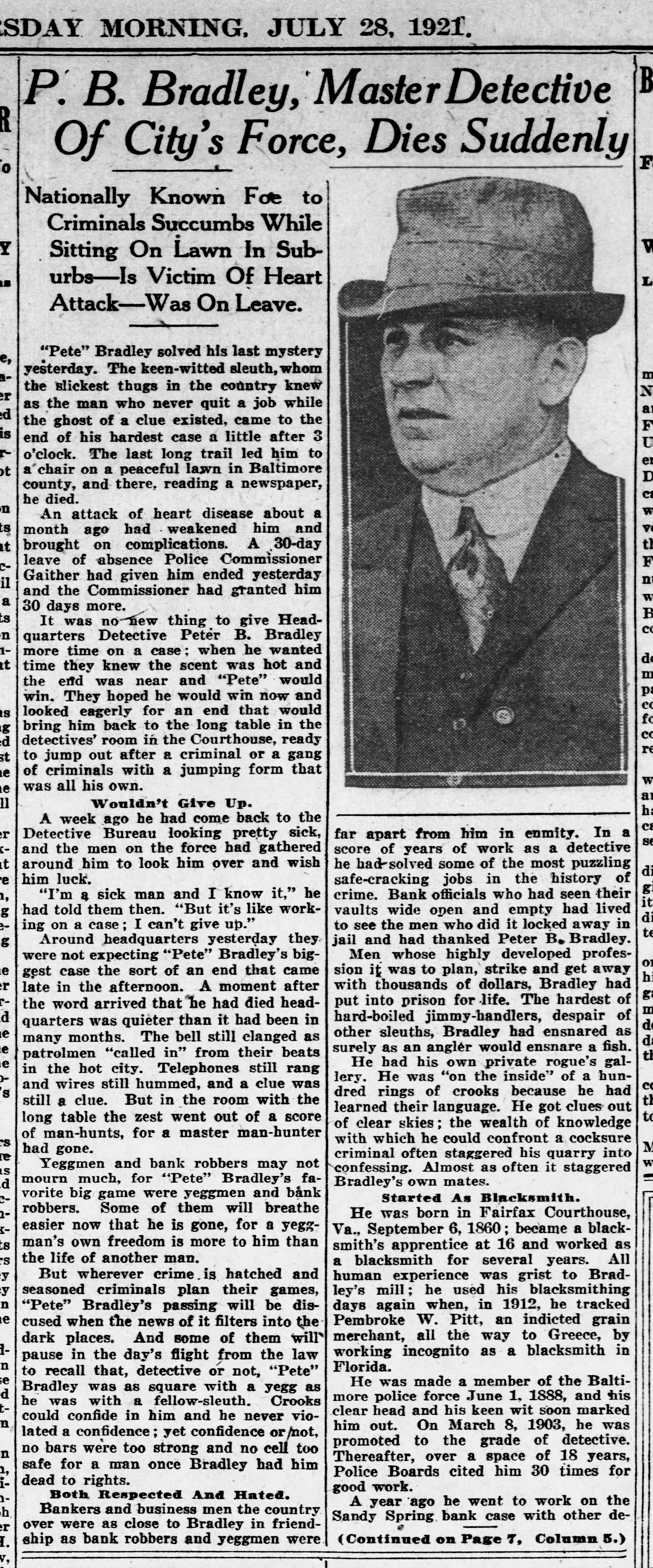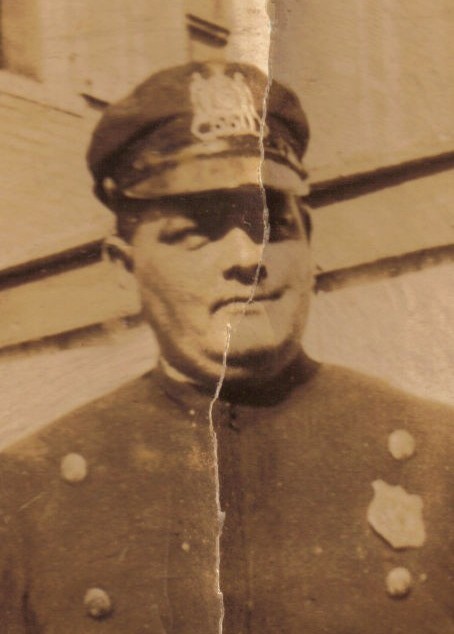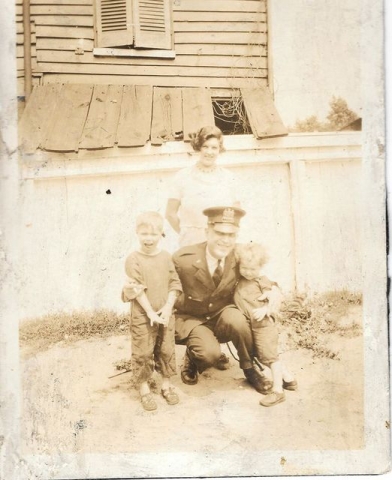
1800 - 1900

1800 - 1900

1 black devider 800 8 72

  1800 - 1900 

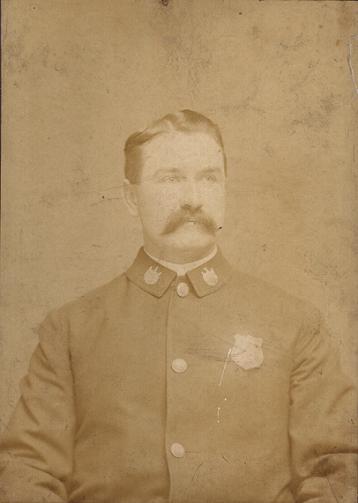
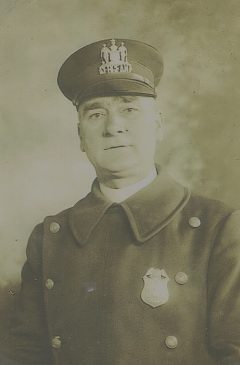
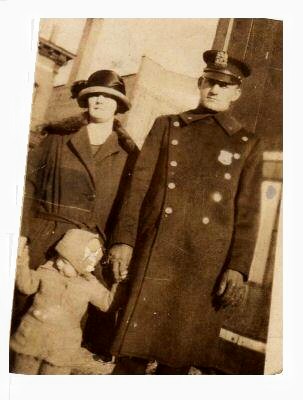
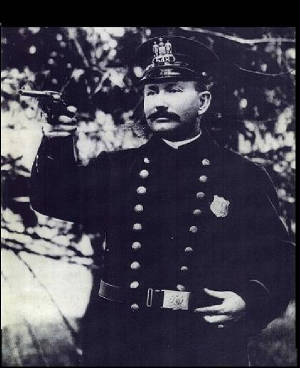
BALTIMORE CITY POLICE OFFICERS

We can’t all be heroes; Somebody has to sit on the curb and clap while they go by!

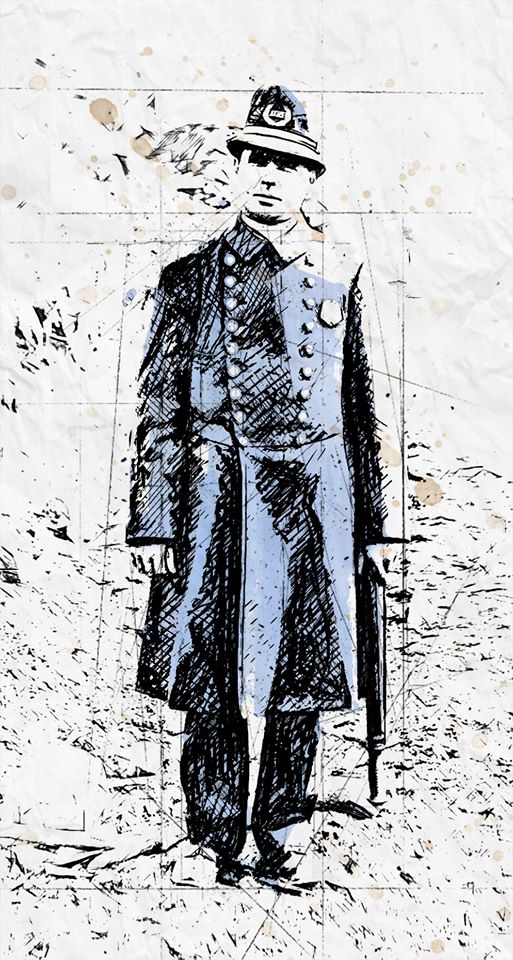
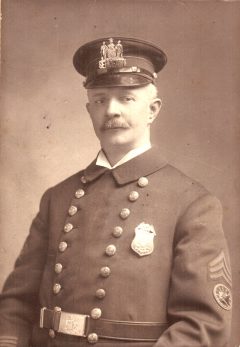
early_bpd_officer.jpg

1866 721866

1800s


joseph_taylor_johnson.jpg
 
Issac, brother-in-Law of Augustus and Joseph.(below)
Information provided by Richard Johnson a family member presently living in Glen Burnie, Maryland.

bpd historic


bpd historic

Devider

Apr 25, 1937

Baltimore's Police Department--A Checkered Career

LEON JACOBSON  The Sun (1837-1987);pg. 60

Baltimore’s Police Department – A Checkered Career
Corruption of Force in the Know-Nothing. Led to Abuse, and State Intervention
Free Elections Assured After Writing and Intimidation of Voters of Earlier Day
By Leon Jacobson
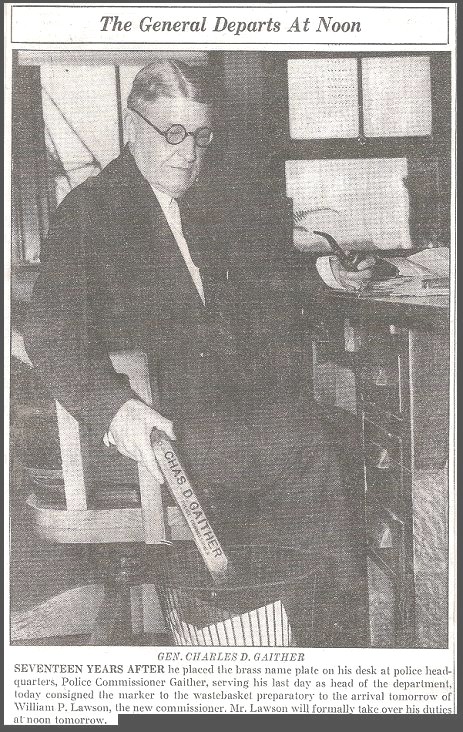
The anomaly of a local police force, maintained by municipal bonds, began under the control of a state agency obtains in only three of the 10 largest cities in the country – Boston, St. Louis and Baltimore. This gives rise to an especially particular situation here, with General Charles D Gaither’s third term as police Commissioner coming to an end in May. His successor will be appointed by Gov. nice, who was rejected at the polls by the city in 1934 and who was carried into office only on the both of Baltimore County. The beginning of state authority over the city police dates back to the most disgraceful era in local history. From its origin in 1784 to 1860 – the police force had been under control of local officials. By that time, however three or four decades of ebullient politics and contaminated it and that body had become so corrupt and ineffective that the state was compelled to assume authority over it. In 1863, the legislature enacted a law created a board of four police commissioners, but subsequent legislation made the commissioners appointed of by the governor and, later, establish a single Commissioner in place of the board. Gen. Gaither, appointed by the late Gov. Ritchie in 1920, was the first single head.

MOBTOWN RIDING
Sporadic writing and mild violence especially around election time had by 1825 already one for the city the soubriquet Mobtown. But the Mobtown epoch in local history is generally considered to have lived and died contemporaneously with the know nothing party, because it was not until the introduction of this party locally that politics found the lowest depths of depravity, and democracy, here at least met its greatest challenge.
Preaching and anti-alien, at the Catholic doctrine, the know nothings known also as the American party first appeared here as a secret order in 1852, probably in the month of October. The time, however, was not yet ripe for such a movement to make an impression, the old parties being too entrenched for this newcomer to edge into the field. But the temper of Pre-Civil War politics was rapidly melting the national solidarity of the old parties and as the weekend nationally, so they did it locally. The know nothings, appealing to the considerable anti-alien sentiment latent in the city and counties, made the most of the situation.

VICTORIES IN 1854
In 1854 – their mayoralty candidates one in Cumberland and Hagerstown; in 1855 – they added Annapolis and Williamsport. In 1856, they completed their meteoric rise. The city and 13 hour of 21 counties were now arranged in their column. With his first taste of success – the party had discarded its secrecy and division into covert councils and had reorganize itself in the clubs bearing such candidly prophetic names as the plug uglies, tires, rough skins, bloody tubs and black snakes. In educating the public, these clubs recognized no law. It became their duty to stuff the ballot boxes and terrify the opposition. Their methods – or rather there implements – of persuasion – were shoemakers awls – slingshots – truncheons – mortar lives – pistols and muskets. Scores of dissidents were hustled into damp sellers until the balloting was over. They were beaten and robbed in the process. Others were forcibly intoxicated and was to the polls to vote the right way. (Note there is a rumor that Edgar Allan Poe was one of those forced to intoxication and made the boat at several voting boxes is said this is what led to his death)
Incendiarism was not infrequently practiced. The opposition’s pre-election meetings were with sleep broken up. After one election – eight were reported killed, 150 injured. Not only men but little boys were said to have gone around armed with guns during periods of political excitement. In one instance, a small cannon was brought into play. In this manner, half of the electorate was deprived of its right to vote.

WHAT WERE THE POLICE DOING ALL THIS WHILE?
Prior to 1856 – they had put forth some effort to quell disturbances and preserve order. But they had been unable to cope with the situation for two reasons. First, the other parties had been employing an election tech make just as diabolical as the know nothings, albeit with somewhat more discretion and conscience: and second – they had not been properly upheld by the magistrates in the discharge of their duty.

FREQUENT ARRESTS
In one year – the police commanded by one Capt. Brown of the Western district – arrested one man more than 100 times – only to have him released in each instant by the magistrate. Police officers at the time claimed that they would arrest from 25 to 50 miscreants in one night – but their prosecution would go to naught and their prisoners of their homes. Perhaps no single event or person was more characteristic of the debasement of the day than one judge stump of the criminal court. He was notorious for his loose habits and disregard of the conventions of civilized society and the dignity of a court. He was frequently picked up by the Nightwatch for his convivial habits. His judicial career and it ultimately with impeachment.

END OF POLICE
After 1856 police intervention became an impossibility and order of far-off abstraction. In that year a know nothing mayor was elected and the force soon became permeated with partisan politics. The police, who previously had been making an attempt, how-ever futile, to enforce the law, now became tools in subverting it. The first hint of form occurred just before the state elections in 1857. The near – anarchy attempted every election had been adversely affecting local business. The riding and disorder had secured hundreds of County merchants away from the city and the local tradesmen were determined not to lose out again. Consequently, they combined with those of the electorate who did not participate in party politics and presented being deprived of their vote and argued Governor Ligon, a Democrat, to take measures toward ensuring a peaceful election.

MAYOR REFUSES
Moved by his sense of duty and, undoubtedly, also by his animosity toward know nothing mayor salon – the governor acquiesced. He came to Baltimore and, by letter, invited the Mayor to cooperate with him in the enforcement of all during the approach and election period. The mayor refused blatantly, informing the governor that local law enforcement was his business and not the concerns of the state. The governor, disregarding the mayor’s reply, proceeded at once to make military arrangements for the maintenance of peace. He ordered Maj. Gen. John H. Stuart, of the first light division, to hold his command ready for service: Maj. Gen. John Spears Smith was ordered to enroll six regimens of not less than 600 men each. To arm the equipment this forest – 2000 muskets were barred from the governor of Virginia. At the same time governor Ligon issued the following proclamation; “Having been credibly informed by a large and respectable number of citizens of Baltimore that serious apprehensions are and entertained that the approaching general election is threatened with extreme violence and disorder in this city, sufficient to terrify and keep away from the polls many peaceable voters, unless the civil arm is vigorously interposed for their protection… And having solicited his (Mayor’s) cooperation… And having received from him no favorable response… I hereby proclaim that I have directed the proper military officers to enroll and hold and readiness their respective corpse for active service at once, and especially on the approaching day of election…”

SPECIAL POLICE
But the military range the governor did not prosper, for in his own words, “that class of citizens who military service is mainly to be expected exhibited first, indecision, and, at last, unwillingness to respond to the call which had been made upon the community.” As a result, the mayor agreed to appoint 800 special policeman among the members of the two major parties (he refused, nevertheless, to choose half the number from the ranks of the Democrats). But nothing came of it. The special police were powerless without the support of the regular force. Those who were to conscientious were told to leave the polls – as they had no business there. Many of them tendered their resignations to the mayor before the day was over.

ROUGHING VOTERS
What is the election was with neither riot nor bloodshed, but fraud and intimidation rendered it anything but democratic. The roughs at the polls employed a regular system of signals to indicate the reception to be accorded the voter. For example, as the gator approach, he was solicited by a party heeler and, if he were voting the Know Nothing ticket, the healer would try out: “clear the way: let the voters come up.” But, if he were to decline the Know Nothing ticket, the healer would shout: “meet him on the ice” and the voter would some really be pushed away from the window and into the street. When men were assaulted, the police either arrested them or tried to persuade them to leave the polls. The assailants met with almost no opposition. But deliverance from these chicaneries was not far off. The state election of 1859 signal the decay of the know nothing party. The know nothings carried the city by large majority. But the counties discussed it with the state of affairs in the city, revolted and went into the Democratic column, the result being the legislator for the first time in several years was decisively not Know-Nothing.

BALTIMORE POLICE
One of the first matters to engage in the legislation attention was the question of a proper police force for Baltimore: in one of the first acts passed was one taking control of the police away from the mayor and placing it in the hands of the board of four commissioners elected by the legislature. By 1860, the know nothings had outlived any definite principles accept an attempt to obtain public office. In the local election of that year, they made their last stand. But, we can by internal wrangling’s and missing the aid and comfort of a friendly police force, they were forced to retreat never to reappear on the local political front. The Civil War came the following year and claimed the energy of those turbulent spirits who had been keeping the city continually in a state of warfare.

NOT ALONE
Baltimore was not alone in surrendering control of its police to a state agency. Many another city was also afflicted by the seething politics of the middle decades of the 19th century: and many another police force was given to corruption. As a consequence, it became the fashion of the day to relinquish authority in favor of the state.
State control had been justified mainly on the grounds of police were primarily occupied with the enforcement of laws passed by the legislator and intended to operate uniformly throughout the state. Therefore, it has been argued, they are not agents of the municipality, but rather of the state whose laws they are under oath to execute.
On the other hand, the argument is advanced that since the municipality pays for the maintenance of the police force, it should retain supervisory power over it. In most instances, nevertheless, with the restoration of water, authority has been returned to local hands. But not so here. Probably, because the behavior of our police during the last 77 years has not been so bad as to warrant a change, and probably also because a change is not in itself a guarantee of improvement.

  Devider

 Baltimore Flood

1868 - Friday, July 24, 1868 - The Baltimore Flood overtook the city. In a crisis the bravery of Commissioner Carr in rescuing the victims of the catastrophe, became a matter of national fame. Harper's Weekly, at the time, in a long article on the floods, quoted the following editorial notice from the Baltimore Sunday Telegram, of July 26, 1868: "It is a true saying, that in times of great public calamities, some men rise to the position of a greatness, and such was the case with Police Commissioner James E. Carr. He at first sight apprehended the character of the calamity, and he immediately sent for boats and organized a sufficient force of policemen to manage them. He soon had work enough to do. He led the van in his boat in places of great peril, and rescued women and children preventing them from drowning in a flood the likes of which Baltimore has never seen. The part most difficult to explain, is the rapidity with which the streams rose. The Patapsco River at Ellicott City and Jones Falls, rose at the rate of five feet in ten minutes; the water came down those streams like a great wave on the sea-short. The river at Ellicott City rose ten feet before a drop of rain had fallen there, and was at one time forty feet high. In this city the rise was so rapid that a gentleman entering a cigar store from a dry street returned with a lighted cigar to find himself knee deep in a rapidly rushing stream. A passenger car, while crossing a street, was caught by the flood, and with its passengers was swept several blocks toward the river. The market men were caught at ' their work, and only had time to get on their benches and stalls for safety, and these were washed away with their occupants. Terrible as was the catastrophe in Baltimore, it was much worse in Ellicott City. Had it occurred at night the loss of life that it must have caused is fearful to contemplate! It was about ten o'clock in the morning when the water first rose above the banks of Jones Falls, and began to flood the low streets of this city. Slowly, at their beginning, the floods covered Harrison street, but in a moment they rushed down Harrison street, increasing in volume at each minute, until the bed of the street was filled with a swollen and powerful stream, whirling on in its surface the shattered remains of ruined homesteads, wrecks of furniture, and, in fact, almost everything in ordinary and common use. When it reached Baltimore Street the stream divided into three currents. One rushed like a torrent to the right, the other to the left, and the third ran with more slowness down the center of the market. Above the roar of the vortex could be heard the shrieks of women and children, and the cries of men for help, as they were whirled along with the furious current. Even carriages, with their occupants, were caught up and carried along. For some hours after the awful scenes of destruction had begun in the center of the city, the greater part of the population of the upper portions, kept indoors by the pouring rain, had no idea of the dreadful occurrences below. An extra edition of the Evening Commercial, published at about two o'clock, gave them their first intimation of the disaster. When the flood first appeared on Harrison Street the police busied themselves aiding the residents of the street to carry their household goods to places of safety. In a few moments, however, they were obliged to turn their attention towards rescuing the people themselves. Alarms were rang, and men called in from all the stations, to the scene. Numerous boats were promptly ordered from the wharves by the Police Commissioners, and were hurried to the inundated district. They were manned by experienced boatmen and police men. Most of the boats were launched from the Holiday Street Theater, and were sent thence, under the direction of Commissioner James E. Carr, through Calvert, North Holiday, and other streets, for the purpose of removing families and furniture to places of safety!!!
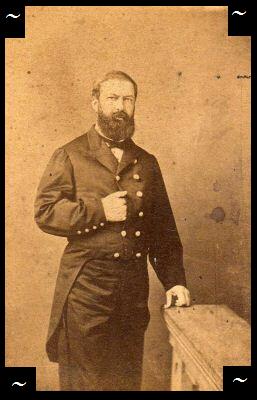
marshal_kane_1860.jpg
Marshal Kane 1860
  Devider

  Apr 29, 1861

PROHIBITING THE DISPLAY OF FLAGS The Sun (1837-1989); pg. 2 Prohibiting the display of flags. At this very critical juncture of opinions on Bunting, the pulling down of an American flag by order of the board of police is an act which a little preserve ingenuity may distort into an atrocious, not to say flag-itious, offense. But the times require good men to be true and reasonable. We are very sorry to find some disposition prevalent to deal unjustly and mischievously with this matter. We can say, with the knowledge of the fact, that our excellent board of police have done several things which none could regret the obvious propriety of doing more than they. Yet in all they have done. Where is the man among us who will say he has suffered the privation of any civil right at their hands? Just think for a moment of the wonderful preservation of the general peace and order of the city seem to tearfully exciting times of the last few weeks. Think how the turbulent elements of the city have been subdued. Think how few Outrages have disturbed our sense of right and justice, when the inflamed populous were bent on securing arms by any means. Think of the mild but effective restraint exercise over the whole community one passion and resentment stirred the whole city to go forth and make war upon the Pennsylvania volunteers at Cockeysville, and happy termination of that affair and sending out to them an abundance of food to relieve their family shooting condition. And think about this is the worst that can be said of that good old Baltimore, which they so lustily abuse in the North, which, as it comes to its senses, will be induced to do us justice, while the South can really have no good cause of complaint against us.But to the flag affair. Our citizens know very well that those whose taste for the display of flags is so exceedingly susceptible. Enjoyed the opportunity of giving the nation Bunting to the breeze on the fall of Sumpter. For several days sympathy with the administration and hostility to the south was expressive in this way at several places in the city and did some newspaper offices. Then came the sad affair of Friday, the 19th, after which, and suddenly, the Confederate flag was in the ascendant, and the emblem of the Southern Confederacy was everywhere, while the national flag was voluntarily retired. But our readers are not all where that one a rush was made upon the corners of the Minutemen to pull down the American flag, the first man who appeared to stop the lawless movement was Mr. Davis, one of the board of police, and to at once resisted their purpose. The flag remained, and was removed voluntarily and that leisure by the Minutemen themselves, under the unpleasant feeling that seemed to associate their sympathies with those who had shed the blood of our own citizens.And a word here upon the Confederate flag demonstration. That was by no means what it has been supposed to be – a secession demonstration. It was an exhibition of that feeling which still pervades pretty nearly this whole community – an unwavering devotion to southern rights. And the mistake still prevails the north that the union men of Baltimore are in different to southern rights: if this is not an egregious mistake, we have misunderstood at her own citizens.The southern rights demonstration, through the exhibition of respect for the southern flag, was apparently all but universal until a few days ago when it was ascertained that a union flag was to be hoisted at two or three places in the city. The fact was one to be seriously considered apart from any disposition to oppose the hoisting the United States flag. It was a question of the same importance, had it been a white sheet, with the same probable result the belief was consistently entertained by the commissioners of police that if they did not prevent the movement or take down the flag, a mob would have attempted it, a desperate riot would have ensued, and the peace of the city have been murderously and possibly overwhelmingly destroyed. Accordingly, true to their office, and the impartial execution of their duty, they issued an order that flags of every description should be withdrawn during the session of the legislature. When that order was issued, there were nothing to be seen but the Confederate flag and the arms of Maryland. Instantly all these flags were withdrawn: but the flag of the union was run up on Fells point and on federal Hill, and the collection of men had rallied to defend them and defy the police. Then it was that the police authorities insisted upon compliance with their orders. The union flags were taken down, and the peace maintained and that good peaceful citizen will not admit that it is far better for the display of flags should be temporarily suspended, rather than the piece of the city be so needlessly disturbed?Amputations against the police are easily made, and sensor is a flippant thing when reason is an abeyance. But peace and good order we enjoy is worth 10,000 times over the display of a flag. Men can cherish their peculiar views, and maintain their associations without Bunting, at least during a period of great domestic excitement. 
 
Devider
 
31 CAL COLT REVOLVER .2
Photo courtesy of Gualtiero Fabbri
A Colt 1849 Pocket Model
baltimore_police_officer_1850s_1.jpg

Issac Henry Jackson

Born: Dec.5, 1820

Died: Aug. 21, 1867

1855-1856: Baltimore (Watchman) Police

1857-1860: Baltimore Police Officer

Samuel Johnson, (no photo available) father of Augustus, Joseph and Caroline Johnson (wife of Issac Henry Jackson )

Born: Feb.22, 1798

Died: Jan: 21, 1871

1855-1857- Baltimore Watchman (Police)

1858-1862- Turn-Key Southern District

1862-1868- Keeper of Battery Square (Riverside Park)

1869-1871- Watchman

Williams_William_Hamilton_1859.jpg
officers_polling_place_1860.jpg
Voters and police assemble outside a barbershop turned polling place. Before the Civil War, election violence was so prevalent that wags often referred to Baltimore as "Mob Town." This early twentieth-century image suggests that elections still attracted a police presence.
 
BPD_Lt_1860.jpg
 
Baltimore Police Lieutenant circa 1860's
j.thomas_arthur-1840-1909.jpg


J. Thomas Arthur was born on 4 April 1840 in County Clare, Ireland. He was in Baltimore by 1864 (above)
Officer Arthur served in Baltimore City's Police Department at the Central Station.
In the photo, Officer Arthur is the older gent seated on the right side of the picture. (below)
The photo of the Central Police Department was taken about 1890. Notice the details, brass lamps and sconces, polished furniture with turned legs ... there's even a telephone on the desktop at the left.
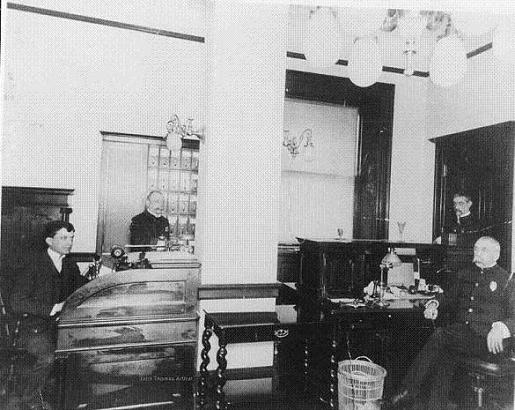
j.thomas-arthur_cd_1890.jpg
 
OFFICER JOHN WEITZEL DISPLAYING SECOND ISSUED BADGE 1860
Devider

17 September 1910

Why The Control Of The Police Board Was Given To The State

Inasmuch as there has recently been some talk of restoring the complete control of the Police Department of Baltimore back to the state. It might be an opportune time to recall the reason the appointment of police Commissioner was committed to the state the first time. In 1860 the police commissioners were appointed by the Mayor and City Council under a law authorizing them “To Establish Night Watch or Patrols and to erect Street Lamps.” Soon after the enactment of this old law the police force became a political machine in the hands of the Mayor. In the 1850s, when the “Know Nothings” were in control of the city and the various societies known as “Blood Tubs,” “Plug Uglies,” “Rednecks,” “Pioneers,” “Spartans,” “Regulators,” “Black Snakes,” “Tigers,” “Eubolts,” “Rip Raps,” “Ranters,” “Little Fellas,” etc., ran riots on election days, the police became an element of the mob. In 1837 a city reform association was organized and issued an address to the people, in which it was declared that there was no reasonable and sufficient security in Baltimore for persons, property or franchise.

The Central Reform Committee in 1859 declared that the police, with a very few honorable exceptions, openly sympathized with the rioters at the November election and in almost every case arrested those who were assaulted by ruffians. The Reform Convention of 1859 appointed a committee to draft loss to reform the city government. The committee was composed of William H. Norris, Philip Francis Thomas, I. Nevitt Steele,, S. Teakle Wallis, and Nielsen Poe. The election of 1860 was carried by violence, but the legislature unseated the whole city delegation, and, at the request of the city for the preservation of peace and good order, enacted the  Jury Law and the Police Law – the latter drafted by Mr. S. Teakle Wallis. That law, passed at the urgent request of the city, took the appointment of Police Commissioner from the city and confided it to the state, where it remained until 1978.

The act of 1860, chapter 7 – which reorganized the police force, retained a singular provision, which it is believed was not in the original draft as written by Mr. Wallis. It is as follows: “provide, also, that no black Republicans or endorser or approver of the Helper Book shell be appointed to any office under said board.” This law created four Commissioners, to be elected by the Legislature, the first board being named in the bill – namely, Charles Howard, William H. Gatchell, Charles D. Hinks and John W. Davis. The board appointed Col. George P. Kane Marshall of the police

The Board of Commissioners continued with four members until 1874, when it was reduced to three. The board was Democratic until 1897. In 1896 the first Republican Legislature was elected, and two Republican Commissioners, Mr. Johnson and Mr. Heddinger, were appointed. From 1897 to 1900 the board was Republican. In 1900, at the request of the city, the appointment of the commissioners was committed to the Governor, where it would remain until 1978. The reason for the change was to put the responsibility for the character of the board upon the Governor. The responsibility of the Legislature was not personal and constituted no restraint. A strong effort had been made in the Republican Legislature of 1898 to give the appointing power to the Governor. A Republican caucus nominated Mr. Frank C. Wachter for Commissioner, but because of divisions in the party the election did not take place, and Mr. Schryver, the only Democrat on the board, held over.

At this session a number of different bills to give the appointing power to the Governor were introduced. Senator S. A. Williams, of Harford County, introduced one of them, and this, we believe, was supported by Senator Putzle, then representing one of the city districts. An amendment was offered by Senator Wescott, of Kent County, giving the appointment to the Mayor of Baltimore. This was rejected all three of the city senators – Putzle – Dobler and Strobridge – voting against it, although all were Republican, and there was at the time a Republican Mayor. Governor Crother, then Senator from Cecil County, introduced two bills for the appointment of the Commissioner by the Governor. One of them provided for a bi-partisan board, two Commissioners from each party. But all the bills failed.

The Reorganization bill of 1900, which was passed by the Legislature, was introduced by a city Senator and was voted for on its final passage by the two city Senators who were present – to wit, Senators Brian and Moses.

The record here presented is given to show that the appointment of Police Commissioners was first taken from the Mayor and City Council and put with the Legislature at the request of the city. It was then taken from the Legislature and given to the Governor upon the initiative of the city and by the action of the representatives of the city in that Legislature. There was never in this connection any assault by the counties upon the home rule of the city. As it is, while the appointing power is at Annapolis, the Police Commissioners must under the law be “three sober and discreet persons, who shall have been registered voters in the city of Baltimore for three consecutive years next preceding the day of their appointment.” 
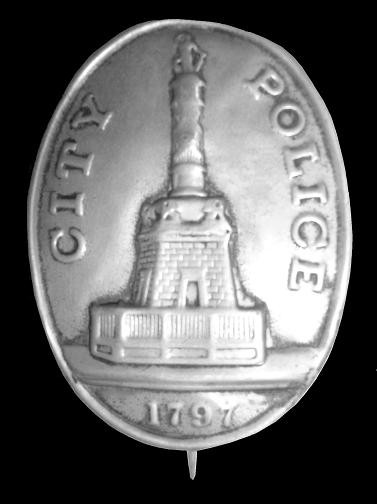
Devider
 
Gault_Albert-Police_Badge.jpg
Photo courtesy Mrs. Karen Kidd
Detective Albert Gault
 
Actual Baltimore Police badge worn by Detective Albert Gault,, who was a Baltimore City Policeman and Detective from 1866, when he joined the force, until his death in 1900. Detective Gault was a celebrated Detective who was involved in numerous cases during his tenure. The book, entitled "Our police: a history of the Baltimore force from the first watchman to the latest appointee", by De Francias Folsom. Chapter X has about twenty pages detailing some of Detective Gault’s cases. (Note that this badge is the center piece of the first issued star badge in 1851. Only the center piece was worn by detectives to make easier to conceal on the detective's belt or inside his jacket) This badge was found by Detective Gault's relatives among his personal effects.

Obituary for Albert Gault,

Detective Baltimore City Police Department

Detective Gault is Dead

His skill and daring in the pursuit of criminals

July 27, 1900

Detective Albert Gault 63 years old, died at 10 minutes past 4 o'clock yesterday afternoon at his house at 1538 W. Lanvale Street where he had been suffering with stomach trouble for the past 6 months. He had been sinking but Wednesday evening there was a decided change for the worse. He had wasted away to a skeleton having taken no nourishment for weeks, but was conscience until the last. Mrs. Gault and all her children except one, Mr. James W. Gault were present. He arrived last night from Connecticut. The children present were Mr. Robert H. Gault, Miss Kate Gault and Mrs. Edwin Kapp. Mrs. Gault was Miss Sarah Ellen Harrison. She and Detective Gault were married in 1860. Detective Gault leaves one sister--Miss Sallie Gault and two brothers, Messrs. Richard and William Gault. The funeral will probably take place Sunday afternoon. Rev. J.P. Campbell, of the Faith Presbyterian Church, Middle Street and Broadway will conduct the services. The interment will be in Greenmount cemetery. The undertakers are Evans & Spence. Detective Gault was a native of Baltimore and a son of Mr. Robert Gault a well known typefounder. When 14 years old, after spending several in the public schools. Detective Gault served an apprenticeship with the gas-fitting firm of Blair & Co. He followed the trade for 13 years. In 1864 he was appointed on the police force and assigned to work in the Central District under Captain John Mitchell. Very soon afterwards attention was attracted to his "detective" qualities by his prompt discovery of over $7,000 worth of goods from Thompson's tailoring establishment on Fayette Street.

During the flood which occurred July 24, 1868 Patrolman Gault attracted attention by saving with great risk to himself two persons from drowning. He was an excellent swimmer. In 1873 while serving under Captain Lannan he was promoted to Sergeant and in the same year was assigned duty as a detective. Among the noted instances of his work as a Detective was the discovery and arrest of the negro, Harris, who was charged with having assaulted a young woman of Saulda, Va. The negro was tried and sentenced to death, but the sentence was commuted to 25 years imprisonment. Detective Gault made several daring arrest of fugitives from justice charged with assault but one of his best pieces of work was the arrest of Marshal Price of Caroline County who was charged with the murder on March 26, 1895 of Sallie E. Dean, a 14 year old girl. Price afterwards was lynched. Detective Gault was also largely instrumental in solving the mystery connected with the murders four years ago in Charles County of the wife and niece of Joseph Cocklag. An instance of his pluck and daring was the bringing to Baltimore from Detroit, Mich., in 1876 Joseph Lewordrell who had robbed Mrs. Lenka, a polish woman, living on Broadway near Thames Street of about $1,000. While the train was passing through the mountains of West Virginia the prisoner whose handcuffs had been removed for a moment, suddenly dashed out of the car door and jumped off the train which was running at full speed, the train was stopped and the detective, unarmed, pursed the fugitive 12 miles through the mountains, recaptured and tied him and flagged the first train. The conductor allowed the two men to get on, but concluded that they were tramps, was about to put them off when a passenger on the train recognized Detective Gault and he was allowed to continue with his prisoner to Baltimore. In September 1895 at Orlando, Fla., he arrested Robert Beason, alias Frank Smith, alias Frank Lefton, alias Clark who defrauded the commission firm Biedler and Jackson, 113 south Charles Street out of over $500. Beason had been a motorman, a check forger and fugitive from justice for many years. Detective Gault had traced him to Florida and returned with the prisoner to Baltimore, he learned on the train that friends of the prisoner had arranged to affect his release. Before arriving at the place where the rescue was to have been attempted Detective Gault got off the train and taking Beason into a swamp, hid there until the next day, when he continued his trip to Baltimore uninterrupted. In the Perot abduction case Detective Gault was commissioned a United States Marshal and sent to England with extradition papers to bring Mrs. Perot back to this country for trial. He was detained in London for over a month, while there a great reception was given him by the London Detective force of Scotland Yard. His death occurred on the anniversary of the day he sailed on the Majestic for London July 26, 1899. Information provided by Mrs. Karen Kidd, who provided a copy of the original newspaper article. (This site and family members are in search of a photo of Detective Albert Gault.)


3officerwentizebadge.jpg

Portrait of a Baltimore Police Officer 1879 wearing 2nd. issue badge

Officers 1800s-1
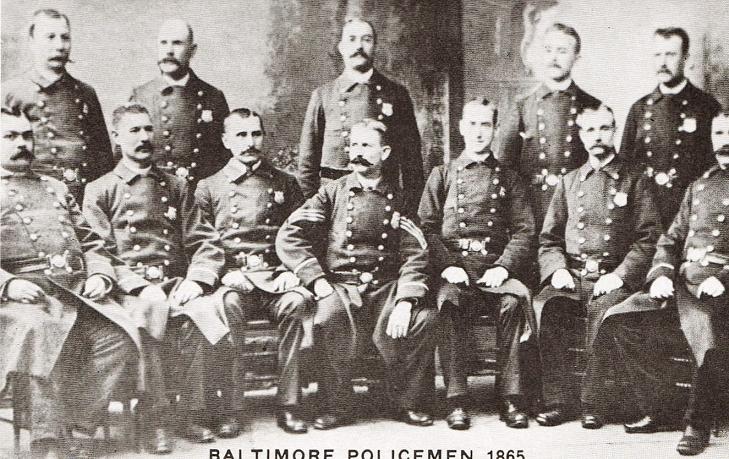
Baltimore_Police_1865.jpg
Baltimore Policemen
1865
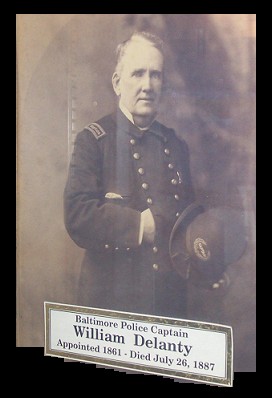
captain1861.jpg
Captain William Delanty
Appointed: 1861
           Died: 1887
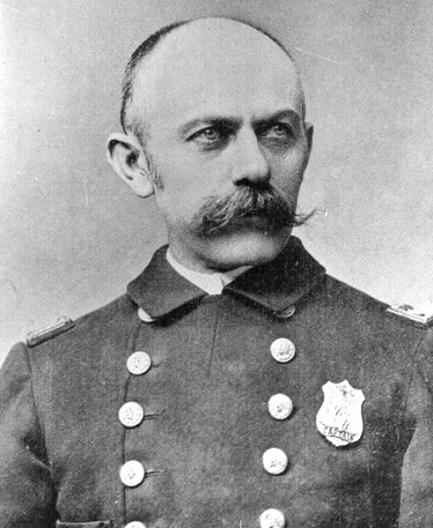
1879-bpd_portrait.jpg
Baldwin_Thomas_Marshall2.jpg

Photo courtesy Sue Whittington

Patrolman Thomas Marshall Baldwin

Baltimore City Policeman

Baldwin_Thomas_Marshall2.jpg

Photo courtesy Sue Whittington

Patrolman Thomas Marshall Baldwin

Baltimore City Policeman

October 6, 1873

Obit: Death of a Police Officer.-- Policeman Thomas Baldwin died yesterday morning, at five o'clock at his residence, No. 289 North Dallas Street. He was a native of Prince George County, Md., and had been on the police force of Baltimore for the past three years, where he was regarded as one of the best officers on the force. He had been severely injured on the night of the 27th. of July last, while conveying Patrick Shane, charged with stoning a house at the corner of Front and Hillen Streets, to the Middle Police Station. Shane was afterwards committed to jail for court by Justice McCaffery, but was subsequently released on bail. Patrolman Baldwin was confined to his house for some weeks after receiving his injuries. For the past month he has been on duty, although complaining at times until a week ago when he was attacked with a severe cold and had been confined to his house up to the time of his death. His funeral will take place this morning at half past eight o'clock. The body accompanied by a detachment of the police force, will be conveyed to Collington Station on the Baltimore and Potomac railroad near where the family reside. He leaves a wife and two children in the city.

Baldwin_Thomas_Marshall1.jpg

 Photo courtesy Sue Whittington

Patrolman Thomas Marshall Baldwin

jacob_frey.jpg
Marshal Jacob Frey
Was Awarded the Departments 1st Medal of Honor
BALTIMORE POLICE DEPARTMENT TO MOVE PRISONERS ON THE B  O RAILROAD 6-7-1880Courtesy Ret Det Kenny Driscoll
Signed 1880 by "Deputy" Marshal Jacob Frey
BALTIMORE POLICE DEPARTMENT TO MOVE PRISONERS ON THE B  O RAILROAD 2-8-1886Courtesy Ret Det Kenny Driscoll
Signed 1886 by "Marshal" Jacob Frey
marshal_farnan.jpg
capt1.jpg
capt2.jpg
patrolman_1870s_3rd_issue_badge.jpg

Devider

 February 19, 1878

The Police force of Baltimore,
Baltimore Sun, 

There is scarcely a citizen in the city of Baltimore having the best interest of said community at heart, who shall become familiar with the provisions of the bill now before the House of Delegates to modify the hours of service of a police force, and to authorize them to appear in citizen dress when off duty, that will not be surprised that such a measure is proposed over the heads of the commissioners. The first duty of the Gen. assembly is to preserve all parts of our judiciary system from the devices of demagogues and an efficient police force lies at the very root of that system. What is known as the Matthews bill directly interferes with the whole present discipline of the force, upsets, indeed, the labor of years and the advantages derived from it. The bill undertakes to regulate the hours of service, instead of leaving that and all such details to those who have the responsibility of administration. It describes an eight hour system to the force as a permanent thing: that is to say, eight hours of duty in uniform as a policeman, and 16 hours off-duty, during which, as if more effectually to remove the wholesome influence of discipline, the men may throw off their uniforms and appear without the least insignia of their honorable calling in the citizens dress. There could scarcely have been a better plan devised for demoralizing the force.

As for the hours of duty they are already regulated with due regard to the comfort of the men and the welfare of the service. None of the officers of the force, many of whom have worked themselves up through the ranks, ask for the changes that are contemplated by the bill: nor do the best man in the force indicate a desire for them, for they foresee as any one may that 16 hours of leisure every day in the citizens dress might lead to nonsense on the part of some of the men and so bring the entire force into disrepute.

Police duty. It is true is more or less hazardous and is some respect onerous, but it is one that has always been sought, and is not shunned.  

"I Doubt less than the largest majority of men now on the force have proper ideas as to what they are paid for. The pay is not simply for the service performed within certain hours, but having been chosen from the mass of their fellow citizens as conservatories of the peace, they feel and recognize the duty of setting an example of discipline and good conduct at all times, and would not wish to see any system introduced that would lessen respect for, or impair the efficiency of the body they belong to, either on or off duty."  

It is difficult to divine the object of this proposed change in the police law unless it is a political one, the seeking of personal advantage at the expense of the community. If there be at least ground for this suspicious. It is quite enough to condemn the bill, apart from the direct injury, it would afflict on the force. The rules regulating hours of police duty at present, as prescribed by the board, are the result of experience and work very sufficiently for all concerned, serving at the same time the proper interest of the public.

The force is ordinary, divided into Sections A, and Section B, the time of duty of Section A numbering 160 men is from 6 AM to 7 PM and of Section B numbering 340 men is from 7 PM to 6 AM, but the force from about 6 January until the severe weather is over is divided into three unequal sections as follows.

Section A 121 men from 7 AM to 6 PM
Section B 223 men from 6 PM to 2 AM and
Section C 156 men from 1 1/2 a.m. to 7 AM

During the winter when the Christmas holidays are over, there is less disorder then at other seasons of the year and the short system is consequently adopted at that time because it can be without danger to the community, and with benefit to the men who shorter hours shield them from to prolonged exposure to the inclement weather. If the short system called for by the Matthews Bill were permanently introduced an increase of police force would be called for to meet it. Consequently, an additional expenditure of money for police purposes. Again, if the force or worked on this shorter system, the result would be that the pay would have to be put on the short system also, as to make up the numerical strength called for without increasing the aggregate the great expense of the force. It stands to reason that if the work of the police force is to be reduced by at least one third The corresponding reduction of pay must follow for the commonality while willing to bear the present aggregate cost of policing the city, have no idea of augmenting that burden, and it is not at all necessary to do so, as every man of honesty and common sense will be aware

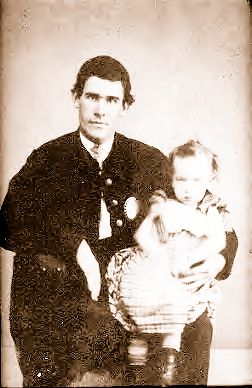
officer04.jpg
Baltimore patrolman wearing 3rd. issue badge
james_william_conner.jpg

James William Conner was born 7 September 1839. He was a Baltimore City police officer from 1868 until 1870. This photo was taken about 1868 and shows his police uniform. The child is possibly his son William Conner. James W. Conner served in the 3rd Artillery CSA from January through November 1862 when he was wounded and mustered out. In 1870, he and other Confederate veterans were dismissed from the police force without cause. James W. Conner died 2 January 1906.

calvin sunstrom may 3 1870.jpg.w300h442
Police Officer Calvin Sunstrom (standing)
May 3, 1870
9b.jpg.w300h413
Bell hat MD hat device front
OFFICERS-1862-1890.jpg
Bell hat Md Buttons side view
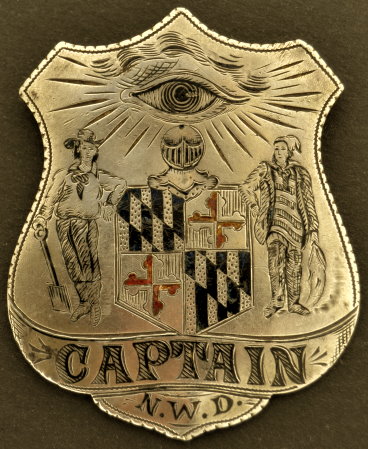
The MD emblem 1st appeared  on the Captains badge in 1886 after Marshal Frey re-designed the badge for our Captains and made the Ever on the Watch - or - All Seeing - "Eye" Badge. So it would only make sense that this hat and device came along sometime after then. If we look at the above pic 2nd row 3rd in we'll see a hat similar to this being worn by what appears to be a Lieutenant

BaltimoreCaptainBADGE 450

The Below article appeared in the Adams Sentinel Newspaper in Gettysburg Pennsylvania.

Sgt. William Jourden Shot

October 19, 1857

Election in Baltimore,

On Wednesday last, an election took Place in Baltimore for members of the City Council, and it appears to have been a scene of lawlessness, riots and bloodshed,On the matter a. mere mockery of the elective franchise. The democrats, it would appear, wore excluded from the polls In two or three wards, and the democratic candidates retired. There were several bloody conflicts; but in the 5th and 8th wards, the riot was the greatest. A Sergeant of the Police, Wm Jourdan, was shot dead, and several others seriously wounded. A number of arrests were made; but riot, outrage, bloodshed and marked the whole day and night—the details of which are painful to read. The vote, of course, was small, only amounting to 14,667, while at the last election 26,771 were polled—being a falling off of 12,104. The American candidates received 11,878, and the democratic only 2,789. All the Americans were elected but one, so that the Council stands 19 to 1.

1 black devider 800 8 72

Posted in the THE COMPILER, another newspaper in Gettysburg, Pennsylvania

29 November 1858

Two hung for murder of a Police Officer in Baltimore, Gambrill and Ford have both been sentenced to-be hung in "Baltimore; for the murder of police officers.

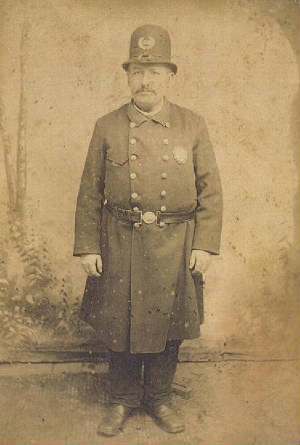
bpdofficer3rdbadge.jpg
Baltimore Patrolman wearing the 3rd. issued badge
swift father.jpg.w300h445
Pictured above is Michael Brooks wearing a 3rd. issue badge
Pictured below is John Edward Swift Sr. wearing the 4th. issue badge
Michael and John are Father-in-law and Son-in-law
(This information comes to us from Michael Brooks' Great-Granddaughter Rose Ireland)
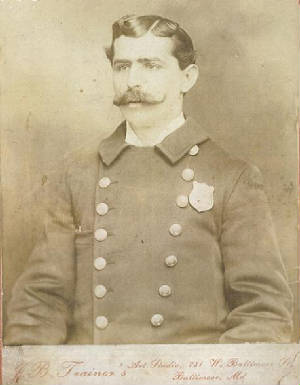
swift-son.jpg.w300h385
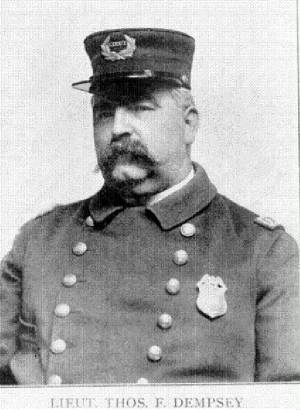
lt thomas dempsey.jpg.w300h410

Devider

POLICE DEPARTMENT

BALTIMORE, MARYLAND

November 17, 1876

Sergeant Seibold, in company with Officer John Connery, of the Northwestern district, on November 17, 1876, arrested William Jennis, colored, alias Brooks, alias Joe Russell, a notorious burglar and sneak, who was charged with burglariously entering the dwellings of Mr. P. E. Kent, No. 85 North Carey Street; Mr. Moses Kahn, No. 266 West Fayette Street; H. R. Williar North Carey Street and others, and stealing money, silverware, jewelry, clothing, etc. He was tried and convicted in Criminal Court of Baltimore and sentenced to the penitentiary for six years, from January 27, 1877. Jennis was arrested also February 20, 1874, for robbing the dwelling of Mr. George W. Flack, No. 142 Mulberry Street. He then gave the name Joseph Russel. He was sent to the penitentiary for one year. This man worked alone, and invariably entered a dwelling house from the rear by climbing sheds, porches or lattice work to second story window, while the family was below at supper. He always used the old fashioned blue head sulphur matches, which were found plentifully strewn about the floors, in the bureau drawers, etc. His work was frequently identified by the matches. About six months after his last release from prison, he went to Philadelphia, Pennsylvania, and robbed several houses there. He was caught, tried, and sent to Cherry Hill prison twelve years.

 

Devider


james_holden_bpd_officer_1890s.jpg
Police Officer James Holden 1890's
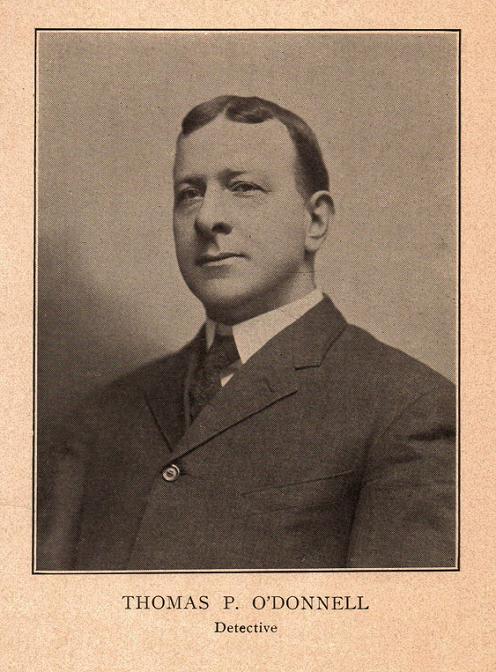
DET_THOMAS_O'DONNELL.jpg

Photo from Clinton McCabe's" History of the Baltimore Police Department, 1774-1907"

Thomas P. O’Donnell, born June 1, 1866 in Birmingham, England.

He was appointed a Baltimore policeman January 24, 1890, and made detective four years later.

One of his most famous cases was the capture of a murderer and Post office robber. The post office at White Plains, N.Y., had been held up and Postmaster Walter B. Adams, a personal friend of then Governor Theodore Roosevelt, had been killed. Police were seeking Eddie Jacks, alias Peter James, for the crime. Thomas O’Donnell, then a rookie detective, got a tip that the fugitive had just slipped into Baltimore and was staying at a boarding house on St. Paul St. Anxious not to let his man get away, the young officer dressed in overalls borrowed a bicycle from Detective Captain Solomon Freeburger and hot-pedaled to the boarding house. He said he had heard the new boarder was a bicycle repairman, so he asked for the fugitive under the pretext of wanting a bicycle lantern repaired. Det. O’Donnell had put two pistols in his coat pockets before calling on the fugitive. As he sat down beside the suspect in a drawing-room, Detective O’Donnell edged up beside him and felt a pistol in his pocket. When the bandit saw one of the gun barrels protruding from the Detective's pocket, James leaped up with not one but two pistols in his hands. At the same moment, Captain Freeburger and a Philadelphia detective burst in and overpowered him. It was believed that the desperado was also planning to rob Mr. Poultney, in the building next door. For the capture of the post office robber he was commended by the late Mayor Malster, and then Governor Roosevelt in person presented a $1000 reward to him for the capture.

In addition to receiving the reward and congratulations from Governor Roosevelt, Detective O’Donnell was given a “Roll-Of-Honor Medal,” the department’s highest award, for the action. At that time–when he had been on the force twelve years–Detective O’Donnell had an imposing record. In his career, he was shot at only once and that was in a gun battle with two burglars in the basement of a cigar factory on Paca street near Cider alley. He trailed two Negroes into the basement and in the darkness, a pistol battle ensued, reinforcement officers arrived in time and the burglars were arrested. Lieutenant O’Donnell was unharmed.

Seventy years old, he retired after forty-eight years of continuous service, 1890-1938, during which he was commended a total of thirty-five times. On his last day he left the Detective Bureau early for his home located 2003 Boone street, where he lives with his wife and daughter. “I’m still active,” he said, as he departed. “I can’t loaf and I’ve got to do something. Guess I’ll try to get me a job as a private detective now.” St. Ignatius Church, on Calvert street has an annual novena and “Tom” O’Donnell is on the job today, every day, just as he has been for 35 years or more, or ever since the novenas were inaugurated by the late Rev. F. X. Brady.

Det. Lieutenant O’Donnell, for half a century a member of the Police Department, and for much of that time one of its best detectives, is retired from active service, so far as his police duties are concerned. But, he is still on duty, night and day, at the church while the novena is being held.

The story is that when the late Father Brady inaugurated the novena, he applied at the Police Department and asked that a tall, slender young man, Thomas P. O’Donnell, whom he knew, be assigned to duty during the special services. The request was granted and so “Tom” has been going back year after year. His colorful career in the Police Department extended over a period of 48 years, in which time he arrested murderers, kidnappers and – in the earlier years – horse thieves. He retired as a detective lieutenant in 1938, the possessor of 35 commendations Lieutenant O’Donnell has been ill approximately a week prior to his death on March 21, 1947

Data compiled by great-niece Sister Anne M. O'Donnell. from Baltimore Evening Sun, April 14, 1938; Baltimore News-Post, Evening, March 9, 1939; Baltimore Sun, March 22, 1947. Photo from Clinton McCabe. History of the Baltimore Police Department, 1774-1907. 2nd ed. Baltimore, MD: Board of Police Commissioners, 1909. Enoch Pratt Central Library.
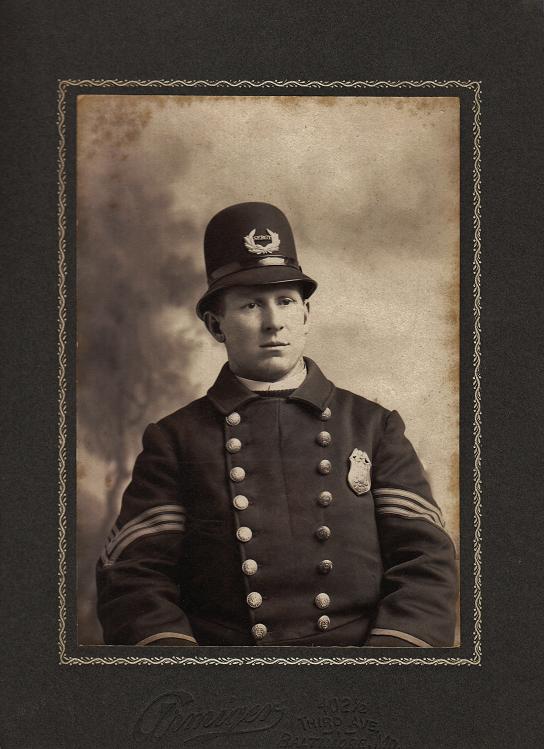
Sgt_Frank_Gatch.jpg

 Photo courtesy Pat Pilling
Sergeant Frank Gatch
1890-1915
bpd_officer01.jpg
75.jpg
BPD-Officer-11
BPD-Officer-22
BPD-Officer-55
BPD Officer 66
67.jpg
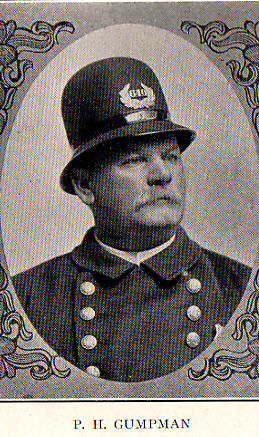
gumpman p.h.

Born:July 5, 1849  Died:January 7, 1917

Peter H. Gumpman appointed to Police Force 1886 and assigned to the Southern District for 30 years.
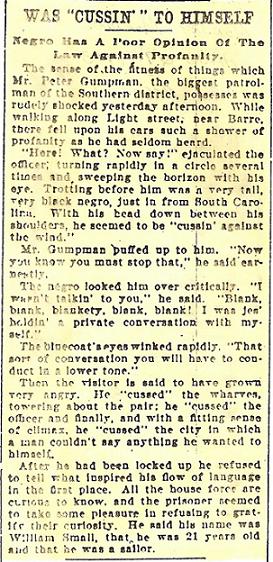
 
gumpman2
Baltimore SUN paper Monday Morning,
April 27, 1903 page 12.
p.hgumpman1
Baltimore SUN paper Monday morning
January 8, 1917 page 3
gumpman3.jpg.w300h99
Baltimore SUN paper Tuesday morning
January 9, 1917 page 6
john_william_garmer_1899-1925.jpg
Officer John William Garmer
Served with the Baltimore City Police
1899-1925
Great-Grandfather of Retired Officer William John Garmer Southern District
68.jpg.w300h437
howard_swope_swd.jpg
Police Officer Howard Swope
Southwest District
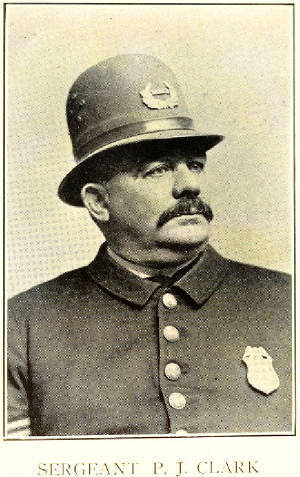
sgtp.j.clark.jpg.w300h477
78.jpg.w560h334
unknownoff7.jpg.w300h414
off.colburn 1893.jpg.w300h296
Police Officer Colburn
unknownoff3.jpg.w300h454
 
sgtalfredmoore1896-1930.jpg
6a.jpg
norton_thomas.jpg
officer_in_the_park.jpg
 
121.jpg
 
BPD-Officer
BPD OFFICER Badge 60

  Devider

Another Reorganization of the Department
History Baltimore Police Department
1774 – 1907

This measure was made an act on February 2, 1860 provided that while the city Council of Baltimore might pass ordinances for preserving order, securing property and persons from violence, danger and destruction, and for promoting the great interest and insuring the good government of the city, it could pass no ordinances which would in any manner obstruct hinder or interfere with the board of police commissioners or any officer under them. All of the Mayor’s powers, conferred by preceding legislation, were repealed. Four members of the board of police commissioners were authorized to be appointed, and the mayor was to be ex officio member of the board.

The first Commissioners appointed under the new act were Messrs. Charles Howard, William H. Getchell, Charles D. Hinks and John W. Davis, two of whom were to serve for two years and two for four years, the duration of their office to be decided by drawing lots.

The duties of the board of commissioners were, in general, “to be at all times, day and night, within the boundaries of the city of Baltimore, as well on water as on land, to preserve the public peace, prevent crime and arrest offenders, protect the rights of persons and property, guard the public health, preserve order at elections and at all public meetings and places and on all public occasions, prevent and remove nuisances in all streets, highways, waters and other places; provide a proper police force at all fires for the protection of the firemen and property; protect strangers, emigrants and travelers at steamboat landings and railway stations; see that all laws relating to elections, the observance of Sunday, and regarding pawnbrokers, gambling, intemperance, lotteries, policy, vagrants, disorderly persons, slaves and free Negroes, and all the public health ordinances were enforced, and also all the ordinances of the Mayor and city Council, provided these be not inconsistent with the provisions of the act or any law of the state which may be made enforceable by a police force.”

The newly created board of police commissioners were authorized to “appoint, equip and arm a permanent police force, the number, exclusive of officers to be 350.” They were also empowered to reduce or increase this force, but could not increase it to more than 450.

No individual could be employed as a policeman who had been convicted of a crime or against whom any indictment was pending for an offense, the penalty for which was imprisonment in the penitentiary.

Policemen were appointed for five years and could only be removed for just cause and after a hearing before the board of commissioners.

In 1862 the military signified its willingness to turn over the Police Department to the civil authorities, from whom they had torn it. The Legislature was at that time in sympathy with the Federal Government. The former police law of 1860 was repealed, but its provisions were practically re-enacted with the difference that the number of Police Commissioners was fixed at two. John Lee Chapman, Mayor of Baltimore, was made an ex-officio member of the Board and Messrs. Samuel Hindes and Nicholas L. Wood were appointed Commissioners. This Board of Commissioners qualified on March 6, 1862, and the oath of fealty to the government was required of them and their subordinates. On March 10 the Board entered upon its duties. The force was entirely reorganized and W. A. Van Nostrand was appointed Marshal. Marshal Van Nostrand went into office when Baltimore was probably one of the most troublous cities in the North. Sectional feeling ran high and there were constant conflicts of opinions between Northern and Southern partisans. The Deputy Marshal was William H. Lyons. Marshal Van Nostrand, besides having charge of the Baltimore Police Department, was United States Provost Marshal of West Virginia, Maryland, Delaware, Pennsylvania and New Jersey. During the greater part of Marshal Van Nostrand's incumbency barricades were established throughout the city, through which no one was allowed to pass after nightfall without a pass. The military and police acted in concert, and while martial law was threatened on a number of occasions, it was never declared, and the courts and magistrates exercised their regular official functions. On March 17, 1864, Marshal Van Nostrand was succeeded in office by Thomas A. Carmichael, and John S. Manly was appointed Deputy Marshal. Marshal Carmichael served until 1867, when a new Board of Commissioners was appointed. Commissioners Nicholas L. Wood and Samuel Hindes continued in office until 1866, when they were removed and Messrs. William T. Valiant and James Young were appointed Commissioners. Messrs. Hindes and Wood refused to deliver to the new Commissioners the police establishment and continued for some time to exercise control over the Police Department. The new Commissioners established their headquarters at another point and began preparing to exercise their official functions. Measures were taken against them in the Criminal Court and they were arrested on the charge of conspiring to obtain possession of the Department. The Commissioners refused to give bail and were imprisoned in the City Jail. They were released by Judge Barton and a few days later took possession of their office and entered upon the performance of their duties. Marshal Carmichael surrendered his command and Commissioners Valiant and Young immediately appointed Col. John T. Farlow Marshal of Police. Capt. John T. Gray, of the Central District, was appointed Deputy Marshal. Marshal Farlow was appointed on April 22, 1867, and served until April 17, 1870, when he resigned. On March 15, 1867, the new Board of the Police Department was organized under the State law. Messrs. Lefevre Jarrett, James E. Carr and William H. B. Fusselbaugh were elected Commissioners by the Legislature. Commissioner Lefevre Jarrett died on February 25, 1870, and the Legislature, then in session, elected Mr. John W. Davis to fill Mr. Jarrett's unexpired first term. Mr. Thomas W. Morse was elected to fill Mr. Jarrett's unexpired second term, and on March 15, 1871, he took his seat, succeeding Mr. Davis. Mr. Morse served four years. In April, 1867, Marshal Farlow retired and Deputy Marshal John T. Gray succeeded him. Capt. Jacob Frey, of the Southern District, was promoted to the office of Deputy Marshal. In 1872 the State Legislature made several important changes in the police law, particularly in regard to the terms of service of the Commissioners. Under the new law Mr. John Milroy and Col. Harry Gilmor were appointed members of the Board. The Board at that time consisted of Colonel Gilmor and Commissioners James E. Carr and Milroy. In 1877 Mr. Milroy retired and Gen. James R. Herbert was elected to succeed him. The riots of 1877 were a setback, in a police and business way, to Baltimore, then rapidly becoming in the matter of good order and commercial prosperity the leading city of the South. The history of the trouble between the Baltimore and Ohio Railroad and its employees has been written fully by historians more competent to deal with this subject, so we will confine ourselves to trying to tell how the members of the Baltimore Police Department distinguished themselves during the stirring days of July, 1877, and will be as brief as possible, considering the importance of the subject. On July 16, 1877, the strike was declared at Cumberland. By noon it had reached Martinsburg, W. Va., and the militia were called out. The police, anticipating trouble, had prepared for it. On the day following the excitement began. A freight train of eighteen loaded cars bound for Locust Point was partially wrecked by means of a misplaced switch near the foot of Leadenhall Street, Spring Gardens. That night the Baltimore and Ohio Railroad employes held a meeting and decided to support the strikers. At 3 o'clock on the afternoon of the Friday following Governor Carroll held a consultation with the Baltimore and Ohio Railroad officials and an order was issued for the First Brigade, M. N. G., to repair to Cumberland. At 5.45 o'clock that evening the military call, "1 - 5 - 1,” was sounded by the City Hall and fire bells. The people knew what the call meant, and in a short time the streets around the armories were filled with crowds of strike sympathizers. In front of the Sixth Regiment Armory, Fayette and Front Streets, a large crowd had gathered. The officers of the regiment saw the menacing concourse and sent word to Police Headquarters asking that policemen be sent to protect them along the line of march to Camden Station. Their request was promptly responded to. At 7 o'clock P. M. a brick was thrown through one of the windows of the armory. Four policemen, Officers Whiteley, Jamison, Oliver and Roberts, were stationed at the door of the armory, and when the rioters charged the doors the faithful policemen manfully repulsed them. By 8.15 o'clock the crowd became more menacing. The militia had orders to march to Camden Station and prepared for trouble. The first attempt of the soldiery to leave the building was received with such an outburst of groans, hisses and stones that they retired. The next time they came out they had orders to fire if molested. The first company fired high, but the attack became so serious that the following companies aimed their weapons at the crowd and discharged them. From then until Camden Station was reached the firing was general; a dozen people were killed and scores wounded. Soon after the regiment reached the building the station was set on fire. Firemen appeared to extinguish it, but were set upon by the rioters and would have been not the police rushed to their rescue and beaten back the crowd. The soldiers appeared to incense the mob, while the police awed it. A scanty handful, compared to the throngs that surrounded them driven from the scene had they charged and charged again to protect the armed soldiers from injury. On Saturday crowds again collected around the station, and a fire alarm so excited the rioters that they rushed toward the lines formed by the police. Deputy Marshal Jacob Frey called to his comparatively few men to "stand steady" and gave the command "Draw your revolvers." Several shots were fired from the crowd and four policemen fell wounded. At this the Deputy Marshal gave the order, "Fire, and aim low." The command was obeyed, and as the policemen fired they rushed forward and each officer seized a prisoner. In all fifty arrests were made, eight men were killed and a number wounded. At 11 P. M. of the same date there was another outbreak and more arrests were made. The next morning (Sunday) the mob again collected around the station, but the surrounding streets were cleared by the police. When the riot had assumed such threatening proportions that the police and local militia were unable to cope with it United States troops from New York and other points were hurried to Baltimore and two war vessels, with decks cleared and ready for action, anchored in the Patapsco. The Board of Police Commissioners swore in several hundred special officers, among whom were Baltimore's most prominent citizens. Messrs. C. Morton Stewart, Alex-

The first powered boat in the Baltimore Police Harbor Patrol came in 1891 – and was The Lannan, followed in 1928 – by The George G. Henry, then in 1940 – came The Charles D. Gaither, and then in
1946 – came the The Beverly Ober.


Devider

THE HARBOR POLICE
History Baltimore Police Department
1774 – 1907
pages 144-146

Nearly everyone who patronizes the summer excursion boats and the score of passenger boats that enter and leave Baltimore harbor is familiar with the sight of a trim looking little dark-hulled steamer that makes her way in and out of the tangle of shipping, skirting around wharves, running into tortuous docks, darting around the ships and steamships that lie at anchor at the wharves or in the regular anchorages. Sometimes at night the passengers on incoming and outgoing steamers catch a glimpse of a dark hull close aboard them and then a glare from a searchlight is sent across their decks and searches the wharves that line both sides of the river front. The little steamer is the harbor police cruiser "Lannan," named in honor of former Deputy Marshal John Lannan, deceased, who had charge of her construction. The Lannan was built in 1891 by James Clark & Co., from plans kindly loaned the Department by the United States Government. The harbor patrol boat was completed on August 10, 1891, and after a very successful trial trip was accepted and immediately put into commission. The steamer is sixty feet long overall and has thirteen feet beam. She draws about six feet of water and has seventy-five indicated horse power.

Prior to the launching of the Lannan the harbor was patrolled by policemen in rowboats, but, as it can be very readily understood, this plan proved utterly inadequate to the police needs of nearly ten miles of water front. Since the time she was launched the Lannan has been continuously in service, save when she was on the ways for necessary repairs. In touring the harbor the Lannan averages nearly fifty miles per day, and as she has been almost steadily on the move since the day she was launched, she has, on a conservative estimate, traveled about 127,750 miles, a distance nearly six times the circumference of the globe. Prior to the launching of the Lannan the vessels in the harbor and the warehouses along and around the wharves were nightly attacked by thieves who operated from the river. Frequently the captains of small vessels would go ashore to return and find that their craft had been stripped of everything movable, including cordage and sails. The commissioning of the police cruiser practically put an end to this extensive thievery, and the fact that she was equipped with a powerful searchlight and could train it over and under piers and on the decks of suspicious craft acted as a check to river pirates and criminals who lurked and operated along the water-front. Shortly after she was built the Lannan was equipped with a fire-fighting plant, and the latter has been used to great effect in fighting fires in the warehouses and along the wharves where the steamer has her regular patrol.

The Lannan is also used for the recovery of the bodies of persons who are drowned in the harbor, and frequently she is called upon to go to distant points in the Chesapeake on the same mission. Her crew is trained in the expert use of the grappling irons and hooks with which the bodies of drowned men and women are fished from the river bed, and the deck of the little steamer has carried many a pitiful canvas covered burden, the earthly remains of some unfortunate who accidentally fell into the water or purposely sought death and oblivion in the murky waters of the harbor.

In the summer of 1906 the Board of Police Commissioners purchased a gasoline launch to act as an auxiliary to the Lannan. This boat was rebuilt and remodeled recently and was launched on May 4, 1907, when she was christened the Farnan, in honor of Marshal Thomas F. Farnan, who on April 30, 1907, completed forty years' continuous service as a member of the Baltimore Police Department. During the warm months the Farnan will patrol the harbor instead of the Lannan, which will be kept at the Harbor Police Headquarters, Philpot and Thames streets. Thus the Department will have two thoroughly able boats at its command should an emergency occur where the services of both the Lannan and the Farnan might be called upon. The members of the Harbor Police Force, who are commanded by Lieutenants Albert L. League and Edward J. Carey, are: Patrolmen John B. Dorsey, Milton Harrington and John J. Ryan. Thomas E. Perry is chief engineer and Charles H. Aborn, assistant engineer. Richard Murphy
is fireman and Richard Stanton, assistant fireman.

In the last report of the harbor police service made to the Maryland General Assembly of 1905 it was shown that during the year 1904 property valued at $13,257.46 was saved and recovered by the harbor police and during the year 1905 the property saved and recovered amounted to $7,616.41. From this a small idea can be gained of the work accomplished by the police who guard the harbor and the docks, warehouses and business concerns that hem it.

  1 black devider 800 8 72

Excerpts from - Proceeding of City Council 11 Dec 1856

(During this December 11th session in 1856) Mr. Boyd moved to strike out all of the section providing for arming the police with revolvers and other suitable weapons AND placing muskets at the station-houses. Mr. Boyd said the cost of arming the police with revolvers would alone amount to $516l; that there were men in the police not fitted to trust with arms, and if the amendment was not adopted he feared he should be compelled to vote it was necessary to arm the police, as long as rowdies were armed with revolvers and other weapons. In New York and Philadelphia where there is a penalty for carrying concealed weapons, the police are armed by the city authorities. The muskets at the stations houses were to be kept there under the charge of the Mayor, to be used only in case of riot, where such arms were necessary to compete with armed mobs Mr. Boyd replied that only a few weeks since one of the police had drawn his revolver at Carroll Hall on one of the night police - He reiterated that there were men not fit to be trusted with such arms. The time was when twenty-six men kept this city quiet and in good order without being armed. As to giving the police muskets, we might as well have a standing army. If muskets are necessary at any time, the military are always ready to obey any call of the Mayor. Mr. Pinkney again urged that it was necessary to arm the police - you must arm them to have any effect at all. If the military were called out at the present state of feeling in the public mind, instead of preventing, or suppressing riot, it would lead to one of the bloodiest riots on record. Mr. Howard opposed the amendment - he believed that it was necessary to arm the police in order to protect the citizens - to put down the riots that had so often of late violated the law and shot down peaceable persons. We may have seen outrages heretofore, but we have not seen orderly citizens shot down at their own doors - men driven from the polls when only seeking their right of exercising the elective franchisepolls obstructed and men leading on armed mobs with apparent impunity - Mr. Boyd was willing to judge the present by the past - If we are to have no better men on the police than for time past, he was not willing to place arms in their hands. If the police are armed, no man is safe in this community. The question being taken on Mr. Boyd's proposed amendment, it was rejected by yeas 3, (Messrs. Boyd, Tidy, and Carroll,) and nays 16. Mr. Nalls moved to strike out that portion of the ordinance placing muskets at the station houses rejected by yeas 6, (Messr Daiger, Boyd, Green, Tidy, Carroll and Nalls,) and nays 13. Section 8 was reconsidered, on motion of Mr. Handy, who moved to amend it by making the police officers to be confirmed by the City Council, as other city officers are; which was adopted with but one dissenting voice.

In short, Mr. Boyd’s amendments were struck, and the bill allowing the city to arm police was passed.

During the times the city was nearly taken over by several gangs involved in politics, they would travel the various wards making it nearly impossible for honest voters to vote. As such elections were not fair, the same people won every time. I wouldn't be surprised to hear Mr. Boyd was benefiting more by having the Know Nothings, Plug Ugglies, Bloody Tubs, Etc. ruling the city with an unarmed, or under armed police force, at the time police carried their own weapons, usually single shot pistols, or some other small pocket pistol, ill-equipped to fight these gangs. We lost several officers at the times. Still arming police, wasn't as much to help, or protect the police, so much as it was to allow politicians to receive fair votes. It may also be worth reminding readers of the Know-Nothing Riot of 1856, in which some of the worst rioting of the Know-Nothing era in the United States, occurred in Baltimore. It was the fall of 1856, street tensions had escalated sharply over the preceding six-dozen years as neighborhood gangs, most of them operating out of local firehouses, became increasingly involved in party politics. Know-Nothing candidate Thomas Swann was elected Mayor of Baltimore in 1856 amidst violence and a heavily disputed ballot. Police Commissioner Kane was also involved in this, and in fact testified in open court for the defense in a trial against a Know Nothing that was charged with killing one of Kane’s Officers, Kane was more dedicated to his party than he was his own men. Based on what these gangs were doing, it is obvious what some politicians wouldn’t want to fight it. The point being, City Council may not have as interested in protecting their police, i.e. Officer Safety, or even Public Safety, as much as they were in getting voters to the polls. This is supported by the line in the above artcle in which Mr. Howard who was opposed the amendment said, "He believed that it was necessary to arm the police in order to protect the citizens, to put down the riots that had so often of late violated the law and shot down peaceable persons". He added, "We may have seen outrages heretofore, but we have not seen orderly citizens shot down at their own doors" Finishing off with, "Men driven from the polls when only seeking their right of exercising the elective franchisepolls obstructed and men leading on armed mobs with apparent impunity." This leads me to beleive, or at least has to make me concider much of the motive arming police, was to help getting voters to the poles, I don't have proof, and in a million years could never find such evidence, but I offer the suggestion, with the information, and hope you see what I see.

  Devider

mdcolor

 3  Aug, 1875

The Use of Firearms by the Police  The shooting of a colored man Daniel Brown on Friday night by policeman McDonald, apart from the merits of the particular case, which will be the subject of judicial investigation, is calculated to direct public attention to the general question of the right of police officers to use deadly weapons in the discharge of their duty. The contingencies which require the use of such weapons are happily in this community of where an exceptional occurrence. It is only out of abundant caution that the police are required to be armed at all, or with any other weapon than the ordinary policeman’s club. The club itself all to be, and ordinarily is, but the staff and wand of office – this symbol of authority to was even the disorderly and lawless are compelled to pay obedience. It is upon this respect for law which is excited by the mere display of the external symbols of law that the preservation of society ordinarily rests. It is the badge and uniform other policeman, rather than his muscles or truncheon, which command respect and compel obedience. It is only, as we have said, in exceptional cases and in comparatively rare cases that the assertion of the authority with which he is clothed by law, and which usually makes itself felt and obeyed by moral sanction, requires for its enforcement the aid of blue force, and, above all, of deadly weapons. The law not only denies to the citizen, but punishes him in the use of concealed weapons, such as the pistol and the knife. The law arms its officers with pistols, not that they may use them rationally or indiscriminately, but in order that in extreme, but possible cases, they may not be deprived of the means of necessary self-defense, and the law may not be trampled upon or outraged in their person. In the case that happened on Friday night we, of course, desire to express no opinion as to the extent of the provocation which the officer may have had to use his club, or whether he will be justified in resorting to the pistol. These are questions for a jury here after to consider and determine. As to the rules was all to govern policeman in such cases, or finding themselves similarly situated to Officer McDonald, there can be no question. In the first place, the police force is no place for passionate or excitable men, who are able to easily lose temper, still less to the easily alarmed, and led to believe their lives in danger when no danger really exists at all. The policeman in all cases, and above all other men, all to be cool and collected, capable of the highest self-control, and not liable to lose either his temper or his head. In the next place, before using his authority, it behooves the policeman always to consider what are the limits of his authority, and what is the Association for its exercise. An attempt to commit a murder, or burglary even, presents a totally different case for violation of a city ordinance. A policeman may be justified in shooting a murderer taken red-handed in the act, or who resists and defies arrest, no policeman would be justified in killing a citizen who refused to have his sidewalk cleared of ice, or to exhibit a license for a “cakewalk” or a “pay party.” Again, all citizens of whatever color or degree, rich and poor, white and black, have the same and equal rights of personal immunity and protection before the law. Consequently the case of officer McDonald must be judged in all respects precisely as if the person whom he shot had been a white man, and with reference solely to the circumstance under which he acted, and in which, if at all, his justification must be found. At the most, it appears, a violation of the city ordinance might have been committed by the Keller people, who’s noisy and unseasonably revels officer McDonald undertook to regulate. Conceding that the case was one which not only justified, but called for the interruption of the police, the question will still remain – was McDonald justified in the use of either club or pistol? Mere impudence would not justify the use of the former, and unless his life were in danger, or he really, and with probable cause, believed it to be in danger, there was no justification for the use of the latter. These, however, are questions for the jury. What concerns the community is what the police, as well as all others, should be taught to feel that human life is a sacred thing, that the life of a citizen, be he black or white, is not to be lightly taken or sacrifice, and the circumstances are few and rare indeed in which a policeman will be tolerated in the use of a death – dealing weapon, for which circumstances, and such only, such weapon is confided to his hands. Too many cases have happened lately – fewer, perhaps, in Baltimore in proportion than elsewhere – of the brutal and lawless use by the police of the powers with which they are clothed. That, however, does not excuse the happening of a single case to the contrary. It is no comfort to the widow and children of a man killed by a police officer, if killed without justification, to be told that such cases rarely happen, and that it is only now and then that a man is shot or club to death by a policeman in mere cruelty or wantonness. We repeat, that we have no desire to prejudge the case of also McDonald, and in view of the good character which his supervisors and Associates on the force seemed to establish for him, it is but right that there should be an entire suspension of the public judgment in his behalf until a competent tribunal shall have passed upon the question of his guilt or innocence. Still, it may be permitted to observe that, if not criminal, he was undoubtedly hasty, and that the arms entrusted to the police are intended to be given to brave, cool and intelligent men only, to be used solely for the purposes of necessary self-defense, or equally necessary enforcement of the law.

Devider

 Dec 14, 1885


Police and Their Uniform 

Reported for the Baltimore Sun
The Sun (1837-1987); pg. 5

Dissatisfaction with the Objection to the 
New System of Work and Barracks Life

[Reported for the Baltimore Sun.]

The new police system is still meeting with vigorous criticism. The patrolman are, as a general thing, greatly disqualified, and some of them say that they can see no good thing in it. The men say that they cannot get their meals regularly, and that this interferes with their doing Effective duty. As regards the sleeping comforts, the men say that it is impossible to get a good sleep at the station. The beds are close together and a lot of the men are huddled in, and the idea that these apartments are as pleasant as their homes is all a mistake. The reserve men say that when at the station they cannot get a good sleep because they are all the time anxious about being called. They do not know what moment the Fire Bell might sound, and then they must be up and awake. One of the practical illustrations of the hardships entitled by the new system is afforded by the burning of a shed in the yard of the number 125 Westville St. at 830 o’clock. By which $15 damage was done. The alarm of course called out the reserve squad of the Northwestern police station: they had been indoors for about an hour and a half only.

A policeman who is served many years on the force, said that the new system was too young to be judged. So far, though, it seems to be a failure, as far as the men are concerned. The Captains and Lieutenants did not feel the change to the full extent that the patrolman do. They are the men who have to bear the brunt of the battle. For a long number of years the force of Baltimore worked under the day and night system. The men grew up with that system and naturally dislike to change it. The average policeman, after he gets through the days work, goes home, and after eating the evening meal. Chats with his family and then jumps into bed. This constitutes his happiness. The night watchman employees the time of rest in about the same manner. Now comes a system that breaks all this up. The men are deprived of the long accustomed habit of domestic pleasures. They have not so many hours now to spend at home. When they would be at home they are cooped up in the station houses. Of course men do not like this. Then under the new system the men are liable to become careless. Under the old system the same policeman worked a certain beat for years. He’d grown up to know the people who lived on that beat. A new their characteristics and habits, and could thereby more intelligently perform his duty. He also knew every nook corner of his beat, and was well acquainted with the dangerous and secluded portions of it. He knew where to look for trouble and knew how to meet it. Then he was jealous to leave his beat in good condition, because if there was any trouble on it, the officer who relieved him would report it, and if he was responsible he could not shirk the penalty. Under the new system different men patrol the same beat. Being one only six hours of the time a man has not the opportunity to judge the people on it. If when an officer is about to leave his beat and give place to his relief something should occur that needed following up, he would say, “well, I don’t care: if I’m Reported I can say it was all right when I left it: let the other fellow look after it.” Being somebody different man on the same post, the indifferent officer will find it easy to escape detection. The new system does not give the same protection to the people as did the old system. All the time one fourth of the entire force is in the station house. Under the old system a part of them at least were on the street doing duty. There will probably never occur any catastrophes so dreaded as to need the presence of at least 100 policeman at one time. The good order of Baltimore is to well assured to purpose that any crisis will arise to meet with one fourth of the police force will be needed. There is too much soldier business about the new system. It was said that the New York policeman, when they worked the old-fashioned system of day and night squads and wore the uniform on all occasions, were the best in the country. Then a change was made, and now the word “finest” when applied to them is understood as a burlesque. Baltimore has always had reason to feel proud of its police force under the old system. It remains to be seen whether or not Change will merit the same feeling. A gentleman who has long watched the progress of the Police Department of Baltimore city said yesterday that for a number of years the police force of Baltimore has enjoyed a reputation for efficiency that made it the pride of all who take an interest in the welfare of the city. No word of praise were to laudatory for the force, and it was only spoken of in words of commendation. Not only in the city of Baltimore where the praises of the department sounded, but all over the country could be heard expressions of confidence. So closely had the force been watching that it was an admitted fact that Baltimore had the best police force in the United States. There being this universal praise bestowed upon the force, and light of the present changes, it was but natural and just to take a glance backward and examine the rules and regulations that governed the department during these years in which it made the record which challenged the admiration of the whole country. For a long number of years the police force of Baltimore city worked in succession known as day and night squads. The men were required at all times and under all circumstances to wear their uniform dress. It is no matter of conjecture that for a long period of time those charged with them management and control of the police force had in contemplation the idea of changing the working hours of the force. This idea was prompted not by a desire to render the force more efficient, but simply to secure to the men some measure of relief from their ardous duties. To jealousy fostered and carefully studied, it was never found expedient to change the old system. The advocates of the new system now in operation make a double claim. First, that the men are greatly relieved and rendered more efficient: and second, that the city itself is more securely protected. That the men are relieved is an open question, and cannot be justly answered until the system has at fair and impartial trial. That the city is given a more ample protection is in absurdity. Under the old system there is no doubt but that men worked too long on a stretch. But after work they had an uninterrupted. Of at least 12 hours to which to preserve for the next. The work. Under the new system, the men, it is true, only do six hours consecutive work in patrol duty. They then either go home or do reserve duty at the station. The periods of rest under the new system are more frequent, but are not as long. True it is, too, that the periods of patrol duty world around more rapidly. The privilege granted the men to wear plain dress while not on duty is certainly a drawback to the efficiency of the force. That it should be voluntary tendered as the men by the police commissioners is a matter of surprise. If, after a request from the men, the police commissioners should have granted the wearing of plain dress when not on duty, the case would not be so surprising. But being bestowed as a gratuity, it is a little strange. No citizen who is acquainted with the history of the late flight in the General Assembly of Maryland over the bill to make it a law that the patrolman should be allowed to wear plain dress when not on duty and fail to see that there has been a radical change in less than two years. Even after the lawmakers power of Marilyn had declared that the policeman of Baltimore city should be allowed to wear plain dress when not on duty, the board of police commissioners, the Marshal of police and the Deputy Marshal all combined to secure the veto of Gov. McLane. After strenuous efforts the bill was vetoed. There is no question but that the uniform protects the police force. While it is true that there are many men on the force who would not take advantage of plain dress to violate any rule of the department, still there are great many the wood. Indeed there are some very efficient men on the force who owe their efficiency to the uniform. While having no desire to violate any rule of the department still in plain dress they would be drawn near and dear to temptation. And at last in an unguarded moment would fail or fall. The men used to argue that with the uniform one they could not walk the streets with their wives and daughters without attracting attention. But the people know the policeman were compelled to wear the uniform, and of late years policeman were not subjected to much annoyance on this account. Under the new system is he annoyance will be increased. The public, knowing that the policeman have the privilege to wear plain dress when not on duty, will share and gaze at them every time a female is seen walking with a on uniformed officer, whether it be his wife or not. There is no question that the uniform made the men more careful. They knew the people watch closely that uniform – saw where went, and made the wearer more careful about his habits. If the new system does relieve the men, then it is a great blessing. That it does cannot now be declared. That the new system will give greater protection to the people of Baltimore is scarcely tenable.

Marshall Frey in speaking of the new system last night said that under his working each man did an equal share of duty. After careful study the schedule of hours for patrol the reserve duty and hours at home have been prepared so that each man was put on equal 40. Under this system the day on which a man does the greatest amount of patrol duty is followed by a day on which he is required to do the least amount of patrol duty. The day that a man does 13 hours patrol duty is followed by one on which he does only 6 hours patrolled duty. In doing this 13 hours patrol duty a man has three turns in which to do it. 24 hours in which a man has no time at all home except in which to get his meals is followed by 24 hours in which he has 18 hours at home, in turns of six and 12 hours. The new system also does away with the short system that was worked in midwinter. Under the short system the city was policed as follows: during the day by 127 men; during the early part of the night, from 6 PM until 1:30 AM by 210 men; during the latter part of the night, from 1:30 AM until 7 AM at 149 men. Under the new system there are 244 men on the street all night. From 1:30 AM until 7 AM the city needs the greatest police protection. Generally speaking the city during those hours are sleep. The citizens are in bed, and life and property is in the hands of the police. These are the hours in which the robbers and thieves are abroad. The short system does not give ample protection with 149 men. The new system places 244 men on the streets during these hours, or an increase of 95 men. During the early part of the night under the short system there were 210 men on the streets under the new system there 244 or an increase of 34 men. Leaving out short system, however, the new system does not have as many men on the street as the old. Under the old system there were 163 day men on duty and 312 night men. This shows a decrease of 41 men in the day force and 60 men and the night force under the new system. That the new system changes the habits of the men there is no doubt and until they become acquainted with the system and a custom to its requirements they will naturally be displeased


1 black devider 800 8 72

Devider color with motto

Please contact Det. Ret. Kenny Driscoll if you have any pictures of you or your family members and wish them remembered here on this tribute site to Honor the fine men and women who have served with Honor and Distinction at the Baltimore Police Department.

Anyone with information, photographs, memorabilia, or other "Baltimore City Police" items can contact Ret. Det. Kenny Driscoll at This email address is being protected from spambots. You need JavaScript enabled to view it." follow us on Twitter @BaltoPoliceHist, like us on Facebook or mail pics to us at 8138 Dundalk Ave. Baltimore Md. 21222

Copyright © 2002 Baltimore City Police History - Ret Det Kenny Driscoll

1900 - 1920

1900 - 1920

 1 black devider 800 8 72

1900 - 1920

carter

The Last Marshal of Baltimore

Robert Dudley Carter, was born in Littleton, Halifax County, North Carolina, 1852. He was the son of Jesse and Sallie Ann Carter (Whitaker). Robert got his middle name after the first elected Governor, "Edward Bishop Dudley" elected by the people of North Carolina 1835. Robert worked on his family farm and as a teamster wagon driver. In 1869, Robert served in the U.S. Navy for 4 years; he married Dona Burkhart his wife, in 1875 at the age of 23. Robert had moved to Baltimore in 1875, Dona gave birth to a daughter, "Bessie May Carter" she was born in Baltimore. Robert was working in Baltimore as a Teamster with the old-horse-car service, after which he was a contracting foreman. In 1878 Dona gave birth to a son "Robert Dudley Carter Jr."; he also was born in Baltimore. He bought his first house in 1880, at 1650 North Gilmore Street. 1884 May 12, Robert received an appointment to (Police Officer), North West District, Baltimore City, he was 32 years old. He work hard at being the best, and in 1888 March 9, he was promoted to Sergeant and 1892 November 17 to Lieutenant. In this same year Robert D. Jr. and Bessie May and her husband were living with Robert and Dona at 1650 North Gilmore Street. 1894 April, Robert's father Jesse, was visiting from Sterms, Granville County, North Carolina and pass-away in bed at Robert's house 1650 North Gilmor St. Baltimore. Dr. George W. Norris was called in and said his death was due to heart disease. Jesse was 73, and was a merchant, in Dry Goods, Stems, and Halifax counties North Carolina. Jesse's body was sent home to North Carolina. Working long days most up to 18 hours, showed Robert as a good Policeman, by 1914 August 14, Robert was promoted to" Marshal of Baltimore City Police Department", he skipped the rank of Captain, he was 62 years old. May 27 1915, there was a 63rd birthday party held at "Arion's Country Club", Wilkens Avenue extended. It was expected to be up to 800 citizens of Baltimore who have become acquainted with Marshal Carter. He was given a "14-karat Solid Gold Badge", with 63 diamonds set in platinum. Topping the American eagle is a one-karat diamond. In 1917 Marshal Carter was elected to the National Commander of the Army and Navy Union at the eighteenth biennial encampment at the Bohemian Hall, on Gay and Preston streets. September 4, 1918 he was the Chief marshal of the parade headed by a delegation of the Grand Army of the Republic, and several thousand United Spanish War Veterans who are holding their twentieth encampment.  1920 was a hard year for Robert, Dona was ill, Robert D. Jr. was ill also. Robert Jr. was in a sanatorium in the mountains, Marshal Carter had Mary Gohagen working for him to help take care of Dona and Robert Jr. Marshal Carter brought Robert Jr. home from the sanatorium knowing that he could live only a short time. December 26, 1920 Robert Jr. pass away at the age of 42, when Dona was told she became unconscious. In 1921 August 7, Dona had passed away, this same year Marshal Carter retired form the Baltimore City Police Department on January 20, 1921 with (36) years (8) months of service at age 68. Marshal Carter moved in with his daughter Bessie and his son-in-law Henry D. Hammond at 604 Hollen Road, Baltimore where he lived until 1936 October 22 when he passed away from pneumonia at the age of 84. The Rev. Bruce H. McDonald, pastor of the Westminster Presbyterian Church, conducted the services. The Burial was in Woodlawn Cemetery, Baltimore County, with his wife Dona and son Robert D. Jr. with wife Effie, and Robert D. Sr., daughter Bessie Carter Hammond. The Baltimore City Police Department named in his honor the "Police Boat" after Robert D. Carter. Marshal Robert D. Carter was the "Last Marshal of Baltimore City Police 1921. When General Gaither, Commissioner of Police, took office late in 1920, he started a reorganization of the department, and when Marshal Carter retired he created the post of Chief Inspector. Marshal Carter, with tears filled his eyes, he stated he did not expect the recognition given him, as he felt he was appointed to the position of Marshal of police by the Police Board and not by the citizens, "but I am happy to say", he remarked, "that the Police Department and every citizen of Baltimore will get the best in me and in the force under me. I feel that Baltimore has the best Police Department in the country. Marshal Carter is personal known to police chiefs across the country. He is a close personal friend of "William A. Pinkerton", the noted Private Detective. Robert was a Thirty-second degree Mason, Shriner, and Knight Templar.

By great grand nephew

Kenneth M. Carter

1 black devider 800 8 72
 

Officer at call box
COURTESY OFFICER JAMES McCARTIN

Officer Center Market
 
sst1903.jpg
 
1904fire.jpg
Officers at the great Baltimore Fire of 1904
officer07.jpg

1904 Presidential Election Judges John Ruddy, Arthur Ningard, Arthur Ford, James Scott. This photo, depicts the Judges of Election in the Twelfth Precinct (Locust Point, Baltimore City) during the 1904 presidential campaign. Teddy Roosevelt was elected. Pictured here are John Ruddy (top left), Arthur C. Ningard (top right), Arthur Ford (bottom left policeman) and James W. Scott (bottom right). The fifth man is unknown.

trafficsquad1905.jpg
TRAFFIC SQUAD  1905
"Beauty Squad"

In some of the officer's hands, it appears that they are holding swords, those are actually sticks, a sort of swagger stick, that was used to direct traffic, in a squad of well-dressed, well-groomed men, that wore white parade gloves year round. There were complaints about the gloves, but the no one listened, they said the gloves were part of the uniform, and will continue to be worn. That is downtown, the further west the squad went the more laxed the rules were.
 
w.j._broadfoot.jpg
Police Officer W.J. Broadfoot in 1907
1bateman w.j.

W.J. Bateman, Baltimore Police Officer 1907, great-grandfather of Ron Bateman, the current AA County, Maryland Sheriff and a retired Captain from AA County Police Dept.

Potter_Charles_Sergeant_1965.jpg

Fireworks in America - Fireworks in Baltimore

Americans have been setting off fireworks to celebrate our independence since 1777, Baltimore City was one of the first Cities to illegalize the use of consumer fireworks. The first year of these rules came about was 1904 when we saw improvements in reduced injuries immediately. While surrounding counties the same year with relaxed firework laws, say death and dismemberment in 1904 with two young men each losing a hand to fireworks.

Frank_Vavra2.jpgPhoto courtesy Nancy Cook

BPD-Officer-3-3.jpg
 
13a.jpg
 
1 black devider 800 8 72
 
Pawnshop History BPD

21 July 1909

To Keep Tabs on Pawnshops
Col. Swann Once Law Regarding Daily Reports of Deals

To help the police keep tabs on secondhand dealers and pawnbrokers who by stolen goods, Col. Sherlock Swann, President of the Board of Police Commissioners, will have introduced into the next Legislature a bill compelling Three-Ball Experts to make daily reports to the police Headquarters their purchases of valuables. Laws like this are in existence in nearly every other city.

“It is very important,” said Col. Swann yesterday, “that we have such a law in Baltimore. I do not say this simply because other cities have it, but only because it is necessary to keep tabs on stolen articles.

"I hope that when the bill is introduced at the coming Legislature it will pass, for it will be of great help to our department. Such a law affords the police the opportunity to recover the stolen property if the thieves are not caught. “Marshall Farnan warmly approved of the idea. "It's a necessity," said the Marshal. "To do good work we have to be able to date, and we should, by all means, have a system of knowing what jewelry is bought by secondhand dealers and pawnbrokers."

1 black devider 800 8 72

j.t.tevesbadge478.jpg
Officer J. T. Teves badge# 478

1 black devider 800 8 72Retired Marshal Jacob Frey Buried

Notable men attend the funeral of Former Police Chief
The Sun Jan 5, 1911

With his bier surrounded by veteran policemen who admired him in life for his ability and courage, the funeral of ex-marshal Jacob Frey, who Died Sunday night, took place at 2 o'clock yesterday afternoon from his home 510 N Carey St. The service conducted by Rev Harry D Mitchell, Pastor Harlem Methodist Episcopal Church, brought tears not only to the eyes of the veteran Police, and Family, but also to the several members of the old Lobby Club, which met several years ago at Ford's Theater Opera House.

The pallbearers were Messrs Emerson Loudenslager, Frank Reynolds, Rodger Reynolds, Jacob Frey, George Frey, and Roger Frey, grandsons and nephews of Marshal Frey. Burial was in Greenmount Cemetery. The parlor was beautiful floral tributes sent by friends and by policemen from all 9 districts.

three bank president - Mr. Donald H Thomas, Mr. Thornton Rollins, and Mr. Jacob Hook - all of whom were closely associated with Mr. Frey in life and who were members of the lobby club, were present Marshal Farnan, with all district captains in uniform, also attended and when the body was carried to the hearse from the house, they formed a guard on the pavement.

At the grave, Mr. Mitchell paid a glowing eulogy to Mr. Frey. Besides Marshal Farnan and Messrs. Thomas, Rollins and Hook the following were present:

Deputy Marshal Manning, Johns Swikert, secretary to Marshal Farnan, Josiah A. Kinsey, secretary to the police board, Captains League, McGee, Santry, Cole, Morheiser, Henry, Moxley, and Gottings, Serge, Edward Shultz, Retired Capts. Cadwalder and Gilbert and Retired officers P H Stewart, Augustus Reinhardt, W J Fairbanks, William Wallace, William Pearson, and Andrew J Saucer. Messrs, Robert Fusselbough and William J Murray Police inspector Andrew Houghton of Boston also attended

joseph h itzell 4-12-1911.jpg.w300h447
Officer Joseph H.Itzel (above)
April 12, 1911
 
Captain Joseph H. Itzel (below)
1937
captain_joseph_h_itzel.jpg
Chief Inspector Joseph H. Itzel (below)
Retired April 25. 1954
j.itzel_chief_inspector_ret._4-24-1954.jpg
BPD Captain, Lieutenant, Sergeant (below)
19.jpg
 
1 black devider 800 8 72

5 July 1909

‘Twas a Quiet Fourth

Young America Dared Not Defy Strict Orders of Police

Many Spent the Day in Country

Celebrations Planned for Today Marshall Says, He Will Enforce Law to The Letter

Young America in and about town been the supply and need yesterday to the law. There was few shattering’s of the atmosphere by noisy crackers or dynamite caps and the day was one of the quietest fourth of July’s this city has seen. This may have been because the day was Sunday. But if Marshall Farnan’s police force can enforce the law today there will be a little loud celebration.

Public opinion has demanded a “bloodless” fourth, and while there may have been several policemen “willing to wink there I to let a lad throw a cannon cracker under a horse in the street, they feared to use do so because Marshall Farnan, accompanied by deputy Marshal Manning and Marshall’s secretary’s Swikert, drove around the city in the morning and afternoon.

Stop it the ban was placed on the following explosives: shooting crackers, cannon crackers, Roman candles, skyrockets, pinwheels, split devils, dynamite caps and kindred noisemakers. Occasionally the boom of a cracker or the pop of the torpedo was heard, but the warnings by the police cause parents to watch their offspring’ movements.

Few dealers in the city directly sold any explosives, as they were warned that they would be subjected to heavy panel these if they violated the law. Across the city line, however, the ores are stocked with all sorts of explosives.

Marshall Farnan was highly pleased with the quietness of the day.

“I am as patriotic as anyone in the country.” He said, “I believe in celebrating days of achievement in the proper manner. The use of fireworks of an explosive nature is a means to the community and I hold myself responsible for the lives and property.

“Go to the country – to the parks and resorts. Take your lunches and enjoy yourselves romping on the grass and reading in the cool and shade of the trees. It should be observed like any other holiday – not by making noise, setting fires to valuable property and injuring and killing a large percentage of the populace. Do you call that a proper means of celebrating?

“Every department in this country has followed our idea of having a strict observance of the Fourth of July. We have lessened this toll formerly cause. People feel better, save money and enjoy the day just as well.”

Thousands of Baltimoreans left the city for the suburbs, where many of them will stay until tonight and celebrate the day. The many other resorts that cluster around Baltimore also had therefore quota. At most of these places, there will be a display of fireworks tonight.

Suspicions that the real fourth is at hand were awakened at night by the ascent of some hundreds of balloons from the city, the small boy being unable to restrain his enthusiasm till this morning and uncorked his patriotism at sundown. So, too, did many a paterfamilias surreptitiously send up a hot air bag from the backyard for the delight of the children and his own intense satisfaction. In many of the streets, youngsters gathered an inflated their very colored balloons, which sailed slowly up to incalculable altitudes. Like stars, they twinkled in the heavens, and the elasticity of the human vertebrae was demonstrated as hundreds of heads were bent back in an effort to follow the messengers of independence.

The day was celebrated by the Mecca beans at their country home at Brightside. A specially arranged program was carried out, including the raising of the flag and a salute, a patriotic address, national songs, a concert, military drill, basketball, and dancing.

nwsergeants1890s.jpg
Two Sergeants from the Northwest District
 
1 black devider 800 8 72
COATLESS "COPS"? NO!
15 July 1912

The Sun (1837-1989);

Policemen, Fat and Thin, Balk At

Suggestions For Comfort.

MARSHALL FARNAN SWATS PLAN

Modest Apollo’s, weary of displaying formless, sidestep proposals for a shirtwaist forced

Police official do not seem to take kindly to the suggestion of a “shirtwaist” form in hot weather. The idea has been advanced that lighter clothing would increase the comfort and efficiency of the men as it was done with letter carriers.

Marshall Farnan would be perfectly willing to have the men wear shirtwaist if it were practicable, but he says he doesn’t think it will be.

“In the first place,” said the Marshal, “they wouldn’t have any place to put their pistols. A policeman carries his gun in a holster (in his pocket) under his coat where he can get to it quickly. If he had to wear a shirtwaist he would have to carry it in his back pocket, and probably but in the pocket even at that, it would attract attention and be hard to get out quickly if he needed it. “Of course, a policeman doesn’t often need his gun, but when he does wanted he wants it badly and he wants a quick. That’s the main reason against shirtwaist’s.

In rainstorms and tussles

“Then if he got caught in a rainstorm and had his shirtwaist soaked, he would be a rather forlorn looking site until he changed it. A man can’t keep a couple of shirtwaist handy, so as to put them on when he gets wet. A coat doesn’t look so bad when it gets wet. 

“And then there’s another thing. When a policeman starts to arrest some fellows he often has to wrestle with his prisoner and it would be easy to have a shirtwaist ripped off. Some of the men even get their coats torn. A policeman with a ripple shirtwaist would be like a fellow coming home in a barrel. “The close the men wear in the summer has been chosen because of its lightweight. You could almost see through the stuff, but it wears well and it’s economical.” “How would you like to wear a shirtwaist?” He was asked. “Well,” he mused, “I don’t know. I’m so used to wearing a coat that I guess if I went out in a shirtwaist I take a side street, so that no policeman would see me and arrest me for not having enough close on. I’m not built for shirtwaist, anyway.”

Views of Stout and Thin

One of the Stout policeman was asked what he thought of the plan. “Say,” he puffed, wiping his steaming face, “I’m hot now, all right, but if I had to wear one of those things and have fresh guys coming along every few minutes yelling, “peak – a – Bill,” I guess I’d be hotter still. I’m right touchy about my shape. Somebody would come along and say, “get a V shape, officer, get a V-shaped –“ and I guess I’d have a sweet time explaining to the police magistrate that I had run a fellow in for disorderly conduct.” One of the thin ones was asked if he would like to wear a shirtwaist. “Say,” he replied, “what would I look like, standing at the corner of Charles and Baltimore streets at 2 o’clock of an afternoon with a shirtwaist on and no suspenders. I’m thin; can’t you see that? And my suspenders do real work. No, sir re-, none of these shirtwaist for mine. Let the letter carriers wear them – nobody loves them.”

1 black devider 800 8 72


Marshal Robert D CarterCOURTESY OFFICER JAMES McCARTIN

1 black devider 800 8 72

Baltimore Police Marshal Robert D. Carter

1914-1921

The last Marshal of Baltimore City

1890s_officer1.jpg

Overdue Honor Paid Officer Slain In 1915

By Donald K. Miller 1944

An error 29 years old in the Police Department records was rectified today when Commissioner Hamilton R. Atkinson ordered the name of Patrolman George C. Sauer inscribed on the role of honor beside those of 22 other policemen who met a violent death in the performance of their duties. Patrolman Sauer was fatally shot in the abdomen shortly after 4 o'clock on the morning of April 9, 1915, by one of three out-of-town. gunmen whom he had chased up a blind alley that runs between Hare Street and Ellwood Avenue. Omission A Mystery Accounts of the killing and of the subsequent roundup of the criminals and their trial in Criminal Court occupied prominent space in the newspapers for many weeks. No one now connected with the Police Department is able to explain the omission all these years of the slain patrolman's name from the Honor Roll. Had not Lieutenant George Sauer, a Central District policeman and son of the slain officer read a recent article in The Evening Sun which listed names on the Police Department's role of honor, more years could have elapsed before the award. My father was a policeman killed in the line of duty. Why wasn't his name mentioned with the others?" the Lieutenant asked. Old-Timers Remember When he was told that police records. dating back to 1870 contained no data on his father's death, the matter was brought to the attention of Commissioner Atkinson. A canvass of the police force unearthed a handful of old-timers who recall the slaying of Officer Sauer. One was Capt. Lawrence King, Commander of the Southwestern District, who at the time was a Detective Lieutenant and one of the Policemen who came to the aid of the stricken officer. As Capt. king recalled, the tragedy followed by three gunmen from a saloon on eight street near Lombard, because of disorderly conduct. Gunmen Open Fire the gangsters, who had been given the bums rush by other patrons of the saloon, whipped out their guns and started blazing away. As they ran down the street pursued by a crowd of infuriated civilians patrolman Sauer joined the chase. Sauer was chasing one of the men up a blind alley when felled by a bullet. Before the assailant had time to escape, he was collared by King. Later in the day, the two other men, identified as companions of the captured gunmen were arrested in their hotel in the unit block of North Liberty Street. The loaded revolvers were found under the pillow of their bed. Two Sentenced to Prison Records of the Maryland Penitentiary disclose that David Bender, of Brooklyn, NY and Harry McQuade, of Philadelphia., were convicted of second-degree murder in connection with Patrolman Sauers death and given 18-year terms in the prison. Bender escaped over the wall of the penitentiary on June 27, 1921, but was later arrested in California on September 20th. On November 16 of the same year, after escaping from the institution, he was sentenced to two more years. Bender was paroled on May 19, 1931, and McQuade was granted a parole on March 25, 1930.

22.jpg
Police Officer Adam Smith

1 black devider 800 8 72

ARE NOW CITY POLICE
The Sun (1837-1987); Jan 6, 1919;
pg. 6

ARE NOW CITY POLICE

33 Former Members of County Department Accepted By City

WERE ASSIGNED YESTERDAY (5 January 1919)

Many of Them Will Patrol Their Old Post in the Newly Annexed Territory

Marshal Carter announced last night That 33 former Baltimore county policemen had been accepted during the past week as members of the city department; had received their uniforms and equipment, and, were attached yesterday to six of the outlying districts and assigned to posts mapped out by the Police Board. As the Annexation act allowed but 60 men patrolling the 50 square miles of the Annex, Marshall Carter intends to build up the outline force as soon as he can obtain 27 new men for the territory.

Only two sergeants were made for the populous sections of Highlandtown and Canton. They were William C Feehly and Christian Hesse. Sgt. Feehly and Sgt. Hesse will alternate on the schedule of six weeks day and six weeks night duty. The policeman attached to the six districts are as follows;


Eastern District
 – Hesse, Patrolman Andrew Hartman, Timothy Feehly, Henry Wachter, Joseph F Hess, Nicholas Wolf, and Michael Noppinger.


Northeastern District
 – Patrolman John Pilsch, Dennis F. Starr, Henry B. Nuth, G Ritter G. Ritter, and Robert Grace.


Northern District
 – Louis Mehring, Perry A. Knight, Louis F. Bortner, John Rutledge, and John F Hufstettler.


Northwestern District
 – Daniel M. Hoffman, James E. Kleeman, James McConkey and Earl L. Jackson.


Southern District
 – Sgt. John P. Helmer, patrolman John Dotterweich. Frank P. Hasse, Henry E. Rapp, Philip Mewshaw and Howard J. Swope.


Southwestern District
 – Patrolman Thomas G. Stein, Henry Schwink, Joseph A. Arnold, Barney R. Bealefild and George A. Moeller.

Some Are Dissatisfied

A number of the patrolman who lives in Highlandtown, and to formerly assigned to post near their homes, have been assigned to post, and in the extreme outlying sections of the new territory in the southwestern and northern districts. Some of the men require nearly 2 hours to reach their post, and they are kicking. Marshall Carter is cognizant of the condition, and he proposes to remedy it as soon as he obtains men for the faraway posts. Many of the patrolmen, however, are patrolling their formal posts in an annexed area, and they have no complaint to make. All agree, however, that they expected shorter hours: a tour of duty which would conform with three shift system of the city. For several weeks, however, the patrolman of the Annex will be obliged to work on a 12-hour basis.

1 black devider 800 8 72
Marshall Addresses Men

What Marshall Carter said to the former County policeman when he had them appear in his office at police headquarters is quite interesting.

“Men, you are now members of the Baltimore Police Department.” He said, “and I want you to distinctly understand that you owe your allegiance to no politician, no gambler, or no one else who by act disposition, is opposed to law and order. There are no strings tied to your job. You are responsible for the preservation of law on the post assigned to you, and there is no one who can, in any degree, interfere with you in the performance of your duty. I earnestly believe that you are men who will perform your duty, and to that and you will have the unqualified support of your superiors and the board of police commissioners.”

He continued with, “There are three things which this department will not tolerate: disorderly houses, elicit from selling and gambling. Should you have occasion to proceed against such violators, I want you to do it with vigor, and I will back you up. You need have no fear when you enforce the law because you are protected by law and by the integrity of this department.”

A number of the new members of the force were greatly pleased with what Marshall said. They were men who knew what the old system of policing in the county had been, and who had actually had a difficult time keeping their jobs when politicians of the old 12th district got after them.  It won’t be long, probably a week, before motorcycle patrolman will be detailed to the outlying sections to aid police work, and if Marshall Carter and the police board are successful in carrying out their plans it is probable that the Canton police station will be reopened in a few weeks.  Definition of “Ere” 1. Ere (adverb) before; sooner than 2. Ere (adverb) rather than 3. Ere (verb) to plow. [Obs.] See Ear, v. t

officer_spangenberger.jpg
Police Officer Spangenberger (above & below)
Stationed at the 5th Precinct 6 Ward
officer_spangenberger_2.jpg
37.jpg
OFFICER SWIFT, Jr.
14.jpg
Patrolman Hough Gooding
z9 584 pp8
The Mask System - 1908
13516266 10207627807116708 2172544810845153237 nMask

Sleuths Have Mask System

The Sun (1837-1989); Jul 29, 1908; pg. 12

The first prisoner subjected to ordeal turned pale

The mask system, which enables detectives to examine Crooks without being recognized, was inaugurated yesterday 28 July 1908 by the detective department. The masks worn by the detectives were of the ordinary white dominoes, with Muslin covering the lower part of their faces. They are adjusted by the elastic band, which is slipped over the back of the head.

The prisoner put under the eyes of the 20 detectives was Hyman Movitz, 18 years old, who is charged with being a pickpocket. He was placed on a platform in the assembly room of the courthouse by Capt. of detectives Pumphrey, who was not masked, who told the detectives who the man was and what he was charged with. “I want you men to examine this youth closely,” he said.

The 20 detectives scrutinized the youth. The latter group pale and seized the brass railing under the ordeal. During the examination Col. Sherlock Swann, president of the police board, stood by and took in the proceedings with interest. Col. Swan brought the idea from New York, where he went last spring to familiarize himself with the methods adopted by the police of that city. He was greatly impressed by the scheme, believing it an excellent means of having detectives identify prisoners or suspects without themselves being scrutinized. Moritz, who face the detectives yesterday, was arrested Monday night by patrolman Wulfert, of the central district, on the charge of picking the pocket of Adolph Ettner, 1500 North Chapel St., and stealing seven dollars. He was committed for court by justice Grannan, of the Central District.

1 black devider 800 8 72

Baltimore's Subtle Sleuths Now Wear Masks

2 Aug 1908

A mysterious looking mask now Baltimore detective. They are used forms part of the equipment of everyday morning inspection when all the burglars, murderers, bunco-steerers, highwaymen and other desperate criminals bad during the night are trotted out for the sleuth’s inspection. In a dimly lit room, the detectives gather each with his face covered by his mask. Then the door opens, and a trembling felon, with gyves upon his wrists, is brought forth from the dungeon beneath the courthouse. The felon mounts a platform and 20 pairs of eager eyes drink in every detail of his visage. “This,” says Capt. Pumphrey, “is William Smith, alias Billy the bunk, alias horrible Harold, alias the blood tubs. He has served 20 years in Moyamensing for murder, 20 in Moundsville for Rob ring a post office, 23 and Juliet for arson, 30 in Sing Sing for piracy on the high seas, and 10 days in Baltimore city jail first spit in a streetcar. Feast your eyes, gents, upon his malevolent features. Pipe his evil eyes. See his sloping brow. He is a harsh, desperate man. Remember him.” And then William is dropped back into his dungeon and another crook is brought forth. Each is subjected to the close scrutiny of every sleuth in the office. By this means the detectives make themselves familiar with the faces of all of the most eminent criminals, while the criminals, in turn, have no chance to make notes of the facial peculiarities of the detectives.

1 black devider 800 8 72

officer12.jpg
officernearbridge.jpg.w300h431
15a.jpg
30.jpg
bpd-officer-family.jpg
31.jpg.w300h368
bpd officer.jpg.w300h414
1 black devider 800 8 72

BPD painted Button

1 black devider 800 8 72

1 Oct 1942

Brass Buttons Taboo, Policemen's Future Dark

The Evening Sun 1 Oct 1942 page 27 and page 44

Officers Face World Grimly as WPB [War Production Board] Order takes Twinkling Coat easterners From New uniform Coats.

The Baltimore Police Department found itself in a hole today - a BUTTONHOLE… The fortunes of war "shot" the tradition brass buttons right off the uniform of the Bluecoats. Boy, are the police glad their pants buttons are black! A button manufacturer in Waterbury, Connecticut, informed uniform makers here that no more brass buttons will be available for police uniforms, and the uniform manufactures notified Commissioner Robert F. Stanton, who in turn notified Senator George R. Radcliffe.

Could Wear Overalls

Senator Radcliffe tendered his deepest buttons - beg pardon, sympathies - but said there was nothing he could do to help the police department out of its hole. The restriction on the manufacture of brass buttons is a War Production Board order which became effective 4 Sept 1942, he said. The order prohibits the use of brass buttons for anything except overalls or dungarees, which, if you ask the bluecoat on the beat, sounds a little bit like rubbing it in.

What! No Pants?

The next class of probationary policemen to be graduated from the police school will be the first members  of the department to feel the pinch of the button crisis. But the last class, numbering 30, which was graduated yesterday, had a hint of the hard times ahead. They had to graduate without their pants, that is. The graduation took place in the Police Building on the Fallsway. The graduates had coats, caps, white shirts and black ties, but no pants - uniform pants. Furthermore, they can't go on the street duty until they get pants - uniform pants.

Stanton is Perplexed

1 black devider 800 8 72
 
officer_11.jpg
 
sergeant_b_graff1.jpg
Sergeant B. Graff
11
 
unknownoff6.jpg.w300h456
lawrencewilliams1920.jpg.w300h488
Officer William E. Lawrence
circa 1920
27.jpg

Officer Harry Koffenberger,

His son, also named Harry Koffenberger retired as a Major. Grandfather of Chief Ken McLaughlin, Ocean View, Delaware Police Department and Officer Timothy P. McLaughlin, and Michael Koffenberger both of the Baltimore County Police Department, Cockeysville Precinct and Franklin Station respectively. A true and dedicated Police Family.

koffenberger.jpg

Harry Koffenberger is a 24-year veteran of the Baltimore City Police Department, where he rose through the ranks to retire as a major and district commander of the department’s southeastern district, an area that includes Fells Point, Canton, Highland town and Little Italy. Starting as a beat police officer, he was promoted to sergeant and served with the helicopter service. Later, he advanced to the rank of lieutenant in the homicide division. One of the distinguishing characteristics of Koffenberger’s police career was his strong community involvement.


1 black devider 800 8 72

Donations

Donations help with web hosting, stamps and materials and the cost of keeping the website online. Thank you so much for helping BCPH. 

Paypal History Donations

1 black devider 800 8 72

POLICE INFORMATION

Copies of: Your Baltimore Police Department Class Photo, Pictures of our Officers, Vehicles, Equipment, Newspaper Articles relating to our department and or officers, Old Departmental Newsletters, Lookouts, Wanted Posters, and or Brochures. Information on Deceased Officers and anything that may help Preserve the History and Proud Traditions of this agency. Please contact Retired Detective Kenny Driscoll.

This email address is being protected from spambots. You need JavaScript enabled to view it.

Devider color with motto

NOTICE

How to Dispose of Old Police Items

Please contact Det. Ret. Kenny Driscoll if you have any pictures of you or your family members and wish them remembered here on this tribute site to Honor the fine men and women who have served with Honor and Distinction at the Baltimore Police Department. Anyone with information, photographs, memorabilia, or other "Baltimore City Police" items can contact Ret. Det. Kenny Driscoll at This email address is being protected from spambots. You need JavaScript enabled to view it. follow us on Twitter @BaltoPoliceHist or like us on Facebook or mail pics to 8138 Dundalk Ave. Baltimore Md. 21222


Copyright © 2002 Baltimore City Police History - Ret Det Kenny Driscoll 
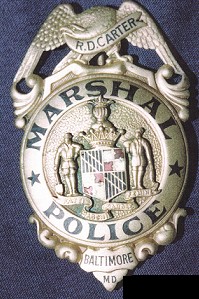
1920 - 1940

1920 - 1940

 
1 black devider 800 8 72
1920 - 1940
 
 
THE BAND
bpd_band.jpg
The Baltimore Police marching band 1920's
Officers_1920s.jpg
BPD Officers in the early 1920's

Commissioner will Appeal to Board of Estimates for Funds to Necessary Equipment Including at Least 30 motorcycles,

Police Commissioner Charles D. Gaither has begun definite steps toward the establishment of the three-platoon system for Baltimore's police force, in less than six months' time the eight-hour tour of duty for Baltimore policemen will be in force.

It was learned yesterday that General Gaither is having a redraft made of the fixed posts. Officers competent for the work have been assigned to resurvey the police posts for the purpose of extending the lines. Many posts will be made larger. This will give an equal distribution of police service and will provide the necessary men for the three-platoon system.

Six months’ Time Needed,

General Gaither is convinced that within six months the police force will be divided into three shifts. The General said that, with the necessary equipment at hand, he will be able to put the three platoon system in operation January 1, 1921. The foundation for the system lies in reorganizing the various posts.

Work is now underway rearranging the new posts for the Central District. "I am quite positive that better morale will be obtained throughout the department by instituting the three-platoon system," said General Gaither. "The city will get a straight eight-hour tour of duty from each of the three: platoons. Foot policemen arc necessary for certain sections of the city, but a mobile department can, in my judgment, render the most effective service. The thing cannot be done in a day, but 1 expects to put the three-platoon system into actual operation by January 1.” 

1 yellow devider 800 8 stroke 72

The Baltimore Sun Thu Jul 28 1921 pt 172

Click HERE of on the article above

The Baltimore Sun Thu Jul 28 1921 pt 272

Click HERE of on the article above


1 yellow devider 800 8 stroke 72

Henry Trebes 1927  Henry Trebes
1927

1 yellow devider 800 8 stroke 72

1920 to 1940

Notice the way the sticks are held, with the "Barrel Head," away from the officer.
Also notice the round hats, and last, take a look at the recall light, first issue circa 1922
24 April 1939 at an Anti-Nazi Demonstration

 Conrad Raymond HelwickConrad Raymond Helwick

Courtesy Rudy Baumann
1920's 1930's

1 yellow devider 800 8 stroke 72

Will Use Thirty Motorcycles.

To execute this plan at least 30 motorcycles equipped with sidecars will be necessary. During the fall, General Gaither will go before the Board of Estimates and ask for sufficient funds for the necessary equipment. Within a few months, the personnel of the department may be up to its full quota, as it is believed men will be attracted to the department because of the new system.

George_W_Myers_1920s_tintype.jpg
Photo courtesy Bill Manzke
 
Patrolman George W. Myers (L) seen here with an un-named officer 1920's. The photo is an old tintype and is deteriorating from age
 
George_W_Myers_uniform_1930s.jpg
Photo courtesy Bill Manzke
Patrolman George W. Myers 1920's
Courtesy of Charles Trebes Jr.
Officer Henry Trebes, his wife, Maria and children, Charles and Edward, 1927
They are behind their home on Hamburg St.  
 
Officer_George_W_Myers_BCPD.jpg

 Photo courtesy Bill Manzke
Patrolman George W. Myers 1920's on an Indian Police Motorcycle ready to patrol the streets of Baltimore

The Baltimore Sun Sun Jun 1 1924 94 86 72Badge Number 96 Dies at Age 84 after Nearly 50 Years of Service
7 May 1840  -  1 June 1924

1 yellow devider 800 8 stroke 72

Old Police3

Courtesy
Jeff Rosen

1 black devider 800 8 72

Baltimore Police Uniforms

Information, from Retired Lt. Jerry DeManss - From author H.L Mencken's book "Happy Days" Mr. Menchen describes the Police as "Cops." In his West Baltimore neighborhood's Hollins St. address as their having what he referred to as "being heavy on their feet, and hence easy to outrun. They wore thick and uncomfortable uniforms, in the Summer as well as they did during the Winter months. Squeaky shoes with soles as solid as slabs of oak, and domed helmets that always fell off when they attempted to run, scattering lead pencils, peanuts, red bandana handkerchiefs and chewing tobacco, a few cigars, oranges, and bananas. The police officer in pursuit of a young man had to hold on to his helmet with one hand, and clutch his revolver with the other, lest it go off in the holster flopping from his stern and end up with a self-inflicted gunshot wound to the leg. Any of the young men, including Barrell Fairbanks, could beat the police in a fair race. The only juvenile collared by stratagem was always dirty and was captured then given the switch before releasing him to his mother. 

Uniform changes Thu Jul 21 1921 Aiiii

 21 July 1921

Contrast In Uniforms

The Evening Sun prints today the first of a series of photos showing the type of uniform worn by police in other cities, as contrasted with the uniforms of the Baltimore police. The Baltimore Officer all through the hot summer must wear a coat and he must keep the top button fastened. He stands or walks in the sun a good bit, and before he is in duty many hours he is too uncomfortable to do his best work. The lower picture shows the summer uniform od  Philadelphia policeman. He wears no coat and doesn't suffer from heat as much as do the Baltimore officers. The Philadelphia Officer's costume combines comfort with dignity.

Uniforms Thu Jul 21 1921 2

 28 July 1921

Contrast In Uniforms

With a temperature of 93 at noon today Baltimore City Policemen are sweltering in their uniforms. In contrast, the State Police, doing the same general sort of duty, are comparatively comfortable. The difference is due to a blouse, or coat, worn by the city police. When the hot spell came recently Captain Williams, of the State police, issue an order for the men to discard their coats and wear only their uniform shirts. The men generally welcomed the order. Baltimore policemen also, at least those who have been asked about it, would welcome a similar order. The blouses worn by the city policemen are much like the old navy officers' blouses, that were discarded during the war. Because they were so uncomfortable the officers couldn't work. The Evening Sun recently printed a photograph showing the summer uniform of a Philadelphia policeman. It is similar to the Maryland State Police uniform.

1 yellow devider 800 8 stroke 72
George_Myers.jpg
Photo courtesy Bill Manzke

Patrolman George W. Myers 1920's
Heiderman_Walter_H_1923.jpg

Officer Walter H. Heiderman with his daughter Marie 1923


Heiderman Walter 1933

Officer Walter H. Heiderman in 1933. Notice the 1929 Ford prowl car in the background
 
Offs_Cooney_Ray_Miles.jpg
Photo courtesy Ray Miles, Jr.

Patrolman Cooney(L) Patrolman Raymond Miles, Sr.(R)  1926

Offs_Franz_Flanigan.jpg
Photo courtesy Ray Miles, Jr.

Patrolman Franz(L) and Patrolman Flanigan(R)  1926

Offs_Franz_Jackson.jpg
Photo courtesy Ray Miles, Jr.

Patrolman Franz(L) and Patrolman Jackson(R)  1926

Offs_Hoff_Tarbutton.jpg
Photo courtesy Ray Miles, Jr.

Patrolman Hoff (L)  and Patrolman Tarbutton (R)  1926

Offs_Maloney_Ray_Miles_Jackson.jpg
Photo courtesy Ray Miles, Jr.

Patrolman Maloney (L) Patrolman Ray Miles (Center) Patrolman Jackson  1926

Offs_McGraff_Lynch.jpg
Photo courtesy Ray Miles, Jr.

Officer McGraff (L) and Patrolman Lynch (R)  1926

Offs_Tarbutton_Hoff_Miles_Flanagan_unk_1926.jpg

Patrolman Tarbutton, Hoff, Miles, Flanigan, un-named Officer  1926

William_E_Taylor_3-12-1928.jpg
Photo courtesy Mrs. Julie Melocik

Patrolman William E. Taylor

March 12, 1928
borailroadfairironhorse1927indianbaltopoliceofficer2.jpg.w560h351
 

Frank J. Vavra, (1872-1932) Pictured above after joining the Baltimore Police Department around 1907.

He walked foot in the area around Monument St. & Madison Avenue and lived at 619 N. Belnord Avenue in Baltimore's 8th Ward. Officer Vavra pictured below in the early 1920's. His tenure with the Baltimore Police is unknown as he suffered a long time with Alzheimer’s disease before his death in 1932.


BPD baseball team 1930s
SWD baseball team, sometime in the 1930's. The second person from the right sitting on the bench is Officer Fred Block.After leaving the SWD he went to Motors, where he was shot and served the rest of his time doing desk work. He may have been promoted to the rank of Sergeant.

John_R_Stein1.jpg

John R. Stein has seen above as a new Baltimore City Patrolman in 1907, in the 1920's he was promoted to the rank of Sergeant and in the 1930's he was again promoted to the rank of Lieutenant as he is seen below. Lieutenant John R. Stein served the citizens of Baltimore and the Police Department valiantly until his death on August 11, 1939, at the age of 60.

John_R_Stein2.jpg
Photo courtesy Mrs. Jane Hammen

Lieutenant John R. Stein

25.jpg

Officer John Neussinger

October 29,1931

28.jpg

Patrolman John Bianca, Badge 33

1933
Look_out_Thursday_December_21_1933_Morning.jpg
Photo courtesy Paul Bouthner Jr.

Baltimore City Police "Look Out" dated:

Thursday, December 21, 1933, Morning.

bpdpistolteam.jpg

Baltimore's pistol team Poska, Dunn, Lt. Downs, Dickerson, Walstrum.
 
1935_bpd_police_pistol_medal.jpg
1935 Shooting medal
1939 Shooting medal
1935_bpd_police_pistol_medal_2.jpg
 
captain_james_downes_left_end.jpg
Captain James Downes far left
 
1 yellow devider 800 8 stroke 72
 
Mintiens_John.jpg
John H. Mintiens
UNnamed-OFFICER7.jpg
Police_Officer_1907.jpg
PHOTO COURTESY TRUDY BOWERS
JOHN_F_ZALOUDEK1.jpg
PHOTO COURTESY RANDELL ZALOUDEK
Bowen_Elmer_Z_Officer_1935.jpg
Photo courtesy Lt. William Bowen
Officer Elmer Z. Bowen (1935)
24.jpg
Patrolman John Bianca, Badge 33
1936
1935 Off Arthur Malinofski1
COURTESY OFFICER JAMES McCARTIN

1 yellow devider 800 8 stroke 72 
Patrolman Mike Malinofski Was Slain on Quiet Halloween Night;

Body Discovered in Street by Milkman...

Police work isn't all parades, pavement pounding and helping old ladies and little children across busy streets. It's a grimly serious business sometimes. Every man who wears a police uniform has to be ready to face sudden death any minute and depend on his wits, his muscle, and his gun to get him out alive. In a series, of which the following story is the first, the Baltimore Sunday American present tales from the Baltimore Police Department's recent files of policemen who went to their death in the performance of their duty.

By CLINTON H. JOHNSON December 19, 1936

So far as Patrolman "Mike" Malinofski was concerned it had been a pretty quiet Halloween. For that matter, not much of anything ever did happen out there on his post in Howard Park, so this 1935 Halloween wasn't unusual. Sometimes he'd grumble about it around the Northwestern District station; mutter that the boys, in closer to town got all the action while he spent his nights trying well-locked doors. When he would come home after his all-night tour of duty, his wife Mrs. Gladys Malinofski would try to find out what had happened. What had he seen? Had there been any accidents? Any fires? Any burglars to chase? He used to chuckle at her persistence, assure her that she hadn't missed anything by not being with him during those long, cold hours between midnight and dawn, riding the deserted streets of Howard Park in his little roadster. Parting Warning... So Halloween hadn't been any different from the other nights. Maybe he felt the loneliness a little more because, when he went on duty at midnight, he'd just come from a happy family party at his brother's home. As he left someone called a parting warning: "Take care of yourself " He remembered that some five hours later as he pulled his car up beside a row of stores at Gwynn Oak and Maine avenues and jumped out to try the doors. Take care of himself? Huh., What did they think, anyway? All he had to worry about out here in the sticks was getting enough action to keep warm. Mechanically he switched on his flashlight, turned down beside the row of storefronts, rattled their door handles with brisk efficiency, rounded the corner and started for the back doors. He was sprawled in the street when the milkman found him. One outstretched hand gripped his flashlight. It was still lighted. The beam frightened the milkman's horse. The faint light of a distant street lamp glinted dully on the still figure's black puttees.

SUMMONS AID

The milkman looked once, then ran toward an all-night filling station in the next block. A police radio car had just pulled in for some air when the milkman pounded up. The car swung out again. The milkman jumped aboard. Patrolmen Charles Heims and Louis Mohr lost no time when they got to “Mike" his real name was Arthur Malinofski, no one seems to know who started calling him "Mike." Heims took him to the West Baltimore General Hospital. Mohr stayed to question anybody he could find. Heims wild ride to the hospital was in vain, Mike, the doctor said, probably had died instantly. He had been shot in the side and through the heart. A half dozen residents had heard the shots. Five, everybody agreed; two, then a pause, then three more. Some thought they had heard running footsteps, heard a car door slam, heard a car drive off.

5 Empty Shells

Near the slain policeman's car, the police found five empty shells from a .32 caliber automatic. One of them was on the running board, one was under the car, the rest nearby.  Malinowski's gun holster hadn't even been unsnapped when they found him. Out there in the sticks, where nothing ever happened, Death had leaped at him out of the darkness so quickly he couldn't make a move to defend himself. The Malinowski murder is on the “open” files at Police Headquarters. That meant they haven’t found who killed him. But it does mean they won’t. For if there’s one thing the police hate to do, it's admitting defeat on a case where one of their own men is involved. Tough Case The Malinofski case, however, is a tough one. Detectives Jim Manning, Bill Feehley, Mike Cooney and George Mintiens, who still have charge of it, admit that readily. There are three kinds of murder cases, those where you know the killer and can prove it; those where you know the killer, and can't prove it, and those where you simply don't know who did it or why. "Mike" Malinowski's murder comes in the latter class. There were suspects questioned, but none held more than a day or two. There were all sorts promising "angles" but they all collapsed on the investigation. Even within the last few weeks Detectives Manning and Feehley worked out a "hot" tip until it turned stone cold on them. But they're ready to work the next when it comes. They're determined to get the man who got "Mike" Malinofski. They’ll take him peaceably, of course, if they can. But. They rather hope he'll try to fight:

1 yellow devider 800 8 stroke 72

Officer Blank Gave Life

Facing Bandit's Gun In Attempted Robbery

scan0001A
COURTESY OFFICER JAMES McCARTIN

scan0004A.JPG.w180h184


WHERE PATROLMAN JOHN BLANK WAS KILLED BY BANDITS
Two fled at his approach, but the third caught him by surprise, dropped him before he could shoot.

Records of Police Department Tell of Bravery

About every ten months, on an average, a Baltimore policeman loses his life in the performance of his duty. Some have died with their guns blazing. Some have been shot down before they could lift a hand to defend themselves. Following is the second in a series of stories from the Baltimore Police Department's most recent files concerning members of the force killed in action. By CLINTON H. JOHNSON December 26, 1936 Something about the shop didn't look right, but for a moment Patrolman John Blank couldn't figure out just what it was. Then it dawned on him. The light in the office was out. He knew it should be on. The company' safe was in that front office, in full view of the street, and when the last employee departed every night he switched out the desk lights, turned on a single bulb hanging over the safe. Now this, too, was out. Saw Light Blank moved close to the windowpane; trying to peer into the darkened office. Then he made his second disturbing discovery. The door to the rear office was closed but there were lights in there. No one will ever know exactly what John Blank thought the few crowded minutes that followed. Perhaps he reflected on the bad luck that had to bring him face to face with such a problem in the last few minutes of his 4 P. M. to midnight tour of duty. He was on his way to the police call box at Harford Avenue and Preston street to check out for the night. It was February 11, 1934, and a clear, bitterly cold night. This shop in the 1400 block Central Avenue was almost the last on his post. A few steps more, a few more door handles to rattle and he would have been ready for the checkout call. Then a cup of coffee somewhere and home to bed. That had been the program. And now this had to happen. Police Training If John Blank thought of all those things they stayed in his subconscious mind. The rest of his brain, reacting automatically to long police training, directed his actions along prescribed lines. A homeward bound youth of the neighborhood was passing. To him, Blank muttered a quick order: "Beat it down to the call, box. You'll find some police there waiting to call in. Tell 'em to get up here quick." The youth dashed off. Blank hurried around the corner to have a look at the back of the building. It was L-shaped, with a front entrance on Central Avenue, a rear entrance on Oliver street. It was only a moment before Patrolman William Atkinson arrived, a little out of breath. He took a look at the front, figured Blank bad gone to the rear and went around after him. Blank, crouched in the shadows against a wall, told him: “There's somebody in there all right. Go on back to the front, I'll stick here." Atkinson turned ran back toward the Central Avenue entrance. He hadn't even reached it before he heard two shots. He didn't know, as he turned back again what they meant. But he soon found out. They meant the end of Patrolman John Blank. It wasn't hard for Detectives Ben Busky, Bill Feebly and Fred Harbourne to find out later exactly what happened. They heard the story from a taxi-driver, from a casual pedestrian, from three people who, emerging from a bridge game, had been almost directly opposite the shop's rear entrance on Oliver street. Their stories all checked. And this is what happened: Gun To Gun Blank had gone a few yards up the narrow alley that runs from Oliver to Hoffman street, hoping to peer in a rear window of the shop. As he did so, two men burst out the rear door, turned east, dashed across the alley mouth, spotted him and without halting, yelled back over their shoulders: "Look out, Mac." Their warning startled Blank. He swung his gun up, turned, and started for them. As he reached the sidewalk line he met "Mac," face to face, gun to gun. "Mac," it seems, had waited to pick up the burglar toolkit. Blank hadn't counted on a third man. His surprise made him a split-second slow with his trigger finger. That was all "Mac" needed. One bullet went straight to John Blank's brain. He went down as if he'd been struck by a pile-driver. “Mac" hurdled his body and fled down the alley. He was only a dim shape in the darkness when Atkinson reached his fallen comrade. Atkinson commandeered a passing cab, circled the block, returned empty-handed, took up the sorry task of sending Blank to a hospital, spreading the alarm, listing the witnesses, making out a report. Safe Robbed They found the safe blown open inside the shop, with some $1,100 gone. They found the toolkit, too, about 200 feet up the alley. There weren't any fingerprints worth anything, however, on either. John Blank’s murder, like that of Patrolman Malinofski, told in last Sunday's American, is an "open" case in the Headquarters files. But there's a subtle difference in the way they talk about the two cases. They haven't an idea who killed "Mike." They've got a very good idea who killed Blank. Not a positive identification, of course. It was too dark for the witnesses to tell. John Blank could have told, perhaps, but "Mac" fixed him. Still, they have a very good idea who "Mac" was. There won't be any arrest, though. For "Mac"-if they are right- is dead, too, He lived about a year longer than John Blank and died, finally, by his own hand.

carroll_hanley.jpg
 
 
10.jpg
OFFICER JOHN JOSEPH BIANCA
1936

Officer John Joseph Bianca & Officer William Knight were partners assigned to Radio Car 21.When a disturbance in a "political club" resulted in a suspect pursuit, a foot chase & car chase ensued, shots fired and the death of Officer Knight on November 7, 1943

Frank_Vavra1.jpg
Photo courtesy Nancy Cook
unnamed_bpd_officer.jpg
Photo courtesy Trudy Bowers

1920s_BALTIMORE_CITY_POLICEMAN.jpg

captain_kalbfleisch.jpg
Unidentified_Officer_1920s.jpg
 
1 yellow devider 800 8 stroke 72
1937
1928 Det Sgt Joseph Carroll 1-E
COURTESY OFFICER JAMES McCARTIN
Det Sgt Joseph Carroll

Policeman Must Face Peril As Part of Work and Many Here Have Given Lives On Job

The average citizen can keep himself out of dangerous situations from one year's end to the next if he's reasonably cautious. A policeman, however, can't do that. He's got to be ready to face anything, any time, without dodging. In a series of stories, of which the following is the third, the Baltimore Sunday American is presenting tales from the Baltimore Police Department official records of men who have gone to death performing their duty. By: CLINTON H. JOHNSON January 2, 1937

1 yellow devider 800 8 stroke 72

Murdered In The Performance Of His Duty...Saga Of  Officer John Block

Off John Block

Officer John Block

Heroic Policeman Shot, Unaware of Hold-Up

Noticed Car Had Tags From Two States on It A policeman has no way of knowing when he may find Death staring him in the face.

That's part of his job, however, and he accepts it as such. He has a gun, a club, a flashlight, a whistle and his wits. Sometimes they'll save him, sometimes they won't. They didn't help John Block, the hero of the following story, fourth in a series of tales from the Baltimore Police Department's records of officers who have lost their lives in the line of duty in recent years.By CLINTON H. JOHNSON January 9, 1937, Patrolman John Block didn't even know there had been a hold-up. The roadster he used to patrol the Annapolis road out near the Southern city limits wasn't equipped with radio and the job had been pulled off clear across the town at Thirty-ninth and Charles Streets, a scant half hour before. They were still busy at headquarters getting the story from the two bus drivers who had been robbed. Block, consequently, had no warning of' danger when he pulled up beside the black sedan and got out to question the driver. He made a mental note of the rear license plate---Florida, 115-345, and walked around to the front of the machine. There was a Kentucky plate, No. 214-352. Block had been bending over the front headlights. Now he straightened up, suspicion dawning in his mind. He moved toward the driver. There were two quick shots. Block stumbled backward tugging at his pistol. Then he took one uncertain step forward and dropped. Gears clashed, the car roared off into the darkness. One of the bus drivers told the police: "There were two men. I don't know where they got on. At the end of the line, one of them asked the fare and they dropped' money in the box. Then they pulled guns and told me to hand over everything I had. I gave 'em the bills. One of ‘em yanked my change carrier oft my belt. One went to another bus parked ahead and brought the driver back to my bus and pushed him inside. They told us: 'Stay in here for five minutes. If you come out sooner it'll be too bad. Then they ran off. "There was a car up at the corner. They jumped in and drove off without lights." Just then the phone rang and a Southern District officials reported the murder of John Block. About the same time, a Central District policeman called in to say he had found a Kentucky tag, No. 214-352, lying on a Pratt street pavement. A taxi driver helped fill in the story. He had picked up two young men in the 600 block North Charles Street. They told him to follow a black sedan that emerged from a nearby alley. The route led to the Annapolis road. A rear tag dropped off the sedan on Pratt street. At the city line traffic light, a police roadster pulled up beside the sedan and a policeman got out. When the light turned green, he said, his passengers ordered him to drive around the halted sedan. A mile farther down the road, they made him turn into a side road and wait. In it few minutes the black sedan arrived and his passengers paid him off, entered it, and drove away. On the way back he passed the scene of the shooting and learned of Block's murder. Later an Annapolis Road resident told of being awakened by three young men who said their sedan wouldn't run. He drove. them to Annapolis for $5.00. The sedan was found. Its license plates had been removed but the motor number permitted police to trace the car to Tallahassee, Fla., and discover it belonged to one Kenneth Lewis. Lewis, they learned, was visiting an aunt in Buckhannon, W.Va. A telegram to the Upshur county sheriff brought a rapid action. The sheriff went looking for Lewis, found him at a farm near Buckhannon, told him he was wanted for questioning. Lewis preceded the sheriff out of the house, walked some 30 feet ahead of him, across the yard, toward the waiting car. Suddenly the fugitive snatched a pistol from his pocket, raised it to his temple and fired. He was dead before the sheriff could reach his side. That occurred on the afternoon of April 26, 1933, just six, days after Block was murdered. Credit for the quick clean-up of that case belongs to Detectives Bob Bradley, Jim Manning, Bill Feehley, Tony Parr and Gilbert Cooney. Subsequent investigation satisfied them that Lewis was the one who killed Block. They went on looking for the other two, however, and finally found one in Florida. He got 18 years for the hold-up. The third man hasn't been found yet.

Officer-Block
COURTESY OF JAMES McCARTIN

STATE of MARYLAND  GIVES HERO'S HONOR TO WIDOW

After Patrolman John Block gave his life in the performance of his duty, his widow received a medal commemorating his heroism. The late Governor Ritchie is shown bestowing the medal.

1 yellow devider 800 8 stroke 72

1937 Command Promotions1E
COURTESY OFFICER JAMES McCARTIN
Command Promotions May 24, 1937
Captain Joseph Itzel, Inspector Hamilton Atkinson, Inspector John Mittens, Captain John Cooney
 
1 yellow devider 800 8 stroke 72
 
General Charles Gaither1
COURTESY OFFICER JAMES McCARTIN

General Charles Gaither

May 31, 1937

1 black devider 800 8 72

BPD painted Button

1 Oct 1942

Brass Buttons Taboo, Policemen's Future Dark

The Evening Sun 1 Oct 1942 page 27 and page 44

Officers Face World Grimly as WPB [War Production Board] Order takes Twinkling Coat easterners From New uniform Coats.

The Baltimore Police Department found itself in a hole today - a BUTTONHOLE… The fortunes of war "shot" the tradition brass buttons right off the uniform of the Bluecoats. Boy, are the police glad their pants buttons are black!

A button manufacturer in Waterbury, Connecticut, informed uniform makers here that no more brass buttons will be available for police uniforms, and the uniform manufactures notified Commissioner Robert F. Stanton, who in turn notified Senator George R. Radcliffe.

Could Wear Overalls

Senator Radcliffe tendered his deepest buttons - beg pardon, sympathies - but said there was nothing he could do to help the police department out of its hole. The restriction on the manufacture of brass buttons is a War Production Board order which became effective 4 Sept 1942, he said.

The order prohibits the use of brass buttons for anything except overalls or dungarees, which, if you ask the bluecoat on the beat, sounds a little bit like rubbing it in.

What! No Pants?

The next class of probationary policemen to be graduated from the police school will be the first members  of the department to feel the pinch of the button crisis. But the last class, numbering 30, which was graduated yesterday, had a hint of the hard times ahead. They had to graduate without their pants, that is.

The graduation took place in the Police Building on the Fallsway. The graduates had coats, caps, white shirts and black ties, but no pants - uniform pants. Furthermore, they can't go on the street duty until they get pants - uniform pants.

Stanton is Perplexed

1 black devider 800 8 72

General Charles Gaither2
COURTESY OFFICER JAMES McCARTIN
officer_Pat_Durkin.jpg
Officer Pat Durkin, passed away July 30, 1937

officer_1940s.jpg
1 yellow devider 800 8 stroke 72

1938
Battee_Lewis.jpg
2 Policemen Injured Wreck Police Car In Chase
2-Policemen-Injured.jpg
COURTESY OFFICER JAMES McCARTIN

In pursuit of a speeding suspicious car, this police traffic cruiser went out of control, crashed over a curb and into a fire hydrant, and turned over three times before coming to rest upside down on Hillen Road and Thirty-third street. Two patrolmen in the car were hurt.Suspicious Auto Escapes After Smash Up

October 8, 1938

Two traffic policemen were hurt today when their car, in pursuit of a fleeing automobile, hit a bump at sixty-miles-an-hour, went out of control, jumped a curb, hit a fire hydrant, and turned over three times. The accident occurred near the intersection of Hillen Road and Thirty-third Street, where Patrolmen Fred Dunn and John S. Moore were attempting to overtake a car being driven in a suspicious manner.

BOTH INJURED

Neither patrolman was seriously hurt. Moore was treated for a dislocated shoulder and abrasions at St. Joseph's Hospital and Dunn, the driver, was treated for abrasions by a police department Physician. Dunn said the pursuit started on Loch Raven Boulevard when the driver the car ahead of the traffic cruiser suddenly turned off into a dirt road when he saw the police car.

CHASE GAINS SPEED

The police car followed the machine through to Hillen Road, where the speed of the car in front was jumped up to sixty miles an hour and maintained at that rate until the time of the accident. The fleeing car got away after the crash but the patrolmen have its number.

1938 wreck2
Officer John Moore and Officer Fred Dunn
October 8, 1938
 
1938_wreck3.jpg
1938_Safe_Robbed2.jpg
COURTESY OFFICER JAMES McCARTIN
1938_Safe_Robbed2.jpg
COURTESY OFFICER JAMES McCARTIN
 
1938_Safe_Robbed3.jpg
COURTESY OFFICER JAMES McCARTIN
 
1938 Safe Robbed1

1930 Off Potaka Neiss Stover Emling 10-19-1938

12-11-1938E
October 19, 1938, Officer Joseph Potaka, Officer John R. Reiss, Officer Elmer Stover, Officer Albert Emling
 Unknown traffic officer with a whistle in his mouth 
December 11, 1938
 
1 yellow devider 800 8 stroke 72
1939

ASKS 72 POLICE CARS BE REPLACED

Stanton Suggests $21,500 Surplus Salary Account Be Used For This

February 28, 1939

Commissioner Robert F. Stanton wrote the Board of' Estimates today, asking that 21,500 surpluses in the Police Department's salary account be applied toward replacement of seventy-two police automobiles. All the seventy-two cars were bought between 1929 and 1935, and are showing their age, the commissioner said. Some of the older ones, he added, are very much the worse for wear and tear. Forty-three of the machines are being used for patrol work in the suburban sections and twenty-eight are being used in the radio patrol. Old No. 72 is the Southern district patrol wagon, which has gone more than 200,000 miles in its day.

$100,000 Appropriated

According to Commissioner Stanton, the present police budget appropriates only $100,000 for the maintenance and replacement of equipment. Last year $85,000 was expended for maintenance alone. Since the police rolling stock is no a better this year than last, that same sum or more probably will be required for maintenance, leaving only $15,000 of the $100,000 item for new purchases, the commissioner said. If the salary surplus is applied to new equipment purchases, continued the commissioner, it should work a saving in maintenance costs. Commissioner Stanton explained that the $21,500 excess in the salary account represents an accumulation of several years. It was piled up, he said, through the salary difference that results when a veteran patrolman who gets with bonus, about $46 a week, is replaced by a probationer who gets only $35, and also through temporary vacancies in the officers' ranks of the force. Bids on the department's old cars already have been asked and, received from various automotive firms in the city, Commissioner Stanton said. They have offered bids on seventy-one cars, as a whole and on smaller lots. As yet, however, no bid has been put in for the superannuated Black Maria.

1 yellow devider 800 8 stroke 72

Off_John_Schaefer_Off_Edward_Wilson.jpg
COURTESY OFFICER JAMES McCARTIN
Officer John Schaefer and Edward Wilson
March 4, 1939
 
1939 Off Arthur Plummer 3-6-1939-E
COURTESY OFFICER JAMES McCARTIN
Officer Arthur Plummer
March 6, 1939
 
1939 Off Thomas Doyle
COURTESY OFFICER JAMES McCARTIN
Officer Thomas Doyle rescued little Eileen Zemil from a burning apartment March 7, 1939
 
1939 Police hurt1
COURTESY OFFICER JAMES McCARTIN
1939 Police hurt2
COURTESY OFFICER JAMES McCARTIN
Officer Arthur Withers
March 21, 1939
 
1939 Police hurt3
COURTESY OFFICER JAMES McCARTIN
1939 Police hurt4
COURTESY OFFICER JAMES McCARTIN
Officer Elmer Johnson
March 21, 1939
 
1939 Sgt Schmitt Off Higgins1
COURTESY OFFICER JAMES McCARTIN
Sergeant John Schmitt and Officer Thomas Higgins
April 1, 1939
 

1939SgtSchmittOffHiggins2.jpg

1939SgtSchmittOffHiggins3.jpg

1939SgtSchmittOffHiggins4.jpg

COURTESY OFFICER JAMES McCARTINLt_Thomas_Arthur.jpg


Magistrate Edward Dougherty and Lieutenant Thomas Arthur

Southern District
May 1, 1939
1939-Off-Dougherty 5-8-1939
 
 
COURTESY OFFICER JAMES McCARTIN
Officer E.F. Dougherty at the call box
May 8, 1939
KSCN005572
1936
Baltimore Police Pistol Team
Look at the uniforms, hats, and boots
KSCN005772
1936
Notice the round hats of the two officers to the right, those were worn from 1908 until 1944 between the Bobby Cap and the 8 point cap. The hat on the left is the same round hat but the wire band is smaller and bent to change the shape, commonly worn by members of the Motors Unit

1939-Sgt-Clayton_Lt_Bozman_Sgt_Zaruba_Off_Roche_5-21-1939.jpg
Sergeant William Clayton, Lieutenant Granville Bozman, Sergeant Joseph Zaruba, Officer Thomas Roche

May 21, 1939Off_William_McDonogh.jpg
COURTESY OFFICER JAMES McCARTIN


Officer William McDonogh

May 22, 19391939-Off-William-Pillsbury-Off-Wade-AdamsCOURTESY OFFICER JAMES McCARTIN


In 1939 this squad car being operated by Officer William Pillsbury and Officer Wade Adams were involved in an accident at Eager and Calvert streets.

Espantoon1.jpg

COURTESY OFFICER JAMES McCARTIN

BALTIMORE POLICE ESPANTOON


June 3, 1939

Espantoon2.jpg

COURTESY OFFICER JAMES McCARTIN


Devider

 TRAFFIC KIOSKS TAKEN FROM CORNERS
JUNE 1939
Old but still Going Strong--Three different types of housing for Patrolman directing traffic are shown in the below pictures
 
The high tower "Kiosks" at Charles Street and North Avenue (below)

1938_Lexington_Howard.jpg

COURTESY OFFICER JAMES McCARTIN

Christmas Eve 1939 at Howard & Lexington Sts.

Devider 

EIGHT TRAFFIC KIOSKS TAKEN FROM CORNERS

Rest To Be Removed if Test Indicates They Aren't Needed

Shelters Held Antiquated Experiment Reported Success So Far

June 15, 1939

Believing the small, movable traffic “Kiosks” to be antiquated, Police Commissioner Robert F. Stanton has ordered the removal of eight of them from intersections in the central part of the city as an experiment, he announced today. His order was the result of a survey made by Captain Henry C. Kaste, commander of the Traffic Division. The intersections from which the small enclosures, originally designed to protect traffic patrolmen from the elements, have been removed are at Pratt and Sharp Streets, Pratt and Howard streets. Lombard and Hanover streets Lombard and Charles streets, Lombard and, Calvert streets. Baltimore and Paca streets, Saratoga and Eutaw streets and Charles and Chase streets. Ten of Them Left Commissioner Stanton said today that about ten of the kiosks remains at intersections, but that if it developed that traffic could be directed as well without them they would probably be removed also. The kiosks have always been rolled away from the intersections at night, the Commissioner said, and patrolmen did without them if night traffic warranted their presence at all. The great majority of traffic patrolmen are exposed to the weather when on duty he added so that the loss of the protection the structures afford would work little hardship on the few officers who are being deprived of them. Success So Far  Commissioner Stanton said that at, the intersections from which the kiosks had been removed the Traffic Division officials reported that vehicle movement was being handled with the same facility as before.There is no intention on the part of the department to remove the traffic towers, such as that at North Avenue and Charles street, which can be operated automatically. These towers are, used only on special occasions and at those times they are needed, the Commissioner said. 

"Kiosks" located at Liberty and Lexington Streets (below)
Kiosks Charles North
COURTESY OFFICER JAMES McCARTIN
Kiosks Liberty Saratoga
COURTESY OFFICER JAMES McCARTIN

Devider 

18 KIOSKS STILL USED IN MODERN TRAFFIC RUSH

'Little Houses' Described As Antiquated Fate---Undecided

June 15, 1939

Traffic patrolmen in Baltimore still direct the movements of hundreds of thousands of automobiles from eighteen antiquated kiosks, which have been protecting them from snow, rain, and the summer sun for the past fifteen years, a survey today disclosed. Inside the kiosk- stands a policeman who manually regulates traffic by the turning of a handle within which in turn changes the "Stop" and "Go" signals atop the cubicle. Originally there were approximately forty of the kiosks scattered - mainly along the busy thoroughfares in the downtown section, but with the regulation of traffic by means of electric signals, many were no longer needed, police officials said. Some Good Points Captain Henry C. Kaste, commander of the traffic division of the Police Department, said that the police directing traffic from within the kiosks "look a little antiquated" and stated the little houses still have some "good points." "During rush hours of the morning and afternoon," said Captain Kaste, "I have ordered the men to desert their kiosks and regulate traffic with their hands from vantage points at the intersection. "As fast as automatic traffic signals are installed to regulate traffic at intersections," the captain added, "the kiosk is no longer needed. If the presence of a policeman is needed in an emergency, he can stand in the center of the street directing with his hands." Stanton Considers Them While admitting he is giving the kiosk situation some serious consideration, Commissioner Robert F. Stanton did not amplify his intentions as to the fate of "little houses.'" " In addition to the kiosks, the police still have three traffic towers. They are located at North Avenue and Charles Street, Howard and Lombard Streets and Pratt and Light streets. When first put into operation the tower at North Avenue and Charles Street, which directs traffic through the red, amber and green signaling lights fastened on all four sides, had a policeman on duty manipulating the controls. Except on such special occasions as Easter Sunday, the lights of the tower will work automatically and the presence' of a policeman is not needed Captain Kaste said. Operated Daily By Hand The tower at Howard and Light streets are operated during the rush hours---8 to 10 o'clock in the morning and from 4 to 6 o'clock in the evening by a policeman. At other times of the day, the lights work automatically. As the Pratt and Light streets intersection has more vehicular traffic than any other intersection in the city during the course of its day, it is necessary to keep a policeman on duty manipulating the controls from 7.30 o'clock in the morning until 6 o'clock in the evening. Once Waved Their Hands Before the coming of the kiosks, the traffic policemen of the city did their regulating from the center of the street intersection by waving their hands. Next, they were provided with a wooden platform to which was attached an umbrella. An iron pole jutting through the top of the umbrella supported the "Stop" and "Go" signs, manipulated by the turn of a handle by the policeman. A circular piece of sheet metal attached to the edge of the platform and reaching as high as the policeman's waist served as a protection from the elements. The device was commonly known as a "can" in police circles. In the eighteen remaining kiosks, some of the Police have been directing traffic at the same intersection for as long as ten years. The locations of, the kiosks are as follows: along Pratt Street at Charles, Hanover, Sharp and Howard streets; Lombard Street, at the intersections of Charles, Light, Calvert and South Streets; Baltimore street at Paca Street and the Fallsway; Eutaw and Saratoga streets and Liberty and Saratoga Streets; St. Paul and Saratoga streets, Calvert and Centre streets; Charles street at Chase and Biddle street and Fleet-street and Broadway.

Kiosks Lombard Park
 
Shorter  type tower "Kiosks" at Lombard Street, Howard Street  and Park Avenue, Kiosk-Less COPS Mourn Loss Of Traffic Boxes Six, Flinging Their Arms About And Whistling---Agree Policeman's Lot Is Not A Happy One, What With Hot Asphalt And Hotter Sun June 15, 1939, Six mournful Baltimore traffic cops who have been de-housed by the Police Department. De-housing Authority (probably the commissioner) today were flinging their arms about, tooting their whistles and agreeing with W. S. Gilbert that "a policeman's lot is not a happy one.' The six are a majority of the eight who, until recently, occupied confined kiosks containing stop-go semaphores on one of eight street intersections in the city. Today they were kiosk-less and an investigation indicated that of the eight, six didn't like it at all. Two others couldn't be interviewed.

Counts Ten--Then Replies

The interviewer walked down Charles Street to Lombard, where Patrolman John Thierauf, who has always occupied the booth on the southwest corner of the busy thoroughfare, was standing in the middle of Lombard, arms, and whistle going. "How do you like the change:" the officer was asked, He counted to ten before answering, "It's hard on the feet and hot on the head," he said. "This asphalt gets hot and it isn't like the old wooden floors and the roof. Of course, I don't like it." The officer admitted that the change might have improved the traffic situation somewhat, however.

Counts Twenty, Then

The journey continued to Pratt and Sharp streets, the officer who used to occupy a kiosk at Hanover and Lombard being nowhere in sight. At the former intersection Patrolman, Frank J. Corrigan was standing on the northeast corner. Hanover Street is one way at that point. but there was plenty of traffic to keep the patrolman moving. "How do you like the change?" the interviewer inquired again. Patrolman Corrigan counted about twenty and swallowed. "I don't mind saying that I don't like it a damned bit!" he exploded, "I've been standing in the house over there indicating the southeast corner for the past ten years without an accident at this corner. And I haven’t been on sick report for eight years." he added feelingly.

Just Had It Painted

"The sun is here at 8 o'clock in the morning until 5:30 o'clock in the afternoon during the summer and about half an hour a day in the winter. And I just had that box painted. At Pratt and Howard streets Patrolman Howard W. Singleton was more or less non-committal. He missed his box. He had it on the southeast side of the street. Now he stands on the west side of Howard, about the middle of Lombard. and dodges. Up at Baltimore and Paca Officer, J. M. Collison didn't like the new order of things at all.

Gets Clothes Spotted

"A man buys expensive clothes and tries to look nice and a car come along, one splash and look at them, he said with even more feeling than Officer Corrigan. He was feeling it might be added, the front section of his uniform trousers. There wasn't much in the way of a crease there and they were spotted.

"Did you get wet in the rain on Tuesday?" he was asked, "I did. and I've been trying to get my trousers clean ever since" he said. The patrolman, it was learned, has guided traffic at the intersection for fourteen years. He began with one of the old can-box effects, with the semaphore standing up from the center, and worked his way up to a full-fledged box.

City's Coldest Corner

"And they come around and took it away last Friday" he mourned. "I used to have a system with that box. Now as soon as I take my arms down, traffic stops automatically." The box he added, had never interfered with traffic. The regular officer at Eutaw and Saratoga Streets, where a box has been removed was at the Western Station House on a case and his substitute hadn't much to say about it. From there the interviewer marched to Charles and Chase Streets, where Patrolman John Wess has been standing in a house and taking care of streetcars, buses, private machines, trucks, and pedestrians for some time. And here the interviewer received an entirely new but still protesting point of view. "This here is the coldest corner in town in the winter time," said Patrolman Wess."The wind blows around here something fearful. It once blew the box completely over, with me in it. How's a man going to stand up against a wind like that?"

Kiosks Saratoga Eutaw

COURTESY OFFICER JAMES McCARTIN

"Kiosks" a veteran of fifteen years of service, located at Saratoga and Eutaw Streets (above)


1939_Off_John_Schaffeld_7-12-1939-1.jpg
COURTESY OFFICER JAMES McCARTIN

Patrolman John Schaffeld

July 12, 1939
 
1939_Off_John_Schaffeld_7-12-1939-3.jpg

COURTESY OFFICER JAMES McCARTIN


Patrolman_Thomas_Wojcik.jpg

SHOOTING YOUTH SHOT BY POLICEMAN GETS BLOOD TRANSFUSION

Heart Grazed By Bullet That Entered Burglary Suspect's Back---Officer Says Victim Ignored Order To Halt---Police Inquiry On

July 24, 1939A 15-year-old boy was in a serious condition at the West Baltimore General Hospital, shot in the back today by a policeman who saw him fleeing from a vacant house at 3500 Dolfield Avenue. The bullet entered behind the youth's left shoulder, piercing the entire body, grazing the heart, and came out his right breast, according to hospital doctors who treated him and administered a blood transfusion. Meanwhile, Chief Inspector Stephen G. Nelson began what he called a "routine investigation" into the shooting by Patrolman Thomas A. Wojcik The "investigation." he said will be made by Inspector Thomas J. Mooney. With Patrolman George Kraft, in a police radio patrol car, Wojcik had sighted the youth running southward on Dolfield Avenue from the vacant house as the patrol car made one of its usual rounds about 1.30 A. M. Calling to the boy to halt, the police sped in pursuit, whereupon the youth crossed the street again and plunged between two dwellings, with Patrolman Wojcik after him on foot. Policeman Shoots Him In the rear yard, Wojcik reported, after he had called to the boy six times to halt, the youth reached toward a back pocket as if for a weapon and the policeman fired. The boy went down. Taken immediately to the hospital, the boy was identified as Ralph Rauch, who escaped on July 7 from the Maryland Training School for Boys. Since then he had not been seen either at the training school or at the home of his father, George Rauch at 2609 Cold Spring lane. Father's Statement Mr. Rauch today said "About a year ago my son got in with some bad boys and I sent him away to the Maryland Training School for Boys. He got out supposedly to come home, but we didn't hear from him. "The first I heard from him since the fifteenth was when the police came to the door this morning and told me he had been shot. He is a good boy, but he just got in with some bad company." Captain Lawrence King, of the Northwestern district. reported to Inspector Nelson that subsequent investigation by his men revealed marks on the door of the vacant house at 3500 Dolfield Avenue as though attempts had been made to pry it open. Similar marks were found on a window of a home at 3600 Belle Avenue, a short distance away he said. Stolen Jewelry Reported Also, he reported the finding of two rings in the boy's pockets at the hospital. both of which were identified as part of the jewelry taken several days ago from the home of Edward G. Conrad, at 3300 Sequoia avenue. One was a diamond ring and the other a class ring. Between the two Dolfield Avenue houses where Wojcik had followed the youth afoot, Captain King added, his men found a large screwdriver and one of the youth's shoes. The Rauch boy is tall for his age and in the early morning darkness, Captain King said, it was impossible for his men to know the fleeing figure was that of a boy. Patrolman Wojick in his report said that both he and Patrolman Kraft thought the figure was that of a man when they saw him flee from the vacant house. Captain King, when asked today if he considered the case one of "promiscuous shooting" by police, replied "Oh, no! Absolutely not! Officer Wojcik gave the boy every chance in the world. He called to him six or seven times to stop. Then he saw the boy reach for his back pocket, so he did the only thing he could do" Captain King said he saw nothing unusual in the fact that Wojcik was unable to tell that the runner was a boy, and yet could see him reach for his hip pocket. "The Rauch boy is 5 feet 7 or 8 inches tail" he stated. "It would be next to impossible to tell that he was a boy."

Devider

Earl_Gable_8-19-1939.jpg
COURTESY OFFICER JAMES McCARTIN

Rookie Officer Grabs, Suspect

And Becomes His Family's Joy

August 19, 1939

Patrolman Earl W. Gable Makes Arrest On Fourth Day Even 20 Month Old Son Shows Pride When an experienced policeman makes an arrest it is usually a matter of routine duty and attracts little or no attention, but when a rookie officer apprehends a burglary suspect on the fourth night of duty he becomes the pride and joy of the family. "I'm tickled to death," said Mrs. Margaret Gable yesterday when she learned that her husband, Patrolman Earl William Gable, earlier in the day had arrested a suspect who has a record for burglary and larceny. Son Apparently Proud Patrolman Gable, who was assigned to the Central district Monday night, apprehended the suspect as he endeavored to escape from the top of a window at a drug store at Charles and Read streets. Later a revolver was found near the spot where the man had been hiding. At Patrolman Gable's home at 5021 Williston street yesterday, Earl Guy Gable, the officer's 2O-month-old son, was apparently bubbling over with joy at his daddy's bravery. Goo, goo," he shrieked as he bounced over armchairs, ran a toy lawn mower over the rug, tugged at his mother's skirt and performed other antics in celebration of his father's, success. In "Seventh' Heaven" He knew there was some reason for his mother's happiness and he fell right in tune with her joy.“I'm tickled to death," Mrs. Gable repeated. "Just tickled to find out that he is making headway. "Earl has been crazy about being a policeman ever since he was a boy and he is tickled with his work. I really have no objections, I'm just so glad for him. "He was in seventh heaven when he found out that he had made the grade and was going to be put on the force. Mrs. Gable said that she knew nothing of her husband's arrest of the suspect until a neighbor gave her the message that her husband wouldn't be home because he was working on a case. Mother Also Happy"Then I rushed into the house and looked at the newspaper to see whether there was anything in about Earl. I was so thrilled when I saw the story and I was so proud." When it was mentioned that Patrolman Gable has the same name as at prominent movie star, Mrs. Gable laughing answered that most of his friends call him 'Clark.' Patrolman Gable is 29 and is 6 feet 3 inches tall. I "He has a lot of nerve. too, and is not afraid of anything," his wife added. Drove Armored Car “Earl always had the ambition to be a policeman," she observed. "I know he'll make a good one because he doesn't get excited and has a very good disposition.She recalled that Patrolman' Gable went to Public School No.74, at Twenty-second street and Homewood Avenue, and later attended the Baltimore Polytechnic Institute for several years. Then, she said, he learned the plumbing trade. About five years ago he obtained the position as driver of an armored car for a concern that transports money and worked there until he joined the force. Patrolman Gable has three brothers, and two sisters. His father, Guy Gable, is an engineer for the Pennsylvania Railroad. To Face Grand Jury Action The burglary suspect was later charged with carrying a deadly weapon and with the theft of a revolver from Michael Gransee, of the Philadelphia Road, Chesaco Park, Md. The suspect identified himself as Maurice W. Homer, 23 of the 800 block McKean Avenue.At a hearing yesterday afternoon before Magistrate Elmer J. Hammer, in the Central district police court. Homer was held for action of the grand jury in $500 bail on each charge.

Devider

1939OFF SANDERS
COURTESY OFFICER JAMES McCARTIN

August 21, 1939, a small boy was found wandering on the street by Radio Car #3, manned by Officer Joseph Lewinsky and Officer William McCarthy and he was taken to the Western District Station. Officer George Sanders tries to obtain information from the youth to be able to return him to his parents

Devider

1939 Off Charles Jones 9-7-1939
COURTESY OFFICER JAMES McCARTIN

In 1939 Officer Charles W. Jones leads Albert Beverati & Joan Garrett across the street September 7, 1939

Devider

1939 gun battle
COURTESY OFFICER JAMES MCCARTIN

September 21, 1939, Lieutenant Robert Bradley, Officer Albert Kendrick, Sergeant Donald Madigan, Lieutenant Allen Crone, were involved in a fierce gun battle while attempting to arrest robbery suspects.

1939 Shooting Scene 9-21-1939
COURTESY OFFICER JAMES McCARTIN

SCENE OF SHOOTING---- In this schoolyard police closed in on six colored youths as they congregated near the steps of the main building of Public School No. 112, at Laurens and Calhoun Streets. A gun battle followed, the police said. The body of one youth, fatally injured, was found beneath the tree at the extreme left of the photograph and that of another at the far corner of the small portable school building near the trees. Commissioner Robert F. Stanton was investigating today.

Devider 

2 NEGRO YOUTHS KILLED IN FIGHT

WITH POLICE!

Two Seized In Schoolyard In Northwest Section. Two Others Escape

September 21, 1939

Detectives Report withheld By Officials. Who Say Men Returned Fire Two Negro youths were shot and killed last night in a running battle in the rear yard of Public School No.112. at Laurens and Calhoun streets, by a squad of detectives which had laid in wait for more than a quarter of an hour. Two other Negroes were captured during the fight in which a half dozen shots were fired, and another pair escaped. One of the bullets went wild and crashed through the window of a bedroom in a house one hundred yards from the scene of the shooting. Cooney Gives Statement The only statement made by the police came from Capt. John A. Cooney, of the Detective Bureau, three hours after two of the Negro youths were taken to police headquarters for questioning. He said: "We arrested one man this afternoon for larceny of an automobile and he gave us certain information and we sent detectives to the steps of the school, where they placed six Negroes under arrest. "After being placed under arrest, four of the Negroes broke loose and began shooting. The detectives returned the fire. The police had advance information that one of the Negroes, now dead, had two guns on him. We located one pistol, of a ..38 caliber. Four bullets were in the gun. One empty was found on the ground." Cap Found Near School Lieutenant Oscar Koch, of the Northwestern district who found the pistol, also recovered a cap in the schoolyard. Robert F. Stanton, Commissioner of Police, ordered that the reports of the detectives not be made available and that no additional information be given. Chief Inspector Stephen G. Nelson, who had been closeted with J. Bernard Wells, State's Attorney, the detectives and other police officials for more than three hours, said the detectives involved in the case had not made their reports at that time, and consequently no information was available. Dead Youths Identified At the Provident Hospital where the two dead Negroes were taken, identification was established. The Negroes were: EUGENE DUVALL, 18. of the 2100 block Pennsylvania Avenue, against whom a warrant for assault and robbery had been sworn in the Northwestern district.

LAWRENCE HARVEY, 19, of the 1200 block Park Avenue.

Detectives in the squad were:

Lieutenant Allen D. CRONE.

Lieutenant ROBERT BRADLEY.

Sergeant DONALD MADIGAN.

Patrolman ALBERT KENDRICKS.

Patrolman James H. Butler, Negro.

Although the police would not make public its report on the shooting, the residents of the neighborhood were able to give a detailed account. One of the witnesses, Roger Dorsey, Negro, lives at 1314 North Calhoun Street, about one hundred yards from the rear of the school building. Men In Plain Clothes The cars, with several men in civilian dress inside each, remained parked until a group of Negro youths -- five or six-walked to the rear of the school and sat on the steps facing the play yard. As soon as the Negroes arrived, one man left a car and walked down Calhoun street. This man went around the school building and approached the Negroes from the east side of the schoolyard. Meanwhile, two other men got out of the cars and walked in the direction of the school The man who circled the school shouted “Don't run” Dorsey said. Boys Started To Run At that the Negroes on the step began to flee toward a group of portable school buildings on the north end of the playground. “One of the boys almost ran into one of the men," Dorsey said. At the time he was relating the story, Dorsey did not know the "men" were policemen. "The man fired a shot at close range, but the boy kept on running. Another shot was fired as the man ran after the boy. The boy ran until he reached the curb about thirty yards farther on and then he fell." Residents Seek Safety Meanwhile another series of shots were being fired in the central section of the schoolyard. Residents who had ducked into houses at the beginning of the shooting came out again. By this time it was learned that another boy had been shot fatally near the portable school buildings. Two of the boys were led to the police cars. Some minutes later the two dead Negroes were carried to the cars and the machines were driven off. At this time none of the residents knew what the shooting was all about. Stray Bullet Enters House The second boy was wounded, blood was left as he dragged himself around the corner of one of the portable buildings. He fell dead a short distance away. In the home of Viola Mason, Negro, of 1319 Woodyear Street, a small street which skirts the schoolyard on the east, a stray bullet went through a third story bedroom window. John Mason, brother of Viola, whose bedroom it was, happened to be in the dining room on the first floor at that time. In the bedroom immediately behind his, was Mattie Williams, who heard the noise and discovered the bullet hole. The slug was stopped by the wall over the closet.


Devider

STANTON PROBES SHOOTING OF 2 BOYS BY POLICE

Orders Secrecy, Pending Full Report On Killing Of Youths

Victims Meet Death During Thief Hunt-Seven Suspects Seized

September 21, 1939

Police Commissioner Robert F. Stanton announced today that he was undertaking a complete investigation of the killing of two colored youths by detectives last night in the yard of a public school at Laurens and Calhoun streets. Until a course of action in regard to the shooting has been established, secrecy concerning all of its details was ordered by the commissioner. Cites Court Ruling He said that disclosure of the circumstances surrounding the killings might be in contravention of a Supreme Bench ruling against discussion of pending cases by the police. Information gained from police sources revealed that the police were conducting a roundup of suspected purse snatchers and bandits when the pistol clash occurred. Seven prisoners, one of them a 14-year-old colored girl, have since been taken into custody and the roundup continued today.

Trap Set By Police

Captain John A. Cooney, commander of the Detective Bureau, said that one of the seven now in custody, Reginald Duvall, 17 years old, a brother of one of the dead youths were arrested yesterday afternoon on an automobile larceny charge. After questioning him, a detective squad went to Public School No. 112, Laurens and Calhoun Streets, and lay in wait for a group of suspects. Six colored youths appeared at the school. The police surrounded them, an action that was followed shortly by gunfire in the schoolyard. Two suspects were taken alive, two were dead and two escaped. The dead were sent to the morgue and were identified as Eugene Duvall, 18 years old, and Lawrence Harvey, 19. Captain Cooney was asked who fired the first shot, the detectives or the suspects. He replied: "The first shot was fired by one of the Negroes." Issues Secrecy Order An order issued by Commissioner Stanton suppressed written reports filed by the detectives at the office of Chief Inspector Stephen G. Nelson. These reports were delivered to the commissioner today. After the shooting, the police continued the roundup of suspects. On the docket at the Northwestern police station, a penciled notation said they were suspected of purse snatching and the holdup of ice cream stores and pharmacies. All were sent to the Police Building to be presented in a lineup, viewed by recent holdup victims. Captain King Investigating Captain Lawrence King. in command of the Northwestern police district, said he was heading an investigation into the shooting because it happened in his district, but that the detectives involved had made no report there. Commissioner Stanton said: "A thorough investigation of the fatal shooting of the two suspects will be made by me. I have received the written reports of the men. I am not in a position to make them public. The Supreme Bench has held this might be contempt of court. Wells' Office Investigating Both State's Attorney J. Bernard Wells and Deputy State's Attorney William H. Maynard were absent from their offices today. Mr. Wel1s is expected to return tomorrow. Assistant State's Attorney Thomas N. Biddison said: "I talked to Mr. Wells today and he asked me to take charge of the case until he returns and to make an investigation. "Assistant State's Attorney Anselm Sodaro was at police headquarters and detective headquarters for several hours last night and talked to everyone concerned. I expect to go to police headquarters today and to thoroughly investigate the whole matter. "When the investigation has been completed, there will probably be a preliminary hearing before the police magistrate of the Northwestern police district. in which the shooting occurred.

Devider

PATROLMAN FIRES TWO SHOTS AT LIEUTENANT

SEPTEMBER 24, 1939

An Eastern District patrolman walked into his station last midnight to report for duty, without warning pulled out his service pistol and fired two' shots point-blank at Lieutenant Ezekiel Williams, both shots going wild. Other officers immediately leaped on him and prevented further shooting.

RECENTLY FINED

The man who fired the shots is Patrolman Elmer Griffith, who on September 13 was fined $10 for taking a nap on duty. Griffith was immediately stripped of his stick, badge, pistol, and club and locked in a cell. Two physicians were immediately summoned to examine him.

SHOT MISSES OPERATOR

One of the shots came within inches of striking Charles Spurrier, telephone operator, as he sat at his switchboard. Those who witnessed the Shooting credited Inspector Thomas J. Mooney, Captain Adelbert Plantholt, Lieut. Alfred Plitt and Patrolman Maurice Gorman with saving Lieutenant Williams from injury. They leaped around the desk and grabbed Griffith preventing him from firing more shots.

DESCRIBES INCIDENT

A civilian eyewitness, Charles H. Starr, of Washington. was leaning against the desk railing. He said "I saw the police officer come in the door. He took several steps into the room, then pulled out his pistol and fired twice. By that time he was grabbed by the' other officers. "One of them said Get his cap and badge and they had his gun and club" which dropped on the floor. I picked them up and handed them over the desk and then got out of there. Patrolman Griffith, Capt. Plantholt said, had been charged with dereliction of duty by Lieut. Williams when Griffith had been found in a laundry which he was supposed to be guarding, sound asleep. Capt. Plantholt said: "There was nothing personal about these charges Lieut. Williams had to make them. I am informed that he and Patrolman Griffith had no harsh words about the matter at all."

Lieut. Williams said:

SEES GRIFFITH

"I was sitting at the desk getting ready for roll call when I saw Griffith coming in the room with his pistol in his hand. "Often police hand in their guns when they're going on leave or vacation.

"All of a sudden he pointed the pistol right at me and I began to duck sideways and toward the floor for I felt he was going to shoot. His hand was jerking nervously.

GRABBED BY PATROLMAN

"I hadn't gotten far when the two shots came. It seemed to me that Patrolman Gorman grabbed him and probably saved me. "After Griffith had been disarmed he said that I was the one he was after."

LIEUTENANT COMMENDED

Lieutenant Williams has been commended for outstanding qualities on at least two occasions. He received a special citation for his work in the investigation of the recent torso murder and was decorated by Governor Nice on another occasion.

Griffith's record shows a strange succession of "jinx" occurrences.

Chronologically, these are:

February 10, 1928 struck by an auto (hit-run driver)

April 16, 1928 cripple he arrested claimed Griffith had hit him with a club.

OVERCOME BY SMOKE

September 25, 1928, overcome by smoke rescuing family from fire.

June 24, 1930, went to aid of a screaming woman and was beaten severely with a hammer by her husband, whom he also beat with the butt of his pistol. Both had to go to the hospital.

July 15, 1931, car driven by Griffith hit taxicab, two injured, Griffith found a case of homebrew on another machine.

August 27, 1932, arrested a man, who battled with him on way to the station, Griffith injured, man fined $51.45.

September 13, 1939, fined $10, for sleeping on duty.

September 23, 1939, arrested and charged with shooting at a superior officer.

Griffith Is forty-six married and lives on the 600 block Washington Boulevard. He was appointed to the force on March 27, 1924.

Lieutenant-shot-at.jpg 

COURTESY OFFICER JAMES McCARTIN

INSPECTOR THOMAS J. MOONEY (left) was in the Eastern Police Station last midnight when Patrolman Elmer Griffith walked in and fired two shots without warning at Lieut. Ezekiel Williams (right). Both shots went wild. Inspector Mooney was one of the group which disarmed Griffith.


1 black devider 800 8 72

Donations

Donations help with web hosting, stamps and materials and the cost of keeping the website online. Thank you so much for helping BCPH. 

Paypal History Donations

1 black devider 800 8 72

POLICE INFORMATION

Copies of: Your Baltimore Police Department Class Photo, Pictures of our Officers, Vehicles, Equipment, Newspaper Articles relating to our department and or officers, Old Departmental Newsletters, Lookouts, Wanted Posters, and or Brochures. Information on Deceased Officers and anything that may help Preserve the History and Proud Traditions of this agency. Please contact Retired Detective Kenny Driscoll.

This email address is being protected from spambots. You need JavaScript enabled to view it.

Devider color with motto

NOTICE

How to Dispose of Old Police Items

Please contact Det. Ret. Kenny Driscoll if you have any pictures of you or your family members and wish them remembered here on this tribute site to Honor the fine men and women who have served with Honor and Distinction at the Baltimore Police Department. Anyone with information, photographs, memorabilia, or other "Baltimore City Police" items can contact Ret. Det. Kenny Driscoll at This email address is being protected from spambots. You need JavaScript enabled to view it. follow us on Twitter @BaltoPoliceHist or like us on Facebook or mail pics to 8138 Dundalk Ave. Baltimore Md. 21222


Copyright © 2002 Baltimore City Police History - Ret Det Kenny Driscoll 
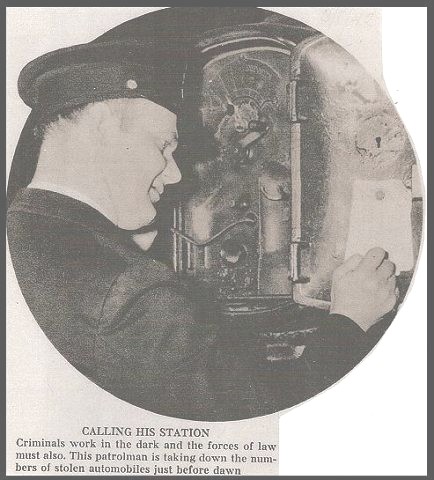
Leonard Hamm

Leonard Hamm

Commissioner Leonard Hamm who served as Baltimore's Police Commissioner for 2004-2007 tops the lists, followed by Edward Norris (2000-2002)

Watchman Turner

Watchman Turner

Fallen HeroNight Watchman Turner

watchman turner 1787

We'll include more information on this when it becomes available


1 black devider 800 8 72

POLICE INFORMATION

If you have copies of: your Baltimore Police Department class photo; pictures of our officers, vehicles, and equipment; newspaper articles relating to our department and/or officers; old departmental newsletters; lookouts; wanted posters; or brochures. Information on deceased officers and anything that may help preserve the history and proud traditions of this agency. Please contact retired detective Kenny Driscoll.

This email address is being protected from spambots. You need JavaScript enabled to view it.

Devider color with motto

NOTICE

How to Dispose of Old Police Items

Please contact Det. Ret. Kenny Driscoll if you have any pictures of you or your family members and wish them remembered here on this tribute site to honor the fine men and women who have served with honor and distinction at the Baltimore Police Department. Anyone with information, photographs, memorabilia, or other "Baltimore City Police" items can contact Ret. Det. Kenny Driscoll at This email address is being protected from spambots. You need JavaScript enabled to view it. follow us on Twitter @BaltoPoliceHist or like us on Facebook or mail pics to 8138 Dundalk Ave. Baltimore Md. 21222


Copyright © 2002 Baltimore City Police History: Ret Det. Kenny Driscoll 
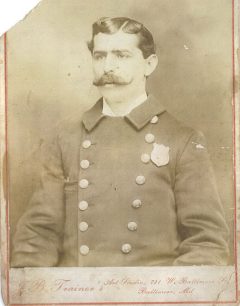
P/O Robert Wayne Peregoy

P/O Robert Wayne Peregoy


Officer Robert W PeregoyThe Baltimore Sun Wed Dec 16 2009 Click the above article to enlarge

More details

NameDescription
End of Watch 14 December 2009
City, St. SB - I795
Panel Number N/A
Cause of Death           Heart Attack
Weapon N/A
District Worked Western

1 black devider 800 8 72

POLICE INFORMATION

Copies of: Your Baltimore Police Department Class Photo, Pictures of our Officers, Vehicles, Equipment, Newspaper Articles relating to our department and/or officers, Old Departmental Newsletters, Lookouts, Wanted Posters, and/or Brochures. Information on deceased officers and anything that may help preserve the history and proud traditions of this agency. Please contact retired detective Kenny Driscoll.

This email address is being protected from spambots. You need JavaScript enabled to view it.

Devider color with motto

NOTICE

How to Dispose of Old Police Items

Please contact Det. Ret. Kenny Driscoll if you have any pictures of you or your family members and wish them remembered here on this tribute site to honor the fine men and women who have served with honor and distinction at the Baltimore Police Department. Anyone with information, photographs, memorabilia, or other "Baltimore City Police" items can contact Ret. Det. Kenny Driscoll at This email address is being protected from spambots. You need JavaScript enabled to view it. follow us on Twitter @BaltoPoliceHist or like us on Facebook or mail pics to 8138 Dundalk Ave., Baltimore, Md. 21222
 

Copyright © 2002 Baltimore City Police History: Ret Det. Kenny Driscoll 
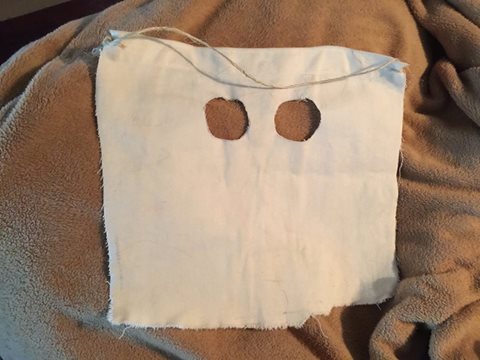
Sgt. Edward M. Sawyer

Sgt. Edward M. Sawyer

Fallen Heroes BannerSgt. Edward M. Sawyer 
E. M. Sawyer Dies at Work
CLICK HERE FOR AUDIO
 1 black devider 800 8 72
Dec 12, 1956
 
Had been officer 22 years Sgt. Edward M. Sawyer, a member of the Baltimore Police Department for 22 years, died suddenly yesterday as he worked on the automobile of the police commissioner in the garage near headquarters. He was 50 years old.
 
Sgt. Sawyer, who had served as a chauffeur for three commissioners, was polishing Commissioner James M. Hepbron's car when he passed out. He was pronounced dead on arrival at Mercy Hospital. A native of Baltimore, Sgt. Sawyer was appointed to the department in June 1934. His first assignment was to the motorcycle traffic division. He was made commissioner during the tenure of Hamilton Atkinson. Later, he served under the late Commissioner Beverly Ober and continued on the job under Mr. Hepbron.
He was made a Sgt. in March 1948.
 
1 black devider 800 8 72Baseball Career
 
Before joining the Police Department, Mr. Sawyer was a shortstop in professional baseball, playing in Frederick, Maryland. And Birmingham, Alabama, before going into police work.
 
Funeral services will be held Friday at the John Jay. Going and Sun establishment at Hollins and Poppleton streets. The hour for the service had not been set last night. Sgt. Sawyer leaves behind his wife, Mrs. Mary Sawyer, son, Edward F. Sawyer, brother, Morton, and three sisters, Mrs. Selma Mills, Mrs. Hilda Johnson, and Mrs. Mildred Smith, all of Baltimore.
 
 
1 black devider 800 8 72

POLICE INFORMATION

Copies of: Your Baltimore Police Department Class Photo, Pictures of our Officers, Vehicles, Equipment, Newspaper Articles relating to our department and/or officers, Old Departmental Newsletters, Lookouts, Wanted Posters, and/or Brochures. Information on deceased officers and anything that may help preserve the history and proud traditions of this agency. Please contact retired detective Kenny Driscoll.

This email address is being protected from spambots. You need JavaScript enabled to view it.

Devider color with motto

NOTICE

How to Dispose of Old Police Items

Please contact Det. Ret. Kenny Driscoll if you have any pictures of you or your family members and wish them remembered here on this tribute site to honor the fine men and women who have served with honor and distinction at the Baltimore Police Department.

Anyone with information, photographs, memorabilia, or other "Baltimore City Police" items can contact Ret. Det. Kenny Driscoll at This email address is being protected from spambots. You need JavaScript enabled to view it. follow us on Twitter @BaltoPoliceHist or like us on Facebook or mail pictures to 8138 Dundalk Ave. Baltimore Md. 21222


Copyright © 2002 Baltimore City Police History: Ret Det. Kenny Driscoll 

Ret P/O Calvin McCleese

Ret P/O Calvin McCleese

Retired Officer Calvin McCleese

Retired Officer Calvin McCleese

On March 5, 1989, retired officer Calvin McCleese would die, effecting an arrest in his neighborhood. For years, the toll bridge at the end of Dundalk Ave. in Baltimore County was closed; it sat unused and inoperable. Even longer than that, it was under the watchful eye of one of our department’s finest. Southeast District’s Officer Calvin McCleese lived on the corner of Dundalk Ave. and Bullneck Rd., just across the street from the bridge and Watersedge Park. The ladies and gentlemen that collected tolls were safe from anyone trying to bring them harm. Even though its location is in the county, like his family and his post, Officer McCleese protected his neighborhood. He had two sons, Michael and Jeff, who would also grow up to be police officers.

Calvin McCleese worked his entire career with the Baltimore Police Department, all in the same area since his joining in 1957. He started out in the Eastern District's Southeast Substation until 1958/59, when Southeast Station House on Eastern Ave. opened. The kind of police Calvin was; on January 22, 1970, while patrolling in Highland Town, he grew suspicious of a car parked around the corner from The Chesapeake Federal Savings and Loan. Officer McCleese approached the car just as the car’s tag number was broadcast over his radio in a report about a bank robbery at The Chesapeake S&L. Officer McCleese pulled his handgun and single-handedly captured the two men in the car, one of whom was armed with a sawed-off shotgun. But that was 1970, and that was the way Officer McCleese worked.

He retired from the department in 1985 and went on to be the typical retired police officer. He still looked out for his family and his neighborhood… until this day in 1989, when a vehicle being operated by a drunk driver, either not knowing the bridge was closed or just plain losing control, hit the bridge embankments, had an accident and his car burst into flames. Retired Officer McCleese ran to the driver’s aid; after breaking the windows and getting the driver out, the driver woke up. Fearing he would be arrested for DWI and an out-of-state warrant, he decided he would fight the man who just came to his aid and saved his life. Having just fought his way into a burning car and got a man out, then realizing the man was drunk, Officer McCleese wasn’t about to just let him go. So he fought back, subduing the individual until Baltimore County Police would show up on scene, laying on top of him and pinning him down when police arrived and took over the arrest. Officer McCleese had had a heart attack, which he would succumb to on the scene. Officer McCleese had held on for as long as he could. His last action in his life was to first save a life and then to effect the arrest of a drunk driver and wanted fugitive.

Those that knew him knew how much he loved being a Baltimore Police Officer and the pride he had in wearing our badge. While he had already been retired for a few years, he died on this day in 1989 doing what he loved best: serving his community. BTW, one of the ladies P/O McCleese was intent on guarding at that toll booth was his wife, Rebecca McCleese, the mother of his two sons.

May he never be forgotten as "His service "Honored" the City of Baltimore and the Police Department." God bless and RIP

1 black devider 800 8 72
 

POLICE INFORMATION

If you have copies of: your Baltimore Police Department class photo; pictures of our officers, vehicles, and equipment; newspaper articles relating to our department and/or officers; old departmental newsletters; lookouts; wanted posters; or brochures. Information on deceased officers and anything that may help preserve the history and proud traditions of this agency. Please contact retired detective Kenny Driscoll.

This email address is being protected from spambots. You need JavaScript enabled to view it.

Devider color with motto

NOTICE

How to Dispose of Old Police Items

Please contact Det. Ret. Kenny Driscoll if you have any pictures of you or your family members and wish them remembered here on this tribute site to honor the fine men and women who have served with honor and distinction at the Baltimore Police Department. Anyone with information, photographs, memorabilia, or other "Baltimore City Police" items can contact Ret. Det. Kenny Driscoll at This email address is being protected from spambots. You need JavaScript enabled to view it. follow us on Twitter @BaltoPoliceHist, like us on Facebook or mail pictures to 8138 Dundalk Ave., Baltimore, Md. 21222


Copyright © 2002 Baltimore City Police History: Ret Det. Kenny Driscoll 

P/O Keona Holley

P/O Keona Holley

1 black devider 800 8 72

Two suspects charged with the shooting of Baltimore police officer

Two suspects in the Thursday shooting of a Baltimore police officer who was sitting in her patrol vehicle are in custody, police said.

The duo—Elliot Knox and Travon Shaw—were charged with attempted murder in the shooting of Officer Keona Holley as well as murder for shooting 27-year-old Justin Johnson nearby, the Baltimore Police Department announced Friday.

The gunmen approached Holley—now in critical but stable condition, according to CNN—from behind around 1:30 a.m. Thursday and opened fire, hitting her multiple times, police said.

She was shot twice in the head, once in the leg and once in the hand, according to documents obtained by the Baltimore Sun.

Both alleged shooters had criminal histories, according to a report.

Officer Keona Holley, who was shot twice in the head, once in the leg and once in the hand, is in critical but stable condition.

Facebook

Shaw, 32, was awaiting trial in Baltimore County for a March 2020 arrest for being a felon in possession of a firearm, The Sun reported, citing court records. He reportedly had a previous conviction for armed robbery and assault from a 2006 case.

Knox, 31, was convicted of three armed robberies in 2006, when he was 16 and sentenced to 15 years in prison.

Travon Shaw.

Travon Shaw reportedly had a previous conviction for armed robbery and assault from a 2006 case.

Baltimore Police Department, via AP

Elliot Knox.

Elliot Knox was convicted of three armed robberies in 2006.

Baltimore Police Department, via AP

Investigators found weapons allegedly used in the pair of shootings, the police department said.

“What we now know is that both shootings are related,” Police Commissioner Michael Harrison said during a news conference. “As we now know, the perpetrators of Officer Holley’s shooting then left that scene, went to Lucia Avenue, and then committed the homicide of Justin Johnson.”

“These incidents are tragic and remind us of the culture of violence that pervades Baltimore. Life is precious and sacred, but unfortunately there are those who have no regard for it,” Harrison said in a statement, blasting the “cowards responsible” for the shooting.

“No family should have to endure this type of heartache over the holidays, so please keep Officer Holley’s family and the entire community in your prayers.”

State Attorney for Baltimore Marilyn Mosby pledged to prosecute the suspects “to the fullest extent of the law.”

“We will have zero tolerance for those who seek to use violence and murder to settle their grievances. And the criminals that do will be prosecuted to the fullest extent of the law,” she said, according to CNN.”

Keona Holley

The State Attorney for Baltimore pledged to prosecute the suspects in Holley’s shooting “to the fullest extent of the law.”

Facebook

As officer Holley continues to fight and fight for her life, we vow to her, her family, her colleagues, and this community that we will get justice on her  behalf—fo every victim that has been affected by these heinous acts of violence, we will get justice on their behalf.”

Holley, 39, was working an overtime shift in the Curtis Bay neighborhood when she was shot, according to the Baltimore Sun.

On Saturday, NYPD Commissioner Dermot Shea on Twitter expressed his support for the wounded Baltimore cop.

1 black devider 800 8 72
23 Dec 2021


Updated 6:04 PM, Dec 23, 2021

BALTIMORE — After deteriorating health and a fight for her life, Holley's family as well as medical officials made a difficult decision.

Baltimore Police Commissioner Michael Harrison and the Baltimore Police Department announce that Officer Keona Holley has been removed from life support.


“Our prayers are with Officer Holley’s family and loved ones, co-workers, and the entire community. I thank her and the entire BPD community for their commitment, service, and sacrifice. We mourn Officer Holley’s death together, and we will heal together,” said Commissioner Harrison.

The department is extending the offer to any support and assistance officers who may need it as free and confidential counseling services are available for all BPD employees. The BPD also continues to support Officer Holley’s family.

“I offer my deepest condolences to the family, friends, and colleagues of Officer Keona Holley, a devoted public servant who worked selflessly to protect our community,” said Mayor Brandon Scott. “Baltimore will never forget Officer Holley’s sacrifice and commitment to making a difference in her beloved city. I ask that everyone please keep Officer Holley’s family in your prayers as they endure the holiday season without their mother, daughter, sister, and loyal friend.”

The Signal 13 Foundation is providing assistance to the family in their time of need. Those who wish to provide financial support to Officer Holley’s family may do so through the Signal 13 website at signal13foundation.org. You can designate your support for Officer Holley’s family, by writing “In support of Officer Holley” in the notes box or in the memo field of a written check.

1 black devider 800 8 72

Police Commissioner Harrison provides update on Officer Holley’s condition
 
23 December 2021
 
Baltimore, MD (23 December 2021) – It is with heavy hearts that Commissioner Michael Harrison and the Baltimore Police Department announce that Officer Keona Holley has been removed from life support. Her health has been deteriorating over the last couple of days, and her family, in consultation with her doctors, has had to make the most difficult decision. Since Officer Holley’s shooting, Dr. Thomas Scalea and the medical staff at the Shock Trauma Center at the University of Maryland Medical Center have provided her with the best medical care in the world. The Baltimore Police Department thanks them for all of their efforts. However, it was Officer Holley’s valiant fight for her life that has brought her this far. Her strength, courage, and resilience are an inspiration to us all.
 
“Our prayers are with Officer Holley’s family and loved ones, co-workers, and the entire community. I thank her and the entire BPD community for their commitment, service, and sacrifice. We mourn Officer Holley’s death together, and we will heal together,” said Commissioner Harrison.
 
“I offer my deepest condolences to the family, friends, and colleagues of Officer Keona Holley, a devoted public servant who worked selflessly to protect our community,” said Mayor Brandon Scott. “Baltimore will never forget Officer Holley’s sacrifice and commitment to making a difference in her beloved city. I ask that everyone please keep Officer Holley’s family in their prayers as they endure the holiday season without their mother, daughter, sister, and loyal friend.”
 
Due to the tragic and traumatic events experienced by the BPD community over the last couple weeks, the department is extending the offer of any support and assistance officers may need. Free and confidential counseling services are available for all BPD employees. The BPD also continues to support Officer Holley’s family, as we do for all members of the force.
 
The Signal 13 Foundation is providing assistance to the family in their time of need. Those who wish to provide financial support to Officer Holley’s family may do so through the Signal 13 website at signal13foundation.org and click on the “Donate” button. Please designate your support for Officer Holley’s family by writing “In support of Officer Holley” in the notes box or in the memo field of a written check.
The Signal 13 Foundation is a nonprofit 501(c)3 established to support Baltimore Police and their families in times of need. Signal 13 provides financial hardship grants and college scholarships for the children of police personnel. All donations are tax-deductible. Any donations received in the name of Officer Keona Holley will be used to support her family.
 
There will, of course, be ways that we can ensure that Officer Holley’s spirit and legacy live on in this department and this city. Those conversations will be had with her family and colleagues after we get through this somber and difficult period. However, the best way to honor Officer Holley is to continue her mission of making Baltimore a safer place for everyone.
1 black devider 800 8 72
The family of fallen Officer Keona Holley has a Christmas Eve message on crime
24 Dec 2021

On this Christmas Eve, the family of Baltimore Police Officer Keona Holley is mourning, and they're speaking out.

Although it's the time of year to be with the ones you love, for her family and the police department, this holiday will be about planning a funeral.

Officer Holley was pulled off life support Thursday, a week after she was ambushed in a shooting in Curtis Bay.

But Holley's sister, Lawanda Sykes, and mother, Karen Eaddy, say on this night before Christmas there's still joy, peace, and a reason to be part of the season.


"I wish everybody a Merry Christmas. I mean, it's still merry to me because I have my grandkids," said Eaddy. "I may not have my child, but I have my grandkids. So, I have to lift myself up and lift them up to have Christmas without their mom."

Holley, who joined the Baltimore police force two years ago, was a 39-year-old mother with four children, the youngest being a 10-year-old son.

Holley's sister says they intend to have a joyful holiday but admits that, amid the upbeat spirit, the pain and tears remain.

"The tears will never go away; they will always be there. But those tears also hold memories. They hold laughter; they hold joy. They hold her life, her essence, and her spirit," said Sykes.

Police say Holley was shot several times while sitting in her police car early that morning, December 16, in south Baltimore. She was shot in the head while working an overtime shift.


Holley had been on life support at the University of Maryland Shock Trauma Center until Thursday, when her family made the difficult decision to remove her from life support, two days before Christmas.

"That, I don't think we're ready to talk about. Too soon for that," said Sykes.

But Sykes is talking about the seemingly-out-of-control gun violence that's happening across the city and the violent crime that cost her sister her life. Her plea now: Stop the violence.

"Something has to be done about it. Whether it comes from our politicians or police department, whatever, no matter what. But the message has to go to the person who's picking up the gun," said Sykes.

Police have arrested and charged two men in the shooting, Elliott Knox and Travon Shaw. They're the same men, police say, who shot and killed Justin Johnson 90 minutes after shooting Holley.

And on this night before Christmas, one sister has a message to her sister's suspected killers.

"Everybody does not have or was given the love that my sister had, and maybe that was missing from them. The only hope that I can find is as that they find forgiveness in God," said Sykes.


1 black devider 800 8 72

POLICE INFORMATION

If you have copies of: your Baltimore Police Department class photo; pictures of our officers, vehicles, and equipment; newspaper articles relating to our department and/or officers; old departmental newsletters; lookouts; wanted posters; or brochures. Information on deceased officers and anything that may help preserve the history and proud traditions of this agency. Please contact retired detective Kenny Driscoll.

This email address is being protected from spambots. You need JavaScript enabled to view it.

Devider color with motto

NOTICE

How to Dispose of Old Police Items

Please contact Det. Ret. Kenny Driscoll if you have any pictures of you or your family members and wish them remembered here on this tribute site to honor the fine men and women who have served with honor and distinction at the Baltimore Police Department. Anyone with information, photographs, memorabilia, or other "Baltimore City Police" items can contact Ret. Det. Kenny Driscoll at This email address is being protected from spambots. You need JavaScript enabled to view it. follow us on Twitter @BaltoPoliceHist or like us on Facebook or mail pics to 8138 Dundalk Ave., Baltimore, Md. 21222


Copyright © 2002 Baltimore City Police History: Ret Det. Kenny Driscoll 

Cpt Charles H Burns

Cpt Charles H Burns

Fallen HeroCaptain Charles H Burns

The Baltimore Sun Fri Mar 10 1933 72

Click HERE of the above Article to see full size Article

The Baltimore Sun Fri Mar 10 1933 lodd pg2 72

 Click HERE of the above Article to see full size Article

1 black devider 800 8 72

Captain Charles H Burns

  D.O.D     9 Match 1933

1 black devider 800 8 72
More details
 
NameDescription
End of Watch 9 March 1933
City, St. City, St.
Panel Number N/A
Cause of Death LOD Illness
District Worked              Detective Department

 1 black devider 800 8 72
POLICE INFORMATION

Copies of: Your Baltimore Police Department Class Photo, Pictures of our Officers, Vehicles, Equipment, Newspaper Articles relating to our department and/or officers, Old Departmental Newsletters, Lookouts, Wanted Posters, and/or Brochures. Information on deceased officers and anything that may help preserve the history and proud traditions of this agency. Please contact retired detective Kenny Driscoll.

1 black devider 800 8 72

POLICE INFORMATION

Copies of: Your Baltimore Police Department Class Photo, Pictures of our Officers, Vehicles, Equipment, Newspaper Articles relating to our department and/or officers, Old Departmental Newsletters, Lookouts, Wanted Posters, and/or Brochures. Information on deceased officers and anything that may help preserve the history and proud traditions of this agency. Please contact retired detective Kenny Driscoll.

This email address is being protected from spambots. You need JavaScript enabled to view it.

Devider color with motto

NOTICE

How to Dispose of Old Police Items

Please contact Det. Ret. Kenny Driscoll if you have any pictures of you or your family members and wish them remembered here on this tribute site to honor the fine men and women who have served with honor and distinction at the Baltimore Police Department.

Anyone with information, photographs, memorabilia, or other "Baltimore City Police" items can contact Ret. Det. Kenny Driscoll at This email address is being protected from spambots. You need JavaScript enabled to view it. follow us on Twitter @BaltoPoliceHist, like us on Facebook or mail pictures to 8138 Dundalk Ave. Baltimore Md. 21222


Copyright © 2002 Baltimore City Police History: Ret Det. Kenny Driscoll 

How to Dispose of Old Police Items

logo

Please contact Det. Ret. Kenny Driscoll if you have any pictures of you or your family members and wish them remembered here on this tribute site to Honor the fine men and women who have served with Honor and Distinction at the Baltimore Police Department. Anyone with information, photographs, memorabilia, or other "Baltimore City Police" items can contact Ret. Det. Kenny Driscoll at   Kenny@BaltimoreCityPoliceHistory.com follow us on Twitter @BaltoPoliceHist or like us on Facebook or mail pics to 8138 Dundalk Ave. Baltimore Md. 21222.

NEWSLETTER

Subscribe now to get 100 exclusive photo & two newsletters per month