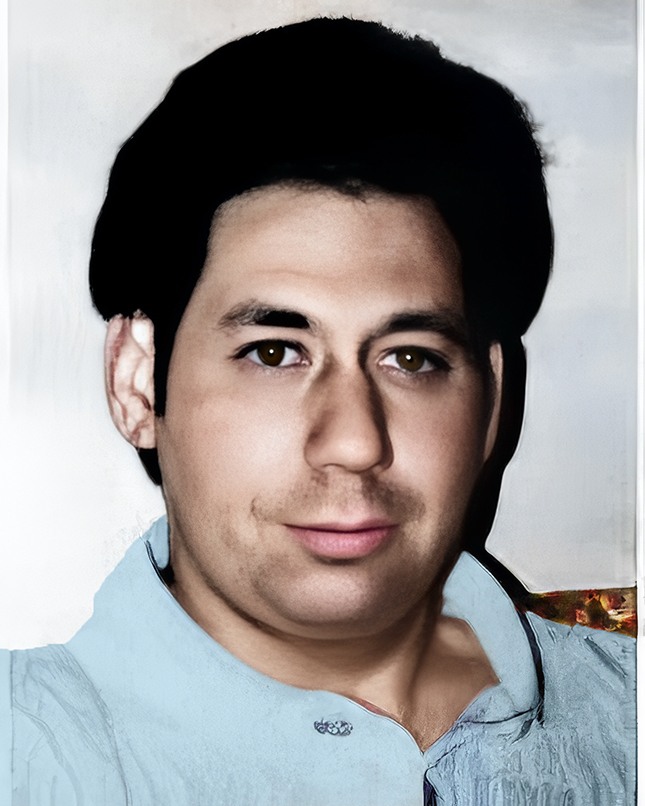
Officer Robert M. Rigdon

Officer Robert M. Rigdon

Fallen HeroOfficer Robert M. Rigdon 
CLICK HERE FOR AUDIO

On this day in Baltimore Police History 5 Nov, 1858 we lost our brother Police Officer Robert M. Rigdon in an Assassination by Gunfire – From the Baltimore Sun paper - The Examination before the Mayor – Investigation and Verdict of the Coroner’s Jury – The Excitement and Incidents of the Tragedy. – the killing of Robert M. Rigdon, an officer of the Western district, who was assassinated in the bosom of his family, at 468 West Baltimore street, the night previous, out of revenge for his testimony delivered in the case of Gambrill, concluded in Criminal Court on the same afternoon for the murder of officer Benjamin Benton, a brother officer of the deceased… The assassination appears to have been one of deliberate premeditation. Officer Rigdon, after answering roll call at the station house on Green street, retired into the privacy of his home. During the evening, and while Mr. Rigdon was in the back-room of his dwelling, a man (since recognized as Peter Corrie) entered the store-room, which is in the front part of the house, and looked at some undershirts and other articles displayed. In the store he conducted himself like a drunken man, but that was evidently feigned. His actions becoming repulsive to Mrs. Rigdon and a female attendant, she called on her husband to eject him from the premises. Fearful that the thing was a ruse to draw him within the reach of his enemies, Rigdon hesitated, and said to his wife, who stood in the doorway leading to the storeroom, “I don’t attend the store – tell him to go out,” or words to that effect. At that moment, while resting with his elbow against the mantel of the fireplace, where he had laid his pistol belt, the weapon of the crouching assailant in his rear was fired through the little window, which opens into the yard from the sitting room. Rigdon, who, from the position of the mantel, must have been but three or four feet distant from the weapon, received five slugs in his back, near the left side. His only exclamation was, “My God! I’m shot!” and attempted to reach for the sofa, but sank on the floor and died after heaving an audible groan. Persons passing upon the street and the residents alarmed by the shot, hastened into the house, where they stood horrified and trembling at the deed of blood before them, for a moment transfixed and unable to act. His wife is said to have acted heroically, and neither shrieked nor fainted, but recited all with coolness and self-possession which was remarkable. Officer J. Cook being in the vicinity hastened in the direction of the shot, and fell upon Peter Corrie as he was running away from the alley of Rigdon’s house.

The officer gave chase, when another man (since recognized as Mal Cropps,) followed, and ran along on the other side of the street. Cook singled out Corrie, and came up with him on the run, calling on him to stop. Corrie did not heed but ran down Baltimore to Pine and to Penn streets, the pursued and pursuer occasionally exchanging shots. At Penn street, Cook was joined by officers Jamison and Huggins, one of whom sprang his rattle in advance of Corrie, which so alarmed him, that he slackened his pace and was easily captured. When he found himself in the hands of the officers, he begged for life, and said as “God lived” he was innocent of the murder. He then in his fear, confessed, and said “Mal Cropps did it.” He was locked up in a cell at the western district.  

Officer Rigdon's murder could have the unfortunate distinction of being the first instance of an American law enforcement officer being murdered while off-duty, for his official actions as a lawenforcement officer.

Baltimore Sun Article Dated 11/08/1858

The Assassination of Robert M. Rigdon – The Examination before the Mayor – Investigation and Verdict of the Coroner’s Jury – The Excitement and Incidents of the Tragedy. – The Sun of Saturday contained the startling announcement of the killing of Robert M. Rigdon, an officer of the Western district, who was assassinated in the bosom of his family, No. 468 West Baltimore street, the night previous, out of revenge for his testimony delivered in the case of Gambrill, concluded in Criminal Court on the same afternoon for the murder of officer Benjamin Benton, a brother officer of the deceased… The assassination appears to have been one of deliberate premeditation. Officer Rigdon, after answering roll call at the station house on Green street, retired into the privacy of his home. During the evening, and while Mr. Rigdon was in the back-room of his dwelling, a man (since recognized as Peter Corrie) entered the store-room, which is in the front part of the house, and looked at some undershirts and other articles displayed. In the store he conducted himself like a drunken man, but that was evidently feigned.   His actions becoming repulsive to Mrs. Rigdon and a female attendant, she called on her husband to eject him from the premises. Fearful that the thing was a ruse to draw him within the reach of his enemies, Rigdon hesitated, and said to his wife, who stood in the doorway leading to the storeroom, “I don’t attend the store – tell him to go out,” or words to that effect.   At that moment, while resting with his elbow against the mantel of the fireplace, where he had laid his pistol belt, the weapon of the crouching assailant in his rear was fired through the little window, which opens into the yard from the sitting room. Rigdon, who, from the position of the mantel, must have been but three or four feet distant from the weapon, received five slugs in his back, near the left side. His only exclamation was, “My God! I’m shot!” and attempted to reach for the sofa, but sank on the floor and died after heaving an audible groan. Persons passing upon the street and the residents alarmed by the shot, hastened into the house, where they stood horrified and trembling at the deed of blood before them, for a moment transfixed and unable to act. His wife is said to have acted heroically, and neither shrieked nor fainted, but recited all with coolness and self-possession which was remarkable.   Officer J. Cook being in the vicinity hastened in the direction of the shot, and fell upon Peter Corrie as he was running away from the alley of Rigdon’s house.

The officer gave chase, when another man (since recognized as Mal Cropps, followed, and ran along on the other side of the street. Cook singled out Corrie, and came up with him on the run, calling on him to stop. Corrie did not heed but ran down Baltimore to Pine and to Penn streets, the pursued and pursuer exchanging shots occasionally. At Penn street, Cook was joined by officers Jamison and Huggins, one of whom sprang his rattle in advance of Corrie, which so alarmed him, that he slackened his pace and was easily captured. When he found himself in the hands of the officers, he begged for life, and said as “God lived” he was innocent of the murder. He then in his fear, confessed, and said “Mal Cropps did it.”   He was locked up in a cell at the western district. 


Baltimore Sun Article Dated January 27, 1859

At about 10 ½ o’clock it was announced that the jury, who had been out all night in the case of Corrie, had agreed upon a verdict, and they soon after entered the court. Their names having been called, and the prisoner directed to hold up his right hand, the court said the verdict must be received in silence, and without demonstration whatever on the part of the spectators. The clerk then, amid breathless silence, asked – “What say you, is the prisoner at the bar guilty or not guilty?” The foreman replied, “guilty of murder in the first degree.”

Baltimore Sun Article Dated April 9, 1859

Yesterday was the day fixed upon by the Governor of the State of Maryland for the execution of the four condemned murders, Henry C. Gambrill (Note; this is the person who murdered Officer Benton), Marion Cropps, Peter Corrie and John Stephens… Many persons had arrived in the city during Thursday to witness the scene – all parts of the State, the District of Columbia, Virginia and Pennsylvania, and even New York city and Buffalo being represented on this occasion. Early in the morning throngs of persons began to pour in from Baltimore, Howard, Anne Arundel, Harford and adjacent counties, and the houses of the city appeared empty themselves of their inhabitants – all wending their way to the streets and hills to the west and north of the jail, which commanded full view of the gallows erected within the jail yard. The housetops, windows, trees and all other places from whence a more enlarged view could be obtained were crowded with human beings. A sea of faces met the eye far and near – men, women and children – old age and infancy – white and black – swelled up the vast multitude, drawn to witness the horrible spectacle…

The execution throughout was conducted with the greatest precision and humanity, the orders and arrangements of Sheriff Creamer being carried out with the most scrupulous fidelity. To the sheriff and those deputies who assisted him every credit is due for the faithful discharge of their duties – No execution that ever occurred in Baltimore was performed with more strict regard to mercy and humanity, and not a single circumstance occurred which could cause regret, the performance of the stern demands of the law.   

As his brothers and sisters of the Baltimore Police Department we will not let him be forgotten, His service Honored the City of Baltimore, and the Baltimore Police Department may he rest in peace, and may God bless him.

1 black devider 800 8 72 More Details

Name

Description

End of Watch 5 November, 1858
City, St.    468 West Baltimore street
Panel Number 24-E: 21
Cause of Death         Gunfire
District Worked Western

1 black devider 800 8 72


POLICE INFORMATION

Copies of: Your Baltimore Police Department Class Photo, Pictures of our Officers, Vehicles, Equipment, Newspaper Articles relating to our department and or officers, Old Departmental Newsletters, Lookouts, Wanted Posters, and or Brochures. Information on Deceased Officers and anything that may help Preserve the History and Proud Traditions of this agency. Please contact Retired Detective Kenny Driscoll.

This email address is being protected from spambots. You need JavaScript enabled to view it.

Devider color with motto

NOTICE

How to Dispose of Old Police Items

Please contact Det. Ret. Kenny Driscoll if you have any pictures of you or your family members and wish them remembered here on this tribute site to Honor the fine men and women who have served with Honor and Distinction at the Baltimore Police Department.  Anyone with information, photographs, memorabilia, or other "Baltimore City Police" items can contact Ret. Det. Kenny Driscoll at This email address is being protected from spambots. You need JavaScript enabled to view it. follow us on Twitter @BaltoPoliceHist or like us on Facebook or mail pics to 8138 Dundalk Ave. Baltimore Md. 21222


Copyright © 2002 Baltimore City Police History - Ret Det Kenny Driscoll 

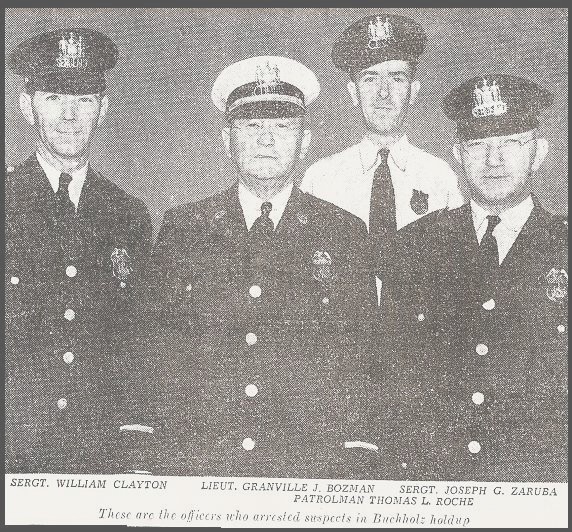
Lt. Cornelius J. Roche

RocheLt. Cornelius J. Roche


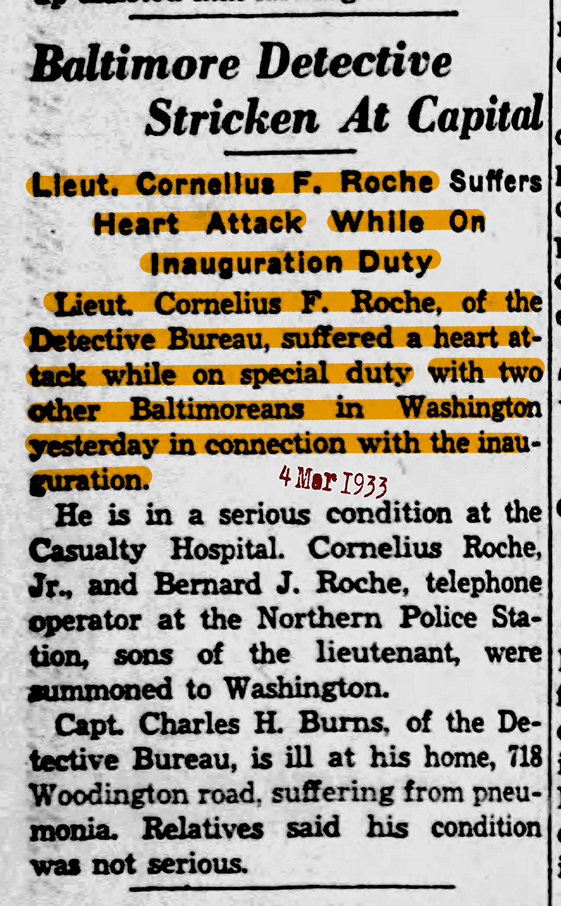
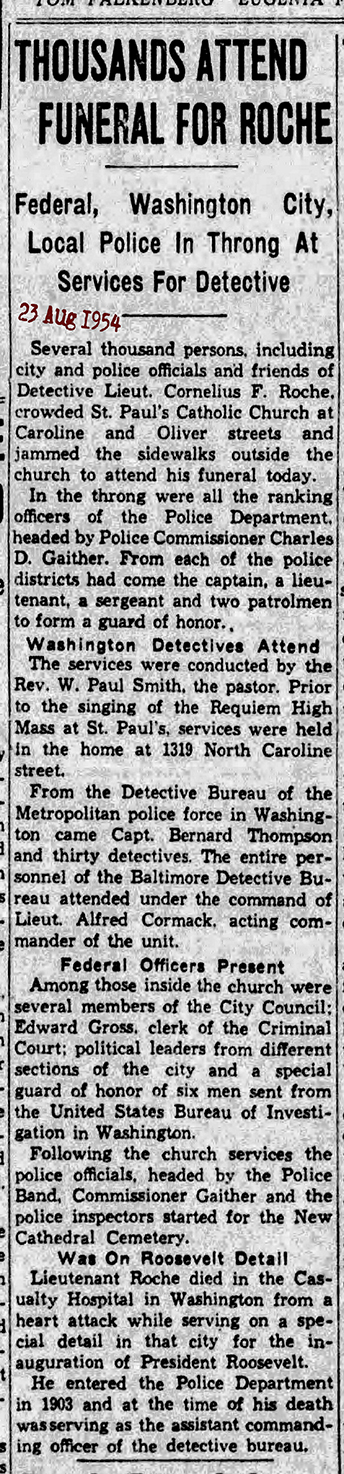
On this day in BPD history 7 March 1933 we lost our Brother Lt. Cornelius J. Roche of Baltimore's Detective Bureau, Lt Roche suffered a Heart Attack and Paralytic Stroke while on duty and working the Presidential Inauguration of Franklin Delano Roosevelt in Washington DC. The Heart Attack and Stroke would take the Lieutenat's life before he could leave the city and get back to his family in Baltimore.

We lost two of our men while in DC the second was Capt. Charles H Burns, also from the Detective Bureau. The Captain passed away in his home on the 9th of March 1933. 

Please take a minute to read the following articles, we will always add info as it is learned.

The Baltimore Sun Sat Mar 4 1933 72


The Evening Sun Sat Mar 11 1933 72

Devider chrome


1 black devider 800 8 72

 More details
 
NameDescription
End of Watch 7 March 1933
City, St. City, St.
Panel Number N/A
Cause of Death Heart Attack
District Worked Detective Department

 1 black devider 800 8 72
POLICE INFORMATION

Copies of: Your Baltimore Police Department Class Photo, Pictures of our Officers, Vehicles, Equipment, Newspaper Articles relating to our department and/or officers, Old Departmental Newsletters, Lookouts, Wanted Posters, and/or Brochures. Information on deceased officers and anything that may help preserve the history and proud traditions of this agency. Please contact retired detective Kenny Driscoll.

This email address is being protected from spambots. You need JavaScript enabled to view it.

Devider color with motto

NOTICE

How to Dispose of Old Police Items

Please contact Det. Ret. Kenny Driscoll if you have any pictures of you or your family members and wish them remembered here on this tribute site to honor the fine men and women who have served with honor and distinction at the Baltimore Police Department.

Anyone with information, photographs, memorabilia, or other "Baltimore City Police" items can contact Ret. Det. Kenny Driscoll at This email address is being protected from spambots. You need JavaScript enabled to view it. follow us on Twitter @BaltoPoliceHist or like us on Facebook or mail pictures to 8138 Dundalk Ave., Baltimore Md. 21222


Copyright © 2002 Baltimore City Police History: Ret Det. Kenny Driscoll 

Officer Jamie A. Roussey

Officer Jamie A. Roussey

Fallen Hero

 Officer Jamie A. Roussey

CLICK HERE FOR AUDIO

CLICK HERE FOR AUDIO

Information from the “Officer Jamie A. Roussey Memorial Web Page” 22 year-old Police Officer Jamie Roussey, who had been on the job slightly more than a year, died last night of injuries he sustained when his Jeep Cherokee patrol vehicle collided with a car at a West Baltimore intersection. Officer Roussey was responding to help an officer involved in a foot pursuit. As he traveled northbound in the first block of N. Fulton Ave., he collided with a Dodge Neon at the 1700 block of W. Fayette St. The driver’s side of the Jeep hit a utility pole. Officer Roussey was transported to the hospital, where he succumbed to his injuries.

Devider

On this day in Baltimore Police History 2000 we lost our brother Police Officer Jamie Allen Roussey - Officer Roussey died from injuries he sustained when his Jeep Cherokee patrol vehicle collided with a car at an intersection in West Baltimore. Jamie was responding to help an officer involved in a foot pursuit. As he traveled northbound in the unit block of N. Fulton Ave, he collided with a Dodge Neon at the 1700 block of W. Fayette St. The driver’s side of the Jeep hit a utility pole. Officer Roussey was transported to the hospital where he succumbed to his injuries.

 Devider

A Career Inseparable from Family
Officer Killed in Crash had Father, Brother, 2 Relatives on Force

March 10, 2000

By Peter Hermann | Peter Hermann,SUN STAFF

Jamie A. Roussey had one career and one family. The two were indistinguishable.

His father, brother, uncle and cousin doubled as colleagues in the Baltimore Police Department, a proud lineage that makes the Roussey name synonymous with law enforcement for virtually anyone who wears a badge in the city. The close ties were evident Wednesday, when Roussey sped to help three fellow officers and died when his cruiser collided with another car in West Baltimore. His cousin, Seth Roussey, was the first officer on the scene. "That's a very proud police family," said Mayor Martin O'Malley, who has Roussey's uncle, Officer Vincent Roussey, on his security detail. "He was a young, bright, dedicated kid who has the toughest job in this great city." O'Malley ordered flags flown at half-staff until Monday's funeral at the family church in Catonsville. Roussey, 22, is the third officer in two years to die in the line of duty and the 100th since the department was formed in 1870. He graduated from the police academy four months ago. He lived with his motherand father, Frederick, a police sergeant, who often brought his young son to work in the Western District. "He knew he was going to be a Baltimore City police officer," said Rob Tomback, Roussey's principal at Catonsville High School. "There was no doubt. He had his sights set on that, and that is what he achieved." Grief-stricken family members did not make public statements yesterday but indicated they might meet with reporters today. Two years ago, Roussey's parents took out a full-page ad in his high school yearbook to showcase their son's achievements. "Your sparkling personality and sense of humor have brightened many days," they wrote under a photo spread showing Roussey in his football uniform, standing beside his pickup truck and smiling as a baby. "Nothing is beyond your reach," they added. "We love you and we'll always be there to support you."

Roussey was killed as he sped through an intersection at North Fulton Avenue and West Fayette Street about 5: 45 p.m. Wednesday. He was trying to reach officers running after a man suspected of possessing marijuana. The suspect was later arrested. A Dodge Neon broadsided the passenger side of the police Jeep, sending it hurtling into a utility pole and crushing the driver's side of the vehicle. The cause of the accident remains under investigation. Maj. Michael Bass, a police spokesman, said witnesses reported that Roussey had his emergency lights and siren activated, but that he may have gone through a red light.Police vehicles are allowed to go through red lights only after coming to a complete stop, to make sure the intersection is clear of traffic. Bass said investigators have not determined whether that was done in this case. The driver and passenger of the Neon have not been charged or cited in connection with the crash. But police said they found a Glock 9 mm gun in the Neon's trunk and suspected drug paraphernalia with a trace amount of suspected marijuana.

Calvin Thompson Jr., 20, of the 4100 block of Mountwood Road, and Robert Scott, 28, of the 100 block of Palormo Ave., were charged with handgun and drug possession and were being held in the Central Booking and Intake Center last night. Accidents involving police cars occur frequently, though the numbers have declined since 1995, when 554 were reported. That year, 186 were listed as the officer's fault. In 1998 -- the most recent year numbers are available -- 255 departmental accidents occurred, with 95 listed as the officer's fault.

Officer Harold A. Carey was killed in 1998 when his cruiser collided with another patrol car -- both speeding to the same emergency. One went through a red light. Roussey's death hit the Western District station hard. Though new to the police force, the young officer was well-liked. He wanted to patrol the Western, in one of the city's toughest neighborhoods, and teased his cousin, Seth, assigned to the more sedate Southern, officers there said. "My learning experiences will be a lot greater than yours," he told his cousin, recalled Sgt. Andre O. Monroe. "He used to always come up to me, and he used to tell me how excited he was to come into the Western District."

The mood was somber during yesterday's roll call for Roussey's 4 p.m. to midnight shift. Lt. John Mack told officers that Roussey would want them to continue to make the city safer. Business as usual was easier said than done yesterday. "Behind this blue uniform, there are definitely hurt souls," Mack said. Roussey grew up in Catonsville, across the street from the high school -- a center of neighborhood activity in the close-knit community. The response to a call to the school and a request for someone who knows the Rousseys tells how well the name is known there.

"That would be everybody," said an administrator.

In high school, Roussey excelled as a student and participated in lacrosse, football and wrestling. His principal, Tomback, remembers the 6-foot-2, 215-pound lineman motivating his teammates to rally for a come-from-behind victory that at "one point just seemed hopeless."

The five active-duty Rousseys made up one of the largest family contingents in the Police Department. His father, Sgt. Frederick Roussey, is assigned to the sex offense unit. His brother, Frederick Roussey Jr., patrols the Southern District, along with his cousin, Seth. His uncle, Vincent, is a member of the mayor's security detail. "It's one of those names that is synonymous with law enforcement in Baltimore City," said Officer Gary McLhinney, the police union president. Added Bass: "Their friends are in the hundreds in this agency." Lt. Susan Young has known Roussey since he was 10. Not only is she a family friend -- she was at their home Wednesday night to help them grieve -- she helped train the young man at the academy. "He had the potential to be one of the best," Young said. Unlike his father, who was outgoing, she said Roussey was "one of those quiet ones that maybe you didn't think was listening, but if you asked him a question, he had the answer." Young said she kept her friendship with Young a secret at the academy, to avoid any appearance of favoritism. But they had their own hidden game during inspections, where Roussey tried to be serious.

"I would crack a smile, give him a wink, and he couldn't keep a straight face," Young said. "I purposely did it to him, just to make him laugh." At his Nov. 5 graduation, Roussey joined 46 of the department's newest officers at the War Memorial Building, where they heard a top police commander tell them, "The quality of life on the streets is still rotten," and it was their job to make it better. Roussey's friends said he took those words to heart. His father had worked the drug-torn streets of the Western District, and that was where he wanted to be. McLhinney described Roussey's father, whom he spoke to Wednesday night, as proud but devastated.

"Most fathers want their sons to follow in their footsteps," the union president said. "He was such a young guy who really wanted to make a difference." Sun staff writer Stacey Hirsh contributed to this article. Viewings, Funeral Viewings for Officer Jamie A. Roussey will be held at Witzke Funeral Home, 1630 Edmondson Ave., Catonsville, from 7 p.m. to 9 p.m. today and from 3 p.m. to 5 p.m. and 7 p.m. to 9 p.m. tomorrow and Sunday. The funeral is scheduled for 10 a.m. Monday at St. Agnes Roman Catholic Church, St. Agnes Lane and Baltimore National Pike. Interment will follow at Dulaney Valley Memorial Gardens in Timonium. The family has set up the Jamie A. Roussey Scholarship Fund. Donations can be sent to Baltimore City Fraternal Order of Police, Lodge 3, 3920 Buena Vista Ave., Baltimore 21211. We his brothers and sisters of the Baltimore Police Department will not let him be forgotten. God Bless and Rest in Peace as "His service "Honored" the City of Baltimore and the Police Department"


Devider

Officer Killed in Collision went Through Red Light

March 11, 2000

Siren, lights were on

Police say other driver might be charged

By Peter Hermann | Peter Hermann,SUN STAFF

Police investigating Wednesday's car accident that claimed the life of a Baltimore police officer have determined that the officer went through a red light, a department spokesman said yesterday. But authorities said they are considering charging the 20-year-old driver of the Dodge Neon involved in the crash with some type of traffic offense, possibly failing to yield to an emergency vehicle or a more serious charge related to the fatality.

Maj. Michael Bass, the spokesman, said a decision will be made in a week to 10 days, after results of the investigation are presented to the city state's attorney's office and prosecutors review the case. Police officials were busy yesterday planning Monday's funeral for Officer Jamie A. Roussey, 22, who was killed four months after graduating from the police academy while trying to reach three fellow officers chasing a drug suspect. The officer's family -- which includes a father, brother, cousin and uncle who are on the city force -- have not made any public comments. Relatives would not comment when reached at their home yesterday. The funeral is at 10 a.m. Monday at St. Agnes Roman Catholic Church in Catonsville. Flags in the city have been ordered to fly at half-staff and a black mourning cloth has been draped over the entrance to the Western District police station, where Roussey had been assigned.

100th to die on duty

He was the 100th Baltimore police officer to die in the line of duty since the department was formed in 1870, the second in two years to be killed in a car accident. Officer Harold A. Carey died in 1998 when his cruiser collided with another squad car on North Howard Street. The accident that claimed Roussey's life occurred about 5: 45 p.m. The officer was traveling north on Fulton Avenue in a marked Jeep Cherokee when he was broadsided by the Neon, whose driver was westbound on Fayette Street. Roussey was speeding to help three colleagues -- Officers Robert Peregoy, Sean Miller and Jeff Archamault -- who were chasing a man suspected of holding marijuana several blocks away at Payson and Penrose streets.

Bass said yesterday that investigators have confirmed accounts from several witnesses that the driver of the Neon had the green light and that Roussey went through a red light. The spokesman said the officer's emergency lights and siren were on. Officers are required to come to a full stop at every stop sign and red light, even when responding to emergency calls, to make sure the intersection is clear, before they proceed. Bass said investigators have not determined whether that was done in this case. The law also requires that civilian drivers yield to emergency vehicles. The spokesman would not comment on what specific charges are being considered, but he did say: "Obviously, because it is a fatal accident, there may be charges addressing that aspect." The driver of the Neon has been identified as Calvin A. Thompson Jr., 20, of the 4100 block of Mountwood Road in West Baltimore. Police said that Roland J. Scott, 28, of the 100 block of Palormo Ave. in West Baltimore was in the front passenger seat.

Handgun, drug charges filed

Both were treated for minor injuries and then charged with gun and drug possession; police said they found a 9 mm Glock handgun and a pipe with suspected marijuana residue in the car. Thompson and Scott have been released on $5,000 bail each and have a court hearing set for next month. Neither could be reached for comment yesterday. Thompson's father, Calvin A. Thompson Sr., 49, said he "feel[s] for the family of the officer. It's a tragedy. A man lost his life." He said he has not talked to his son about the crash.Warren A. Brown, a criminal defense attorney, said prosecutors would have to show that the driver of the Neon "had a reckless disregard for human life" to bring an auto manslaughter case -- which he said would be difficult given the circumstances of this case. "It's a tragedy, but nothing criminal," he said.

Devider

Stories Illustrate Officer's Brief, Bright Police Career

March 14, 2000

Family, friends recall Roussey's love of job, kindness to local kids

By Peter Hermann | Peter Hermann,SUN STAFF

Jamie Roussey had been a police officer only four months before he was killed rushing to help a colleague. To those who knew the 22-year-old, it seemed he had worked the streets a lifetime.

He had built a rapport with children on troubled streets, playing the role of tooth fairy to gap-toothed youngsters. He volunteered to work when he should have been off -- like Wednesday, when he was killed in a car crash. At yesterday's funeral Mass at St. Agnes Roman Catholic Church in Catonsville, 500 mourners packed pews and lined aisles to hear story after story that accumulated during Roussey's brief career. "Even if we knew he was going to be killed in the line of duty, we wouldn't have lifted a finger to stop him," said the fallen officer's father, Sgt. Frederick Roussey, also a member of Baltimore's police force. In addition to his father, Roussey's uncle Vincent; his brother Frederick Jr.; and his cousin Seth are active city officers -- making the name one of the most recognizable on the 3,200-member department.

Roussey was killed while speeding to help three colleagues who were chasing a drug suspect in West Baltimore. The marked Jeep Cherokee he was driving was broadsided by a car at North Fulton Avenue and West Fayette Street. The 100th city officer to die in the line of duty since 1870, Roussey had always wanted to be a police officer. His father took him to the station when he was age 2, and he grew up wanting to work at Western District. In a rousing, tearful eulogy, the senior Roussey praised his son as a casualty of battle -- "a soldier in the war on crime. Do not allow the criminals to win. If we let them divide us or break our spirit, it means Jamie died for nothing."

The young Roussey embraced the family credo -- that life matters "because I was important to a life of a child." Moments before he sped to help his fellow officers, he had been passing out bags of chips to children. "He wasn't cynical about this job," said Mayor Martin O'Malley. "There was nothing he wanted to do other than be a police officer in this city. And he insisted on going to the Western District, one of the most violent in our city, one that takes enormously hard work and compassion." The mayor turned to Roussey's relatives. "No family," he said, "will ever pay a higher price to make the city a safer place. Our city owes your family a debt we will never be able to repay."

Roussey, a 1997 Catonsville High School graduate, had been a standout in football, wrestling and lacrosse, and was awarded the Catonsville Gold Award for participating in three sports while maintaining a B average. He completed police academy training in November and told anyone who would listen that he wanted to be a sergeant by age 25 and a lieutenant by 30. Monsignor Victor Galeone acknowledged the grief and anger felt at Roussey's death. "If Jamie had only been off that night like he was supposed to. If only Jamie had not responded to the Signal 13, an officer's call for distress. If only Jamie had gone through that intersection three seconds earlier. If only. If only." Galeone said he wished he had known Roussey better than the quick handshakes at the end of Sunday Mass -- about how close Roussey was to his family, about the pickup truck he bought and cherished, about the children he helped on inner-city streets. The priest said his most touching moment of the past several days was Friday, during an evening viewing, when a brother carefully arranged rosary beads in Roussey's hands, and another put a can of Guinness beer, his favorite, in the other.

The theme of Easter and resurrection echoed through the church -- the Gospel reading was of Jesus raising Lazarus from the dead. Galeone said Roussey did not "wear his religion around his neck, like I do, but where it is most important, down in his heart." He recounted Roussey leaving work one day and spying a boy missing his front tooth:

"Hey, little fella," Roussey called out, "did the tooth fairy give you any money?" The child answered no. "Of course not," the officer answered. "The tooth fairy gave me the money and said to give it to you." Roussey handed the child a dollar bill. Before he knew it, another kid said, "My tooth is missing." And another He came home and said, "Pop, before I got out of there, I was out 10 bucks." Midway through the Mass, a former girlfriend and a high school friend walked to the casket -- draped in a white resurrection cloth -- and placed Roussey's cap and badge on top -- a tribute that remained in place through the service. O'Malley, on behalf of the family, read a poem by an unknown author called "The Final Inspection," about a police officer facing God at judgment time. The officer is forced to acknowledge that he's missed Mass and not always turned the other cheek. "No, Lord, I'll be straight; Those of us carry a badge; Can't always be a Saint." The fallen officer tells God of his daily routine -- that he never took a penny that wasn't his and he "never passed a cry for help." God answers: "Step forward now Policeman; You've borne your burden well; Come walk a beat on Heaven's streets; You've done your time in hell."

Devider 

In the Spirit of Fallen Officer, a Family Laces up to Run

21 Mar 03

By Marcia Ames

Posted 5/21/03

Sixteen-year-old David Roussey filled some big shoes last week for the final stretch of a police memorial run to Washington, D.C. - his brother Jamie's size 11 Nikes. "I told him, 'Tie 'em tight, 'cause they're big,'" said their father, Lt. Frederick Roussey of the Baltimore City police. David, a Catonsville High School junior who had never run more than eight miles at a time, ran 17 miles in his own size 9-1/2 shoes the first day, May 12, and 16 miles the next. On May 14, he donned Jamie's Nikes and some extra socks to complete the final 10-mile leg. After reaching the finish line on time at noon, David walked a few yards to the National Law Enforcement Officers Memorial, where a gray marble wall is engraved with thousands of names. Knowing exactly where to find Jamie's name, he touched it, and wept. Jamie Allen Roussey died on a Wednesday three years ago - March 8, 2000 - while on duty as a Baltimore police officer. His police jeep was broadsided at an intersection by another vehicle as he rushed to help fellow officers in pursuit of a suspect.

Barely 22 years old, Roussey had graduated from the police academy exactly four months earlier in the top 5 percent of his class. He had worn the Nikes during 1999's Law Enforcement Memorial Run, but did not live to see the 2000 event. Sitting in the family's Catonsville home on Wednesday afternoon, David held Jamie's shoes and wept again, recalling the older brother who "was always happy, always caring." His sister Laura, a 15-year-old CHS freshman who completed a five-mile segment last week in Baltimore, smiled as she talked about Jamie. "He would call me 'girl,' or just 'special-special,'" she said, but then fell silent, her eyes to the floor. "I see him in everybody," said Christopher, 18, another brother, who stayed in school last week for a Comets lacrosse game. "I don't stop thinking about him."

Despite the family's loss, both brothers plan to follow Jamie's footsteps into the police academy, to serve alongside their father. And although he approves, Frederick Roussey said he and his wife, Charlene, will never forget the sight of Jamie's lifeless body lying on a gurney at Maryland Shock Trauma, the day of the accident. "That's the image that is burned into my brain," he said. "But I also think of him when he was a little kid going to kindergarten, said Roussey. "He would say, 'I'm going to be a police officer one day - just like you, Dad.'" Roussey said the Law Enforcement Memorial Run is sponsored annually during National Police Week by the Philadelphia chapter of Concerns of Police Survivors (COPS), a nonprofit outreach group serving the families of law enforcement officers killed in the line of duty. The course begins in Philadelphia, and continues through Delaware and Maryland to D.C. "It's a three-day memorial to make people aware that these guys were killed serving the public," said Roussey. "Jamie's name is on the memorial with about 16,000 other names - and this year we're adding about 149."

The full list includes seven officers from the Baltimore County Police Department: Patrolman Edward Kuznar, who died in 1969 in an automobile accident; Patrolman Charles Alan Huckeba, 1977, from gunfire; Cpl. Samuel L. Snyder, 1983, from gunfire; Patrolman Robert William Zimmerman, 1986, who was struck by a vehicle; Sgt. Bruce Allen Prothero, 2000, from gunfire; Officer John W. Stem Sr., 2000, from gunfire; and Sgt. Mark Frank Parry, who was assaulted by a vehicle in January of last year.

Laura and David's friends Rachel Pietrowiak, Alex Hook and John and Mike Filipiak ran a few miles of the total last week to honor Jamie. So did a number of Frederick's friends and the Baltimore police academy's current training class. Frederick said that more than 60 people completed the full, 150-mile course, and hundreds more participated. He accompanied David by van, and coordinated a videotaping of the event for use in recruiting additional participants next year. Other major sponsors included the Pennsylvania Fraternal Order of Police and the Philadelphia office of the FBI. Contact Marcia Ames via e-mail at This email address is being protected from spambots. You need JavaScript enabled to view it.. "He would say, 'I'm going to be a police officer one day _ just like you, Dad.'"Frederick Roussey, Baltimore City police lieutenant
#‎BPDNeverForget‬
 

1 black devider 800 8 72

 More details
 
NameDescription
End of Watch 8 March, 2000
City, St. 1700 block of W. Fayette St.
Panel Number 7-W: 22
Cause of Death Auto Accident
Weapon - Vehicle
District Worked Western


1 black devider 800 8 72

POLICE INFORMATION

Copies of: Your Baltimore Police Department Class Photo, Pictures of our Officers, Vehicles, Equipment, Newspaper Articles relating to our department and or officers, Old Departmental Newsletters, Lookouts, Wanted Posters, and or Brochures. Information on Deceased Officers and anything that may help Preserve the History and Proud Traditions of this agency. Please contact Retired Detective Kenny Driscoll.

This email address is being protected from spambots. You need JavaScript enabled to view it.

Devider color with motto

NOTICE

How to Dispose of Old Police Items

Please contact Det. Ret. Kenny Driscoll if you have any pictures of you or your family members and wish them remembered here on this tribute site to Honor the fine men and women who have served with Honor and Distinction at the Baltimore Police Department.

Anyone with information, photographs, memorabilia, or other "Baltimore City Police" items can contact Ret. Det. Kenny Driscoll at This email address is being protected from spambots. You need JavaScript enabled to view it. follow us on Twitter @BaltoPoliceHist or like us on Facebook or mail pics to 8138 Dundalk Ave. Baltimore Md. 21222


Copyright © 2002 Baltimore City Police History - Ret Det Kenny Driscoll 

Officer Richard D. Seebo

Officer Richard D. Seebo

 Fallen HeroPolice Officer Richard D. Seebo

CLICK HERE FOR AUDIO


Baltimore City Police Department EOW:
Saturday, May 26, 1962 Cause: Gunfire

Officer Seebo stopped a vehicle in the 300 Block of E. 20th Street for traffic violations. As he pulled his motorcycle to the rear of the vehicle, the driver put his car in reverse and backed into the officer, throwing him to the ground. Officer Seebo went to the driver’s side window to confront the motorist. When he confronted the driver, the driver withdrew a pistol and shot him in the chest. Officer Seebo fell to the ground, and the assailant shot him again in the back as he stood over top of him. Officer Seebo was married and the father of two children. The occupants of the car, Henry Ben Huff, 18, and Wallace Creighton, were charged with the murder of the officer. The suspect was later arrested in South Carolina. Officer Seebo served in the U.S. Navy from August 15, 1955 to August 23, 1957.

On this day in Baltimore Police History 1962, we lost our brother, Police Officer Richard D. Seebo, to gunfire, based on the following new reports:

Baltimore city police last night (26 May 1962) arrested one of two suspects wanted for questioning in the Saturday night slaying of Patrolman Richard B. Seebo. Only fifteen minutes before, a national alarm for the two had been sent out. The youth picked up for questioning is an l8 year old construction worker who lives in the 800 block of Guilford Avenue. He was taken to the Northern District Police Station. The first definite lead in the case came after police questioned four women and two men from mid-afternoon yesterday, until just after 9 o'clock last night. These six people who lived in, the 300 block of East Twentieth Street, the scene of the shooting gave the officers the names of the two suspects who shot Officer Richard Seebo. 

Man Kept in Custody

One of the men questioned yesterday afternoon was apparently kept in custody for additional questions. As described in the alarm, which went out at 9.15 P.M., both of the suspects are black, and one was said to be about 35 and the other 19 or 20. The older man was further described as brown skinned with a thin build, wooly hair, and visibly decayed teeth. The youth was described as being about 6 feet tall, weighing about 175 pounds, with a dark complexion, rough skin, a small goatee, and straightened hair.

Officer's Pistol Missing  

The youth arrested after the alarm went out was said to answer the description of the younger suspect given in the alarm. The national alarm stated that the wanted pair might be riding in a 1953 or 1954 four door Pontiac Sedan with a white top, gray body, and an outside sun shield. The two were believed to have a .32·caliber pistol in their possession and possibly Patrolman Seebo's.38·caliber revolver, which was missing. The information provided in the alarm was at variance with that which police had previously received.

It was first reported that the getaway car was a white-and-green 1955 Pontiac with a man and woman in it. May have used Officer's Gun it is suspected that Patrolman Seebo was slain with his own gun. Dr. Rudiger Breitnecker, assistant medical examiner, said the patrolman had been shot once—in the right lung and heart by what appeared to have been a .38 caliber gun. Reports on how many shots one of the men in the car fired varied.

Baltimore police, beginning at 9 a.m. yesterday, started a house-by-house, floor-by-floor check for witnesses in the neighborhood surrounding the 300 block East Twentieth Street, where the 27·year-old motorcycle officer was gunned down. 

Several people were questioned

Immediately after the shooting, which occurred shortly after 10 p.m. Saturday, all were released later. Of the several others questioned yesterday, only one who was picked up at 3.10 p.m. remained in custody. The fullest account of what happened was given to police by Frank Tunstall, 18, of the 400 block East Twentieth. The youth approached Patrolmen John Smith and Harry Bailey, who were cruising in the 1900 block Greenmount Avenue, and told them a policeman had just been shot in the 300 block of East Twentieth. The patrolmen found the wounded officer lying on the sidewalk in front of 329 East Twentieth Street. Semi-conscious, Patrolman Seebo was lying on his side, his knees drawn up to his chest and clutched in his arms. 

Tried to Render Aid

Patrolmen Smith and Bailey turned him over, tried to render aid, and then called for more assistance. Patrolman Seebo's pencil was in his right hand, and his traffic book was lying under his right leg. His helmet was off and lying to the left of him, and his motorcycle was lying on its side two doors away at 33 East Twentieth. Young Tunstall told police he saw a car coming north on Barclay Street, making a left turn into East Twentieth, its tires screeching during the turn. The mounted patrolman was right behind the car. In front or 329 East Twentieth, the car stopped, and the officer pulled up to the right rear bumper. Car Backs Up the car then backed up and knocked the patrolman off his motorcycle, young Tunstall reported. Patrolman Seebo got up, walked over to the car, got the driver out of the car and started talking to him. The driver then got back into his car and started cursing. Ordered out of the car again, the man started to do so, and then a shot was fired, the witness said Patrolman Seebo then tried to pull his gun but the other man apparently took the gun away from him and fired another shot, young Tunstall said. The man then drove west to Guilford Avenue, south to North Avenue, and then cast on North Avenue, when young Tunstall lost sight of the car and went to call police, Patrolman Seebo died either on the scene or on the way to Union Memorial Hospital. He was dead on arrival at the hospital at 10.20 P.M. The patrolman, who lived in Pasadena leaves a wife, Patricia, and two daughters. Patricia Louise, 3, and Phyllis Ann, 8 months. Patrolman Seebo was the second City policeman to be shot to death in less than two months. Patrolman Harry Smith, Jr., was killed April 7, apparently while trying to break up a dice game in the 700 block West Lexington Street. Murder charges have been placed in that case.

While he is no longer with us, we his brothers and sisters of the Baltimore Police Department, will not let him be forgotten. RIP Brother


1 black devider 800 8 72

 More details
 
NameDescription
End of Watch 26 May, 1962
City, St. 300 Blk E. 20th Street
Panel Number 8-E: 5
Cause of Death Gunfire
District Worked Motors

1 black devider 800 8 72

 POLICE INFORMATION

Copies of: Your Baltimore Police Department Class Photo, Pictures of our Officers, Vehicles, Equipment, Newspaper Articles relating to our department and/or officers, Old Departmental Newsletters, Lookouts, Wanted Posters, and/or Brochures. Information on deceased officers and anything that may help preserve the history and proud traditions of this agency. Please contact retired detective Kenny Driscoll.

This email address is being protected from spambots. You need JavaScript enabled to view it. 

Devider color with motto

NOTICE

How to Dispose of Old Police Items

Please contact Det. Ret. Kenny Driscoll if you have any pictures of you or your family members and wish them remembered here on this tribute site to honor the fine men and women who have served with honor and distinction at the Baltimore Police Department.

Anyone with information, photographs, memorabilia, or other "Baltimore City Police" items can contact Ret. Det. Kenny Driscoll at This email address is being protected from spambots. You need JavaScript enabled to view it. follow us on Twitter @BaltoPoliceHist or like us on Facebook or mail pictures to 8138 Dundalk Ave. Baltimore Md. 21222


Copyright © 2002 Baltimore City Police History: Ret Det. Kenny Driscoll 

Officer Edgar Rumpf

Officer Edgar Rumpf

1img160 Edgar J Rumpf

CLICK HERE FOR AUDIO


Edgar Rumph color 72Edgar J. Rumpf
1-E: 11

End of Watch: February 15, 1978
Baltimore City, Maryland, P.D.


Smoke was pouring out of the windows of a second-floor apartment at 1526 Park Avenue, when alert Central District officers noticed this and called for the Fire Department. Several officers, including Officer Edgar Rumpf, bravely began to go door to door in an effort to alert residents, saving countless lives. Fire apparatus began to arrive and immediately called for others. As quick as it began, the fire required a third alarm. By 1430 hours, the fire was a six alarm blaze. It reached nine alarms before being brought under control. On the Central District radio frequency, officers could be heard checking with each other, assuring the building was being cleared. Then came a call from Officer Edgar Rumpf, one of the two officers assigned to 134 car. He was trapped in an elevator and there was no way to reach him. To their credit, firefighters followed screens of water through the burning building in a vain effort to locate Officer Edgar Rumpf, often greatly risking their own lives. After repeated attempts in which the firefighters found themselves completely encircled by flames, the reality of the situation was clear, there could be no more rescue effort. A roll call was conducted on the radio in the hope that Officer Rumpf might have made it safely, but after several attempts, Officer Rumpf could not be raised. He was found the next morning.

Devider

On this day in Baltimore Police History 1978, we lost our brother, Officer Edgar James Rumpf, Jr. to an apartment fire based on the following; Officer Edgar James Rumpf, Jr. died in the Beethoven North Apartments fire after leading two children to safety, He was buried by a priest who instructed the hero's family, and fellow policemen about love. The Rev. Robert C. Callahan, celebrating the mass of Christian burial at Christ the King Catholic Church in Dundalk, derived his eulogy from words of St. Paul.

He said to the mourners:

"Love is patient. Love is kind. Love is not jealous. It does not put on airs. It is not snobbish. It is not rude. It is not self-seeking, nor is it prone to anger, or prone to be injurious." Telling the mourners that, "There are, No limits to God's Love," Father Callahan added softly of the fallen officer: "Perhaps even the men who knew him well didn’t fully appreciate the depths of his love." After the 33-year-old officer was buried at Dulaney Valley Memorial Gardens, Father Callahan told a reporter: "I don't like to be long-winded, and I'm capable of that. But I wanted to tell them that because Jimmy sacrificed his life, they all had something to be proud of. He gave up his life for people as an act of perfect love."

Officer Rumpf, was the 81st officer to die in the line of duty. Since 1808, Officer Rumph was the first, according to departmental records, to have died responding to a fire. He radioed headquarters after seeing smoke billow from the Bolton Hill apartment building, his colleagues reported, “He then rushed inside to escort residents from the structure.” The police officer was known to have led two children to safety, then apparently re-entered the Beethoven in search of other tenants.Officials accounted for all who had been in the building when the fire started but they listed Officer Rumpf as missing. His body was found Thursday morning in the pit of an elevator shaft. In his eulogy, Father Callahan, 47, made an effort to console the officer's family and the more than 300 police officers in attendance-each perhaps wondering if it could have been his or her funeral instead. Public officials also helped pack the Catholic church in the 300 block Sollers Point road. After the 35-minute mass, acting Governor Lee said be bad been touched by the service, which he termed "so- sad but a beautiful funeral" Mr. Lee said Officer Rumpf, with a reputation for quiet and unspectacular diligence during his seven years on the force, remained an unsung hero until his death. "You never know bow men respond until an act occurs to show heroism,'' be said. "Some men respond and some men don't. This man responded beautifully.'' When Officer Rumpfs body was found, his service revolver was recovered but his badge and cap emblem were missing. They still have not been found. His commander, Maj. Harwood W. Burritt, Jr., of Central District, said at the graveside that Officer Rumpf therefore had to be buried without them, although replicas will be made and delivered to his widow, Judy Ann. Mrs. Rumpf, who entered the church on the arms of a police officer as she clutched a color portrait of her husband, sat quietly during Father Callahan's eulogy. Her children, Peter C., 4, and Clinton J., 8 months, were not present. At the grave, escorted by her mother, Mrs. Rumpf sat stoically, still holding the portrait, as a city police honor guard stood at attention arid police pallbearers lifted the 175-pound, gray metal casket with silver-colored maple leafs. Mrs. Rumpf sat silently, not crying, responding to Father Callahan's final prayers, alternately looking down into the grave, then gazing up at the canopy over the site, as a bugler sounded taps. When Major Burritt presented Mrs. Rumpf the flag from her husband’s casket, she kissed it, then acknowledged sentiments whispered to her by Mayor Schaefer and Donald D. Pomerleau, city police commissioner, as both passed by. She offered a smile to Father Callahan. Then Mrs. Rumpf stood, leaned over the casket, kissed it, and walked away. Father Callahan said later that he had been "working on" obtaining an annulment of Mrs. Rumpf's prior marriage and had recently told the couple that he would be able to officiate at a Catholic church wedding for them "within a few months." "We were trying to get it through and then, of course, Jimmy died,'' be said. The priest said the couple had married at Dundalk Methodist Church. He had officiated at Mrs. Rumpf's first marriage, the priest said, as well as at those of her two brothers, and was close to her entire family. The couple bad moved about a month ago into the 1300 block Broening highway, which meant that they should have been parishioners of St. Rita's Church, But Father Callahan said that when the word came last Thursday that Officer Rurnpf's body had been found in the aftermath of the nine-alarm fire in which 77 tenants lost their homes, he was called in. The priest said that while no decision had been made yet on support of the family, he hoped a combination of city compensation and support from friends would see the family through until Mrs. Rumpf makes decisions about the future.

"She was in the Air Force for a while," he noted. "She has a very close-knit and very good family. They stick together. I'm sure they'll all be very realistic." Other public officials who attended the funeral were Walter S Orlinsky, City Council president; Hyman A. Pressman, city comptroller, and William A. Swisher, the state's attorney. No one spoke at the service. As the coffin ,was transported by hearse from the church through Dundalk and onto the Beltway, Baltimore county police closed intersections and Beltway access ramps to allow the mile-long funeral procession to move uninterrupted. They controlled traffic, saluting as they stood at attention, as the motorcade passed by slowly. As we take this time to remember him and thank him for his service and sacrifice,. We, his brothers and sisters of the Baltimore Police Department, will not let him be forgotten. God Bless and rest in Peace.

Devider

I was the "motorized" footman for Bolton Hill on this terrible day. I had been dispatched to a call on Chase Street and was heading back to 158 post when I heard Ed on the radio reporting that he found smoke coming out of one of the front 2nd floor apartment windows. He requested the Fire Department to respond. By this time, I was coming up the hill on Park Ave. and heard someone come across the radio calling for help. They were coughing and obviously from the sound of their voice, in distress. I knew it was Ed. When I pulled passed the building, there were no fire units on the scene. I saw P/O Richard Sprouse brining out some people, as was a mail carrier. There were flames shooting from the front 2nd floor window and again the radio crackled and in a calmer and softer spoken voice, I heard coughing and then the word "help". It was Ed. P/O Steve Ossmus arrived and we entered the stairs on north side of the building. This was the first time I realized I could hear sirens. We went straight to the second floor and attempted to go through the door but as soon as I grabbed the door handle that led to the hall, I had to let go. It was too hot to touch. Steve and I tried to open it but to no avail. He and I ( as foolish as it was) went to the top floor. We opened the stairwell door and found the hall saturated in smoke. The fire alarm was going off and some people were in the hall. We directed them down the stairs we came up. We yelled, banged on doors, and blew our whistles to get some other people to come out of their apartments. Luckily, most people had gone to work and only a few remained. We were in the stairwell of the 3rd floor when some of the ceiling tiles started melting over our heads. We made it outside to find the Fire Department just hooking up their first line. (It was later learned that the fire units on McMechen Mechen St just 5 blocks away had responded to a false alarm pulled by a school kid). As we made it to the front of the building, I was shocked to see how much the fire had spread from the time I had arrived. Steve and I were lucky. What a stupid thing we did! But it was to look for Ed. I stood in a line with many other officers from Sectors 3 and 5 and watched the building burn. It was surreal. I could only hear the Central District dispatcher doing a Sector by Sector roll call. Not once.... But twice. Both times when they called Ed's unit number.... No response. We all knew Ed was gone. Several days later the building laid in a huge pile of stone and metal. There was a hook and ladder still putting water on the rubble. There was a crane digging in the area of the elevators. They were looking for Ed. We watched this for a couple more days until the Fire Chief came into the command post and told Major Burritt that they believed they had located Ed at the base of the elevator shaft. I was still the postman and was directed to go to the excavation with the medics for the purpose of identifying the remains. The pit was filled with water and debris. Obviously the fire personnel had placed the remains on a ledge of debris. I won't provide any further description out of respect for Ed and his family, but I saw that familiar collar of a reefer. The chain was still attached and there was a partial shoulder patch on the partial coat. No doubt about it... It was Ed. What came next was totally surprising. As I sat in the command post the Fire department brought in some articles they found around Ed. Including the portion of the reefer that I had identified. In looking over the coat where our badge is located was a large melted mass. I'm sure it was Ed's badge that melted from the heat. There was a partially burned left handed gun belt. There was a small part of the holster still attached. Surprised at the articles they brought in, I was shocked to be handed a wet, tightly compressed roll of paper money. The top and bottom of the bills were scorched. I unrolled the top bill and when I laid it out, you could clearly see scorched parallel lines on the bill. Subsequently I unrolled all of the money and had later learned that it was the same amount of money Ed received when he cashed his pay check earlier on that dreadful day.

Fire personnel then brought in another surprise..... a bucket of coins. They reported that the coins were found at the bottom of the pit with Ed. Deputy Battaglia was on the scene and directed me to respond to ECU with the cash and coins. After it was processed, ECU gave it back to me and directed to go to the Commissioner's Office. When I arrived Commissioner Pomerleau looked at the ECU inventory sheet and then he made a call. I heard him tell the person on the other end of the call how much had been inventoried and that he was sending an officer over to see him. He terminated the call and told me to take the money to the Union Trust Bank across from City Hall and that what ever I received from the manager, I was to immediately take it to the Rumph residence and turn it over to Sgt. Joe Richardson, who was with Judy and her family. He was Ed's Sergeant. At the bank, I was taken into the manager's office, where he gave me two sealed envelopes. One, I'm sure, was a check in the amount of the inventoried money. When he gave me the other snowball, he said.."This is for the family". I took the envelopes as direct. I met Sgt. Joe at the door and gave them to him. The house was packed with family and blue uniforms. I have no recollection of the drive back to the command post. For years, Judy Rumph would show up at the station on holidays or special events to bring us food, desserts and her inspirational attitude to survive what life give you. She is a remarkable woman. What a terrible, terrible week. Every year on this anniversary of Ed's death, I say a prayer for him and his family. I then give thanks to GOD for seeing Steve and I safely through our search that day. Over the years, I have had many thoughts on this entire incident. The one thing that keeps coming to mind is that being left handed, knowing he was probably going to die, and thinking of his family Ed wrapped his recent pay inside the grasp of his left hand and laid on his left side. This last assumption is supported by the fact that the portions of the gun belt and reefer were from the left side.
Rest in peace, Ed.

Devider color with motto

Smoke was pouring out of the windows of a second floor apartment at 1526 Park Avenue, when alert Central District officers noticed this and called for the Fire Department. Several officers, including Officer Edgar Rumpf, bravely began to go door to door in an effort to alert residents, saving countless lives. Fire apparatus began to arrive and immediately called for others. As quick as it began, the fire required a third alarm. By 1430 hours, the fire was a six alarm blaze. It reached nine alarms before being brought under control. On the Central District radio frequency, officers could be heard checking with each other, assuring the building was being cleared. Then came a call from Officer Edgar Rumpf, one of the two officers assigned to 134 car. He was trapped in an elevator, and there was no way to reach him. To their credit, firefighters followed screens of water through the burning building in a vain effort to locate Officer Edgar Rumpf, often greatly risking their own lives. After repeated attempts in which the firefighters found themselves completely encircled by flames, the reality of the situation was clear, there could be no more rescue effort. A roll call was conducted on the radio in the hope that Officer Rumpf might have made it safely, but after several attempts, Officer Rumpf could not be raised. He was found the next morning.

Devider

On this day in Baltimore Police History 1978, we lost our brother, Officer Edgar James Rumpf, Jr., to an apartment fire based on the following; Officer Edgar James Rumpf, Jr., died in the Beethoven North Apartments fire after leading two children to safety, He was buried by a priest who instructed the hero's family, and fellow policemen about love.The Rev. Robert C. Callahan, celebrating the mass of Christian burial at Christ the King Catholic Church in Dundalk, derived his eulogy from the words of St. Paul. He said to the mourners: "Love is patient. Love is kind. Love is not jealous. It does not put on airs. It is not snobbish. It is not rude. It is not self-seeking, nor is it prone to anger, or prone to being injurious." Telling the mourners that, "there are, no limits to God's love," Father Callahan added softly of the fallen officer: "Perhaps even the men who knew him well didn’t fully appreciate the depths of his love." After the 33-year-old officer was buried at Dulaney Valley Memorial Gardens, Father Callahan told a reporter: "I don't like to be long-winded, and I'm capable of that. But I wanted to tell them that because Jimmy sacrificed his life, they all had something to be proud of. He gave up his life for people as an act of perfect love." Officer Rumpf, was the 81st officer to die in the line of duty. Since 1808, Officer Rumph was the first, according to departmental records, to have died responding to a fire. He radioed headquarters after seeing smoke billow from the Bolton Hill apartment building, his colleagues reported, “He then rushed inside to escort residents from the structure.” The police officer was known to have led two children to safety, then apparently re-entered the Beethoven in search of other tenants. Officials accounted for all who had been in the building when the fire started, but they listed Officer Rumpf as missing. His body was found Thursday morning in the pit of an elevator shaft. In his eulogy, Father Callahan, 47, made an effort to console the officer's family and the more than 300 police officers in attendance—each perhaps wondering if it could have been his or her funeral instead. Public officials also helped pack the Catholic church on the 300-block Sollers Point road. After the 35-minute mass, acting Governor Lee said he had been badly touched by the service, which he termed "so- sad but a beautiful funeral." Mr. Lee said Officer Rumpf, with a reputation for quiet and unspectacular diligence during his seven years on the force, remained an unsung hero until his death. "You never know how men respond until an act occurs to show heroism,'' be said. "Some men respond, and some men don't. This man responded beautifully.'' When Officer Rumpf's body was found, his service revolver was recovered, but his badge and cap emblem were missing. They still have not been found. His commander, Maj. Harwood W. Burritt, Jr., of Central District, said at the graveside that Officer Rumpf therefore had to be buried without them, although replicas will be made and delivered to his widow, Judy Ann. Mrs. Rumpf, who entered the church on the arms of a police officer as she clutched a color portrait of her husband, sat quietly during Father Callahan's eulogy.Her children, Peter C., 4, and Clinton J., 8 months, were not present. At the grave, escorted by her mother, Mrs. Rumpf sat stoically, still holding the portrait, as a city police honor guard stood at attention as police pallbearers lifted the 175-pound, gray metal casket with silver-colored maple leafs. Mrs. Rumpf sat silently, not crying, responding to Father Callahan's final prayers, alternately looking down into the grave, then gazing up at the canopy over the site, as a bugler sounded taps.When Major Burritt presented Mrs. Rumpf the flag from her husband’s casket, she kissed it, then acknowledged sentiments whispered to her by Mayor Schaefer and Donald D. Pomerleau, city police commissioner, as both passed by. She offered a smile to Father Callahan. Then Mrs. Rumpf stood, leaned over the casket, kissed it, and walked away. Father Callahan said later that he had been "working on" obtaining an annulment of Mrs. Rumpf's prior marriage and had recently told the couple that he would be able to officiate at a Catholic church wedding for them "within a few months." "We were trying to get it through, and then, of course, Jimmy died,'' be said. The priest said the couple had married at Dundalk Methodist Church. He had officiated at Mrs. Rumpf's first marriage, the priest said, as well as at those of her two brothers, and was close to her entire family. The couple moved about a month ago into the 1300 block Broening highway, which meant that they should have been parishioners of St. Rita's Church, But Father Callahan said that when the word came last Thursday that Officer Rurnpf's body had been found in the aftermath of the nine-alarm fire in which 77 tenants lost their homes, he was called in. The priest said that while no decision had been made yet on the support of the family, he hoped a combination of city compensation and support from friends would see the family through until Mrs. Rumpf makes decisions about the future.
"She was in the Air Force for a while," he noted. "She has a very close-knit and very good family. They stick together. I'm sure they'll all be very realistic." Other public officials who attended the funeral were Walter S Orlinsky, City Council president; Hyman A. Pressman, city comptroller; and William A. Swisher, the state's attorney. No one spoke at the service. As the coffin ,was transported by hearse from the church through Dundalk and onto the Beltway, Baltimore County police closed intersections and Beltway access ramps to allow the mile-long funeral procession to move uninterrupted. They controlled traffic, saluting as they stood at attention, as the motorcade passed by slowly. As we take this time to remember him, and thank him for his service and sacrifice,. We, his brothers and sisters of the Baltimore Police Department, will not let him be forgotten. God bless you and rest in peace.

I was the "motorized" footman for Bolton Hill on this terrible day. I had been dispatched to a call on Chase Street and was heading back to 158 post when I heard Ed on the radio reporting that he found smoke coming out of one of the front 2nd floor apartment windows. He requested the Fire Department respond. By this time, I was coming up the hill on Park Ave. and heard someone come across the radio calling for help. They were coughing, obviously from the sound of their voice, in distress. I knew it was Ed. When I pulled past the building, there were no fire units on the scene. I saw P/O Richard Sprouse brining out some people, as was a mail carrier. There were flames shooting from the front 2nd floor window, and again the radio crackled, and in a calmer and softer voice, I heard coughing and then the word "help.". It was Ed. P/O Steve Ossmus arrived, and we entered the stairs on the north side of the building. This was the first time I realized I could hear sirens. We went straight to the second floor and attempted to go through the door, but as soon as I grabbed the door handle that led to the hall, I had to let go. It was too hot to touch. Steve and I tried to open it but to no avail. He and I, as foolish as it was) went to the top floor. We opened the stairwell door and found the hall saturated with smoke. The fire alarm was going off, and some people were in the hall. We directed them down the stairs we came up. We yelled, banged on doors, and blew our whistles to get some other people to come out of their apartments. Luckily, most people had gone to work, and only a few remained. We were in the stairwell of the 3rd floor when some of the ceiling tiles started melting over our heads. We made it outside to find the Fire Department just hooking up their first line. (It was later learned that the fire units on McMechen St., just 5 blocks away, had responded to a false alarm pulled by a school kid.). As we made it to the front of the building, I was shocked to see how much the fire had spread since the time I arrived. Steve and I were lucky. What a stupid thing we did! But it was to look for Ed.I stood in line with many other officers from Sectors 3 and 5 and watched the building burn. It was surreal. I could only hear the Central District dispatcher doing a sector-by-sector roll call. Not once, but twice. Both times when they called Ed's unit number... No response. We all knew Ed was gone. Several days later, the building lay in a huge pile of stone and metal. There was a hook and ladder still putting water on the rubble. There was a crane digging in the area of the elevators. They were looking for Ed. We watched this for a couple more days until the Fire Chief came into the command post and told Major Burritt that they believed they had located Ed at the base of the elevator shaft. I was still the postman and was directed to go to the excavation with the medics for the purpose of identifying the remains.The pit was filled with water and debris. Obviously, the fire personnel had placed the remains on a ledge of debris. I won't provide any further description out of respect for Ed and his family, but I saw that familiar collar of a reefer. The chain was still attached, and there was a partial shoulder patch on the partial coat. No doubt about it... It was Ed. What came next was totally surprising. As I sat in the command post, the fire department brought in some articles they found around Ed. Including the portion of the reefer that I had identified. In looking over the coat where our badge is located, there was a large melted mass. I'm sure it was Ed's badge that melted in the heat. There was a partially burned left-handed gun belt. There was a small part of the holster still attached. Surprised at the articles they brought in, I was shocked to be handed a wet, tightly compressed roll of paper money. The top and bottom of the bills were scorched. I unrolled the top bill, and when I laid it out, you could clearly see scorched parallel lines on the bill. Subsequently, I unrolled all of the money and later learned that it was the same amount of money Ed received when he cashed his pay check earlier on that dreadful day. Fire personnel then brought in another surprise: a bucket of coins. They reported that the coins were found at the bottom of the pit with Ed. Deputy Battaglia was on the scene and directed me to respond to ECU with the cash and coins. After it was processed, ECU gave it back to me and directed me to go to the Commissioner's Office. When I arrived, Commissioner Pomerleau looked at the ECU inventory sheet, and then he made a call. I heard him tell the person on the other end of the call how much had been inventoried and that he was sending an officer over to see him. He terminated the call and told me to take the money to the Union Trust Bank across from City Hall and that what ever I received from the manager, I was to immediately take it to the Rumph residence and turn it over to Sgt. Joe Richardson who was with Judy and her family. He was Ed's Sergeant. At the bank I was taken into the manager's office where he gave me two sealed envelopes. One I'm sure was a check in the amount of the inventoried money. When he gave me the other snowball he said.."This is for the family". I took the envelopes as direct. I met Sgt. Joe at the door and gave them to him. The house was packed with family and blue uniforms. I have no recollection of the drive back to the command post. For years Judy Rumph would show up at the station on holidays or special events to bring us food, desserts and her inspirational attitude to survive what life give you. She is a remarkable woman. What a terrible, terrible week. Every year on this anniversary of Ed's death I say a prayer for him and his family. I then give thanks to GOD for seeing Steve and I safely through our search that day. Over the years I have had many thoughts on this entire incident. The one thing that keeps coming to mind is that being left handed, knowing he was probably going to die, thinking of his family Ed wrapped his recent pay inside the grasp of his left hand and laid on his left side. This last assumption is supported by the fact that the portions of the gun belt and reefer were from the left side. Rest in Peace Ed.

1 black devider 800 8 72

 More details
 
NameDescription
End of Watch 15 February, 1978
City, St. 1526 Park Avenue
Panel Number 1-E: 11
Cause of Death Knife
District Worked Central

1 black devider 800 8 72

POLICE INFORMATION

Copies of: Your Baltimore Police Department Class Photo, Pictures of our Officers, Vehicles, Equipment, Newspaper Articles relating to our department and or officers, Old Departmental Newsletters, Lookouts, Wanted Posters, and or Brochures. Information on Deceased Officers and anything that may help Preserve the History and Proud Traditions of this agency. Please contact Retired Detective Kenny Driscoll.

This email address is being protected from spambots. You need JavaScript enabled to view it. 

Devider color with motto

NOTICE

How to Dispose of Old Police Items

Please contact Det. Ret. Kenny Driscoll if you have any pictures of you or your family members and wish them remembered here on this tribute site to honor the fine men and women who have served with honor and distinction at the Baltimore Police Department.

Anyone with information, photographs, memorabilia, or other "Baltimore City Police" items can contact Ret. Det. Kenny Driscoll at This email address is being protected from spambots. You need JavaScript enabled to view it. follow us on Twitter @BaltoPoliceHist or like us on Facebook or mail pics to 8138 Dundalk Ave. Baltimore Md. 21222


Copyright © 2002 Baltimore City Police History - Ret Det Kenny Driscoll 

Crystal D. Sheffield

Crystal D. Sheffield

 Crystal D. Sheffield

CLICK HERE FOR AUDIO

CLICK HERE FOR AUDIO

On Wednesday, August 21, 2002, Crystal D. Sheffield, a dedicated Baltimore police officer, tragically became the city’s first female officer to die in the line of duty. Known for her ability to defuse tense situations, Sheffield was responding to a call for assistance in West Baltimore late Wednesday night when her police cruiser was struck by an unmarked police car responding to the same call.

Sheffield, a mother, wife, and member of a family of police officers, succumbed to her injuries at Maryland Shock Trauma Center the following morning. Police Commissioner Edward T. Norris expressed his sorrow, noting Sheffield’s family’s dedication to public service.

Sheffield, 35, was the sixth officer to die in the line of duty since Norris joined the force in 2000. The collision occurred as Sheffield, with her patrol car’s lights flashing and sirens wailing, slowed down at an intersection and began to turn. An unmarked police car traveling south struck her vehicle on the driver’s side. The officers in the unmarked car, Daniel Meehan and James Lester, were treated for minor injuries.

Despite wearing her seat belt, Sheffield suffered severe injuries and had no brain activity upon arrival at the hospital. Her family was by her side when life-support machines were turned off. The crash left debris scattered near the intersection, and a dozen roses were placed on the sidewalk. The news of Sheffield’s death led to officers placing black bands on their badges and flags being flown at half-staff.

Colleagues remembered Sheffield as a meticulous and hard-working officer who loved her job. She joined the force in 1999, following in the footsteps of her family members. Her brother, sister, and brother-in-law also serve in the police department. Officer Robert A. Jones, who often worked with Sheffield, recalled her willingness to face dangerous situations and her ability to resolve domestic disputes. Colleagues praised her professionalism, reliability, and commitment to the job. "She was aggressive," said Lt. John J. Paradise. "She never complained. She liked to go after drugs. She was always, always, always reliable. She's hard to describe. She took the job seriously. She was a professional. She's going to be missed in this district."


1 black devider 800 8 72

More details
 
NameDescription
End of Watch       22 August, 2002
City, St. Carey Streets
Panel Number 14-E: 23
Cause of Death        Auto Accident
District Worked Western


1 black devider 800 8 72

 POLICE INFORMATION

Copies of: Your Baltimore Police Department Class Photo, Pictures of our Officers, Vehicles, Equipment, Newspaper Articles relating to our department and or officers, Old Departmental Newsletters, Lookouts, Wanted Posters, and or Brochures. Information on Deceased Officers and anything that may help Preserve the History and Proud Traditions of this agency. Please contact Retired Detective Kenny Driscoll.

This email address is being protected from spambots. You need JavaScript enabled to view it.

Devider color with motto

NOTICE

How to Dispose of Old Police Items

Please contact Det. Ret. Kenny Driscoll if you have any pictures of you or your family members and wish them remembered here on this tribute site to Honor the fine men and women who have served with Honor and Distinction at the Baltimore Police Department.  Anyone with information, photographs, memorabilia, or other "Baltimore City Police" items can contact Ret. Det. Kenny Driscoll at This email address is being protected from spambots. You need JavaScript enabled to view it. follow us on Twitter @BaltoPoliceHist or like us on Facebook or mail pics to 8138 Dundalk Ave. Baltimore Md. 21222


Copyright © 2002 Baltimore City Police History - Ret Det Kenny Driscoll 


Officer Edward S. Sherman

Officer Edward S. Sherman

 Fallen HeroOfficer Edward S. Sherman

CLICK HERE FOR AUDIO

Funeral services were conducted Wednesday, September 17, 1975 for Southwestern District Officer Edward S. Sherman who died September 13th as the result of a unique and tragic set of circumstances. Officer Sherman, 28, a 5-year veteran of the Baltimore Police Department, was found unconscious in his patrol car by two fellow officers who were on routine patrol. The following excerpts from investigative reports shed light on what caused the officer to succumb to carbon monoxide poisoning. “At about 0710 hours this date, Officer Gary Martin and Officer R. Gooden working 812 car, responded to the rear of Edgewood Elementary School…to try up same. Upon arrival they found 811 car…on the rear lot with the motor running and all the windows rolled up tight…” “The car was butted against a chain link face with a deep undergrowth (of weeds). …After attempting to arouse the officer by beating on the windows…Officer Martin broke the right front window and pulled Officer Sherman from the vehicle. While on the scene Officer Martin checked Officer Sherman’s vital signs and could find none…” Investigation of Officer Sherman’s vehicle revealed that a piece of rubber molding was missing underneath the trunk lid. Combined with the facts that the vehicle was butted against a chain link fence with thick undergrowth, all the windows were up, the engine was left running and the heater was not in use caused the carbon monoxide level to become fatal.

On September 13, 1975 in Baltimore City Police History 1975 we lost our brother Police Officer Edward Sherman based on the following – South Western District’s Officer Edward S. Sherman a 5-year veteran of the Baltimore Police Department, was found unconscious in his patrol car by two fellow officers who were on routine patrol. The following excerpts from investigative reports shed light on what caused the officer to succumb to carbon monoxide poisoning. “At about 0710 hours 09/13/1975, Officers Gary Martin and R. Gooden were working 812 car, responded to the rear of Edgewood Elementary School…to try up same. Upon arrival they found 811 car… it was parked on the rear lot with the motor running and all the windows rolled up tight…” - “The car was butted against a chain link fence with a deep undergrowth (of weeds and grass). …After attempting to wake the officer by beating on the windows…Officer Martin broke the right front window and pulled Officer Sherman from the vehicle. While on the scene Officer Martin checked Officer Sherman’s vitals and finding none he and Godden rendered first aid/CPR” Investigation of Officer Sherman’s vehicle revealed that a thin rubber seal was missing underneath the trunk lid. Combined with the facts that the vehicle was butted against a chain link fence with undergrowth, all the windows were up, the engine running caused the carbon monoxide level to become fatal.

Investigators felt that due to his working a midnight shift, Officer Sherman would have backed his car up to the curb near a chain link fence to guard against anyone approaching from the rear. At the time 1974/1975 officers were being targeted and attacked by members of the Blackpanthers; we lost many of our brothers to them by ambush… so he may have felt this was his best line if defense against attack. He wouldn’t have known about the thick deep undergrowth of the weeds that were covering his exhaust pipes on the 1974 Plymouth Satellite he was using as his patrol car that night. He would have begun to feel drowsy, but who hasn’t on a midnight shift. He unwittingly became the victim of an odorless poison which would have given him no chance of defeating this silent killer. In most cases people under the effects of carbon monoxide poisoning just feel extra tired and think they are falling asleep, this happens while the carbon monoxide is replacing the oxygen in his body, eventually taking their life. There is only one positive to an ugly and tragic situation such as this, and that is, carbon monoxide poisoning is said to be painless, so we know he didn’t suffer.

Officer Edward S. Sherman was a 5 year veteran Baltimore police officer, the father of two children, and husband to his beautiful wife. According to the Sun Paper 6 Nov 1975, City Hall offered his widow and now fatherless children, just 25 per cent of his pension pending a Pension Board Hearing to determine whether she should get full benefits. I am not sure of the outcome of that hearing, I can only hope they did the right thing. Because, not only was he our brother, but based on this incident, it was learned that the trunk seal on nearly all of the 1974 Plymouth Satellites in patrol were defective, allowing Carbon Monoxide to enter the vehicles. Many officers during that period were suffering severe headaches, and never knew why until Officer Sherman lost his life due to carbon monoxide poisoning. All of the vehicles were removed from service, inspected and repaired. Officer Sherman lost his life, but his death saved many of his brothers and sisters from serious illness, or death.

As his brothers and sisters, we will not let him be forgotten. His service honored the city of Baltimore, and the Baltimore Police Department. RIP Officer Edward Sherman and may God bless you and your family on this day.

1 black devider 800 8 72

 More details
 
NameDescription
End of Watch 13 September, 1975
City, St. Edgewood Elementary School Parking Lot
Panel Number 62-E: 14
Cause of Death LOD Illness
District Worked Southwestern

1 black devider 800 8 72

POLICE INFORMATION

Copies of: Your Baltimore Police Department Class Photo, Pictures of our Officers, Vehicles, Equipment, Newspaper Articles relating to our department and or officers, Old Departmental Newsletters, Lookouts, Wanted Posters, and or Brochures. Information on Deceased Officers and anything that may help Preserve the History and Proud Traditions of this agency. Please contact Retired Detective Kenny Driscoll.

This email address is being protected from spambots. You need JavaScript enabled to view it. 

Devider color with motto

NOTICE

How to Dispose of Old Police Items

Please contact Det. Ret. Kenny Driscoll if you have any pictures of you or your family members and wish them remembered here on this tribute site to Honor the fine men and women who have served with Honor and Distinction at the Baltimore Police Department.

Anyone with information, photographs, memorabilia, or other "Baltimore City Police" items can contact Ret. Det. Kenny Driscoll at This email address is being protected from spambots. You need JavaScript enabled to view it. follow us on Twitter @BaltoPoliceHist or like us on Facebook or mail pics to 8138 Dundalk Ave. Baltimore Md. 21222


Copyright © 2002 Baltimore City Police History - Ret Det Kenny Driscoll 

Officer Henry Smith Jr.

Officer Henry Smith Jr.

 Fallen HeroOfficer Henry Smith Jr.

CLICK HERE FOR AUDIO

On this day in Baltimore Police History 1962, we lost our brother, Police Officer Henry Smith Jr. to gunfire based on the following:

From Sun paper news, 8 April, 1962

Two Guards in Patrolman Slaying Case: Wounded Men Hospital: Police Probe Street Shooting. Two wounded men remained under guard at University Hospital Yesterday, police investigated the murder of then off-duty Central District Patrolman Henry Smith. The slain officer, 35-year old Patrolman Henry Smith Jr., who was the father of five, a five year veteran of the force, was shot to death early 7 April, 1962 outside a tavern in the 700 block of West Lexington Street. Police said bullets extracted from the patrolman and the two wounded men will be sent to the crime lab for ballistics examination.

The service weapons of Officer Smith and the two officers that came to his aid have also been sent to the laboratory for comparison, according to police officials. Officers believe Patrolman Smith may have been slain with his weapon. His holster was empty, and his revolver was found later in an area next to 702 West Fayette Street.  

ONE IN SERIOUS CONDITION

Plainclothes and uniform officers canvassed the area throughout the day, seeking possible witnesses to the slaying, which occurred shortly before 2 AM. The police said they have not been able to question the wounded men. One was a 30-year-old resident of 500 Blk. North Freemont Ave. he is listed in serious condition with gunshot wounds. The second 39-year-old suspect lives in the 200 block . of North Freemont Ave. was shot about five times, and was listed in satisfactory condition, the hospital said.

Patrolman James Thompson, of the Western District, said he was a block away when he heard reports from the gunfire. Evidence at the scene, based on evidence at the scene, police theorized, Officer Smith came upon a dice game outside the saloon and was shot to death when he went to break it up. This was believed because of a stack of bills, and a pair of dice found at the scene.

We, his brothers and sisters of the Baltimore Police Department, will not let him be forgotten – RIP Officer Henry Smith and God bless Your service "Honored" the City of Baltimore, and the Baltimore Police Department."  

Follow-up - On 10 April 1962, police had not found the gun used to kill their brother officer - Patrolman Henry Smith Jr. They had at first felt he may have been killed with his department issue handgun, but as his gun had been found after the shooting in the 700 Blk. of West Fayette Street, it had been emptied. Another officer had witnessed the two men standing over Patrolman Smith, apparently emptying a gun into his body. That officer emptied his revolver into the two men.

1 black devider 800 8 72

 More details 
NameDescription
End of Watch 700 block West Lexington St
City, St. 7 April, 1962
Panel Number 64-W: 7
Cause of Death Gunfire
District Worked Central


1 black devider 800 8 72

 POLICE INFORMATION

Copies of: Your Baltimore Police Department Class Photo, Pictures of our Officers, Vehicles, Equipment, Newspaper Articles relating to our department and/or officers, Old Departmental Newsletters, Lookouts, Wanted Posters, and/or Brochures. Information on deceased officers and anything that may help preserve the history and proud traditions of this agency. Please contact retired detective Kenny Driscoll.

This email address is being protected from spambots. You need JavaScript enabled to view it. 

Devider color with motto

NOTICE

How to Dispose of Old Police Items

Please contact Det. Ret. Kenny Driscoll if you have any pictures of you or your family members and wish them remembered here on this tribute site to honor the fine men and women who have served with honor and distinction at the Baltimore Police Department.

Anyone with information, photographs, memorabilia, or other "Baltimore City Police" items can contact Ret. Det. Kenny Driscoll at This email address is being protected from spambots. You need JavaScript enabled to view it. follow us on Twitter @BaltoPoliceHist or like us on Facebook or mail pics to 8138 Dundalk Ave. Baltimore Md. 21222


Copyright © 2002 Baltimore City Police History: Ret Det. Kenny Driscoll 

Sergeant Joseph F Smyth

Sergeant Joseph F Smyth

Fallen HeroSergeant Joseph F Smyth

On this day in Baltimore Police History 16 September 1911 we lost our Brother Sergeant Joseph F Smyth in the line of duty to heart failure based on the following Baltimore Sun newspaper article dated 17 Sept 1911

One of the Most Popular Men in the Police Department Fell Dead

Serge. Joseph F. Smyth, of. the Central District, one of the most popular men in the Police Department, fell dead a few minutes after 10 o'clock last night (16 Sep 1911) on Lombard street, near Charles. Leaving the Lombard bowling alleys, where he had seen a number of young men rolling ten pins, the sergeant remarked to Patrolman Poske, who was with him: "Poske, those young fellows are having a good time." Were the last words that left his lips the sergeant collapsed and staggered to the pavement. "What's the matter, Sarge," asked Poske. He received no answer. Poske tried. to lift him to his feet, but Smyth could not rise.

Reaches Hospital Too Late

Hurrying to the nearest patrol box. Poske sent for the Central district ambulance. fellow-policemen lifted the sergeant into the patrol wagon and in a few minutes, he was at Mercy Hospital. Not until the body was put on an operating table was it found the Sergeant was dead. It seemed to Poske that "Joe," as Smyth was affectionately known to every policeman in the city, was only ill. Lieutenant Klinefelter heard the sergeant was ill and hurried to the hospital, but when he met Dr. Aubrey Lawson, the latter conveyed the story with one word "Dead." Big policemen, used to the world's weal and woe, gathered at the table on which lay the uniformed sergeant, tears formed in their eyes. Poske, known practically to everyone who frequents the downtown section after dark, wept in was deep sadness at his very threshold for the loss of his Sergeant and friend Sergeant Joseph F Smyth.

Four Cousins In The Priesthood

Sergeant Smyth was a member of a well-known family and four of his cousins, All of whom are brothers, are priests. They are Rev. Thomas G. Smyth, pastor of St. Ann's Church, Tensly, D. C.; Rev. James' A. Smyth, assistant pastor of St. Patrick's Church. Washington; Rey. C. Carroll Smyth, assistant pastor of St. Patrick's Catholic Church, Baltimore, and Rev. Tobu Carter Smyth. a member of the Paulist Order. who Is in New York. Another cousin, a brother of the four priests, is Patrolman William H. Smyth. Tr. The sergeant was only 34 years old. He was appointed to the force August 17, 1901. On. May. 1910, he was promoted to a sergeant. His promotion was the result only of a meritorious record. He was loved and esteemed by every policeman who worked under him.


1 black devider 800 8 72

 More Details


NameDescription
End of Watch 16 September 1911
City, St.      Lombard street, near Charles 21223
Panel Number N/A
Cause of Death     Heart Attack
District Worked Central

1 black devider 800 8 72

POLICE INFORMATION

Copies of: Your Baltimore Police Department Class Photo, Pictures of our Officers, Vehicles, Equipment, Newspaper Articles relating to our department and or officers, Old Departmental Newsletters, Lookouts, Wanted Posters, and or Brochures. Information on Deceased Officers and anything that may help Preserve the History and Proud Traditions of this agency. Please contact Retired Detective Kenny Driscoll.

This email address is being protected from spambots. You need JavaScript enabled to view it.

Devider color with motto

NOTICE

How to Dispose of Old Police Items

Please contact Det. Ret. Kenny Driscoll if you have any pictures of you or your family members and wish them remembered here on this tribute site to Honor the fine men and women who have served with Honor and Distinction at the Baltimore Police Department.  Anyone with information, photographs, memorabilia, or other "Baltimore City Police" items can contact Ret. Det. Kenny Driscoll at This email address is being protected from spambots. You need JavaScript enabled to view it. follow us on Twitter @BaltoPoliceHist or like us on Facebook or mail pics to 8138 Dundalk Ave. Baltimore Md. 21222


Copyright © 2002 Baltimore City Police History - Ret Det Kenny Driscoll 

Officer Milton Spell

Officer Milton Spell

Fallen Hero

Officer Milton Spell

CLICK HERE FOR AUDIO

On the night of August 15, 1974, in the 1600 block of North Bradford Street just before 9:30 p.m., Officer Milton Spell parked his car to begin foot patrol.

Officer Spell’s attention was drawn to a vehicle that was weaving side to side, traveling in the same block. Feeling that the driver may be intoxicated, he notified the dispatcher that he was attempting to stop the vehicle to investigate the driver. Following normal procedures, he requested a backup unit and continued to approach the vehicle.

Moments before the backup unit arrived, while Officer Spell was speaking to the driver, shots rang out from inside the suspect’s vehicle, striking Officer Spell. Officer Spell fell to the street with chest and abdomen wounds. The suspect and a companion fled the scene.

Officer Louis W. Michelberger was a little more than a block away when he heard the shots fired. He arrived to find more than 200 people standing near the fallen officer. Officer Michelberger attempted to save Officer Spell’s life using CPR. Officer Spell was transported to Johns Hopkins Hospital where he died, undergoing emergency treatment.

Officer Spell was a member of the Baltimore Police Department since 1967. He was 27 years old at the time of his death.


Devider

Slaying Suspect Arrested

Aug 17, 1974 


The Sun (1837-1987); pg. B1

Slaying Suspect Arrested
Man – 32 – Held In Killing City Policeman
Police arrested a 32-year-old West Baltimore man yesterday for the slaying of the police officer who was shot while on duty Thursday night. Avon Mason Simmons, of the 1700 block of Mosher Street, was charged with homicide in the arrest warrant and taken into custody by two plainclothes officers without incident at 2:24 PM yesterday at Calhoun and Lafayette streets.

Also charged last night was Josepha Marie Herring, 26, of the 2100 block of Park Avenue, who police allege jumped into the assailant’s car after the shooting. She was charged with being an accessory after the fact.

The slain officer, Milton Spell, of the Eastern District, had been on routine patrol at 9:30 PM in his police cruiser when he pulled up behind a parked car he believed had been operated by a drunk driver in the 1600 block of N. Bradford Street. Police said Officer Spell asked the driver for his license and registration and was shot once in the chest and once in the abdomen by the occupant of the car. The driver then drove away. Officer Spell died minutes later on the emergency room operating table at Johns Hopkins Hospital. Police said the officer’s gun was still in its holster when a backup policeman rushed to his aid.

The car, which had been stolen a short time before the shooting, according to police, was recovered late Thursday night. Police did not disclose a motive for the slaying of the officer. There was another man with Mr. Simmons at the time of his arrest, according to police. He was being questioned last night by homicide detectives but had not been charged with a crime.

“I didn’t think too much of him wanting to be a policeman,” said Richard Spell, the dead officer’s father. “I knew somebody had to do it, and yes, I thought that someday something like this would happen,” added Mr. Spell, a 54-year-old assembler at General Motors. The officer lived with his father and three-year-old son, Milton S. Spell, in the 1800 block of W. Lanvale Street. 

3 Tours in Vietnam

According to his mother, Claudia Spell, 44, of the 800 block of George Street, Officer Spell enlisted in the Army at 17 and served three tours in Vietnam in a special forces engineering detachment.

Family members said he was studying the violin and eventually wanted to pursue a career in music. “No mother really has a craving for her son to join the police force, but he wanted to do it and there was no way I could change his mind,” Mrs. Spell said yesterday. “I was always afraid that something might happen. But he’d say, ‘Mom, stop worrying about me, I’ll be all right.’” She added that he used to play his violin for her and in church.

Neighbors said he was helpful as a child and would run errands for persons unable to do so themselves. His estranged wife, Carol, 26, lived with their two daughters, Tonya, three, and Michelle, six, in Platteville, Alabama. They were due to arrive in Baltimore last night. His mother said, “He said to me last week, ‘Whenever I achieve what I want to, I’m going to have you right here with me.'"


Pomerleau Asks Study of Bullet Proof Vests

Donald D. Pomerleau, the police Commissioner, yesterday ordered a study of the feasibility of providing officers with lightweight, synthetic, bulletproof vests.

The action came in the wake of the shooting death of Officer Milton Spell, who was felled by a bullet in the heart. The other two city officers slain this year – Sgt. Frank W. Grunder, Jr. and Officer Frank Whitby – also died from chest wounds.

A police spokesman said the Commissioner had been looking at the possibility of bulletproof vests for some time, and yesterday ordered the planning and research division to make a “comprehensive study” of the cost and feasibility of such a program.


Devider
City to Get Bullet-Proof Police Vests

Jun 5, 1975

RICHARD BEN CRAMER
The Sun (1837-1987); pg. C1

The city government authorized a $288,379 expenditure yesterday for more than 3,000 bulletproof vests for Baltimore’s police officers. The unanimous vote by the Board of Estimates, approving a $250,000 federal grant and adding more than $20,000 in city funds, marked the final step in the campaign begun by Donald D. Pomerleau, the police commissioner, after four policemen were fatally shot last year. All of Baltimore’s officers will be issued the nylon-substance flexible vests and covering garments. Experts employed by the International Association of Chiefs of Police reportedly consider the type of armor sought for Baltimore’s police the best protection available.

The vests, about 1 ¼ inches thick and weighing about 1 ¼ pounds each, are designed to protect an officer’s heart, chest, stomach, and kidney areas. Tests showed that the 12 layers of nylon substance, called Kevlar, can stop a .38-caliber slug fired at point-blank range toward an officer’s body. The major innovation of the Kevlar vest, according to Police Department experts, is the diffusion of the shock caused by the impact of the bullet. Other types of body armor, they say, will stop the bullet but will not diminish the shock from its collision with a body. The Kevlar vest is designed to spread the shock laterally so that bullet impact is less likely to cause internal injuries.

C. Edward Hawkins, chief of the Protective Engineering Group at the Edgewood Arsenal, told reporters earlier this year that a full-grown man wielding a sharp knife could not cut through all 12 layers of Kevlar which make up the vest. Kevlar yarn is twice as strong as steel wire of the same weight. City officials said yesterday they expect the vests to be ready for police use later this year. Only one other city, San Francisco, has its Police Department fully outfitted with the bulletproof armor.

Mr. Pomerleau accelerated the department study of body armor last August, after Milton I. Spell became the third policeman to die of gunshot wounds in 1974. A fourth policeman, Martin J. Greiner, 25, died in December of two gunshot wounds in the abdomen.

In other Board of Estimates action yesterday, the ARA Food Services Corporation lost a million-dollar contract to provide summer lunches for impoverished Baltimore children. The board awarded the contract to Marlin’s, Inc., the food service which runs Martin’s West and other banquet halls. The Marlin’s firm, which submitted an original bid $80,000 higher than ARA’s for the 1.5 million box lunches this summer, successfully argued that the exceptions ARA made in its proposal violated the city’s specifications.

After more than an hour of convoluted argument at the close of yesterday’s session, the five members of the board voted unanimously to take the contract away from ARA despite its lower bid. The two problems with ARA’s bid cited were the lack of a minority contractor to participate in the venture and a clause which would have allowed ARA to pull out of the contract unilaterally with no recourse for the city. Both the ARA and Marlin’s bids were below the subsidy level offered by the federal government. Mayor Schaefer praised both contractors, claiming that both performed excellently on previous contracts. His difficulty in choosing between them exceeded his impatience at the international hearings on the subject. “This food program,” he remarked, “is becoming distasteful.”


Devider

Court upholds conviction in '74 police slaying

Aug 25, 1976

ROBERT P WADE
The Sun (1837-1987); pg. D3

Court upholds conviction in '74 police slaying

Annapolis - The conviction of a 31-year-old Baltimore man for the 1974 slaying of city police Officer Milton Spell was upheld yesterday by the state Court of Special Appeals. A three-judge panel also affirmed convictions against Hardy Herring for armed robbery and illegal use of a handgun.

The court’s decision, contained in a six-page opinion, leaves intact a life prison sentence plus 25 years for the armed robbery and gun charges imposed by Judge James A. Wise of the Caroline County Circuit Court. The case was transferred there from Baltimore City Criminal Court.

Herring is now an inmate of the Maryland. Penitentiary

Officer Spell was shot to death on August 15, 1974, during a routine check for “a possible DWI,” as he told police communications over his walkie-talkie just moments before being murdered. A “DWI” is a drunk driver.

The 28-year-old officer had been playing with a group of neighborhood children just before walking over to the car Herring was driving. The officer was shot twice and fell to the ground without pulling his revolver from his holster.

Herring was convicted of first-degree murder and of stealing the car, some cash, and a Masons ring. He agreed to talk only after being given assurances he would not be incarcerated at the City Jail, fearing reprisals for activities as a police informer. However, Howard Gersh, an assistant state’s attorney, told the trial court that his decision not to lock the man in the jail had nothing to do with Herring’s willingness to talk, but was based instead on a belief that Herring’s fears may have been well-founded.

The court rejected that line of reasoning, as well as an argument by Mr. Buchman that Herring’s act could not have been willful or premeditated because Herring was drunk.


DeviderMore details

Name Description
End of Watch       15 August, 1974
City, St. Baltimore, Md
Panel Number 17-E: 2
Cause of Death        Gunfire
District Worked Eastern


1 black devider 800 8 72

POLICE INFORMATION

If you have copies of: your Baltimore Police Department class photo; pictures of our officers, vehicles, and equipment; newspaper articles relating to our department and/or officers; old departmental newsletters; lookouts; wanted posters; or brochures. Information on Deceased Officers and anything that may help Preserve the History and Proud Traditions of this agency. Please contact Retired Detective Kenny Driscoll.

This email address is being protected from spambots. You need JavaScript enabled to view it.

Devider color with motto

NOTICE

How to Dispose of Old Police Items

Please contact Det. Ret. Kenny Driscoll if you have any pictures of you or your family members and wish them remembered here on this tribute site to Honor the fine men and women who have served with Honor and Distinction at the Baltimore Police Department. Anyone with information, photographs, memorabilia, or other "Baltimore City Police" items can contact Ret. Det. Kenny Driscoll at This email address is being protected from spambots. You need JavaScript enabled to view it. follow us on Twitter @BaltoPoliceHist or like us on Facebook or mail pics to 8138 Dundalk Ave. Baltimore Md. 21222


Copyright © 2002 Baltimore City Police History - Ret Det Kenny Driscoll 

How to Dispose of Old Police Items

logo

Please contact Det. Ret. Kenny Driscoll if you have any pictures of you or your family members and wish them remembered here on this tribute site to Honor the fine men and women who have served with Honor and Distinction at the Baltimore Police Department. Anyone with information, photographs, memorabilia, or other "Baltimore City Police" items can contact Ret. Det. Kenny Driscoll at   Kenny@BaltimoreCityPoliceHistory.com follow us on Twitter @BaltoPoliceHist or like us on Facebook or mail pics to 8138 Dundalk Ave. Baltimore Md. 21222.

NEWSLETTER

Subscribe now to get 100 exclusive photo & two newsletters per month