Nicholas Biddle

Nicholas Biddle

The Baltimore Riots 1861
Nick Biddle and the First Defenders

Biddle Nicholas Nicholas Biddle

18 April 1861 after a day of screaming, hollering, yelling, cursing, throwing bricks, or portions of cobblestones that put men in the hospital, fighting for their lives. But, it wasn't enough, and it certainly wasn't the end of it, in fact, they were just warming up, for worse things to come the following day.

Click Here to View 18 April 1861 Newspaper Article


19 April 1861, Southern sympathizers attacked the Massachusetts 6th Regiment Infantry, screaming, hollering, yelling, cursing, throwing bricks, or pieces of cobblestone, and that was the least of their troubles. Not long after bricks were hurled in the direction of the soldiers, the report of a handgun was heard to have rung out in the area. Before long, shots were heard coming from both sides. Later the military denied having fired on the crowd, but these shootings were witnessed by Marshal Frey, Mayor Brown and many others. Four soldiers were killed in what has since become known as the Pratt Street Riots, or the Baltimore Riot of 1861 or the Pratt Street Massacre. [New York Public Library]

Click Here to View 19 April 1861 Newspaper Article


Click HERE to Hear Audio

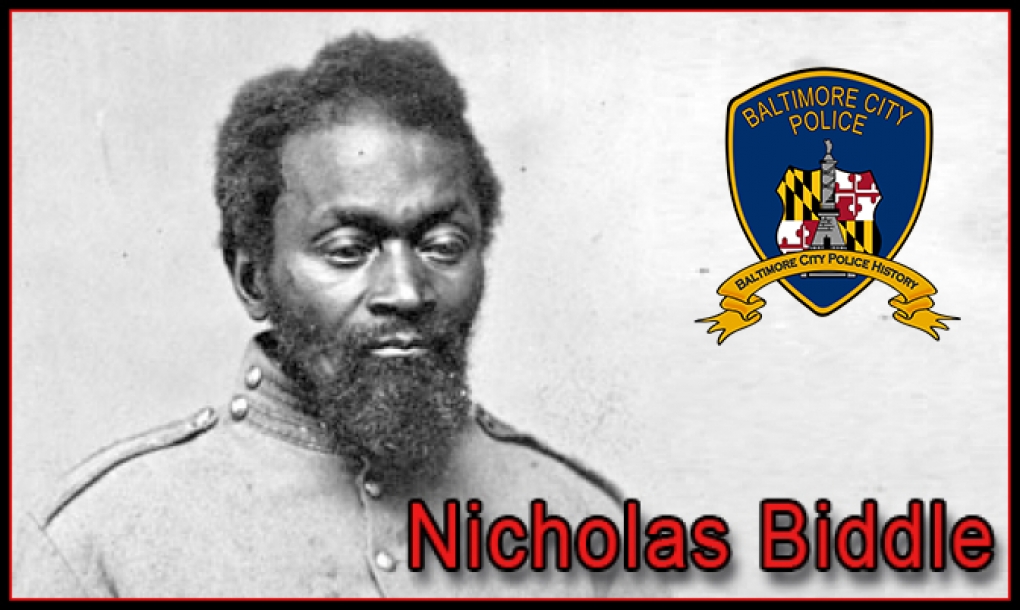
The first man to shed blood during the Civil war was an escaped slave by the name of Nicholas Biddle from Pottsville, PA. Due to his having escaped a life of slavery very little is known of Mr. Biddle's life.  From what we have learned he was born to slave parents in Delaware circa 1796. At some point, he escaped slavery and settled in Pennsylvania. It was common practice for escaped slaves to change their names to avoid capture, two stories told of Nicholas Biddle.

According to one historian's findings; Biddle escaped to Philadelphia and got a job as a servant for Nicholas Biddle, the wealthy financier, and president of the Second Bank of the United States. In this story, the former slave and the financier traveled to Pottsville for a dinner meeting of entrepreneurs and industrialists at nearby Mount Carbon to celebrate the first successful operation of an anthracite-fueled blast furnace in America. The servant remained in Pottsville to live. Another account is that Biddle relocated from Delaware directly to Pottsville and became a servant at the hotel where the aforementioned celebratory dinner was held, at which he met the famous Biddle. 

In any event, we know that he adopted the name of the prominent Philadelphian, and by 1840 Nicholas Biddle was residing in Pottsville. He worked odd jobs to earn a living, including street vending, selling oysters in the winter and ice cream in the summer. The 1860 U.S. census lists his occupation as "porter." 

Biddle befriended members of a local militia company, the Washington Artillerists, and attended their drills and excursions for the next 20 years. The company members were fond of Biddle and treated him as one of their own, and although African Americans were not permitted to serve in the militia, they gave him a uniform to wear.

At the outbreak of the Civil War and the fall of Fort Sumter on April 15, 1861, President Lincoln issued a call for 75,000 volunteers to serve for three months to suppress the insurrection in the South.  Unlike other antebellum militia units, the Washington Artillery had maintained a state of readiness and was among the first companies to respond to Lincoln's call to arms.

Two days later, the Washington Artillerists departed Pottsville by train to enter the war, along with 65-year-old Nicholas Biddle, who served as an aide to the company's commanding officer, Captain James Wren.

On April 18, five companies, numbering some 475 men, were sworn in at Harrisburg and mustered into the service of the United States. That is, all except for Nicholas Biddle, who as an African American was prohibited from serving in the U.S. Army.

The soldiers left on an emergency order to defend Washington, DC against a rumored Confederate attack. But in 1861, there was no continuous passenger rail service through Baltimore, and when the soldiers detained in the largest city in the slave state of Maryland, they encountered a hostile mob of pro-Southern sympathizers.

As the companies marched to meet their trains, members of the mob taunted the soldiers and hurled bricks and stones. Biddle, a black man in uniform, was an easy target. Someone threw a brick, striking Biddle in his head and knocking him to the ground. This made Nicholas Biddle the first casualty caused by hostile action in the Civil War.

The wound was grave enough that it exposed his bone. It was reportedly the first and most serious injury suffered that day, and he bore the scar the rest of his life.

An anxious President Lincoln learned of the arrival of the five Pennsylvania companies and of their treacherous passage through the mob at Baltimore. The morning after they arrived in Washington, Lincoln personally thanked each member of the five companies and singled out the wounded for special recognition.

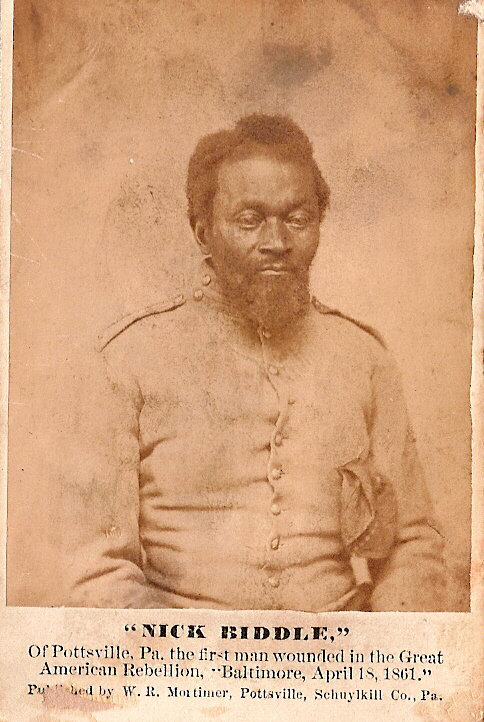
After his military service, Biddle returned to relative obscurity in Pottsville, where he eked out a living performing odd jobs.  In the summer of 1864, he appeared at the Great Central Fair in Philadelphia, where photographs of him in a Washington Artillerists uniform, captioned "the first man wounded in the Great American Rebellion," were sold to raise funds for the relief of Union soldiers. In the end, however, Biddle was forced to solicit alms to make ends meet. He died destitute in 1876 without even enough money to cover his burial expenses. Surviving members of the Washington Artillerists and the National Light Infantry each donated a dollar to purchase a simple headstone for him, and they had it inscribed: "In Memory of Nicholas Biddle, Died Aug.2, 1876, Aged 80 years.  His was the Proud Distinction of Shedding the First Blood in the Late War for the Union, Being Wounded while marching through Baltimore with the First Volunteers from Schuylkill County, 18 April 1861. Erected by his Friends in Pottsville."

Throughout the remainder of his life, Biddle retained unpleasant memories of his perilous journey with the Washington Artillerists through Baltimore. Although it garnered him the "proud distinction of shedding the first blood," he was often heard to remark "that he would go through the infernal regions with the artillery, but would never again go through Baltimore."

1 black devider 800 8 72

 Nick Biddle

This card/photo served as a remarkable testament to the bravery and sacrifice of Nick Biddle, who was recognized as the first man wounded during the significant event that came to  be known as the Great American Rebellion. By proudly wearing his uniform and attending various fairs and events, Biddle aimed to commemorate his role in history and inspire others with his story. The fact that this card/photo was printed by W.R. Mortimer of Pottsville, Schuylkill Co., Pa., adds an intriguing detail about the local history.1 black devider 800 8 72

Nick BiddleClick the above article, or HERE to see full article

The violence erupted when a mob of southern sympathizers attacked a group of Union soldiers passing through the city on their way to Washington, DC. The tragic events that took place on Howard Street on the 18th and Pratt Street on the 19th, leading to death and serious injury, marked a turning point in the nation's history, highlighting the deep divisions in our country, and serving as a grim precursor to the widespread violence and bloodshed that would soon engulf the entire country into a Civil War. 

1 black devider 800 8 72

Nicholas Biddle and the First Defenders
By Ronald S. Coddington

18 April, 2011


On the afternoon of April 18, 1861, Nick Biddle was quietly helping his unit, the Washington Artillery from Pottsville, Pa., set up camp inside the north wing of the Capitol building. The day before, he was almost killed.

Biddle was a black servant to Capt. James Wren, who oversaw the company of about 100 men. On April 18 the Washington Artillery had been one of several Army outfits, totaling about 475 men, heading through Baltimore en route to Washington, D.C., in response to President Lincoln’s call for 75,000 troops to put down the Southern rebellion.

Collection of Thomas Harris Nicholas “Nick” Biddle by William R. Mortimer of Pottsville, Pa., circa 1861 - Thousands of pro-Confederate Baltimoreans turned out to meet them at the city’s northern train station. (Another group, 45 regular Army soldiers from the Fourth Artillery en route from St. Paul, Minn., to Fort McHenry, also disembarked.) The crowd expressed disappointment in the non-military look of some of the volunteers, who hailed from eastern Pennsylvania coal-mining country. They “were not more than half uniformed and armed, and presented some as hard-looking specimens of humanity as could be found anywhere,” reported the Baltimore Sun. Most of the men carried their own revolvers, while a few toted antiquated flintlocks. A select group carried state-issued modern muskets but had no gunpowder for them.

Captain Wren, Biddle and the others were aware of Baltimore’s pro-secession sentiment and expected trouble. One volunteer reportedly asked Biddle if he was afraid to face rowdy “plug-uglies” and jokingly warned, “They may catch you and sell you down in Georgia.” Biddle replied in dead earnest that he was going to Washington trusting in the Lord and that he wouldn’t be scared away by the devil himself — or a bunch of thugs.

The Pennsylvanians formed a line and prepared to march through Baltimore to another station, where they could catch a Washington-bound train. The regulars would lead the way. The line started and moved rapidly, shielded from the abusive mobs by policemen stretched 10 paces apart. A private recalled the “Roughs and toughs, ‘longshoremen, gamblers, floaters, idlers, red-hot secessionists, as well as men ordinarily sober and steady, crowded upon, pushed and hustled the little band and made every effort to break the thin line.”

The mob derided the volunteers and cheered for Jefferson Davis and the Confederacy. Some aimed their abuse at Biddle. Capt. Wren remembered, “The crowd raised the cry, ‘Nigger in uniform!’ and poor old Nick had to take it.”

Around the halfway point of the journey, the regular troops split off and marched to Fort McHenry, leaving the Pennsylvanians alone. “At this juncture the mob was excited to a perfect frenzy, breaking the line of the police and pushing through the files of men, in an attempt to break the column,” wrote one historian. The boldest in the crowd spit, kicked, punched and grabbed at the coattails of the volunteers.

As the Pennsylvanians neared the station, rioters chucked cobblestones and jagged pieces of broken brick. The bombardment intensified as the volunteers arrived at the station and began to board the cars. Suddenly a chunk of brick struck Biddle in the head and left a deep, profusely bleeding cut. He managed to get on the train as the mob climbed on top of the cars and jumped up and down on the roofs. Biddle found a comfortable spot, wrapped his head in a handkerchief, and then pulled his fatigue cap close over the wound.

When the Pennsylvanians finally arrived in Washington that evening, they received a very different reception, as enthusiastic crowds welcomed them as saviors. They occupied temporary barracks in the north wing of the Capitol. One officer remembered that, when Biddle entered the rotunda of the building, “He looked up and around as if he felt that he had reached a place of safety, and then took his cap and the bloody handkerchief from his head and carried them in his hand. The blood dropped as he passed through the rotunda on the stone pavement.”

From Heber S. Thompson’s The First Defenders, scanned by openlibrary.org Front and back of a commemorative medal approved by an act of the Pennsylvania legislature in 1891 and issued to surviving members of the First Defenders.

A grateful President Lincoln later greeted the Pennsylvanians. He reportedly shook hands with Biddle and encouraged him to seek medical attention. But Biddle refused. He preferred to remain with the company. At the time some considered Biddle’s blood the first shed in hostility during the Civil War.

The House of Representatives later passed a resolution thanking the Pennsylvanians for their role in defense of the capital. The volunteers came to be known as the “First Defenders” in honor of their early response to Lincoln’s call to arms.


Sources: The Baltimore Sun, April 19, 1861; James M. Guthrie, “Camp-Fires of the Afro-American”; Samuel P. Bates, “History of Pennsylvania Volunteers, 1861-5,” Vol. 1; Heber S. Thompson, “The First Defenders”; Weekly Press (Philadelphia, Pa.), March 24 and July 21, 1886; John D. Hoptak, “A Forgotten Hero of the Civil War,” Pennsylvania Heritage, Spring 2010; W.W. Munsell & Co., “History of Schuylkill County, Pa.”; Lowell (Massachusetts) Daily Citizen and News, April 20, 1870; U.S. House of Representatives, Journal of the House of Representatives of the United States; Weekly Miners’ Journal (Pottsville, Pa.), Aug. 11, 1876; Herrwood E. Hobbs, “Nicholas Biddle,” Historical Society of Schuykill County, 1961.


Ronald S. Coddington is the author of “Faces of the Civil War” and “Faces of the Confederacy.” His forthcoming book profiles the lives of men of color who participated in the Civil War. He writes “Faces of War,” a column in the Civil War News.

1 black devider 800 8 72

Nicholas Biddle: The Civil War’s First Blood

Just days after Fort Sumter, a pro-Confederate mob in Maryland turned ex-slave Nicholas Biddle into the war's first casualty.

By JOHN D. HOPTAK
 

“N—— in Uniform! N—— in Uniform!” screamed the agitated Baltimore crowd of Southern sympathizers. They had been angry enough when Pennsylvania militiamen had detrained at Bolton Street station and began marching down Eutaw Street toward Camden Station on April 18, 1861, but when they saw Nicholas Biddle, an African American in uniform who was treated as an equal by his white comrades, their blood lust only increased and their calls grew louder. “Poor Nick had to take it” as the mob closed in like “wild wolves,” Captain James Wren, Biddle’s commander, later recorded.

Biddle soon became the target of more than just oaths, as salvos of bricks pried loose from the streets began to fly through the air. One struck Biddle in the head, knocking him to the ground and leaving a wound that reportedly exposed bone.

Many Pennsylvanians present that day believed Biddle was the first person to die in the Civil War at the hands of an enemy combatant. Regardless of who shed first blood in what would be the bloodiest of all America’s wars, it seems strange that Biddle remains an overlooked and almost entirely forgotten figure in the Civil War’s rich history.

At the time, however, Biddle received the attention of Abraham Lincoln as the president visited the militiamen being billeted at the U.S. Capitol on April 19. Lincoln wanted to thank the men who had arrived to defend Washington only four days after he called for 75,000 volunteers to quell the rebellion that began with the attack on Fort Sumter on April 12.

The president learned the Pennsylvanians had been attacked while traveling through Baltimore en route to the capital. Private Ignatz Gresser, a native of Germany, suffered from a painful ankle wound, and Private David Jacobs had a fractured left wrist and a few broken teeth. But it was the frail 65-year-old Biddle, wearing the uniform of the Washington Artillery, his head wrapped in blood-soaked bandages, who especially caught Lincoln’s attention. Biddle refused the president’s advice to seek medical attention, insisting that he preferred to remain with his company.

The Pennsylvanians were the first of the volunteers to arrive in the District of Columbia and would thus go down in history as the “First Defenders.” Their Baltimore injuries occurred as the men arrived for the final leg of their journey from Pennsylvania to Washington. The entire Baltimore police force had been summoned to escort the volunteers through the streets, but even the police had a difficult time controlling the raucous crowd of 2,000, which jeered the anxious militiamen while hurrahing for Jefferson Davis and the Southern Confederacy.

As the volunteers arrived at Camden Station, they were pelted with stones, bricks, bottles, and whatever else the local mob could reach; some were even clubbed or knocked down by a few well-landed punches. A few bolder Confederate sympathizers lunged at the unarmed Pennsylvanians with knives and drawn pistols. First Defender Heber Thompson wrote that one man was caught dumping gunpowder on the floor of one of the train cars “in the hope that a soldier carelessly striking a match in the darkened interior... might blow himself and his comrades to perdition.” For the idealistic volunteers from Pottsville, Allentown, Reading, and Lewistown, the ordeal quickly erased any romanticized notions of soldiering they might have had.

BIDDLE’S INJURIES WERE THE MOST SERIOUS, an irony considering he wasn’t technically a soldier since the federal government would not muster him in because of his race. Biddle, however, had willingly marched off to war as the orderly of Captain Wren, the Washington Artillery’s commanding officer. He had been a part of the company since its founding in 1840, and because the other members of the unit regarded him so highly, they gave him a uniform.

Little is known about Biddle’s life, except that he was born a slave in Delaware about 1796 and later escaped. But exactly when he slipped the chains of human bondage is not known. Nor is it known where Biddle first settled in Pennsylvania. One account has him settling in Philadelphia, where he was possibly taken in by abolitionists. He reportedly soon found work as a servant in the lavish home of Nicholas Biddle, the wealthy financier and longtime president of the Second Bank of the United States, whose name the escaped slave adopted as his own.

According to this account, Biddle, along with his servant, traveled to the Schuylkill County seat of Pottsville in January 1840 for a celebratory dinner at the Mountain House hotel in the nearby village of Mount Carbon. Along with 80 industrialists and capitalists, they celebrated the success of William Lyman’s Pottsville Furnace, the first in the United States to smelt iron by an anthracite-fired blast furnace continuously for 100 days. For whatever reason, the servant Biddle remained behind in Pottsville when his employer returned to Philadelphia.

Another story, perhaps more plausible, has the escaped slave settling in Pottsville itself and becoming a servant at the Mountain House hotel, where he was employed during the January 1840 dinner. If this is true, then, as Schuylkill County historian Herrwood Hobbs wrote, “something of financier Biddle rubbed off on him,” and he adopted the capitalist’s name.

Whatever the truth, by 1840, Biddle had made Pottsville his home, taking up residence in a modest dwelling on Minersville Street. He took an active interest in the city’s two militia companies, the National Light Infantry and the Washington Artillery, whose members he quickly befriended. When news of President Lincoln’s call to arms spread throughout the North in April 1861, both the National Light Infantry and the Washington Artillery were quick to tender their services. Departing Pottsville on April 17, 1861, they reached Harrisburg late that evening. The following morning, the two companies, along with the Ringgold Light Artillery from Reading, the Logan Guards from Lewistown, and the Allen Infantry of Allentown, boarded the North Central Railroad and began their journey to Washington via Baltimore. Before setting out from the Pennsylvania capital, the soldiers of the five companies took the oath of allegiance and were all sworn in as soldiers of the United States. All of them except Nicholas Biddle, of course.

The term of service for the initial 75,000 Northern volunteers—including those in the ranks of the First Defender companies—was for three months, and in late July 1861, the soldiers were mustered out. But most of the First Defenders were quick to reenlist, this time “for three years, or the course of the war.” Almost to a man, the National Light Infantry became Company A of the 96th Pennsylvania Infantry, while most members of the Washington Artillery reenlisted into the ranks of Company B, 48th Pennsylvania Infantry, with James Wren remaining as captain. Nick Biddle, however, did not accompany Wren when the 48th left Schuylkill County in September 1861. He remained in Pottsville, still nursing the painful head wound he had suffered in Baltimore.

Biddle spent the rest of his life in Pottsville, performing odd jobs, until he began to suffer from rheumatism. As he grew older and more infirm, he couldn’t perform any labor. Despite being a wounded veteran, he could not draw a Federal pension because he had never mustered in. Impoverished in his final years, he walked the streets of Pottsville seeking charity.

Pottsville’s leading newspaper, The Miners’ Journal, appealed to the community for help.

“If poor old Nick Biddle calls on you with a document, as he calls it, don’t say you are in a hurry and turn him off, but ornament the paper with your signature and plant a good round sum opposite your name,” the paper implored. “Nick has been a good soldier and now that he is getting old and feeble, he deserves the support of our citizens.”

Nicholas Biddle died in his home on August 2, 1876, at the age of 80. Before he died, the proud figure claimed he had enough money saved up in the bank for a proper funeral and burial, but upon his death, it was discovered that there was not a penny to his name.

The surviving veterans of the Washington Artillery and the National Light Infantry once again answered the call. Agreeing to pay for the costs, they arranged Biddle’s funeral, which took place just two days after his death. A large crowd gathered in front of Biddle’s home and then, as a drum corps played, began the solemn procession up Minersville Street to the “colored burying ground” adjacent to the Bethel A.M.E. Church.

AFTER THE SERMON AT THE CEMETERY, a number of uniformed First Defenders carried the simple coffin to the burial site and laid Nicholas Biddle to rest. The surviving First Defenders contributed $1 each to pay for a tombstone, upon which was inscribed:

In Memory of Nicholas Biddle, who died on August 2, 1876, Aged 80 Years. His Was the Proud Distinction of Shedding the First Blood In the Late War For the Union, Being Wounded While Marching Through Baltimore With the First Volunteers From Schuylkill County 18 April 18, 1861. Erected By His Friends In Pottsville.

On April 18, 1951, the 90th anniversary of the First Defenders’ famed march through Baltimore, the people of Pottsville dedicated a bronze plaque for the Civil War Soldiers’ Monument in Garfield Square. “In Memory of the First Defenders And Nicholas Biddle, of Pottsville, First Man To Shed Blood In The Civil War. April 18, 1861,” it reads.

Since then, awareness of Biddle's contribution to the Civil War has almost completely vanished, and shamefully, vandals have destroyed his tombstone.

John D. Hoptak works as a ranger at Antietam National Battlefield. He is the author of First in Defense of the Union: The Civil War History of the First Defenders, and maintains a Web site on the 48th Pennsylvania at 48thpennsylvania.blogspot.com.

Click HERE for the original page

1 black devider 800 8 72

The Grave of Nick Biddle:
By Chaplain James M. Guthrie

The grave of Nick Biddle a Mecca should be 
To Pilgrims, who seek in this land of the free
The tombs of the lowly as well as the great
Who struggled for freedom in war of debate;
For there lies a brave man distinguished from all
In that his veins furnished the first blood to fall
In War for the Union, when traitors assailed
Its brave “First Defenders,” whose hearts never quailed.

The eighteenth of April, eighteen-sixty-one,
Was the day Nick Biddle his great honor won
In Baltimore City, where riot ran high,
He stood by our banner to do or to die;
And onward, responsive to liberty’s call
The capital city to reach ere its fall,
Brave Biddle, with others as true and as brave,
Marched through with wildest tempest, the Nation to save.

Their pathway is fearful, surrounded by foes,
Who strive in fierce Madness their course to oppose;
Who hurl threats and curses, defiant of law,
And think by such methods they might overawe
The gallant defenders, who, nevertheless,
Hold back their resentment as forward they press,
And conscious of noble endeavor, despise
The flashing of weapons and traitorous eyes

Behold now the crisis—the mob thirsts for blood:-
It strikes down Nick Biddle and opens the flood—
The torrents of crimson from hearts that are true—
That shall deepen and widen, shall cleanse and renew
The land of our fathers by slavery cursed;
The blood of Nick Biddle, yes, it is the first,
The spatter of blood-drops presaging the storm
That will rage and destroy till Nation reform.

How strange, too, it seems, that the Capitol floor,
Where slaveholders sat in the Congress of yore,
And forged for his kindred chains heavy to bear
To bind down the black man in endless despair,
Should be stained with his blood and thus sanctified;
Made sacred to freedom; through time to abide
A temple of justice, with every right
For all the nation, black, redman, and white

The grave of Nick Biddle, though humble it be,
Is nobler by far in the sight of the free
Than tombs of those chieftains, whose sinful crusade
Brought long years of mourning and countless graves made
In striving to fetter their black fellowmen,
And make of the Southland a vast prison pen;
Their cause was unholy but Biddle’s was just,
And hosts of pure spirits watch over his dust.

Click HERE for the original page


Devider color with motto

Please contact Det. Ret. Kenny Driscoll if you have any pictures of you or your family members and wish them remembered here on this tribute site to Honor the fine men and women who have served with Honor and Distinction at the Baltimore Police Department.

Anyone with information, photographs, memorabilia, or other "Baltimore City Police" items can contact Ret. Det. Kenny Driscoll at  This email address is being protected from spambots. You need JavaScript enabled to view it. follow us on Twitter @BaltoPoliceHist or like us on Facebook or mail pics to 8138 Dundalk Ave. Baltimore Md. 21222


Copyright © 2002 Baltimore City Police History - Ret Det Kenny Driscoll

Al Capone

Al Capone

Baltimore City Police Vice Squad

Baltimore Finest CartoonCourtesy Officer Mel Howell

LAWSON PLANS SPECIAL SQUAD TO BATTLE VICE
Newspaper reports of the Times; 5 July, 1938

Lawson will name his new group this week to attack prostitution and gambling

20 members of the force face medical tests on fitness for duty

A special cleanup squad of police whose sole duty will be to ferret out vice and gambling in all forms will be appointed this week by police Commissioner William P. Lawson.

The Commissioner announced this yesterday [4 July, 1938] and at the same time disclosed that about 20 members of the department will appear shortly before medical examiners to determine their fitness to continue on duty.

The Commissioner statement came 24 hours after Jay. Bernard Wells, the state attorney, made public a report showing that vice is widespread in this city and which indicated a close association between vice activities and some members of the Police Department.

There was no definite evidence of police protection of vice obtained, however, by the investigators who compiled the report for the American social hygiene Association. Copies of the report, which was made for a citizen committee headed by Dr. J. M. T. Finney, Senior, were given to Commissioner Lawson and Mr. Wells on Friday.

Dr. Finney last night said he was delighted to hear that Commissioner Lawson had decided to set up a cleanup squad

“But the citizens committees are not reformers.” Dr. Finney said

“They are an interested group of citizens trying to cooperate with the police to make Baltimore a better place to live. We are not after anybody’s scalp. A report was made, and that report was submitted to the proper authorities.”

Commissioner Lawson declined to say how large the new cleanup squad would be or how it would be recruited. He explained that it would be under his direct supervision and that the personnel would include some of the most efficient men in the department. The squad, he added, would be on duty 24 hours a day.

Moreover, Commissioner Lawson insisted that the medical examinations should not be interrupted as part of a general shakeup in the department. Such examinations, he said, are held periodically. Any vacancies caused by those examinations must be filled, he added, and this may cause some changes in assignments.

Commissioner Lawson disclosed that he is carefully studying the report submitted by the Finney committee. Although the copy of the report released by Mr. Wells abbreviated names and locations, the copies given to Mr. Wells and Commissioner Lawson were accompanied by a key.

This key gave the full names of nightclub, tavern, grill and saloon proprietors investigated; the names of their employees; what the employees earn in salaries and commissions; what many waitresses earn by “sitting” and soliciting; the names of prostitutes, their ages, addresses, and other details about them, including places a visit; taxicab drivers names, numbers, and their interests in certain parts of the vice racket; perverts and where they practice; the names and addresses of hotels and apartments where prostitutes and perverts live or went for temporary quarters; and many other details.

Commissioner Lawson’s announcement was a surprise to the executive officers of the police department. It was said that no mention of the creation of such a squad was made by the commissioner when he held a conference yesterday morning with the inspectors and captains at police headquarters.

The move has been urged lately on several occasions by representatives of the criminal justice commission and others.

Devider

Arson Unit

Arson Unit

Where There's Fire - There's Investigation - If the cause of a fire is suspicious in nature there is much more to its end than the cooling of the embers. When the task of the fire-fighter has ended, that of the arson investigator begins. Technically, arson has several meanings in both common law and statutory language, but to the arson investigator it means the deliberate setting fire to one's own property or the property of another, for an unlawful purpose. There is no other crime for which such diversity of motives is found; fraud, vengeance, murder, robbery, spite, evidence destruction, and the excitement found in fire by the pyromaniac. It is also one of the least expensive crimes to commit. Spending twenty-six cents for a book of matches and a gallon of kerosene, the arsonist can start a fire destroying thousands of dollars worth of property, or even more tragic, taking a human life.

Eastern Initiative

Eastern Initiative

Eastern District Initiative The Special Commendation of Eastern District Initiative

Badges

Badges

Pink Ribbon – 1861 During a transition in the rebuilding of our police department, new uniforms and badges weren't yet designed. While waiting for said designations, the Baltimore Police dressed in plain clothes and were distinguished as police by a simple pink ribbon on their left lapel and an espantoon in their hands.

Officer of the Year

Officer of the Year

For the last three or four years, (written in 2016) Patty and I have been wanting to do an Officer of the Year program from the History site. Ideally, we would have liked to have at least one officer from each of the nine districts, but we could end up with nine or more officers all from the same district, nine or more officers from every district, or just one officer from the entire department. What we are saying is that there will not be a limitation on the number of officers that could be selected, and if we end up with what may seem like too many nominations and they all seem to be worthy, then we'll have multiple, "Officer of the Year" awards, and maybe one, "Outstanding Officer for that Year." if it seems one stands out. We would also like to include retired officers too, because we know there are plenty of retired officers that are still dedicated and still making a difference in our police family. If you want to nominate an officer, feel free to send us an email at the following address:  This email address is being protected from spambots. You need JavaScript enabled to view it.

Elizabeth Faber

Elizabeth Faber


Policewoman Elizabeth Faber

First Female Officer Shot in the Line of Duty

Today in Baltimore Police History 17 October 1914 Policewoman Elizabeth Faber was shot down on the west end of the Edmondson Avenue bridge by a black male on the bridge as she and her partner (Patrolman George W. Popp) attempted to effect his arrest. The suspect quickly turned and opened fire on the pair, little hope was entertained by doctors at Franklin Square Hospital for Officer Faber’s survival. At 4 A. M. her recovery chances seemed even less possible. She was shot by a pickpocket along with her partner Patrolman George W. Popp, of the Northwest police district. Officer Pop was also severely wounded he is at the hospital but his chances for recovery were listed as good. Mrs. Faber was shot through one of her lungs and Patrolman Popp has a wound in the side and another in the thigh. At midnight the deposition of the policewoman was taken by Justice Schirm and will be used in case of her death.- making her the first Woman Officer to be shot in the line of duty... She would nearly die as a result of her injuries, and by this time a year later in 1915, she would resign her post as a Baltimore Policewoman.

It should be noted, she was bad ass, one of the smallest of the women officers of her time, she was also one of the most active, often fighting men nearly twice her size. An interesting fact about policewomen of the time, while the first female officer hired was Mary S. Harvey, EOD of June 19, 1912, followed by Margaret B. Eagleston July 22, 1912, they were hired two years before this shooting, at a time when female officers were not trained and did not carry firearms. It would be more than 10 years later in 1925 that female officers would finally be trained and provided with a firearm - 28 March 1925 to be exact. Two female members of the department were given their first lesson in pistol shooting. The newspaper wrote, "Baltimore policewomen yesterday received their first lesson in the use of firearms. Lieut. James O. Downes, expert marksman and instructor of the Baltimore Police Department's Pistol Team, explained the use of pistols to the two policewomen. Mrs. Mary J. Bruff and Miss Margaret B. Eagleston as they were the students who appeared at the Central police station yesterday for this training. Several minutes later the basement of the building resounded with sharp reports (sounds of gunfire) as efforts were made to pierce the "Bulls-eye". The target was 6 feet in distance from the policewomen. Other policewomen would receive their first lessons next week. The distance of the target will be increased as Lieut. Downes plans to make each of five into "Expert Shots". With the exception of Mrs. Mary Harvey, none of the policewomen were familiar with firearms. The others were Miss Eva Aldridge and Ms. Mildred Campbell. But this was not so strange, when Mrs. Whyte came on in 1937, making her the first ever black officer to be hired by the Baltimore Police Department, not only didn’t Mrs. Whyte never wear a uniform but she also never carried a gun.


1 black devider 800 8 72

POLICE INFORMATION

Copies of: Your Baltimore Police Department Class Photo, Pictures of our Officers, Vehicles, Equipment, Newspaper Articles relating to our department and or officers, Old Departmental Newsletters, Lookouts, Wanted Posters, and or Brochures. Information on Deceased Officers and anything that may help Preserve the History and Proud Traditions of this agency. Please contact Retired Detective Kenny Driscoll.

This email address is being protected from spambots. You need JavaScript enabled to view it.

Devider color with motto

NOTICE

How to Dispose of Old Police Items

Please contact Det. Ret. Kenny Driscoll if you have any pictures of you or your family members and wish them remembered here on this tribute site to Honor the fine men and women who have served with Honor and Distinction at the Baltimore Police Department.

Anyone with information, photographs, memorabilia, or other "Baltimore City Police" items can contact Ret. Det. Kenny Driscoll at This email address is being protected from spambots. You need JavaScript enabled to view it. follow us on Twitter @BaltoPoliceHist or like us on Facebook or mail pics to 8138 Dundalk Ave. Baltimore Md. 21222


Copyright © 2002 Baltimore City Police History - Ret Det Kenny Driscoll 
Parking Meters

Parking Meters

A Meter Maid unit began on 8 May of 1961 with 10 Meter Maids and a Sergeant. Prior to that on 1 November 1955, The Baltimore Police department Traffic Enforcement unit enforced parking meter violations. The first Meters went up on North Ave. after 48 days the meters had made a profit of a little more than $29K. $29K in 1955 would be around $275,000.00 in 2019

Patrol Wagons

Patrol Wagons

Patrol Wagon History

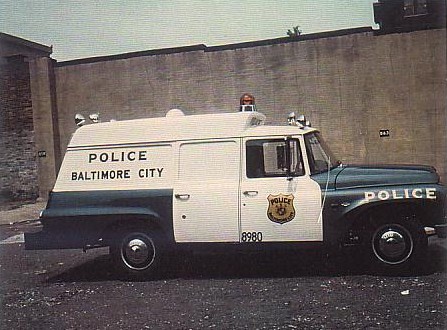
The Patrol Wagon first came to Baltimore in 1885 as part of a package deal put together by then Deputy Marshal Jacob Frey after the Deputy Marshal first saw a Patrol Wagon in use by the Chicago Police Department in a copy of an illustrated newspaper most likely Harper’s Weekly. The other item found in this package deal was the Call Box. For more information please take a look at the Call Box page and the Recall Light page, both on this website. at the following links. Click on either Call Box or Recall Light to visit either of these pages, and look for other links found within these two pages. We also found the history of the term Black Maria and several therories on the term Paddy Wagon they can be found Here

wagons 1

Wagons in a Pinch

29  June 1949

BY THE FIRST-HAND TESTIMONIAL, Baltimore’s new police wagons are vehicles in which their passengers are proud to ride. They are roomier, more fordable, faster, of smarter design and, in dozens of other ways, a world of improvement over the department's former free transportation fleet. The enthusiasm of the passengers is appreciated, but not unexpected Lieut. Leroy Kues, director of the department garage, had the patrons' comfort high in mind when he designed the new model. The new wagons are in service now at most of the department's eight district station houses. By October they will have replaced all of the old vehicles, most of which have been in continuous service since the 1930's.

wagons 4

MECHANICALLY speaking the new wagon Is a streamlined, all-steel detention compartment of "teardrop" design mounted on the light. low chassis of a six-cylinder truck. The new chassis provides a "floating ride," police say, in welcome contrast to the old wagon, "which rides like a stone truck." The new compartment. constructed and mounted by the same Baltimore carriage firm that made the old wagons, is sold as I did that it can be lifted from a worn out chassis and mounted on the new one. Its service expectancy is roughly that of four or five chassis or about 20 years. The most apparent improvement or those that have been made out of consideration for the passengers. The facing bench seats or panel made out of oak that goes between the detention compartment and are considerably larger than the old vehicle. There’s more room for them. They could seat up to a dozen passengers comfortably.

IN A PINCH the old wagons accommodated a dozen passengers. But they had to sit six to a side with their knees interlocking in the narrow aisle between them.

This made for an uncomfortable ride at best. That is even if the passengers were no more than casual acquaintances. When the passenger list included participants from both sides of the street brawl, the cramped quarters presented a situation that age two men before their time. The late models for a mere interior also provide a new convenience for the in disposable Saturday night passenger traffic. It accommodates for persons at full length. Lights in a detention compartment of the new wagon are sunken into the marine plywood paneling. In the old model, they were protruded from the ceiling and many a customer has complained about bumping his head against them. Other popular innovations of the new model or its loading platform and entrance. These are wider, lower an illuminated by the tail light. It was impossible for the passengers to enter the old wagon with any degree of grace and dignity. Particularly if the passenger was a lady. Negotiation of the 228 in steps could be affected and only by the use of both hands, considerable exertion and the help of a policeman. On some of the tavern rates, it took two policemen. But the new wagon has in 18 ends. Then a 14 and step which can be mounted easily and casually without assistance. The riding qualities of the whole vehicle had been improved by double action shock absorbers

STRUCTURAL changes have also been made for a more contented police force. The new wagon Carries this or and under the hood. Away from the weather, the old wheezers were mounted on the outside and would not sound off at full power after a hard rain. The wagon had to pull up to emergency trailing a thin pitiful wail that added an error of frustration to the whole arrest.

FURTHERMORE the siren tone that emanates from the hood of the new wagon is a sharp, shrill cry of authority that doesn’t whimper for, but demands, the right of way. An improvement in the design of the foot men’s handrail at the rear of the new vehicle had safety and convenience to the man on duty there. On a cold type wagon, the handrails rammed the full perpendicular height of the rear. Protesting, passengers sometimes grasped the rail, lifted themselves up and lashed out with their heels at the policeman behind them. A man once Lawson high that way. Several others lost teeth, a nephew suffered broken noses. On the new wagon, the rails are shorter to prevent this sort of thing. 

THE NEW MODEL has a built-in buzzer system from the foot men’s position to the chauffeur. For nearly an hour these men shouted instruction to each other. The signal system is expected to result in more efficient starts and stops and add to the general comfort of the passenger by eliminating a lot of police department shoptalk and from them. Improvements to the chauffeurs can give the new model about 25% more flour and seat space and then the old. In the crowd model that is being retired, even policemen of average build had to squeeze themselves and carefully to get behind in the steering wheel. But sergeants can drive the new vehicle.

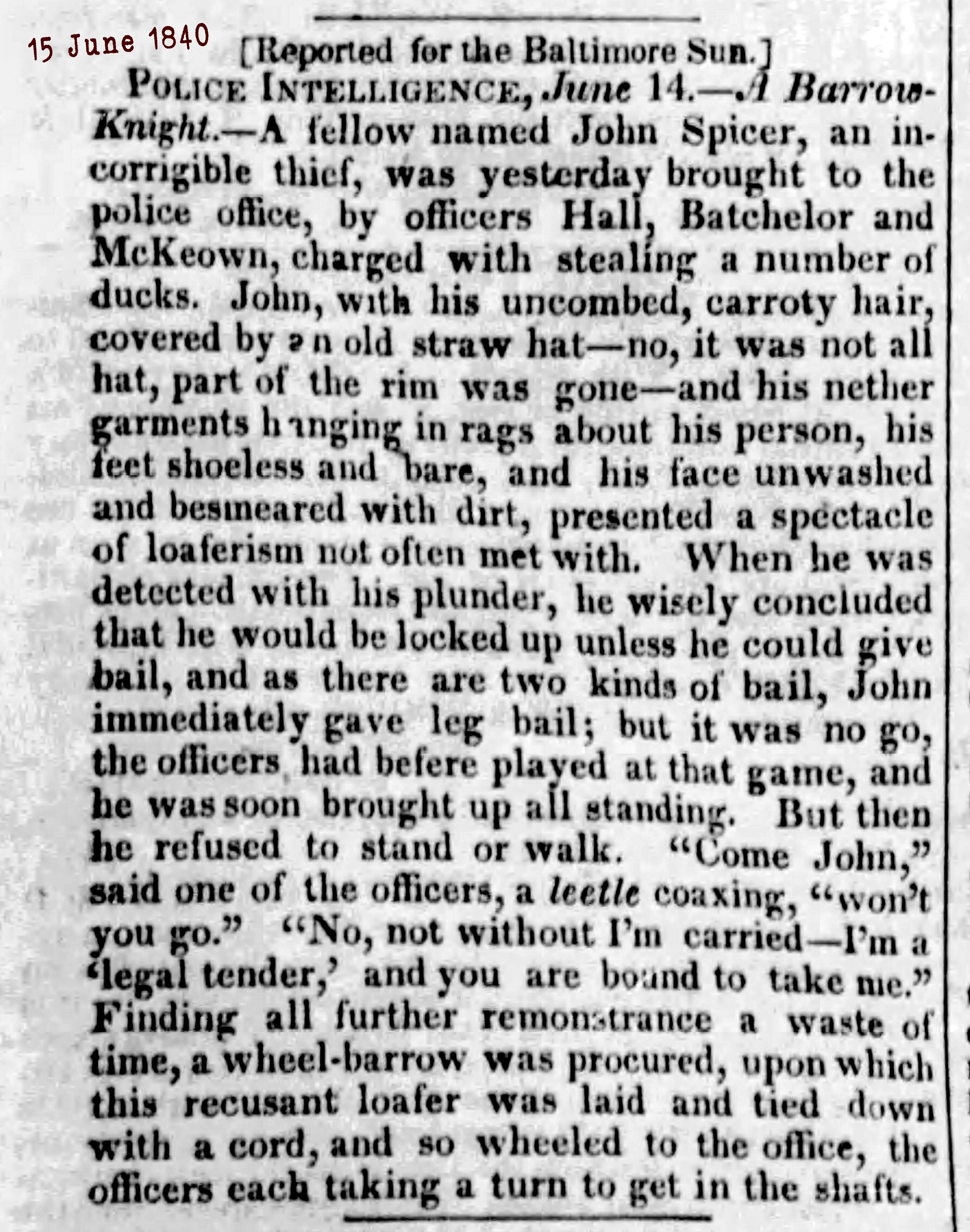
THE SQUARE SET WINDSHIELD and clapping side curtain of the old model wagon held the chauffeur’s visibility to a minimum, even in clear weather. The new vehicle has conventional wide truck windows in the cab and a clean windshield with about 20° pitch. The spare tire that once rode the front left fender and prevented the show for prince wing and his door wide open is now carried in a compartment beneath the rear quarter the driver’s door is also wider so that he no longer has to back out of his cab to help with an arrest. Construction of the new type wagon is the fourth major improvement made in the Police Department's free-transportation system. During the first years of the department,  patrolmen would have their "customers" walk in to see the desk lieutenant. Indisposed ones were trundled by wheelbarrow.

wagons 2

LATER HORSE·DRAWN WAGONS (18 October 1885) were put into service. That was a high-wheeled, open-air delivery-type wagon equipped with a driver, a span of good horses and two nimble footmen to bring back those customers who vaulted over the side and made a break for freedom. Shackles final1y were added to the wagon, for the more difficult passengers. At the turn of the century, when Central district headquarters was on North Street (now Guilford Avenue), an electric runabout supplemented the horse-drawn vehicles and a few wheelbarrows. The horses and barrows made runs while the electric runabout was out of service-it had to plug in at the Station-house and recharge for an hour after each trip. The first motorized vehicles used on a large scale by the department- they were introduced a few years before the First World War - were of about the same design as those now being retired.

THERE ARE POLICE IN BALTIMORE who claim that the retiring wagons operated on ten percent gasoline, 30 percent memory and 60 percent sense of duty. That isn't entirely true but the claim is understandable. All of the old wagons had exhausted their sets of valves and cylinders until the police mechanics lost count.    

The wagon in the Southwestern district, the one some of the policemen called Eleanor, had 293.900 miles to her credit. Her crankshaft became grooved so deeply that the department mechanics had to turn the whole shaft down to 90/l000ths of an inch undersize. That cut down her limping to a great extent, but she continued to suffer from an asthmatic condition until she died at the scrap-yard. The demise of Bronchial Bill and Old Hopeful at other stations followed similar illnesses.

ALREADY THE WAGON set is referring to the new vehicle as Black Maria. That is a title all police vehicles fall heir to, but now the title has a note of respect. One of the first passengers asked the footman if the ride in the new machine would cost him extra when he faced the magistrate. When Southwestern’s new wagon made its first run to the House of Correction. Several inmates who had been taken there just a week earlier were resentful because they had been hauled in "the old stone-wagon." But there's little call for quibbling now. The new wagon will be here for the next twenty years, and the police say there will be a chance for everybody.


1 black devider 800 8 72

Paddy Wagons

First Horse sold to the department for use on our first Patrol Wagon/Ambulance
Article Printed on 25 January 1918

Paddy Wagons

To See the Full Size Article Click HERE
Paddy Wagons

Photo Courtesy Det Kenny Driscoll
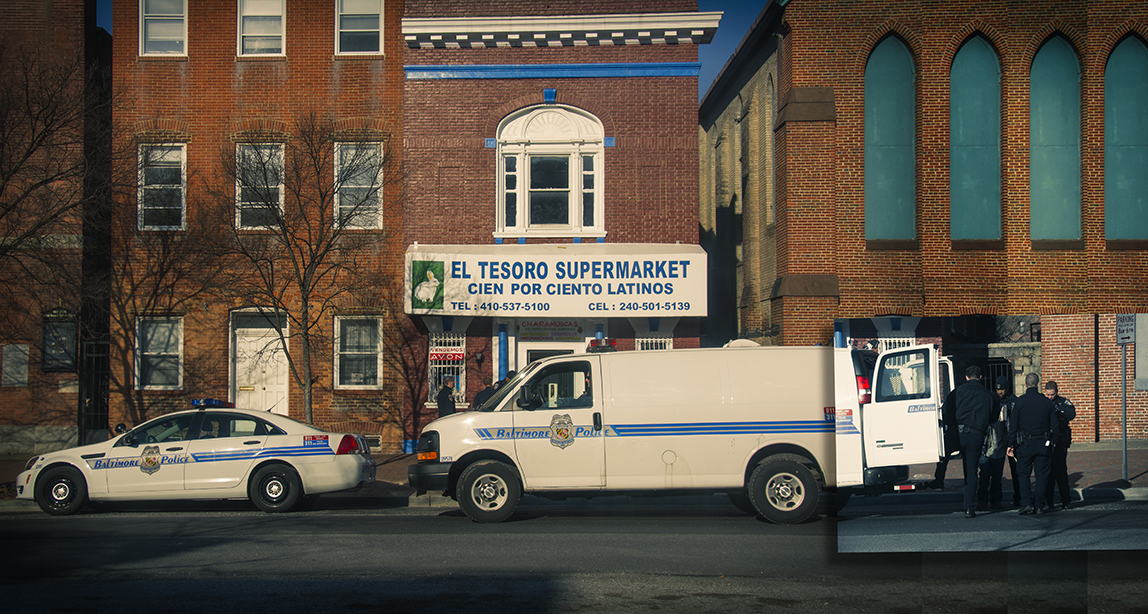
Shot on Broadway, obviously, two pictures put together for a unique look

Brian Kuebler wrote BALTIMORE - Citing efficiency and safety, the Baltimore Police Department is making yet another visible change in its division by eventually decreasing the use of prisoner transport vans. This information comes as a surprise to many of the members of Baltimore’s division, as they fear the safety issues are not at the root of this change. Having worked myself, I happen to know if ever there was a concern for officer safety it is not while the prisoner is in a wagon behind, or in front of an officer's vehicle, so much as it is with the prisoner in the vehicle a little less than 2-ft behind the officer. There are instances of prisoners vomiting, urinating, and or defecating on themselves in the vehicle, or having concealed weapons that could be used to stab, or shoot the officer from behind. So this could be, and most likely is more than an officer safety issue, and is most likely an issue of budget. Either way, safety or budget, it is not about, nor will it affect (in a positive light) officer morale. He went to say The cage equipped vans, or wagons as they are commonly referred, are used to transport suspects from the scene of a crime or an arrest. Often Baltimore Police would process and handcuff suspects before calling and waiting for a transport vehicle. They are more commonly known as “Paddy Wagons” by the public, a derogatory term aimed at the Irish dating back to the 1800s in New York. While there is some truth to this, in that is was aimed at the police most of whom were Irish, and from the time period of the 1800's, but the location is off, it was Boston, not New York, and at the time we pretty much all used "Horse Drawn Wagons", hence the term "Wagon" of course the police at the times were mostly Irish, so yes, it was a "Paddy Wagon". When I was on in the late 80's to early 2000, we still called it a "Wagon", we used a box truck type wagon, much like an ambo, and we called it Wagon, short for "Paddy Wagon" also as an Irishman, I don't think it is derogatory, in fact as a retired Officer, of Irish descent, I am proud to have come from a background of Strong Irish Law enforcement officers, known for fighting crime. The article continued with - But that is not why modern-day Baltimore Police are doing away with their frequent use. In Brian's investigation into this story he learned from Lt. Eric Kowalczyk the cars, will all become PTV's (Prisoner Transport Vehicles) something we used to call "Cage Cars" talk about derogatory, it was called this because the first cage cars, were made up simply by putting a thin cage between the officer's and their prisoners. Often spit would fly between the cage, and toward the officers, so the cage was replaced with Plexiglas to prevent anything, spit, blood or other bodily fluids from being thrown at, or on the police. So when Lt. Kowalczyk said, “In our new vehicles we have made a number of changes and upgrades regarding equipment and tools that will assist our officers in the crime fight. One of those changes will be partitions in the vehicles.  These partitions will assist in ensuring the safety of those involved in the arrest, as well in expediting the event itself. They will still allow for complete mobility within the vehicle,”  We learn this is more about economics than safety, this is nothing new, it is more of the same old "Cage Car" prisoner transport of the late 80's early 90's - Which is confirmed with the final line - Prisoner transport instead will be done more with individual cars.

New car Black

From here they went on to say the following which talks about the vehicle's paint scheme - and for this, they, write - ABC 2-News was the first to reveal the new design Baltimore Police squad cars. Starting with about 30 vehicles in the most recent procurement process, Baltimore will be switching to black colored Chevrolet Caprices with a blue logo. Baltimore is not new to the black car, it hasn't been black for a while, but black is not new to BPD; in the 20's we had black cars, in the 30's, the 40's the 50's, 60's and then sometime in the mid 60's we moved away from black cars, along came the some blue and whites; that carried into the 70's before we went to the white car, the white car swapped stripe patterns a few times. In the early 90's we used a powder blue ford, it didn't last long before we would go back to the white, with a much nicer decal design, and the modern badge on the door in place of the shoulder patch, or police logo. The Commissioner (Anthony Batts) said the officers themselves chose the design, and it was done to boost morale, in the quote he said, "When they are in those cars, that is their office for eight to ten hours a day, that is their office so what I did is I allowed them to design what they wanted out of their police cars" The article went on as follows pointing out things that most followers of the department have said, and BTW liked about the new design, The logo is modeled after the one seen on the department’s choppers and mobile command units. But the change isn’t in just the look of the vehicles. The cages will be installed in the squad cars so that the driver’s seat may be maneuvered for comfort, a simple feature some officers said was not available in all previous iterations of Baltimore Police cars. "We had already prepared to bring in about 165 cars. Some of those will be white because we didn't have time to change up the colors but we are looking to start to have all the cars go to the shape and style that the officers had asked for," the commissioner said. As the new squad cars take to the streets, the more prisoner transport vehicles will come off. It is unclear if there is any timeline for the complete switchover, but the police department says ultimately the move will make policing more efficient and eliminate wait times when a wagon is called. “While wagons remain a vital part of our deployment these newer vehicles, and the resources they provide, are adding to the efficiency and safety of both officers and citizens,” Kowalczyk said. Copyright 2014 Scripps Media, Inc. All rights reserved. This material may not be published, broadcast, rewritten, or redistributed.

 wagon 2

Screen Shot 2013 09 15 at 8 25 54 PM

1st patrol wagon

Wagon CD

Wagon ED

1880wd

COURTESY SGT. ROBERT FISCHER 
1880'S HORSE DRAWN WAGON

1900s BPD wagon movie prop

Pictured above late 1800's-early 1900's Baltimore Police horse-drawn carriage 

sd 1910 wagon

COURTESY BALTIMORE POLICE DEPARTMENT

wagon

1890's Wagon Purchased for BPD Museum 

1920sPatrol Wagon2

Photo courtesy Sergeant Robert Fisher

1920s Wagon

 Photo Courtesy Sergeant Robert Fisher

1928 Studebaker Patrol Wagon 314 CD

Photo Courtesy Sergeant Robert Fisher 
 
1928 Studebaker Wagon #314 D
1920whitewagon
COURTESY SGT. ROBERT FISCHER 
1920'S WHITE WAGON
SIDE VIEW MIRROR AND AN AWNING GRACE THIS VINTAGE WAGON.
NOTE THE BATTLE MONUMENT INSIGNIA ON THE SIDE.
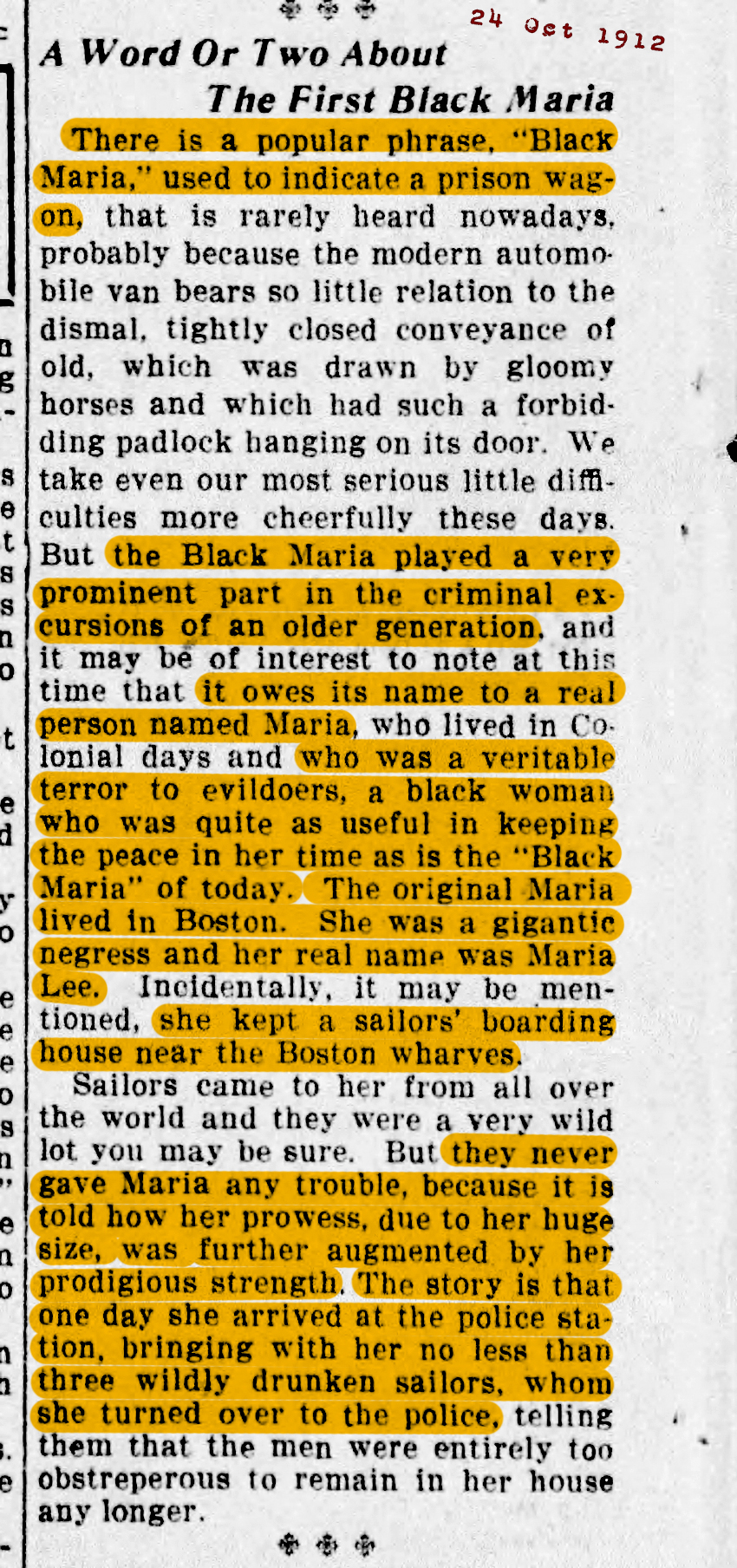
The Evening Sun Thu Oct 24 1912 72
Where the name "Black Maria" came from
Click HERE to see full size article
 
1920ndwagon
1920's POLICE WAGON
"Black Maria" 
Front
1920s ND Patrol Wagon3
 
1920's POLICE WAGON
"Black Maria" 
Back

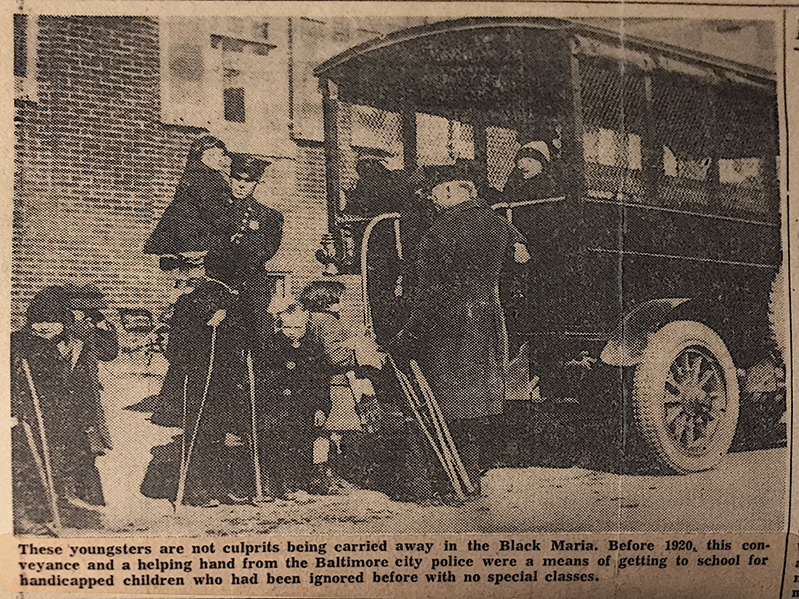
Black Maria 1st school bus 72

Black Maria Served as First School Bus
[Late teens 1900’s]

Black Maria - A Black Maria of the Police Department used to transport crippled children to school in Baltimore in the late teens years of this century. And the children loved it, despite the ominous name given the transportation. For most of them, it represented the only way they could get to school, hampered as they were with braces and crutches. Besides, most of them had never ridden in a motor driven vehicle before. The fact that there was any transportation at all for handicapped children at that period was largely the result of the stubborn determination of a young girl a Baltimore who has been described as “the spark and the flame,” of what is now the Baltimore league for crippled children and adults: Isabel Kann Frank.

Best Narrator - She, perhaps, better than anyone else can describe the slow evolution which went from provisions for handicapped children to the league’s 36th anniversary this year in the field. Mrs. Henry L Frank was the founder of the league and still spends every day at the league’s headquarters on Greenmount Avenue. The league, coincidentally, is conducting its Easter Seal drive for funds for its activities through April 14. Baltimore 50 years ago had no provisions for formal schooling for the more severely handicapped children who were destined to watch, from their windows, at the other children swinging their book straps on their way to school. “When I was a little girl on my way to Girls' Latin School, I used to pass the crippled children’s hospital at Charles and 20th streets. I would see the children at the windows, day after day. I used to wonder if anyone was teaching them to read and write. Dr. R. Turnstall Taylor directed the hospital, and one day after building up my courage, I walked into his office and asked him if there wasn’t something I could do to help the children. Dr. Taylor was amused, but he said I could come in after school and teach the children. “In those days the attitude of a great many people was, “Nobody can do anything for these children – it’s just an act of God.” Once they had bought braces and shoes, they had done their job. “I was only 13 then, but my interest in these children never flagged. When I was a little older I joined the guild for crippled children which was formed in 1889. Theirs was a pioneering effort in the face of public apathy. In 1913 there was still no convenience to carry the children to public schools and no special facilities or classes. But in that same year, when Mrs. Robert Laucheimer was chairman of the committee, we were told two classrooms were being made available for the children if we had a way to get them there! “Undaunted, the committee went straight to the Della Transfer Company on Race Street and hired a horse-drawn omnibus. What a day that was when the “Elsie” clattered over the cobblestones and the "clop-clop" of the white horses alerted the children on their first day at school!

Help Children - “The driver would stop each morning to help the children into the bus – some of them had to be carried, but all of them had to be helped with their crutches and their braces. After school, the bus would call for the children and deliver them happily and safely to their doors. “The first two schools to experiment with this program for the handicapped were General Henry Lee Elementary School at Hanover and Lee Streets and Sir Robert Eaton Elementary School at Preston and Eden Streets. The children not only had their lessons in the schoolroom, but they also had their soup and cocoa warmed on a hot plate. I remember replacing the odd, crippled assortment of cups, plates, and cutlery with shiny new equipment. “As thrilling is the omnibus arrangement was, the guild found its meager funds would not stretch to continue hiring transportation.

Cooperative Police - “And so, a cooperative Police Department came to the rescue with the Black Maria and the Motorcycles with Sidecars. That was another first to remember when the police officers, of Baltimore City with tenderness and devotion, carried the little ones back and forth. Of course, the children were wild with the delight at motor transportation and would triumphantly waive their crutches as they went by. “In 1921 I became chairman of the guild and proposed to the parent Council of Jewish Women that it merge with the guild’s efforts into a new professional organization to serve the crippled children throughout Maryland. From this proposal, the Maryland League for Crippled Children was organized in 1927. In 1952 it affiliated with the Easter Seals and became the Baltimore League for Crippled Children and Adults, Inc. “The project of organization became more and more exciting as we chalked up progress, slowly but surely. There were many fine professional people who worked untiringly, but I expected that I was the chief “pesterer” spending hours in the offices of prominent doctors and businessmen until I could tell them my story. I took about a year to finally complete the distinguished board of directors for the League. The honorary vice presidents were Judge William C. Coleman, Jacob Epstein, Frank A. Furst and Dr. William Welch. Dr. George E. Bennett organized the corps of young orthopedic doctors to volunteer time and provide their own travel expenses to man crippled children clinics throughout the State of Maryland. “After the League’s organization, the big goal was modern, specialized school buildings and staffs devoted to the instruction of the children.

Demand Action - “Dr. William S. Baer, Dr. Bennett, and other eminent medical authorities and civic groups demanded action. At long last in 1931, the Maryland Legislature passed an act enabling the creation of two modern schools for handicapped children in Baltimore. By 1933 the William S. Baer School was erected at Warwick Avenue, and the Francis Wood School for Negro children was completed at Franklin and Schroeder streets. “Among the names to be remembered for outstanding service through the organizational and build-up years of the League are those of Ellen Krause, first employee; Mary E. Church, first director of the League; and Miss Margaret Huffington, assistant director of the League, who came on duty the first day the league opened its doors in 1927. When the Doctor William S. Bear School opened its doors, a beautiful shiny motor bus delivered the children in style. My husband who stood there with me said, “you’re very excited, aren’t you?" and I said, “I’ve never been so excited in my life!” “How about the day you were married?”. He teased. “Oh well,” I said, “I expected to get married, but I never expected this dream to come true!” “Memories of those early days are a real pleasure, but the present has its satisfaction, too. When I see men and women who once rode to school in the wagon, the Black Maria, and other school buses, now educated and trained occupying useful positions in the community, the efforts of all those who helped seemed very worthwhile.” NOTE - Use of the word Crippled from the first line, "A Black Maria of the Police Department used to transport crippled children to school in Baltimore in the late teens years of this century" This was the way it was written in the 1919 newspaper article, and while some may be offended, let me explain and I should point out by definition I myself am a cripple, and, I take no shame in the word or its meaning which is as follows - crippled ˈkrip(ə)ld/ an adjective meaning (of a person) unable to walk or move properly; disabled. 

The Baltimore Sun Thu Jan 5 1956 72

More on the "Black Maria" paddy wagon
Click HERE to see full size article
 
1947 international wagon
COURTESY SGT. ROBERT FISCHER
1947 International Wagon
Officer Oliver R.Ellis, Traffic Division
April 26, 1947
1947international gaither place
COURTESY SGT. ROBERT FISCHER
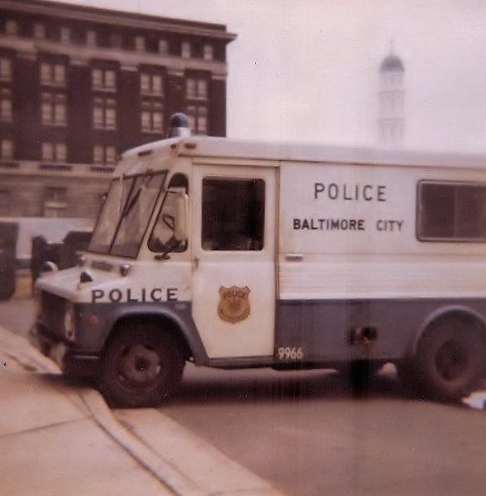
1970s Blue White Wagon
Photo courtesy Officer Mike Caplan
1970's blue and white cruising
Patrol-Wagon / Police-Wagon / Paddy wagon
 
In this 1885 Sun Paper article, we see two stories. The first makes mention of our Police Wagon; it seems they are mentioning its successful use, the district for which it was to be first used and that as we know from this article and others, it was the Central or as it was known back then “The Middle District.” So while this article is interesting, what drew our attention and made this what we thought would be of interest to others was the article in the next column. It is entitled, “RACING IN VIRGINIA” it was dispatched to the Baltimore Sun from Gainsville, Virginia about five lines down near the end of the line it starts and ends the next line and it says, J.K Maddux’s “Black Maria"; - running race, the half-mile dash. This is interesting because this article was well before the nickname that would soon come. But because these horse-drawn wagons were so slow, that our police in typical police sarcasm started calling them “Black Maria” after the racehorse, a silly nickname started in America and quickly spread to London and remained in use even into the 1920’s and 30’s when we used a motorized police wagon. Some say it endured being called the Black Maria until a new nickname came about, a nickname that came from the Fighting, or maybe the drunken Irish. Other's say it was not those that OCCUPIED the wagon, but those that OPERATED it. It started out calling it a Police Wagon they called police Paddy's and so it became known as a Paddy wagon. In this 1885 Sun Paper article, we see two stories. The first makes mention of our Police Wagon; it seems they are mentioning its successful use, the district for which it was to be first used and that as we know from this article and others, it was the Central or as it was known back then “The Middle District.” So while this article is interesting, what drew our attention and made this what we thought would be of interest to others was the article in the next column. It is entitled, “RACING IN VIRGINIA” it was dispatched to the Baltimore Sun from Gainsville, Virginia about five lines down near the end of the line it starts and ends the next line and it says, J.K Maddux’s “Black Maria"; - running race, the half-mile dash. This is interesting because this article was well before the nickname that would soon come. But because these horse-drawn wagons were so slow, that our police in typical police sarcasm started calling them “Black Maria” after the racehorse, a silly nickname started in America and quickly spread to London and remained in use even into the 1920’s and 30’s when we used a motorized police wagon. Some say it endured being called the Black Maria until a new nickname came about, a nickname that came from the Fighting, or maybe the drunken Irish. Other's say it was not those that OCCUPIED the wagon, but those that 
The Irish beat cops, that helped change the name of the Black Maria into the name that is more commonly known to this day.   Paddy wagon correctly spelled as one word or two Paddy wagon. But like we started out calling it a "Police Wagon" we had so many Irish police that they started calling the police "Paddy's" and then they called their wagon a Paddy wagon instead of a Police wagon.
 
1968international
1968 International Paddy Wagon 
1968 International 1
 COURTESY SGT. ROBERT FISCHER 
1968 International 2
COURTESY SGT. ROBERT FISCHER
1968 International 3
COURTESY SGT. ROBERT FISCHER
1968international1
COURTESY SGT. ROBERT FISCHER
1968 International wagon
Photo courtesy Officer Mike Caplan
1968 INTERNATIONAL
1968 Picture
COURTESY SGT. ROBERT FISCHER
1968int
1968 INTERNATIONAL
EARLY MODEL OF THE BLUE & WHITE COLOR SCHEME
SHOP# 8988
1970s Pontiac
Ambo, Paddy Wagon, 1970's Pontiac BPD unit
 
BPD utility vans 1975E
PHOTO COURTESY OFFICER MICHAEL CAPLAN
 
cruising patrol
  
NWD Cruising Patrol1
Jon Foote 1
Photo Courtesy Officer J.P. Foote
Officer Jon Foote Seq.# D080 in 1983 with the District Cruising Wagon
 
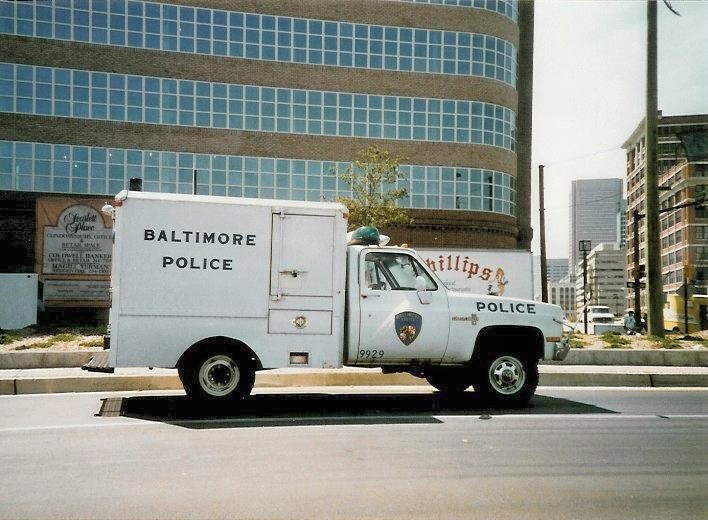
BPD Cruising Patrol shop9929 E
 
PHOTO COURTESY OFFICER MICHAEL CAPLAN
Baltimore Police Cruising, Paddy Wagon, Prisoner Transport Vehicle. By any name, it was often a great sight to behold, to see its flashing lights and hear the siren coming while hanging onto a prisoner and trying at the same time to keep the crowd back.

There were two assigned to each of the nine police districts.

Officer White SWD

1 black devider 800 8 72

The Following Pics came to us Courtesy of retired Lieutenant Robert Wilson

img162img163img170img181< class="mce-object mce-object-undefined">img297img299img301img309img463

1 black devider 800 8 72

 baltimoredoor

 BALTIMORE POLICE DOOR SHIELDS

Cage Cars aka Prisoner Transport Vehicles (PTV)

John Szuba Told us Facebook BPD friends that when he was the vehicle coordinator for the division. He said they conducted tests to see if anyone could get their hand around the "Cage" and attack the Driver. They tried over a half a dozen styles of cages and on everyone. The test was to see if someone in the backseat could reach around and grab at the driver's neck, or could kick out the partition separating back from the front. (These were with the Chevy Impalas). The cage in the Ford Crown Vic was solid but Ford phased out these models and Ford would not loan the new Interceptor to the Department to conduct a test to see if it met Departmental needs. They could only test the Dodge Charger and the Chevy Impala than the Caprice. Officer Szuba said at the time he couldn't sign off on new cage car because he didn't think it was safe for the Officer who would drive it. He went on to say, he, "believe the Prisoner Transport Vans (Wagons) were safer for all concerned". and he personally liked the Old Box style Wagons ....(I agree with his, I also liked the old box wagons better) John went on to say, they were self-contained heat and air for the prisoners and the Drivers air wasn't recycled from the back of the wagon like the Van style.... (This was nice, because it reduced airborne paths that could lead to illness) but it was deemed too expensive. We all I hope the Department conducted a test on the "New" cages...Officer Safety should always be first.

Devider

Black Maria/Paddy-Wagon

Pronounced Mah-Rye-Ah
You have the right to remain confounded.

Detectives, come in all shapes, and all sizes, Criminal Detective, History Detective, Medical, and now Word Detectives: All looking for answers, all listening to the clues. Paying attention not to what they want a word to mean, but what it means, do the clues match up with the era, the location, and most importantly the language. So let’s look at a few terms, a few rules, a few rumors, and most importantly a new fact. In the early 1900’s a Prisoner Transport Vehicle, most commonly known today as a “Paddy Wagon”, were often called a “Black Maria” in this country and even in London England… In this article, we will investigate the term “Black Maria” as referred to in relation to the “Paddy Wagon” here in the states. However, it has been said that there have been stories written in Alexander Solzhenitsyn’s books referring to a black car used by the KGB (Russia) for police to secretly take away prisoners in the middle of the night. It has often been wondered where the term came from, rumors have been started; we should note, normally when a rumor comes up that is was a person, and that person exists in similar life form, both in Boston and in Liverpool! Most often, that person is fiction. But for now we will hold judgment until further investigation, as with any investigation, the clues, the evidence, or the facts, might not always go where we want to go, so let’s sit back and let them take us, where they might.

A “Black Maria” is, as they used to say, a police van, truck, or similar conveyance used to transport prisoners most often to jail, holding, prison, or to a court appearance, and it is worth noting at the outset that “Maria” in this case is pronounced “mah-RYE-ah,” as in Mariah Carey (as this was most common in the 19th century, not “Mah-REE-ah.” Then again, “usually” it is a bit of a stretch because few have heard the term spoken aloud in decades. “Paddy Wagon” is far more common.

As is common when phrases involving personal names, a number of theories have been devised, proposed at tracing “Black Maria,” a term which first appeared in print around 1835, to actual people named Maria. A fella by the name of Michael Quinion, has it on his website (www.worldwidewords.org), that two such theories suggested by his readers. One, centering on an upper-class woman of 19th century London, known for wearing splendid black dresses. That version fails due to the simple fact that “Black Maria” is indisputable of American origin. The other, of a large African-American woman named Maria who ran a Boston boarding house and assisted the police in apprehending fugitives, this is too cute for most reads taste and, more importantly, doesn’t explain why a Boston woman would have appeared in New York City.

The most credible theory yet advanced of the origin of “Black Maria” does tie the phrase to an actual “Maria,” but not a human. “Black Maria” was a famous racehorse of the day, born in Harlem in 1826, whose exploits were widely celebrated in the newspapers. It seems entirely plausible that the name of the horse thereafter would be sarcastically applied to the police carriages, which were not long before pulled by horses, and now are often made by the same wagon/carriage makers, and usually colored black, which swiftly transported miscreants to jail.

Note: found elsewhere on the internet - Black Maria, a slang term for a police van used to transport prisoners, originally these were horse-drawn and so could take some time to arrive at a crime scene. “Black Maria” was a famous racehorse of the day, born in Harlem USA in 1826. The name was sardonically applied to the police carriages (which were also usually colored black).

Incidentally, “Paddy Wagon” takes its name from “Paddy,” a familiar form of the name Patrick (from the Irish form, Padraic or Padraig), which was used in early 20th century America as a derogatory term for Irish immigrants. One might assume that this use is similarly derogatory, referring to a supposed propensity of Irish-Americans being arrested, but big city police forces of the period were themselves composed largely of Irish-Americans, so the term may well have simply referred to a wagon driven by “the paddies,” i.e., the police.


1 black devider 800 8 72

Donations

Donations help with web hosting, stamps and materials and the cost of keeping the website online. Thank you so much for helping BCPH. 

Paypal History Donations

1 black devider 800 8 72

POLICE INFORMATION

Copies of: Your Baltimore Police Department Class Photo, Pictures of our Officers, Vehicles, Equipment, Newspaper Articles relating to our department and or officers, Old Departmental Newsletters, Lookouts, Wanted Posters, and or Brochures. Information on Deceased Officers and anything that may help Preserve the History and Proud Traditions of this agency. Please contact Retired Detective Kenny Driscoll.

This email address is being protected from spambots. You need JavaScript enabled to view it.

Devider color with motto

NOTICE

How to Dispose of Old Police Items

Please contact Det. Ret. Kenny Driscoll if you have any pictures of you or your family members and wish them remembered here on this tribute site to Honor the fine men and women who have served with Honor and Distinction at the Baltimore Police Department.

Anyone with information, photographs, memorabilia, or other "Baltimore City Police" items can contact Ret. Det. Kenny Driscoll at This email address is being protected from spambots. You need JavaScript enabled to view it. follow us on Twitter @BaltoPoliceHist or like us on Facebook or mail pics to 8138 Dundalk Ave. Baltimore Md. 21222


Copyright © 2002 Baltimore City Police History - Ret Det Kenny Driscoll 


Thomas Farnan

Thomas Farnan

There were chiefs, and there were chiefs. Some chiefs had become chief, chiefly by virtue of enormous and helpful political pull. Some have become chiefs merely because fortune happened to be in a sunny humor one day and blew a feather of leadership on their caps.

How to Dispose of Old Police Items

logo

Please contact Det. Ret. Kenny Driscoll if you have any pictures of you or your family members and wish them remembered here on this tribute site to Honor the fine men and women who have served with Honor and Distinction at the Baltimore Police Department. Anyone with information, photographs, memorabilia, or other "Baltimore City Police" items can contact Ret. Det. Kenny Driscoll at   Kenny@BaltimoreCityPoliceHistory.com follow us on Twitter @BaltoPoliceHist or like us on Facebook or mail pics to 8138 Dundalk Ave. Baltimore Md. 21222.
NEWSLETTER

Subscribe now to get 100 exclusive photo & two newsletters per month