The Baltimore Police marching band 1920's

BPD Officers in the early 1920's
Commissioner will Appeal to Board of Estimates for Funds to Necessary Equipment Including at Least 30 motorcycles,
Police Commissioner Charles D. Gaither has begun definite steps toward the establishment of the three-platoon system for Baltimore's police force, in less than six months' time the eight-hour tour of duty for Baltimore policemen will be in force.
It was learned yesterday that General Gaither is having a redraft made of the fixed posts. Officers competent for the work have been assigned to resurvey the police posts for the purpose of extending the lines. Many posts will be made larger. This will give an equal distribution of police service and will provide the necessary men for the three-platoon system.
Six months’ Time Needed,
General Gaither is convinced that within six months the police force will be divided into three shifts. The General said that, with the necessary equipment at hand, he will be able to put the three platoon system in operation January 1, 1921. The foundation for the system lies in reorganizing the various posts.
Work is now underway rearranging the new posts for the Central District. "I am quite positive that better morale will be obtained throughout the department by instituting the three-platoon system," said General Gaither. "The city will get a straight eight-hour tour of duty from each of the three: platoons. Foot policemen arc necessary for certain sections of the city, but a mobile department can, in my judgment, render the most effective service. The thing cannot be done in a day, but 1 expects to put the three-platoon system into actual operation by January 1.”


Click HERE of on the article above

Click HERE of on the article above
 Henry Trebes
1927

Notice the way the sticks are held, with the "Barrel Head," away from the officer.
Also notice the round hats, and last, take a look at the recall light, first issue circa 1922
24 April 1939 at an Anti-Nazi Demonstration
 Conrad Raymond Helwick
Courtesy Rudy Baumann
1920's 1930's
Will Use Thirty Motorcycles.
To execute this plan at least 30 motorcycles equipped with sidecars will be necessary. During the fall, General Gaither will go before the Board of Estimates and ask for sufficient funds for the necessary equipment. Within a few months, the personnel of the department may be up to its full quota, as it is believed men will be attracted to the department because of the new system.
 |
| Photo courtesy Bill Manzke |
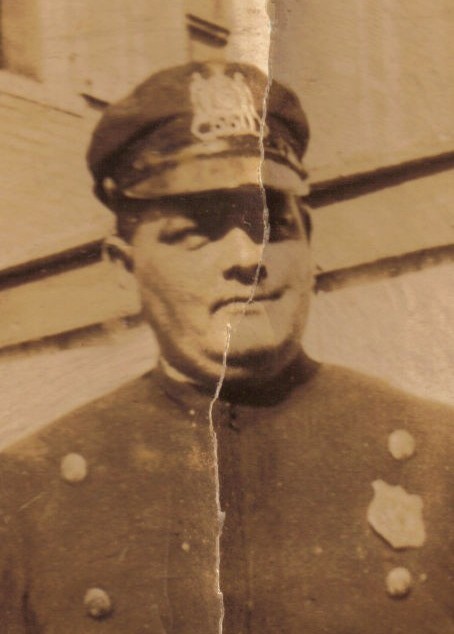
Patrolman George W. Myers (L) seen here with an un-named officer 1920's. The photo is an old tintype and is deteriorating from age
 |
| Photo courtesy Bill Manzke |
Patrolman George W. Myers 1920's
 Courtesy of Charles Trebes Jr.
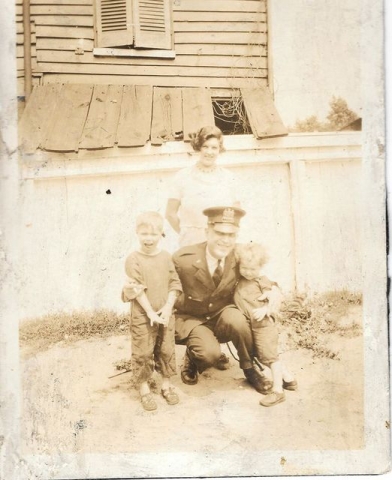
Officer Henry Trebes, his wife, Maria and children, Charles and Edward, 1927
They are behind their home on Hamburg St.
Photo courtesy Bill Manzke
Patrolman George W. Myers 1920's on an Indian Police Motorcycle ready to patrol the streets of Baltimore
 Badge Number 96 Dies at Age 84 after Nearly 50 Years of Service
7 May 1840 - 1 June 1924

Courtesy
Jeff Rosen

Baltimore Police Uniforms
Information, from Retired Lt. Jerry DeManss - From author H.L Mencken's book "Happy Days" Mr. Menchen describes the Police as "Cops." In his West Baltimore neighborhood's Hollins St. address as their having what he referred to as "being heavy on their feet, and hence easy to outrun. They wore thick and uncomfortable uniforms, in the Summer as well as they did during the Winter months. Squeaky shoes with soles as solid as slabs of oak, and domed helmets that always fell off when they attempted to run, scattering lead pencils, peanuts, red bandana handkerchiefs and chewing tobacco, a few cigars, oranges, and bananas. The police officer in pursuit of a young man had to hold on to his helmet with one hand, and clutch his revolver with the other, lest it go off in the holster flopping from his stern and end up with a self-inflicted gunshot wound to the leg. Any of the young men, including Barrell Fairbanks, could beat the police in a fair race. The only juvenile collared by stratagem was always dirty and was captured then given the switch before releasing him to his mother.

21 July 1921
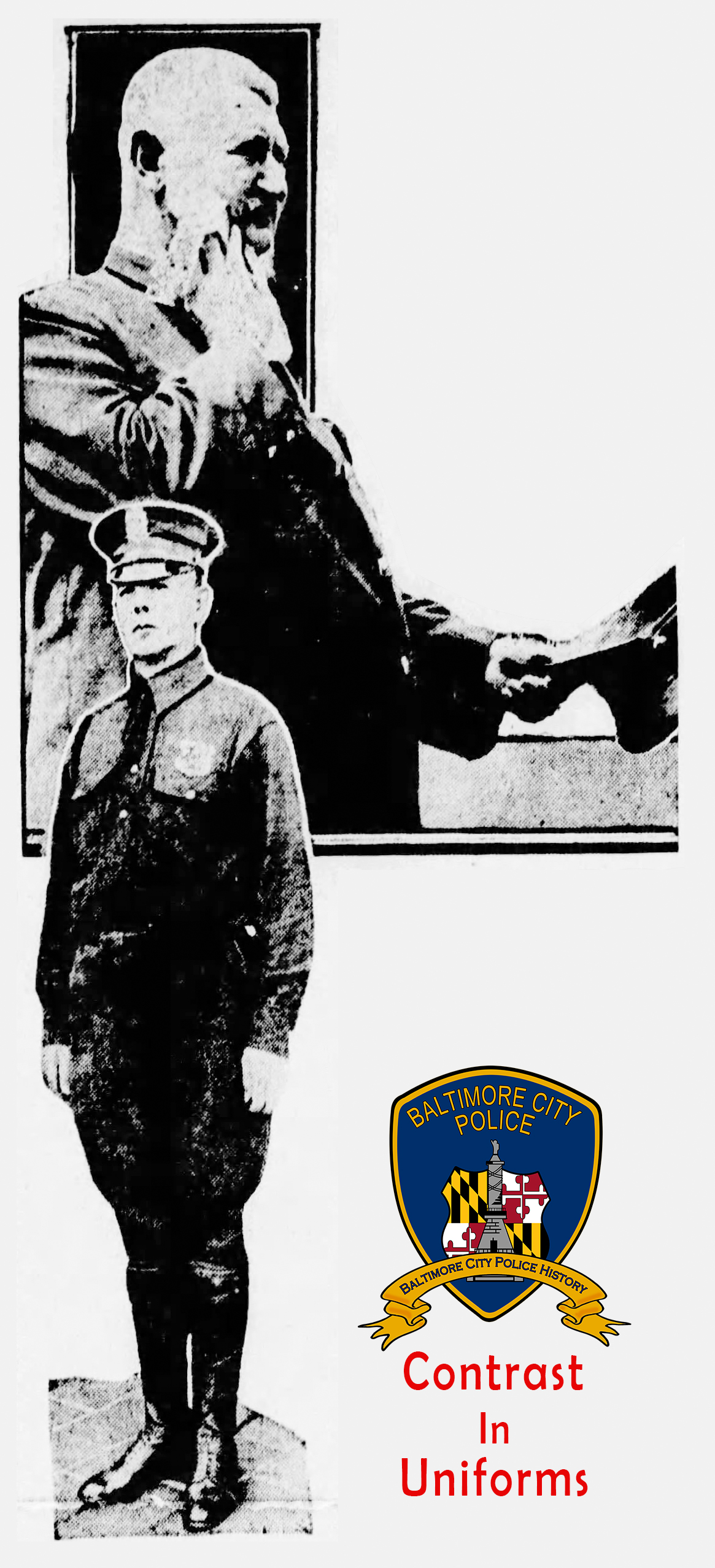
Contrast In Uniforms
The Evening Sun prints today the first of a series of photos showing the type of uniform worn by police in other cities, as contrasted with the uniforms of the Baltimore police. The Baltimore Officer all through the hot summer must wear a coat and he must keep the top button fastened. He stands or walks in the sun a good bit, and before he is in duty many hours he is too uncomfortable to do his best work. The lower picture shows the summer uniform od Philadelphia policeman. He wears no coat and doesn't suffer from heat as much as do the Baltimore officers. The Philadelphia Officer's costume combines comfort with dignity.
28 July 1921
Contrast In Uniforms
With a temperature of 93 at noon today Baltimore City Policemen are sweltering in their uniforms. In contrast, the State Police, doing the same general sort of duty, are comparatively comfortable. The difference is due to a blouse, or coat, worn by the city police. When the hot spell came recently Captain Williams, of the State police, issue an order for the men to discard their coats and wear only their uniform shirts. The men generally welcomed the order. Baltimore policemen also, at least those who have been asked about it, would welcome a similar order. The blouses worn by the city policemen are much like the old navy officers' blouses, that were discarded during the war. Because they were so uncomfortable the officers couldn't work. The Evening Sun recently printed a photograph showing the summer uniform of a Philadelphia policeman. It is similar to the Maryland State Police uniform.
 Photo courtesy Bill Manzke
Patrolman George W. Myers 1920's

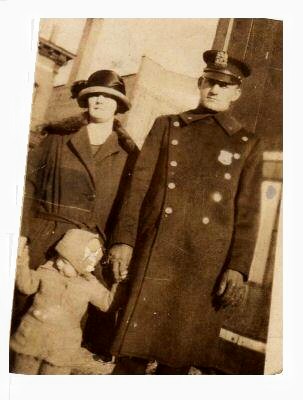
Officer Walter H. Heiderman with his daughter Marie 1923
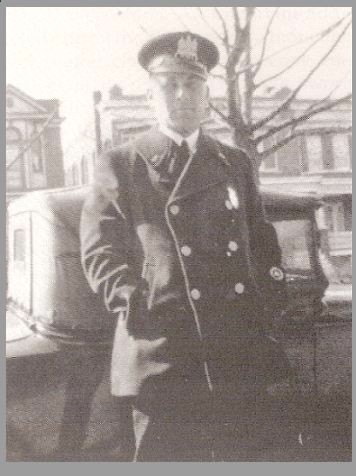
Officer Walter H. Heiderman in 1933. Notice the 1929 Ford prowl car in the background
 |
| Photo courtesy Ray Miles, Jr. |
Patrolman Cooney(L) Patrolman Raymond Miles, Sr.(R) 1926
 |
| Photo courtesy Ray Miles, Jr. |
Patrolman Franz(L) and Patrolman Flanigan(R) 1926
 |
| Photo courtesy Ray Miles, Jr. |
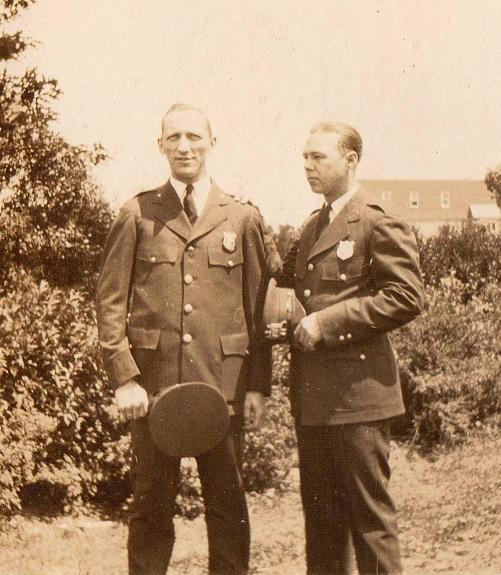
Patrolman Franz(L) and Patrolman Jackson(R) 1926
 |
| Photo courtesy Ray Miles, Jr. |
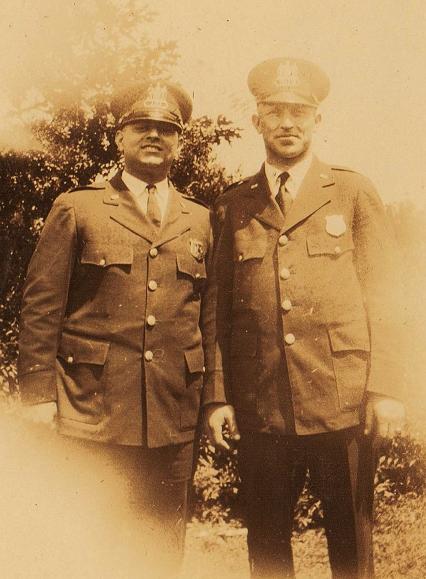
Patrolman Hoff (L) and Patrolman Tarbutton (R) 1926
 |
| Photo courtesy Ray Miles, Jr. |
Patrolman Maloney (L) Patrolman Ray Miles (Center) Patrolman Jackson 1926
 |
| Photo courtesy Ray Miles, Jr. |
Officer McGraff (L) and Patrolman Lynch (R) 1926
Patrolman Tarbutton, Hoff, Miles, Flanigan, un-named Officer 1926
 |
| Photo courtesy Mrs. Julie Melocik |
Patrolman William E. Taylor
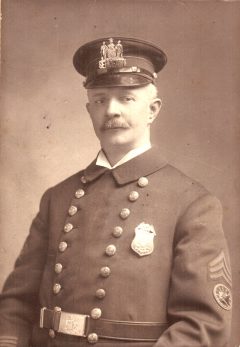
Frank J. Vavra, (1872-1932) Pictured above after joining the Baltimore Police Department around 1907.
He walked foot in the area around Monument St. & Madison Avenue and lived at 619 N. Belnord Avenue in Baltimore's 8th Ward. Officer Vavra pictured below in the early 1920's. His tenure with the Baltimore Police is unknown as he suffered a long time with Alzheimer’s disease before his death in 1932.
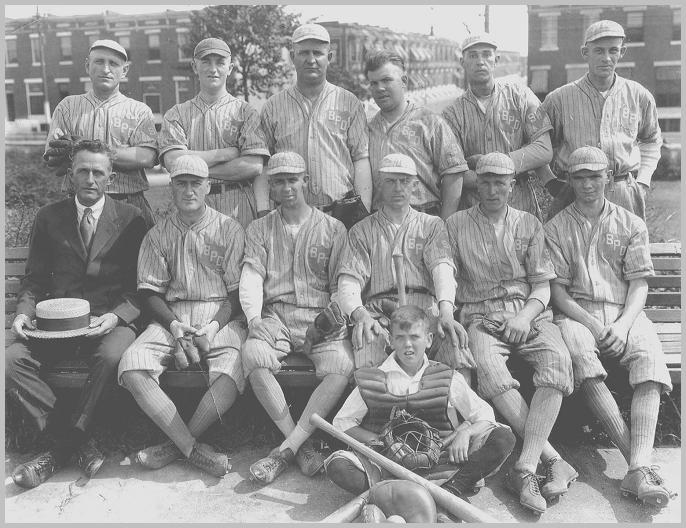
SWD baseball team, sometime in the 1930's. The second person from the right sitting on the bench is Officer Fred Block.After leaving the SWD he went to Motors, where he was shot and served the rest of his time doing desk work. He may have been promoted to the rank of Sergeant.

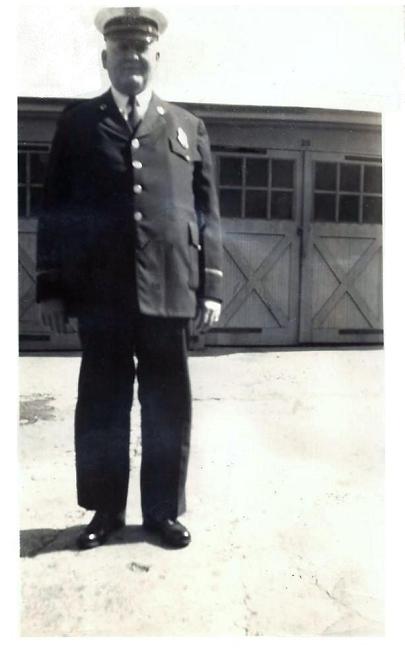
John R. Stein has seen above as a new Baltimore City Patrolman in 1907, in the 1920's he was promoted to the rank of Sergeant and in the 1930's he was again promoted to the rank of Lieutenant as he is seen below. Lieutenant John R. Stein served the citizens of Baltimore and the Police Department valiantly until his death on August 11, 1939, at the age of 60.
 |
| Photo courtesy Mrs. Jane Hammen |
Lieutenant John R. Stein

Officer John Neussinger

Patrolman John Bianca, Badge 33
 |
| Photo courtesy Paul Bouthner Jr. |
Baltimore City Police "Look Out" dated:
Thursday, December 21, 1933, Morning.

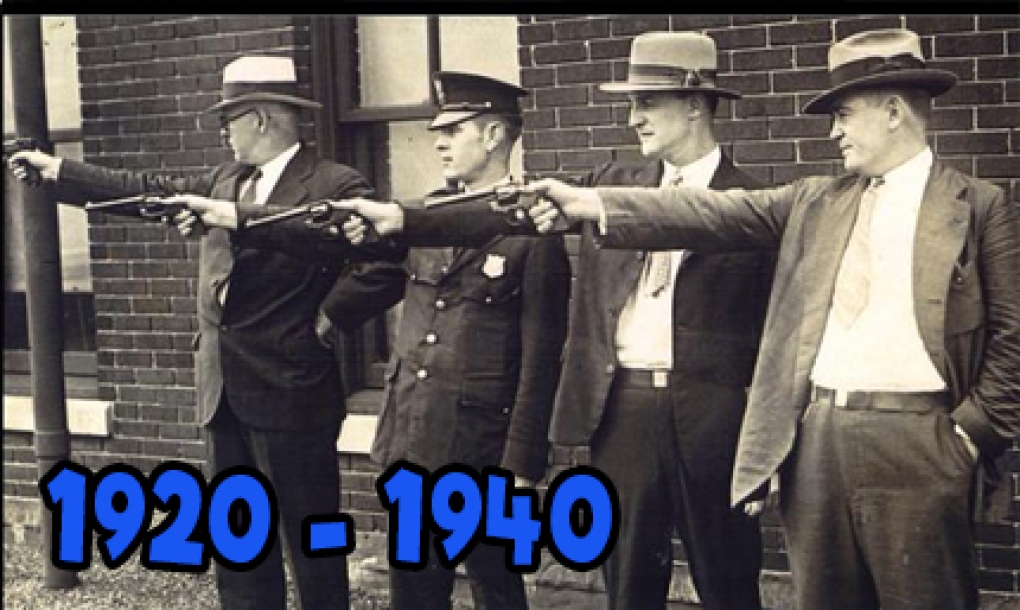
Baltimore's pistol team Poska, Dunn, Lt. Downs, Dickerson, Walstrum.
1935 Shooting medal
1939 Shooting medal
Captain James Downes far left
 |
| PHOTO COURTESY TRUDY BOWERS |
 |
| PHOTO COURTESY RANDELL ZALOUDEK |
 |
| Photo courtesy Lt. William Bowen |
Officer Elmer Z. Bowen (1935)
Patrolman John Bianca, Badge 33
1936
 |
| COURTESY OFFICER JAMES McCARTIN |
Patrolman Mike Malinofski Was Slain on Quiet Halloween Night;
Body Discovered in Street by Milkman...
Police work isn't all parades, pavement pounding and helping old ladies and little children across busy streets. It's a grimly serious business sometimes. Every man who wears a police uniform has to be ready to face sudden death any minute and depend on his wits, his muscle, and his gun to get him out alive. In a series, of which the following story is the first, the Baltimore Sunday American present tales from the Baltimore Police Department's recent files of policemen who went to their death in the performance of their duty.
By CLINTON H. JOHNSON December 19, 1936
So far as Patrolman "Mike" Malinofski was concerned it had been a pretty quiet Halloween. For that matter, not much of anything ever did happen out there on his post in Howard Park, so this 1935 Halloween wasn't unusual. Sometimes he'd grumble about it around the Northwestern District station; mutter that the boys, in closer to town got all the action while he spent his nights trying well-locked doors. When he would come home after his all-night tour of duty, his wife Mrs. Gladys Malinofski would try to find out what had happened. What had he seen? Had there been any accidents? Any fires? Any burglars to chase? He used to chuckle at her persistence, assure her that she hadn't missed anything by not being with him during those long, cold hours between midnight and dawn, riding the deserted streets of Howard Park in his little roadster. Parting Warning... So Halloween hadn't been any different from the other nights. Maybe he felt the loneliness a little more because, when he went on duty at midnight, he'd just come from a happy family party at his brother's home. As he left someone called a parting warning: "Take care of yourself " He remembered that some five hours later as he pulled his car up beside a row of stores at Gwynn Oak and Maine avenues and jumped out to try the doors. Take care of himself? Huh., What did they think, anyway? All he had to worry about out here in the sticks was getting enough action to keep warm. Mechanically he switched on his flashlight, turned down beside the row of storefronts, rattled their door handles with brisk efficiency, rounded the corner and started for the back doors. He was sprawled in the street when the milkman found him. One outstretched hand gripped his flashlight. It was still lighted. The beam frightened the milkman's horse. The faint light of a distant street lamp glinted dully on the still figure's black puttees.
SUMMONS AID
The milkman looked once, then ran toward an all-night filling station in the next block. A police radio car had just pulled in for some air when the milkman pounded up. The car swung out again. The milkman jumped aboard. Patrolmen Charles Heims and Louis Mohr lost no time when they got to “Mike" his real name was Arthur Malinofski, no one seems to know who started calling him "Mike." Heims took him to the West Baltimore General Hospital. Mohr stayed to question anybody he could find. Heims wild ride to the hospital was in vain, Mike, the doctor said, probably had died instantly. He had been shot in the side and through the heart. A half dozen residents had heard the shots. Five, everybody agreed; two, then a pause, then three more. Some thought they had heard running footsteps, heard a car door slam, heard a car drive off.
5 Empty Shells
Near the slain policeman's car, the police found five empty shells from a .32 caliber automatic. One of them was on the running board, one was under the car, the rest nearby. Malinowski's gun holster hadn't even been unsnapped when they found him. Out there in the sticks, where nothing ever happened, Death had leaped at him out of the darkness so quickly he couldn't make a move to defend himself. The Malinowski murder is on the “open” files at Police Headquarters. That meant they haven’t found who killed him. But it does mean they won’t. For if there’s one thing the police hate to do, it's admitting defeat on a case where one of their own men is involved. Tough Case The Malinofski case, however, is a tough one. Detectives Jim Manning, Bill Feehley, Mike Cooney and George Mintiens, who still have charge of it, admit that readily. There are three kinds of murder cases, those where you know the killer and can prove it; those where you know the killer, and can't prove it, and those where you simply don't know who did it or why. "Mike" Malinowski's murder comes in the latter class. There were suspects questioned, but none held more than a day or two. There were all sorts promising "angles" but they all collapsed on the investigation. Even within the last few weeks Detectives Manning and Feehley worked out a "hot" tip until it turned stone cold on them. But they're ready to work the next when it comes. They're determined to get the man who got "Mike" Malinofski. They’ll take him peaceably, of course, if they can. But. They rather hope he'll try to fight:
Officer Blank Gave Life
Facing Bandit's Gun In Attempted Robbery
 |
| COURTESY OFFICER JAMES McCARTIN |
WHERE PATROLMAN JOHN BLANK WAS KILLED BY BANDITS
Two fled at his approach, but the third caught him by surprise, dropped him before he could shoot.
Records of Police Department Tell of Bravery
About every ten months, on an average, a Baltimore policeman loses his life in the performance of his duty. Some have died with their guns blazing. Some have been shot down before they could lift a hand to defend themselves. Following is the second in a series of stories from the Baltimore Police Department's most recent files concerning members of the force killed in action. By CLINTON H. JOHNSON December 26, 1936 Something about the shop didn't look right, but for a moment Patrolman John Blank couldn't figure out just what it was. Then it dawned on him. The light in the office was out. He knew it should be on. The company' safe was in that front office, in full view of the street, and when the last employee departed every night he switched out the desk lights, turned on a single bulb hanging over the safe. Now this, too, was out. Saw Light Blank moved close to the windowpane; trying to peer into the darkened office. Then he made his second disturbing discovery. The door to the rear office was closed but there were lights in there. No one will ever know exactly what John Blank thought the few crowded minutes that followed. Perhaps he reflected on the bad luck that had to bring him face to face with such a problem in the last few minutes of his 4 P. M. to midnight tour of duty. He was on his way to the police call box at Harford Avenue and Preston street to check out for the night. It was February 11, 1934, and a clear, bitterly cold night. This shop in the 1400 block Central Avenue was almost the last on his post. A few steps more, a few more door handles to rattle and he would have been ready for the checkout call. Then a cup of coffee somewhere and home to bed. That had been the program. And now this had to happen. Police Training If John Blank thought of all those things they stayed in his subconscious mind. The rest of his brain, reacting automatically to long police training, directed his actions along prescribed lines. A homeward bound youth of the neighborhood was passing. To him, Blank muttered a quick order: "Beat it down to the call, box. You'll find some police there waiting to call in. Tell 'em to get up here quick." The youth dashed off. Blank hurried around the corner to have a look at the back of the building. It was L-shaped, with a front entrance on Central Avenue, a rear entrance on Oliver street. It was only a moment before Patrolman William Atkinson arrived, a little out of breath. He took a look at the front, figured Blank bad gone to the rear and went around after him. Blank, crouched in the shadows against a wall, told him: “There's somebody in there all right. Go on back to the front, I'll stick here." Atkinson turned ran back toward the Central Avenue entrance. He hadn't even reached it before he heard two shots. He didn't know, as he turned back again what they meant. But he soon found out. They meant the end of Patrolman John Blank. It wasn't hard for Detectives Ben Busky, Bill Feebly and Fred Harbourne to find out later exactly what happened. They heard the story from a taxi-driver, from a casual pedestrian, from three people who, emerging from a bridge game, had been almost directly opposite the shop's rear entrance on Oliver street. Their stories all checked. And this is what happened: Gun To Gun Blank had gone a few yards up the narrow alley that runs from Oliver to Hoffman street, hoping to peer in a rear window of the shop. As he did so, two men burst out the rear door, turned east, dashed across the alley mouth, spotted him and without halting, yelled back over their shoulders: "Look out, Mac." Their warning startled Blank. He swung his gun up, turned, and started for them. As he reached the sidewalk line he met "Mac," face to face, gun to gun. "Mac," it seems, had waited to pick up the burglar toolkit. Blank hadn't counted on a third man. His surprise made him a split-second slow with his trigger finger. That was all "Mac" needed. One bullet went straight to John Blank's brain. He went down as if he'd been struck by a pile-driver. “Mac" hurdled his body and fled down the alley. He was only a dim shape in the darkness when Atkinson reached his fallen comrade. Atkinson commandeered a passing cab, circled the block, returned empty-handed, took up the sorry task of sending Blank to a hospital, spreading the alarm, listing the witnesses, making out a report. Safe Robbed They found the safe blown open inside the shop, with some $1,100 gone. They found the toolkit, too, about 200 feet up the alley. There weren't any fingerprints worth anything, however, on either. John Blank’s murder, like that of Patrolman Malinofski, told in last Sunday's American, is an "open" case in the Headquarters files. But there's a subtle difference in the way they talk about the two cases. They haven't an idea who killed "Mike." They've got a very good idea who killed Blank. Not a positive identification, of course. It was too dark for the witnesses to tell. John Blank could have told, perhaps, but "Mac" fixed him. Still, they have a very good idea who "Mac" was. There won't be any arrest, though. For "Mac"-if they are right- is dead, too, He lived about a year longer than John Blank and died, finally, by his own hand.

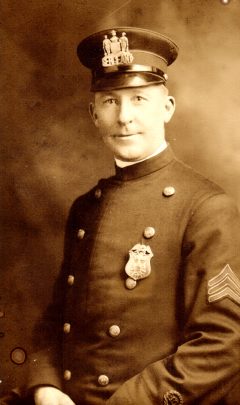
OFFICER JOHN JOSEPH BIANCA
1936
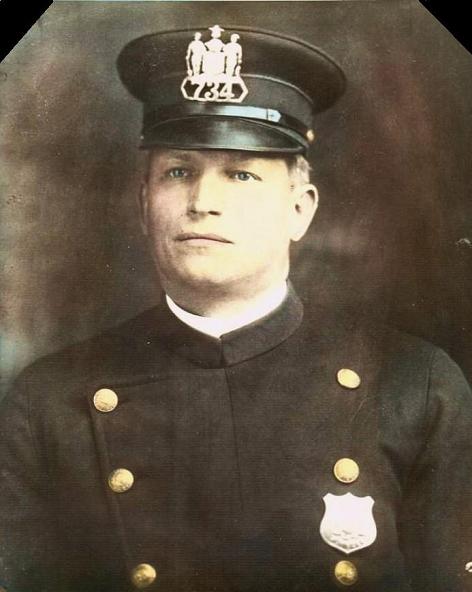
Officer John Joseph Bianca & Officer William Knight were partners assigned to Radio Car 21.When a disturbance in a "political club" resulted in a suspect pursuit, a foot chase & car chase ensued, shots fired and the death of Officer Knight on November 7, 1943
 |
| Photo courtesy Nancy Cook |
 |
| Photo courtesy Trudy Bowers |

1937
 |
| COURTESY OFFICER JAMES McCARTIN |
Policeman Must Face Peril As Part of Work and Many Here Have Given Lives On Job
The average citizen can keep himself out of dangerous situations from one year's end to the next if he's reasonably cautious. A policeman, however, can't do that. He's got to be ready to face anything, any time, without dodging. In a series of stories, of which the following is the third, the Baltimore Sunday American is presenting tales from the Baltimore Police Department official records of men who have gone to death performing their duty. By: CLINTON H. JOHNSON January 2, 1937
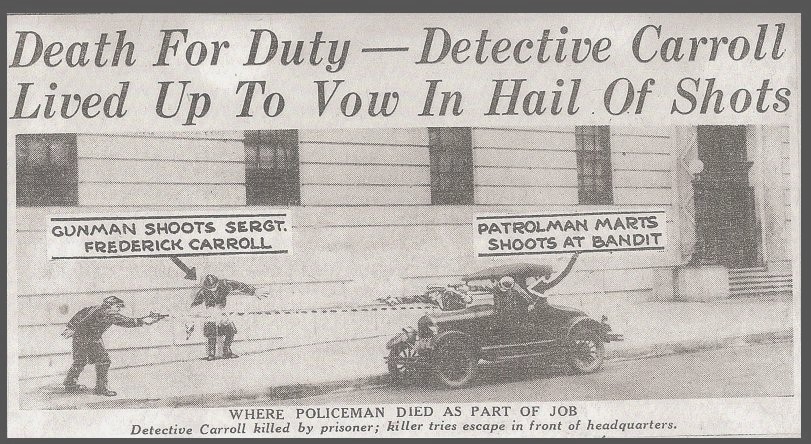
Murdered In The Performance Of His Duty...Saga Of Officer John Block
Officer John Block
Heroic Policeman Shot, Unaware of Hold-Up
Noticed Car Had Tags From Two States on It A policeman has no way of knowing when he may find Death staring him in the face.
That's part of his job, however, and he accepts it as such. He has a gun, a club, a flashlight, a whistle and his wits. Sometimes they'll save him, sometimes they won't. They didn't help John Block, the hero of the following story, fourth in a series of tales from the Baltimore Police Department's records of officers who have lost their lives in the line of duty in recent years.By CLINTON H. JOHNSON January 9, 1937, Patrolman John Block didn't even know there had been a hold-up. The roadster he used to patrol the Annapolis road out near the Southern city limits wasn't equipped with radio and the job had been pulled off clear across the town at Thirty-ninth and Charles Streets, a scant half hour before. They were still busy at headquarters getting the story from the two bus drivers who had been robbed. Block, consequently, had no warning of' danger when he pulled up beside the black sedan and got out to question the driver. He made a mental note of the rear license plate---Florida, 115-345, and walked around to the front of the machine. There was a Kentucky plate, No. 214-352. Block had been bending over the front headlights. Now he straightened up, suspicion dawning in his mind. He moved toward the driver. There were two quick shots. Block stumbled backward tugging at his pistol. Then he took one uncertain step forward and dropped. Gears clashed, the car roared off into the darkness. One of the bus drivers told the police: "There were two men. I don't know where they got on. At the end of the line, one of them asked the fare and they dropped' money in the box. Then they pulled guns and told me to hand over everything I had. I gave 'em the bills. One of ‘em yanked my change carrier oft my belt. One went to another bus parked ahead and brought the driver back to my bus and pushed him inside. They told us: 'Stay in here for five minutes. If you come out sooner it'll be too bad. Then they ran off. "There was a car up at the corner. They jumped in and drove off without lights." Just then the phone rang and a Southern District officials reported the murder of John Block. About the same time, a Central District policeman called in to say he had found a Kentucky tag, No. 214-352, lying on a Pratt street pavement. A taxi driver helped fill in the story. He had picked up two young men in the 600 block North Charles Street. They told him to follow a black sedan that emerged from a nearby alley. The route led to the Annapolis road. A rear tag dropped off the sedan on Pratt street. At the city line traffic light, a police roadster pulled up beside the sedan and a policeman got out. When the light turned green, he said, his passengers ordered him to drive around the halted sedan. A mile farther down the road, they made him turn into a side road and wait. In it few minutes the black sedan arrived and his passengers paid him off, entered it, and drove away. On the way back he passed the scene of the shooting and learned of Block's murder. Later an Annapolis Road resident told of being awakened by three young men who said their sedan wouldn't run. He drove. them to Annapolis for $5.00. The sedan was found. Its license plates had been removed but the motor number permitted police to trace the car to Tallahassee, Fla., and discover it belonged to one Kenneth Lewis. Lewis, they learned, was visiting an aunt in Buckhannon, W.Va. A telegram to the Upshur county sheriff brought a rapid action. The sheriff went looking for Lewis, found him at a farm near Buckhannon, told him he was wanted for questioning. Lewis preceded the sheriff out of the house, walked some 30 feet ahead of him, across the yard, toward the waiting car. Suddenly the fugitive snatched a pistol from his pocket, raised it to his temple and fired. He was dead before the sheriff could reach his side. That occurred on the afternoon of April 26, 1933, just six, days after Block was murdered. Credit for the quick clean-up of that case belongs to Detectives Bob Bradley, Jim Manning, Bill Feehley, Tony Parr and Gilbert Cooney. Subsequent investigation satisfied them that Lewis was the one who killed Block. They went on looking for the other two, however, and finally found one in Florida. He got 18 years for the hold-up. The third man hasn't been found yet.
 |
| COURTESY OF JAMES McCARTIN |
STATE of MARYLAND GIVES HERO'S HONOR TO WIDOW
After Patrolman John Block gave his life in the performance of his duty, his widow received a medal commemorating his heroism. The late Governor Ritchie is shown bestowing the medal.
 |
| COURTESY OFFICER JAMES McCARTIN |
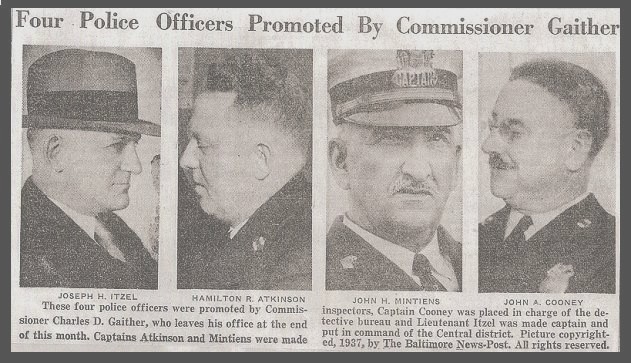
Command Promotions May 24, 1937
Captain Joseph Itzel, Inspector Hamilton Atkinson, Inspector John Mittens, Captain John Cooney
 |
| COURTESY OFFICER JAMES McCARTIN |
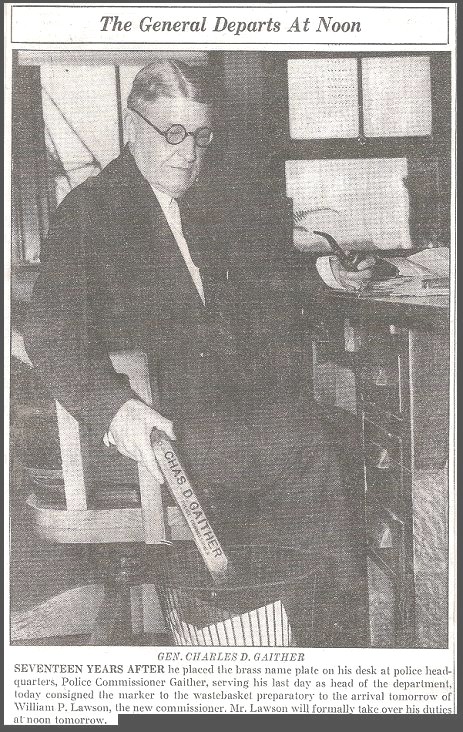
General Charles Gaither
May 31, 1937


1 Oct 1942
Brass Buttons Taboo, Policemen's Future Dark
The Evening Sun 1 Oct 1942 page 27 and page 44
Officers Face World Grimly as WPB [War Production Board] Order takes Twinkling Coat easterners From New uniform Coats.
The Baltimore Police Department found itself in a hole today - a BUTTONHOLE… The fortunes of war "shot" the tradition brass buttons right off the uniform of the Bluecoats. Boy, are the police glad their pants buttons are black!
A button manufacturer in Waterbury, Connecticut, informed uniform makers here that no more brass buttons will be available for police uniforms, and the uniform manufactures notified Commissioner Robert F. Stanton, who in turn notified Senator George R. Radcliffe.
Could Wear Overalls
Senator Radcliffe tendered his deepest buttons - beg pardon, sympathies - but said there was nothing he could do to help the police department out of its hole. The restriction on the manufacture of brass buttons is a War Production Board order which became effective 4 Sept 1942, he said.
The order prohibits the use of brass buttons for anything except overalls or dungarees, which, if you ask the bluecoat on the beat, sounds a little bit like rubbing it in.
What! No Pants?
The next class of probationary policemen to be graduated from the police school will be the first members of the department to feel the pinch of the button crisis. But the last class, numbering 30, which was graduated yesterday, had a hint of the hard times ahead. They had to graduate without their pants, that is.
The graduation took place in the Police Building on the Fallsway. The graduates had coats, caps, white shirts and black ties, but no pants - uniform pants. Furthermore, they can't go on the street duty until they get pants - uniform pants.
Stanton is Perplexed
 |
| COURTESY OFFICER JAMES McCARTIN |
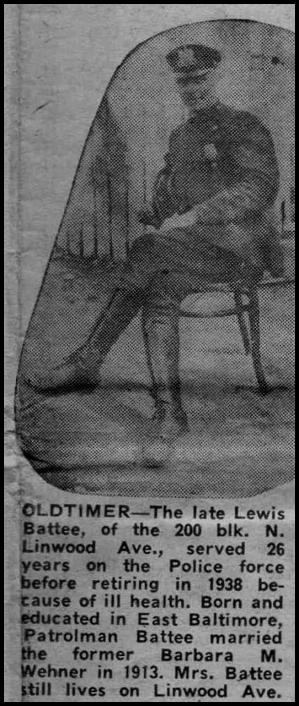
Officer Pat Durkin, passed away July 30, 1937

1938
2 Policemen Injured Wreck Police Car In Chase
 |
| COURTESY OFFICER JAMES McCARTIN |
In pursuit of a speeding suspicious car, this police traffic cruiser went out of control, crashed over a curb and into a fire hydrant, and turned over three times before coming to rest upside down on Hillen Road and Thirty-third street. Two patrolmen in the car were hurt.Suspicious Auto Escapes After Smash Up
October 8, 1938
Two traffic policemen were hurt today when their car, in pursuit of a fleeing automobile, hit a bump at sixty-miles-an-hour, went out of control, jumped a curb, hit a fire hydrant, and turned over three times. The accident occurred near the intersection of Hillen Road and Thirty-third Street, where Patrolmen Fred Dunn and John S. Moore were attempting to overtake a car being driven in a suspicious manner.
BOTH INJURED
Neither patrolman was seriously hurt. Moore was treated for a dislocated shoulder and abrasions at St. Joseph's Hospital and Dunn, the driver, was treated for abrasions by a police department Physician. Dunn said the pursuit started on Loch Raven Boulevard when the driver the car ahead of the traffic cruiser suddenly turned off into a dirt road when he saw the police car.
CHASE GAINS SPEED
The police car followed the machine through to Hillen Road, where the speed of the car in front was jumped up to sixty miles an hour and maintained at that rate until the time of the accident. The fleeing car got away after the crash but the patrolmen have its number.
 Officer John Moore and Officer Fred Dunn
October 8, 1938

 |
| COURTESY OFFICER JAMES McCARTIN |
|
| COURTESY OFFICER JAMES McCARTIN |
 |
| COURTESY OFFICER JAMES McCARTIN |

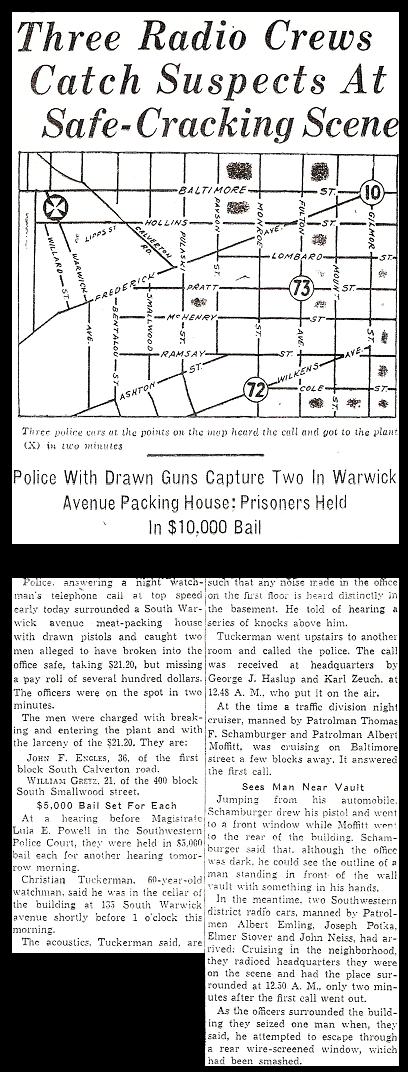
October 19, 1938, Officer Joseph Potaka, Officer John R. Reiss, Officer Elmer Stover, Officer Albert Emling
Unknown traffic officer with a whistle in his mouth
December 11, 1938
1939
ASKS 72 POLICE CARS BE REPLACED
Stanton Suggests $21,500 Surplus Salary Account Be Used For This
February 28, 1939
Commissioner Robert F. Stanton wrote the Board of' Estimates today, asking that 21,500 surpluses in the Police Department's salary account be applied toward replacement of seventy-two police automobiles. All the seventy-two cars were bought between 1929 and 1935, and are showing their age, the commissioner said. Some of the older ones, he added, are very much the worse for wear and tear. Forty-three of the machines are being used for patrol work in the suburban sections and twenty-eight are being used in the radio patrol. Old No. 72 is the Southern district patrol wagon, which has gone more than 200,000 miles in its day.
$100,000 Appropriated
According to Commissioner Stanton, the present police budget appropriates only $100,000 for the maintenance and replacement of equipment. Last year $85,000 was expended for maintenance alone. Since the police rolling stock is no a better this year than last, that same sum or more probably will be required for maintenance, leaving only $15,000 of the $100,000 item for new purchases, the commissioner said. If the salary surplus is applied to new equipment purchases, continued the commissioner, it should work a saving in maintenance costs. Commissioner Stanton explained that the $21,500 excess in the salary account represents an accumulation of several years. It was piled up, he said, through the salary difference that results when a veteran patrolman who gets with bonus, about $46 a week, is replaced by a probationer who gets only $35, and also through temporary vacancies in the officers' ranks of the force. Bids on the department's old cars already have been asked and, received from various automotive firms in the city, Commissioner Stanton said. They have offered bids on seventy-one cars, as a whole and on smaller lots. As yet, however, no bid has been put in for the superannuated Black Maria.
 |
| COURTESY OFFICER JAMES McCARTIN |
Officer John Schaefer and Edward Wilson
March 4, 1939
 |
| COURTESY OFFICER JAMES McCARTIN |
Officer Arthur Plummer
March 6, 1939
 |
| COURTESY OFFICER JAMES McCARTIN |
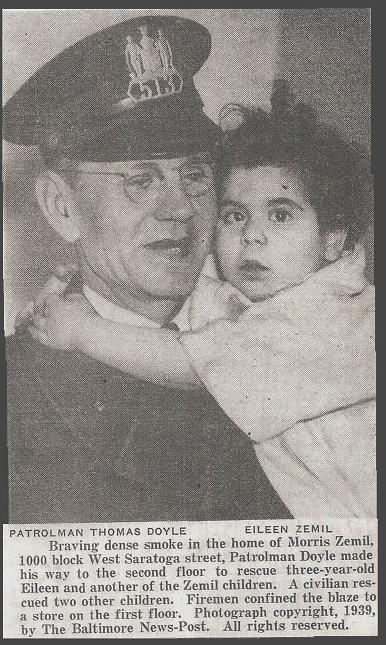
Officer Thomas Doyle rescued little Eileen Zemil from a burning apartment March 7, 1939
 |
| COURTESY OFFICER JAMES McCARTIN |
 |
| COURTESY OFFICER JAMES McCARTIN |
Officer Arthur Withers
March 21, 1939
 |
| COURTESY OFFICER JAMES McCARTIN |
 |
| COURTESY OFFICER JAMES McCARTIN |
Officer Elmer Johnson
March 21, 1939
 |
| COURTESY OFFICER JAMES McCARTIN |
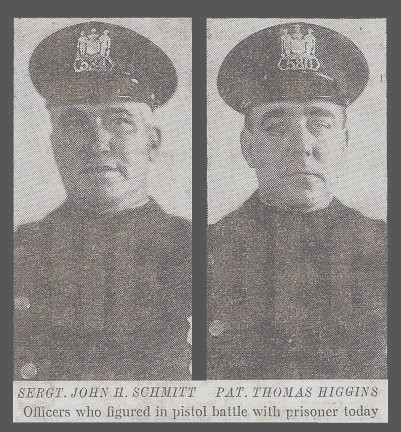
Sergeant John Schmitt and Officer Thomas Higgins
April 1, 1939
|


COURTESY OFFICER JAMES McCARTIN
|
Magistrate Edward Dougherty and Lieutenant Thomas Arthur
Southern District
May 1, 1939
COURTESY OFFICER JAMES McCARTIN
Officer E.F. Dougherty at the call box
May 8, 1939 1936Baltimore Police Pistol TeamLook at the uniforms, hats, and boots
 1936Notice the round hats of the two officers to the right, those were worn from 1908 until 1944 between the Bobby Cap and the 8 point cap. The hat on the left is the same round hat but the wire band is smaller and bent to change the shape, commonly worn by members of the Motors Unit

Sergeant William Clayton, Lieutenant Granville Bozman, Sergeant Joseph Zaruba, Officer Thomas Roche
May 21, 1939
COURTESY OFFICER JAMES McCARTIN
Officer William McDonogh
May 22, 1939 COURTESY OFFICER JAMES McCARTIN
In 1939 this squad car being operated by Officer William Pillsbury and Officer Wade Adams were involved in an accident at Eager and Calvert streets.
COURTESY OFFICER JAMES McCARTIN
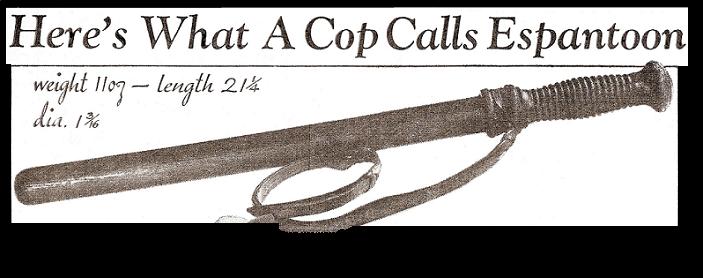
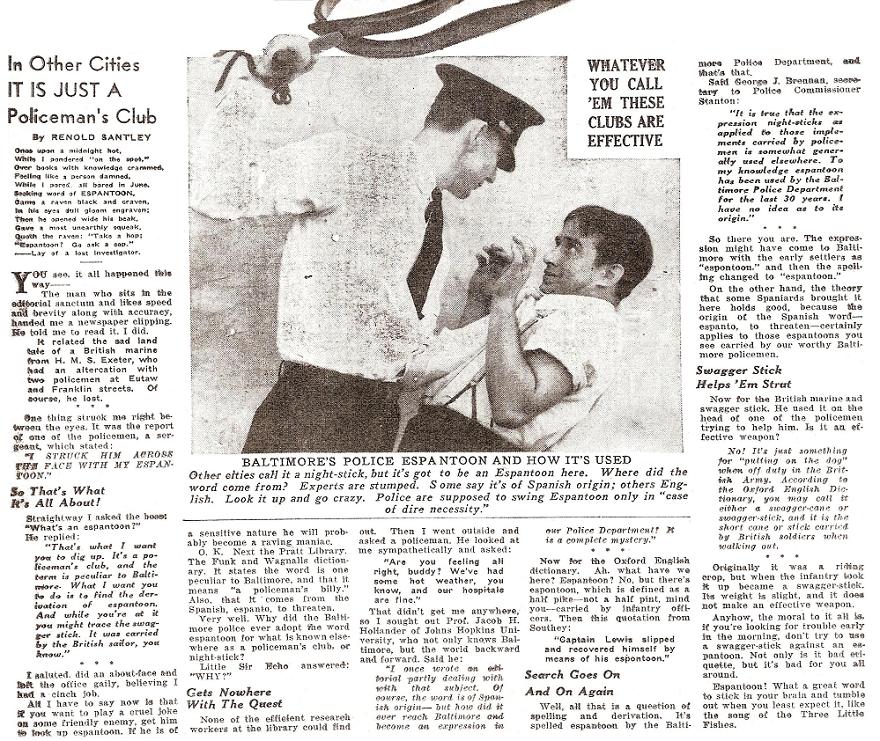
BALTIMORE POLICE ESPANTOON
June 3, 1939
COURTESY OFFICER JAMES McCARTIN
TRAFFIC KIOSKS TAKEN FROM CORNERS
JUNE 1939
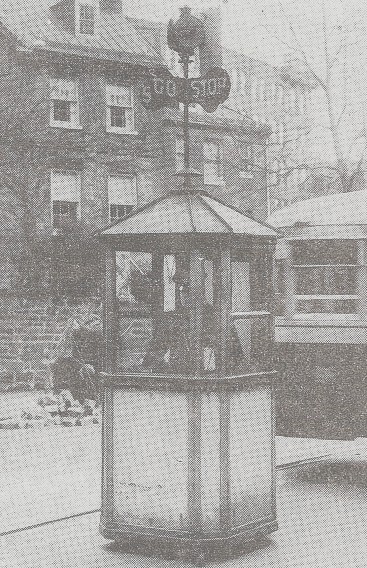
Old but still Going Strong--Three different types of housing for Patrolman directing traffic are shown in the below pictures
The high tower "Kiosks" at Charles Street and North Avenue (below)

COURTESY OFFICER JAMES McCARTIN
Christmas Eve 1939 at Howard & Lexington Sts.
EIGHT TRAFFIC KIOSKS TAKEN FROM CORNERS
Rest To Be Removed if Test Indicates They Aren't Needed
Shelters Held Antiquated Experiment Reported Success So Far
June 15, 1939
Believing the small, movable traffic “Kiosks” to be antiquated, Police Commissioner Robert F. Stanton has ordered the removal of eight of them from intersections in the central part of the city as an experiment, he announced today. His order was the result of a survey made by Captain Henry C. Kaste, commander of the Traffic Division. The intersections from which the small enclosures, originally designed to protect traffic patrolmen from the elements, have been removed are at Pratt and Sharp Streets, Pratt and Howard streets. Lombard and Hanover streets Lombard and Charles streets, Lombard and, Calvert streets. Baltimore and Paca streets, Saratoga and Eutaw streets and Charles and Chase streets. Ten of Them Left Commissioner Stanton said today that about ten of the kiosks remains at intersections, but that if it developed that traffic could be directed as well without them they would probably be removed also. The kiosks have always been rolled away from the intersections at night, the Commissioner said, and patrolmen did without them if night traffic warranted their presence at all. The great majority of traffic patrolmen are exposed to the weather when on duty he added so that the loss of the protection the structures afford would work little hardship on the few officers who are being deprived of them. Success So Far Commissioner Stanton said that at, the intersections from which the kiosks had been removed the Traffic Division officials reported that vehicle movement was being handled with the same facility as before.There is no intention on the part of the department to remove the traffic towers, such as that at North Avenue and Charles street, which can be operated automatically. These towers are, used only on special occasions and at those times they are needed, the Commissioner said.
"Kiosks" located at Liberty and Lexington Streets (below)
COURTESY OFFICER JAMES McCARTIN
COURTESY OFFICER JAMES McCARTIN
18 KIOSKS STILL USED IN MODERN TRAFFIC RUSH
'Little Houses' Described As Antiquated Fate---Undecided
June 15, 1939
Traffic patrolmen in Baltimore still direct the movements of hundreds of thousands of automobiles from eighteen antiquated kiosks, which have been protecting them from snow, rain, and the summer sun for the past fifteen years, a survey today disclosed. Inside the kiosk- stands a policeman who manually regulates traffic by the turning of a handle within which in turn changes the "Stop" and "Go" signals atop the cubicle. Originally there were approximately forty of the kiosks scattered - mainly along the busy thoroughfares in the downtown section, but with the regulation of traffic by means of electric signals, many were no longer needed, police officials said. Some Good Points Captain Henry C. Kaste, commander of the traffic division of the Police Department, said that the police directing traffic from within the kiosks "look a little antiquated" and stated the little houses still have some "good points." "During rush hours of the morning and afternoon," said Captain Kaste, "I have ordered the men to desert their kiosks and regulate traffic with their hands from vantage points at the intersection. "As fast as automatic traffic signals are installed to regulate traffic at intersections," the captain added, "the kiosk is no longer needed. If the presence of a policeman is needed in an emergency, he can stand in the center of the street directing with his hands." Stanton Considers Them While admitting he is giving the kiosk situation some serious consideration, Commissioner Robert F. Stanton did not amplify his intentions as to the fate of "little houses.'" " In addition to the kiosks, the police still have three traffic towers. They are located at North Avenue and Charles Street, Howard and Lombard Streets and Pratt and Light streets. When first put into operation the tower at North Avenue and Charles Street, which directs traffic through the red, amber and green signaling lights fastened on all four sides, had a policeman on duty manipulating the controls. Except on such special occasions as Easter Sunday, the lights of the tower will work automatically and the presence' of a policeman is not needed Captain Kaste said. Operated Daily By Hand The tower at Howard and Light streets are operated during the rush hours---8 to 10 o'clock in the morning and from 4 to 6 o'clock in the evening by a policeman. At other times of the day, the lights work automatically. As the Pratt and Light streets intersection has more vehicular traffic than any other intersection in the city during the course of its day, it is necessary to keep a policeman on duty manipulating the controls from 7.30 o'clock in the morning until 6 o'clock in the evening. Once Waved Their Hands Before the coming of the kiosks, the traffic policemen of the city did their regulating from the center of the street intersection by waving their hands. Next, they were provided with a wooden platform to which was attached an umbrella. An iron pole jutting through the top of the umbrella supported the "Stop" and "Go" signs, manipulated by the turn of a handle by the policeman. A circular piece of sheet metal attached to the edge of the platform and reaching as high as the policeman's waist served as a protection from the elements. The device was commonly known as a "can" in police circles. In the eighteen remaining kiosks, some of the Police have been directing traffic at the same intersection for as long as ten years. The locations of, the kiosks are as follows: along Pratt Street at Charles, Hanover, Sharp and Howard streets; Lombard Street, at the intersections of Charles, Light, Calvert and South Streets; Baltimore street at Paca Street and the Fallsway; Eutaw and Saratoga streets and Liberty and Saratoga Streets; St. Paul and Saratoga streets, Calvert and Centre streets; Charles street at Chase and Biddle street and Fleet-street and Broadway.

Shorter type tower "Kiosks" at Lombard Street, Howard Street and Park Avenue, Kiosk-Less COPS Mourn Loss Of Traffic Boxes Six, Flinging Their Arms About And Whistling---Agree Policeman's Lot Is Not A Happy One, What With Hot Asphalt And Hotter Sun June 15, 1939, Six mournful Baltimore traffic cops who have been de-housed by the Police Department. De-housing Authority (probably the commissioner) today were flinging their arms about, tooting their whistles and agreeing with W. S. Gilbert that "a policeman's lot is not a happy one.' The six are a majority of the eight who, until recently, occupied confined kiosks containing stop-go semaphores on one of eight street intersections in the city. Today they were kiosk-less and an investigation indicated that of the eight, six didn't like it at all. Two others couldn't be interviewed.
Counts Ten--Then Replies
The interviewer walked down Charles Street to Lombard, where Patrolman John Thierauf, who has always occupied the booth on the southwest corner of the busy thoroughfare, was standing in the middle of Lombard, arms, and whistle going. "How do you like the change:" the officer was asked, He counted to ten before answering, "It's hard on the feet and hot on the head," he said. "This asphalt gets hot and it isn't like the old wooden floors and the roof. Of course, I don't like it." The officer admitted that the change might have improved the traffic situation somewhat, however.
Counts Twenty, Then
The journey continued to Pratt and Sharp streets, the officer who used to occupy a kiosk at Hanover and Lombard being nowhere in sight. At the former intersection Patrolman, Frank J. Corrigan was standing on the northeast corner. Hanover Street is one way at that point. but there was plenty of traffic to keep the patrolman moving. "How do you like the change?" the interviewer inquired again. Patrolman Corrigan counted about twenty and swallowed. "I don't mind saying that I don't like it a damned bit!" he exploded, "I've been standing in the house over there indicating the southeast corner for the past ten years without an accident at this corner. And I haven’t been on sick report for eight years." he added feelingly.
Just Had It Painted
"The sun is here at 8 o'clock in the morning until 5:30 o'clock in the afternoon during the summer and about half an hour a day in the winter. And I just had that box painted. At Pratt and Howard streets Patrolman Howard W. Singleton was more or less non-committal. He missed his box. He had it on the southeast side of the street. Now he stands on the west side of Howard, about the middle of Lombard. and dodges. Up at Baltimore and Paca Officer, J. M. Collison didn't like the new order of things at all.
Gets Clothes Spotted
"A man buys expensive clothes and tries to look nice and a car come along, one splash and look at them, he said with even more feeling than Officer Corrigan. He was feeling it might be added, the front section of his uniform trousers. There wasn't much in the way of a crease there and they were spotted.
"Did you get wet in the rain on Tuesday?" he was asked, "I did. and I've been trying to get my trousers clean ever since" he said. The patrolman, it was learned, has guided traffic at the intersection for fourteen years. He began with one of the old can-box effects, with the semaphore standing up from the center, and worked his way up to a full-fledged box.
City's Coldest Corner
"And they come around and took it away last Friday" he mourned. "I used to have a system with that box. Now as soon as I take my arms down, traffic stops automatically." The box he added, had never interfered with traffic. The regular officer at Eutaw and Saratoga Streets, where a box has been removed was at the Western Station House on a case and his substitute hadn't much to say about it. From there the interviewer marched to Charles and Chase Streets, where Patrolman John Wess has been standing in a house and taking care of streetcars, buses, private machines, trucks, and pedestrians for some time. And here the interviewer received an entirely new but still protesting point of view. "This here is the coldest corner in town in the winter time," said Patrolman Wess."The wind blows around here something fearful. It once blew the box completely over, with me in it. How's a man going to stand up against a wind like that?"

COURTESY OFFICER JAMES McCARTIN
"Kiosks" a veteran of fifteen years of service, located at Saratoga and Eutaw Streets (above)
 |
| COURTESY OFFICER JAMES McCARTIN |
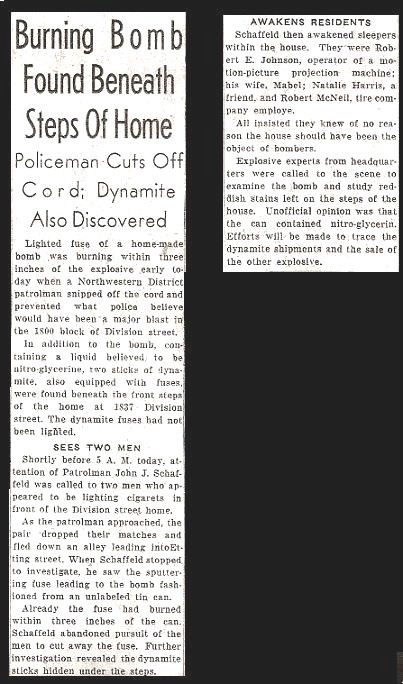
Patrolman John Schaffeld
 |
|
COURTESY OFFICER JAMES McCARTIN
|
SHOOTING YOUTH SHOT BY POLICEMAN GETS BLOOD TRANSFUSION
Heart Grazed By Bullet That Entered Burglary Suspect's Back---Officer Says Victim Ignored Order To Halt---Police Inquiry On
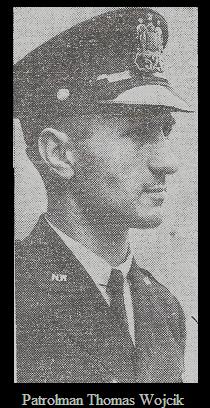
July 24, 1939A 15-year-old boy was in a serious condition at the West Baltimore General Hospital, shot in the back today by a policeman who saw him fleeing from a vacant house at 3500 Dolfield Avenue. The bullet entered behind the youth's left shoulder, piercing the entire body, grazing the heart, and came out his right breast, according to hospital doctors who treated him and administered a blood transfusion. Meanwhile, Chief Inspector Stephen G. Nelson began what he called a "routine investigation" into the shooting by Patrolman Thomas A. Wojcik The "investigation." he said will be made by Inspector Thomas J. Mooney. With Patrolman George Kraft, in a police radio patrol car, Wojcik had sighted the youth running southward on Dolfield Avenue from the vacant house as the patrol car made one of its usual rounds about 1.30 A. M. Calling to the boy to halt, the police sped in pursuit, whereupon the youth crossed the street again and plunged between two dwellings, with Patrolman Wojcik after him on foot. Policeman Shoots Him In the rear yard, Wojcik reported, after he had called to the boy six times to halt, the youth reached toward a back pocket as if for a weapon and the policeman fired. The boy went down. Taken immediately to the hospital, the boy was identified as Ralph Rauch, who escaped on July 7 from the Maryland Training School for Boys. Since then he had not been seen either at the training school or at the home of his father, George Rauch at 2609 Cold Spring lane. Father's Statement Mr. Rauch today said "About a year ago my son got in with some bad boys and I sent him away to the Maryland Training School for Boys. He got out supposedly to come home, but we didn't hear from him. "The first I heard from him since the fifteenth was when the police came to the door this morning and told me he had been shot. He is a good boy, but he just got in with some bad company." Captain Lawrence King, of the Northwestern district. reported to Inspector Nelson that subsequent investigation by his men revealed marks on the door of the vacant house at 3500 Dolfield Avenue as though attempts had been made to pry it open. Similar marks were found on a window of a home at 3600 Belle Avenue, a short distance away he said. Stolen Jewelry Reported Also, he reported the finding of two rings in the boy's pockets at the hospital. both of which were identified as part of the jewelry taken several days ago from the home of Edward G. Conrad, at 3300 Sequoia avenue. One was a diamond ring and the other a class ring. Between the two Dolfield Avenue houses where Wojcik had followed the youth afoot, Captain King added, his men found a large screwdriver and one of the youth's shoes. The Rauch boy is tall for his age and in the early morning darkness, Captain King said, it was impossible for his men to know the fleeing figure was that of a boy. Patrolman Wojick in his report said that both he and Patrolman Kraft thought the figure was that of a man when they saw him flee from the vacant house. Captain King, when asked today if he considered the case one of "promiscuous shooting" by police, replied "Oh, no! Absolutely not! Officer Wojcik gave the boy every chance in the world. He called to him six or seven times to stop. Then he saw the boy reach for his back pocket, so he did the only thing he could do" Captain King said he saw nothing unusual in the fact that Wojcik was unable to tell that the runner was a boy, and yet could see him reach for his hip pocket. "The Rauch boy is 5 feet 7 or 8 inches tail" he stated. "It would be next to impossible to tell that he was a boy."
 |
| COURTESY OFFICER JAMES McCARTIN |
Rookie Officer Grabs, Suspect
And Becomes His Family's Joy
August 19, 1939
Patrolman Earl W. Gable Makes Arrest On Fourth Day Even 20 Month Old Son Shows Pride When an experienced policeman makes an arrest it is usually a matter of routine duty and attracts little or no attention, but when a rookie officer apprehends a burglary suspect on the fourth night of duty he becomes the pride and joy of the family. "I'm tickled to death," said Mrs. Margaret Gable yesterday when she learned that her husband, Patrolman Earl William Gable, earlier in the day had arrested a suspect who has a record for burglary and larceny. Son Apparently Proud Patrolman Gable, who was assigned to the Central district Monday night, apprehended the suspect as he endeavored to escape from the top of a window at a drug store at Charles and Read streets. Later a revolver was found near the spot where the man had been hiding. At Patrolman Gable's home at 5021 Williston street yesterday, Earl Guy Gable, the officer's 2O-month-old son, was apparently bubbling over with joy at his daddy's bravery. Goo, goo," he shrieked as he bounced over armchairs, ran a toy lawn mower over the rug, tugged at his mother's skirt and performed other antics in celebration of his father's, success. In "Seventh' Heaven" He knew there was some reason for his mother's happiness and he fell right in tune with her joy.“I'm tickled to death," Mrs. Gable repeated. "Just tickled to find out that he is making headway. "Earl has been crazy about being a policeman ever since he was a boy and he is tickled with his work. I really have no objections, I'm just so glad for him. "He was in seventh heaven when he found out that he had made the grade and was going to be put on the force. Mrs. Gable said that she knew nothing of her husband's arrest of the suspect until a neighbor gave her the message that her husband wouldn't be home because he was working on a case. Mother Also Happy"Then I rushed into the house and looked at the newspaper to see whether there was anything in about Earl. I was so thrilled when I saw the story and I was so proud." When it was mentioned that Patrolman Gable has the same name as at prominent movie star, Mrs. Gable laughing answered that most of his friends call him 'Clark.' Patrolman Gable is 29 and is 6 feet 3 inches tall. I "He has a lot of nerve. too, and is not afraid of anything," his wife added. Drove Armored Car “Earl always had the ambition to be a policeman," she observed. "I know he'll make a good one because he doesn't get excited and has a very good disposition.She recalled that Patrolman' Gable went to Public School No.74, at Twenty-second street and Homewood Avenue, and later attended the Baltimore Polytechnic Institute for several years. Then, she said, he learned the plumbing trade. About five years ago he obtained the position as driver of an armored car for a concern that transports money and worked there until he joined the force. Patrolman Gable has three brothers, and two sisters. His father, Guy Gable, is an engineer for the Pennsylvania Railroad. To Face Grand Jury Action The burglary suspect was later charged with carrying a deadly weapon and with the theft of a revolver from Michael Gransee, of the Philadelphia Road, Chesaco Park, Md. The suspect identified himself as Maurice W. Homer, 23 of the 800 block McKean Avenue.At a hearing yesterday afternoon before Magistrate Elmer J. Hammer, in the Central district police court. Homer was held for action of the grand jury in $500 bail on each charge.
 |
| COURTESY OFFICER JAMES McCARTIN |
August 21, 1939, a small boy was found wandering on the street by Radio Car #3, manned by Officer Joseph Lewinsky and Officer William McCarthy and he was taken to the Western District Station. Officer George Sanders tries to obtain information from the youth to be able to return him to his parents
 |
| COURTESY OFFICER JAMES McCARTIN |
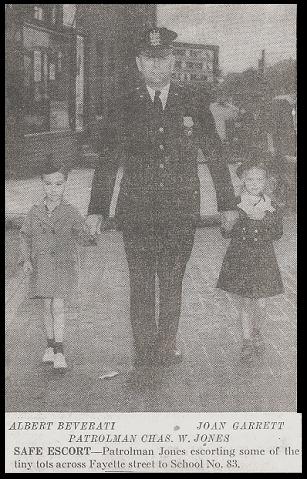
In 1939 Officer Charles W. Jones leads Albert Beverati & Joan Garrett across the street September 7, 1939
 |
| COURTESY OFFICER JAMES MCCARTIN |
September 21, 1939, Lieutenant Robert Bradley, Officer Albert Kendrick, Sergeant Donald Madigan, Lieutenant Allen Crone, were involved in a fierce gun battle while attempting to arrest robbery suspects.

COURTESY OFFICER JAMES McCARTIN
SCENE OF SHOOTING---- In this schoolyard police closed in on six colored youths as they congregated near the steps of the main building of Public School No. 112, at Laurens and Calhoun Streets. A gun battle followed, the police said. The body of one youth, fatally injured, was found beneath the tree at the extreme left of the photograph and that of another at the far corner of the small portable school building near the trees. Commissioner Robert F. Stanton was investigating today.
2 NEGRO YOUTHS KILLED IN FIGHT
WITH POLICE!
Two Seized In Schoolyard In Northwest Section. Two Others Escape
September 21, 1939
Detectives Report withheld By Officials. Who Say Men Returned Fire Two Negro youths were shot and killed last night in a running battle in the rear yard of Public School No.112. at Laurens and Calhoun streets, by a squad of detectives which had laid in wait for more than a quarter of an hour. Two other Negroes were captured during the fight in which a half dozen shots were fired, and another pair escaped. One of the bullets went wild and crashed through the window of a bedroom in a house one hundred yards from the scene of the shooting. Cooney Gives Statement The only statement made by the police came from Capt. John A. Cooney, of the Detective Bureau, three hours after two of the Negro youths were taken to police headquarters for questioning. He said: "We arrested one man this afternoon for larceny of an automobile and he gave us certain information and we sent detectives to the steps of the school, where they placed six Negroes under arrest. "After being placed under arrest, four of the Negroes broke loose and began shooting. The detectives returned the fire. The police had advance information that one of the Negroes, now dead, had two guns on him. We located one pistol, of a ..38 caliber. Four bullets were in the gun. One empty was found on the ground." Cap Found Near School Lieutenant Oscar Koch, of the Northwestern district who found the pistol, also recovered a cap in the schoolyard. Robert F. Stanton, Commissioner of Police, ordered that the reports of the detectives not be made available and that no additional information be given. Chief Inspector Stephen G. Nelson, who had been closeted with J. Bernard Wells, State's Attorney, the detectives and other police officials for more than three hours, said the detectives involved in the case had not made their reports at that time, and consequently no information was available. Dead Youths Identified At the Provident Hospital where the two dead Negroes were taken, identification was established. The Negroes were: EUGENE DUVALL, 18. of the 2100 block Pennsylvania Avenue, against whom a warrant for assault and robbery had been sworn in the Northwestern district.
LAWRENCE HARVEY, 19, of the 1200 block Park Avenue.
Detectives in the squad were:
Lieutenant Allen D. CRONE.
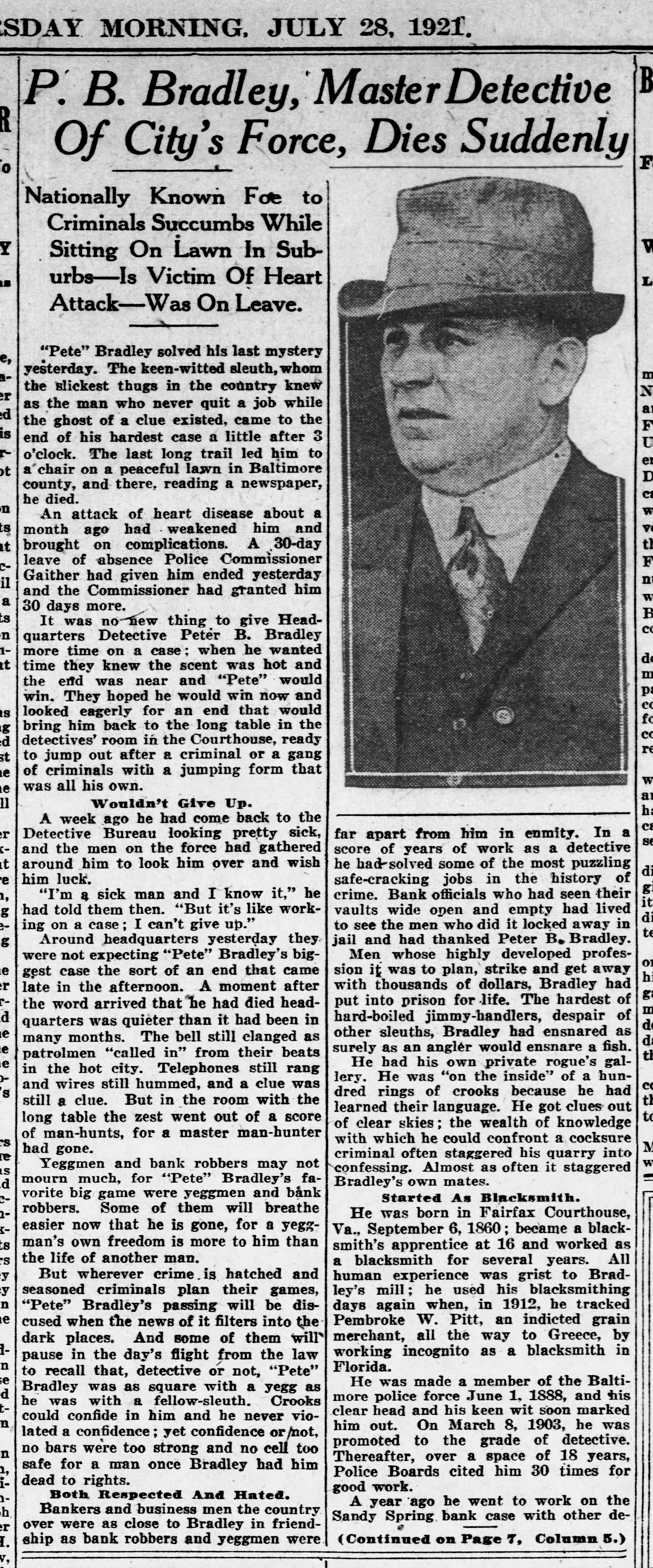

Lieutenant ROBERT BRADLEY.
Sergeant DONALD MADIGAN.
Patrolman ALBERT KENDRICKS.
Patrolman James H. Butler, Negro.
Although the police would not make public its report on the shooting, the residents of the neighborhood were able to give a detailed account. One of the witnesses, Roger Dorsey, Negro, lives at 1314 North Calhoun Street, about one hundred yards from the rear of the school building. Men In Plain Clothes The cars, with several men in civilian dress inside each, remained parked until a group of Negro youths -- five or six-walked to the rear of the school and sat on the steps facing the play yard. As soon as the Negroes arrived, one man left a car and walked down Calhoun street. This man went around the school building and approached the Negroes from the east side of the schoolyard. Meanwhile, two other men got out of the cars and walked in the direction of the school The man who circled the school shouted “Don't run” Dorsey said. Boys Started To Run At that the Negroes on the step began to flee toward a group of portable school buildings on the north end of the playground. “One of the boys almost ran into one of the men," Dorsey said. At the time he was relating the story, Dorsey did not know the "men" were policemen. "The man fired a shot at close range, but the boy kept on running. Another shot was fired as the man ran after the boy. The boy ran until he reached the curb about thirty yards farther on and then he fell." Residents Seek Safety Meanwhile another series of shots were being fired in the central section of the schoolyard. Residents who had ducked into houses at the beginning of the shooting came out again. By this time it was learned that another boy had been shot fatally near the portable school buildings. Two of the boys were led to the police cars. Some minutes later the two dead Negroes were carried to the cars and the machines were driven off. At this time none of the residents knew what the shooting was all about. Stray Bullet Enters House The second boy was wounded, blood was left as he dragged himself around the corner of one of the portable buildings. He fell dead a short distance away. In the home of Viola Mason, Negro, of 1319 Woodyear Street, a small street which skirts the schoolyard on the east, a stray bullet went through a third story bedroom window. John Mason, brother of Viola, whose bedroom it was, happened to be in the dining room on the first floor at that time. In the bedroom immediately behind his, was Mattie Williams, who heard the noise and discovered the bullet hole. The slug was stopped by the wall over the closet.
STANTON PROBES SHOOTING OF 2 BOYS BY POLICE
Orders Secrecy, Pending Full Report On Killing Of Youths
Victims Meet Death During Thief Hunt-Seven Suspects Seized
September 21, 1939
Police Commissioner Robert F. Stanton announced today that he was undertaking a complete investigation of the killing of two colored youths by detectives last night in the yard of a public school at Laurens and Calhoun streets. Until a course of action in regard to the shooting has been established, secrecy concerning all of its details was ordered by the commissioner. Cites Court Ruling He said that disclosure of the circumstances surrounding the killings might be in contravention of a Supreme Bench ruling against discussion of pending cases by the police. Information gained from police sources revealed that the police were conducting a roundup of suspected purse snatchers and bandits when the pistol clash occurred. Seven prisoners, one of them a 14-year-old colored girl, have since been taken into custody and the roundup continued today.
Trap Set By Police
Captain John A. Cooney, commander of the Detective Bureau, said that one of the seven now in custody, Reginald Duvall, 17 years old, a brother of one of the dead youths were arrested yesterday afternoon on an automobile larceny charge. After questioning him, a detective squad went to Public School No. 112, Laurens and Calhoun Streets, and lay in wait for a group of suspects. Six colored youths appeared at the school. The police surrounded them, an action that was followed shortly by gunfire in the schoolyard. Two suspects were taken alive, two were dead and two escaped. The dead were sent to the morgue and were identified as Eugene Duvall, 18 years old, and Lawrence Harvey, 19. Captain Cooney was asked who fired the first shot, the detectives or the suspects. He replied: "The first shot was fired by one of the Negroes." Issues Secrecy Order An order issued by Commissioner Stanton suppressed written reports filed by the detectives at the office of Chief Inspector Stephen G. Nelson. These reports were delivered to the commissioner today. After the shooting, the police continued the roundup of suspects. On the docket at the Northwestern police station, a penciled notation said they were suspected of purse snatching and the holdup of ice cream stores and pharmacies. All were sent to the Police Building to be presented in a lineup, viewed by recent holdup victims. Captain King Investigating Captain Lawrence King. in command of the Northwestern police district, said he was heading an investigation into the shooting because it happened in his district, but that the detectives involved had made no report there. Commissioner Stanton said: "A thorough investigation of the fatal shooting of the two suspects will be made by me. I have received the written reports of the men. I am not in a position to make them public. The Supreme Bench has held this might be contempt of court. Wells' Office Investigating Both State's Attorney J. Bernard Wells and Deputy State's Attorney William H. Maynard were absent from their offices today. Mr. Wel1s is expected to return tomorrow. Assistant State's Attorney Thomas N. Biddison said: "I talked to Mr. Wells today and he asked me to take charge of the case until he returns and to make an investigation. "Assistant State's Attorney Anselm Sodaro was at police headquarters and detective headquarters for several hours last night and talked to everyone concerned. I expect to go to police headquarters today and to thoroughly investigate the whole matter. "When the investigation has been completed, there will probably be a preliminary hearing before the police magistrate of the Northwestern police district. in which the shooting occurred.
PATROLMAN FIRES TWO SHOTS AT LIEUTENANT
SEPTEMBER 24, 1939
An Eastern District patrolman walked into his station last midnight to report for duty, without warning pulled out his service pistol and fired two' shots point-blank at Lieutenant Ezekiel Williams, both shots going wild. Other officers immediately leaped on him and prevented further shooting.
RECENTLY FINED
The man who fired the shots is Patrolman Elmer Griffith, who on September 13 was fined $10 for taking a nap on duty. Griffith was immediately stripped of his stick, badge, pistol, and club and locked in a cell. Two physicians were immediately summoned to examine him.
SHOT MISSES OPERATOR
One of the shots came within inches of striking Charles Spurrier, telephone operator, as he sat at his switchboard. Those who witnessed the Shooting credited Inspector Thomas J. Mooney, Captain Adelbert Plantholt, Lieut. Alfred Plitt and Patrolman Maurice Gorman with saving Lieutenant Williams from injury. They leaped around the desk and grabbed Griffith preventing him from firing more shots.
DESCRIBES INCIDENT
A civilian eyewitness, Charles H. Starr, of Washington. was leaning against the desk railing. He said "I saw the police officer come in the door. He took several steps into the room, then pulled out his pistol and fired twice. By that time he was grabbed by the' other officers. "One of them said Get his cap and badge and they had his gun and club" which dropped on the floor. I picked them up and handed them over the desk and then got out of there. Patrolman Griffith, Capt. Plantholt said, had been charged with dereliction of duty by Lieut. Williams when Griffith had been found in a laundry which he was supposed to be guarding, sound asleep. Capt. Plantholt said: "There was nothing personal about these charges Lieut. Williams had to make them. I am informed that he and Patrolman Griffith had no harsh words about the matter at all."
Lieut. Williams said:
SEES GRIFFITH
"I was sitting at the desk getting ready for roll call when I saw Griffith coming in the room with his pistol in his hand. "Often police hand in their guns when they're going on leave or vacation.
"All of a sudden he pointed the pistol right at me and I began to duck sideways and toward the floor for I felt he was going to shoot. His hand was jerking nervously.
GRABBED BY PATROLMAN
"I hadn't gotten far when the two shots came. It seemed to me that Patrolman Gorman grabbed him and probably saved me. "After Griffith had been disarmed he said that I was the one he was after."
LIEUTENANT COMMENDED
Lieutenant Williams has been commended for outstanding qualities on at least two occasions. He received a special citation for his work in the investigation of the recent torso murder and was decorated by Governor Nice on another occasion.
Griffith's record shows a strange succession of "jinx" occurrences.
Chronologically, these are:
February 10, 1928 struck by an auto (hit-run driver)
April 16, 1928 cripple he arrested claimed Griffith had hit him with a club.
OVERCOME BY SMOKE
September 25, 1928, overcome by smoke rescuing family from fire.
June 24, 1930, went to aid of a screaming woman and was beaten severely with a hammer by her husband, whom he also beat with the butt of his pistol. Both had to go to the hospital.
July 15, 1931, car driven by Griffith hit taxicab, two injured, Griffith found a case of homebrew on another machine.
August 27, 1932, arrested a man, who battled with him on way to the station, Griffith injured, man fined $51.45.
September 13, 1939, fined $10, for sleeping on duty.
September 23, 1939, arrested and charged with shooting at a superior officer.
Griffith Is forty-six married and lives on the 600 block Washington Boulevard. He was appointed to the force on March 27, 1924.

COURTESY OFFICER JAMES McCARTIN
INSPECTOR THOMAS J. MOONEY (left) was in the Eastern Police Station last midnight when Patrolman Elmer Griffith walked in and fired two shots without warning at Lieut. Ezekiel Williams (right). Both shots went wild. Inspector Mooney was one of the group which disarmed Griffith.
Donations
Donations help with web hosting, stamps and materials and the cost of keeping the website online. Thank you so much for helping BCPH.

POLICE INFORMATION
Copies of: Your Baltimore Police Department Class Photo, Pictures of our Officers, Vehicles, Equipment, Newspaper Articles relating to our department and or officers, Old Departmental Newsletters, Lookouts, Wanted Posters, and or Brochures. Information on Deceased Officers and anything that may help Preserve the History and Proud Traditions of this agency. Please contact Retired Detective Kenny Driscoll.
This email address is being protected from spambots. You need JavaScript enabled to view it.

NOTICE
How to Dispose of Old Police Items
Please contact Det. Ret. Kenny Driscoll if you have any pictures of you or your family members and wish them remembered here on this tribute site to Honor the fine men and women who have served with Honor and Distinction at the Baltimore Police Department. Anyone with information, photographs, memorabilia, or other "Baltimore City Police" items can contact Ret. Det. Kenny Driscoll at This email address is being protected from spambots. You need JavaScript enabled to view it. follow us on Twitter @BaltoPoliceHist or like us on Facebook or mail pics to 8138 Dundalk Ave. Baltimore Md. 21222
Copyright © 2002 Baltimore City Police History - Ret Det Kenny Driscoll


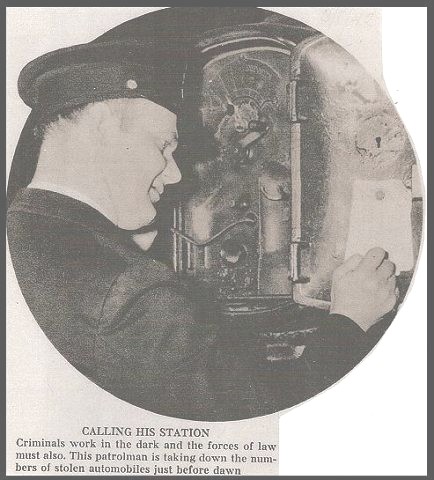
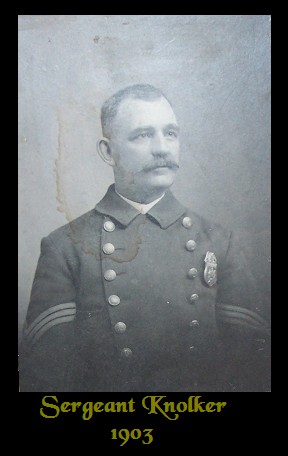


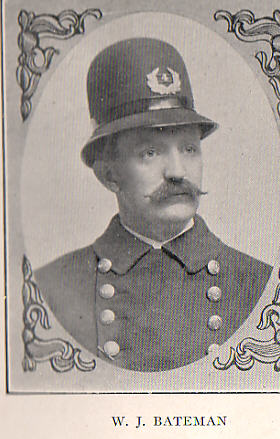

 Photo courtesy Nancy Cook


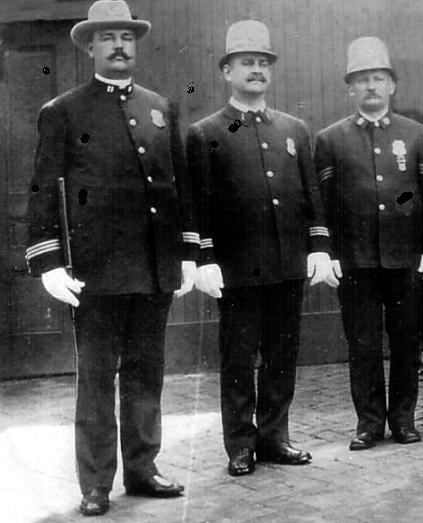

 COURTESY OFFICER JAMES McCARTIN
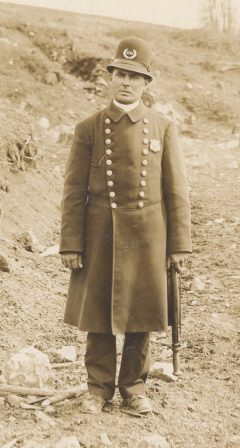


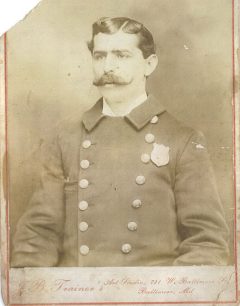


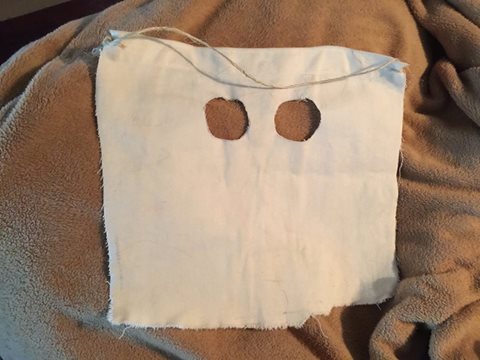 Mask
Mask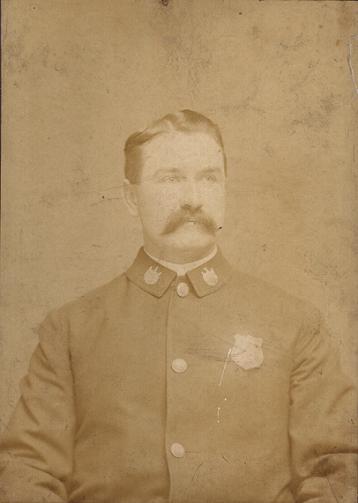


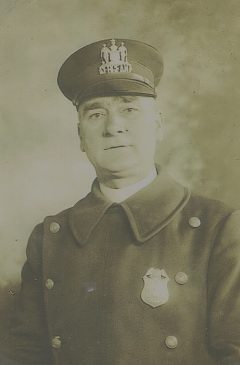













 Night Watchman Turner