Good Cop - Bad Cop

Good Cop - Bad Cop

Good  Cop  Police / Bad Cop

Baltimore City Police Insight 
Good Cop Bad Cop

The Baltimore Police Department has experienced some negative publicity in recent years due to several high profile, corruption, and brutality allegations, including the 2005 arrest of Officers William A. King and Antonio L. Murray by the FBI on federal drug conspiracy charges. But there are some things that should be mentioned about The Baltimore Police; the department has more than 3300 members, it is full of guys and gals that risk their lives every day to make sure those they swore to protect, are protected. All it takes is a single phone call to 911, or even 311 and they will do everything in their power to get to that call... more importantly, to get to you. If when they get there, you are being held at gunpoint, they will risk their own lives to get you out of that situation alive, and uninjured. If your home is on fire, and the Fire Department is in route, the police will often enter your home (risking their lives) to help get you, and your family out. So while there has been negative publicity, the number of officers involved in those types of incidents are small in number when compared to the number of police that leave their homes every day, ready to lay down their lives to protect yours.

Take a look at the number of “bad cops” on this page, and the number of “good police” on this page, then take a look at the number of “injured, and or the fallen” police, and ask yourself, would a bad cop, become crippled to help you, would a bad cop give his life to help you, the answer is, "Of course not!" So yes, there were a few bad cops, and due to recent news it seems there are a lot of bad cops, but compared to the number of police in the department (3300), the percentage of those that are bad, is far less than 1%. There are bad people everywhere, Teachers, Postal Workers, Politicians, even in the Clergy. But to think all Teachers, all Postal Workers, all Politicians, all Clergy, or all Police are bad, that is just a wrong way of thinking, a prejudice way of thinking, and I think the pages on this site will go a long way to show our police are not bad, and that our police are basically good hard working police that want to help our citizens. In small agencies were corruption is often found, it happens because other police in those agencies allow it, in Baltimore Police however they do not allow that kind of behavior, we are a big department, but still small enough to see what's going on, and here police still, “police each other”. But what about the “Thin Blue Line” that everyone hears so much of… Well first let’s talk about what a, "Thin Blue Line" really is, and then we’ll explain why in Baltimore, police will be quick to report other officers doing wrong. First, the Thin Blue Line, the Thin Blue Line, is a line of Police that stand between the, "innocent minded", to protect them from the, "criminal minded".

From Wikipedia

BPD Pancreatic Cancer Purple7272

Ken did this because it was false to claim that police officers were cooperating and lying to cover for one another along the thin blue line. There is a term for that; at this time, I am not sure what it is. I will find out and post it when I do. As for the Thin Blue Line, though, a "The Thin Blue Line" is the thin line of police standing between good and evil, or between right and wrong. It is protecting society from criminals that would rape, rob, and pillage the hard-working, loyal citizens of this country. To demonstrate this in the picture above, Ken named tons of crimes and evils, and then on the other side, spread out much further were things like honor, trust, law enforcement order, caring, loyalty, and other positive things in a civil society. We hope it shows that the thin blue line is a thin shield that stands between good and bad and is all we have to protect us from those evils. The thin line is our police, and they put themselves between the good and evil of our society to protect us. 

The thin blue line symbolizes the crucial role that law enforcement plays in maintaining a safe and orderly society. It represents the sacrifices made by police officers who put themselves at risk to safeguard citizens from the various crimes and evils that exist. This symbol serves as a reminder of the importance of supporting and respecting our police force as they strive to uphold justice and protect our communities. 

Anti-police groups try to turn it into a hate symbol because they have no true understanding of what the flag means. If anything, it serves as a reminder to good police of their loyalty, dedication, and honor, reminding them to stay true to a line so thin that without them it could break, and no one wants to be the weak link. The thin blue line flag has become a symbol of solidarity among law enforcement officers, representing the courage and sacrifice they make to maintain peace and order. It is crucial to recognize that the flag does not promote hatred or discrimination but rather acknowledges the vital role that police officers play in our society. It is unfortunate that some groups misinterpret its meaning and attempt to discredit the honorable work of our police force. 

Just as hate groups don't want others to decide who they are or what their reasons are, police don't want anyone wrongly branding or misidentifying them. If a person were to use common sense, it would be easy to realize that if the police really didn't care, they would not show up at all. Why risk injury or death to try to help someone you hate? It is important to recognize that the actions of a few individuals should not overshadow the dedication and commitment of the majority of police officers; no more than the actions of a few bad people in a neighborhood should be reflected upon everyone in that neighborhood. Police, for the most part, genuinely strive to protect and serve their assigned communities. It is crucial for society to support efforts that promote transparency, accountability, and dialogue between law enforcement and the communities they serve in order to foster mutual understanding and trust. 

This page will show both good police and bad cops. Something Ken has always said is that the word 'cop" is, or historically was, dorogatory. Police have taken nasty words used toward them and adopted them as jokes, like Pig, which now stands for "Pride Integrity and Guts." Over the years, some have taken Cop on as well. That said, Ken is still uncomfortable with the word cop, so here he uses cop for the bad cops and police for the good. To give us the, "Good Police - Bad Cop" play on the interogation technique, in which two interrogators will go at a suspect, one abrasive and the other more laid back and sympathetic, The suspect, wanting an ally, will build a rapport with the good police and sometimes confess to him rather than deal with the bad cop. This technique allows for a more nuanced approach to extracting information from suspects, as it recognizes that not all police officers possess the same qualities or intentions. By differentiating between "good police" and "bad cops," Ken acknowledges the complexity within law enforcement and highlights the importance of integrity and empathy in police work. This approach also emphasizes the significance of building trust and rapport with suspects to facilitate effective investigations.
Devidertarnished 72

For more information on Detectives Murray, and King, Click HERE to read an Article entitled 
One Drug Dealer, Two Corrupt Cops and a Risky FBI Sting 
Written by Yudhijit Bhattacharjee of The Guardian

Devider

 The Thin Blue Line is a symbol used by law enforcement, it originated in the United Kingdom but is now more prevalent in theThin Blue Line

United States, and Canada to commemorate fallen officers, and to symbolize the relationship of the police and the community as the protectors of the citizenry from the criminal element. It is an analogy to the term Thin Red Line. Each stripe on the emblem represents certain respective figures: the blue center line represents law enforcement, the top black stripe represents the public whilst the bottom represents the criminals. The idea behind the graphic is that law enforcement (the blue line) is all stands between the violence and victimization by criminals of the would-be victims of crime.

Now the reasons police in Baltimore are quick to report a dirty cop, first, it comes down to safety; who would want a dirty cop as a “back-up”, how much can anyone rely on, or trust a dirty cop… and when your life is on the line, on a dangerous call, a dirty cop would be the last person you would want backing you up. Like anyone when it comes police we want an honest officer as our partner, a partner we can be proud to serve alongside, a partner that while we are risking our lives to protect yours, we know is risking their lives to protect ours. Ask anyone that has ever been in battle, when bullets are coming your way, or the fight is on, you are too busy protecting your partner to be scared, and you assume, your partner is doing the same for you. If your partner is unreliable for any reason, you don't feel safe. This is why good police, hate bad cops, more than the public hates bad cops, and as such we are quick to turn them. Also, if we were to work with a dirty cop, people will think we were dirty, and no good police want to be associated with a bad cop. So taking down a dirty cop is the best case an officer can make, it protects us from a criminal within our group; from someone that may have infiltrated our family.

On this page, we will try to show both sides of a story, and we’re always ready to hear your thoughts. But as police, we work with evidence, not a rumor, or speculation. We go by truth, and not animosity toward police, or any other group. There have been cases we’ve worked where information from the street, pointed to one person, but the evidence doesn’t follow the rumor, so as much as we may have liked the suspect for the crime, the second they are cleared by the evidence, they are cleared by us; the public has to do the same with some of these police cases. to quote Johnny Cochran, "If the evidence doesn't fit, you must acquit" and that is how good police work, it is how you should work, once the evidence doesn't match up with the information coming in from the street, we have considered it impossible, and if it is impossible, then the person has to be cleared. The thing with police other than possibly interviewing, we don't arrest until we have a case, so often we don't treat anyone like a criminal, or even confront them until we have information, and can charge them, and then we arrest them on a warrant. Good police doing the job right deserve the same treatment, don't treat them as criminals/bad cops, until you know for sure they are dirty, then take your information to the department's Internal Investigations (there is little they like more than arresting bad cops).

In the old days they called it profiling, to find a car with tinted windows, fancy rims, that looked like cars often driven by drug traffickers, and to stop them based on appearance alone, it is lazy police work, and to say an officer is dirty simply because he or she is wearing a badge, no better than the lazy, dirty cops we all despise. It is lazy and non-productive… to be productive, we need to let an officer do his job, don’t bait him or her by giving them a hard time. If these were drug stings or a vice cases; it would be entrapment, what we need to do is cooperate with the officer, and see where they take it. Let them cross the line first, even then, stay calm don’t give them an excuse, to turn "nothing", into something it was not. With this method of full cooperation, we will see who the good police are, and who the bad police are. But this is something that needs cooperation between good police, and good citizens. To go up to anyone, even the best person on earth in an aggressive manner, they will be put on the defensive.

This page will try to post the stories as they come up, both good and bad. If you have a story feel free to send it to us. This email address is being protected from spambots. You need JavaScript enabled to view it. Some information on this page is of Wikipedia, the free encyclopedia - some of this information was updated by us because we feel the only way to share the history of this department is to give the good and the bad. 

Devider

Baltimore Police Officer Caught on Camera Stealing Envelope of Cash from Business

Justin Fenton

Published 9/25/2023

A Baltimore Police car and crime scene tape remains on the scene after a vehicle exploded inside a five-story parking garage in Baltimore’s Fells Point neighborhood on 7/27/22. Two people are being treated for injuries, fire officials said Wednesday afternoon.
Baltimore Police Officer Eric Payton was charged with theft and misconduct in office last week after he was caught on camera stealing an envelope of cash from a business, according to charging documents. (Ulysses Muñoz/The Baltimore Banner)
A Baltimore Police officer charged with theft and misconduct in office last week was caught on camera stealing an envelope of cash from a business, according to charging documents.

VDRYAS2Q4FCU7ALYFJTXYGTLXI

Click HERE of picture above to visit article

Officer Eric Payton, 46, responded as backup after another officer found a business in the 4800 block of Belair Road open and unsecured in the early morning hours of Sept. 20. Later that day, the business owner called police and reported that she had surveillance videotape of an officer taking an envelope containing $111 that had been dropped off by an employee.

Police viewed the video and confirmed that Payton was seen on the video kicking the envelope, then picking it up and putting it in his pocket.

The officer investigating the theft then summoned a supervisor, who contacted evidence control to determine whether any property had been submitted in connection with the investigation of the open door. “It was determined that Officer Payton did not submit any currency or any additional property,” police wrote in court documents.

There’s no mention in the documents of whether Payton or the officer he was backing up activated their body-worn cameras while inside the business.

Police moved swiftly to charge Payton, a seven-year veteran. In a news release issued late Friday — which did not detail the allegations against Payton — they said he had been suspended without pay.

“The Department takes misconduct in office, and other illegal behaviors, very seriously. Each member takes an oath of office to uphold the Constitution and to serve the citizens of Baltimore,” Acting Commissioner Richard Worley said in a statement. “It is of the upmost importance to the Department that we continue to work to strengthen trust with the community, strengthen relationships and remain steadfast in our commitment to transparency. This type of conduct, if proven, erodes that process and hurts us all.”

Payton’s attorney, Chaz Ball, did not immediately reply to a request for comment.

Payton was previously a city schools police officer before joining the Baltimore Police Department. Salary records show he was paid $76,800 in fiscal year 2022, despite earning a base salary of $89,380. That year, court records show, he appealed a worker’s compensation case and lost.

This email address is being protected from spambots. You need JavaScript enabled to view it.

Devider

WMAR 2 News Baltimore

BPD Sergeant Arrested After Pulling Out Gun to Dispute Restaurant Bill

7 March 2023

By Rushaad Hayward,

Baltimore police sergeant Larry Worsley was arrested following a dispute over his restaurant bill. He was charged with first-degree assault, second-degree assault, theft, and firearm violations. Charging documents reveal the incident took place at the Tequila Sunset restaurant in the 2700 block of Pennsylvania Avenue. Worsley consumed three shots of an alcoholic beverage before becoming "noticeably intoxicated." While inside, the sergeant was seen assaulting an unidentified woman that he came with. Worsley had to be separated from the woman and the bartender stepped outside to remind him he had an outstanding tab of $42 that needed to be paid. At this point, Worsley pulled out a black handgun and said, "I'm not paying for s***," according to the charging documents. He then walked towards a white Mercedes while dragging the unidentified woman by her hair with the gun still in his hands. She drove off without him while he continued to walk on foot. Another officer found him, and while conducting a search, they discovered a BPD identification card identifying him as a sergeant. A loaded Glock 22 .40 caliber pistol with one round in the chamber was also recovered. Police say the Public Investigation Bureau (PIB) is aware of the case and he currently has his police powers suspended.

DeviderBALTIMORE (WBFF) - In a scathing review of his time at the Baltimore City Police Department, former commissioner Anthony Batts listed a litany of problems he says he found at the department while he was leading it. The comments came during his testimony before a state commission on police reform

shamefull

"I think it was a culture of people trying to be badasses instead of a police department focusing on community policing," said Batts. "I saw that use of force was, what I thought, was too high for an organization of that size. I saw that officer-involved shootings, I believe, the level was too high. The policies were outdated."

Batts became commissioner in July 2012. He was fired in July of 2015 after the death of Freddie Gray and the riots that followed.

Response 1 - If he really thought that while he was commissioner, and this isn't just a half assed, after thought, then why didn't he address it [Between 2012 and 2015] while he was in charge. Why was it never put into writing, discussed with E&T [Education and Training]. If it was truly an issue then shame on him for not addressing it.
If I was asked what I saw as a member of the Baltimore police, I would have to say, Real police working together on a common cause to be advocates of the victims of Baltimore crime. Helping those that were forced to live in high crime areas giving them someone that they could come to when they were being victimized by high crime in a culture of not snitching on those that were bullying their hard working neighbors into looking the other way while crime was being committed all around them. Our police often worked with used or ineffective equipment, but still risked everything to make sure those that called for their help received that help.
 
So depending on his definition of badass, perhaps they didn't just look badass but may have been badass. After all it is hard not to look badass when you are coming to the rescue of anyone in need of your help, and you run through whatever obstacles are in the way to answer their calls. Under that definition, it is better to look like a badass, then it is to talk like a dumbass.
 

Response 2 - It's the mental illness of those individuals who think, thought that way in the Dept. We lived, thought, responded, handled, mourned, gave promise to those, gave condolences to those, gave support to those, locked up those and brought to justice those that chose to injure those under our charge that we swore to protect and serve. I feel no shame in that endeavor. 

Batts Statement made in 2015 is a little different than his bad ass statement of 2020 -  The full statement is below:

"There has been reporting recently on statements that have been made by Police Commissioner Anthony Batts regarding forced separations from this agency. When the Police Commissioner arrived in Baltimore in September of 2012 he was asked by the Mayor to assist in reforming the organization. The Baltimore Police Department was in need of change, the primary focus of change was to rebuild trust, trust in the community and to also build a stronger and better police department internally.
"The Police Commissioner has said he will back his officers who do a good job, officers who make mistakes but their hearts are in the right places. The Commissioner has further stated that he has no tolerance for officers who have malice in their hearts and wish to harm the community. In law enforcement in particular it is necessary to recognize those individuals, to take the opportunity to train and mentor them or as circumstances necessitate to terminate.

"Under the Police Commissioner's tenure there have been a total of 72 forced separations from the agency. Twenty-six of those separations are terminations. The remaining forty-six are individuals who resigned or retired in lieu of termination. These are individuals who have been internally charged with misconduct, false statements, criminal activities, neglecting their duty and other offenses. Had these individuals remained on the department and had not retired or resigned they would have been terminated. These numbers do not include the hundreds of officers who have nobly served their department, this profession and this community who resigned or retired in good standing.

"The forced separations assist in building trust both in the community and within the department. The community is able to tangibly see that their concerns and complaints have been heard and those individuals who have caused harm have been identified and are no longer law enforcement officers. The Baltimore Police Department will not tolerate misconduct and will not tolerate individuals who tarnish the relationship that thousands of dedicated officers have risked their lives to build. The Baltimore Police Department takes pride in its officers who should hold their heads high with the respect each and every one of them deserves. Police Commissioner Batts applauds those courageous and hardworking officers."

Commissioner Anthony Batts
Wednesday, June 3rd 2015

Devider

Baltimore police officer suspended with pay after viral video shows him punching, tackling the man

A Baltimore police officer was suspended with pay by the department Saturday after a viral video emerged showing him repeatedly punching a man in the face before taking him to the ground.

UPDATE: Baltimore officer from viral beating video resigns, police confirm »

Interim Police Commissioner Gary Tuggle said he was “deeply disturbed” by the video, and that the incident is under investigation.

“The officer involved has been suspended while we investigate the totality of this incident,” Tuggle said. “Part of our investigation will be reviewing body worn camera footage.”

Police said a second officer on the scene at the time of the incident was placed on administrative duties pending the outcome of the investigation.

Attorney Warren Brown, who is representing the man who was punched, identified his client as Dashawn McGrier, 26. Brown said McGrier was not being charged with a crime, but was taken to a hospital and was having X-rays taken of his jaw, nose, and ribs late Saturday for suspected fractures from the altercation.

Brown said McGrier had a previous run-in with the same police officer — whom he identified as Officer Arthur Williams — in June that resulted in McGrier being charged with assaulting the officer, disorderly conduct, obstructing and hindering, and resisting arrest. Brown said that in that incident and in the one Saturday, McGrier was targeted without justification by the officer.

“It seems like this officer had just decided that Dashawn was going to be his punching bag,” Brown said. “And this was a brutal attack that was degrading and demeaning to my client, to that community, and to the police department.”

Williams could not be reached for comment.

Tuggle did not identify the officer or the man who was punched, but the department said the officer has been on the force for just over a year.

At Williams’ graduation from the police academy last year, he received awards for top performance, including for high marks in "defense tactics, physical training, and emergency vehicle operations,” for his "academic achievement, professional attitude, appearance, ability to supervise,” and for his "tireless and unwavering dedication" and "outstanding leadership ability,” according to a video of the graduation ceremony.

The police department said the incident Saturday began after two officers stopped McGrier, let him go, then approached him again to give him a citizen contact sheet.

“When he was asked for his identification, the situation escalated when he refused,” the department said. “The police officer then struck the man several times.”

Brown said McGrier was sitting on steps when Williams passed by in his vehicle, then moments later was walking down the street when the officer, now on foot, told him to stop without giving him a reason.

“My client was saying, ‘What is this all about? You don’t even have probable cause,’ ” Brown said. That’s when Williams began shoving McGrier, Brown said.

Police and communities gather for National Night Out events across Baltimore region

Tuggle asked anyone who witnessed the incident to contact the Office of Professional Responsibility at 410-396-2300.

“While I have an expectation that officers are out of their cars, on foot, and engaging citizens, I expect that it will be done professionally and constitutionally,” he said. “I have zero tolerance for behavior like I witnessed on the video today. Officers have a responsibility and duty to control their emotions in the most stressful of situations.”

The incident occurred Saturday outside Q’s Bar and Liquors in the 2600 block of E. Monument St. in East Baltimore.

The video shows the officer pushing McGrier against a wall, with his hand on McGrier’s chest, and then McGrier pushing the officer’s hand off his chest. It is then that the officer starts swinging.

The officer throws repeated punches, shoves McGrier onto rowhouse steps and continues beating him until McGrier lands on the pavement. McGrier appears to be bleeding when he gets to the ground.

McGrier appears to try to deflect some of the officer’s punches but does not punch back.

A second officer, who the department did not identify, briefly places his hand on McGrier’s arm as McGrier tries to avoid the blows but does not appear to try to stop the first officer from throwing punches.

Police pleaded with the man to drop the knife before shooting at the behavioral health clinic, body camera footage shows Shantel Allen, 28, who said she grew up with McGrier and considers him like a brother, called the escalation of the encounter by Williams shocking.

“I was speechless. I was enraged. I was hurt. I was shocked more than anything. That is really something you don’t expect,” she said. “I truly feel as though this officer needs to be dealt with in a very serious manner, so none of his fellow officers or anyone else in the criminal justice system feels like they can use this kind of force.

“This is a crime. You can’t just go around putting your hands on people,” she said.

Brown said Internal Affairs officers were at the hospital to speak with McGrier. Brown said he also had spoken with the office of Baltimore State’s Attorney Marilyn Mosby. Mosby’s office did not respond to a request for comment.

The police department said Mosby’s office “provided information related to this case,” but did not explain what that meant.

Several men on Monument Street at the time — who asked not to be named, for fear of reprisal from the police for discussing the matter — said the officer who threw the punches knew McGrier from prior interactions, and that they believed he was targeting him.

They said the officer is young and had previously worked foot patrol along the corridor, but recently began working out of a car.

The men said the officer stopped McGrier on Saturday without good reason, which is why McGrier was talking back to the officer before the officer started throwing punches.

“He knows his rights, and he felt as though his rights were being violated, and he took offense to that,” one man said.

That the officer responded physically was completely out of line, and must result in serious consequences, the men said.

'I'm about to send this kid to the ... hospital': Baltimore police reviewing the interaction between the cop “We want justice. We don’t want things like that to happen. We want him to be held accountable, and not no paid suspension,” one man said.

Mayor Catherine Pugh echoed Tuggle in a statement late Saturday, in which she also called the encounter between the officer and McGrier “disturbing.” She said she was in touch with Tuggle and had “demanded answers and accountability.”

“We are working day and night to bring about a new era of community-based, Constitutional policing and will not be deterred by this or any other instance that threatens our efforts to re-establish the trust of all citizens in the Baltimore Police Department,” the mayor said.

City Councilman Brandon Scott said the department did the right thing by suspending the officer. Scott said he spoke with Tuggle after seeing the video, and the commissioner assured him it would be handled appropriately. He said the officer should be fired.

“You see that video and you see what we are trying to prevent in the police department,” said Scott, who is chair of the council's public safety committee. “It goes against the consent decree and the work we’re trying to do to rebuild trust between the community and the police department.”

The city entered into a federal consent decree in 2017 after the U.S. Justice Department found officers routinely violated people’s constitutional rights.

The justice department’s investigation began soon after the death of 25-year-old Freddie Gray following injuries he suffered in police custody. The 2015 incident became a flashpoint in the national conversation about police brutality.

A look at recent Baltimore Police scandals, from De Sousa's resignation to Gun Trace Task Force

Despite increased oversight, the city’s police department has had numerous scandals in recent months, including allegations of police misconduct.

Police said late last month that they were reviewing a different piece of viral civilian footage depicting a tense interaction with officers. The video shows a young boy being forcefully brought to the ground and handcuffed by an officer.

Seven Baltimore police officers were arrested Wednesday on racketeering charges, accused of stealing from hapless victims who often committed no crimes and of filing bloated overtime claims that almost doubled their salaries.

The indictment comes less than a month after the Justice Department reached a sweeping reform agreement with the embattled police department. U.S. Attorney Rod J. Rosenstein said Wednesday's charges involved "abuse of power" by six detectives and a sergeant on the city's Gun Trace Task Force team.

"What is particularly significant about the allegations in this indictment is that these officers were involved in stopping people who had not committed crimes," Rosenstein said. "Not only seizing their money but pocketing it."

Rosenstein said the amount of money the officers would seize, without any charges being filed, ranged from hundreds of dollars to $200,000. Some of the alleged overtime abuses included one officer who claimed overtime for a day of gambling at a casino. Another officer was paid while vacationing in Myrtle Beach, S.C., for a week.

The indicted officers include Det. Momodu Bondeva Kenton "GMoney" Gondo, 34, who also was charged in a drug-dealing conspiracy; Det. Evodio Calles Hendrix, 32; Det. Daniel Thomas Hersl, 47; Sgt. Wayne Earl Jenkins, 36; Det. Jemell Lamar Rayam, 36; Det. Marcus Roosevelt Taylor, 30; and Det. Maurice Kilpatrick Ward, 36.

Jenkins was the worst overtime offender in fiscal 2016, according to the indictment. His salary was $85,406, but he received more than $83,000 in additional overtime pay. Five of the officers claimed more than $50,000 in overtime that year.

"This kind of conduct by police officers tarnishes the reputation of all police officers," Rosenstein said.

Rosenstein said the investigation stemmed from a drug probe conducted by the Drug Enforcement Administration. Information was passed on to the FBI. Local police also aided the effort.

Baltimore Police Commissioner Kevin Davis said it was a difficult day for the city and a "punch in the gut" for his police force. But he said such crackdowns are part of the change and would be applauded by his officers.

"These seven police officers acted disgracefully," Davis said. "They betrayed the trust we have — and are trying to build upon — at a very sensitive time in our city’s history."

Last month the Justice Department and police department agreed on a series of changes that are awaiting a judge's approval. The overhaul stems from a scathing federal report on police operations issued after the widely publicized death of Freddie Gray in April 2015 while in police custody. Gray's death sparked days of sometimes-violent protests across the city.

The report claimed officers routinely conducted unlawful stops and used excessive force often targeting black residents in low-income, African-American neighborhoods. Vanita Gupta, head of the Justice Department's Civil Rights Division, said the department's "zero tolerance" strategy had little impact on crime solving while severely damaging community relations.

Six officers were charged in connection with Gray's death. Three were acquitted and charges against the others were then dropped.


Devider

The Baltimore Eight GTTF

dirty cops

Marcus Taylor and Daniel Hersl

The second week in the trial of Daniel Hersl and Marcus Taylor brought to light a series of shocking revelations as a growing list of witnesses testified to the depravity and devastation shown by the elite Gun Trace Task Force (GTTF), which moved with reckless impunity throughout the city dealing drugs and committing robbery, extortion, theft, and over-time fraud. Six other members of the operational unit that was charged with getting guns off the street have pleaded guilty. Hersl and Taylor, who are charged with robbery, extortion, using a firearm to commit a violent crime, and fraud charges relating to overtime theft have pleaded not guilty.

Callous cops and structural inequity: On Aug. 31, 2016, two cars full of Gun Trace Task Force officers watched in the distance as two cars that had just collided sat on the sidewalk badly damaged, with the state of the passengers unknown.

Det. Jemell Rayam suggested they get out and help, but aiding the injured drivers was not an option because Sgt. Wayne Jenkins—who was described by those he commanded in the GTTF as both a “prince” in the Baltimore Police Department and as “crazy”—told them not to do anything.

He had also told them to initiate the chase that led to this moment.

So they listened to the radio, waiting for a concerned citizen to call in the crash or for other cops to come to the scene.

This is all according to Rayam, who pleaded guilty along with all of the officers except for Daniel Hersl and Marcus Taylor, and seemed visibly shaken and sometimes confused on Jan. 30, his second day testifying in the ongoing federal corruption trial of the GTTF.

And though Taylor’s defense relied solely on presenting the witnesses as liars, what Rayam said was corroborated by audio from a bug the FBI had planted in the car of GTTF Detective Momodu Gondo.

Rayam explained it all began that day when Jenkins saw a car he wanted to stop at a gas station. The car fled and both Jenkins and Gondo, each driving an unmarked car, drove after it in pursuit. The car they were pursuing ran a red light and, in Rayam’s words, was “pretty much T-boned,” by another car.

“It was bad, real bad,” Rayam said. “Both of the cars collided with each other.”

Briefly, he couldn’t answer follow up questions—a crying Rayam wasn’t sure which crash they were asking about.

“There were so many car accidents,” he said.

Intead of checking on the victims of the accident, the members of the GTTF sat tight and waited, worrying that their role in the event may have been discovered.

“None of us stopped to render aid or to see if anyone was hurt,” Rayam said.

On the tape, Hersl suggested covering it up: “We could go stop the slips at 10:30 before that happened. ‘Hey I was in this car just driving home,’” he said, and laughed.

The trial, now in its second week, has presented a tremendous amount of evidence showing that the officers claimed overtime for hours they did not work.

Hersl laughed again on the tape and wondered what was in the car.

Jenkins and others worried that Citiwatch may have it all recorded—they hoped the rain that night would make them hard to see—and worried the pursued may be able to mention he was chased.

“That dude is unconscious. He ain’t saying shit,” Taylor said.

“These car chases. That’s what happens. It’s a crapshoot, you know?” Hersl said.

This was an extraordinary statement to hear coming from Hersl as his family sat in the courtroom. In 2013, a driver—who was being followed, but not chased, by a state trooper—killed Hersl’s brother Matthew in front of City Hall in downtown Baltimore. WBAL said that Stephen, Herl’s other brother, told them Matthew “didn’t drive because he didn’t like traffic and thought drivers were dangerous.”

This incident wherein a chase led to a car crash echoes other events in this case. In 2010, Jenkins, Officer Ryan Guinn, and Det. Sean Suiter initiated a chase that also ended in a crash—one that was fatal. According to the federal indictment, the officers had a sergeant come and bring an ounce of heroin to plant in the back of the car they were pursuing, before giving first aid to the man, who ultimately died. Umar Burley, who was driving the car they chased, was recently freed from federal prison. Det. Suiter was murdered a day before testifying in the case—and the police car bringing him to Shock Trauma crashed on the way there. Guinn was reinstated to BPD after a two-week suspension and, last week in court, another GTTF member Maurice Ward testified that Jenkins told him that Guinn had informed the squad that they were under investigation.

Hersl has admitted to stealing money, but his lawyers argue that because he had probable cause he did not rob his targets—and did not use violence to take the money. He glared at Rayam as he testified about the wreck and various thefts. Rayam has confessed to dealing drugs, stealing drugs, and strong-arm robbery. In court, he suggested that Gondo, with whom he worked closely, had discussed other serious crimes, including a possible murder. Rayam alluded on several occasions to the numerous internal affairs complaints against Hersl, but the judge shut him down—that information was not admissible in court. On another occasion, federal prosecutors asked Rayam if Hersl gave him money for selling cocaine. Hersl’s lawyer objected and the judge sustained the objection.

But the overall sense is that, for the GTTF—and especially Jenkins, who has pleaded guilty but is not expected to testify—Baltimore City was at once a killing field and playground.

It is too easy to see Jenkins and Gondo and Rayam as sociopathic exceptions who are especially depraved. More testimony later the same day showed how this behavior stems from creating a city which criminalizes—or at best contains—a large part of its population. This structural disdain for life became clear in testimony from Herbert Tate, one of the witnesses against Hersl, who was treated like a criminal by defense attorneys.

Tate said he was on Robb Street in the Midway neighborhood on Nov. 27, 2015 to see old friends. A few days earlier, he said, Hersl had stopped him on Robb Street, searched him, and given him a slip of paper—not a proper citation, just a piece of paper—called it a warning, and said, “Next time I see you, you’re going to jail.”

It was about 5 p.m., Tate said, when he was walking up the street with an alcoholic beverage—he couldn’t remember if it was beer or wine—when Hersl, Officer Kevin Fassl, and Sgt. John Burns pulled up on him. Tate says that Hersl told Fassl to grab him. Fassl searched him, including searching his waistband and putting their fingers in his mouth, and then sat him down in handcuffs. In his pockets, they found $530 in cash, some receipts, and pay stubs—but no drugs. Hersl, Tate testified, dug around in vacants and on stoops looking for drugs. He went around a corner for about 10 minutes, Tate said, and came back with “blue and whites.”

Tate testified that he did not know what “blue and whites” were at the time but later learned it was heroin. Hersl sat beside his lawyer, William Purpura, glowering as Tate testified that Fassl asked Hersl what to do with the money and Hersl said, “Keep it.”

When Tate asked them to count it, he says that Burns got angry and bragged about how much money he made. According to a 2016 spreadsheet of Baltimore City employee salary data, Burns brought in a little more than $86,000, but with overtime—one of the main issues at stake in the case—he made nearly double that, bringing in $164,403 in 2016. On Feb. 21, 2017—just over a week before the Gun Trace Task Force indictments came down, Burns took medical leave and began raising funds with a GoFundMe account that claimed he was diagnosed with Guillain-Barre syndrome triggered, the fundraiser says, from “inhaling fecal matter during a search warrant.”

By the time the money made its way into evidence, the $530 had become $216. When Tate was released from jail, he was given 91 cents back. He never saw the rest of the money.

Defense lawyers made a different issue out of the money. Christopher Nieto, who is representing Marcus Taylor (who was not involved in Tate’s arrest at all), made a point of mentioning that some of the money submitted as evidence was in small bills like singles, fives, and tens.

“Dollar bills suggest drug distribution,” Nieto said.

“Everybody has dollar bills,” Tate responded.

The claim was odd in the context of a trial in which it had been repeatedly stated that large sums of cash also indicated drug dealing. Whatever amount of money African-Americans have in Baltimore City can indicate criminal activity, apparently: Tate had a 2003 charge tied to possession and distribution of narcotics, for which he took probation before judgement and admitted on the stand that when he was in high school he “did some things”—meaning small-time dealing—but had never been arrested back then.

Nieto repeatedly referred to Robb Street as “an open air drug market,” “a drug neighborhood,” and a “not a great neighborhood.” A perception encouraged, in part, because these neighborhoods are criminalized.

“That’s what y’all label it as, but that’s not what it is to me,” said Tate, who testified that he had grown up in the area and had friends and family there and coached a children’s basketball team in the area. Nieto also said that Tate had a black ski mask when he was arrested, though Tate said he had it on him because it was cold and that he was wearing it as “a winter hat.”

This attitude displayed in the questioning of Tate (that certain people are inherently criminal) is the animating force behind the GTTF criminal enterprise, but it isn’t that far from the assumptions of our criminal justice system, which, in 21st century American cities, is based on an almost Calvinist view of crime: If some people are criminal, nothing you do to them can be criminal.

Because of the 2015 arrest, Tate said, he lost his job because he was in jail for four days, then he lost his car because he couldn’t pay for it and couldn’t get another job because of the narcotics charge—and to this day, he owes a friend for the bail.

“I’m still paying them back,” Tate said.

In March of 2016, the state dismissed Hersl’s charges against Tate—a common occurrence in Baltimore. After the charges were dismissed, Tate was able to get another job as an HVAC technician, which he has to this day. He also said that after the arrest, he moved away from Baltimore to Anne Arundel County.

“I got out of the city,” he said. (Baynard Woods & Brandon Soderberg)

 These guys had it all, a job that gave them prestige, an income of nearly 100K a year, and they still had to throw it all away over greed. 

Seven Baltimore Cops Indicted on Federal Racketeering Charges

Seven Baltimore police officers were indicted Wednesday for federal racketeering crimes ranging from filing false overtime claims while actually at a casino to robbing a driver during a traffic stop.

One of the cops is facing a separate charge for drug distribution.

Investigators said the crimes — some of them committed by some members of the elite Gun Trace Task Force — took place last year as the Department of Justice investigated the Baltimore Police Department for use of excessive force, among other violations. The racketeering investigation was conducted in secret over the past year as part of what officials described as a sweeping reform effort across the department.

Those indicted include Det. Momodu Bondeva Kenton "GMoney" Gondo, 34; Det. Evodio Calles Hendrix, 32; Det. Daniel Thomas Hersl, 47; Sgt. Wayne Earl Jenkins, 36; Det. Jemell Lamar Rayam, 36; Det. Marcus Roosevelt Taylor, 30; and Det. Maurice Kilpatrick Ward, 36.


Maryland U.S. Attorney Rod J. Rosenstein said the crimes were an abuse of power.

"They were involved in stopping people who had not committed crimes and not only seizing their money but pocketing it," he said. "These are really simply robberies by people who are wearing police uniforms."

Baltimore City Police Commissioner Kevin Davis said the indictments were "a punch in the gut" for the Baltimore Police Department. "These officers are 1930s-style gangsters as far as I'm concerned," he said.

Davis said that this investigation is part of a larger effort to reform the police department.

"Reform isn't always pretty. It's messy sometimes," Davis said.

Last August, in the wake of the tumult following Freddie Gray's death, the Justice Department issued a report that said the Baltimore police department often used excessive force and conducted unlawful traffic stops in some of the city's poorest and predominantly black communities. As part of an agreement with the DOJ, the Baltimore police department agreed to a consent decree to install sweeping reforms.

"We wouldn't be under a consent decree if we didn't' have issues. We have issues," Davis said.

Posters detailing specific allegations from 2016 sat on either side of the podium during the press conference.

In one case, four of the officers are alleged to have stolen $200,000 from a safe and bags and a watch valued at $4,000. In July 2016, three officers conspired to impersonate a federal officer in order to steal $20,000 in cash.

Prosecutors said one officer helped a friend being tracked as part of a drug conspiracy remove a GPS tracking device placed by the Drug Enforcement Agency on the person's car.

In another case, the officers watched a drug home for a full day and then stole $3,000 from people who later emerged from the home.

In yet another instance, an officer charged overtime while at a casino when the sergeant in charge was on vacation, the Maryland U.S. attorney's office said. Another officer claimed overtime while vacationing in Myrtle Beach, South Carolina.

Sometimes, the officers turned off their body cameras to avoid recording what they were up to, according to the indictment.

As first reported by the Baltimore Sun, several of the officers were also highly praised in the October 2016 Baltimore Police newsletter in an article written by Lt. Chris O'Ree, a member of the ATF taskforce.

"I am extremely proud to showcase the work of Sergeant Wayne Jenkins and the Gun Trace Task Force," O'Ree wrote. "Sergeant Jenkins and his team have 110 arrests for handgun violations and seized 132 illegal handguns." He added, "I couldn't be more proud of the strong work of this team."

Rosenstein said that the investigation involved electronic surveillance and the installation of a recording device in the cars of one of the officers. He said that the recordings demonstrate "a lack of respect for the system, particularly in discussions about overtime."

One of the accused officers reportedly said that working for the police department is "easy money."

"I can assure you that for the officers that are doing their legitimate jobs, this is not easy money by any means," Rosenstein said.

The president of the Baltimore City Fraternal Order of Police, Gene Ryan, said he was "disturbed" by the charges.

"We are very disturbed over the charges filed against our members by the U.S. Attorney today," Ryan said in a statement. "These officers are entitled to due process and a fair trial in accordance with the Constitution and the laws of our state."  Shame on them all, these seven officers have tarnished the badges of their brothers and sisters, but at the same time, I hope it shows the amount of temptation the rest of us ignore, because in life there is only one and one wrong when it comes to honor, and these seven have no honor, no respect. They will end up where they belong, and federal prison is no joke. That said, God bless the rest of our Officers who through no fault of their own have been called names, ducked bricks, spit, and many other injustices because they decided they would take an oath to protect a community and as such, they will continue to fight through the injustices of prejudices thrown their way. But their pride, their integrity, and their promise to protect those that sometimes don't want protection, but crime states show protection is needed. As good police, we want nothing more than to see bad cops arrested, and good police maintain a well-deserved reward of honor. 

Devider Bail set at $1M for Officer Charged with Attempted Murder

Justin Fenton and Colin CampbellThis email address is being protected from spambots. You need JavaScript enabled to view it. Contact ReportersThe Baltimore Sun
Mosby, police commissioner announce criminal charges against the city officer in the shooting.

A Baltimore police officer has been charged with attempted murder in the shooting of an unarmed burglary suspect last December, State's Attorney Marilyn J. Mosby and interim Police Commissioner Kevin Davis announced Wednesday.

The officer, 13-year veteran Wesley Cagle, is accused of shooting Michael Johansen, 46, in the 3000 block of E. Monument St. after he had been shot by two other officers. Cagle was charged with attempted first-degree murder, attempted second-degree murder, first-degree assault, and second-degree assault.

District Court Judge Halee F. Weinstein on Thursday cited the "heinous and callous nature" of the allegations in setting Cagle's bail at $1 million. Cagle's defense attorney Chaz Ball argued that Cagle is not a threat to the community or a risk to not appear in court, and instead asked for bail to be set at $150,000.

Mosby said the first two officers were justified in shooting Johansen because he refused to heed commands and made a move toward his waistband.

But Cagle "on his own initiative" came out of an alley, Mosby said, stood over Johansen, called him a "piece of [expletivehttp://www.trbimg.com/img-5798ff53/turbine/bs-md-ci-officer-charged-shooting-20150819-001" data-c-nd="473x596" />

Both Cagle and Johansen are white.

The charges come months after Mosby filed charges against six officers in the arrest and transport of Freddie Gray, the 25-year-old Baltimore man who died in April after suffering a severe spinal cord injury in a police van.

The officer who drove the van was charged with second-degree murder; others were charged with manslaughter or lesser charges.

Cagle, 45, is the first Baltimore police officer criminally charged in an on-duty shooting since Officer Tommy Sanders, who was charged with manslaughter in the 2008 shooting of an unarmed man who ran to evade arrest. A jury acquitted Sanders of all charges in 2010.

bs md gray police rare charges 20150516

Davis, the interim commissioner, called the charges a "punch in the gut" but said that when officers learn more about the case, they will "realize that this Police Department and state's attorney's office did the right thing."

"It doesn't make me feel very good at all," Davis said. "But what's really important here is that the integrity of our profession, the integrity of our agency, wins out."

Cagle was taken into custody Wednesday, police said.

Gene Ryan, president of the city's Fraternal Order of Police lodge, said that he "did not have all of the facts surrounding this investigation" but that "this officer will have his day in court, and I have faith that the judicial system will properly determine guilt or innocence."

Ryan said it was his responsibility as union president "to represent and support each and every one of our members until such time as the evidence suggests otherwise."

"As I have stated numerous times in the past, no one is above the law, but all citizens of our nation are entitled to due process."

The shooting occurred about 4:30 a.m. Dec. 28. Officers were called to the 3000 block of E. Monument St. in the Madison Eastend neighborhood for a report of a burglary at a corner grocery store.

Cagle and Officers Keven Leary and Isiah Smith took up positions on the side and rear of Patel's Corner 3 while Officer Dancy Debrosse went to the front, Mosby said. Leary and Smith then went to the side door while Cagle went to the alley.

Debrosse looked through the front door of the store, saw a masked man near the cash register and watched him head toward a side door, Mosby said. Leary and Smith confronted him, she said and told him to show his hands. When he didn't comply and instead reached toward his waist, she said, they fired at him.

He fell to the floor, his body partially inside of the store and his feet on the steps outside.

While Leary and Smith were covering him with their guns drawn, Mosby said, Cagle walked in and stood over him with his gun drawn. The man said to Cagle, "What did you shoot me with, a beanbag?"

According to Mosby, Cagle replied: "No, a .40-caliber, you piece of [expletive http://www.baltimoresun.com/bal-alison-knezevich-20141007-staff.html#nt=byline" class="trb_ar_by_nm_au_a" style="color: rgb(54, 54, 54); text-decoration: none; transition: color 0.2s ease-out 0s;" itemprop="author">Alison Knezevich This email address is being protected from spambots. You need JavaScript enabled to view it. The Baltimore Sun

Officer Wesley Cagle found guilty of assault, not guilty of attempted murder in shooting of unarmed man.

A Baltimore police officer faces at least five years in prison after a jury convicted him Thursday of two charges in the shooting of an unarmed burglary suspect.

In a rare conviction in a use-of-force case against a police officer, jurors found Wesley Cagle, 46, guilty of first-degree assault and a handgun charge. Prosecutors said Cagle shot Michael Johansen in the groin as he lay in the doorway of an East Baltimore corner store after two other officers had shot the man.

"There was no need for him to take that final shot," said jury foreman Jerome Harper, 64, after he and other jurors left the courthouse.

Cagle was acquitted of the more serious charges of attempted first- and second-degree murder in the shooting.

Cagle, a 15-year veteran of the Police Department, stood silently at the defense table with his attorneys as the decision was announced. Behind him, members of his family wept as they heard the verdict.   

bs md ci cagle verdict 20160803

Cagle trial: Jury returns not-guilty verdict on one charge  but told to resume deliberations Baltimore Police Commissioner Kevin Davis and State's Attorney Marilyn J. Mosby said the case demonstrates their willingness to hold police officers accountable.  "Today's serious criminal charges against a Baltimore police officer happened because our internal investigations worked," Davis said in a statement. Police officials said Davis would take "immediate action" to terminate Cagle's employment. He has been suspended without pay. He earned $76,021.76 in 2015 on a base salary of $69,296. The two other officers who shot Johansen — Isiah Smith and Keven Leary — were cleared in the shooting and testified for the prosecution.

bal photos trial of officer wesley cagle 20160728

"I commend the witnesses who willingly testified against Mr. Cagle's reckless behavior as well as my prosecutors who presented such a strong case," Mosby said. "I'm glad to know that the jury looked at the facts and evidence presented in this case and ensured that justice was served."

Cagle's attorneys, Chaz Ball and Joe Murtha, left the courthouse without commenting.

Both Cagle and Johansen are white.

Johansen, who testified last week about getting shot, did not attend the court proceedings Thursday. On the stand, he described how he has long been addicted to heroin and went to the store the morning of Dec. 28, 2014, to "get some money."

In an interview Thursday, his attorney, Jerome Bivens, praised Mosby's office and the police officers who testified.

"We need more police officers to stand up," Bivens said. "We need more good cops to stand up against the bad cops. If we get that more often, our country will be in much better shape than it is now. This case is a conviction because the police policed themselves."

Cagle testified that he shot at Johansen because he saw a shiny object that could have been a weapon, but Harper said jurors did not believe him.

"That was thrown out," the jury foreman said. "We didn't believe that."

At a time when the public often sees video footage of police encounters, it could become harder for officers to defend their actions by saying they thought someone was armed, said A. Dwight Pettit, a Baltimore attorney who has represented clients in numerous lawsuits against police.

"With all the things the public is seeing, that defense is running kind of thin, especially when there's no evidence to corroborate," Pettit said. "I think juries are going to want more than just, 'I thought I saw him reaching [for a weaponhttp://schema.org/Organization" itemprop="publisher">The Baltimore Sun contact the reporter

Baltimore Officer Michael McSpadden will not face charges for incident caught on tape.

A longtime Baltimore police officer will not face criminal charges for hitting a handcuffed suspect in a downtown parking garage during a 2012 arrest — an incident partially caught on video by a security camera.

Prosecutors determined that the statute of limitations had expired for the most serious offenses, and they could not prove other potential charges against Officer Michael McSpadden, according to a statement released Tuesday. The officer, who has been suspended since October, earns about $69,000 a year.

Devider

Police Seeking two Men in Retired Officer's Killing
Victim was Among 3 people Fatally Shot in City Friday
November 29, 1998 By Dan Thanh Dang

Baltimore police were searching yesterday for two unknown men in the fatal shooting of a retired city officer, who was killed in an apparent robbery outside his longtime West Baltimore home

The victim, Oliver T. Murdock, 73, was pronounced dead just before midnight Friday at Maryland Shock Trauma Center, about two hours after he was shot in the 2500 block of Riggs Ave., city homicide detectives said. Apparently unrelated shootings in the city earlier Friday left two men dead and one wounded, police said. Murdock was returning home with his wife, Katherine, 73, about 9: 50 p.m. when they were confronted by two men demanding money. In a brief scuffle, one of the robbers shot Murdock, who managed to fire one round from the .38-caliber handgun he carried, police said. Katherine Murdock was not injured, and the assailants fled in a dark-colored pickup truck, police said.

The gunfire shattered the quiet of the holiday weekend and left neighbors mourning

"I was watching 'A Miracle on 34th Street' on TV and they had just decided Kriss Kringle was real when I heard the shot," said Erika McAfee, 16, a close friend and neighbor of the Murdocks. "I ran outside and he was lying there on the ground. He was still talking so I thought he was going to be OK. "He was very well-loved and will be missed," McAfee said. Murdock was born and raised in Baltimore. He moved to Riggs Avenue 46 years ago and quickly made a name for himself. He was described by longtime friends and family as a gregarious and helpful man who volunteered in the community and played the role of grandfather for many neighborhood children. Assigned to the Southern District, Murdock retired after nearly three decades in the Police Department, then worked as a security officer for the National Security Agency for more than 18 years and, later, as a master plumber. He helped neighbors with plumbing problems, drove senior citizens on daily errands, and also had volunteered at the Central Rosemont Recreation Center to create the "Sugar and Spice Beauty Pageant" for local children in recent years. "They weren't just your neighbors," said McAfee's mother, Vada McAfee, 42. "They became our family members. Pop was always helping people. It's really, really just a great loss."

Murdock's death left many concerned for their safety in the normally quiet neighborhood, which has many elderly residents.

"This entire block is mostly people who moved here when my father did," said Dorolie Murdock Sewell, 52, the retired officer's daughter. "They're left unprotected. My father would be very worried about that. He tried to look after everybody." The Fraternal Order of Police and Metro Crime Stoppers offered a combined $4,000 reward for anyone with information leading to the arrest and conviction of the assailants. "This is a man who put in 27 years in the Police Department and survived the streets," said homicide Detective Homer Pennington, who is leading the investigation. "And then he becomes a victim of a robbery. It's a shame."

In two other shootings Friday

Two men were wounded, one fatally, in the 100 block of N. Poppleton St. about 5: 30 p.m. by a man who walked up to them and opened fire. One victim, Franswan Opi, 27, was released after hospital treatment. Police said they did not know the name of the other man, who was pronounced dead at Shock Trauma. Police found Curtis Lamont Haynes, 38, of the 4200 block of Massachusetts Ave. lying wounded about 10: 15 p.m. in the 200 block of McCurley St. in Southwest Baltimore. He had been shot several times and was pronounced dead at Shock Trauma.

Pub Date: 11/29/98

Devider

Now In know we are all innocent until proven guilty, but when the paper says the following, is there much doubt?

Feds say sting operation catches Baltimore police officer stealing

A Baltimore police officer is accused of stealing $3,000 after investigators set up a sting in a hotel room, federal prosecutors said in a complaint that was unsealed Thursday. Officer Maurice Lamar Jeffers of Savage, a 12-year veteran who was assigned to a fugitive task force, was charged with theft of government property and "converting property of another," prosecutors said. A Baltimore police internal affairs detective who is part of an FBI corruption task force began investigating Jeffers in October after a woman said $2,200 had gone missing when members of the fugitive task force searched her boyfriend's home. Police said no cash was submitted as evidence after that search. The complaint against Jeffers includes a list of previous allegations from his internal affairs file — records that state law ordinarily allows police to shield from the public. They show Jeffers had been accused of theft three previous times. The first allegation came in 2005, the records show. The outcome of that case is listed as "unknown." In 2006 and 2011, Jeffers was accused of theft while making an arrest. Both cases are listed as "administratively closed."The most recent allegation, made by the woman in October, is listed as pending. Investigators say Jeffers was also accused in April 2010 of soliciting a prostitute while off-duty. "Although the BPD was notified, the incident was not investigated," according to the court document. "BPD records reported the incident as 'administrative tracking only.'" Attempts to reach Jeffers for comment were unsuccessful. Additionally, the state court records database shows that Jeffers was criminally charged twice. In 2006 he was charged in Prince George's County with theft, but found not guilty. And in 1998, before he was a police officer, he was charged in Baltimore with first-degree assault and a handgun violation. Those charges were dropped by prosecutors. In February, an internal affairs investigator approached a member of the task force about Jeffers. The member had not seen Jeffers commit any crimes, prosecutors said, but described his conduct as "suspicious." The member said Jeffers always bought things using cash, and cashed paychecks rather than deposit them into a bank account. Police officers and FBI agents staged a sting operation at the Executive Inn on Pulaski Highway on March 10, prosecutors said. Jeffers and members of his task force were told that a fictitious Prince George's County drug target was staying at the hotel, and they were told to secure the room so Prince George's County police could execute a search warrant. Agents equipped the hotel room with audio and video surveillance, and placed $3,500 in cash around the room. Jeffers told his partner that day to inform their sergeant that no one was in the room, prosecutors said. While the partner was away, prosecutors said, Jeffers was filmed placing money into his pockets. David Lutz, a spokesman for the U.S. Marshals Service, said the Police Department selected Jeffers for the fugitive task force and continued to supervise him. "The task force wasn't aware of any allegations about him until approached by his Baltimore City supervision," Lutz said. "We participated fully in the investigation." Jeffers faces a maximum of 10 years in prison for each of the two theft counts, prosecutors said. He made an initial appearance in U.S. District Court last week and was released pending trial


Devider


I want to start this off by saying, what one officer does in one case, is not representative of what all officers do. Just as we wouldn't reward all officers for the heroic actions of a single solitary officer we should not punish, or judge all police for the wrong, or alleged wrong doings of a solitary officer. Truth be told, police officers love K9's we rely on them to help solve crime, find guns, lost people, drugs, explosives etc. Not only working dogs, but many officers have dogs as part of their families. I myself have a 17 Month old King Shepard that stands more than 30" from floor to shoulder. We all know how quickly a dog becomes part of a family, and like any family member we wouldn't want anyone bringing harm to them. So to assume all police are guilty over the alleged actions of one officer is not only wrong, but it is dangerous. We as a society need to be careful who we bring into our groups, and stop following trends to buy into whatever damaging crap is being sold through social media. Using common sense to learn facts. Recently one of the protest organizers from Ferguson took a "Shoot, Don't Shoot" course, and realized how fast these things happen, how quickly things can go wrong, and that police are the ones with their hands tied, the ones with all the rules. We need to learn the truth, and not rely on rumor... and the untrained to tell us the trained should react to those that resist. Ask yourself, about the credibility of the source before you take up a protest that in the end will have you being the one lead like sheep into slaughter.

Now in this case - Maryland's top medical examiner is prepared to testify on behalf of a Baltimore police officer facing criminal charges for slitting a dog's throat, after reviewing evidence and determining the dog was already dead when the cutting occurred. In this case, most of us do not have any of the "Facts" yes,  "Facts" of the case, we have the story, a basic account of the events that took place, but do we have "Facts" and I would say, "No!", I should also say, aside from our K9 unit, a group of police that obviously love their K9 family; many officers have dogs as their family pets. Parts of their families that they have come to love, and care for. I turn 50 last April, and until June of 2014 I had not had a pet dog, in June my wife and I rescued an 11 month German Shepard, that we later learned was a King Shepard. His name is, "Turk" named after the first K9 dog in Baltimore. And our Dog is part of our family, we all love him, and he appears to care for us too. And if you go to Baltimore Police Twitter account you'll see many officers enjoying their dogs, with their family. So let's not think for a second this is something normal for police. Now let’s also not fall into the trap of judging without facts... this is why we have courts, to preset all facts, not rumor or hearsay. Let's take a look at it this way, assuming the second officer thought the dog was in pain, he working off information from the first officer, may have felt he was doing good by putting the officer out of misery. There were rumors the dog had bitten several people, coupled with more info that the dog was either ill or injured.

Officer Jeffrey Bolger's case is scheduled for trial Thursday after he pleaded not guilty to two counts of animal mutilation, one of animal cruelty and one of misconduct in office. He is accused of killing the dog, a Shar-Pei named Nala, in June even though the animal had been brought under control with a dog pole.

Lawyers for officer accused of killing dog ask Bernstein to reconsider case 

Attorneys for Bolger have filed a motion to dismiss the case, citing the determination from David R. Fowler, Maryland's chief medical examiner. The attorneys also contend that evidence has been lost and that prosecutors did not follow procedure when filing the charges. Bolger's attorneys argued in September that officers on the scene did not have proper equipment to sedate the dogor place it into an animal carrier, and are authorized to euthanize a dog. 

"He used his knife in a fashion intended to cause the dog the least amount of pain and place the public in the least amount of danger," they said. But in their latest motion, the lawyers say they have two non-police witnesses who say the dog was "lifeless for approximately five minutes while on the dog pole" and that two police witnesses will testify that the dog "appeared to have strangulated itself prior to the dog pole being removed."

This is Sarah Gossard,
owner of 7-year-old Shar-Pei Nala.
(Baltimore Sun)

"Agent Bolger could not be certain whether the dog had died or was dying and unconscious after it was removed from the dog pole," attorneys Steven H. Levin and Charles N. Curlett Jr. wrote. "Consequently, in the event that it was still alive, Agent Bolger wanted to end its suffering." The attorneys say Fowler will testify for the defense that the lack of blood where the cutting occurred shows that the dog's heart had already stopped beating.

"In other words, Agent Bolger did not kill the stray dog," the attorneys wrote.

Fowler's conclusion contrasts with the findings of a necropsy performed by a doctor working for the city's animal control. She determined that a cut to an artery caused the dog's death. Bolger's attorneys say her conclusion is "impossible to draw" because the dog's head was removed before the evaluation. Fowler confirmed that he had consulted with the defense. The medical examiner's office performs autopsies and other forensic investigations, and Fowler said it has occasionally done work involving animals. Bolger's attorneys also say the dog pole used in the case was not preserved by police, and the dog's collar and tag are missing. Nala got loose from her home in Canton after slipping through a gate her owner, Sarah Gossard, did not realize had been left open. The dog wandered into Brewers Hill, where police said a woman tried to stop the dog and find its home. Police say the dog bit the woman, though she described it as a minor "nip." A witness reported hearing Bolger say, "I'm going to [expletivehttps://mail.google.com/mail/?view=cm&fs=1&tf=1&to=lbroadwater%40baltsun.com" target="_blank" rel="noopener" style="color: rgb(0, 0, 0); text-decoration: none; transition: color 0.2s ease-out 0s;">This email address is being protected from spambots. You need JavaScript enabled to view it.

Devider

Mistrial declared as Shanahan jury splits

Mar 22, 1984

Karen E Warmkessel
The Sun (1837-1989); Mar 22, 1984; pg. A1
Mistrial declared as jury splits
A mistrial was declared yesterday in the case of a 29-year-old city police
Officer charged with the death of a motorcyclist last summer, after the
Jury announced it could not reach a unanimous verdict.
The Baltimore Circuit Court jury was split 8 to 4 in favor of acquitting
Officer Shanahan of the manslaughter charge was split 6-6 on whether he was. guilty of using a handgun in a crime of violence, the jury forewoman said last night. "I felt there was more that a reasonable doubt. The State did not prove [its case) beyond a reasonable .doubt," said Ray Grollman, the forewoman, who voted for acquittal "We tried." She said the jurors were "hung up from the beginning. A few jurors felt that be was guilty from the beginning.

They did not waver 

Devider

This is another case of showing how the system works... who do you think turned him in, investigated and arrested him, other police. This is not the norm for police. Police pride themselves on doing a job and doing it well, we work to protect each other and to protect the public, and when we see something like this we are as sickened as the public. A brother officer will quickly turn in a fellow officer if they suspect him or her as being dishonest. Think of it this way, the public replies on police to be honest, other police rely on each other for our safety. So when an Officer suspects another officer of dishonesty, or other violations, they turn them in, it could mean the difference of going home alive, or being killed to have a crook as a side partner, if I am relying on someone to back me up and they are not there, I could be killed, so if I suspect a side partner of criminal activity, or dishonesty, I turn them in, in a heartbeat, as would any good police.

Devider

Police were ordered off pursuit before fatal crash, union says! Lawyer for officers says they obeyed orders

By Justin George and Kevin Rector, The Baltimore Sun

9:05 PM EDT, September 27, 2013

Baltimore police are conducting a criminal investigation into  whether officers followed orders to end their pursuit of a sedan before  it was involved in a fatal crash this week, a police union attorney said Friday. Michael Davey, the lawyer representing the officers who  were in a unmarked car that was attempting to stop the sedan, said they  acted appropriately and obeyed orders as soon as they received them.  Three people died in the fiery accident early Tuesday at Northern  Parkway and York Road, and another was critically injured. "When  they were notified to break it off, they did," he said. "We've also  heard information coming from the department that the officers were told to break it off. We're sure that will be investigated, and ... we  believe the officers were acting within policy, based on the information they had in hand." Police confirmed that a criminal investigation into the conduct of two officers is underway. Lt. Eric Kowalczyk, a  police spokesman, declined to discuss whether any orders were given to  the officers. He said police do not want to "taint" the inquiry, in  which city prosecutors are also involved. The Baltimore Police  Department's policy prohibits officers from chasing suspects in vehicles except under "exigent circumstances," such as when officers believe  that failing to pursue could lead to injury or death. Before police can  engage in a high-speed pursuit, agency policy says, officials must  consider whether the hazards to pedestrians and other drivers are  outweighed by the importance of catching the suspect. Officers are supposed to communicate with supervisors before they begin a pursuit,  remain in contact and use their lights and siren. Police are looking  into whether the officers followed those protocols, Davey said. Angel Chiwengo, 46 of Resisterstown was one of three people killed in the  crash when the sedan slammed into a Jeep she was riding in. Relatives  say she was on her way to see her pregnant daughter, who gave birth  later that day. Her brother-in-law, Nathan Franklin, declined to comment on the new details, saying he would reserve opinions until he had more  information. City Councilman Brandon Scott, who represents the  Northeastern police district where officers first encountered the  vehicle, said police must "make sure that everybody is following their  orders." "Just the fact that we had people die in this incident,  for me, makes it a high priority," Scott said. "Every rock needs to be  turned over to make sure that every process was followed to ensure the  safety of not just the victims who unfortunately passed away, but of  everyone else on the road that night." Just past midnight on  Tuesday, plainclothes officers from the Northeastern District were in a  rental car when they observed what police described as "suspicious  activity that was criminal in nature" near Harford Road and East 25th  Street. Police said they tried to stop a Honda carrying two men.  The car fled, and the officers "followed," police said. The agency has  declined to say whether the officers were in what police would describe  as either a pursuit or chase. The Honda collided with the white  Jeep about four miles north, at York Road and Northern Parkway. The  crash also killed both passengers in the Honda: Devell Johns, 26, and  Terrell Young, 28. The Jeep's driver, 54-year-old Andrew Baker Jr., was  critically injured. The fiery crash closed the busy intersection  for 10 hours while police launched an intensive probe that included  repeated landings by a police helicopter carrying crash investigators. Police say the officers involved were Adam Storie, a two-year veteran, and Warren Banks II, a five-year veteran. Christopher Henard, a three-year veteran, was also involved, but Kowalczyk said "he is not part of the review that we asked the state's attorney to  conduct." Kowalczyk did not return an email asking what role Henard  played in the pursuit or why prosecutors weren't asked to criminally  investigate him. Davey said supervisors did ask the officers to halt their pursuit — and that the officers complied. "That is what we've been told," he said, "and that is what our officers did." Davey said he is aware police are investigating the crash to see whether  officers committed any crimes, whether they should face administrative  sanctions and whether the department or officers could face any  lawsuits. He has advised his clients not to speak to investigators until he knows more about the police probe. He said one of the officers has been asked to speak to internal investigators but declined, and the two others have not been asked. Davey called all three good officers and said the Fraternal Order of Police stood firmly behind them. "It's a horrendous incident," Davey said. "None of them ever wanted to be in a position like this. Whether it's them or some other police officer,  they have to make decisions in a split second that other citizens don't  have to make." Kowalczyk said tapes of radio chatter prior to the  crash, which are usually public record and could shed light on what took place before the crash, are being withheld pending the investigation  based on a request from the Baltimore City state's attorney's office. "We're going to be as careful and as meticulous and as diligent in this  investigation as we have to be to make sure we protect the integrity of  it," he said. The early-morning crash brought a huge response to  the scene. Among others, Maryland State Police confirmed that Baltimore  police requested about 2:45 a.m. that the state police's crash team  respond to the accident. Two state police crash team members arrived at  the scene about 4 a.m. "When they arrived, they were told by BPD  their assistance was not needed, so they left," said Greg Shipley, a  state police spokesman, in an email. "MSP was given no information about the incident." Davey said a prosecutor from the state's attorney's office was also at the crash site as part of the investigation. This email address is being protected from spambots. You need JavaScript enabled to view it.This email address is being protected from spambots. You need JavaScript enabled to view it.

While we have a pursuit policy - let's face it, police have to follow/chase to a degree, or what kind of city will we live in, I mean it is bad enough as it is, but if police can't follow on foot, or in a car. All criminals will ever have to do is, refuse to stop, and then what? The good people in society lose. This isn't a police officer’s fault, this is and always will be the criminals fault, and if we blame the police for what the criminals are doing... while excusing the criminals because of a rough childhood. We might as well give up... Let the criminals do what they want. We won't try to have our kids grow up to be law abiding, just let them do what they want to fend for themselves... of course that sounds ridiculous. So instead let's start pointing fingers where they need. Let's direct people back to the root of the crime, and let's let our police do their job, and capture criminals... From the start of time in Baltimore, the goal of its police department has been to reduce crime by, 1) Prevention, 2) Detection and 3) Apprehension. What we really need now are citizens to start putting the blame where it belongs... On the criminals... or to come up with a better plan. Is the public not upset with high crime rates, to want to let their police do their job, follow the rules and do their jobs? Would the average citizen go after any of these criminals on their own… We need public support, or crime will only get worse – These types of accidents are in no way, shape, or form, the fault of the police, and to take the crime off the backs of the criminal and toss it onto the backs of our police is risky, it is a slippery slope that will have more and more of the faults of criminals placed on others.

Devider

Sanity Rules in Case of Cop who Married Gang Leader
Court of Special Appeals upholds Baltimore Officer's dismissal


Of the many words from the Maryland Court of Special Appeals in the matter of Meredith Cross v. Baltimore City Police Department, I like these best: "Costs to be paid by appellant." That's double-good news for city taxpayers: We're on the hook for neither the back salary of a police officer who married a convicted murderer nor for the costs of bringing an audacious appeal of her firing to court. What we have here is formal affirmation that a woman has a right to marry anyone she wishes, including a gangster, but not a right to be a Baltimore City Cop (if she choices to marry a gang member/leader). That was pretty much the court's conclusion Tuesday in the Cross case, echoing Oliver Wendell Holmes Jr. from late-19th-century Massachusetts. In 1892, a New Bedford cop who had been canned for political activity sued the city for reinstatement, arguing that his rights of free expression had been infringed. But the Supreme Judicial Court of Massachusetts, of which Holmes was a member, found that the cop had violated an explicit prohibition against officers soliciting political donations. In the majority opinion, Holmes wrote that "there is nothing in the constitution to prevent the city from attaching obedience to this rule as a condition to the office of policeman," and famously: "The petitioner may have a constitutional right to talk politics, but he has no constitutional right to be a policeman." The cop lost the case; he did not return to his beat. (Maybe he went into whale blubber rendering, I dunno.) Holmes went on to the U.S. Supreme Court, and the rest is legal history. Which is why I scratch my head about the case of Cross, a Baltimore police officer who believed her rights were violated when superiors discovered that she had married a bad guy and kicked her off the force. Call me old-fashioned, but if a cop in 1892 couldn't get his job back because he solicited campaign contributions, a cop in 2013 certainly shouldn't expect to return to duty after marrying the reputed "supreme commander" of Dead Man Inc. We only know the details of this case because of the recent ruling by the Court of Special Appeals. And the Court of Special Appeals only knows about it because Cross appealed there after losing her suit against the city in Baltimore Circuit Court. People sue all the time over all kinds of dubious injustices. But sometimes I'm awed by the audacity. Cross, who was a police officer from 2004 to 2010, argued that her superiors had no business dismissing her because of the guy she married. Here's some of the back story, according to last week's court ruling: In 2002, when Cross was a financial adviser for American Express  in New York, a friend convinced her to start writing letters to one Carlito Cabana, a member of the Dead Man Inc. prison gang (formerly of a gang called Natural Born Killers). He was incarcerated in Maryland for second-degree murder. His gang was once a subsidiary of the infamous Black Guerrilla Family. (Irresistible side note: BGF, of course, is the gang to which Tavon "Bulldog" White belongs, according to federal prosecutors. Tavon is that busy fellow who allegedly impregnated four Maryland corrections officers — one of them twice — at the Baltimore City Detention Center. White has since pleaded guilty to racketeering and attempted murder, and has been shipped to an institution that will undoubtedly end his libertine ways.) A "serious relationship" blossomed between Cross and Cabana, and she moved to Baltimore to be closer to him. In 2004, she applied to be a city cop. When she was asked if she knew anyone in prison, she described Cabana as a "friend." But it wasn't long before Cross and Cabana were married in a "spiritual ceremony" in Patuxent Institution in Jessup. She visited him numerous times, identifying herself as his wife, telephoned him frequently and sent him money orders. In 2009, she and Cabana were officially married. That same spring, officials at the North Branch Correctional Institution in Cumberland alerted Baltimore police that Cross had been making frequent visits to see a confirmed gang leader there. That's what triggered the investigation that led to Cross' dismissal. She was found to have violated department rules by associating with a known gang member — a person of "questionable character" — and by not disclosing the full nature of their relationship. Cross had the audacity to appeal, arguing that her constitutional rights to free and intimate association had been violated. Oh, puh-leez, officer! Thankfully, sanity reigned. Two courts have now ruled against her, saying that the Police Department needs to maintain trust in the community and safety and discipline within its ranks. Neither the department's rules nor Cross' dismissal offend the Constitution. Her superiors did not prohibit Cross from marrying Cabana nor require that she divorce him. So she has every right to be the wife of a gangster; she just can't be a police officer at the same time. Please see the clerk to pay court costs on your way out. This email address is being protected from spambots. You need JavaScript enabled to view it. Dan Rodricks  ' column appears each Tuesday, Thursday and Sunday. He is the host of "Midday" on WYPR-FM.

This shouldn't even need commentary, we all know it is not typical for police to marry gang leaders, drug dealers etc. in fact it is policy that police officers don't associate or fraternizewith people that are part of a criminal element – so this is not common.

Devider

The Baltimore Sun Fri Oct 6 1967 72

Good Police sometimes had to be charged just so the public could hear all the facts of a case and judge for themselves, rather then listen to and depend on rumors made up by people wanting to push and agenda that was either pro or anit-police. Click HERE on on the above article to read full size article 

Devider

Criticism

During the past generation, the Baltimore Police Department has faced criticism from local media, elected officials, and citizen advocacy groups. The criticism has pertained to the high crime rate in the city of Baltimore, which in some years has been ranked among the highest in the nation. Accusations include numerous arrests of innocent minority citizens for seemingly minor offenses, and the failure to sufficiently assist minority victims of crime.

Arrests for Minor Offenses

In the mid-2000s, Maryland State Delegate, the Honorable Jill P. Carter daughter of the late civil rights champion, Walter P. Carter, exposed numerous cases of the Baltimore City Police arresting people for seemingly minor offenses, detaining them at Central Booking for several hours. Many were released without charges. Some were reportedly detained at Central Booking for several days before seeing a court commissioner. All arrestees in Maryland are required to have an initial appearance before a court commissioner within 24 hours of their arrest. It should also be noted that correctional officers at Central Booking were rumored to be on a work slowdown during this time. Corrections personnel are prohibited from striking. The exposure of these cases led to judicial and legislative action. In 2005, the Maryland Court of Appeals ordered all arrestees not charged within 24 hours to be released. On May 16, 2006, a Baltimore city police officer, Natalie Preston, arrested a Virginian couple for asking for directions to a major highway. The couple, released after seven hours in city jail, were not charged with any crime. They were initially taken into custody for trespassing on a public street. Their vehicle was impounded at the city lot, with windows down and doors unlocked, resulting in theft of several personal items. In 2007, the state of Maryland passed a law requiring the automatic expungement the record of one who is arrested, but then released without being charged, thereby eliminating the dilemma many such victims faced that would prevent them from passing a criminal background check if the record remained, but would not allow for a wrongful arrest lawsuit if the record were expunged. On June 23, 2010, a $870,000 comprehensive settlement was reached which culminated more than a year of negotiations between the City and Plaintiffs. The settlement provides for far-reaching reforms of the BPD's arrest and monitoring practices. The suit, which was filed in 2006, and amended in 2007, was brought on behalf of thirteen individual plaintiffs and the Maryland State Conference and Baltimore City Branch of the NAACP.

Devider

When this story was heard they couldn't not help but SMILE, and maybe do a tail shake or two! :) Then they got to thinking more about it. How awesome is this story! Not only does it have a happy ending to it, but there are also some major applause points: Instead of assuming the dog to be vicious and shoot it dead, (as we see so many times before) he analyzes the situation, and sees a nervous dog that needs help. Instead of letting animal control pick up the dog, and let it disappear, or be put down, he personally takes it to a shelter, IN HIS POLICE CRUISER!!! Finally, he offers the pup a new home forever!  So the fine folks at "Mk9" sayThank You! Officer Dan, thank you for taking the time to be patient and give a dog a chance. for stepping outside the stereo type box and seeing this for what it is. A loose dog who was nervous, and needed someone to help him. Not someone to yell at him and assume him to be dangerous. 

Here is "Bo" with his new family. A perfect picture of a perfect ending or an amazing new beginning for a dog in Baltimore City

We at www.BaltimoreCityPoliceHistory.com also thank you for helping us show you as part of the 99.9% of good police that do the right thing.

1 black devider 800 8 72
Baltimore police officer charged with pimping wife

By Justin Fenton, The Baltimore Sun

5:29 PM EDT, May 10, 2013 

A 31-year-old Baltimore Police officer was charged  Friday with pimping out his wife after officers from a human trafficking task force found him outside a hotel room where the woman had agreed to have sex for cash with an undercover officer. The child recovery task force was working a proactive investigation  into human trafficking when they came across a "young-looking female"  advertised as an escort on a website, police said. Officers arranged to  meet the female at a hotel near BWI airport, court records show. Inside the hotel room, a woman identified by police as Marissa  Braun-Manneh told an undercover officer that she would have sex for  $100, and she was placed under arrest, charging documents show. She said that her husband, Lamin Manneh, was waiting outside in a  car, and that she gives him her money and he drives her from  "date-to-date," according to court records. She also said that he posts  the online ads using his credit card. Police said Manneh acknowledged  his role in an interview with detectives, records show. Elena Russo, a state police spokeswoman, said both husband and wife  were charged because they appeared to be "working as a team."

Manneh, of the 2400 block of Marbourne Ave. in Baltimore, is an  officer assigned to the Baltimore Police Department's Eastern District.  State police said he was suspended without pay and that the city police  internal affairs would investigate. "This allegation is a disgrace and embarrassment to every member --  both current and retired -- who serve with the Baltimore Police  Department," Baltimore's Deputy Police Commissioner Jerry Rodriguez said in a statement. "We expect every member of this department to hold  themselves to the highest professional standards. Our colleagues and our community deserve nothing less."

Manneh was charged in Anne Arundel County District Court with one  count each of human trafficking and prostitution, and was released on  his own recognizance by a District Court commissioner, records show.  Braun was charged with one count of prostitution and also released on  her own recognizance. Attempts to reach the couple were unsuccessful. Copyright © 2013, The Baltimore Sun

This officer doesn't respect his wife, how can we possibly expect him to have respect for his police family, the community he serves or himself. All I hope is we'll realize, it was police that took him down, and just as with other cases of "Bad Cops" it doesn't matter which agency took him down. He wasn't on the side of our department, or the quality of life we strive to bring to others.


1 black devider 800 8 72

POLICE INFORMATION

Copies of: Your Baltimore Police Department Class Photo, Pictures of our Officers, Vehicles, Equipment, Newspaper Articles relating to our department and or officers, Old Departmental Newsletters, Lookouts, Wanted Posters, and or Brochures. Information on Deceased Officers and anything that may help Preserve the History and Proud Traditions of this agency. Please contact Retired Detective Kenny Driscoll.

This email address is being protected from spambots. You need JavaScript enabled to view it.

Devider color with motto

NOTICE

How to Dispose of Old Police Items

Please contact Det. Ret. Kenny Driscoll if you have any pictures of you or your family members and wish them remembered here on this tribute site to Honor the fine men and women who have served with Honor and Distinction at the Baltimore Police Department.

Anyone with information, photographs, memorabilia, or other "Baltimore City Police" items can contact Ret. Det. Kenny Driscoll at This email address is being protected from spambots. You need JavaScript enabled to view it. follow us on Twitter @BaltoPoliceHist or like us on Facebook or mail pics to 8138 Dundalk Ave. Baltimore Md. 21222


Copyright © 2002 Baltimore City Police History - Ret Det Kenny Driscoll 
 

New Baltimore Department March 1862

New Department March 1862

There are many things in history that no one today can change, but that have over the years seen changes and many improvements for the better. It is true that at one time Baltimore police officers, or Patrolman to be more precise were given orders to chase and arrest slaves, this was long before today’s Baltimore Police Department, and in fact today’s Baltimore Police Department is not the same Baltimore Police Department in more ways than the obvious. If we were to shut down todays department and start a new department tomorrow in this city for obvious reasons it would be called Baltimore City Police Department.  Truth of the matter is, todays Baltimore City Police Department has never made an arrest for slaves, the Baltimore Police Department that made slave arrests ended on 27 June, 1861 when new police commissioners were appointed by the U.S. Military authorities under direction of then president Abraham Lincoln as the former BOC (Board Of Commissioners) was replaced with Columbus O'Donnell,  Archibald Sterling Jr.,  Thomas Kelso,  John R Kelso,  John W Randolph,  Peter Sauerwein,  John B Seidenstricker,  Joseph Roberts, and Michael Warner. All police prior to 27 June 1861 were dismissed from the police force and had to reapply with only the best of the former police being rehired and many left for good. One might also be interested in knowing at the time Baltimore was not as big as it is today, and the city had less than 300 police officers closer to 220 maybe 250. During the next year between June of 1861 and March 1862, the streets were protected by military police. On 3 April 1862 our newly sworn police officers stepped in, wearing a new uniform, a new badge with a new police authority, new rules, under new laws, and new leadership, While Slavery in this country was not abolished until 1864, slave arrest in Baltimore were no longer being made by our police officers. The time between 27 June 1861 and 3 April 1862 the replacement temporary fill in law enforcement wore plain clothes, and were only recognized by a simple, "Pink Ribbon" worn on their left lapel, along with an, "Espantoon" carried for the safety of the public and, the officer's protection. Other than those two identifiers, a uniform for the newly built Baltimore Police Department had not yet been selected, and so until it was, they dressed in civilian attire.

Note: Many of these provost officers were hired on fulltime as the new Baltimore Police, to take the place of the abolished officers. 

The reason for the change was largely due to not just Marshal Kane, and the BOC at the time, but also because of Mayor Brown and City Hall. Many believe after the 18 April 1861 riots on Howard Street where Baltimore civilians attacked U.S. Military on its way to Washington DC in preparation of the war between the states, Mayor Brown and Marshal Kane may have hatched a plan for a second attack to take place a day later, on 19 April 1861 at Pratt and President Streets. There are said to have been telegraphs sent from Kane to his confederate army allies telling them where and when to begin their attack on the 6th Massachusetts Infantry Regiment, a volunteer militia, who passed from the President Street Station a little over 1 mile west, at Camden Station (now Camden Yards). The 6th Massachusetts Infantry were in route to Washington D.C. as were the troops just one day earlier when attacked on Howard Street. It is awfully odd that a day after that Howard Street attacks, Marshal Kane would have some of his men across town, and others stationed at the end of the soldiers’ route and not at the beginning where they knew the soldiers would be departing the trains coming in from the north before transferring to another set of trains to take them into Washington DC.  But the fact is, Marshal George Proctor Kane was arrested, he was found to have been funneling police ammo, weapons, and equipment to the Confederate Army. Kane was first taken to Fort McHenry, but at the request of the fort’s commander, Kane was moved to Ft Warren, Massachusetts. His position as Marshal of Police, and his southern sympathies were well known, and a large part as to why the department with several likeminded officers was disbanded during that June of 1861 and rebuilt into a new department, that started having meeting and firming in March of the following year but didn’t actually hit the streets until the 3rd of April 1862. There we have it, it was officially on that 3rd day of April 1862 when Baltimore City’s new Police Department with its new uniforms, new men, under new leadership hit the streets, and as that new agency it has never made slavery arrests. Note: until 1864 there were still Slave agents working in a private sector for slave owners, they would seeks warrants, and collect bounties for so called runaway slaves, when arrested by those bounty hunters they would bring them local jails, one such incident occurred on 31 May, 1862, when Isaac Brown, was picked up by bounty hunters and charged with being a runaway slave charges fled with the courts by Hamilton Stump who lived at the corner of Paca & Lombard Street. Mr. Brown was held in one of our lockups pending a hearing. It should also be known that in the nearly 160 years since that 27th day of June 1861, other than those picked up by bounty hunters on warrants in which case our turnkeys would have been ordered by the courts by court documents, to take them in. From what we can find in documents, and newspaper reports the new Baltimore Police Department's themselves didn't actively seek, or search for, and arrest slaves. Just as with any family, there have been changes, many changes, many times over until it is nowhere near the agency it was even 20 years ago, much less the agency it was more than 150 years ago since it was newly formed in 1862 or nearly 300 years ago in 1729 when the city first began it's quest for the preservation of the peace, protection of property and to arrest offenders became a goal of Baltimore residents on 8 August, 1729 when the Legislature created Baltimore Town. This town went through some ugly times trying to form a better police force as is also evident of this article - 172 Years of Policing in Baltimore HERE and Baltimore's Roistering Past HERE unlike today where have between 2500 and 3000 police in Baltimore, in 1862 we had a much smaller city and just 232 police for the entire city. Like today the larger part of the majority of our police are activist for the victims of crime, but at the same time we have compassion for the criminals we are forced to arrest by their own actions.

We hope this page helps our visitors to learn more about our police past and present, if you have questions, or further information feel free to send to us via the following email address: This email address is being protected from spambots. You need JavaScript enabled to view it. 

1 black devider 800 8 72

On 13 May, 1861, the Union army entered Baltimore, occupied the city, and declared martial law. Mayor Brown was arrested on 12 September, 1861 at his home. He was imprisoned at Fort McHenry for one night. He was transported to Fort Monroe in Hampton Roads, Virginia, and held for two weeks. Next, he was moved to Fort Warren in Boston Harbor and held for fourteen months. He was released on 27 November, 1862. He returned to Baltimore and resumed his law practice. Francis Key Howard, the grandson of Francis Scott Key was also made a prisoner.

History tells of Mayor George William Brown playing an important role in controlling the Pratt Street Riot, where on 19 April, 1861 the first loss of life through bloodshed of the Civil War occurred. During the riot, Brown was said to have accompanied a column of the 6th Massachusetts regiment through the streets. When the column he was leading was assailed by the mob, "the mayor's patience was soon exhausted, and he seized a musket from the hands of one of the men and killed a man therewith." Immediately following the Riot, Baltimore saw much lawlessness, as citizens destroyed the offices of pro-Union German newspapers and looted shops in search of guns and other weapons. Mayor Brown and Maryland businessmen were said to have visited the White House to urge President Abraham Lincoln to reroute Union troops around Baltimore city to Annapolis to avoid further confrontations that they felt would result from additional troops passing through the city.

Others believe, and history would suggest, Brown wasn't trying to bring aid to Massachusetts' 6th regiment, moreover that he and Marshal Kane hatched the plan that helped lead to the deaths of four of those soldiers and serious injuries to 35 more, as well as the costing the lives of eleven Baltimore citizens during riots that could have, and should have been prevented. If we would consider the events that took place just one day earlier on Howard Street as the 48th Pennsylvania Infantry, and Washington Artillery militia companies of US Artillery, and militia arrived from Harrisburg to Baltimore's Bolton Station. A large crowd assembled at the station, subjecting the militia to verbal abuse and threats. According to the mayor at the time, “An attack would certainly have been made but for the vigilance and determination of Baltimore's police, under the command of Marshal Kane.” However, records show it was a little more than peaceful protests, with some harsh name calling as several members of those troops received serous injuries, from the rocks, bottles and bricks that were hurled into the troops as they marched down Howard Street. There were injuries, however there was no life loss on that day. In John David Hoptak's book, Dear Ma - Curtis Clay Pollock wrote home in letters to his mother of the events of 18 April 1861 - On 17 April of that fateful year, just five days after the war's opening at Ft Sumter and in response to President Abraham Lincoln’s call to arms, an 18-year-old boy by the name of Curtis Pollock marched off to war. He was made a Private in the Washington Artillery, a militia company recruited from the young volunteer’s hometown of Pottsville, Pennsylvania. Curtis Clay Pollock was one of among the more than two million soldiers who donned a Union blue and fought in defense of the United States during the American Civil War.  And, by war’s end, he would be counted among the many hundreds of thousands of those soldiers who died to help ensure that this nation might live. He was among the very first to respond to his countries call, volunteering his service immediately upon the outbreak of hostilities in the spring of 1861. The very next evening, the Washington Artillery, along with four other companies of Pennsylvania volunteers, arrived in the distressed Nation’s Capital.  As it turned out, these men, Pollock included, would be the very first Northern Volunteers to arrive in Washington following the commencement of the war and would go down in history as part of the famed "First Defenders." As earlier that same day (18 April 1861) as the volunteer soldiers of these companies they made their way through the streets of Baltimore on their journey south to Washington, they were assaulted by a vehement mob of Pro-Confederate sympathizers who hurled not only insults, but also bricks, bottles, and stones. Pollock wrote home to his mother. Pollock escaped injury, but some of the Pennsylvanians were not so lucky as they had become part of the troops that were struck down and seriously injured during the melee, thereby shedding some of the very first blood in what would prove to be America’s bloodiest war. This book serves as more written documentation of the first day of fighting in Baltimore's two days of rioting in our streets. The first day, 18 April 1861 led to the first bloodshed of the civil war, the next day on the 19th the country would have it's first deaths of the War Between the States.


The following are articles written in 1862 referencing those early changes as they occurred.

1 black devider 800 8 72

2 April 1862 The Baltimore Sun Wed Apr 2 1862 72

Sun Paper Article 2 April 1862
Click HERE for full article

3 april 1862 The Baltimore Sun Thu Apr 3 1862 new police force with officers72

Sun Paper Article 3 April 1862
Click HERE for full article

4 April 62 The Baltimore Sun Fri Apr 4 1862 72

Sun Paper Article 4 April 1862
Click HERE for full article

4 april 1862 The Baltimore Sun Fri Apr 4 1862 new1 72

Sun Paper Article 4 April 1862
Click HERE for full article

22 mar 1862 The Baltimore Sun Sat Mar 22 1862 new police72

Sun Paper Article 22 March 1862
Click HERE for full article

24 mar 1862 The Baltimore Sun Mon Mar 24 1862 new police 72

Sun Paper Article 24 March 1862
Click HERE for full article

26 mar 1862 The Baltimore Sun Wed Mar 26 1862 72

Sun Paper Article 26 March 1862
Click HERE for full article

28 mar 1862 The Baltimore Sun Fri Mar 28 1862new police 72

Sun Paper Article 28 March 1862
Click HERE for full article

29 mar 1862 The Baltimore Sun Sat Mar 29 1862 new police 72

Sun Paper Article 29 March 1862
Click HERE for full article

31 Mar 1862 The Baltimore Sun Mon Mar 31 1862 72

Sun Paper Article 31 March 1862
Click HERE for full article

31 mar 1862 The Baltimore Sun Mon Mar 31 1862 new police262 72

Sun Paper Article 31 March 1862
Click HERE for full article


1 black devider 800 8 72

POLICE INFORMATION

Copies of: Your Baltimore Police Department Class Photo, Pictures of our Officers, Vehicles, Equipment, Newspaper Articles relating to our department and or officers, Old Departmental Newsletters, Lookouts, Wanted Posters, and or Brochures. Information on Deceased Officers and anything that may help Preserve the History and Proud Traditions of this agency. Please contact Retired Detective Kenny Driscoll.

This email address is being protected from spambots. You need JavaScript enabled to view it.

Devider color with motto

NOTICE

How to Dispose of Old Police Items

Please contact Det. Ret. Kenny Driscoll if you have any pictures of you or your family members and wish them remembered here on this tribute site to Honor the fine men and women who have served with Honor and Distinction at the Baltimore Police Department.

Anyone with information, photographs, memorabilia, or other "Baltimore City Police" items can contact Ret. Det. Kenny Driscoll at This email address is being protected from spambots. You need JavaScript enabled to view it. follow us on Twitter @BaltoPoliceHist or like us on Facebook or mail pics to 8138 Dundalk Ave. Baltimore Md. 21222


Copyright © 2002 Baltimore City Police History - Ret Det Kenny Driscoll 
Baltimore the Second Capital of the United States

Baltimore the Second Capital of the United States

20 December 1776 - As British troops closed in on Philadelphia at the end of 1776, the Continental Congress decided to abandon the city and flee south to the safer haven of Baltimore. Bypassing the city’s old courthouse, delegates instead convened on December 20, 1776, inside the spacious house and tavern of Henry Fite. The three-story brick building, redubbed “Congress Hall,” was among the largest in Baltimore and outside the possible artillery range of the British navy. Warmed by the two fireplaces inside the house’s long chamber, delegates learned of Washington’s crossing of the Delaware River and his surprise victories at Trenton and Princeton. With the British threat to Philadelphia blunted, the Continental Congress reconvened inside Independence Hall on March 4, 1777. Fire destroyed the Henry Fite House in 1904.

1 red devider 800 8 72

capital Fri Dec 20 1946 172

To see full size article Click HERE or the article above

1 red devider 800 8 72

capital Fri Dec 20 1946 172

To see full size article Click HERE or the article above

capital Fri Dec 20 1946 272

To see full size article Click HERE or the article above

1 red devider 800 8 72

capital Fri Dec 20 1946 272

To see full size article Click HERE or the article above

1 red devider 800 8 72

Continental Congress Flag for Baltimore the Second Capital of the United States

Retroactive_Federal_Capital_City_Flag_for_Balitimore_for_the_Continental_Congress_1783_November.jpg

Did you know just after the Declaration of Independence was issued, the 'Capital' moved from Philadelphia to Baltimore on December 12, 1776?  Just in time for the first American Christmas of 1776! Congress was under war pressure from the UK, so it was decided to head south for safety - Baltimore, Maryland that is.

The colors of Baltimore's Congressional Capital Heritage Flag are taken from the flag of Maryland and mixed with the modern design of the District of Columbia, which was a part of Maryland during the American Revolution.

The newly independent nation of America opened for business in Baltimore Maryland on December 20, 1776 at the Henry Fite House.  Thus the first Christmas, New Years, and Ground Hog Day for the capital city of USA B.C. - USA Before the Constitution took place in Baltimore, Maryland.

In a weird way it foreshadowed that a part of Maryland would sacrifice a part of herself, which would become the permanent Capital of Washington DC.

baltimore_capital_city_heritage_flag_from_the_american_revolution_December_20_1776_unto_February_27_1777.jpg

Reference HERE

Henry Fite House HERE


1 red devider 800 8 72

POLICE INFORMATION

Copies of: Your Baltimore Police Department Class Photo, Pictures of our Officers, Vehicles, Equipment, Newspaper Articles relating to our department and or officers, Old Departmental Newsletters, Lookouts, Wanted Posters, and or Brochures. Information on Deceased Officers and anything that may help Preserve the History and Proud Traditions of this agency. Please contact Retired Detective Kenny Driscoll.

This email address is being protected from spambots. You need JavaScript enabled to view it.

Devider color with motto

NOTICE

How to Dispose of Old Police Items

Please contact Det. Ret. Kenny Driscoll if you have any pictures of you or your family members and wish them remembered here on this tribute site to Honor the fine men and women who have served with Honor and Distinction at the Baltimore Police Department.

Anyone with information, photographs, memorabilia, or other "Baltimore City Police" items can contact Ret. Det. Kenny Driscoll at This email address is being protected from spambots. You need JavaScript enabled to view it. follow us on Twitter @BaltoPoliceHist or like us on Facebook or mail pics to 8138 Dundalk Ave. Baltimore Md. 21222


Copyright © 2002 Baltimore City Police History - Ret Det Kenny Driscoll 
The Secret History of City Slave Trade

The secret history of city slave trade; Blacks and whites alike of modern-day Baltimore have ignored the story of the jails that played a key role in the U.S. slave trade of the 1800s.

SCOTT SHANETHE BALTIMORE SUN

ON JULY 24, 1863, three weeks after the Battle of Gettysburg, Union officers freed the inmates of a slave trader's jail on Pratt Street near the Baltimore harbor. They found a grisly scene.

"In this place I found 26 men, 1 boy, 29 women and 3 infants," Col. William Birney of the U.S. Colored Troops wrote to his commanding officer. "Sixteen of the men were shackled and one had his legs chained together by ingeniously contrived locks connected by chains suspended to his waist."

The slaves were confined in sweltering cells or in the bricked-in yard of "Camliu's slave-pen," where "no tree or shrub grows" and "the mid-day sun pours down its scorching rays," Birney wrote. Among those imprisoned was a 4-month-old born in the jail and a 24-month-old who had spent all but the first month of his life behind bars.

The liberation of the slave jails marked the end of a brutal Baltimore institution whose story remains unknown except to a handful of local historians.

For a half-century before the Civil War, more than a dozen slave traders operated from harborside storefronts along Pratt and adjacent streets. Some advertised regularly in The Sun and other papers, declaring "5,000 Negroes Wanted" or "Negroes! Negroes! Negroes!" In an 1845 city directory, "Slave Dealers" are listed between "Silversmiths" and "Soap."

Out-of-town dealers would routinely stop for a week at Barnum's or another downtown hotel and place newspaper advertisements declaring their desire to buy slaves.

A routine spectacle was the dreary procession of black men, women and children in chains along Pratt Street to Fells Point, where ships waited to carry them south to New Orleans for auction. Weeping family members would follow their loved ones along the route; they knew their parting might be forever, as there would be no way to know where slaves shipped south would end up.

The grim drama in Baltimore was part of a major industry. Though the United States banned the import of slaves in 1808, the domestic slave trade thrived, as the need for labor shrank in the Chesapeake area and boomed in the Deep South, where the cotton gin had revolutionized agriculture. Between 1790 and 1859, according to one scholar's estimate, more than 1 million slaves were "sold south," most of them from Virginia and Maryland.

The broken families and severed relationships resulting from this commerce were a human catastrophe that can be compared in scale, if not in violence or death toll, to the original tragedy of the Middle Passage. Scholars estimate that perhaps 11 million captured Africans survived the journey to the Americas, but most went to Brazil and the Caribbean; only about 650,000 came to the colonies that would become the United States.

Yet the story of the domestic slave trade has been swallowed in America's long amnesia about slavery in general.

"A dream of mine would be to have a little Baltimore tour -- not showing where Frederick Douglass worked in Fells Point or where Thurgood Marshall lived, but where the slave traders were, where the slaves were whipped," says Ralph Clayton, a librarian at the central Pratt library and a historian who has authored most of the few works on the city's slave trade. "But I've run into many people of both races who say, 'Why are you digging this up? Leave it alone.'"

'Slave Pen'

Agnes Kane Callum, dean of Maryland's African-American genealogists, remembers seeing a still-standing slave jail as a girl in the 1930s. Her father would take the family on Sunday drives and point out a hulking brick building with barred windows at Pratt and Howard streets.

"He called it a slave pen," recalls Callum, 74, a North Baltimore grandmother who has researched slavery for 30 years. "He'd say, 'That was where my grandmother was held.'" The slave dealer sold Callum's great-grandmother, who had been snatched as a girl from a beach in the Cape Verde Islands off West Africa, to a plantation in St. Mary's County.

Camliu's and all the other physical evidence of Baltimore's once-thriving slave trade has been erased by demolition and redevelopment. But its history can be pieced together from surviving documents.

The slave jails served several purposes. Slave owners leaving for a trip could check their slaves into a jail to ensure they would not flee. Travelers stopping in Baltimore could lock up their slaves overnight while they slept at a nearby inn. Unwanted slaves or those considered unreliable because of runaway attempts could be sold and housed at the jail until a ship was ready to take them south, usually to New Orleans.

The slave ships anchored off Fells Point, which the traders' generally preferred because of fear of interference from the large number of free blacks working at the Inner Harbor, says Clayton. He has researched the story of an Amistad-style rebellion by slaves on one ship, the Decatur, southbound from Baltimore. The Sun carried ads for the ships' regular runs from Baltimore to New Orleans.

By the Civil War, while slaves outnumbered free blacks in Maryland, in Baltimore there were 10 free people of color for every slave. Yet the slave trade posed a constant threat to free African-Americans, who were in danger of being kidnapped and sold into slavery.

In fact, the warden of the Baltimore County jail ran regular newspaper notices listing black men and women he had arrested on suspicion of being runaways but who claimed to be free. Each notice would include a detailed description and the admonition, "The owner of the above described negro man is requested to come forward, prove property, pay charges and take him away, otherwise he will be discharged according to law."

The great abolitionist Frederick Douglass recalled witnessing the traffic in slaves as a boy in the 1820s: "I lived on Philpot Street, Fells Point, and have watched from the wharves, the slave ships in the basin ... with their cargoes of human flesh, waiting for favorable winds to waft them down the Chesapeake. In the deep still darkness of midnight, I have often been aroused by the dead heavy footsteps, and the piteous cries of the chained gangs that passed our doors."

At that time, the city's leading slave trader was Austin Woolfolk. Woolfolk won notoriety for beating up Benjamin Lundy, a Baltimore abolitionist, who had referred to him in his journal, Genius of Universal Emancipation, as a "monster in human shape." Lundy took Woolfolk to court, but the judge -- pro-slavery in his sympathies, like most white Baltimoreans -- took note of the provoking nature of the name-calling and fined the slave trader only $1.

In The Sun in 1838, Hope H. Slatter, a Georgia-born trader who succeeded Woolfolk as Baltimore's leading trafficker in human beings, announced under the heading "Cash for Negroes" the opening of a private jail at Pratt and Howard, "not surpassed by any establishment of the kind in the United States." Slatter offered to house and feed slaves there for 25 cents a day, declaring: "I hold myself bound to make good all jail breaking or escapes from my establishment."

To keep the supply flowing, Slatter added: "Cash and the highest prices will at all times be given for likely slaves of both sexes. ... Persons having such property to dispose of, would do well to see me before they sell, as I am always purchasing for the New Orleans market."

Facing complaints about the grim procession of chained human beings along Pratt Street, Slatter found a solution of sorts: He hired newfangled, horse-drawn "omnibuses" to move the slaves to the Fells Point docks. He would follow on horseback.

"The trader's heart was callous to the wailings of the anguished mother for her child. He heeded not the sobs of the young wife for her husband," wrote one abolitionist eyewitness whose account was discovered by Clayton.

"I saw a mother whose very frame was convulsed with anguish for her first born, a girl of 18, who had been sold to this dealer and was among the number then shipped. I saw a young man who kept pace with the carriages, that he might catch one more glimpse of a dear friend, before she was torn forever from his sight. As she saw him, she burst into a flood of tears, sorrowing most of all that they should see each other's faces no more," the abolitionist wrote.

Families Broken Up

Though Slatter assured customers and critics -- among them the abolitionist poet John Greenleaf Whittier -- that he never broke up families, Clayton found records suggesting that the claim was marketing fraud, designed to salve the consciences of owners unloading their slaves for cash. He found a manifest listing two girls ages 6 and 4 among the slaves Slatter was shipping south on one ship; their last names were different from one another and from those of all the adults on board.

"In states like Maryland," Charles MacKay, a visitor from Scotland, wrote just before the Civil War, "slavery exists in its most repulsive form; for the owner, having no use for superabundant Negroes, seems to acknowledge no duties or responsibilities toward them, but breeds them as he would cattle, that he may sell them in the best market. ... The owners have little compunction in selling the wife without the husband, or both without the children, according to the caprice or wants of the purchaser."

The agonizing consequences of the trade is captured in an 1854 flier preserved in the archives of the Maryland Historical Society.

The flier, circulated by a white Baltimore preacher, sought donations to buy the freedom of 18-year-old Eliza Rogers. Rogers had been hired out by her owner to work as a servant in another family, a common practice in the city. But when the owner decided to sell Rogers, he merely notified a slave trader, who took the young woman from her employer's house and prepared to sell her south.

Rogers' mother was particularly distraught, the flier said, because she had lost another daughter in the same manner four years earlier, "of whom she has never since heard." Rogers' stepfather, a free man, had offered to bind himself to service to work off the $850 necessary to buy her freedom. But the slave trader was unwilling to wait, so the preacher, identified as S. Guiteau, was trying to raise the necessary sum.

"Let mothers and daughters imagine the case their own," Guiteau wrote, "and they cannot but act with promptness."

Reopening Old Wounds

Why have such spellbinding stories so rarely been told? Callum, the Baltimore genealogist, attributes it to the reluctance of both races to reopen the wound left by slavery.

"White people naturally don't want anyone to know their ancestors owned slaves," Callum says. But black people, too, have kept silent, she says. Callum's maternal grandfather was born into slavery, but when the subject arose, the old man would declare, "No man owned me!"

"His voice was so full of emotion, a hush would fall over the room," Callum recalls, sitting in her North Baltimore rowhouse surrounded by the tools of the genealogical trade.

"Some black people still feel that way today, six generations later," she says. "But we cannot let people forget our holocaust, the black holocaust of slavery."

Scott Shane is a reporter for The Sun.

Pub Date: 06/20/99


1 black devider 800 8 72

POLICE INFORMATION

Copies of: Your Baltimore Police Department Class Photo, Pictures of our Officers, Vehicles, Equipment, Newspaper Articles relating to our department and or officers, Old Departmental Newsletters, Lookouts, Wanted Posters, and or Brochures. Information on Deceased Officers and anything that may help Preserve the History and Proud Traditions of this agency. Please contact Retired Detective Kenny Driscoll.

This email address is being protected from spambots. You need JavaScript enabled to view it.

Devider color with motto

NOTICE

How to Dispose of Old Police Items

Please contact Det. Ret. Kenny Driscoll if you have any pictures of you or your family members and wish them remembered here on this tribute site to Honor the fine men and women who have served with Honor and Distinction at the Baltimore Police Department.

Anyone with information, photographs, memorabilia, or other "Baltimore City Police" items can contact Ret. Det. Kenny Driscoll at This email address is being protected from spambots. You need JavaScript enabled to view it. follow us on Twitter @BaltoPoliceHist or like us on Facebook or mail pics to 8138 Dundalk Ave. Baltimore Md. 21222


Copyright © 2002 Baltimore City Police History - Ret Det Kenny Driscoll 
Lt. Joe Koenig

Joe Koenig

ONeill 1ONeill 2


ONeill 3

See Jimmy Lyston's page HERE 

ONeill 14

ONeill 3

ONeill 4ONeill 5ONeill 6ONeill 7ONeill 9ONeill 10ONeill 11ONeill 12ONeill 13


1 black devider 800 8 72

POLICE INFORMATION

Copies of: Your Baltimore Police Department Class Photo, Pictures of our Officers, Vehicles, Equipment, Newspaper Articles relating to our department and or officers, Old Departmental Newsletters, Lookouts, Wanted Posters, and or Brochures. Information on Deceased Officers and anything that may help Preserve the History and Proud Traditions of this agency. Please contact Retired Detective Kenny Driscoll.

This email address is being protected from spambots. You need JavaScript enabled to view it.

Devider color with motto

NOTICE

How to Dispose of Old Police Items

Please contact Det. Ret. Kenny Driscoll if you have any pictures of you or your family members and wish them remembered here on this tribute site to Honor the fine men and women who have served with Honor and Distinction at the Baltimore Police Department.

Anyone with information, photographs, memorabilia, or other "Baltimore City Police" items can contact Ret. Det. Kenny Driscoll at This email address is being protected from spambots. You need JavaScript enabled to view it. follow us on Twitter @BaltoPoliceHist or like us on Facebook or mail pics to 8138 Dundalk Ave. Baltimore Md. 21222


Copyright © 2002 Baltimore City Police History - Ret Det Kenny Driscoll 
Revolver Speedloader History

W.H. Bell's revolver speedloadePatent 223100 for W.H. Bell’s revolver speed loader.

03/30/2013 07:00 AM | by Chris Eger

Like most firearms, the revolver suffers from a very annoying limitation that affects virtually anyone using it in the field: once you fire every chamber, the gun needs to be reloaded. Most of the time (meaning range time), reloading is a minor albeit sometimes irritating inconvenience and time is a no issue. Sometimes however, a bad person or animal is attempting to end your existence and, under the stress of this real-life situation, time is a priceless luxury. It was for just these occasions that the speed loader was created.

THE EARLY DAYS

The first revolver speed loader patented was that of William H. Bell in 1879. Bell’s device was a simple metal disk with a rotating locking mechanism that held six revolver rounds. When used with a top-break revolver of the time, such as the Smith and Wesson Lemon squeezer, the speed loader would drop six ready rounds in the cylinder extremely rapidly. It is unclear if Bell’s device ever was manufactured, but it certainly seems like the first of its species.

In 1893, one Mr. William de Courcy Prideaux, a subject of Queen Victoria, patented a device he referred to as a ‘cartridge-packet holder’. This device was a circular disc through which 12 spring-steel fingers protruded in six pairs. Each pair held one .455 caliber round for the British Webley style revolver. A later 1914 improved design added a bridge-like handle to the rear of the plate.

Prideaux’s device became popular with professional army officers and discerning

Webley Prideux with speedloader

Webley revolver with Prideux speed loader.

Webley owners in the UK as they allowed the revolver to be reloaded very fast and very efficiently in a high-stress situation (even in total darkness). As you might expect, these neat little gems saw combat with British officers who bought and brought them to the Boer war and later WWI. Today if you are lucky enough to find a real one, they often run $300 or more with collectors.

Although Mr. Prideaux sold many of his devices and even experienced some competition from one Major Arthur Watson who produced a similar loader, by 1919, with the rise of the semi-automatic, revolver speed loaders entered a stage of hibernation.

Prideaux advertisement.

Prideaux advertisement 

ENTER THE PLASTICS

Despite near universal interest in the new semi-automatic handgun design by militaries around the world, one notable gun toting demographic clung to their wheelguns well into the late 1970s: American law-enforcement officers.  For the most part of the 20th century, American police were issued revolvers and if they even carried reloads for them at all, they did so single cartridge belt-loops or in dump pouches.

Dump pouches were so notoriously ineffective that officers typically crammed seven rounds into them rather than six so when they inevitably dropped one, it was no big loss. By the middle of the century, the speed reloader was due for a Renaissance.

Pachmayr of Los Angeles built a rubber-plastic speed loader to the design of J.M. Hunt

Dade speedloaders

Dade speedloaders

in the 1950s and Matich produced a similar loader in 1965 but they were not very successful. In 1968 Dade Machine Screw Products produced an all-plastic framed revolver speed loader that carried six rounds to line up with the S&W K-frame, L-frame, and Colt revolvers of the day. To make them cheap, light, easy to make and dependable, Dade constructed the body of the speed loader from plastic.  A spring steel loop held the tension on the base of the cartridge to keep them from falling out. Once aligned with the open and empty cylinder of the revolver, a center push-button was pressed to drop the rounds into the chambers. This meant that the average shooter after a little practice could reload their revolver in under four-seconds whereas reloading each individual chamber by hand often took several times as long.

Dade loaders were the top of the line gee-whiz geardo invention of their time and, like the earlier speed loaders, individual police officers across the country began to buy them with their own money. The fictional San Francisco Police Inspector Harry Callahan in the Dirty Harry movies carried Dade speed loaders for his .44 Magnum, which no doubt, contributed to the enthusiasm of their adoption. By the late 1970s, enough speed loaders were out there that departments started buying them for their officers and training in their use. This saw two other companies, HKS and Safariland begin to produce their own, much improved versions of the plastic-bodied circular revolver speed loader.

SPEEDLOADERS TODAY

Today, decades after the semi-automatic pistol supposedly stuck the last a nail in the coffin of the wheel gun era, there are more speed loader options than ever. Safariland offers their popular Comp-series in no less than three different models for CCW,

HKS revolver speed loade

HKS revolver speedloader

police, and competition use for almost any 5-6-7-8 shot revolver out there. HKS still provides their twist-knob speed loaders, which are standard in security and law enforcement circles that still issue revolvers. There have probably been more HKS Model-10A speed loaders made than there are revolvers to fit them.

For those looking for something different, many smaller shops build custom and near-custom presentation-grade speed loaders to order.  One of the better known of these smaller players is Five Star Firearms who make their loaders from high-grade billet aluminum with stainless steel inner workings. They even make an anodized green ‘zombie’ speed loader (of course!) complete with engraved biohazard markings.

For an accessory that is over 130-years old, the speed loader just keeps evolving. Looks like Mr. Bell was really onto something way back in 1879.

1 black devider 800 8 72

POLICE INFORMATION

If you have copies of: your Baltimore Police Department Class Photo, Pictures of our Officers, Vehicles, Equipment, Newspaper Articles relating to our department and or officers, Old Departmental Newsletters, Lookouts, Wanted Posters, and or Brochures. Information on Deceased Officers and anything that may help Preserve the History and Proud Traditions of this agency. Please contact Retired Detective Kenny Driscoll.

This email address is being protected from spambots. You need JavaScript enabled to view it.

Devider color with motto

NOTICE

How to Dispose of Old Police Items

Please contact Det. Ret. Kenny Driscoll if you have any pictures of you or your family members and wish them remembered here on this tribute site to Honor the fine men and women who have served with Honor and Distinction at the Baltimore Police Department. Anyone with information, photographs, memorabilia, or other "Baltimore City Police" items can contact Ret. Det. Kenny Driscoll at This email address is being protected from spambots. You need JavaScript enabled to view it. follow us on Twitter @BaltoPoliceHist or like us on Facebook or mail pics to 8138 Dundalk Ave. Baltimore Md. 21222


Copyright © 2002 Baltimore City Police History - Ret Det Kenny Driscoll 
Parking Meter History

Parking Meter History

Parking Meter History

The History of Parking Meters in Baltimore City 
From 1937 to the Present

Introduction

Parking meters have long been a fixture of urban life, designed to manage congestion, encourage turnover of spaces, and generate revenue for cities. Invented in the 1930s as a response to growing automobile use, they first appeared in Oklahoma City in 1935, where the "Black Maria" meter charged a nickel for an hour of parking. Baltimore, like many American cities, grappled with traffic issues in the post-Depression era, leading to proposals for meters as early as 1937. However, implementation was delayed by opposition and bureaucratic hurdles, with the first meters not installed until 1955. Over the decades, Baltimore's parking meter system has evolved from simple coin-operated devices to sophisticated digital networks integrated with mobile apps. This article traces that history, drawing on key events, technological shifts, and administrative changes up to the present day in 2026.

Early Proposals and Opposition (1937–1954)

The story of parking meters in Baltimore begins in the summer of 1937, when the City Council first considered installing them to address mounting traffic congestion in business districts. Inspired by successes in other cities—such as Oklahoma City's pioneering use of meters from the Magee-Hale Park-O-Meter Company—the proposal aimed to regulate curb parking and improve traffic flow. However, it faced immediate resistance. Police Commissioner Charles D. Gaither opposed the idea, arguing that meters would exacerbate downtown traffic problems rather than solve them.

In 1938, an ordinance was introduced requesting just 56 meters, but it failed amid vociferous opposition from the Police Department and the American Automobile Association (AAA). Mayor Howard Jackson's administration shelved the plan, and the debate simmered for years. Proposals resurfaced annually, often tied to broader traffic reforms, but were repeatedly stalled by concerns over enforcement, costs, and public backlash. By the early 1950s, Baltimore remained one of the few major U.S. cities without parking meters, a point highlighted by traffic experts.

The turning point came in 1954 under the influence of Henry A. Barnes, Baltimore's innovative but controversial traffic director. Barnes, known for his aggressive urban planning, requested 1,177 meters with varying time limits: 12-minute, 24-minute, one-hour, and two-hour options, all at a rate of 1 cent per 12 minutes. His goal was to combat "squatters"—drivers who parked all day in prime spots—and promote quicker turnover for shoppers and visitors.

Installation and Early Expansion (1955–1960s)

On March 5, 1955, the bill authorizing nearly 3,000 meters on about 40 business streets was signed into law by Mayor Thomas D'Alesandro Jr. By August, the City Board of Estimates awarded contracts to the Duncan-Miller Parking Meter Corporation of Chicago for 2,490 mechanical meters at a cost of $114,237, with later automatic models from the Dual Parking Meter Company. The first meter was installed on North Avenue on November 1, 1955, followed quickly by others on Charles Street. Rates were set at a nickel per hour for private vehicles, with higher fees for commercial trucks, such as 25 cents for two hours for semi-trailers in areas like Sam Smith Park near the waterfront.

Expansion was swift under Barnes' direction. By 1956, meters reached Eastern and Pennsylvania Avenues, near Cross Street Market, and business districts in Waverly and Highlandtown. Enforcement initially fell to the Baltimore Police Department's Traffic Enforcement unit. In 1958, tensions arose when the U.S. Marshal refused to fund meters on federal property near the Battle Monument, citing unreserved spaces for government vehicles.

By 1961, a dedicated "Meter Maid" unit was formed, consisting of 10 female officers and a sergeant, to handle violations more efficiently. This period marked meters as a major downtown feature, with their revenue helping fund traffic improvements. By the early 1990s, the city boasted 11,700 meters, generating $5.3 million annually.

Technological Advancements and the Parking Authority Era (1970s–2000s)

The 1970s and 1980s saw incremental updates, but significant modernization began with the establishment of the Parking Authority of Baltimore City (PABC). In 1979, the City Council passed an ordinance creating a Parking Enterprise Fund, laying groundwork for more professional management. However, city-owned garages and lots were often criticized as dark, dirty, and underutilized.

In 2000, Ordinance 2000-71 formally created the PABC as a quasi-governmental agency to oversee planning, development, and operations of parking infrastructure. Operations began in 2001, shifting enforcement from police to Parking Control Agents under the PABC. This marked a professionalization of the system, with the PABC managing 13 garages, 20 lots, and thousands of meters.

A key upgrade came in 2004 with the introduction of "pay and display" meters (also called EZ Park Meters), which required drivers to print and display receipts on their dashboards. These multi-space machines replaced many single-space coin-operated ones, allowing for credit card payments and easier rate adjustments. By the mid-2010s, the PABC celebrated its 15th anniversary in 2016, highlighting improvements in meter technology and garage maintenance.

Recent Developments and Current System (2010s–2026)

The 2020s brought further digitization. In 2021, the PABC completed replacing all pay-and-display meters with "pay by license plate" systems from vendors like IPS and Flowbird. This eliminated the need for dashboard receipts; instead, enforcement officers scan plates to check payment status via a central database. Rates vary by location, typically $0.40 to $3.25 per hour, with meters active from 8 a.m. to 6 p.m., Monday to Saturday (some on Sundays). Mobile apps like ParkMobile allow users to pay and extend time remotely.

The COVID-19 pandemic disrupted enforcement, with rules suspended for much of 2020–2021, leading to a drop in tickets. In March 2025, the city reinstated 24-hour enforcement to address illegal parking, resulting in a surge of citations—primarily for expired tags—and boosting revenue. As of 2026, the PABC oversees over 900 multi-space and 4,000 single-space meters, plus 3,600 reserved residential disabled spots and 50 Residential Permit Parking areas issuing over 30,000 permits yearly. Meters are free on holidays like New Year's Day, Independence Day, Labor Day, Thanksgiving, and Christmas.

In late 2025, Mayor Brandon Scott signed zoning reforms eliminating parking minimums for new developments to encourage housing and reduce car dependency, potentially impacting future meter demand. The PABC continues to focus on data-driven strategies, including mobile payments and garage renovations, to enhance equity and efficiency. Revenue from meters supports broader transportation initiatives, reflecting their enduring role in Baltimore's urban fabric.

Conclusion

From a contentious proposal in 1937 to a digitized network in 2026, Baltimore's parking meters illustrate the city's adaptation to automotive growth and technological progress. What began as a simple tool for traffic control has become integral to revenue generation and urban planning. As Baltimore evolves, so too will its parking systems, balancing convenience, enforcement, and sustainability.

1 black devider 800 8 72

The first working fully coin operated operational parking meter was designed in 1935 by an engineering professor at Oklahoma Agricultural and Mechanical College (now Oklahoma State University), Holger George Thuesen, and former engineering student and 1927 OSU graduate, Gerald A. Hale. The parking meter was dubbed the “Black Maria.”

Work began on the parking meter in 1933 at the request of Oklahoma City lawyer and newspaper editor Carlton C. Magee (January 1872 – February 1946).

Why would anyone, anywhere, place the scourge of parking meters upon the globe, you ask?  Who was Carlton C. Magee?  We, too, asked the same questions.

As history goes, in the pre-1930s, there was free, unregulated reign on downtown parking in Anywhere, USA.  There wasn’t any regulated parking in Oklahoma City either, as it turns out. Since retail employees occupied most of the available parking spaces, there was no room for customers to park. Traffic back-ups were a persistent problem, clogged streets added to the congestion, and shoppers/motorists impatiently honked their horns for mercy and a place to park. But most of all, businesses were losing revenue as shoppers went elsewhere.  It was high time that someone launched a way to regulate parking.  

Enter Carlton C. Magee, who recently moved from New Mexico to Oklahoma City, Oklahoma, in 1927.  That’s just before the opening of the Oklahoma City Oil Field in 1928. The enormous oilfield added security to the state’s economy during the Great Depression and produced some 7.3 million oil barrels over the next 40 years.

With big business comes people, and with people comes cars.  (Statistics reveal that between 1913 and 1930, the number of vehicles registered in Oklahoma shot up from 3,000 to an astronomical 500,000.  Great balls of fire, that’s a lot of cars.)

Anyways, Carlton had previously worked as a reporter for an Albuquerque newspaper and exposed the Teapot Dome scandal and testified against Secretary of the Interior Albert B. Fall. Keeping all this in mind, it’s safe to say Carlton must’ve been a bulldog for solving pressing issues. 

As January 1933 approached, the parking problem was well out of hand and then some. Downtown Oklahoma City retailers, local government, and Chamber of Commerce, all feeling the pinch of revenue losses and searching for a resolution, launched a traffic committee with Magee as its chairman. As it turns out, Carlton was in the right place at the right time–he was the perfect individual to chair the parking committee.

first parking meterMagee felt the best resolution to the parking dilemma was to assess a charge for parking.  But how?  Magee explained that employing a mechanical timer in each space would solve the City’s headaches.  To further demonstrate his idea, Magee developed a rudimentary prototype.  He also applied for its’ patent on December 21, 1932, and established the Magee-Hale Park-O-Meter Company.

Aware that his prototype wasn’t hitting on all cylinders, Magee launched a design competition with prize money of $160 for the winning design and $240 for the submission of a working model. The contest ran from February 17 through May 6, 1933.  open to the Oklahoma Agricultural and Mechanical College students to design a working prototype. Though a variety of designs were presented, students weren’t able to assemble a working model.

Thuesen and Hale stepped up to the plate (parking meter) when all hope seemed lost and created Magee’s prototype. The prototype withstood the test of durability and time–cost-efficient, weather-resistant, and security proof.  They hit paydirt.

Anxious to test the meter’s effectiveness, they were installed on one side of the street in Oklahoma City for a test run. The initial cost for the meters was 5 cents an hour.  The meters seemed to be the answer the city retailers, local government, and the Chamber of Commerce was seeking.   Three days after their installation, retailers across the street appealed to the local government to install meters on their side of the street. Oklahoma City’s traffic movement improved, and the traffic jams were resolved. 

Industrial production started on the parking meter in 1936.  Magee received a patent for the improved parking meter apparatus on May 24, 1938. (In the fairness of history, it’s important to note that the first patent for a parking meter was filed by Roger W. Babson ten years earlier, on August 30, 1928. The parking meter’s power was derived from a parked vehicle’s battery-thus necessitating a unique connection from the vehicle to the meter.)

The parking meter models were based on a coin acceptor, a dial to employ the device, and an obvious indicator to register the paid session’s termination. The metered model endured for more than 40 years, with a few minor changes to its exterior design–the double-headed design for incorporating two adjoining parking spaces alongside the inclusion of new materials and production procedures.

Interesting facts:

The world’s first installed parking meter was installed at the corner of First Street and Robinson Avenue in downtown Oklahoma City on July 16, 1935.

Reverend CH North of Oklahoma City was given the first ticket ever issued for a parking meter violation in 1935.  North took the parking meter company to court.  He lost his case. 

In 1936, M.H. Rhodes Inc. of Hartford, Connecticut, started making meters for the Mark-Time Parking Meter Company of Miami. Rhodes meters were distinctly different from Magee’s design because only the driver’s action of turning a handle was needed to keep the spring-wound.  In contrast, Magee’s meters required a specialist to wind the spring occasionally.

The Magee-Hale Park-O-Meter Company later changed its name to POM (the initials of Park-O-Meter) and is still active in producing parking meters today. 

In 1960, New York City retained its first crew of “meter maids”; all were women. In 1967 the first man was hired as a ‘meter maid.”

In the mid-1980s, a digital version parking meter was introduced, transitioning the mechanical components with electronic components: boards, keyboards, and displays. 

By the beginning of the 1990s, millions of parking meter units were marketed around the world. Today, new solutions, including collective pay and display machines and new payment forms, are developed along with electronic money and communication technologies.

References:

History Lesson: https://www.parking-net.com/parking-industry-blog/history-lesson-the-first-parking-meter

Oklahoma Historical Society

Parking meter – Wikipedia. https://en.wikipedia.org/wiki/Parking_meter


1 black devider 800 8 72

POLICE INFORMATION

If you have copies of: your Baltimore Police Department Class Photo, Pictures of our Officers, Vehicles, Equipment, Newspaper Articles relating to our department and or officers, Old Departmental Newsletters, Lookouts, Wanted Posters, and or Brochures. Information on Deceased Officers and anything that may help Preserve the History and Proud Traditions of this agency. Please contact Retired Detective Kenny Driscoll.

This email address is being protected from spambots. You need JavaScript enabled to view it.

Devider color with motto

NOTICE

How to Dispose of Old Police Items

Please contact Det. Ret. Kenny Driscoll if you have any pictures of you or your family members and wish them remembered here on this tribute site to Honor the fine men and women who have served with Honor and Distinction at the Baltimore Police Department. Anyone with information, photographs, memorabilia, or other "Baltimore City Police" items can contact Ret. Det. Kenny Driscoll at This email address is being protected from spambots. You need JavaScript enabled to view it. follow us on Twitter @BaltoPoliceHist or like us on Facebook or mail pics to 8138 Dundalk Ave. Baltimore Md. 21222


Copyright © 2002 Baltimore City Police History - Ret Det Kenny Driscoll 
Inspector John Schueler Sr

Inspector John Schueler Sr 72

Inspector John Schueler Sr

John Schueler Sr. born 10 April 1897 later became a Baltimore City Police Officer. There are many articles about his career in law enforcement. He became a Patrolman in 1919 at age 22, by age 30 he was promoted to the rank of Sergeant, three years later he was again promoted this time to the rank of Lieutenant. By age 36 he was a Captain, and then ten years later at age 46 he was promoted to the rank of Inspector.

He was the first Director of the Police Boys Club and the youngest Inspector the department had seen in his time. 

1 black devider 800 8 72
In trying to guess the date of the above pictures we take the following into consideration, and hope the information will help, educate us on the years many changes took place, and perhaps help with dating other pictures with some of the clues we find or don't find here.
 

1944 - 7 Nov 1908 to 7 Oct 1944 - BPD wore the round hats. This was right after the Bobby helmet, and before 8-point hats seen today.
1952 - 28 June 1952 - The department started using a Single Rocker type shoulder patch on the left shoulder. No shoulder patch tells us it was before the 1952 date
1966 - 29 April 1966 - The Nameplate was first worn by City Police Officers, no nameplate tells us this was before the 1966 date
1966 - 1 July 1966 - The title/rank "Inspector" ends, and the new rank Deputy Commissioner takes its place. Seeing Inspector on his hat device tells us, this was prior to that 1966 date.

The “Round hat,” tells us all we need to know here, but the other info is interesting for us BPD history nerds.

If I had to guess, I would say this was taken on or around the day he was promoted to Inspector which would have been in 1943 the year prior to our hat changing from the round hat to the 8-point hat.


1 black devider 800 8 72

POLICE INFORMATION

If you have copies of: your Baltimore Police Department Class Photo, Pictures of our Officers, Vehicles, Equipment, Newspaper Articles relating to our department and or officers, Old Departmental Newsletters, Lookouts, Wanted Posters, and or Brochures. Information on Deceased Officers and anything that may help Preserve the History and Proud Traditions of this agency. Please contact Retired Detective Kenny Driscoll.

This email address is being protected from spambots. You need JavaScript enabled to view it.

Devider color with motto

NOTICE

How to Dispose of Old Police Items

Please contact Det. Ret. Kenny Driscoll if you have any pictures of you or your family members and wish them remembered here on this tribute site to Honor the fine men and women who have served with Honor and Distinction at the Baltimore Police Department. Anyone with information, photographs, memorabilia, or other "Baltimore City Police" items can contact Ret. Det. Kenny Driscoll at This email address is being protected from spambots. You need JavaScript enabled to view it. follow us on Twitter @BaltoPoliceHist or like us on Facebook or mail pics to 8138 Dundalk Ave. Baltimore Md. 21222


This page is just beginning to be built, keep coming back to see the updates. 


Copyright © 2002 Baltimore City Police History - Ret Det. Kenny Driscoll 


David Simon Made Baltimore Detectives Famous

Now Their Cases Are Falling Apart.
Has reality caught up to the “Murder Police”?

By Lara Bazelon

This story was produced in partnership with the Garrison Project, an independent, nonpartisan organization addressing the crisis of mass incarceration and policing.

At 7:45 p.m. on December 27, 1986, Faheem Ali was shot dead in the streets of Baltimore. No physical evidence tied anyone to the killing, and no eyewitnesses immediately came forward. But Baltimore homicide detectives Thomas Pellegrini, Richard Fahlteich, and Oscar “The Bunk” Requer were not going to give up easily.

Requer was later immortalized as a central character in David Simon’s iconic HBO series The Wire. As Simon wrote in the afterword for his acclaimed 1991 nonfiction book Homicide: A Year on the Killing Streets, Requer “lives on in Wendell Pierce’s portrayal of the legendary Bunk Moreland on The Wire, right down to the ubiquitous cigar.” Pellegrini, meanwhile, was the jumping-off point for Detective Tim Bayliss, a character in the long-running television show Homicide: Life on the Street, which was inspired by Simon’s book. Requer and Pellegrini are among a constellation of Baltimore Police Department officers who have, through Simon’s work, defined what it means to be a homicide detective in the popular imagination — and whose biggest cases are starting to fall apart or have been overturned.

Determined to find out who killed Faheem Ali, Pellegrini, Fahlteich, and Requer homed in on 12-year-old Otis Robinson, who was outside when the shooting happened. They allegedly brought Robinson and his mother to the police station and separated them, questioning the seventh-grader alone. Robinson told the detectives that when he left his house to go to the corner store, he saw a few men across the street in conversation, though he didn’t notice much in the dark. As he continued walking toward the store, he heard a gunshot and fled.

Even though Robinson insisted he could not identify a shooter, the detectives showed him an array of photos, including one of Gary Washington, a 25-year-old Black man, according to a lawsuit Washington filed against the city and the detectives in 2019. Robinson knew Washington, but he made clear that he did not see who shot Ali. The detectives wrote down this statement.

Then, according to the lawsuit, the questioning took a turn. “Cooperate,” the detectives allegedly told the 12-year-old, “or you’ll never see your mother again.” Unless Robinson identified the shooter, the officers allegedly continued, he could be charged with homicide.  Robinson “crumbled under the pressure” of threats from the detectives, according to the lawsuit, and signed a second statement falsely identifying Washington as the shooter. His first statement was never turned over to prosecutors or defense attorneys for Washington. (Attorneys for the defendants have denied liability in court pleadings but declined to comment, stating that they were “constrained to speak only through the judicial process.”)

Five months later, Pellegrini testified at a pretrial hearing. The lawsuit says he “committed perjury” by telling the court that Robinson was not threatened or coerced when he implicated Washington. The next day, Washington was tried on first-degree murder and weapons charges. On the witness stand, Robinson testified that Washington was the shooter. Washington’s attorneys called multiple witnesses who testified that the killer was a man named Lawrence Thomas, but the jury believed Robinson. As a judge later wrote, “For all intents and purposes, Otis Robinson was the state’s entire case.” Washington was convicted of Ali’s murder and sentenced to life in prison.

Robinson recanted his testimony in 1996 to an investigator for Washington. He did the same in court in 1999 and again in 2017, explaining he had been strong-armed by detectives. In 2018, a judge overturned Washington’s conviction. In 2019, the Baltimore City State’s Attorney’s Office dismissed the charges against him. Lauren Lipscomb, the deputy state’s attorney who oversees both the Conviction Integrity Unit and Police Integrity Unit, stated, “We respect the finding of the judge who found Robinson’s recantation credible. Evidence insufficiency is not the same as factual innocence and evidence insufficiency is the reason we dismissed.”

Washington, now 57, walked free. He spent more than three decades in prison. Whether the detectives who put him there will face any repercussions remains to be seen.

Since 1989, 25 men convicted of murder in Baltimore have been exonerated, according to the National Registry of Exonerations. Official misconduct was present in 22 of the cases. “The history of BPD officers and detectives withholding exculpatory evidence from the accused, coercing and threatening witnesses, fabricating evidence, and intentionally failing to conduct meaningful investigations is decades long,” wrote the attorneys for Clarence Shipley, a Baltimore man who spent 27 years in prison for a murder he did not commit before he was exonerated in 2018. “BPD’s misconduct in [Shipley’s] case,” they said, is “yet another chapter in the long story of BPD’s pattern and practice of wrongdoing during homicide investigations.”

Baltimore homicide detectives have coerced witnesses (including children), fabricated evidence, ignored alternative suspects, and buried all of that information deep in their files, attorneys for Washington and other exonerees say. “So much of this is a war mentality that is infused with a strong racist edge,” said Michele Nethercott, who retired in July as the director of the University of Baltimore Innocence Project. “It is a war out here and we just do whatever we have to do and if that means threatening kids and threatening witnesses, we will do it. They use the same tactics on the witnesses as they do on the suspects.”

More than a dozen such cases can be traced directly to misconduct by the Baltimore Police Department in the 1980s and 1990s. Many of the detectives accused of being bad actors — Pellegrini, Requer, Fahlteich, Donald Kincaid, Gary Dunnigan, Terrence McLarney, Jay Landsman, and several others — were chronicled in Simon’s book Homicide. Some of them, like Pellegrini, Landsman, and Requer, inspired beloved television characters on Homicide: Life on the Street or, later, The Wire.

On The Wire, Bunk’s supervisor was “Jay Landsman” just as in real life, Requer’s boss was Detective Sergeant Jay Landsman. Simon says the character John Munch in Homicide: Life on the Street was “a combination” of Dave Brown and Terry McLarney (though a caption in the 2006 edition of Homicide identifies Munch as being based on Landsman, too). McLarney has also been accused of misconduct. Brown, who died in 2013, is implicated in the suppression of evidence in Shipley’s lawsuit, though he is not named as a defendant. The lawsuit says that Brown and others “acted with impunity in an environment in which they were not adequately supervised” by McLarney and Landsman.

These men became bold-faced names in Homicide, Simon’s chronicle of the year he spent with their elite unit in 1988. The suspects say little other than to issue blanket denials or outright lies. And the dead of course cannot speak. So it is the “murder police” — an expletive-spewing, gallows-humored brotherhood — who take center stage. In Simon’s telling, they are stubborn, hard-drinking, and at times highly unpleasant. But the reader also comes to believe that they are dogged in their pursuit of justice.

“You are one of thirty-six investigators entrusted with the pursuit of the most extraordinary crimes: the theft of a human life,” Simon writes. “You speak for the dead. You avenge those lost to the world. Your paycheck may come from fiscal services, but goddammit, after six beers you can pretty much convince yourself that you work for the Lord himself.”

Read through the lens of what we now know about the criminal legal system, however, the book reveals a dark side to this God complex: an arrogance, overreach, and ends-justify-the-means mentality that resulted in wrongful convictions and ruined lives. The excruciating pressure Otis Robinson said that detectives used on him is on florid display.

In one scene, Simon describes how Pellegrini and Landsman attempt to solve the killing of a man named Roy Johnson. Potential witnesses are brought in, including a girl wearing a yellow miniskirt. Looking her over, Pellegrini thinks, Helluva body, too. When she refuses to cooperate, Landsman screams at her, “YOU’RE A LYING BITCH.”

Berating her fails to produce results, but Landsman continues, “You just got a charge, you lying piece of shit.” Then, as he leaves her alone in a cramped interrogation room, he calls out to Pellegrini, “NEUTRON THIS BITCH.” This is merely a request for a swab of her hands, but Simon writes that “Landsman wants to leave her stewing on it, hoping she’s in that box imagining that someone’s about to irradiate her until she glows.” It’s just one example of “the Landsman blitzkrieg,” which Simon tells the reader “often succeeded simply because of its speed.”

Detectives from Homicide worked on the cases of at least six of the 25 men exonerated for murder who are identified in the National Registry. One man, James Owens, was convicted in 1988 for the murder of a young woman and served 20 years in prison before he was exonerated by DNA evidence. James Thompson Jr., the state’s star witness against Owens, was interrogated multiple times by Pellegrini, his supervisor Landsman, and Detective Dunnigan. Each time, Thompson told a different story. The final version came after hours of coercion by detectives “to force him to fabricate a story,” according to a lawsuit filed by Owens. In 2018, Baltimore officials settled with Owens for $9 million, the largest settlement in the city’s history.

To date, legal settlements related to the Baltimore homicide unit have cost Maryland taxpayers at least $45 million. Eight exonerees have pending federal civil rights lawsuits. The detectives deny all wrongdoing, and their lawyers declined to comment for this story.

The list of wrongful convictions is growing: On December 21, Paul Madison’s conviction was vacated by a Baltimore City Circuit Court judge after he spent 30 years in prison for a murder he did not commit. Early this month, Baltimore announced an $8 million settlement to the family of Malcolm Bryant, who served 17 years for a murder he did not commit and died in 2017 at the age of 42.

Other cases that are not counted as exonerations by the National Registry raise similar concerns about Baltimore’s homicide detectives. Among them is Wendell Griffin, convicted of the shooting death of James William Wise in 1982. In a federal civil rights lawsuit filed in 2013, Griffin accused homicide detectives Kincaid and Brown, along with Landsman’s brother Jerry, of suppressing witness statements “excluding Mr. Griffin as the shooter.” In 2012, when public-records requests revealed that exculpatory evidence had never been shared with the prosecution or defense, Griffin accepted a plea to time served rather than face a retrial — and it was on that basis that his federal lawsuit was dismissed. While the State’s Attorney’s Office has previously cited that the known evidence supports Griffin’s guilty plea, Griffin is still fighting to clear his name. Lipscomb stated, “Our position is that it is a resolved case and I have no further comment.”

The Baltimore Police Department is not an outlier. In recent years, similarly ingrained misconduct has been revealed at police departments in New York, Boston, Philadelphia, Kansas City, and Chicago. What is different is the veneer of gritty integrity that has long burnished the images of Baltimore’s homicide detectives.

“Overall, following those detectives on other cases from January 1988 to December 1988, I did not see police work in which evidence was purposely mishandled or in which exculpatory evidence was purposely ignored or obscured,” Simon wrote in an email to New York. “That may be because as a civilian, I didn’t recognize such moments, or because my presence during casework made such behavior prohibitive. I can’t say.”

Homicide recounts interrogation methods by detectives that few police departments would endorse today. These brutal, dehumanizing tactics come across as an ugly but necessary strategy to secure convictions. In Homicide, Simon writes that, in 1988, the Baltimore police’s murder clearance rate was 74 percent — in 2020, by contrast, the department’s clearance rate was 40.3 percent — and the reader is given no reason to believe that the numbers represent anything other than the guilty getting caught. If anything, Simon wrote at the time, Baltimore juries convicted too seldomly. “In truth,” he writes, “juries want to doubt.” As a result, “the chances of putting the wrong man in prison become minimal.” (In an email, Simon wrote that he would now reconsider his skepticism about the likelihood of wrongful convictions: “I minimized the chance of an investigative or prosecutorial error — never mind purposed misconduct — making it all the way to a jury and conviction; that chance is more substantial than I once believed.”)

Three decades later, the portrait of policing in Homicide lands differently. Maryland has just over 6 million residents, but in 2019 it ranked sixth in exonerations, tying with Florida, which has a population of nearly 22 million. Only Illinois, Pennsylvania, Texas, New York, Michigan, and California had higher totals. We are regularly informed of high-profile exonerations in Baltimore and elsewhere, including the men wrongly convicted of killing Malcolm X; Anthony Broadwater, cleared in the 1981 rape of best-selling author Alice Sebold; and Kevin Strickland, freed in November after spending 43 years in prison for a triple murder in Kansas City, Missouri, he did not commit.

But when Homicide was published in 1991, DNA testing was in its infancy, the Innocence Project did not exist, and wrongful convictions were viewed by many as a fever dream. In 1993, U.S. Supreme Court Justice Antonin Scalia, roundly rejecting the argument that a prisoner could bring an appeal based solely on his innocence, wrote, “With any luck, we shall avoid ever having to face this embarrassing question again.”

In the criminal legal system, treating child suspects and witnesses like hardened adults was also a common practice, even though children are easily intimidated and vulnerable to coercion, and therefore likely to say whatever police want. The 1990s was the era of the “super-predator.” Coined by the Princeton political scientist John J. Dilulio, super-predators were conscienceless child criminals who roamed the streets committing rape, murder, and mayhem. To protect society — and especially their own communities — they had to be locked away.

Consider the case of Ransom Watkins, Alfred Chestnut, and Andrew Stewart Jr., all 16 when they were convicted in Baltimore in 1984 for the shooting death of 14-year-old DeWitt Duckett in his junior-high school so they could steal his jacket. Watkins, Chestnut, and Stewart were sentenced to serve life terms in an adult prison.

Midway through Homicide, a dramatic confrontation takes place between Watkins and Donald Kincaid, the Baltimore homicide detective who brought him down. It is the summer of 1988, and the Baltimore police have been enlisted to investigate a riot at the Maryland Penitentiary, where Watkins is serving his life sentence. Landsman and Kincaid set up shop in the deputy warden’s office, questioning a steady stream of shackled suspects. Most of the prisoners decline to speak with them, some less politely than others.

Watkins — described by Simon then as “a thick-framed nineteen-year-old monster” — has something to say, and it is not about the riot. Staring down Kincaid, the teenager asks, “How the hell do you sleep at night?” To which Kincaid replies, “I sleep pretty good. How do you sleep?”

Watkins retorts, “How do you think I sleep? How do I sleep when you put me here for something I didn’t do?” Angry and on the verge of tears, Watkins continues, “You lied then and you lyin’ now.” Kincaid responds that Watkins is guilty. The teenager tries to argue, but Landsman cuts him off, calling for the guards to take him away. “We’re done with this asshole,” he says.

In November 2019, a Baltimore judge found Watkins, Chestnut, and Stewart factually innocent after the State’s Attorney’s Office conceded they were wrongfully convicted.

The case against Watkins, Chestnut, and Stewart — known as “the Harlem Park Three” — turned on the purported eyewitness testimony of four middle-schoolers. All have since recanted, claiming that they testified falsely under relentless threats and pressure from Kincaid and his partners John Barrick and Bryn Joyce. One of the witnesses, Ron Bishop, recently told The New Yorker that “if I didn’t tell them who did it, I could be charged with accessory to murder.” Bishop, 14 at the time, grew desperate: “I was thinking, Should I get a gun and blow my brains out? I was torn between committing suicide or, you know, go into court and tell these bunch of lies.”

Lipscomb called the detectives’ conduct in the Harlem Park Three case “appalling,” and said that “what was even more troubling was that they were putting these juvenile witnesses in a patrol car and taking them to [the police station] without their parents after they had given interviews to detectives with their parents in their homes. So there is one story when the parents are present and it appears that the detectives were not happy with that story and so they took the teenagers down to homicide.” According to Lipscomb, one witness, now an adult, heard his mother screaming outside the interview room demanding to know why police had taken her son without her knowledge.

Collectively, the Harlem Park Three served 108 years in prison. In March 2020, the state of Maryland awarded the three men nearly $9 million. In August 2020, they filed a federal civil rights lawsuit seeking unspecified damages for the violation of their civil rights. Attorneys for the three alleged that Kincaid’s investigation was sloppy and biased — Kincaid himself testified that he took no notes during the interviews. And according to the State’s Attorney’s Office, Kincaid told Watkins, “You have two things against you — you’re Black and I have a badge.” (Kincaid has denied all wrongdoing). “This triple exoneration,” their lawyers wrote, “is the largest wrongful conviction case in American history.”

While the Harlem Park Three grew into middle-age men behind bars, Michael Willis, the alleged murderer, went free. This, too, is attributed to the detectives’ misconduct. As Kincaid and his team pursued Watkins, Chestnut, and Stewart, they had evidence implicating Willis in Duckett’s murder, including witness statements that Willis threw away a gun and wore the victim’s jacket, all on the day of the murder. (Willis was murdered in 2002.) None of that information was turned over to the defense, as required by the 1963 U.S. Supreme Court ruling Brady v. Maryland.

Simon says that he accurately reported the encounter between Watkins and Kincaid.  He also wrote, “I didn’t cover any exonerated cases in 1988, the year I was permitted in the homicide unit. So my first-hand knowledge of the casework in question is nil.”

Watkins remembers the encounter differently, telling New York that Kincaid wanted him to provide information on the prison riot and that he didn’t even recognize Kincaid at first. He also disputed Simon’s physical description of him, stating that he was not particularly big at the time. “I think the word ‘monster,’ frankly of all the people we’ve seen come in and out, I would not call him a monster,” said Lipscomb. “This is a soft spoken, good-natured person.”

Just last month, Landsman, made famous in Homicide for his all-caps battering-ram interrogation method, became a defendant in yet another wrongful-conviction lawsuit. In a complaint filed in federal court on December 14, Shipley, the Baltimore man who served 27 years for a murder he did not commit, alleges that Landsman, McLarney, Robert Bowman, and Richard James — all depicted in Homicide — violated his rights and caused his wrongful conviction in the 1991 murder of Kevin Smith.

The complaint alleges that Landsman and McLarney, another squad leader in Homicide, failed to supervise when at least one detective hit 18-year-old Allan Scott over the head, chained him to a chair in the interrogation room, and refused him medical treatment for hours. The lawsuit alleges Scott gave false testimony in exchange for leniency related to pending theft charges. Shipley’s lawsuit also alleges that the detectives buried evidence implicating the real killer, Larry Davis, who died in 2005.

The lawsuit includes a photograph of a handwritten note from a Baltimore Police employee to Homicide detective David John Brown memorializing an October 26, 1991, phone call with the victim’s brother, Edward Smith. The note reads, “shooter is Larry Davis.” According to the lawsuit, “by the time trial began, the Officer Defendants had changed Edward Smith’s story from implicating Larry Davis to implicating Clarence Shipley. To secure the conviction of Mr. Shipley, the defendants made sure that key evidence, such as the note above, was not provided to Mr. Shipley and his lawyer. As a consequence, when Edward Smith took the stand and pointed the blame at Mr. Shipley, Mr. Shipley’s lawyer had no meaningful way to show that the morning after the murder, Mr. Smith had implicated Larry Davis — not Clarence Shipley.”

Homicide, now three decades old, is very much a product of a particular time and place in the annals of American criminal law. Nethercott, the former head of the University of Baltimore Innocence Project, says it is also “a cautionary tale for embedded journalism.” In the foreword to a 2006 edition of Homicide, writer and longtime Simon collaborator Richard Price addressed this critique: “Are writers like us, writers who are obsessed with chronicling in fact and fiction the minutiae of life in the urban trenches of America, writers who are in fact dependent in large part on the noblesse of the cops to see what we have to see, are we (oh shit …) police buffs?”

Price determines they aren’t, and Simon points out that his next book, The Corner, takes the point of view of those ”being policed and hunted” during the height of the war on drugs. And The Wire provides a kaleidoscope of perspectives from beautifully drawn characters, including cops who are blatantly violent and racist, which is central to why the show was groundbreaking and beloved by so many. “I believe in writing from the point of view of characters as a function of embedded narrative,” Simon said. “This doesn’t mean you don’t include the bad with the good, or change outcomes, but it does demand that you do your job and deliver the worldview of your protagonists for all to see.” Simon said that in both Homicide and The Corner, “the same process of empathetic embedding was employed regardless of where I stood.”

Still, Price’s question is worth considering. As Price noted, the kind of intimacy necessarily created by this kind of prolonged and up-close exposure gives rise to “an unavoidable empathy” for the writer’s subjects. It can also lead to a story that allows some characters the full complexity of three dimensions while flattening others, depriving them of their humanity and readers of the full story.

The detectives of Homicide, for their part, seem to have long been comfortable with Simon’s reporting. In an afterword to the 2006 edition, Simon wrote that they “requested remarkably few changes” when he showed them the manuscript. McLarney, who was later promoted to lieutenant, wrote in an addendum that he and his colleagues were “gratified” by Simon’s portrayal.

Nor do the detectives appear to have significant regrets about their careers. Jay Landsman retired in 1994 to work as a law enforcement officer for the county, where he was promoted to lieutenant in 2015. Reflecting back on his time in the Baltimore Police Department’s homicide unit, he told the Baltimore Sun, “I never had a bad day down there, I loved it.”

Click HERE to see original article

1 black devider 800 8 72

POLICE INFORMATION

If you have copies of: your Baltimore Police Department Class Photo, Pictures of our Officers, Vehicles, Equipment, Newspaper Articles relating to our department and or officers, Old Departmental Newsletters, Lookouts, Wanted Posters, and or Brochures. Information on Deceased Officers and anything that may help Preserve the History and Proud Traditions of this agency. Please contact Retired Detective Kenny Driscoll.

This email address is being protected from spambots. You need JavaScript enabled to view it.

Devider color with motto

NOTICE

How to Dispose of Old Police Items

Please contact Det. Ret. Kenny Driscoll if you have any pictures of you or your family members and wish them remembered here on this tribute site to Honor the fine men and women who have served with Honor and Distinction at the Baltimore Police Department. Anyone with information, photographs, memorabilia, or other "Baltimore City Police" items can contact Ret. Det. Kenny Driscoll at This email address is being protected from spambots. You need JavaScript enabled to view it. follow us on Twitter @BaltoPoliceHist or like us on Facebook or mail pics to 8138 Dundalk Ave. Baltimore Md. 21222


Copyright © 2002 Baltimore City Police History - Ret Det Kenny Driscoll 
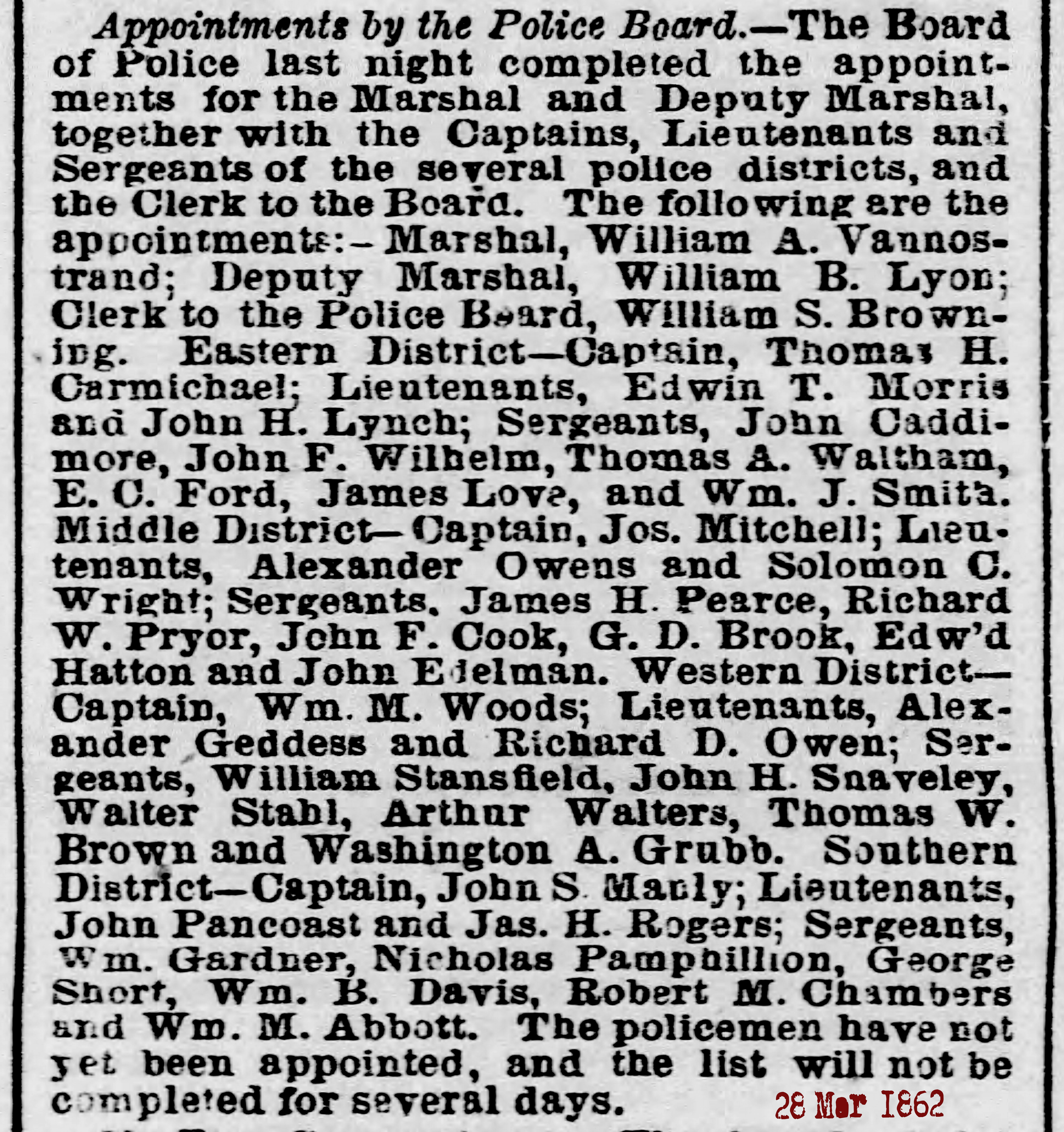
From Lamplighter to Magistrate to Sheriff of Baltimore

Brooklyn Rising: Potee’s Army

From lamplighter to magistrate to sheriff of Baltimore, the colorful Brooklyn figure was a populist leader unlike any other

 Click here for original Rik Forgo article HERE

Feb 18, 2020
 
By Rik Forgo
 

When motorists traveling in South Baltimore toward Brooklyn cross over the Hanover Street Bridge through the easternmost portion of Cherry Hill, they may scarcely realize that they are on Potee Street. That short stretch of highway between South Hanover Street and Ritchie Highway was known as Race Street for a short time in the early 1940s, but Brooklyn residents there asked for it to be renamed in honor of one of the town’s founding families, the Potees.

John E. Potee

And while the street’s name recognizes the entire family, one specific family member was on residents’ minds when the request was made by the Baltimore City Council in 1943: former Baltimore Sheriff John E. Potee.

John Potee was a popular and enigmatic figure in Anne Arundel County and Baltimore for nearly 40 years. He ascended a political ladder that his powerful father helped build, but started out as a lowly but affable lamplighter in his hometown of Brooklyn. He became a favorite of the local political machine and climbed from magistrate to sheriff of Anne Arundel County and then to sheriff of Baltimore in post-annexation Baltimore. He achieved success through his own unique brand of populism, which endeared him to the working class and later to industrial leaders and political heavyweights. But his initial success was built on the business and political foundation that his father, George, built in Brooklyn.

A Powerful Father Builds an Elite Family

The Potee family arrived in America in the early 1700s, supposedly on one of the Mayflower voyages. The family was said to have settled in the area that became Washington, D.C., and then fanned out across Maryland. Family patriarch Lewis Potee was born in 1716 in Joppa, Maryland, just northwest of Baltimore, according to Ancestry.com. His great-grandson, George Needham Potee, was born in 1830, and as an adolescent, he trained as a plasterer. With his brother Isaac, George took a job as an apprentice at the brickyards of George R. Rea on Washington Road in Curtis Bay. By the time he was 18, he had become foreman of William H. Pitcher’s brickyard in Baltimore and married the former Sarah Roche in 1850; the couple moved south of Baltimore to a then-emerging community, Brooklyn.

George and Sarah became one of the town’s first residents, and he started a successful business there as a well-digger and brickmaker. Brooklyn was just forming, and homes were being built steadily; his skills were in high demand. The Potee Brick Company made bricks for most of the construction in northern Anne Arundel County and southern Baltimore for more than 40 years. The business made him very wealthy, and, as its proprietor, George developed a knack for making powerful friends. Those friends trusted him well, and over the years, he was appointed to an array of high-level positions in northern Anne Arundel County, including tax collector, county commissioner, tobacco inspector, treasurer of the Brooklyn Banking Association, and chairman of Anne Arundel’s Democratic Committee. In 1884 and 1885, he was elected to represent Anne Arundel County’s District 5 as a member of the Maryland State Legislature.

George and Sarah settled at 11 South First Street in Brooklyn in the mid-1850s and had 16 children: 13 sons and three daughters. George continued to grow the business and worked with Richard Crisp and John Cromwell to secure approval for the Long Bridge, which connected Brooklyn to Baltimore. Meanwhile, Sarah, who was a leader in the temperance movement, led church campaigns to reign in drinking on the Sabbath. She was especially vocal against other Brooklyn figures who provided the temptations of alcohol to the working class, including, most prominently, John. T. Flood, proprietor of the notorious Flood’s Park in Curtis Bay, and Chief of Police Harry Acton, whose son, Samuel G. Acton, owned Acton’s Park, another riverside park near the Long Bridge on the shores of the Patapsco River.

All 13 of the Potee boys helped out in the family business in some capacity, and many left for college after working in the family’s brickmaking plant. Their second-to-last child, John Edgar, was born in 1873. He was a gregarious boy, and, like his father, he had a gift for making friends. He went to school at the well-regarded Knapp’s German and English School in Baltimore, studied at New Windsor College in Carroll County, and graduated from Bryant & Stratton Business College in Baltimore in 1895.

John joined his father’s brickmaking business in Brooklyn after graduating. He was just a few months into his apprenticeship when his father, George, died from a stroke in 1895 at 65 years old. His passing was a somber event in Brooklyn, where he was the oldest and most well-known resident at the time, according to the Baltimore Sun. More than 750 people attended his funeral.

Tragedy in Brooklyn

Roughly a decade after George’s death, his family remained a revered presence in Brooklyn. But troubled times loomed for the family on dueling fronts, personally and for the brickmaking business.

One of his sons, Walter, contracted scarlet fever in 1905, and his resulting psychosis would very nearly end John’s life. Walter was a mild-mannered, respected man employed as a timekeeper by the B&O Railroad yard in Curtis Bay. But he was never quite the same after his illness, which left him suffering from paranoia and depression for nearly a year. His relationship with his family, especially his mother, became strained. His behavior became erratic, and he would disappear for weeks on end; he was once arrested in northern Maryland on vagrancy charges after unlawfully riding as a hobo on a Pennsylvania and Maryland freight train in Bel Air, Maryland. His family described one incident where he barged into the home of one of his brother’s and threatened them with two pistols.

But on March 23, 1920, Walter’s behavior was the least of the Potee’s concerns. John’s nearly two-year-old son, John Edgar Jr., had died of an unspecified illness on March 20, 1906, and the grieving family held a well-attended wake in their First Street family home. Walter showed up to pay his respects that Saturday afternoon and showed no signs of violence, but he had three loaded pistols and a shotgun in the house. John was despondent as the wake started and Walter offered him a handkerchief, according to a detailed account of the day in the Baltimore Sun. But mere seconds after consoling his brother, he pulled his two pistols from his trousers and shot John in the back. The shots set off a panic in the house, and Walter went on a shooting spree.

In just minutes, he had wounded eight more people, including his two brothers-in-law, William Miller and Walter McPherson, Chief of Police Tom Irwin, and two of his patrolmen, who had responded to the gunfire. As Irwin and more officers made plans to apprehend the gunman, Walter cornered his mother and sister-in-law and aimed his pistols at them but couldn’t pull the triggers. He ran upstairs, barricaded himself inside the bedroom of the now-empty house, and set it ablaze. Firemen from Brooklyn’s #12 Engine Company didn’t arrive in time to save the entire house but managed to control the fire and keep it from spreading to neighboring homes.

When the fire was finally put out, Irwin scaled a ladder and crawled through an upstairs window to search for Walter, but found that he had fallen through the burnt timbers into the parlor below; he had died not from the fire but rather from a self-inflicted shotgun blast to the chest. It was a tragic day for the Potees. Services were held for the baby later in the week, and a private ceremony was held for Walter days later. Things settled down in the days after the shooting, and despite severe wounds, all those injured recovered. But bad news was on the horizon for the family brickmaking business.

The Popular Lamplighter

John and his brothers, George H. and Peter, took over the Potee Brick Company after his father's passing in 1895. His elder brothers carried the load and taught John the business, and together they operated the company for nearly a decade more before a series of lawsuits forced the company into liquidation in late 1906.

Now in his mid-twenties, John was married with a growing family. He had started his own building contracting business, and his many contacts from his father’s brick business proved helpful. Some of those contacts proved useful in other ways too, as he was able to secure a political appointment as the town’s lamplighter.

Electricity had not made it to Brooklyn by the early 1900s, but the community had an assortment of gas, oil, and candle lamps on poles to keep the village’s streets illuminated at night. Potee, with a ladder under one arm and a box of matches under the other, would traverse these neighborhoods, lighting the lamps at dusk and then putting them out again every morning. People would spend time on their front porches chatting and looking forward to Potee’s daily rounds and cheerful banter. His charm and dedication earned him praise and admiration from residents and local officials. He served on the board of directors for both the Industrial Bank of Curtis Bay and, later, the Brooklyn and Curtis Bay Bank. Encouraged by friends, he threw his hat in the ring to become a magistrate in Brooklyn. His influential political friends recommended him to newly elected Maryland Gov. Austin L. Cruthers, who then appointed him to that role in 1908.

‘Judge’ Potee Takes the Bench

As magistrate, Potee operated as a judge who dealt with lower-level crime cases, such as minor theft, criminal damages, and drunk and disorderly cases, along with traffic offenses, death certifications, and minor domestic disputes that didn’t warrant attention from Anne Arundel County’s legal leaders in Annapolis. Friends started calling him “Judge Potee,” a nickname that he vigorously embraced and that would follow him for the rest of his life.

Potee served as Brooklyn’s magistrate for two short years, but he had his eye on a bigger prize. He ran for sheriff of Anne Arundel County and won the election in 1913, a position he held for two years. Winning proved he could land a bigger political office; he was clearly burnishing his reputation as an emerging political power player. People were attracted to his brand of populism, and his influence was growing. In 1916, the new governor Emerson C. Harrington reappointed him as magistrate of Brooklyn after he had served as that county's sheriff for two years. This position paid him a tidy sum of $85 per month.

From his bench in the local police station in Brooklyn, which had been expanded to accommodate his new office, Potee made decisions and performed his duties in ways that the everyman of the day, especially those in his district, simply loved:

  • Potee granted a pardon for each dog claimed by anyone willing to stand in front of him and ask when the neighborhood dog catcher rode into Brooklyn and gathered up more than 500 stray dogs;
  • He threw out first pitches at baseball games for the local amateur clubs in East Brooklyn and Curtis Bay.
  • He loudly protested the Curtis Bay Light and Water Company's imposition of high water rates on the residents of Brooklyn and Curtis Bay as his voice grew in power to influence local issues that were popular with the general public.
  • With a nod to the church and his temperance movement-driven mother, he arrested, booked, and fined saloon keepers who illegally sold liquor on Sundays; and
  • He dismissed drunk driving charges for a horse-drawn wagon driver who was under the influence—aa conviction that at the time would have drawn 30 days in jail—bbecause “a horse has some brains, whether a driver has or not, whereas the same is by no means true of an automobile.”

Annexation Anxiety

There was rampant political uncertainty in Baltimore and northern Anne Arundel County in 1916 and 1917. Baltimore was steadily losing its place among the most populated metropolises in the nation, and the loss of national stature was threatening its bond rating with major banks. Cities in the top 10 could easily borrow money to fund projects, but lower-ranking cities had more challenges and, as a result, fewer resources to choose from. Other industrial cities like Pittsburgh and Cleveland were busily inflating their populations by annexing neighboring towns, and Baltimore had been considering doing the same. After studying the issue for nearly a decade, Baltimore City got the state’s approval to annex Brooklyn and Curtis Bay over the strident objections of Anne Arundel County.

Potee opposed Baltimore’s annexation, likely because of the uncertainty that it brought to local politics. The “Wells Machine,” named for Dr. George Wells, a former Anne Arundel County tax collector and treasurer who controlled much of the county’s Democratic political apparatus from the mid-1800s to just after the turn of the century, had opposed annexation, and Potee echoed the party line. But when the Maryland State Legislature approved the city’s power play at the end of 1917, it was a fait accompli, and Potee found a way to make it work for him.

After annexation occurred, “Judge Potee” was assigned the magistracy of Baltimore’s Southern Police District. Back in the familiar role of magistrate, he returned to dispensing his own brand of justice, and some of his notions were very progressive.

While he still lived in his family home in Brooklyn, he had also bought a farm in Hawkins Point and grew produce for the markets in Baltimore. When older, broken men were brought before his bench in Brooklyn for vagrancy, he would suspend their sentences and send them to his farm to pick and plow, and he paid them a working wage. “The first man he sent there stayed and worked an entire season, delighted to be self-supporting once more,” Katherine Scarborough wrote in her column in the Baltimore Sun in April 1945. “Another, after earning a few dollars and eating his fill of good food, left for a better job. Once [Potee] received a letter from an 18-year-old Negro who, after a week at the farm, had earned enough money to take him back to the home in Cincinnati he had left.”

Potee’s Army

While he was still dispensing justice in Brooklyn and Curtis Bay, his new position required him to spend more time in Baltimore City, and he began making new political friends there. After serving his second go-round as magistrate, this time for six years, he decided to take another political risk: he campaigned for and won the office of sheriff of Baltimore City in 1923.

Baltimore had a robust police force in the mid-1920s, and Potee’s role as sheriff was as process server. His office served writs, warrants, and subpoenas, and he presided over sheriff’s juries that heard domestic cases. His staff was relatively small, with just four or five funded deputy sheriffs and some support staff. But he drew considerable support from his army of unpaid, armed deputies that he anointed—aas many as 1,500 at one point in his tenure. And that’s where Sheriff Potee’s political rivals took aim.

Questions began arising about the sheriff’s office shortly after Potee took office in early 1924. In February, he swore in his first 29 “special” deputies, all of whom were assigned to oversee the “industrial plants and other places where they are employed,” the Baltimore Sun reported. The special deputies did not serve summonses or writs, and they had no authority to act as regular sheriff’s deputies. Potee compared them to special policemen on railroads, who, he said, were frequently commissioned. They were each issued a badge, authorized to carry a gun, and tasked with “preserving order among their fellow employees.”

The notion of deputized citizens was not novel to Baltimore. In times of public danger, Baltimore’s sheriff and police commissioner were authorized to appoint special policemen, though doing so was rare. The Commissioner of Motor Vehicles in Baltimore had a small cadre of deputies, and Potee alleged that his predecessor, Sheriff Thomas F. McNulty, had his own team of 250; Potee, citing the precedent, steadfastly defended his approach.

“If the people who are heads of the [industrial] plants come to me and say they want somebody appointed special deputy sheriff for their protection, what am I going to do? I can’t turn them down, can I? The moving-picture men say that a special deputy sheriff’s badge keep fellows from loafing around the moving-picture places.”

— Sheriff John Potee, August 1924

Some alleged that the special deputies were “heavies” and “spies” for the industries. Those who patrolled the factories and packing plants in Curtis Bay, Fairfield, and Brooklyn were often managers and foremen for these companies too. Allies of labor claimed that these men were government-sponsored union busters who had special privileges.

When asked if it was necessary to appoint special deputies at plants and moving picture theaters when Baltimore already had a police force to protect them, Potee defended the practice. “The badge that special deputies are entitled to wear is one of the best preservers of peace to be found,” Potee told the Baltimore Evening Sun in March 1924. “Frequent [fights] that begin in moving-picture theaters would be avoided if all the managers were equipped with them. The presence of authority would deter the rowdy who would otherwise start a fight and cause him to remain calm. If more theater managers were made special deputies, it would relieve the regular policemen of the necessity of visiting theaters and increase police protection on the street.”

Some in Baltimore’s government complained that special deputy selections were being made as political favors, which Potee and his supporters dismissed as mere posturing since the granting of choice positions to political allies was a regular practice in Baltimore and Anne Arundel County. But Potee’s use of special deputies was more worrisome than other white-collar appointments because his deputies carried a badge and gun. Moreover, considerable concern grew because of the sheer number of deputies he was appointing. Just three months after being elected, there were already 250 special deputies, and within two years, “Potee’s Army” would reach an unwieldy size of more than 600. The administration, vetting, and policing of these special deputies would eventually come to haunt him.

The appointment of deputies was managed by the self-funded Deputy Sheriff’s Association, which levied a $5 fee on men (and one woman) who applied to become one, along with an annual $12 assessment for members if selected ($74.27 and $178, respectively, in 2020 dollars, according to DollarTimes.com). The group’s membership committee, managed by Arthur B. Price, ironically, the owner of the Wizard Moving Picture Theater in Baltimore, reviewed and conveyed all applicants to Potee for his blessing. Potee said the men chosen as deputies “are all passed on by the membership committee of the association and are known to be responsible men before they are appointed.” This seemed largely true at the outset, but the behavior of some deputies became questionable later.

Potee’s deputy troubles started in earnest in August 1924, when a Baltimore City patrolman spotted special deputy James Ringgold illegally directing traffic at the intersection of Light and Camden Streets. When the patrolman approached him and asked him what he was doing, Ringgold declared he had the right; the patrolman insisted that he was not authorized, a dispute erupted, and Ringgold punched the officer in the nose. Ringgold was arrested and dragged before the city’s district magistrate. But when Ringgold told the judge that he was a special deputy for the sheriff, the disorderly charges against him were summarily dismissed, and he was released. Ringgold was, indeed, a proper deputy, but no one had explained the boundaries of the role to him. Sheriff Potee didn’t know Ringgold and initially thought he was masquerading as a deputy. Later, he learned that he had approved the paperwork granting him the position.

Other embarrassing incidents followed. One special deputy exceeded his authority by arresting a man for carrying a flask of whiskey in violation of the Volstead Act (Prohibition). Another former special deputy illegally sold his special deputy badge to a con man who used it to extort money from a local business. Another deputy broke up an illicit craps game, chased a youth involved, and fired his weapon on a crowded street while in pursuit. Still another pulled a gun on a Baltimore patrolman and threatened to “blow his head off” for willfully parking in a prohibited area. The deputy association wasn’t vetting its deputies well, and the sheriff’s office was getting a black eye over it. The press was having a field day.

Court-Ordered Prisoner Whipping

Amidst the unwanted attention that had arisen over his deputy army, Potee found himself thrust into another unwanted, high-profile situation in the spring of 1926. Baltimore Criminal Court Judge Eugene O’Dunne sentenced convicted wife beater James Kingsmore to 60 days in jail and five lashes at Baltimore’s whipping post for an assault on his wife. It was an unusual order, since only two public floggings had occurred in the city since the mid-1880s. Further, the statute O’Dunne drew from made the brutal act optional. Deputy State’s Attorney Rowland K. Andrews pleaded with the jury to render a verdict that carried the whipping penalty, and the jury unanimously obliged.

Potee was clearly not thrilled. “It is an unpleasant duty,” he said, “but it is a duty imposed on the sheriff, and I will perform it.” Letters to the editor of the Baltimore Evening Sun implored the sheriff to ignore the order or to simply delegate the duty to a deputy sheriff, but he declined. Other letter writers were angry and advised him to resign rather than perform the lashing, while some simply warned him they would remember him at the polls if he went through it. But on April 29 at 10 a.m., Potee gave Kingsmore five lashings in accordance with the order in front of a crowd of more than 150 people at the Baltimore City Jail. The task, carried out using a whip with leather thongs known as the “cat-o’-nine-tails,” occurred so quickly that those in attendance barely realized it was over. The Evening Sun reported that “the blows seemed to be light ones” and that “the whipping left no welts that were visible a few feet away.”

The attending physician, Dr. Frank J. Powers, said that apart from nervous strain before the lashing, Kingsmore did not suffer. When it was over, Potee simply walked back to the jail, hung the whip on its perch, and proceeded with his daily duties. Outwardly, Potee seemed reluctant to engage in the task, but his office did sell tickets to the event. And, notably, in his early days as an Anne Arundel County magistrate, he recommended the whipping post for a man who attempted to murder his wife in a drunken rage. But his statements and actions suggested he was a reluctant participant.

Other ‘Armies’ and Deputy Infighting

Despite the negative press from his deputy army and the whipping sentence he carried out, the popular Potee ran unopposed for sheriff in 1926. He was temporarily successful in tamping down the furor over his deputy army in the year leading up to the election, but the bad press returned in 1927. Potee’s deputy association, a private organization, had become a very profitable enterprise. And although E. Austin Baughman, the city’s Commissioner of Motor Vehicles, had already been using special deputies for years, he advertised for deputies in a move some believed was intent on mirroring Potee’s success. In February 1927, more than 3,000 people applied to be “special deputy automobile commissioners,” which drew a flood of negative attention from state lawmakers concerned about scores of deputies “running around with tin badges and guns.”

Potee focused on his duties, but more trouble was brewing with his deputy association, which by late 1928 was brimming with more than 1,500 members and burnished sardonic nicknames like “Potee’s Army,” “the Patapsco Valley Army of Occupation,” and “the Gold Badge Boys.” The association was profitable for its chiefs, and rival factions within the group increasingly wanted more say in the selection of its leadership. Personal dustups, infighting, and jealous arguments were becoming commonplace. The organization was collapsing under its own enormous weight, and Potee could only watch as bickering consumed the group. Then the wheels fell off. The association reorganized into two separate organizations, each vying to draw members from the other, with Potee squarely in the middle. But the reality was that by then it was essentially over.

As the group’s dysfunction played out, Potee’s political rivals in Baltimore were vying to remove him. The Wells Machine’s grip on power in Anne Arundel County was loosening as its leaders aged, and it wielded less influence in Baltimore. Things were changing in the electorate chemistry. Potee depended on commercial and industrial interests that helped him win the election in 1924 and 1926, but those forces were ineffective in 1930. Potee narrowly lost his bid for reelection as sheriff in the Democratic primary in 1929 despite being unopposed at the polls in 1926. Former deputy sheriff Joseph C. Deegan had spent a lot of time campaigning against the special deputies.

The primary vote was split among Deegan, Potee, and another deputy sheriff, August Klecka, and Potee lost by fewer than 2,000 votes. He requested and received a recount, but it didn’t change the results. The era of Potee’s political reign had ended; he would not hold another elected office. As promised, Deegan dismantled the special deputy operation a year after he took office, and he emerged as a popular, colorful figure in Baltimore. He held onto the sheriff’s office for more than 30 years.

Potee Street

Judge Potee returned to Brooklyn after his loss. His new bench was on his front porch at the 3611 Hanover Street (formerly 11 First Street) home where he was born. Despite his political fall, he remained a popular figure in his hometown. His health was failing, even as he campaigned for sheriff, and the inactivity of being constantly at home didn’t seem to help his condition. A year after the loss, the Baltimore Sun reported that he was frequently seen on his porch as neighbors waved and chatted, but he was barely able to respond. A shell of his former outgoing self, he died of an unspecified illness on November 19, 1933, in that same house.

Though he was gone, he was not forgotten. In 1942, Baltimore City constructed Race Street as a southern connection point to what would eventually connect to Ritchie Highway. A year later, a group of residents from Brooklyn approached the city council, seeking a name change for two streets. They wanted Race Street renamed “Revell Street” in honor of the longtime Anne Arundel County Democratic boss Frank Revell, and they wanted Leadenhall Street renamed “Potee Street.” The city’s Bureau of Plans and Surveys approved a change to Race Street since it was so new, but it ruled against the change to Leadenhall Street because it was already so well established. Given the choice of renaming the one street they were allowed to change between Potee and Revell, they dropped Revell and chose to honor the Potee family instead. So in March 1945, the city council approved an ordinance changing the name of Race Street, between Hanover and Jack Street, to Potee Street.

John Potee dispensed his version of justice from varying roles in Brooklyn and Baltimore, and he became an icon in pre-World War II Baltimore. His contributions have been somewhat forgotten, but he was a larger-than-life man of the people who had an outsized populist appeal. Not too bad for a lamplighter.

Brooklyn Rising


Brooklyn Rising, Part 1: Pristine Town Emerges on the Shores of the Patapsco

Brooklyn Rising, Part 2: The Long Bridge

Brooklyn Rising, Part 3: The Lost City of Pennington

Brooklyn Rising, Part 4: The Great Walnut Tree

Flood’s Park

King Johnson

Acton’s Park

Andy Youngbar

Bill Hohman

Orioles Break the Sunday Baseball Taboo in Brooklyn


Editor's Note: The University of Maryland-College Park, University of Maryland-Baltimore County, the Kuethe Library in Glen Burnie, the Maryland State Archives, the Anne Arundel County Planning and Zoning Department, and a number of local archives all contributed to the creation of this history of Brooklyn. Thanks also go out to Horton and Maryann McCormick, Carole Kenny, Frank Bittner, Rick Arnold, Elaine Borrison, the USCG’s Dottie Mitchell, Geraldine Bates, the Chesapeake Arts Center’s Belinda Fraley-Huesman, Nicole Caracia, and a host of others.

1 black devider 800 8 72

POLICE INFORMATION

If you have copies of: your Baltimore Police Department class photo; pictures of our officers, vehicles, and equipment; newspaper articles relating to our department and/or officers; old departmental newsletters; lookouts; wanted posters; or brochures. Information on deceased officers and anything that may help preserve the history and proud traditions of this agency. Please contact retired detective Kenny Driscoll.

This email address is being protected from spambots. You need JavaScript enabled to view it.

Devider color with motto

NOTICE

How to Dispose of Old Police Items

Please contact Det. Ret. Kenny Driscoll if you have any pictures of you or your family members and wish them remembered here on this tribute site to honor the fine men and women who have served with honor and distinction at the Baltimore Police Department. Anyone with information, photographs, memorabilia, or other "Baltimore City Police" items can contact Ret. Det. Kenny Driscoll at This email address is being protected from spambots. You need JavaScript enabled to view it. follow us on Twitter @BaltoPoliceHist, like us on Facebook or mail pics to 8138 Dundalk Ave., Baltimore, Md. 21222


Copyright © 2002 Baltimore City Police History: Ret Det. Kenny Driscoll 

How to Dispose of Old Police Items

logo

Please contact Det. Ret. Kenny Driscoll if you have any pictures of you or your family members and wish them remembered here on this tribute site to Honor the fine men and women who have served with Honor and Distinction at the Baltimore Police Department. Anyone with information, photographs, memorabilia, or other "Baltimore City Police" items can contact Ret. Det. Kenny Driscoll at   Kenny@BaltimoreCityPoliceHistory.com follow us on Twitter @BaltoPoliceHist or like us on Facebook or mail pics to 8138 Dundalk Ave. Baltimore Md. 21222.
NEWSLETTER

Subscribe now to get 100 exclusive photo & two newsletters per month