Fahlteich

Fahlteich

Fahlteich

Major Richard "Rick" Fahlteich

Major Richard "Rick" Fahlteich served the Baltimore Police Department with distinction for over three decades, rising from patrol officer to Major of the Homicide Unit. Known for his loyalty to his officers and relentless pursuit of justice, he left an indelible mark on the department.

Early Career

Fahlteich joined the Baltimore City Police Department in 1974 after serving in the Army at age 17 and a brief stint at Norris Industries. Starting as a patrolman, he quickly advanced through the ranks, earning a reputation for sharp investigative skills. By the 1980s, he served as a detective in the Homicide Unit, featured in David Simon's book Homicide: A Year on the Killing Streets, where he worked alongside detectives like Tom Pellegrini and Oscar "The Bunk" Requer on gritty street cases.

Rise Through the Ranks

Promoted to Sergeant, Fahlteich contributed to key department initiatives, including training committees alongside Sgt. Deborah Owens and Officer Ray Hodgins in the mid-1990s. His leadership shone in high-stakes investigations, such as preparing search warrants for Northwest Baltimore homicides in 1987. Colleagues remembered him as a hands-on leader who prepared meticulously and supported his team through long hours and tough cases.

Homicide Unit Leadership

Fahlteich reached the rank of major and commanded the Homicide Unit, retiring in 2004 after 32-33 years of service with numerous commendations. That same year, he answered the police commissioner's call to return as commander, showcasing his unwavering commitment before fully retiring in 2006. His tenure emphasized officer welfare—he went above and beyond for his people, ensuring they kept their ranks and badges even in hardship.

Legacy and Honors

Inducted into the Baltimore Police Department's Hall of Fame, Fahlteich embodied resilience and dedication. He inspired younger officers as an instructor and prioritized his team's well-being, turning potential career setbacks into successes through personal intervention and high-level advocacy. Fahlteich passed away on January 13, 2023, remembered as a true guardian of his fellow officers.


 1 blue devider 800 8 72

Trinh Suspect Arrested 
DNA sample leads police to 27-year-old man 'not a stranger' to campus


By Greg Rienzi
The Gazette

Baltimore City Police announced on March 23 the arrest of a 27-year-old male Baltimore resident charged with the murder of Johns Hopkins undergraduate Linda Trinh. The capture of the suspect effectively ends a search that included two months of forensic laboratory investigations and hundreds of interviews by detectives.
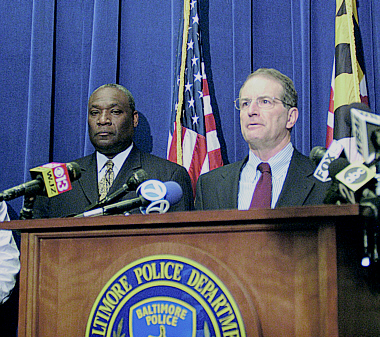
University officials attended the news conference, held at Baltimore Police headquarters, where Maj. Richard Fahlteich announced the apprehension of Donta Maurice Allen, a non-Hopkins affiliate who was a "close friend" of one of Trinh's sorority sisters. According to Fahlteich, Allen was "not a stranger" to the Homewood campus, and a lot of students, including Trinh, were familiar with him.

"He was readily accepted in the community and had access to the building where Trinh and her fellow sorority sisters lived," he said.

Trinh, a 21-year-old senior biomedical engineering major and former president of her sorority, was found dead on Jan. 23 in her residence in the Charles Apartments, a privately owned building across Charles Street from the Homewood campus.

Allen has a criminal record that includes possession of a controlled and dangerous substance and malicious destruction of property. Police said that he was identified very early on in the investigation among a group of nonstudents who frequented the Charles Apartments. However, it was only last week that they received the results of the DNA tests that tied Allen to the crime.

"The evidence we have recovered clearly, categorically, and unequivocally says that Mr. Allen is our suspect," Fahlteich said.

Allen has been seen on video surveillance records entering and leaving the Charles Apartments, but police declined to say whether he was caught on video surveillance on the day Trinh was killed.

Police said that although Allen would have been an "unwelcome guest," they do not believe he broke into Trinh's apartment.

Fahlteich also said there was no "direct evidence" of a sexual assault in this case and that investigators do not know, or would not release, what Allen's motive may have been. The cause of death is said to be asphyxiation.

Police Commissioner Leonard Hamm opened the briefing by saying that the department takes every homicide very seriously and that all are tragic, but because of the special circumstances involved in this case, a news conference was deemed appropriate.

Trinh was a well-known and widely admired student, and her death led to an outpouring of support for her family and friends. A memorial service held for her on Feb. 2 drew nearly 1,200 members of the Johns Hopkins community.

President William R. Brody, who spoke at the news conference, thanked Commissioner Hamm and his officers for their aggressive pursuit of the case and the many man-hours they devoted.


"I want to say how especially grateful we are to every detective, every officer, every forensic investigator, and everyone who contributed in any way to the successful conclusion of this investigation," Brody said. "Not only as president but as a parent, I can tell you that the safety and security of our students are of paramount importance to us at Johns Hopkins. We have been working very hard—often in close cooperation with the community, the police, and the city—to enhance that safety and security. I pledge today that we will not let up in our dedication to that effort of making the community safe for all."

Allen was charged with first-degree murder. He was scheduled for a bail review on Friday.

On Thursday, Allen's defense attorney, Warren A. Brown, told The Baltimore Sun that his client informed police interrogators that he had forced his way into Trinh's apartment and hit her, but that he did not kill her. According to the article, which appeared on Friday, Allen's statements to detectives came in the hours after his Wednesday arrest.

Trinh's death marked the second time in less than a year that Johns Hopkins' undergraduate community and the university at large suffered such a tragic loss. The day after an early morning attack by an intruder in the off-campus building that his fraternity, Sigma Alpha Epsilon, occupied, junior Christopher Elser passed away from knife wounds on April 18, 2004.

In response to the two deaths, President Brody enacted a 15-point security action plan in late January, a series of new initiatives intended to enhance the safety and security of students on the Homewood campus and in the neighboring community. Implementation of the plan is proceeding at a rapid pace. The first phase of the "smart camera" video surveillance system is expected to go live this week.

The police said they continue to believe there is no connection between the two student deaths. A $50,000 reward remains in effect for information leading to the arrest and conviction of a suspect in the Elser case.

 Go to MARCH 28, 2005 table of contents
 Go to the GAZETTE front page. Full Article HERE


About

Baltimore City Police History
About Us

BPDH 72

Mel Tallagsen and Ryan Schiloh assisted in creating this website with the assistance of Retired Detective Kenny Driscoll and his wife, Honorary Police Officer Patricia Driscoll. Patty holds things together for Ken, and while he may be more of a lead investigator or researcher, Patty keeps him going, takes care of his medical needs, and their kids and grandkids are what drive Ken to work harder. Patty gives him that drive. Ryan helped Ken get started building the first site. But when that build got out of hand, Ryan turned everything over to Mel. All three have known each other since they were kids. Mel not only helped Ken build the sites, but he also trained Ken on how to build sites himself, how to write items, articles, etc., and then how to use Mod. The site wouldn't be what it is without these four and how they drive each other to be better. Ken has also said he wouldn't have been able to do any of this without Bill Hackley trusting him with his old site, which at the time was 90 pages. Ken's second and third sites had as many as 1200 pages. Ken did this rebuild using a new system that allows him to be less repetitive. On old sites, if you saw the same picture twice, it was on there twice. Now, if you see the same picture 100 times, it is on there once but being called up 100 times. This has reduced not only the number of pictures, but the same was done with pages; we had some pages duplicated because lines wouldn't work from certain mods. The new site has about 800 pages, so it is nearly nine times larger than the first site and now holds the same information as the 1200-page site. Which we hope will give us a safer site (less points of entry) and a smaller site with less repetitiveness. Ken says he will build the site back to 1200 or 2400 pages, whatever it takes, to put as many officer stories on here as they want. Ken, as well as others that have worked on this site, feel that any officer who ever put on the badge of a Baltimore City officer deserves to be on the site. So if you have a story and want it told.

Write Ken or Patty at either This email address is being protected from spambots. You need JavaScript enabled to view it. or This email address is being protected from spambots. You need JavaScript enabled to view it., and they would be more than happy to add whatever information you might have to their site. The website is a great resource for anyone interested in the history of law enforcement in Baltimore City. It is constantly updated with new information and stories from current and retired officers. Whether you are a history enthusiast, a law enforcement professional, or simply curious about Baltimore City's past, this website provides a valuable platform to explore the rich heritage of the city's police force. By actively encouraging individuals to contribute their stories and information, Ken and Patty ensure that the website remains a dynamic and comprehensive resource for all. Don't miss out on the opportunity to contribute to this important archive and help preserve the legacy of Baltimore City's law enforcement.

Blessed are the peacemakers for they shall be called the children of God. - Matthew 5:9

1 black devider 800 8 72

Baltimore Police Historical Society

It is difficult to comprehend and appreciate that Baltimore Police Officers have been patrolling Baltimore streets since 1784 and doing so with pride, loyalty, and dedication. It is one of the oldest police departments in the country. During these nearly 240 years of service, the department has experienced major changes that have been negative, positive, and tragic. Because of this, in 2014, the Baltimore Police Historical Society was founded. The men and women who comprise the society are volunteers who recognize the significance of our past, which is steeped in dignity, honor, pride, and tradition. More than 200 of Baltimore’s police officers have lost their lives while working or in the line of duty. Until the society began its research, most of them had been completely forgotten. It was in their memory, and the memory of every officer who has served this department, that the Baltimore Police Museum was rebuilt in 2016. The society continues to research the department's proud history and locate and display police memorabilia in the museum and on this site. The Baltimore Police Museum stands as a testament to the sacrifices made by these brave officers, preserving their legacy for future generations. Through its exhibits and displays, the museum educates visitors about the rich history of the department and the dedication of its officers. The society's ongoing research ensures that no officer's contribution is forgotten, fostering a sense of honor and pride within the community. 

Retired Detective Kenny Driscoll recalls talking our history over with Bill Hackley back in 2008 and offering to help Bill with his website, a site dedicated to Baltimore Police history but geared more toward remembering our fallen and injured police. Ken made several suggestions, such as adding a page for Baltimore’s Women in Blue, Baltimore African American Police, and several others. Bill refused, saying we had worked too long to desegregate our department for us to separate everyone. Ken understood Bill's view but also felt it was part of our history and something that needed to be done. In other talks with Bill, it was decided that Ken could work on the site’s photos. Ken had been using Photoshop and was able to clean up many of the old photos as well as make banners. The site had 90 pages. In 2012, Bill called Ken; he used to make a post on Facebook on the days our police had passed, giving the name of the fallen officer, and asking that he be remembered. He asked Ken if he was ill and if he would take over making these posts. Within a week, Bill passed away. Ken received an email asking him to contact Bill’s wife as Bill was handing Ken the website. They drove to someplace near the Pennsylvania state line to pick up the passwords to the site. Ken tried paying the monthly hosting fees, but Bill’s wife refused. Then Ken started adding to the site, and before long he received a message from the hosting company that he had reached the limit and that it would cost an extra $40 a month to get more space. Ken offered to pay the difference, but again, Bill’s wife refused. Ken asked if she would mind him moving the site to a professional hosting company, and Ken would take over all payments. She agreed, and Ken got started. It took two months, but the site was done, going from 90 pages to more than 300 pages. The site has been rebuilt five times. One of the sites called for making duplicate pages or very similar pages and had nearly 1200 pages; most of them were due to the site’s calendar. In Ken's last build, he had everything the old site had, including a calendar, and the site was right under 600 pages. The calendar mentioned is important and often visited by city leaders as it has "This Day in Baltimore Police History on it, telling when officers had fallen in the line of duty, when various units began, and when certain tools and equipment was introduced, or ended use within the agency. The site is one of the most viewed police history sites in the country; it is used by city hall, departmental commissioners, education and training as well as other top brass, local media, authors, playwrights, movie and TV scriptwriters looking to gather historical data as technical support. With the historical society, the police newsletters took notice, and our agency’s historical interest picked up. The police academy started having trainees do reports on fallen officers, and they added a timeline to a wall in the police school so young officers could learn about the footsteps they would be following. The department is rich with talent, accomplishment, and pride, all of which are built on a tradition of excellent service to the community. Not everyone can work as a police officer. It is a special calling that requires unique attributes not found in the civilian sector. In particular, officers must have the courage to face injury and the possibility of death every day and constantly deal with society at its worst. Once accepted, an officer becomes part of something special. It is hard to explain, but those who have worn the badge of a Baltimore City Police Officer will tell you that it is a unique experience. The Baltimore Police Historical Society is dedicated to ensuring that the service of all the officers who have proudly served or are currently serving our city will always be remembered. Being a police officer is not an easy job, it requires a great deal of courage and strength to face the things they do, which can be emotionally draining. However, for those who are accepted into the force, it is a truly special experience. The camaraderie and sense of purpose that come with being part of our department are hard to explain, but they are something that all Baltimore City Police Officers understand. That's why the Baltimore Police Historical Society is so important—it ensures that the service of all officers, past, present, and future, will always be remembered. By preserving our stories and honoring our sacrifices, we can continue to appreciate the vital role Baltimore’s Police Officers play in the communities. The Baltimore Police Historical Society serves as a platform for officers to connect with one another and share their experiences, fostering a strong bond within the department. Additionally, by highlighting the contributions of past officers, it inspires current and future officers to uphold the legacy of dedication and service in their own careers. 

They are no longer a 501(c)(3) non-profit because they never wanted to bring in enough funds that they would have a surplus of funds. They never wanted to pay anyone to be part of their group. They want people who are interested enough in the department's history to want to contribute their help because they know what they have to offer is needed and would improve or add to our already-known information. They do take donations, but not like most people would think. Donations are used to pay for, or partially pay for, domain names, web storage, and Sun archives, which are used for research, etc.  Essentially, donations are just chipping in to help cover the bills. They receive so few donations that maintaining a 501(c)(3) was costing them more than they were bringing in, and while some people said they could have made what the society had a profitable business, they don't want to get into having a historical society that has the purpose of making money. As a result, in most cases, Ken pays for everything out of his pocket, amounting to around $1500 a year, just over $100 a month for the site's servers, and about $300 a year for domain names (they have a few), archive experiences, and a few other necessary needs to keep things up and running. So if you would like to contribute to one of the bills, use one of the donation buttons found on most of the pages. Ken's dedication to maintaining the historical society's website is truly commendable. Despite the financial burden he bears alone, he remains committed to keeping the site running smoothly for everyone's benefit. If you believe in preserving history and want to support this noble cause, consider making a donation through the conveniently placed buttons on various pages of the website.

1 black devider 800 8 72

Using The Site

Using the site, obviously, you could use the top drop down menu to find most of what you are looking for, but remember that we also have what are known as "hidden articles." These are pages that are linked to from other pages and not found in the drop down, photo banners, or side menus. You could also use the search engine; just type in what you are looking for, click on one of the links provided in the search results. Once you get to that page, we recommend hitting CTRL F and again typing a key word as to what it is you are looking for; it should highlight the word searched, but you could also use the down arrow in the search box to skip from word to word until you find what you are looking for. Ken built the site and uses the search engine anytime he is researching something on the site; first always using the search box just under the calendar on the top right side of the page, then CTRL F to find what he is looking for on a specific page. Using the search engine not only saves Ken time but also allows him to quickly navigate through the vast amount of information on the site. Additionally, CTRL F is a handy tool that helps him locate specific details within a page, ensuring he doesn't miss any important information. 

Speaking of the calendar, any day of the year you can look at the calendar, and if it has a color or black underline, click the date and you will see what happened on that day in history. The calendar is often used by mayors, commissioners, and deans of Baltimore's universities; it is a wealth of information.  In addition to the calendar, the site also features a section dedicated to other historical information from Baltimore's past. The site is regularly updated and provides information on Baltimore's police, good or bad. Visitors are invited to join us on Facebook to stay up-to-date on our latest historical findings or memorabilia purchases. The Facebook page also serves as a platform for users to engage in discussions and share their own stories and memories of Baltimore's history. It creates a sense of community among history enthusiasts and fosters a deeper appreciation for the city's rich heritage. Furthermore, the site offers a comprehensive collection of photographs, documents, and artifacts that allow visitors to visually explore Baltimore's past and gain a deeper understanding of its cultural significance. 

If you have something to add to the site, it would be best to contact Ken at, This email address is being protected from spambots. You need JavaScript enabled to view it. 

1 black devider 800 8 72

About the Baltimore Police Museum

The Baltimore Police Museum was re-established in 2016 by retired Detective Kenny Driscoll and Officer Bobby Brown, who are also the department’s volunteer historians. The exhibits on display began in large part with Ken's personal collection and has since grown through the donations made by family members of former Baltimore officers. In most cases, items are given to Ken, or Ken will offer to buy them from family members, so the item's ownership is maintained by Ken. This is done so if the museum is ever shut down for any reason, the exhibits would be kept together so they could be shown at another location. This is done because in the 1990s we lost a 20 year old museum when the department decided to close it down and rededicate that space as office space, and storage. At the time, several exhibits were lost and have not been recovered. When exhibits have ownership, if anything were to happen to the museum, the department would give the owners time to remove their exhibits and they would be safely preserved. The museum is presently located in Police Headquarters Building, 601 E. Fayette St. Where the museum offers visitors a unique look back in time, into our department from its inception and on to present time through the use of police artifacts such as old uniforms, vehicles, handguns, shotgun, badges, espantoons, handcuffs, patches, a wagon, a large archive of photos, and other police related memorabilia. Visitors can explore the rich history of our department by immersing themselves in the diverse collection of police artifacts. From vintage uniforms and vehicles to an extensive archive of photographs, the museum showcases the evolution of law enforcement over the years. Additionally, the exhibits include a variety of weapons, badges, and handcuffs that provide a fascinating glimpse into the tools and techniques used by officers throughout history. 

The museum is maintained and operated by the Baltimore Police Historical Society, a non-profit organization dedicated to preserving the memory of our fallen, our injured, and all those who have faithfully served the Baltimore City community over the years. Currently, funding to maintain the exhibit is acquired exclusively through "private donations," and donations are made to pay operating costs and expenses directly. The museum offers visitors a unique opportunity to explore the evolution of law enforcement equipment, from handcuffs and batons to modern-day body cameras and forensic technology. By showcasing these tools and techniques, the museum aims to educate the public about the challenges faced by police officers in different eras and foster a deeper appreciation for their service. The Baltimore Police Historical Society actively seeks support from individuals and organizations that share their mission, as every contribution helps ensure that this valuable exhibit can continue to inspire and inform future generations. 

The Baltimore Police Museum is open for viewing to individuals or groups by appointment only and has become a valuable asset to help the Baltimore Police Department educate the citizens of Baltimore, potential recruits, trainees, and others about police work in our city. It can be arranged to have one of the department historians come to your tour and verbally guide visitors from 1784 to the present, emphasizing the proud history of the men and women of the Baltimore Police Department. The museum showcases a wide range of artifacts, including historical uniforms, weapons, and equipment used by the police force throughout the years. Visitors can also learn about significant cases and milestones in the department's history, providing a comprehensive understanding of law enforcement in Baltimore.
 

1 black devider 800 8 72

POLICE INFORMATION

Copies of: Your Baltimore Police Department Class Photo, Pictures of our Officers, Vehicles, Equipment, Newspaper Articles relating to our department and or officers, Old Departmental Newsletters, Lookouts, Wanted Posters, and or Brochures. Information on Deceased Officers and anything that may help Preserve the History and Proud Traditions of this agency. Please contact Retired Detective Kenny Driscoll.

This email address is being protected from spambots. You need JavaScript enabled to view it.

Devider color with motto

NOTICE

How to Dispose of Old Police Items

Please contact Det. Ret. Kenny Driscoll if you have any pictures of you or your family members and wish them remembered here on this tribute site to Honor the fine men and women who have served with Honor and Distinction at the Baltimore Police Department.

Anyone with information, photographs, memorabilia, or other "Baltimore City Police" items can contact Ret. Det. Kenny Driscoll at This email address is being protected from spambots. You need JavaScript enabled to view it. follow us on Twitter @BaltoPoliceHist or like us on Facebook or mail pics to 8138 Dundalk Ave. Baltimore Md. 21222


Copyright © 2002 Baltimore City Police History - Ret Det Kenny Driscoll 

Saunders Range

Saunders Range

These are not part of the history sites public pages, if you found this page, it is intended for Ken's research

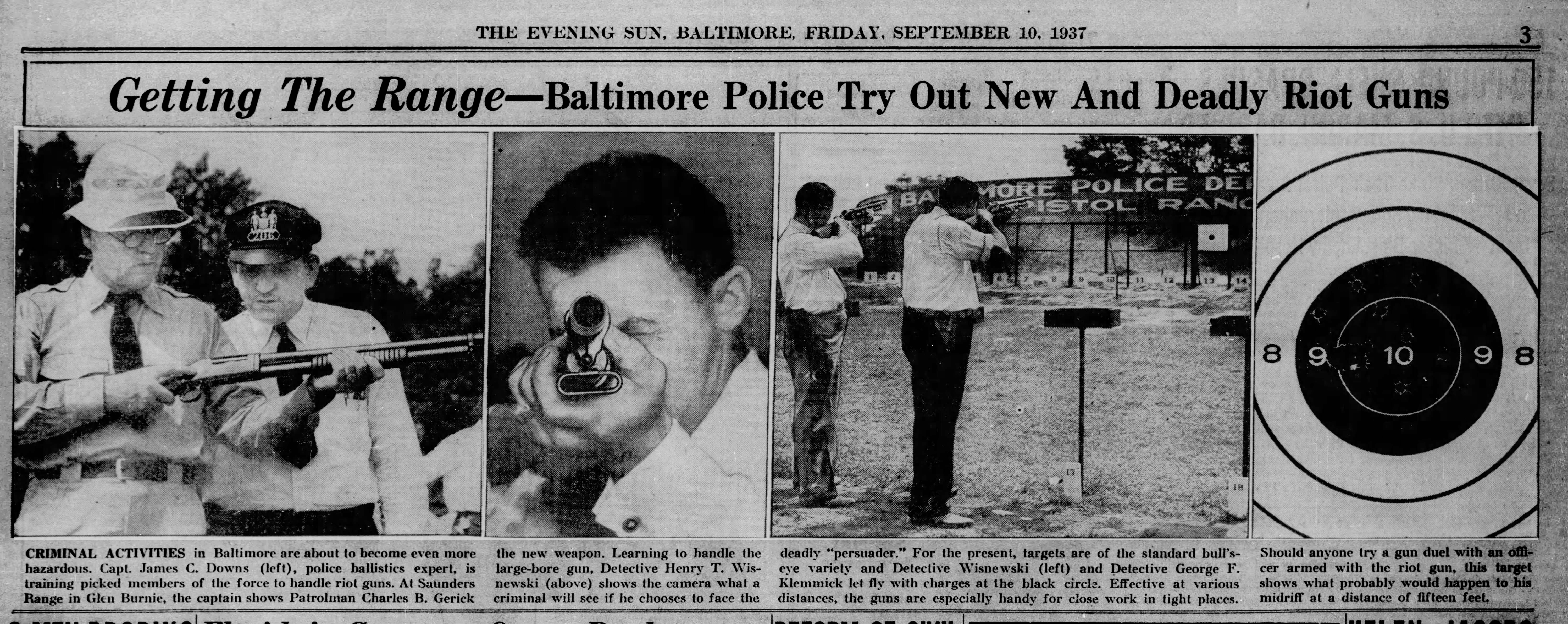
The Evening Sun Fri Sep 10 1937 range 72

Click HERE or the Above Pic to See Fullsize Article

Saunders Range

Saunders Range, named for Adjutant General of the Maryland National Guard, John S. Saunders, opened in 1904 on the property now known as Harundale. It was established for the training of army, navy and guard personnel in shooting and marksmanship. Men were assigned by company to spend two or three days at the site gaining proficiency with rifles and revolvers, aiming at targets set 200, 400, 800 and 1000 yards away. The training season ran from May 1 to about mid-August after which the site closed for the winter.

Practice began at 8:15 a.m. and ended at 6:00 p.m. with a one-hour break for lunch. Men lived in tents on the ground with few amenities at first. The year after the range was established, a canteen was added with a “No Intoxicants” policy strictly enforced. Emil E. Vanous and his brother, William, local residents were awarded the contract to run the establishment. In the following years an administration building was erected, and a sewage system was installed in 1910.

The site was ideally located in open country with sandy soil providing good drainage and a plentiful artesian water supply. It was close to the B&A Short Line Railroad which provided transportation and to Furnace Branch Creek which provided recreation for the men. Even at the time, “open country” was a debatable term. Mr. Osborn S. Pumphrey who owned a large farm in Marley, complained vociferously that bullets from the range were striking his house and he could not hire laborers for the fields since they feared being shot. Changes to target siting seems to have remedied the situation.

While the nearby railroad offered easy transportation to both Annapolis and Baltimore, few passes were given to the soldiers for fear of their bringing back “diseases contracted in the city.” Instead, evening entertainments were supplied within the camp. Shows with singing, music and “moving pictures” were offered along with boxing matches between companies. Shooting competitions were also held with medals and cups awarded to the best marksman.

In 1915, as the World War loomed, mobilization of civilians began. Classes of recruits were sent to Saunders Range for an introduction to military regulations, physical drills and shooting practice.

Saunders Range closed in 1926 and the Maryland National Guard put the property up for sale. In 1939, a proposal to build a “Negro housing development” on the site was met by spirited local opposition and soon abandoned. Finally, in 1946, the property was acquired by Byrne Communities, Inc. and in 1947 ads began to appear in local newspapers offering homes for sale in the new development of Harundale.

Information on Saunders Range came to us from Ann Arrundell County Historical Society 

1 black devider 800 8 72

1897

Winchester Model 1897

The Model 1897 was a superior slide-action exposed hammer shotgun that was specifically designed for the new smokeless powder.  Winchester manufactured just shy of one million Model 1897 shotguns, with the production taking place from July 1897 to September 1957.  The Model 1897 was an improved redesign of the older Model 1893.  Serial numbers were a continuation of the Model 1893 and began in the 34150 range, and continued through 1024701 

The Model 1897 was originally offered in solid frame 12 gauge only with a 2 ¾ chamber until April of 1898 when the Take Down was introduced.  The new 16 gauge with a 2 9/16” chamber was introduced in 1899, Take Down only.

The Model 1897 was offered in a variety of grades: standard Field; Fancy; Standard Trap; Special Trap; Pigeon; Tournament; Brush; Riot and Trench Gun.  The 20” barrel Riot and Trench Guns were especially desirable for Military and Law enforcement use. The Law enforcement Riot and Trench Guns may have police or prison unit markings.  The WW II military Riot and Trench guns will have “U.S” and flaming ordnance bomb markings.  Trench guns differed from Riot guns in that they have a ventilated heat shield and a bayonet stud attachment.  All Trench Guns and the military Riot Guns were equipped with sling swivels. The WW I Trench and Riot Guns were made in solid frame only, then for WW II, they were all Take Downs.

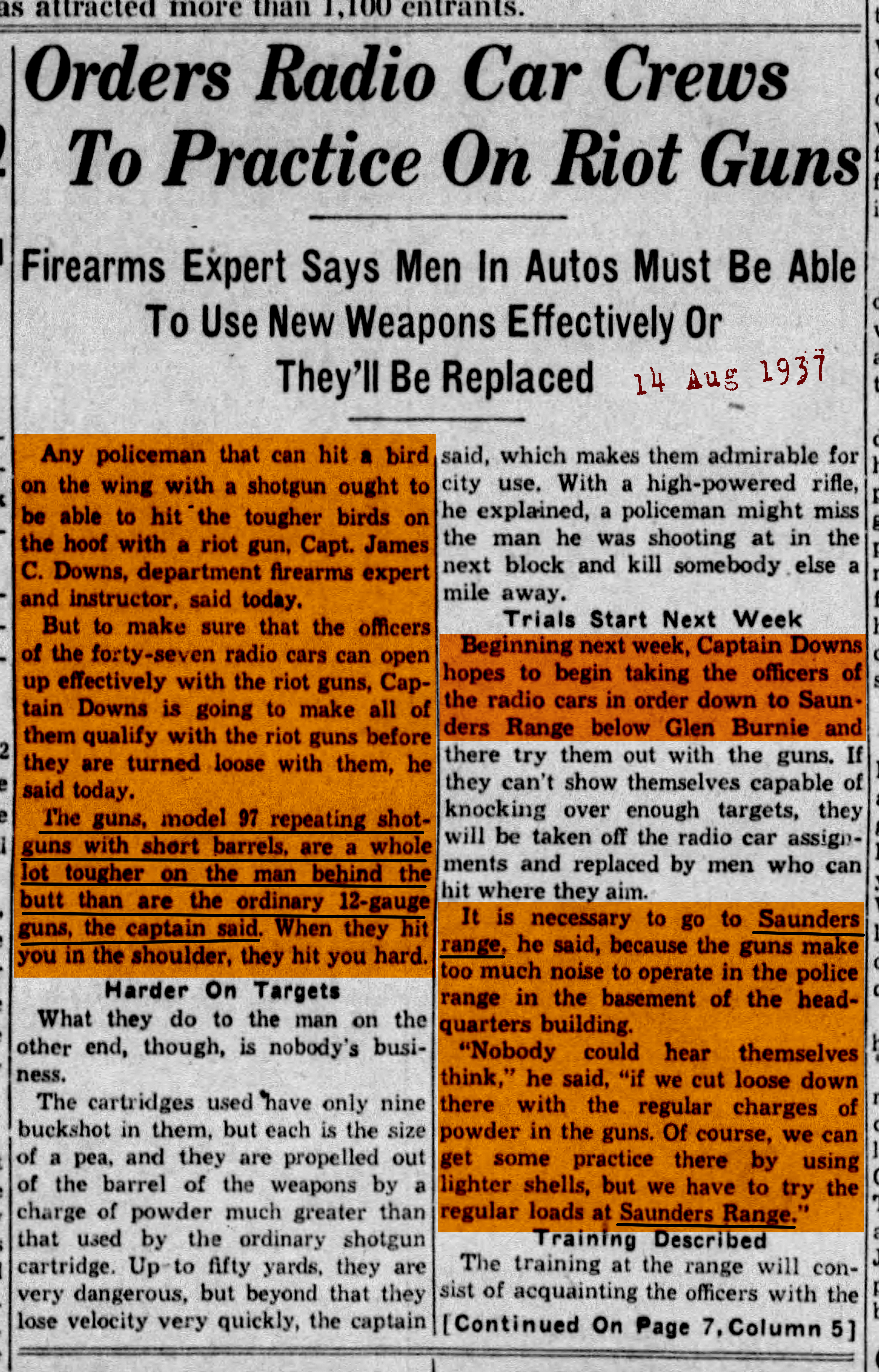
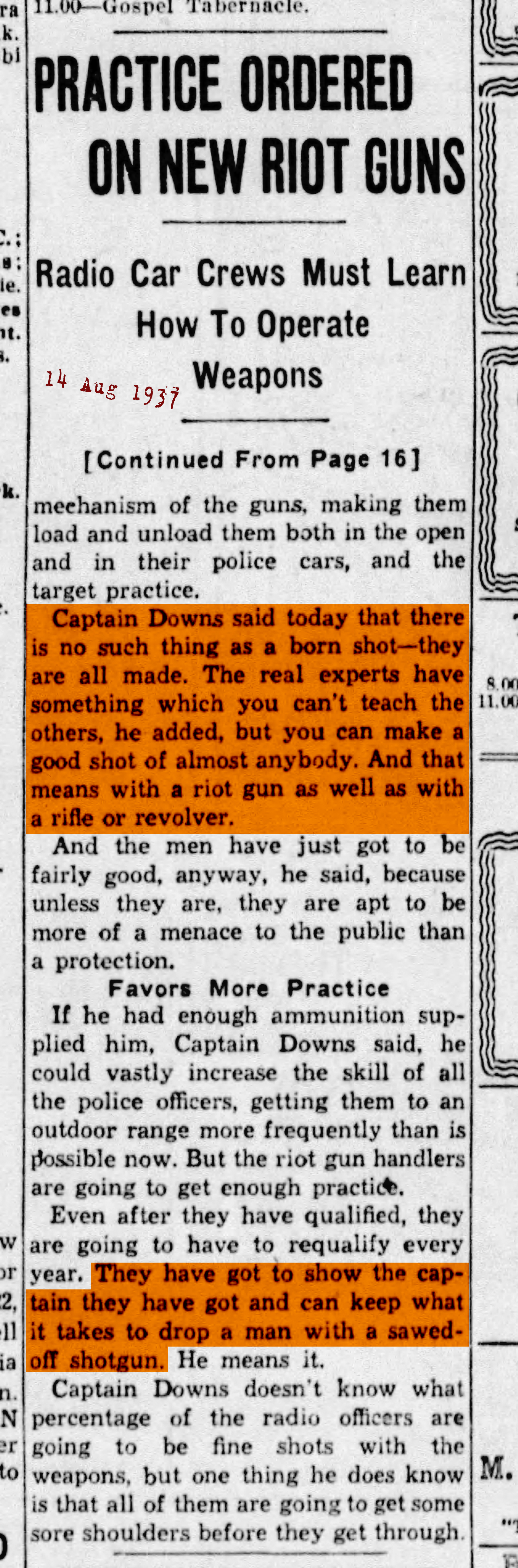
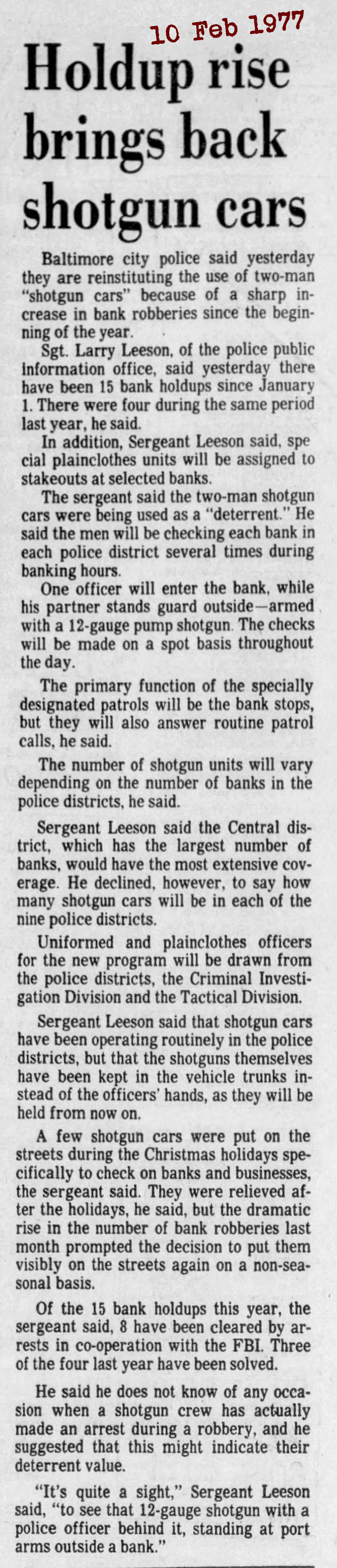
Shotguns were first put in radio patrol cars in 1937 the shotgun used at the time was the Winchester 1897. They only had 47 radio cars citywide at the time, training for the shotgun was done at Saunders Range in Glen Burnie. If officers couldn't qualify, they would be sent back to foot patrol and someone else would be given a chance. Training for qualification began on 21 Aug 1937

The Evening Sun Sat Aug 14 1937 Mod 97 pg 1 72To read the above article in full size click HERE or on the article

The Evening Sun Sat Aug 14 1937 Mod 97 pg 2 72

To read the above article in full size click HERE or on the article

1 black devider 800 8 72The Evening Sun Sat Aug 14 1937 Mod 97 pg 2 72

To read the above artical in full size click HERE or on the above article

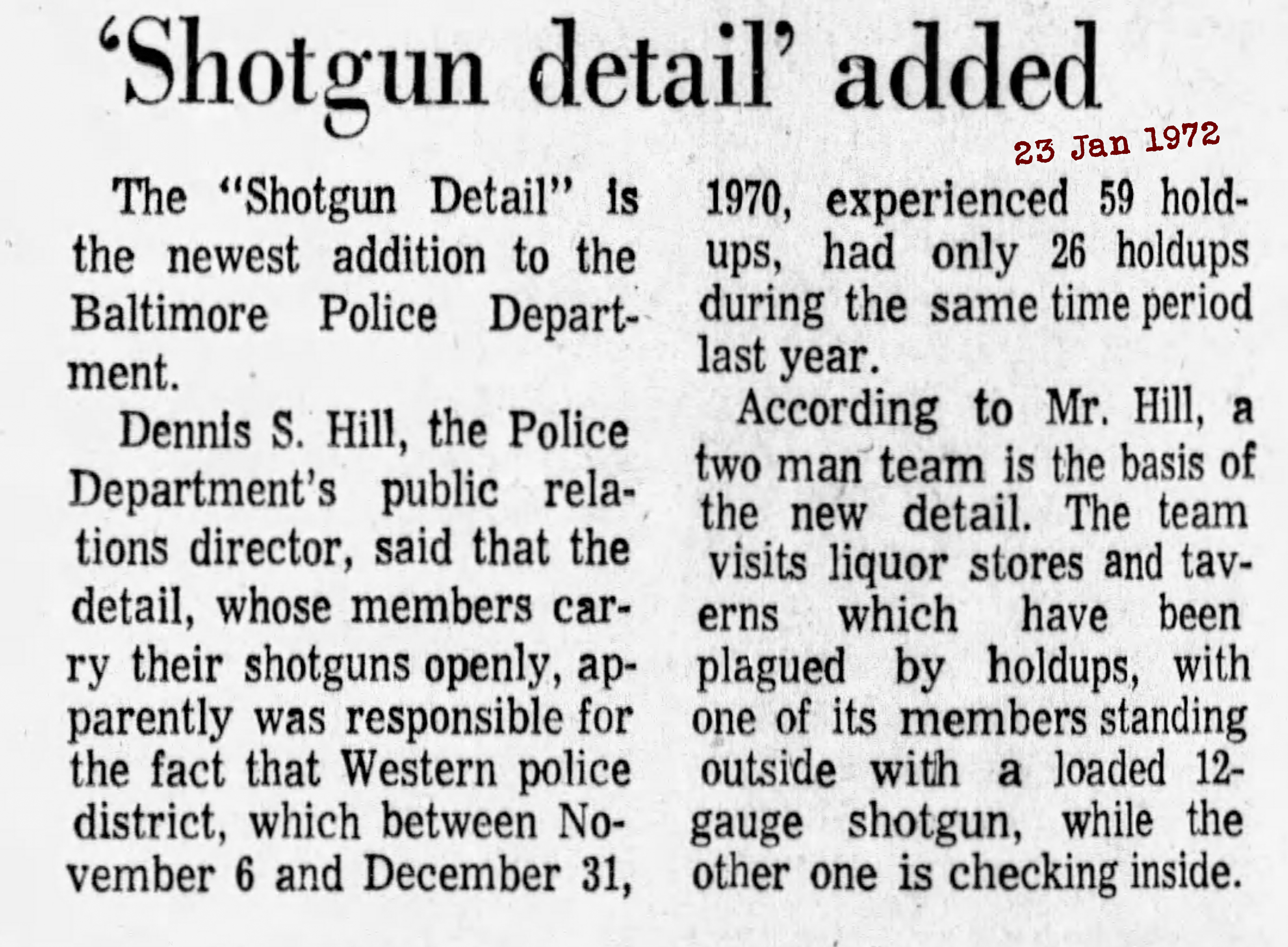
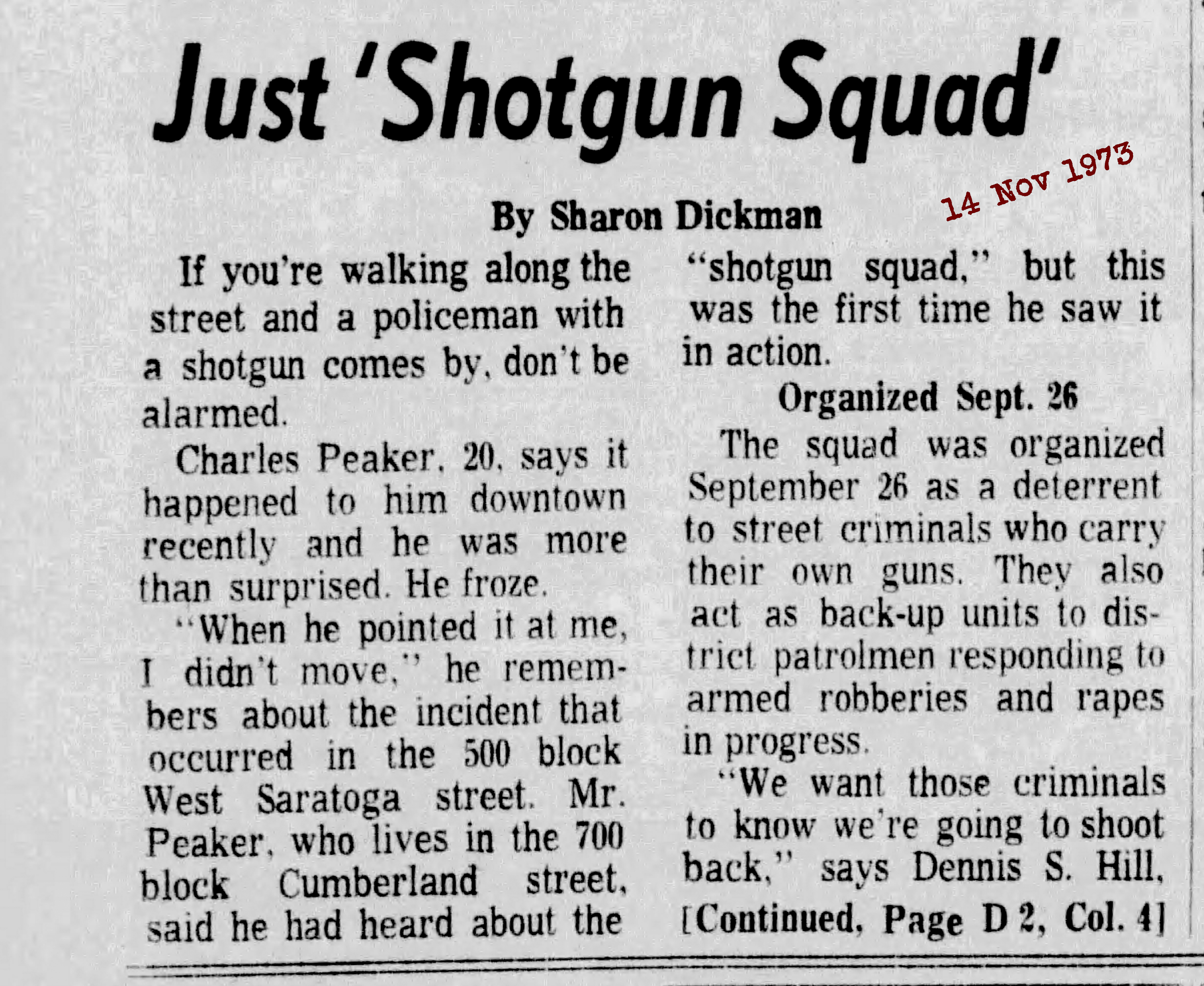
The Evening Sun Wed Nov 14 1973 shotgun unit pg 1 72

To read the above artical in full size click HERE or on the above article

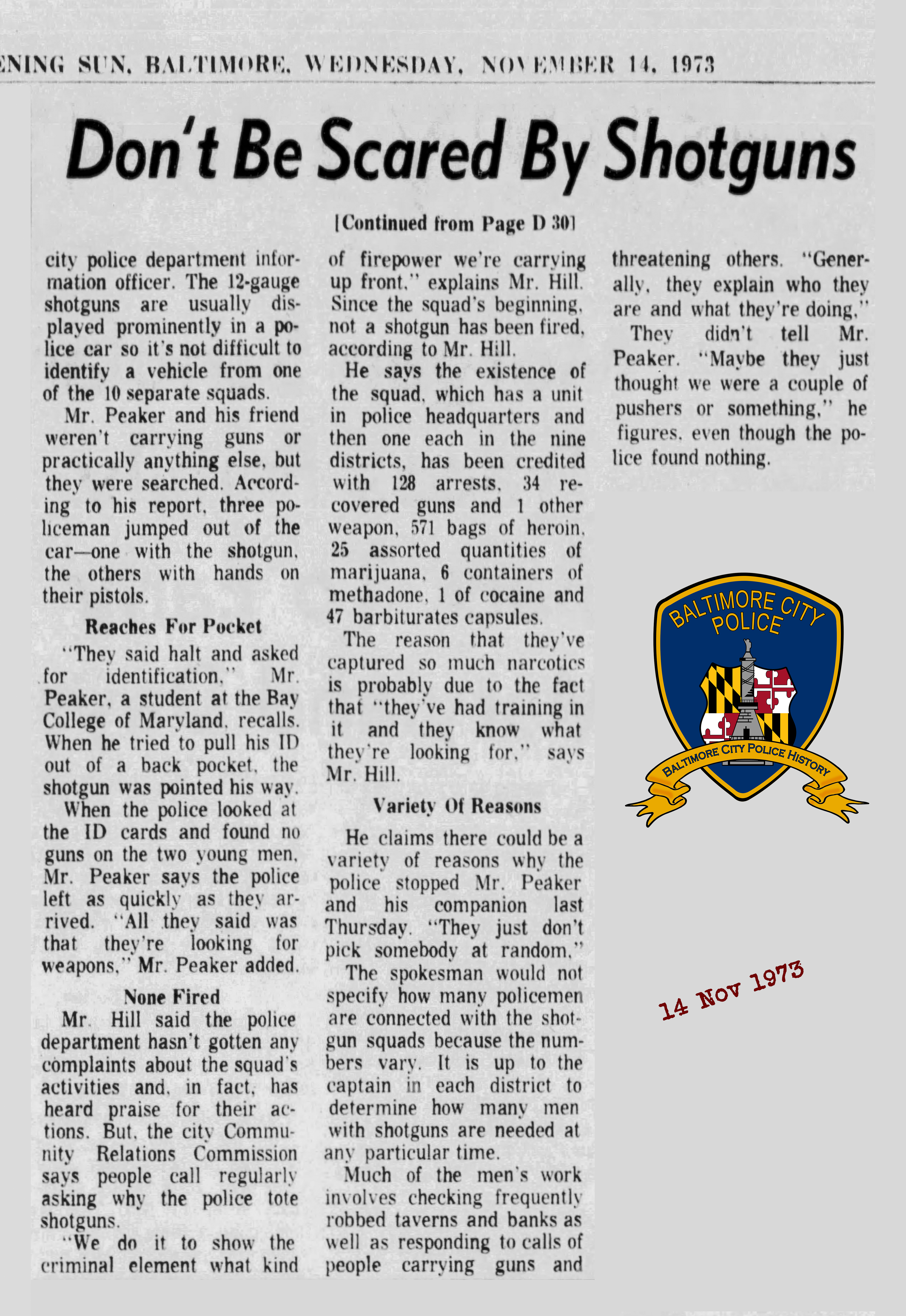
The Evening Sun Wed Nov 14 1973 shotgun unit pg 2 72

To read the above artical in full size click HERE or on the above article

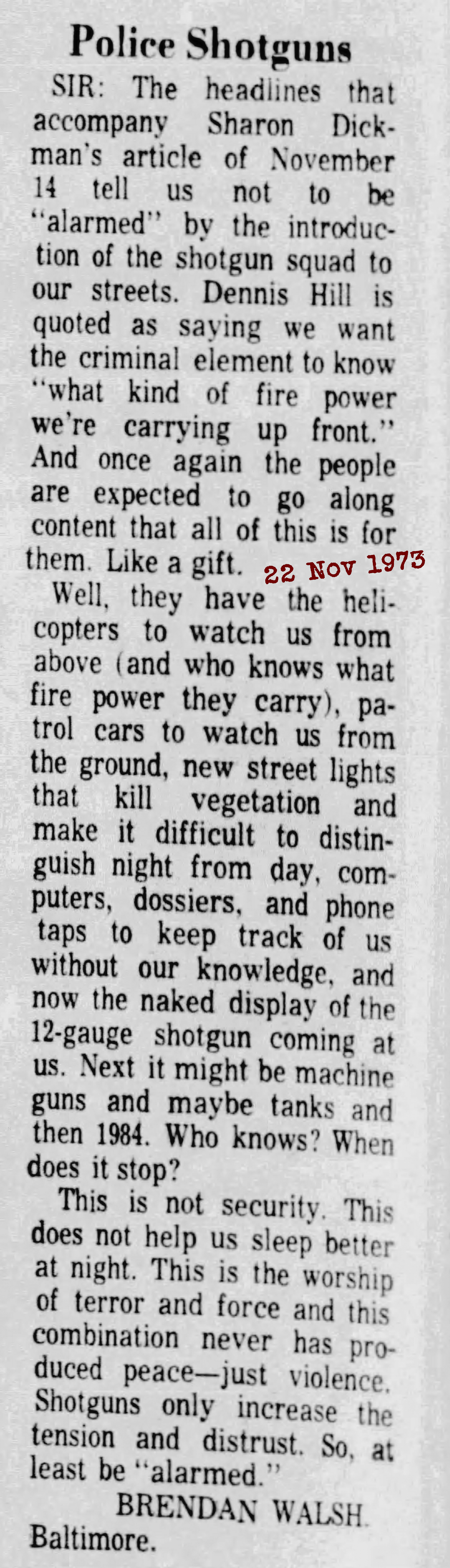
The Evening Sun Thu Nov 22 1973 Shotgun unit 72

To read the above artical in full size click HERE or on the above article

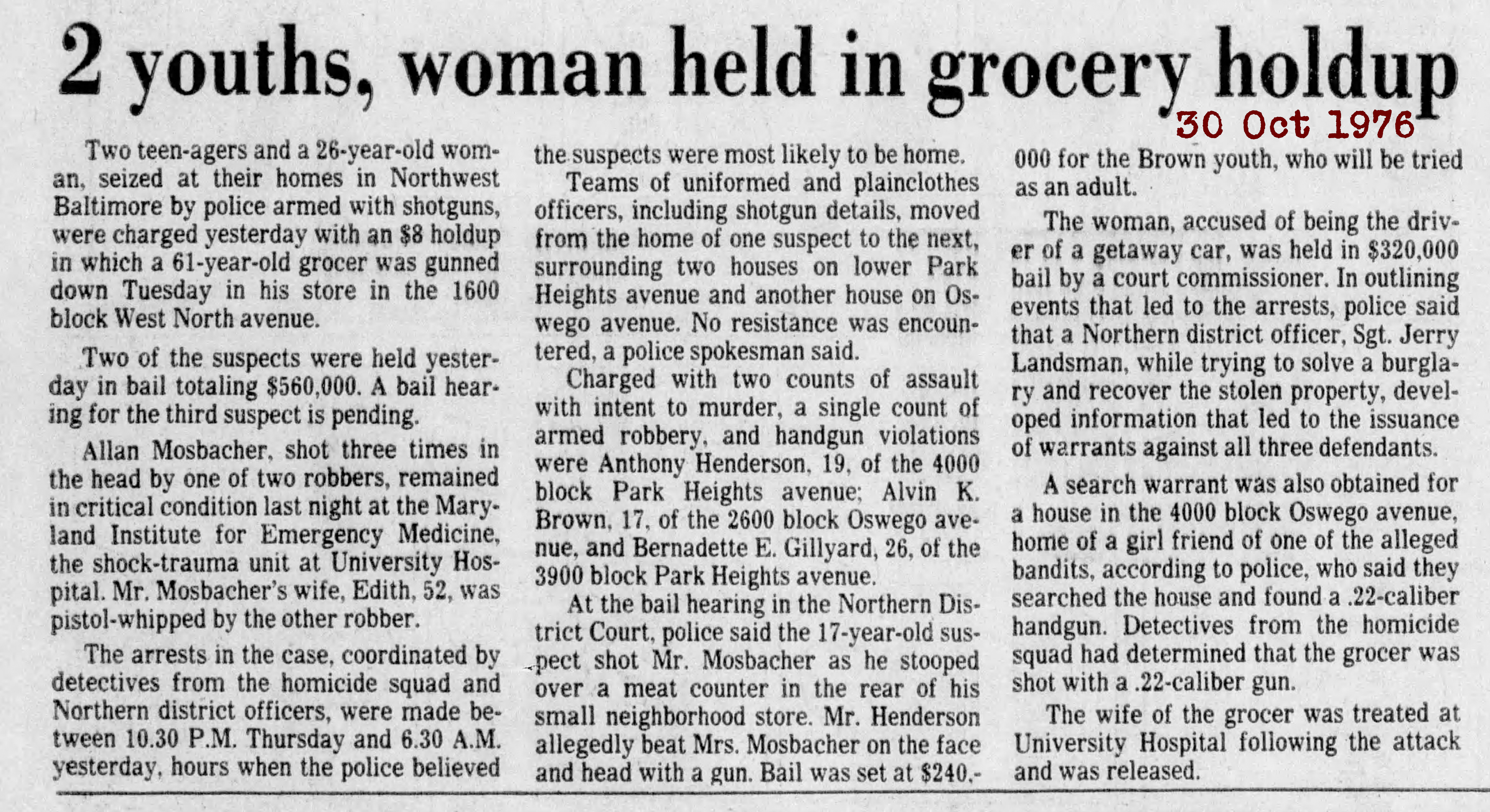
The Baltimore Sun Sat Oct 30 1976 Shotgun unit 72

To read the above artical in full size click HERE or on the above article

The Baltimore Sun Thu Feb 10 1977 Shotgun unit 72

To read the above artical in full size click HERE or on the above article

1 black devider 800 8 72
These links are mostly stories about the CIO Squad... Samuel Monkhouse was a member of the squad, he was shot in the line of duty back in 1930 had a bullet in his chest until 1952 when it shifted and needed to be removed. The shooter was a safe cracker, he got away that night, but his lookout was captured by Monkhouse. The next day the shooter was arrested, he escaped at one point during his prison sentence, eventually he completed his time, got out and raped a woman in Ann Arundel County and was hung for his crime. 

http://baltimorepolicemuseum.org/images/Wed__Jun_6__1928_.jpg

http://baltimorepolicemuseum.org/images/Sat__Oct_10__1931_Samuel-Monkhouse.jpg

http://baltimorepolicemuseum.org/images/Sat__Oct_10__1931_Samuel-Monkhouse-2.jpg

http://baltimorepolicemuseum.org/images/Sun__Jun_3__1945_shotgun-squad.jpg

http://baltimorepolicemuseum.org/images/Sat__Mar_24__1951_vice-cio-squad.jpg 

http://baltimorepolicemuseum.org/images/Fri__Jan_29__1960_Sam-Monkhouse-1.jpg 

http://baltimorepolicemuseum.org/images/Fri__Jan_29__1960_Sam-Monkhouse-pg2.jpg

http://baltimorepolicemuseum.org/images/Tue__Aug_25__1964_.jpg

http://baltimorepolicemuseum.org/images/Mon__Dec_7__1964_.jpg

http://baltimorepolicemuseum.org/images/Wed__Jun_23__1965_CIO-squad.jpg

http://baltimorepolicemuseum.org/images/Wed__Jun_23__1965_.jpg

http://baltimorepolicemuseum.org/images/Wed__Jun_23__1965_2.jpg

http://baltimorepolicemuseum.org/images/Mon__Feb_8__1965_.jpg 

http://baltimorepolicemuseum.org/images/Fri__Dec_24__1965_1.jpg  

http://baltimorepolicemuseum.org/images/Fri__Dec_24__1965_pg2.jpg

1 black devider 800 8 72

POLICE INFORMATION

If you have copies of: your Baltimore Police Department Class Photo, Pictures of our Officers, Vehicles, Equipment, Newspaper Articles relating to our department and or officers, Old Departmental Newsletters, Lookouts, Wanted Posters, and or Brochures. Information on Deceased Officers and anything that may help Preserve the History and Proud Traditions of this agency. Please contact Retired Detective Kenny Driscoll.

This email address is being protected from spambots. You need JavaScript enabled to view it.

Devider color with motto

NOTICE

How to Dispose of Old Police Items

Please contact Det. Ret. Kenny Driscoll if you have any pictures of you or your family members and wish them remembered here on this tribute site to Honor the fine men and women who have served with Honor and Distinction at the Baltimore Police Department. Anyone with information, photographs, memorabilia, or other "Baltimore City Police" items can contact Ret. Det. Kenny Driscoll at This email address is being protected from spambots. You need JavaScript enabled to view it. follow us on Twitter @BaltoPoliceHist or like us on Facebook or mail pics to 8138 Dundalk Ave. Baltimore Md. 21222


Copyright © 2002 Baltimore City Police History - Ret Det Kenny Driscoll 

Fugitive Squad

Fugitive Squad

Fugitive Squad


Understanding the Distinct Roles of Escape & Apprehension and Fugitive Units

In the intricate world of law enforcement, different units serve unique purposes, each contributing to the overall mission of maintaining public safety. Two such units, often misunderstood, are the Escape & Apprehension (E&A) and the Fugitive units. This article aims to clarify their various roles by providing an explanation from a seasoned officer who worked in the E&A unit named Retired Detective Leo Smith.

The Escape & Apprehension Unit

The E&A unit operates on the front lines of law enforcement. Their primary responsibility is to investigate and arrest individuals who have escaped from custody. This unit plays a crucial role in ensuring that those who attempt to evade justice are promptly returned to the legal system.

Unlike many other units, officers in the E&A unit typically wear street clothes, blending in with the general public. This allows them to carry out their duties without drawing unnecessary attention. In addition to their primary role, the E&A unit also serves warrants for serious crimes such as Robbery and Homicide, further contributing to public safety.

The Fugitive Unit

The Fugitive unit, on the other hand, operates in a more administrative capacity. Their main task is to handle the paperwork for individuals who have been arrested in another state but are wanted in Maryland, and vice versa. This involves coordinating with law enforcement agencies across state lines to ensure these individuals are extradited to the state where they are wanted.

While the Fugitive unit does not make many arrests, their work is vital in ensuring that individuals cannot evade justice simply by crossing state lines. They ensure that no matter where a person is arrested, they will be held accountable for their actions in the state where they are wanted.

Conclusion

While the E&A and Fugitive units may operate differently, both play essential roles in the justice system. By understanding their distinct responsibilities, we can better appreciate the complexity and breadth of law enforcement efforts to maintain public safety.

The Evening Sun Mon Jan 5 1976 ESCAPE AND APPREHENSION 72

Click Article above, or HERE to see full size Article

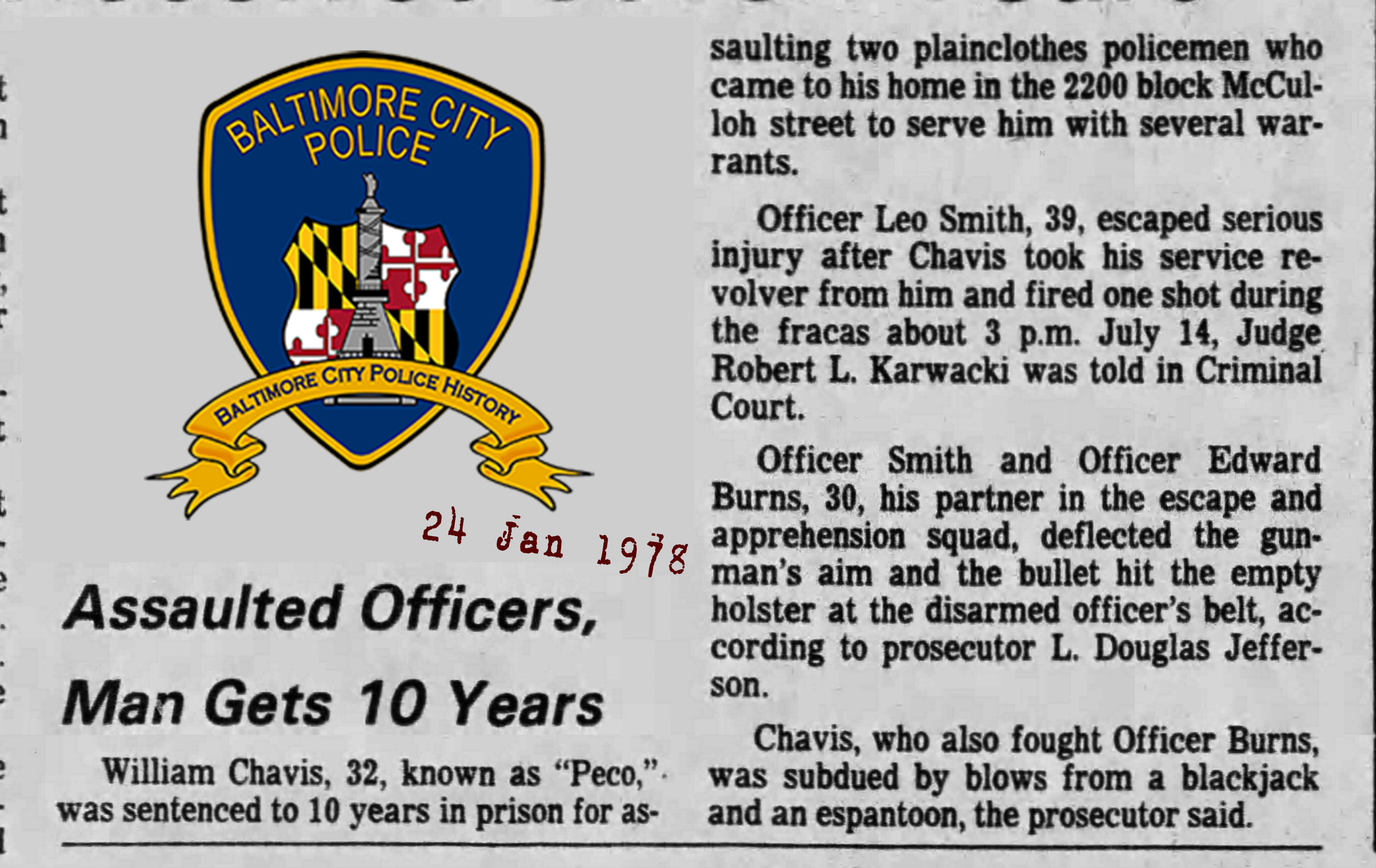
The Evening Sun Tue Jan 24 1978 Uncle leo escape and Aprehension 72

Click Article above, or HERE to see full size Article

Escapeandapprehension

Special thanks to BullCreek Arms for rebuilding this 1939 Baltimore Police Fugitive Squad Winchester model 1897,12 gauge shotgun. It came to us as a literal basket case and was put back together by BullCreek. Along side BullCreek, a special thanks goes out to Worth-A-Shot for helping us getting the gun parts back to Baltimore, she offered to send it on to BullCreek for us, but we felt she did enough and didn't want to take advantage of her good nature. 

fugitive

Side Inscribed Baltimore Police Fugitive Squad

Winchester Model 1897

The Winchester Model 1897, also known as the Model 97, M97, or Trench Gun, is a pump-action shotgun with an external hammer and tube magazine manufactured by the Winchester Repeating Arms Company. The Model 1897 was an evolution of the Winchester Model 1893 designed by John Browning. From 1897 until 1957, over one million of these shotguns were produced. The Model 1897 was offered in numerous barrel lengths and grades, chambered in 12 and 16 gauge, and as a solid frame or takedown. The 16-gauge guns had a standard barrel length of 28 inches, while 12-gauge guns were furnished with 30-inch length barrels. Special length barrels could be ordered in lengths as short as 20 inches, and as long as 36 inches. Since the time the Model 1897 was first manufactured it has been used by American soldiers, police departments, and hunters.

History

The Winchester Model 1897 was designed by American firearms inventor John Moses Browning. The Model 1897 was first listed for sale in the November 1897 Winchester catalog as a 12 gauge solid frame. The 12 gauge takedown was added in October 1898, and the 16 gauge takedown in February 1900. Originally produced as a tougher, stronger and more improved version of the Winchester 1893, itself an improvement on the early Spencer pump gun, the 1897 was identical to its forerunner, except that the receiver was thicker and allowed for use of smokeless powder shells, which were not common at the time. The 1897 introduced a "take down" design, where the barrel and magazine tube could easily be separated from the receiver for cleaning or transportation, the ease of removal of the barrel becoming a standard in pump shotguns made today, like the Remington 870 and Mossberg 500 series. Over time, "the model 97 became the most popular shotgun on the American market and established a standard of performance by which other kinds and makes of shotguns were judged, including the most expensive imported articles". The Winchester Model 1897 was in production from 1897 until 1957. It was in this time frame that the "modern" hammerless designs became common, like the Winchester Model 1912 and the Remington 870. The Model 1897 was superseded by the Winchester Model 1912. However, the gun can still be found today in regular use.

Improvements from the 1893

While designing the new Model 1897, many of the weaknesses present in the earlier Model 1893 were taken into account and remedied. These improvements included:

The frame was strengthened and made longer to handle a 12 gauge 2+3⁄4-inch shell, as well as the 2+5⁄8-inch shell.

The top of the frame was covered so that the ejection of the fired shell was entirely from the side. This added a lot of strength to the frame of the gun and it allowed the use of a 2+3⁄4 inch shell without the danger of the gun constantly jamming.

The action could not be opened until a slight forward movement of the slide handle released the action slide lock. In firing, the recoil of the shotgun gave a slight forward motion to the slide handle and released the action slide lock which enabled the immediate opening of the action. In the absence of any recoil, the slide handle had to be pushed forward manually in order to release the action slide lock.

A movable cartridge guide was placed on the right side of the carrier block to prevent the escape of the shell when the shotgun was turned sideways in the act of loading.

The stock was made longer and with less drop.

Of these improvements, the slide lock is the one that made the Model 1897 into a safe firearm. This improved slide lock kept the shotgun locked until actual firing occurred which prevented it from jamming in the case of a misfire. The slide lock "stands in such a relation to the body of the firing pin as will prevent the firing pin reaching the primer until the pin has moved forward a sufficient distance to insure locking of the breech bolt". This prevents the action sleeve "from being retracted by the hand of the gunner until after firing, and hence rendering the firearm more safe".

Description

The Winchester Model 1897 and the Winchester Model 1893 were both designed by John Browning. The Model 1897 is an external hammer shotgun lacking a trigger disconnector. This means that the user can hold the trigger down while cycling the shotgun and once the action is returned to battery the shotgun fires. The firearm itself is classified as a slide action pump shotgun. It was the first truly successful pump-action shotgun produced. Throughout the time period the Model 1897 was in production, over a million of the type were produced in various grades and barrel lengths. 16-gauge guns had a standard barrel length of 28 inches, while 12-gauge guns were furnished with 30-inch length barrels. Special length barrels could be ordered in lengths as short as 20 inches, and as long as 36 inches. Along with various grades and barrel lengths, the Model 1897 came in two different chamberings. One was the 12 gauge and the other was the 16 gauge. The shells should be of the 2+3⁄4 inch or 2+5⁄8 inch model. Any shells larger are not recommended. An average Model 1897 can hold 6 shotgun shells in the magazine tube. When working the action of the Model 1897 the forend (fore grip) is pulled back, forcing the breech bolt to the rear which extracts and then ejects the spent shell while simultaneously cocking the external hammer by pushing it to the rear. When the forend is slid forward again, the breech bolt pushes a fresh shell into the gun's chamber and locks into place.

The Chinese company Norinco has made an effort to reproduce this firearm. The Norinco 97 is an almost exact copy of the Winchester 1897, produced in both Trench and Riot grades, yet lacking in the fit and finish of the originals.


1 black devider 800 8 72

POLICE INFORMATION

If you have copies of: your Baltimore Police Department Class Photo, Pictures of our Officers, Vehicles, Equipment, Newspaper Articles relating to our department and or officers, Old Departmental Newsletters, Lookouts, Wanted Posters, and or Brochures. Information on Deceased Officers and anything that may help Preserve the History and Proud Traditions of this agency. Please contact Retired Detective Kenny Driscoll.

This email address is being protected from spambots. You need JavaScript enabled to view it.

Devider color with motto

NOTICE

How to Dispose of Old Police Items

Please contact Det. Ret. Kenny Driscoll if you have any pictures of you or your family members and wish them remembered here on this tribute site to Honor the fine men and women who have served with Honor and Distinction at the Baltimore Police Department. Anyone with information, photographs, memorabilia, or other "Baltimore City Police" items can contact Ret. Det. Kenny Driscoll at This email address is being protected from spambots. You need JavaScript enabled to view it. follow us on Twitter @BaltoPoliceHist or like us on Facebook or mail pics to 8138 Dundalk Ave. Baltimore Md. 21222


Copyright © 2002 Baltimore City Police History - Ret Det Kenny Driscoll 

Calendar

Baltimore Police Historical Society Calendars 


To see the Baltimore Police Historical Society calendar, Click
HERE

To see the Regular month-to-month calendar, Click
HERE


1 black devider 800 8 72

POLICE INFORMATION

If you have copies of: your Baltimore Police Department class photo, pictures of our officers, vehicles, equipment, newspaper articles relating to our department and/or officers, old departmental newsletters, lookouts, wanted posters, or brochures, or information on deceased officers, and/or anything else that may help preserve the history and proud traditions of this agency, please contact Retired Detective Kenny Driscoll.

This email address is being protected from spambots. You need JavaScript enabled to view it.

Devider color with motto

NOTICE

How to Dispose of Old Police Items

Please contact Det. Ret. Kenny Driscoll if you have any pictures of you or your family members and wish them remembered here on this tribute site to honor the fine men and women who have served with honor and distinction at the Baltimore Police Department. Anyone with information, photographs, memorabilia, or other "Baltimore City Police" items can contact Ret. Det. Kenny Driscoll at This email address is being protected from spambots. You need JavaScript enabled to view it. follow us on Twitter @BaltoPoliceHist or like us on Facebook or mail pics to 8138 Dundalk Ave., Baltimore, Md. 21222


Copyright © 2002 Baltimore City Police History: Ret Det. Kenny Driscoll 

Robert Carter

Robert Carter

Baltimore Police Department
Marshal Robert D Carter

BPD IMG085 crop 72 CarterCourtesy Gary Provenzano

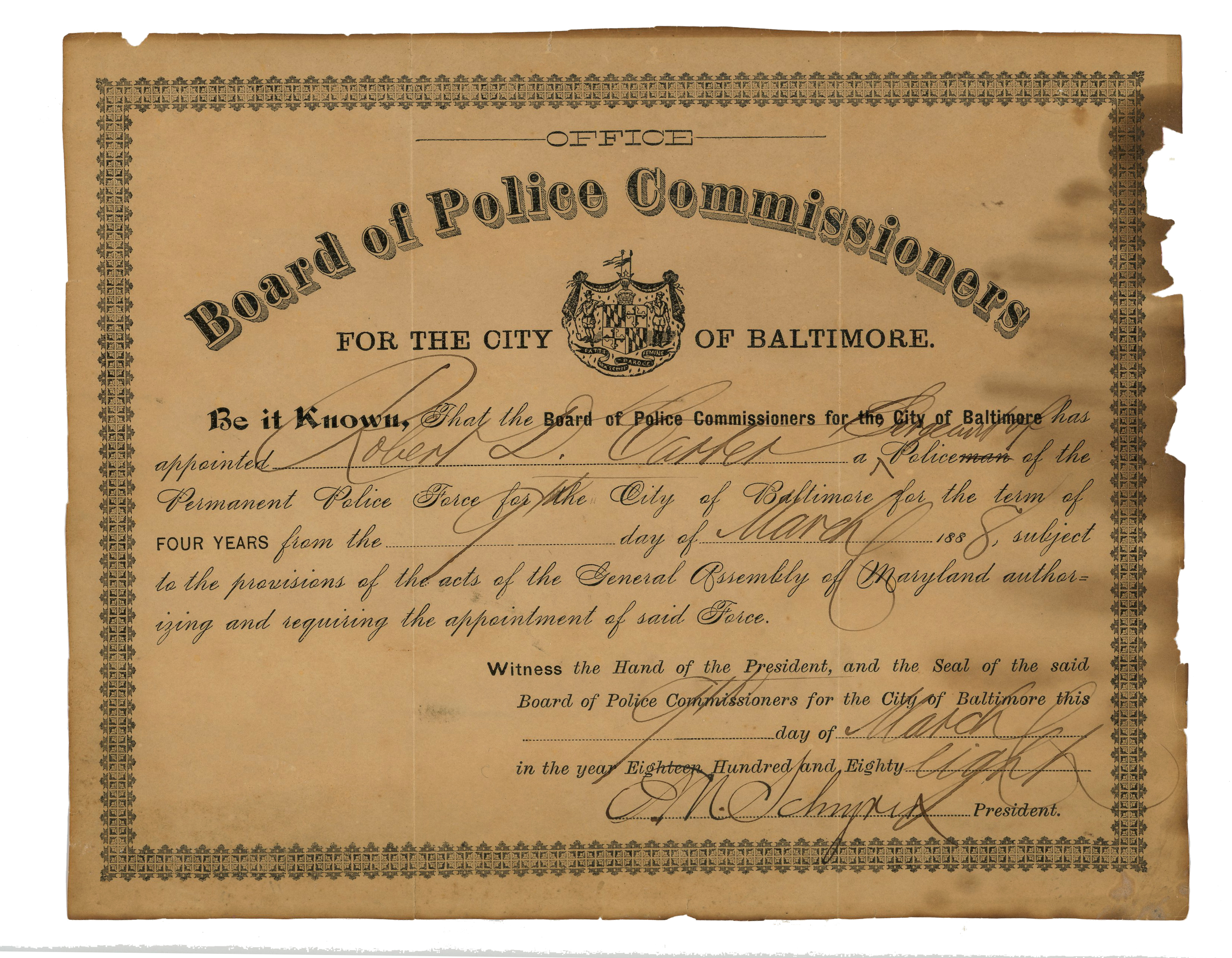
Certificate from the Board of Police Commissioners and signed by Edson M. Schriever President of the BOC
This is the original, it is dated 9 March 1888 the same date Robert D Carter was appointed to the Rank of Sergeant

1894 April, Robert's father Jesse, was visiting from Stems, Granville County, North Carolina, and passed away in his sleep at Robert's house 1650 North Gilmor Street, Baltimore. Dr. George W. Norris was called in and said his death was due to heart disease. Jesse was 73 years old, and was a merchant, in Dry-Goods, he started a store in Littleton and moved to Stems. Robert took Jesse back home to North Carolina.

Working long days most up to 18 hours, showed Robert as a good Policeman, by 1914 August 14, Robert was promoted to "Marshal of Baltimore City Police Department", he skipped the rank of Captain, he was 62 years old.

February 1915, Marshal Carter, made his debut as a public speaker, when he told an audience of students of the "Johns Hopkins Medical School, just what the Police Department of Baltimore City, was doing in the way of seeing that the laws of the city and State are obeyed.

May 27, 1915, there was a 63rd. birthday party held at "Arian's Country Club", Wilkens Avenue Extended. It was expected to be up to 800 citizens of Baltimore who have become acquainted with Marshal Carter. He was given a "14-karat Solid Gold Badge", with 63 diamonds set in platinum. Topping the American Eagle is a One-karat diamond.

In 1917 Marshal Carter was elected to be the National Commander of the Army and the Navy Union, held at the eighteenth biennial encampment at the "Bohemian Hall", on Gay and Preston streets. September 4, 1918, he was made the Chief Marshal of the parade which was headed by a delegation of the "Grand Army of the Republic", and several thousand United Spanish War Veterans who are holding their twentieth encampment in Baltimore.

1920 was a very hard year for Marshal Carter, Dona his wife was very ill, and Robert D. Jr., was ill also, he had tuberculosis. Robert D. Jr. was in a sanatorium in the mountains, Marshal Carter had Mary Gohagen working for him to help take care of Dona and Robert D. Jr.

Marshal Carter, brought Robert D. Jr., home from the sanatorium knowing that he could live only a short time. On December 26, 1920, Robert D. Jr. passed-away at the age of 42, when Dona was told Mrs. Carter she became unconscious. In 1921 August 7, Dona passed-away, this same year Marshal Carter retired from the Baltimore City Police Department on January 20, 1921, he had 36 years and 8 months of service at the age of 68.

Marshal Carter, moved in with his daughter Bessie, and his son-in-law Henry D. Hammond at 604 Hollen Road, Baltimore where he lived until 1936 October 22, when he passed away from pneumonia at the age of 84. The Rev. Bruce H. McDonald, the pastor of the Westminster Presbyterian Church, conducted the service. The Burial was at "Woodlawn Cemetery, Baltimore County, Maryland. With him is wife Dona, son Robert D. Jr., with his wife Effie, and Robert's daughter Bessie Carter Hammond. The Baltimore City Police Department named in his Honor 
the Police Boat "Robert D. Carter" after Marshal Carter.

Marshal Robert D. Carter, was the "Last Marshal of Baltimore City Police Department",  As in 1920, when General Gaither, was made "Commissioner of Police" by the Police Board in late 1920, he started a reorganization of the department, and after Marshal Carter retired Gen. Gaither created the new post of Chief Inspector.

Marshal Carter, with tear-filled eyes, stated he did not expect the recognition given him, as he felt he was appointed to the position of Marshal of Police by the Police Board and not by the citizens of Baltimore, " But I am happy to say", he remarked, "That the Police Department, and every citizen of Baltimore will get the best in me and in the force under me. I feel that Baltimore has the best Police Department in the Country." and he worked to maintain that status during his tenure as Baltimore's Last Marshal.

Marshal Carter, was personally known to Police Chiefs across the country. He was a close personal friend of "William A. Pinkerton", of the Pinkerton Detective Agency and at the time a well noted Private Detective. Robert was also a "Thirty-Second Degree Mason", a "Shriner", and a "Knight Templar".

This information was gathered and compiled by Marshal Carter's Great-Grandnephew Kenneth M. Carter of Mount Airy, Maryland

1 black devider 800 8 72

Robert d Carter

Baltimore Police Department
Marshal Robert D Carter

Today in Baltimore Police History 14 Aug 1914 we got a new Marshal - Robert D Carter Appointed Marshal - Marshal Carter would remain the department' s Marshal until 1917 when Baltimore Police stopped using Marshals, Making Marshal Carter Baltimore's last Marshal. The Last Marshal of Baltimore

Robert Dudley Carter was born in Gaston/Littleton, Halifax County, North 
Carolina, March 28, 1852. He was the son of Jesse and Sallie Ann Carter "Whitaker". Robert got his middle name after the first elected Governor, "Edward Bishop Dudley" elected by the people of North Carolina 1835.  Robert worked on his family farm and also as a Teamster wagon driver.

In 1869, he came to Baltimore, at 17 years old, Robert enlisted at 67 Thames street Fells Point, Baltimore Maryland, and served in the U.S. Navy for 3 years. He married Dona Burkhart, early in 1875 at the age of 23.

In 1875 Robert had moved to Baltimore for good, that same year Dona gave birth to a daughter, "Bessie May Carter", she was born in Baltimore City, Robert was working in Baltimore as a Teamster with the old-horse car service, after which he was a contracting foreman. In 1878 Dona gave birth to a son "Robert Dudley Carter Jr", he too was born in Baltimore. Robert bought his first house in "1880", at 1650 North Gilmor Street.

1884 May 12, Robert was given the appointment to (Police Officer) and worked in the North West District, Baltimore City, he was 32 years old. He worked hard at being the best, and in 1888 March 9, he was promoted to "Sergeant", and 1892 November 17 he was promoted to "Lieutenant". In this same year Robert D. Jr., and Bessie May, and her husband Henry D. Hammond were all living with Robert and Dona at 1650 North Gilmor street.

1 black devider 800 8 72

Jan 22 1916 72


Sep 16 1917 172

Nov 28 1917 72

Feb 28 1918 72

Aug 14 1918 72

Jan 28 1921 72

Jan 11 1922 72

Oct 23 1936 72


1 black devider 800 8 72

POLICE INFORMATION

Copies of: Your Baltimore Police Department Class Photo, Pictures of our Officers, Vehicles, Equipment, Newspaper Articles relating to our department and or officers, Old Departmental Newsletters, Lookouts, Wanted Posters, and or Brochures. Information on Deceased Officers and anything that may help Preserve the History and Proud Traditions of this agency. Please contact Retired Detective Kenny Driscoll.

This email address is being protected from spambots. You need JavaScript enabled to view it.

Devider color with motto

NOTICE

How to Dispose of Old Police Items

Please contact Det. Ret. Kenny Driscoll if you have any pictures of you or your family members and wish them remembered here on this tribute site to Honor the fine men and women who have served with Honor and Distinction at the Baltimore Police Department. Anyone with information, photographs, memorabilia, or other "Baltimore City Police" items can contact Ret. Det. Kenny Driscoll at This email address is being protected from spambots. You need JavaScript enabled to view it. follow us on Twitter @BaltoPoliceHist or like us on Facebook or mail pics to 8138 Dundalk Ave. Baltimore Md. 21222
 

1 black devider 800 8 72

Baltimore Police Historical Society

Baltimore Police Historical SocietyBaltimore Police Historical Society put the articles found on this site together using research from old newspapers, old books, old photographs, and old artifacts. We rely more heavily on information written at, or near the time of the incidents or events that we are researching. We do not put too much weight on the more recently written historic information, or information that has been written with a biased opinion, or agenda. We will not tell our readers what to think about our past, as much as we will tell a story as it was written with the hopes our readers will form their own opinions. We tell a story about what happened, and not why it happened. That said, ever so often we might come across a story that to us is so exciting we might express an enthusiasm in our writings. We hope the reader will still form an opinion of their own based on the information written at the time, and not information more recently written that has a so-called "filtered past" or that has been twisted and pulled in the direction of a storyteller's personal feelings or agenda. Please enjoy the site and feel free to write us should you have any questions or information.


Copyright © 2002 Baltimore City Police History - Ret Det Kenny Driscoll  
Donald Sager

Donald Sager

Fallen Hero Officer Donald W. Sager

CLICK HERE FOR AUDIO

On this day in Baltimore City Police History 24 April 1970, we lost our Brother Officer Donald W. Sager to gunfire based on the following; Officer Donald W. Sager, assigned to the Central District, was shot and killed on Friday, April 24, 1970, while working in the 1200 block of Myrtle Avenue. In Officer Sager’s car was his partner Officer Stanley Sierakowski, who was shot and seriously wounded. As Officers Sager and Sierakowski were seated in the car, the suspect shot through the back window, striking Officer Sager in the back of the head, killing him instantly. Officer Sierakowski was then shot 5 times with a .45 caliber pistol. The suspect’s sole motivation was to ambush a police officer. The suspect was said to have been a militant member of the Black Panther Party. 

sager1

Sunpaper Photo taken by Photographer Irving Phillips
25 April 1970 Captioned:  Shell Casings Found
Arrows point to three shell casings found on Myrtle Avenue 
Two police officers were ambushed about 10 o'clock last night by members of the Black Panthers

City Policeman Shot Dead; Second Wounded Officer's Body Found Beside Car
A massive search begun in West Baltimore - Three suspects held - One policeman was killed and a second was critically wounded last night in a shooting in the 1200 block of Myrtle Avenue in West Baltimore. Police identified the victim as Patrolmen Donald W Sager, 35 who has been with the city police department for about 17 years. Patrolman Stanley Sierakowski, 40 was reported in critical condition at Maryland General Hospital. Police said the shooting occurred about 10 PM. Within minutes, more than 40 other policeman and 14 marked, and unmarked cars flooded the area, sealing it off, and began an intensive house to house and rooftop search. Three suspects arrested, shortly afterward, the arrest of the three suspects was reported. Police said they found two men hiding under some steps in the vicinity of the shooting. They were taken to Central District Police Station. The third suspect, found on a vacant lot near the scene of the shooting, he was taken to Provident Hospital, although he was not reported to have been wounded. The Commissioner Donald D. Pomerleau and 12 homicide detectives appeared at the scene, and at the two hospitals within a half-hour of the shooting. The police reported that the two patrolmen had been called to a home in the 1200 block of Myrtle Avenue to handle a domestic disturbance. After taking care the disturbance, they returned to their car and were then ambushed by the gunman, or gunmen that started shooting at the policeman. Police reported that patrolman Sierakowski was found in a gutter between the police car and the sidewalk and patrolman Sager was inside the car. With at least three suspects in custody by midnight, police centered their search around a two-block area near the corner of Shields Place and Myrtle Avenue, where one patrolman fought a gun duel in an alley with one of the suspects.

Searchlight is Used 
The fire department set a truck with a high power searchlight to illuminate the rooms of buildings in the area. At least half of the houses are vacant and the police were breaking into them to search for more suspects. The shooting match between the patrolman and the suspect happened within five minutes of the shooting on Myrtle Avenue and only about a block away. Patrolman Roger Nolan of tactical squad reported that he was driving in the area when he saw a man running along Fremont Avenue. He had of his car and chased the man into an alley where the suspect turned and fired six shots at him, Patrolman Nolan returned six shots and gave chase again, but he said he tripped over some garbage cans and lost the suspect. Attorney Richard Rosen, the lawyer refused to say if the three defendants arrested in this shooting were members of the Black Panthers. Sources close to the investigation said the Black Panther Party was not implicated in the shooting. The third suspect was arrested shortly before midnight Saturday at the main post office where he was said to have been a clerk. He was identified as Marshall E Conway, 24. Police searched his home. The 1400 block of Mount St. They said they recovered no weapons all three defendants are charged with murder and assault with intent to murder for the death of Patrolmen Donald Sager and the wounding of Patrolman Stanley Sierakowski. A preliminary hearing for the defendants was postponed until 3 PM in Central's Municipal Court. Mr. Rosen, the lawyer for the Black Panthers represented Jack London 25 of the 1700 block of N. Asquith St. at 1 PM session in Central's Municipal Court lawyer was a company by two men who identified themselves as Black Panthers. The two were not dressed in familiar paramilitary panther garb. Judge Joseph L Broccolino Jr allowed Mr. Rosen and one of the men who identified himself as William P Coats of the 1100 block of Cherry Hill Rd. to remain in the hearing, which was closed to all spectators but the press. Mr. Coates said he was the closest friend. He [Mr. Johnson] after several urgent nods from Mr. Coates, accepted Mr. Rosen as his lawyer, Mr. Rosen then volunteered. a not guilty. Although such a plea is not made at a preliminary hearing. Earlier in the day. The other two suspects, Mr. Conway and James Powell 33 of the 1400 block of N. Mount St. appear before Judge Broccolino in a court session that also was cleared of all spectators but the press. Mr. Conway was also charged with assault with intent to commit murder in the running gun battle with the patrolman who had gone to investigate the shooting. Police said Conway is the subject that traded pistol shots with Patrolman Nolan shortly after the 10 PM shooting and that neither he nor Patrolman Nolan were wounded in the exchange. 

Dead on Arrival
Patrolman Sager and patrolman Sierakowski were shot in a hail of bullets as they sat in their patrol car on a 1200 block of Myrtle Avenue, where they had gone to investigate a domestic complaint, patrolman Sager had a bullet in his brain and right hand, he was pronounced dead on arrival at Provident Hospital. Patrolman Sierakowski was considered to be in fair condition yesterday at Maryland General Hospital with four wounds to the stomach and wounds to both hands.


Devider. black


Officer Sager had served with the agency for 12 years. He was survived by his wife and child. Though he is no longer with us, we his brothers and sisters of the Baltimore Police Department won’t let him be forgotten. RIP Brother…

On this Day In Baltimore Police History 1970, we lost our Brother Officer Donald W. Sager to gun fire based on the following:

On 24 April 1970 Police Officer Donald W Sager assigned to the Central District, was shot and killed while working the 1200 block of Myrtle Avenue. In Officer Sager’s car with him was his partner Officer Stanley Sierakowski, Officer Sierakowski was also shot and seriously wounded.

As Officers Sager and Sierakowski were seated in their radio car, an unprovoked member of the Black Panthers (Marshall “Eddie” Conway) snuck up from the rear of their car and began shooting through the back window at them. His first rounds struck Officer Sager in the back of the head killing him instantly.

Officer Sierakowski rolled out his door in an attempt to escape the attack, and shoot the suspect… however, he too was shot. In fact, when the smoke cleared it was learned Officer Sierakowski would end up taking 5 rounds from that .45 caliber pistol. The suspect’s sole motivation was to ambush, and kill police.

During the early 70’s the heat of the 1968 riots was still brewing and was far from cooled down… African American groups like the Black Panthers were killing police at an alarming rate, often unprovoked. Either through fake calls to the police drawing officers to areas where they were set up to be ambushed, of just by following them around and waiting for them to let their guard down… stop for a bite to eat, a car stop, etc.

When an officer wasn’t looking, or least expecting it; he would be attacked. And it wasn’t just white police, the Panthers considered all police their enemy, and they would shoot a black officer as quick as they would a white officer… In fact, during that time in our history, black officers had it pretty rough, they were not excepted by the white community, and they were shunned by most of the black community.

It was a confusing time, a time when a man could be shot for no other reason that wearing a uniform, the Black Panther in question wasn’t being chased, wasn’t wanted by the officers.. had never been arrested by the partners.. they just happened to have been wearing a uniform at a time when the Black panthers wanted to shoot and kill police.

This year is more than 4o years since the suspect took the life of a Baltimore Police Officer he was set free - After being behind bars for more than 40 years, a man convicted of killing a police officer is a free man. Marshall “Eddie” Conway – a former member of the Black Panther Party – who killed a man just because he wore the uniform of a police officer. He was released from prison Tuesday. Civil rights activists say it’s a big win, but a big win for who.. the officer was sitting in his car, with his partner preparing paperwork when they were ambushed via an unprovoked assassination by no less than four members of the Black Panther Party. So while some fist bumps, and throw their fists in the air, others are upset that a cold blooded murder is walking free.

Eddie Conway was convicted of killing Baltimore City police officer Sager in 1970 but civil rights activists say he didn’t get a fair trial. For the first time in more than 40 years, Marshall “Eddie” Conway walks free. Conway was convicted of the 1970 murder of Baltimore City police officer Donald Sager. Sager and his partner were ambushed by three gunmen while responding to a domestic disturbance call in West Baltimore. Conway was a leader in the Black Panther Party, a controversial militant organization. He’s always claimed he was framed for the crime. While his conviction stands, Conway was re-sentenced to time served after he challenged whether the jury in his case was given proper instructions. But officials with the Baltimore City police union say they are troubled by Conway’s release. “It’s a difficult thing to learn after all these years that he’s not going to fulfill the sentence he was given, which was death,” the vice president of the Fraternal Order of Police told WJZ’s media partner, the Baltimore Sun. Conway’s supporters say they understand the frustration. “I can understand them saying that because they lost one of their partners. They lost one of their members,” Hill-Aston said. Officer Sager’s family has also expressed frustration over the years with the push for Conway’s release. Under an agreement, Conway will be on supervised probation for the next five years.

I can only say I am sorry to the Family of Officer Sager, and to the memory of Officer Sager... I am sorry we couldn't have done better to make sure your killer would stay in jail where he belongs. I am sorry we don't do more to promote police to the public in a way that would have them understand what it would be like without police. I think we need to do more rallies, hang more posters to make the public know of the sacrifices you, and others made.


Devider. black

Panther Role Admitted

Newspaper reports of the Times; May 25, 1972; pg. D24

Murder case defended sites party orders

Jack Ivory Johnson Jr., The third Black Panther Party member to go on trial for the ambush slaying of a policeman, told police in a statement admitted into evidence in criminal court yesterday that he was sent on the killing mission on orders of the party.

“When Black Panthers are told, they are to do a job, no questions are ever asked; they just have to go and do it,” Mr. Johnson was quoted as saying by Detective Lieutenant Thomas J. McKew, of the police department’s Homicide Division.

Two other party members already have been sentenced to life in prison, plus consecutive terms in the slaying of Patrolman Donald Sager, 35, and the near fatal wounding of Sgt. Stanley Sierakowski, then Patrolman, in April 1970 [24 April 1970 - We lost our Brother Police Officer Donald W. Sager]

A Fourth Man Mentioned

For the first time since the trials began, mention was made of a fourth man by Mr. Johnson in his statement. The fourth man, Mr. Johnson statement said, carried a sawed-off shotgun, but apparently did not fire it.

Mr. Johnson of the 1700 block of N. Asquith St., told Lieut. McKew that his role in the shootings was to make sure that the policeman nearest the microphone in a departmental cruiser did not call for assistance.

Mr. Johnson declared that he merely fired two shots in the air from his 32 caliber pistol, because after he had seen all the shots fired at the officer by the other men, he “did not have the heart to just kill the pig,” the jurors and the Judge J. Harold Grady’s courtroom were told.

Testimony disclosed that patrolman Sager was killed by bullets that struck him in the head and chest and that Sgt. Sierakowski received several 45 caliber gunshot wounds from which he recovered.

The two men were sitting in a parked police car in the 1200 block of Myrtle Avenue making out a report on a domestic complaint when they were felled by a barrage of shots from behind their car.

Lieut. McKew quoted Mr. Johnson is saying at the outset of the verbal statement that, “you’re not going to get me for killing anybody because I fired my gun in the air.”

“If I had did what I was supposed to do you would never have caught me,” Mr. Johnson was further quoted as saying.

Ask what he was supposed to do, Mr. Johnson replied that, “it was his job to see that the police officer did not get to the mic,” the Lieut. testified.

The defended in his statement asserted that he and James E Powell, 35, who already has been convicted, or on the east side of the city when they received a call to come to the west side where they were notified they had a “job to do” and to make sure they had gloves and firearms.


Devider. black

More details


NameDescription
End of Watch 24 April, 1970
City, St.   1200 block of Myrtle Avenue
Panel Number 21-W: 3
Cause of Death    Gunfire
Weapon Handgun
District Worked Central

 1 black devider 800 8 72Facebook Responce to memoral tribute

Lawrence Reid wrote - "Nice tribute to Sager, I worked 132 car while getting broken in. The front seat was black, the rest of interior blue. I asked why my partner at the time told me it was the death car. Sager was killed in the car, his partner Serikowski was shot numerous times but survived. So the had the front seat upolstered in black as a tribute to memorilize Patrolman Sager." 

1 black devider 800 8 72

POLICE INFORMATION

Copies of: Your Baltimore Police Department Class Photo, Pictures of our Officers, Vehicles, Equipment, Newspaper Articles relating to our department and or officers, Old Departmental Newsletters, Lookouts, Wanted Posters, and or Brochures. Information on Deceased Officers and anything that may help Preserve the History and Proud Traditions of this agency. Please contact Retired Detective Kenny Driscoll.

This email address is being protected from spambots. You need JavaScript enabled to view it.

Devider color with motto

NOTICE

How to Dispose of Old Police Items

Please contact Det. Ret. Kenny Driscoll if you have any pictures of you or your family members and wish them remembered here on this tribute site to Honor the fine men and women who have served with Honor and Distinction at the Baltimore Police Department. Anyone with information, photographs, memorabilia, or other "Baltimore City Police" items can contact Ret. Det. Kenny Driscoll at This email address is being protected from spambots. You need JavaScript enabled to view it. follow us on Twitter @BaltoPoliceHist or like us on Facebook or mail pics to 8138 Dundalk Ave. Baltimore Md. 21222


1 black devider 800 8 72

Baltimore Police Historical Society
Baltimore Police Historical SocietyBaltimore Police Historical Society put the articles found on this site together using research from old newspapers, old books, old photographs, and old artifacts. We rely more heavily on information written at, or near the time of the incidents or events that we are researching. We do not put too much weight on the more recently written historic information, or information that has been written with a biased opinion, or agenda. We will not tell our readers what to think about our past, as much as we will tell a story as it was written with the hopes of our readers will form their own opinions. We tell a story about what happened, and not why it happened. That said, ever so often we might come across a story that to us is so exciting we might express an enthusiasm in our writings. We hope the reader will still form an opinion of their own based on the information written at the time, and not information more recently written that has a so-called "filtered past" or that has been twisted and pulled in the direction of a storyteller's personal feelings or agenda. Please enjoy the site and feel free to write us should you have any questions or information.


Copyright © 2002 Baltimore City Police History - Ret Det Kenny Driscoll  
James Scholl 

James Scholl 


Fallen HeroSgt. James L. Scholl 
CLICK HERE FOR AUDIO

On this day on Baltimore Police History 1953 we lost our brother Sgt. James L. Scholl to gunfire based on the following. Sgt. Scholl, 41 years old, was shot on July 20, 1953 in a pre-dawn gun battle at an East Baltimore Tavern at 1800 Broening Highway known as “Brown’s Bar” Sgt. Scholl was investigating a call about a suspicious automobile. Another officer was also wounded in the incident. As Sgt. Scholl and the other officer approached the vehicle, they were ambushed by gunfire and drawn into a gun fight. Roger Wylye was charged with the murder of Sgt. Scholl and the other gunman died on scene. Sgt. Scholl died of his injuries on August 1, 1953. He was married and the father of two daughters. Sgt. Scholl joined the department on June 1, 1942.  


Devider
 POLICEMAN SHOT IN GUN BATTLE DIES

Aug 2, 1953

The Sun (1837-1987); pg. 34

POLICEMAN SHOT IN GUN BATTLE DIES

SEGEANT SCHOLL HAD BEEN WOUNDED BY BANDIT JUL 20

Sergeant James L. Scholl the 41year-old policeman, severely wounded in a predawn gun battle July 20 at an East Baltimore tavern died yesterday at City Hospitals. Sergeant Scholl, who walked into a dark storeroom and a fusillade of bandit's bullets but was able to empty his own pistol before he fell, died as the result of gunshot wounds in the stomach and pelvis.

One bandit was killed in the battle, another policeman was wounded and another gunman was seized without firing a shot after twelve policemen had converged on the tavern, in the 1800 blk of Broening highway, when an anonymous tipster reported a suspicious automobile near the establishment.

Three-Hour Operation

The Eastern· district sergeant, the father of two children, underwent a three-hour· intestinal operation immediately after the shooting Some 200 volunteer blood donors came to the hospital within a few hours after officials said Sergeant Scholl would need transfusions.

Despite the operations and the transfusions, the policeman remained in critical condition until he died. The gunman killed in the shooting was identified as Beauford Saunders, 20-year-old Cleveland Negro.

Shot ln Shoulder

The wounded policeman is Patrolman Thomas Alford, 25 who was shot in the shoulder. Since the shooting, the grand jury has presented Rodger Dennis Wyley, 20-year-old Negro of Fostoria, Ohio, on charges of assault with intent to murder

Sergeant Scholl and Patrolman Alford and with burglary at the Broening highway tavern. Sergeant Scholl was born in Baltimore, the son of the late Lieut. Mark R. Scholl, who died a few years ago after retiring from the Northeastern district. The sergeant attended public schools and was graduated from City College.

He was appointed to the force on June 1, 1942, and served !01 many years in the Central district on 9 August, 19S1, he was promoted to sergeant and assigned to the Eastern district. He received two commendations during his twelve years of service. The first was in 1943 and the second on February 23 of this year 'when Col. Beverly Ober, police commissioner, cited his work In the investigation of an assault and robbery case. Sergeant Scholl according to fellow officers, is the second man in the history of the district to die as the result of wounds sustained in action.

The first man was Patrolman


Frank L. Latham, killed 29 February, 1924, according to the bronze plaque which hangs in the stationhouse on Bank Street near Broadway. A similar plaque is to be erected to Sergeant Scholl and his badge number 118, will be set in the face of the memorial. That number will never be issued again to another Baltimore policeman. The announcement of the Sergeant's death was made at the Eastern station at the afternoon rollcall. It was received quietly by his fellow officers, who left for their assigned posts in silent contrast to the usual walking and joking that accompanies the postmen to their beats. Sergeant Scholl is survived by his wife, Margaret and two daughters, Catherine. 10, and Linda, 7. The family lived at 3536 Cliftmont avenue.

Receive Tip On car

Events leading up to Sergeant Scholl's shooting were these, After the police received the tip of a suspicious auto near the tavern. Two police answered the call and were soon joined by Sergeant Scholl and another officer. The police found that a window on one side of the building had been jimmied and Sergeant Scholl crawled through it. Using flashlights, Sergeant Scholl, Patrolman Alford and the other policemen made their way down a narrow, dark hall to the storeroom in the rear of the tavern. Sergeant Scholl entered the storeroom and immediately faced a round of gunfire from someone inside.

The policemen returned the fire. It was all over in a few seconds. Scholl and Alford were wounded and the one gunman, Saunders, died on the way to the hospital. After the shooting, Capt. August K. Gribbin, commander of the Eastern commended all the men who took part in the case and said the incident was an example of "splendid teamwork."

Funeral Services

Funeral services for Sergeant Scholl will be held at 8 AM Wednesday at a funeral establishment in the 5300 block of Harford road. A requiem high mass will be held at 9 A.M. at the Shrine of The Little Flower, Belair road and Brendan Avenue. Fellow officers will be pallbearers and will form a guard of honor at the funeral. The sergeant will be buried in Holy Redeemer Cemetery. Captain Gribbin said he was deeply grieved by the death of Sergeant Scholl. "I'm sure his memory will linger long as a man of outstanding courage and bravery, "The Captain Said, "The Eastern district and the department as a whole has lost a real policeman and one of great promise. He was very popular throughout the whole department and deserved to be for the many fine traits he possessed." We his brothers and sisters of the Baltimore Police Department will not let him be forgotten. His service "Honored" the City of Baltimore and the Police Department - God Bless and Rest in Peace our brother Sgt. James L. Scholl

We his brothers and sisters of the Baltimore Police Department will not let him be forgotten. His service "Honored" the City of Baltimore and the Police Department - God Bless and Rest in Peace our brother Sgt. James L. Scholl

The Evening Sun Fri Jan 15 1954 First Fallen officer plaque 72 First Memorial Plaque

DeviderMore details


NameDescription
End of Watch 1 August, 1953
City, St.     1800 Broening Highway
Panel Number 62-E: 13
Cause of Death       Gunfire
District Worked Eastern


1 black devider 800 8 72

POLICE INFORMATION

Copies of: Your Baltimore Police Department Class Photo, Pictures of our Officers, Vehicles, Equipment, Newspaper Articles relating to our department and or officers, Old Departmental Newsletters, Lookouts, Wanted Posters, and or Brochures. Information on Deceased Officers and anything that may help Preserve the History and Proud Traditions of this agency. Please contact Retired Detective Kenny Driscoll.

This email address is being protected from spambots. You need JavaScript enabled to view it.

Devider color with motto

NOTICE

How to Dispose of Old Police Items

Please contact Det. Ret. Kenny Driscoll if you have any pictures of you or your family members and wish them remembered here on this tribute site to Honor the fine men and women who have served with Honor and Distinction at the Baltimore Police Department. Anyone with information, photographs, memorabilia, or other "Baltimore City Police" items can contact Ret. Det. Kenny Driscoll at This email address is being protected from spambots. You need JavaScript enabled to view it. follow us on Twitter @BaltoPoliceHist or like us on Facebook or mail pics to 8138 Dundalk Ave. Baltimore Md. 21222
 

1 black devider 800 8 72

Baltimore Police Historical Society

Baltimore Police Historical SocietyBaltimore Police Historical Society put the articles found on this site together using research from old newspapers, old books, old photographs, and old artifacts. We rely more heavily on information written at, or near the time of the incidents or events that we are researching. We do not put too much weight on the more recently written historic information, or information that has been written with a biased opinion, or agenda. We will not tell our readers what to think about our past, as much as we will tell a story as it was written with the hopes our readers will form their own opinions. We tell a story about what happened, and not why it happened. That said, ever so often we might come across a story that to us is so exciting we might express an enthusiasm in our writings. We hope the reader will still form an opinion of their own based on the information written at the time, and not information more recently written that has a so-called "filtered past" or that has been twisted and pulled in the direction of a storyteller's personal feelings or agenda. Please enjoy the site and feel free to write us should you have any questions or information.


Copyright © 2002 Baltimore City Police History - Ret Det Kenny Driscoll  
Charles Fisher

Charles Fisher

Fallen HeroOfficer Charles W. Fisher  
CLICK HERE FOR AUDIO

On this day in Baltimore Police History 6 January 1884 we lost our brother Police Officer Charles W. Fisher - Officer Fisher drowned to death when he fell into the freezing water from a pier at the end of South Street at approximately 0130 hours. Officer Fisher was making his rounds when it is believed he was either chasing a suspect, or investigating suspicious activity and fell from the pier and through the ice of the basin. A harbor officer nearby heard his scream and the sound of ice breaking, at which time he immediately started searching the area with the assistance of a private watchman. The two were unable to find anything and alerted another officer who was walking by. A short time later, the searchers located Officer Fisher's hat and Espantoon next to a hole in the ice. Additional officers were called to the scene and started dredging the water for Officer Fisher's body which was recovered a short time later.

Officer Fisher was a Confederate Army veteran of the Civil War. He had served with the Baltimore Police Department for just under 10 years and was assigned to the Eastern District. He was survived by his wife and five children.

As his brothers and sisters of the Baltimore Police department we will not let him be forgotten, on this day we’ll take time to remember him and thank him for his service and sacrifice.

More Details

NameDescription
End of Watch         6 January 1884
City, St. City, St.
Panel Number 1
Cause of Death Drowning
District Worked          Eastern


1 black devider 800 8 72

POLICE INFORMATION

Copies of: Your Baltimore Police Department Class Photo, Pictures of our Officers, Vehicles, Equipment, Newspaper Articles relating to our department and or officers, Old Departmental Newsletters, Lookouts, Wanted Posters, and or Brochures. Information on Deceased Officers and anything that may help Preserve the History and Proud Traditions of this agency. Please contact Retired Detective Kenny Driscoll.

This email address is being protected from spambots. You need JavaScript enabled to view it.

Devider color with motto

NOTICE

How to Dispose of Old Police Items

Please contact Det. Ret. Kenny Driscoll if you have any pictures of you or your family members and wish them remembered here on this tribute site to Honor the fine men and women who have served with Honor and Distinction at the Baltimore Police Department. Anyone with information, photographs, memorabilia, or other "Baltimore City Police" items can contact Ret. Det. Kenny Driscoll at This email address is being protected from spambots. You need JavaScript enabled to view it. follow us on Twitter @BaltoPoliceHist or like us on Facebook or mail pics to 8138 Dundalk Ave. Baltimore Md. 21222
 

1 black devider 800 8 72

Baltimore Police Historical Society

Baltimore Police Historical SocietyBaltimore Police Historical Society put the articles found on this site together using research from old newspapers, old books, old photographs, and old artifacts. We rely more heavily on information written at, or near the time of the incidents or events that we are researching. We do not put too much weight on the more recently written historic information, or information that has been written with a biased opinion, or agenda. We will not tell our readers what to think about our past, as much as we will tell a story as it was written with the hopes our readers will form their own opinions. We tell a story about what happened, and not why it happened. That said, ever so often we might come across a story that to us is so exciting we might express an enthusiasm in our writings. We hope the reader will still form an opinion of their own based on the information written at the time, and not information more recently written that has a so-called "filtered past" or that has been twisted and pulled in the direction of a storyteller's personal feelings or agenda. Please enjoy the site and feel free to write us should you have any questions or information.
 

Copyright © 2002 Baltimore City Police History - Ret Det Kenny Driscoll  
 
Bronze Star

Bronze Star

Awarded by the Police Commissioner to sworn members who distinguish themselves by displaying exceptionally meritorious service to the department and to the community. The sworn member must have displayed abilities and exercised judgment well above the expected standard and thereby contributed materially to the success of a major mission, investigation or endeavor. 

How to Dispose of Old Police Items

logo

Please contact Det. Ret. Kenny Driscoll if you have any pictures of you or your family members and wish them remembered here on this tribute site to Honor the fine men and women who have served with Honor and Distinction at the Baltimore Police Department. Anyone with information, photographs, memorabilia, or other "Baltimore City Police" items can contact Ret. Det. Kenny Driscoll at   Kenny@BaltimoreCityPoliceHistory.com follow us on Twitter @BaltoPoliceHist or like us on Facebook or mail pics to 8138 Dundalk Ave. Baltimore Md. 21222.

NEWSLETTER

Subscribe now to get 100 exclusive photo & two newsletters per month