The Middle District
The Middle district station-house, at the corner of Holliday and Saratoga streets, was a small brick two-story building. It was the oldest of the four stations, having been built originally as a "watch house," in the early part of the century. The lower floor, which was the only place where police business was transacted, the upper story being used as a sleeping room for the night reserves of the squad, was originally one large room. This was divided almost in half by a partition, making a front apartment, in which was the captain's desk, etc., and which answered also as a drill-room for the policemen. The rear apartment was again divided into two parts, with a narrow hallway running between them. Here the prisoners were kept ; the females on one side and the males on the other. The drainage of the building was so defective that a foul odor lingered constantly about the place. At last, in view of the utter inadequacy of such a structure to the needs of the force, the City Council passed a resolution providing for the purchase of the land upon which the present (1888) " Central " station-house, as it is now called, was built, and for the erection of the building. The first captain appointed for the Middle district under the new Board of Police was John Mitchell, who had many years previously been high constable of the town. In October, 1874, he resigned, and Captain John Lannan, of the Northwestern district, was appointed to fill his place. In the latter part of 1885, upon the promotion of Captain Lannan to the rank of Deputy-marshal, Captain Farnan, the present commander of the district, assumed his position. The Middle District, later and currently known as the Central District is where we got our Motto from HERE
The Eastern District
The second oldest station-house is the Eastern. Though this was never so poor a place for a police station quarters as the old Middle district watch house, it was far from meeting the demands of the reorganized force of 1867, and by acts of the City Council it was enlarged on one occasion, and has been several times altered and repaired. The more recent improvements have been effected under the direction of the Police Commissioners themselves, the money for the work being drawn from the " special fund " in the hands of the Board. Benjamin F. Kenney assumed command of the police of the Eastern district under the reorganization. Upon his death, in November, 1883, he was succeeded by Lieutenant Auld, the present captain.
The Western District
The third district organized in Baltimore was the Western. Its old station-house was a quaint looking little building, on Greene street, south of Baltimore street. The present station is an ample and pleasing structure on Pine street, adjoining Pin alley. The Police Board of 1867 appointed Mr. W. H. Cassell, captain of the district. He was an old and efficient policeman, having been captain of the police under earlier regimes. After a few months Captain Cassell resigned, and he was succeeded on October 14, by Captain George W. Zimmerman. Mr. Zimmer man commanded the Western district for nearly five years, when he resigned on May 14, 1872, and Lieutenant Thomas Moore was promoted to take his place. Captain Moore fell very ill a few days after his appointment, and on the 14th of May he died. Lieutenant Daniel Lepson was then made Captain, and remained in command at the Western station-house until. August, 1884, when, upon the establishment of the Southwestern district, he was appointed to take charge of and organize the new force there. Lieutenant John Baker was promoted to the captaincy, and filled Captain Lepson's vacated place until October 12, 1886, when Captain Cadwallader was appointed to command the force. At the same time, Captain Lqpson was retired on half pay, and Captain Baker assumed his position in the Southwestern.
The Southern District
The last of the four old stations to be established was the Southern. This district is to-day (1888) the largest in the city. The new Commissioners of 1867 appointed Jacob Frey to be captain there. Captain Frey fulfilled his duties so creditably that he was appointed Deputy-marshal after three years. He is now marshal of the police. In the Southern district his ablest assistant was sergeant William Delanty. The commissioners appointed this gentleman to the vacated captaincy. Few police captains ever filled their positions more acceptably to everybody than did the late Captain Delanty. He had been a well-known citizen before he joined the police force, which he first did in 1861, under Marshal Kane. His is the only case in the history of the Department where a sergeant has been promoted directly to a captaincy. As captain he was so thorough jn his work, so just to his men, and to all who had business at the old Southern station, and so honest, upright, kind-hearted and genial that everybody who knew him respected and admired him. His popularity obtained for him the soubriquet of " Mayor of South Baltimore."
On December 8, 1886, the Police Board retired the captain on a pension. His retirement grieved the old policeman deeply. He died on July 26, 1887. At Captain Delanty's funeral the pall bearers were Deputy-Marshal Lannan and police Captains George W. Earhart, Lewis W. Cadwallader, John Baker, Charles H. Claiborne, Thomas F. Farnan, Benjamin F. Auld, and Philip J. Barber. The history of the new stations, the Northwestern, the North eastern, and the Southwestern is embodied in the sketches of their respective captains in the next chapter. Captain Delanty was succeeded at the Southern station by Captain Charles H. Claiborne.

The Central District
Captain Thomas F. Farnan commands the Central Police district, a province which includes the commercial and financial centers of the city." Captain Farnan's command patrols the heart of the municipality, and the one hundred and seventy- four men who compose it find themselves kept busy at their work. The district is bounded as follows: From the corner of Howard and Pratt streets to Liberty street, thence to Park street, to Cathedral street, to Boundary avenue, thence to Green- mount avenue; from the west side of Greenmount avenue to Madison street, to Aisquith street, to Baltimore street, and to Central avenue, to Pratt street, to West Falls avenue and the water front ; from the water front back to Pratt and Howard streets. This district includes most of the fine buildings in the city. Some of these are the City Hall, the United States Court House, the Post Office (both the old and the new buildings), the Custom House, the Peabody Institute, the art gallery of William T. Walters, the Pratt Library, the Baltimore & Ohio Railway Company's general offices, the Masonic Temple, Odd Fellow's Hall, Pythian Hall, the residence of Robert Garrett, and the home of Postmaster Frank Brown. It contains most of the banking institutions, the Holliday Street Theatre and the Monumental Theatre, and the offices of the Baltimore American, the Sun, the Herald, and the Evening News, the building of the Chamber of Commerce, and the Belair and Marsh Markets. Captain Farnan was born in Baltimore on March 15, 1846, and in point of years is still a young man. He secured part of his early education in the public schools and part at Calvert Hall, a Catholic institution of great educational influence in the city. The lad had become so thoroughly determined to begin life for himself that his parents acceded to his importunities when he was but seventeen years old, and he began to make money as an errand boy in a music store kept by Mr. J. T. Stoddard in Calvert street. There the boy remained one year, but at the end of that time he decided that he did not fancy mercantile life and his parents apprenticed him to the trade of house carpenter. After a brief experience with this branch young Farnan thought he might like the calling of a machinist better, and persuaded his family to assist him in this desire. He finally found employment in the machine works owned by Charles Reeder and Son, and there learned his trade of millwright. Again the ambition to better himself seized the young man, and having had a fancy for the calling of a policeman he made a formal application to the heads of the police department for the position of a patrolman, and on April 30, 1867, was appointed to serve in the Southern District by the then commissioners : President Lefevre Jarrett, James E. Carr, and W. H. B. Fusselbaugh. It was then that his successful career as a police officer was begun ; a career which has reached what is one of the most important commands in the service. Because of faithful and meritorious service President Jarrett advanced Officer Farnan to the post of sergeant on February 1, 1880, and he took one more step on the ladder when, on April 24, 1871, President Fusselbaugh, the then head of the police board, appointed Sergeant Farnan to be lieutenant. The young officer was reappointed lieutenant successively on April 24, 1875, 1879, and 1883, and finally attained command of a district when he was assigned on October 15, 1885, to direct the work of the Southern. Captain Farnan remained in command there for but one day when he was transferred to the Central station. Captain Farnan has ever since his joining the force been an enthusiastic follower of his profession. He has had experience with the most desperate of criminals, and he has met cunning with a superior intelligence which invariably has led to success for him and the defeat of the schemes of the evil doers. He had achieved considerable reputation for being an alert officer, when on January 7, 18G9, he made an arrest in a case which had aroused the horror and indignation of the community. About a year before the date of the arrest Captain Wallace Clayton, of the schooner Pringy, then lying at Bowly's Wharf, was attacked by some unknown persons while he was asleep in his cabin. The assault upon him had been of the most brutal character. The ruffians forced their way into the captain's room and there found him slumbering quietly in his berth, dreaming, as he afterward said, of his wife and little one whom he had left in New England. The thieves carried no lights with them, but groped their way towards the sleeping man, led by the heavy breathing from the berth. As they approached the captain he was warned by an intuitive sense of danger and started from his slumbers. The ruffians leaped upon him before he had a chance to defend himself and garroted him. He struggled with his assailants desperately and sought to call some of the members of his crew who were asleep in the forecastle. But his cries were smothered and his struggles were of no avail. The word " help" was stopped in his throat by the fierce grasp of his assailants, and when he sought to draw a clasp knife from his belt the ruffians picked up a heavy bar in the room and struck him over the head, making him unconscious. Not content with this the would-be murderers again attacked the helpless man and one of them in a spirit of devilishness seldom equaled, cut out the captain's left eye and abandoned him, bathed in blood and dying. Then they ransacked the vessel and carried away a large amount of money, most of which was found in the captain's state-room. The clue left by the ruffians was almost nothing. Officer Farnan was put upon the case, and for many months he devoted his entire attention to searching for a further confirmation of son\e suspicions which he had. By tracing the merest thread to some bad characters who had been seen on the night of the crime loitering about the vessel lie succeeded in running down one George Woods, alias George Moore, a desperate negro. When arrested Woods protested his innocence and endeavored to establish an alibi, but the web of circumstantial evidence which had been woven about him by Officer Farnan's work was made conclusive by the identification of the man by Captain Clayton as his assailant. Woods was tried and convicted by Judge Gilmore, and sentenced by that magistrate to fifteen years imprisonment in the Maryland Penitentiary. The case in which Captain Farnan particularly distinguished himself as one of the shrewdest officers in the force took place while he was lieutenant at the Southern district. At about midnight on September 28, 1878, Baltimore was being threatened with a heavy storm ; the thick clouds having obscured the bright moonlight, the city was left almost in darkness. An undersized man was walking along one of the streets leading from Hughes street half intoxicated. As he passed the entrance of an alley, the name of which was unknown to him, he met a rather pretty colored girl. She glanced at him somewhat curiously, and he being too drunk to be mindful of consequences, spoke to her. He accompanied her into the alley way, with her permission. He soon left her, but as he was departing from the alley he met a burly negro who stopped him, demanding, with an oath, " what he was there for." The girl rushed toward the men and seeing that trouble was likely to follow, cried out : " For God's sake, Jack, let the old man alone !" This entreaty was of no avail. "Jack" seized the man about the neck, drew a heavy dirk-knife and stabbed him repeatedly in the breast. Then uttering the most horrible curses, he threw the wounded man from him and rushed away. The stranger dragged himself to the gate of the alley and cried as loudly as his ebbing strength would allow: " Help, police — I'm cut to death !" Still crawling along and still uttering his pitiable prayer for assistance, the wounded man finally attracted the attention of an officer and was taken to Dr. Dodge's office in Hanover street. The policeman posted a man to tell his chief. Lieutenant Farnan happened to be behind the desk that night, and the messenger told him of the probable murder. The lieutenant ran to the physician's office and there found the wounded man to be Louis Schmidt, a Frenchman, who said he did not know who had stabbed him or where the cutting had occurred. Tie only knew, he said, that it had been done in "a narrow alley running off a small street." When the officer inquired whether the alley was far away, the dying man replied that he thought it was about " two squares." Lieutenant Farnan lighted a lantern, and after inspecting several alleys found himself in Hughes street. The wounded man had bled excessively and the officer hoped to use the blood stains as a ghastly trail to the criminal. In a small alley near Sharp street the lieutenant found some stains, and upon entering the court discovered a pool of blood. The place where the stabbing had occurred had been found. The lieutenant at once entered the only house which opened into the alley, and with the assistance of some officers arrested every person in it. When the prisoners had been locked up one of them "weakened," and at his cell the lieutenant obtained the information that a negro named John Heath had stabbed Schmidt because the latter had been talking to the former's girl. Schmidt died a week after. Heath was arrested, tried and sentenced to be hanged by Judge Gilmore. The Governor, however, commuted his sentence to a life imprisonment. Among other crimes in which Captain Farnan was personally the detecting and arresting officer, was that which led to the arrest of Thomas Lour on May 19, 1868, for entering a residence in Guilford avenue and stealing $225 worth of clothing. On May 19, 1869, he arrested Robert Blake and John Gale, both colored, for entering a store in Chestertown, Kent county, and stealing $600 of clothing, for which the men were sentenced to five years in the Penitentiary. On August 24, 1870, he arrested and secured the conviction of Charles Walker on the charge of burglary. On March 6, 1879, he arrested Joseph Reed, a negro, for committing burglary at No. 112 York street. Lieutenant Farnan, while he has always been the dread of all classes of evil doers, has a special antipathy to burglars, and he has arrested a large number of them. His determination to root them out of his neighborhood has become so manifest that it has become generally understood among local "crooks" it is wise to let Captain Farnan's district alone. Three of the more notorious of this class of criminals who were captured by the commander of the Central district were Charles Simpson and James McCarthy, who were convicted of breaking into No. 124 South Sharp street on January 27, 1871 ; and James H. Royal, alias Samuel Short, who was captured for a similar crime after a desperate resistance on October 23, 1875. During the "miners' riot" of 1877 Mr. Farnan saw hard service as lieutenant under the command of Captain Delanty of the Southern district. The force was then stationed for three days and nights at the Camden station, Lieutenant Farnan having but three officers. When the Fifth regiment arrived at the depot the mob began to brickbat them, but by herculean efforts the lieutenant and his squad drove the crowd back and succeeded in getting the regiment into the enclosure. During these riots Mr. Farnan was struck by a stone, but fortunately was not seriously injured. But this was not because the lieu tenant did not place himself in danger. One incident of that time is valuable in showing the bravery of the officer. The Fifth regiment had scarcely appeared at the railway station when Lieutenant Farnan saw a strapping fellow in the crowd throw a stone at the troops. Mr. Farnan immediately went up to him and arrested him. As he did so one of the policemen standing near declared that he might as well let him go again, as no officer with a prisoner would be allowed to go through the mob, the rioters rescuing all their sympathizers. "But I have arrested this man," replied Lieutenant Farnan, " and I intend taking him to the station." Handcuffs were placed upon the fellow's wrists, and Mr. Far nan and his prisoner started for the Southern station. The pair were hustled and elbowed by the crowd, but no decided attempt at a rescue was made until they reached Lee street, between Sharp and Howard streets. There a desperate mob surrounded the officer and his charge. There was likely to be serious trouble, and the brave policeman set his teeth and was ready to meet the worst. The rioters cried : " Rescue the lad ! rescue him !" But a determined front was shown. The threats of the crowd became so violent and the hustling so severe that ladies looking from the windows of the neighboring houses cried to Mr. Farnan, begging him to enter their houses and save himself from death. But Lieutenant Farnan was not that sort of a man. He drew his revolver and placing its muzzle against his prisoner's head, said : " Tell them that you don't want to be rescued, that you are going with me willingly, or I'll blow your brains all over them." This threat was sufficient for the prisoner. lie did as he was told, and Lieutenant Farnan earned the distinction of being the only policeman who got through the mob with a prisoner. On October 15, 1880, Captain Farnan arrested George Wilson, a notorious thief, and furnished sufficient evidence of his evil doings to secure his sentence to the penitentiary for one year. In the following December he arrested William Johnson for entering No. 25 North Broadway, and stealing a large amount of valuable property, for which Johnson was sent to the penitentiary for two years. He captured Philip Gordon, a colored burglar, for breaking into No. 20 Washington avenue, and shortly afterwards arrested John Kennard, a negro, for assaulting and shooting Isuac Garner, another negro. The last case in which Lieutenant Farnan personally made an arrest was that of Teter Keyser, who robbed the Baltimore and Ohio Railway company of large quantities of iron. Lieutenant Farnan caused Keyser to receive a sentence of two years in the penitentiary. Since Mr. Farnan has commanded the Central district he has waged war against policy shops and gambling houses with so much success that there are fewer of these evils now than ever before since the organization of the present department. Captain Farnan has an absolutely clean police record. Not even the most trifling charge has been made against him to the commissioners. His men know this and they serve the city with added enthusiasm when led by a man whom they greatly respect. On the evening of July 25, 1887, Captain Farnan was the recipient of an unexpected and most gratifying honor. The men- were assembled for evening roll-call, and the captain was just taking his place behind his desk when Lieutenant Frazier stepped up and read the following address : "To Captain Thomas F. Farnan, Central Police District. " Dear Sir : — The members of the police force of the Central district, to which you have been assigned to duty for the past twenty-one months, have observed with much pleasure and satisfaction your course as executive officer of the district. They have been much impressed with your zeal and fidelity in the dis charge of important, onerous and often delicate duties entrusted to you. We feel that your superiors are to be commended for their selection in choosing you for your position. The example you furnish in the tireless energy with which you prosecute your du ties cannot but have a salutary effect upon those who serve under you, as well as merit the approbation of the people, who have reason to expect a high degree of efficiency in the police organization. " In your relations to us, while exacting a full measure of duty as demanded by the regulations for our government, and the strict enforcement of the discipline so essential to a properly organized force, you have been suave and aflable and have given us wise and practical counsel. We have regarded with much appreciation your general conduct, and desire to so testify it by bestowing upon you the accompanying souvenir, which we beg you to accept. " It is our hope that you may have a long life of continued usefulness and enjoy the consciousness of having performed your duty well. May the hands of this time-keeper only record moments which may bring you prosperity." The lieutenant then handed Captain Farnan a large and handsome gold, stem-winding time-piece, made by the American Watch Company, of Waltham, Massachusetts, attached to a chain composed of massive gold links, and of extra length. The captain's monogram, " T. F. F.," was engraved on one of the covers of the watch, and on the inside of the back lid were inscribed the following words : " Presented to Captain Thomas F. Farnan by the officers of the Central District, July 25, 1887." Captain Farnan was completely taken aback when Lieutenant Frazier finished his speech and advanced with the beautiful gift in his hand. The officers applauded, and then the captain, in a short but feeling address, expressed his great gratification at the unexpected honor. The occasion was a thorough surprise to Captain Farnan. When Lieutenant Frazier began speaking, he listened in mystified astonishment, not realizing the purport of the remarks until he had nearly finished. Lieutenant James H. Busick was born in Cambridge, Dorchester county, Maryland, on August 22, 1827. He entered the police department as a patrolman on May 1, 1867. On January 5, 1871, he was promoted to the sergeancy and was made lieu tenant on May 27, 1874. The duties of a lieutenant of police in Baltimore prevent him from taking an active, out-of-door part in the pursuit of criminals. His post is in the station-house all the time, from the minute he goes on duty until he is relieved by his alternate. At the station-house, however, he receives all the prisoners arrested in his district, and his experience with wrong doers is ample and varied. Previously to his promotion to the lieutenancy, Mr Busick made many important arrests. Among them was the apprehension, in company with two other police men, of James Cullen and William J. Clarke, for the murder of Patrick Cullen, in May, 1870. Mr. Busick, who was a patrol man at the time, was standing on Sunday afternoon with two friends, both policemen, at a corner of Belair Market, when suddenly the sounds of four pistol-shots were heard. The three officers ran in the direction of the sounds, and in a neighboring alley found the two men whom they arrested, with pistols still smoking in their hands. Their victim lay on the pavement, a sacrifice to a drunken brawl. Cullen and Clarke were convicted of murder in the second degree and were sentenced to long terms of imprisonment. Lieutenant William II. Frazier was born in Baltimore on October 17, 1826. He was appointed a patrolman on April 25, 1867, and was made a sergeant on June 9, 1868. He was promoted to the lieutenancy on April 28, 1875. Thus it will be seen that the connection of Lieutenant Frazier with the department has been almost contemporaneous with that of Lieutenant Busick in the positions that each have held. Since his appointment as lieutenant, Mr. Frazier has had occasion to make the arrest of one malefactor whose foul deed roused the community to a pitch of excitement seldom witnessed in Baltimore. This was the capture of the burly negro wife-murderer, Charles Coster, in 1870. The murder took place in a negro's dwelling on Holliday street close by the old Middle district station. A horror-stricken neighbor ran into the station-house at 5 o'clock in the morning and informed the Lieu tenant, who was on duty at the time, what had taken place. Lieu tenant Frazier ran around to Coster's apartment and found Mrs. Coster, a middle-aged negress, lying on the dining-room floor. Her throat was cut from ear to ear, and the entire apartment was strewn with gore. He caught Coster hiding in a cupboard. The couple had the reputation of being very religious, and Coster escaped the gallows by claiming that it was under the influence of a religious frenzy that he had murdered his wife. Sergeant Frank J. Toner was born in Ireland, on March 17, 1849. He has been a policeman in Baltimore since May 12, 1871. After much meritorious service as a patrolman he was made a sergeant on February 17, 1882, which rank he occupied until January 5, 1887, when he was appointed to fill a vacancy on the detective force. After four months' service under Captain Freburger he resigned from the secret service and was reap pointed a sergeant in the Central district. Sergeant Toner has done much service in weeding out the gambling dens, opium joints and other illegitimate places of resort which constantly spring up in the midst of great cities. So early as 1873, in company with detective Schaffer, he dis tinguished himself by capturing Lemuel Witts and Jacob Evans, two grave-robbers, who bad desecrated several tombs and vaults in the Glendy cemetery. On September 27, 1884, after a long chase, which ended in a severe struggle with the prisoner, Sergeant Toner captured John H. Remper, a notorious burglar ; and on February 12, 1885, he arrested Joseph Prior, a well-known pickpocket and thief, with many aliases. While connected with the detective force Mr. Toner made many clever captures. His record is a long and honorable one. Sergeant Joseph J. Gilbert was born in Baltimore on December 4, 1852, and was appointed to the police force as a patrolman on January 27, 1881. He was made a sergeant on August 4, 1884. Sergeant Ambrose A. Rvan was born in Baltimore on March 17, 1852. He was appointed to the police as patrolman on December 21, 1875, and was made a sergeant on April 26, 1882. Sergeant "William Barker was born in Virginia on February 22, 1830. He entered the police department as a patrolman on April 25, 1867, and was promoted to the sergeancy on June 28, 1875. Sergeant Henry Shoemack was born in this city on August 8, 1847. He was appointed a patrolman on November 29, 1876, and was made a sergeant on April 12, 1882. Sergeant Martin P. Schimp was born here on December 28, 1835. lie was appointed a patrolman on January 12, 1867; resigned in July of the same year, and was reappointed on September 2, 1868. He was commissioned as sergeant on June 1, 1870. Sergeant Louis Kirsch was born in Baltimore on December 10, 1838. He was appointed to the police department as a patrol man on April 15, 1870, and promoted to be sergeant on September 30, 1875. Sergeant James A. Nippard was born in Baltimore on March 1, 1839. He entered the department as a patrolman on January 11, 1873, and was promoted to the sergeancy on June 13, 1876. On the night of March 29, 1882, Sergeant Nippard was assaulted with a brick by a negro named Samuel Peterson, whom he had arrested for larceny. Sergeant George Clautice was born in this city on August 26, 1838. He was appointed a patrolman on September 23, 1873, and was promoted to be sergeant on June 3, 1883. He served on the old police force in 1860-61. Sergeant William G. Scott was born here on June 5, 1849, and entered the police department as a patrolman on December 2, 1876. He was commissioned as sergeant on March 19, 1885. Sergeant William B. Rowe was born near Port Tobacco, Charles County, Maryland, on November 23, 1839. He became a sergeant after serving as a patrolman on April 29, 1875. Sergeant Charles Rcinhardt was born ita Baltimore on January 11, 1841. He was appointed to the police force on December 2, 1871, and was promoted to the sergeancy on April 16, 1875. Sergeant Edward F. Meehan is a Baltimorean, having been born here on April 6, 1855. He became a member of the police force on August 25, 1881. He was made a sergeant on April 9, 1886. Sergeant James Harvey was born in Ireland on June 21, 1828, . After serving several years as a patrolman he was on June 1, 1870, promoted to be sergeant.
The Western District
The Captain of the Western district is Lewis W. Cadwallader formerly in command of the detective squad at police headquarters. Captain Cadwallader was appointed on the police force in 1861, and during his long service in all the grades from patrolman to captain has undergone many stirring adventures. He was born in this city on November 6, 1836, and attended the public schools. His first employment was by the Baltimore and Ohio Railroad Company, where from 1853 to 1861 he was an inspector of cars at the Mount Clare and the Camden stations. On June 27, of the latter year he secured an appointment to the police force as patrolman in the Western district, and since then he has been in one capacity or another and through many regimes and changes, constantly in the employ of the Police department of Baltimore. Having served as a policeman through the war period, Captain Cadwallader was at no time in either the Union or the Confederate army or navy. His first promotion was from patrolman to sergeant on August 14, 1862, about a year after his joining the force. He served as sergeant until May 14,' 1872, during which time he made many important arrests. On the latter date he was promoted to be lieutenant, and ten years later on April 10, 1882, having on many occasions shown his peculiar fitness for the position, he was commissioned by the police board as captain in charge of the detective department of the force. On October 12, 1886, he was transferred back to his old station, the Western, of which he still remains in command. The Western district as it is now constructed covers some of the most valuable business property in the City of Baltimore. The Btation-house is in Pine street, between Lexington and Saratoga streets. The boundaries of the district are as follows : beginning at the northwest corner of Howard and Pratt streets, along the west side of Howard street to Liberty street, and along the west side of Liberty street to Park avenue ; thence to Franklin street ; and westerly along the south side of that street, which forms the northern boundary, to Schroeder street, which is the western boundary ; thence to Pratt street, which extends along the south of the district. To guard this important district Captain Cadwallader has a force of sixty-two men, exclusive of himself. Forty-eight of these are patrolmen, two are lieutenants, nine are sergeants-, one being day patrol sergeant, another night patrol sergeant, and the other seven, squad sergeants, and two turnkeys. Under the guardianship of this force are eight important banks : the West ern National, the Howard National, the Drovers' and Mechanics', the Commercial and Farmers, the Eutaw Savings, the Arlington Savings, the German Savings, and the Border State Savings. There are also a large number of hotels and places of amusement, the principal of which are the Eutaw House and the Howard House, Ford's Opera House, the Concordia Opera House, and the Germania Opera House, besides Lexington Market and eight public schools. Few policemen have made more arrests or more important ones than Captain Cadwallader has since his connection with the Baltimore police force. The books in the possession of the department show the following in a much greater list of captures. In May, 1863, while he was sergeant, he arrested "Sol." Tarlton, a notorious burglar, for robbing the dwellings of Mr. James Hooper, at Govanstown, Dr. Eichelberger and Mr. William Taylor, both at Catonsville, and Seeger & Steifel's and Asa Needhams stores, on the Frederick road. All these robberies took place in Baltimore county. Tarlton stole much money, silverware, etc. He was convicted in the criminal court of this city, and sent to the Maryland Penitentiary for ten years by Judge Bond. In June, 1863, Sergeant Cadwallader arrested Lizzie Warner, a notorious shop-lifter, for stealing silks, etc., from Hamilton Easter's, James McFurlong's and James Getty's dry goods stores. During the same month he arrested Ellen Conway and Mary Turner. These women were house-servant thieves, and were prosecuted for robbing the dwelling of George W. Payne of jewelry, clothing, eta. Both women were convicted and sent to the penitentiary by Judge Bond. Later in June he arrested Jane Revell, Mary Re veil and Martha Revell ; also, Mary F. Gray, Joseph Thomas and Jemima Blackston, hotel and house servants, for robbing the Howard House, Professor D. W. Woodward, Joshua Goodwin, and A. C. Tinville of articles amounting to $1,000. All were convicted in the criminal court and sent to prison. On May 7, 1864, as Sergeant Cadwallader was riding up Penn sylvania avenue, then known as the Hookstown road, he saw a young man running out of Barringer's slaughter house with a heavy gash across his forehead and bleeding from a wound in his left side. The sergeant leaped from the car and recognized the young man as Henry Mesnering, a butcher in the slaughter house, who was noted all through the neighborhood for his phenomenal strength. "Jim Gibbons cut me," said the wounded man as Sergeant Cadwallader approached him. As the words left his hps he fainted. Gibbons had run to the rear of the slaughter house yard and was about to escape when the sergeant pursued and captured him. When they returned Mesnering lay dead. Knowing that a crowd would be apt to assemble as soon as the news of the affray spread, the sergeant hurried his prisoner to the station. He reached it just in time, for Mesnering's brother had heard of the killing, and gathering a crowd of his friends pursued the prisoner. If they had caught him before he had reached the station it is probable that they would have killed him. It was afterward learned that an altercation had arisen in the slaughter-house where the young men were working alone. Gibbons, who was a brother-in-law of the proprietor of the establishment, ordered Mesnering to do some work. The latter denied Gibbons' authority to give orders to him. Words ensued, and Gibbons seeing Mesnering approaching him, grasped a long, keen butcher's knife and stabbed the young giant clear through the body below the left lung. Then withdrawing the knife he made a lunge at Mesnering and cut a deep gash across his face. Mortally wounded as he was Mesnering started to pursue Gibbons. It was as he was running after him out of the slaughter house that Sergeant Cadwallader saw him. In court Gibbons alleged that he stabbed his victim in self-defense. After an exciting trial which lasted several days Gibbons was acquitted of the charge of murder. He was ably defended by Lawyers Whitney, Gittings and Grayson, three of the most prominent criminal lawyers in Mary land at that time. Murders were not infrequent occurrences in the northwestern part of the city in those days, but on account of the great popularity of Mesnering and his wide reputation as the strongest man in the city, his killing caused great excitement. Idle crowds assembled for days to gaze into the slaughter house where the affray took place. Nearly two months after the arrest of Gibbons a colored man named Zachariah Barrett, while in Orchard street, shot and killed Mrs. Thalka Volke, a white woman. On July 4, Mrs. Volke was sitting on her front stoop with a child on her knee. She was the only white woman living in that section at the time. Barrett quarreled on the street with another negro and shot at him. The ball missed its mark and entered Mrs. Volke's head, killing her instantly. Sergeant Cadwallader in company with patrolman Seibold arrested Barrett the next day just as he was preparing to leave the city. By some legal hitch the jury failed to convict the murderer. The next important arrest made by Sergeant Cadwallader was in September, 1867. William Foster, a West Indian negro, quarreled in Biddle alley with a young negress named Emeline Parks. He became incensed at her and chased her into her house. Breaking through her bed-room door he attacked the woman with an enormous clasp-knife and cut her open from the abdomen to the neck. After lying in frightful agony for two hours she died. A general search for the murderer was made. Sergeant Cadwallader soon found a clue, and after a short search located him in a group of small buildings tenanted by negroes, a little distance from the scene of the crime, lie searched one place after another until, upon looking through a crack in a door in an out-house, he distinguished something shining in the darkness. It was the brass cap of the negro's knife which Foster still grasped in his hand. Opening the door carefully the sergeant thrust his arm inside. The negro made a stab at it, but the sergeant was too quick for him. Then the murderer attempted to dash from the building. At the door, how ever, there was a step which Foster had forgotten and, missing it, he tumbled. The sergeant hit him a powerful blow with his club on the head and called to' him to throw away his knife. The negro, half stunned, did as he was commanded and Sergeant Cadwallader arrested him. Foster was tried before Judge Gilmor and sentenced to be hanged. Before his execution, how ever, he received a reprieve from Governor Bowie, and his sentence was finally commuted to imprisonment for life. In November, 1867, Sergeant Cadwallader, with the assistance of patrolman Seibold, arrested George Thomas, Thomas Davadge, Nicholas Gross, Samuel Anderson, Oscar Turner, George Brewer, William Brown, David Sheridan, Elisha Shorter, and William Wilson, all burglars, for entering the houses of Messrs. Farris Moore, John Kabernagle, William Whitelock, Conrad Volke, Cornelius Wicks, Wesley Lowery, John M. Miller, William W. Orndorff, and John Jacobs, citizens of Baltimore and Balti more County. The burglars were convicted and sent to prison. In October of the following year he arrested John Jarboa and John Weiss, alias Miller, notorious horse thieves, for stealing the horses of Mr. James K. Deakins, of Prince George's County, and of Mr. Henry Welsh, of Harrisburg, Pennsylvania. Weiss and Jarboa were both convicted and sent to the Penitentiary for five years. In November, 1868, he arrested Hannah D. Myers, alias Bowen. She was charged with forging a check on the Commercial and Farmers' Bank of Baltimore for $2,400. The • check was drawn in the name of Messrs. Cox & Brown, com mission merchants. She was convicted and sent to jirison for four years by Judge Gilmor. Early in the winter of 1868-69 the people of the mountains in Maryland were horrified at the commission of a cowardly murder. Douglass Love, the superintendent of the Central Coal Company's mines in Allegheny county, was called to the door of his house on Sunday evening, December 6, by a party of men. lie arose from his supper table in response to the summons and walked out upon his front stoop. As soon as he stepped upon it he was shot at by a number of men who were in ambush on each side of the house. Mr. Love was killed almost instantly. His wife hearing the shots rose quickly from the table and ran to the door just in time to receive the corpse of her husband in her arms. The murdered man was thought very highly of by his employers, and he had been considered both by the miners and the officers of the company to be the best superintendent who ever had charge of a mine in that region. The cause of the crime was the discharge by Love of several men for misconduct of some sort and his refusal to re-employ them. Sergeant Cadwallader, in company with detectives Pontier and Carroll, were sent out by the board of police to investigate the murder, as no steps had been taken by the authorities of Allegheny county. They soon found direct evidence convicting four men of the crime. These men were at work in the mines when arrested. They were Patrick Maguire, Lawrence Cottle, Patrick Donohue and Patrick Lannagan. Although the evidence against the prisoners seemed conclusive, they were permitted to be in jail for more than a year and then were discharged from custody, the ense being 11 nolle prossed" on account of the absence of necessary witnesses. Such an occurrence could take place at that time, though it would be practically impossible now. In 1868 the mountain counties in many of the Southern States had not yet been reorganized since the war, and their civil condition was almost chaotic. (Maryland was an exception to this rule.) In August, 1869, Sergeant Cadwallader arrested " Sol " Matthews, alias Jack Tar, Walter Castle, Marcus Wilson, William Dorsey, and Steve Stevenson, for robbing the dwellings of Messrs. E. D. Janvier, John G. Hewes, and John W. Childs, Mrs. C. C. Appold, Miss Annie Morris, Mrs. Armstrong, Mr. John H. Boone, Mr. N. P. Sewell, Mr. James R. Clark, Mr. E. H. Hen- nicks, Mrs. E. R. Lusby, and Mr. Leander Warren. The burglars were all convicted and sent to prison. In the same month he also arrested Charles Wilson for the murder of John Pratt, a boy, by shooting him in the head near the ' Nine Mile House,' Hookstown road. There was no cause whatever for this murderous assault. The boy was riding home from a camp meeting when Wilson, seized with a drunken freak, drew his revolver and shot him. He had never seen the child before. Considerable public excitement was caused by this case. Wilson was convicted of manslaughter and was sentenced to a long term of imprisonment. On Saturday evening, October 30, 1870, Lexington Market was crowded with people buying provisions for their Sunday dinners. Hucksters and stall-owners were calling their wares or contending with many a jest with bartering housewives, when two stylishly dressed young negroes, sauntering in opposite directions, happened to knock each others' shoulders as they passed. Each turned upon the other and the usual braggadocio altercation ensued. "I'll cut yo' neck in half!" shouted one. , " I give yer leave," returned the other as he squared off in a pugilistic attitude. Up to this time the altercation had attracted no particular attention from the people in the neighborhood, but cries of horror arose as the taller of the two youths, whose name was Edward Fullman, whipped out a knife and made a vicious pass at the neck of the other, who was afterward learned to be William H. Faten. The first cut made a gash extending half -way around Faten's neck and severing the jugular vein. Not content with this the assailant struck again and again in rapid succession until he almost fulfilled his threat to cut his victim's neck in half. Then the murderer dropped his knife and ran off before the bystanders had recovered from their horror sufficiently to make an effort to stop him. Faten died in a few seconds. Lieutenant Lannan, now deputy marshal, happened to be on the opposite sidewalk when the affray took place and he witnessed the whole of it. He dashed after the fleeing young murderer and would have caught him had not an accident, which proved quite serious in its consequences, stopped him. An awning rope was stretched tightly across the lieutenant's path. In the darkness he did not see it, however, and ran full against it. He was flung back and fell on the pavement, breaking his collar bone. Sergeant Cadwallader and Officer Seibold were sent out to capture Fullman, whose identity was at that time unknown. A little boy was found in the market who said that the negro drove a doctor's carriage. Sergeant Cadwallader picked up the murderer's hat which he had dropped in his flight, and at once began to in quire among the physicians of the neighborhood for its owner. He visited nearly every physician in the northwestern section of the city before he reached the office of Doctor Beattie and asked him if he recognized the hat. "Yes; that belongs to my waiter boy, Edward Fullman," replied the physician. He has been gone out a good while, and he will probably be in directly." The policeman knew better than this, however, and he at once started out with Officer Seibold to hunt for the negro among his relatives, of whom he had a large number in Baltimore. Finally they found him secreted in the house of his aunt, an aged colored woman, in the outskirts of the city. The prisoner was tried and found guilty of manslaughter. Another curious and horrible case into which Sergeant Cad wallader' s duties brought him was the attempted murder of Fannie Cole, the keeper of a disorderly house in Josephine street, by Frank Battee, a blind man. Battee was well known in the western part of Baltimore. He peddled baskets and brooms for a livelihood, and seemed to make a Very fair living. He could make his way anywhere about the district. Sometimes he visited Fannie Cole's place, and he could secure admission there at any time. On October 29, 1870, he conceived that he had been wronged by the woman. He bought a hatchet at a hardware store, and concealing it under his coat went to see her. She was at supper with a number of other women when he called. Suspecting no harm she sent word to him to come into the dining- room. He did so, and learning her position at the table from her voice, went toward her. As soon as he reached her he grasped her around the neck with his left hand, and with his right showered powerful blows on the top of her head. The hatchet cut through the woman's skull in a number of places, and nearly cut one of her hands off. It was supposed that she was killed, but she was taken to the hospital, and under skillful treatment, in the course of some months almost entirely recovered from her wounds. She has never been entirely cured, however. She now lives in the eastern part of the city. The blind man was convicted of assault with intent to kill, and was sentenced to imprisonment in the penitentiary for ten years. He died after serving about six years of his sentence. Another important arrest made by Mr. Cadwallader, ac companied by Captain Lepson, was that of Jesse Uppercoe, in August, 1872. It was shortly after his promotion from sergeant to lieutenant. Jesse Uppercoe, a fashionable young man, with excellent connections in Baltimore, had charge of the estate of his aunt, Mrs. Amelia Wheat, a wealthy old lady who lived at No. 662 West Lombard street. Uppercoe was also a law student. He got the old lady, who trusted him implicitly, to sign several papers which she supposed to be powers of attorney to enable him to transact her business for her, but which were really deeds assigning blocks of her property to him. He squandered large sums of money, and matters were approaching a stage where Mrs. Wheat was about to learn of her nephew's perfidy, when one morning she was found lying in bed with a bullet in her head. Suspicion at once pointed to Uppercoe, and he was promptly arrested by Lieutenant Cadwallader and Captain Daniel Lcpson. After a trial of three weeks, in which the young man was defended with great ability by ex-Judge Ingliss and John P. Poe, Esq., the jury failed to agree. At a second trial he was acquitted. These are but a few of the great number of important arrests which Captain Cadwallader has made since his connection with the police force. lie has always borne the reputation of being a model policeman, prudent, intelligent and fearless in the prosecution of his duty, while among his associates and the citizens he is equally esteemed. In appearance the Captain is a man rather above the medium height, with broad shoulders and of spare proportions. His countenance is mild and kindly, but his bright, quick eye shows him to be a sharp reader of character. The following is the staff of the Western district: Lieutenant F. Hamilton Scott was born on November 26, 1854, in this city, and received his education in the public schools and at the Baltimore City College. He was appointed a police man on July 6, 1877, and was assigned to the Western district. He was recommissioned on July 6, 1881, and was promoted to a sergeancy on November 21, 1881. On October 15, 1885, he was commissioned as lieutenant. On the night of July 20, 1877, during the railway riots, he was badly injured by being struck by a stone thrown by one of the mob, but he served throughout the troubles nevertheless. Lieutenant Scott has been tho hero of many exciting arrests. Among the most important of them was the capture of William W. Mc Comas for the murder of Jacob Zimmerman, alias Shea. This case was known as " the paint brush murder." McComas had separated from his wife, accusing her of too great intimacy with Zimmerman. At about 6 P. M., on September 4, 1882, Zimmerman was found lying in a ditch near Falls Road, and brought to the Northwestern Station unconscious. A physician advised his removal to the Maryland University Hospital, where Dr. Charles W. Mitchell said that the man had received an injury to his head. He died in about an hour after. Nothing was then known of any quarrel he had with McComas, but after an interview with Mrs. McComas, Mr. Scott concluded to arrest her paramour. McComas admitted having struck Zimmerman on the head with a paint-brush for calling names. McComas was tried on October 13, 1882, and proving a good character, with selfdefence, was acquitted. On June 21, 1883, Lieutenant Scott arrested Charles Durham, a negro, for assaulting, beating and attempting to commit a rape upon Miss Clara Snyder, of Division street. At about 10 o'clock in the evening of June 20 Miss Snyder was returning from a visit to her sister, Mrs. Hunter, who had accompanied her part of the way home. When _ in Presstman street, near Division street, within sight of her home, having just parted from her sister, Miss Snyder was knocked down, beaten and dragged across the street to a field, where her assailant attempted to pull her through the fence. Her sister, who had witnessed all this from a distance, ran screaming toward her, and the negro loosened his hold and ran away without accomplishing his purpose. Early next morning Lieutenant Scott arrested Durham on a general description, and Miss Snyder and her sister identified him as the assailant. He was tried on July 12, 1883, and convicted. In the meantime, while Durham was awaiting in jail the result of his motion for new trial, another assault of the same nature was made on Annie King, alius McCleary, on Etting street north of Townsend street. She was terribly beaten, and was dragged into an alley, where she was found shortly after. After the trial of Durham, the actions of James Mitchell, a hod-carrier, who lived then in Bolden alley near Baker street, caused Lieutenant Scott to notify the officers to watch him closely, and learning that he had been away from home when the assault on Annie King occur red Mr. Scott arrested him. lie was positively identified by Miss King. At the trial, the reputation of Annie King was fully discussed, to her detriment, and although Mitchell made a very lame defense, the jury disagreed because of the reputation of the woman. Lieutenant John Joseph Fullem was born in Dublin, Ire land, on December 25, 1850 ; when he was eight years old he was brought to Baltimore and was educated in a private school in West Baltimore. From the age of sixteen years to the time he was twenty-two years old he traveled through Texas and Mexico. When he returned to Baltimore he was employed by the Gambrill Manufacturing Company and remained with that corporation until he was appointed, on August 22, 1878, a patrolman on the police force. On October 81, 1882, he was promoted to be a sergeant, and on September 15, 1886, was made Patrol-Sergeant. On November 11, 1886, he was commissioned as Lieutenant. His has been an exception ally active career, including the making of over three hundred arrests for every phase of crime. While sergeant he caused the first conviction of a Chinaman (Bow Sing) in Baltimore. The United States secret service premium was awarded him for the conviction of John Williams, counterfeiter. The arrest of burglar Grinnidge and a heroic act at the Maldeis fire are on his long record of faithful and efficient service. Sergeant William Kalbfleisch was born in Baltimore on August 5, 1860. He was made a patrolman on December 6, 1882, and was promoted to be sergeant on May 14, 1885. On June 25, 1885, he was made patrol-sergeant. Sergeant John II. Ilenneman was born on January 13, 1846, in this city, and was appointed on the police force on June 8, 1876. He was promoted to bo sergeant on August 10, 1878. Sergeant Philip R. Berger was born on August 10, 1841, in this city, and during the war served in the Federal navy for two years. He was appointed a patrolman on September 3, 1867, and was recommissioned on September 3, 1871. On July 18, 1872, he was promoted to be sergeant. Sergeant Benjamin T. Allen was born in this city on April 2, 1852. He was appointed to the police force on June 17, 1884, and was promoted to be a sergeant on April 12, 1886. Sergeant John H. Clowe was born at Harper's Ferry, Va., on October 7, 1843. In April, 1861, he was detailed by the Confederate Government to serve at the armory at Harper's Ferry, and in June was transferred to the armory at Fayetteville, North Carolina. Ho was subsequently made a sergeant in the Second North Carolina infantry battalion, and was taken prisoner at Avon's Ferry, North Carolina, on April 25, 1865. On November 16, 1877, he became a Baltimore policeman, and was promoted to his present rank on June 21, 1886. He had been offered a position on the detective force but declined it, preferring to remain in uniform. Sergeant John Driscoll was born in Ireland on March 19, 1843, and came here when quite young. He was appointed a policeman on August 13, 1873, and was promoted to a sergeancy on June 21, 1886. On September 4, 1886, he was promoted to be patrol-sergeant. Sergeant Patrick E. Tierney was bornin Canada on November 28, 1848, and was appointed to the Baltimore police force as a patrolman on February 26, 1880. He was reappointed on February 26, 1884, and was promoted to be sergeant on October 14, 1886. Sergeant Edward J. Hoffman was born in this city on March 10, 1857. He was appointed a patrolman on August 25, 1881, and was . recommissioned on August 25, 1885. He received his commission as sergeant on April 9, 1886. Sergeant John Carlos, was born in England on June 6, 1843. He joined the United States Navy in 1857 and served for three years. He was appointed a patrolman on May 1, 1867, but resigning was reappointed on October 25, 1872. He was promoted to be sergeant on January 6, 1870.
The Eastern District
Captain Benjamin F. Auld commands the Eastern district, the station of which is at the southeast corner of Bank and Bethel streets. Its force includes two lieutenants, nine sergeants, one clerk, two turnkeys and seventy-nine patrolmen. The District is bounded on the north by Baltimore street and extends along that thoroughfare to the eastern city limits, thence to the river at Canton, then along the water front on the south to Jones's Falls on the west; thence along the falls to the south side of Pratt street to Central avenue and south side of Baltimore street and the place of beginning. The territory which Captain Auld and his men have to guard is thus a large one and contains much valuable property. The large stores on Broadway are kept under constant guard, as are the planing mills, box factories, lumber yards and great warehouses along the river front. In the harbor ride the vessels which make the commerce of this city so important. Many of these must be guarded by Captain Auld's com mand lest their sails and rigging be stolen. Captain Auld was born in this city on December 27, 1828. His father was Hugh Auld, a ship builder who formerly lived in Talbot county. Young Auld was educated in the public schools and passed through them with credit. When sixteen years old, at his own request he was apprenticed to the firm of Graham & Spedden, ship-joiners, whose yards were on Philpot street. Almost the first duty assigned to the lad was to assist in fitting out the brig Kirkwood, commanded and owned by Captain Martin. The brig was used for "running" slaves to New Orleans. These slaves were shipped principally by Hope H. Slatter, who had his slave prison on West Pratt street. The negroes were brought down to the ship in omnibuses and put on board during the early hours of the morning, leaving the city generally before many of the citizens were stirring. Young Auld continued with Graham k Spedden for some time longer, and so learned his trade. In 1848 the lad was infected by the excitement which seized all classes of citizens at that time concerning the discovery of gold in California. Among the many vessels which left this port for the new " El dorado " was the ship Exylon, which had been fitted out at Swann's wharf at the foot of Fell street. Many of the lad's school friends had secured berths on board this ship and Auld determined to accompany them. He was confronted by several obstacles in the pursuit of his desire, the chief of them being his lack of money to pay for the passage. Finally he proposed to the Exylon's commander to go as carpenter of the vessel. But again he was doomed to disappointment as one had been already shipped who had sufficient money to pay for one-half his passage. There was nothing left for him to do but to smile at fate, so he continued with his trade, and while it continued to prosper made money. But in 1860 the ship building of the country began to decline, and Mr. Auld had to search for something else as a means of livelihood. He applied for the position of sergeant of police, and in May, 1860, lie was appointed to that office by police commissioners Howard, Gatchel, Hinks and Davis. Within a short time after his appointment Mr. Auld was called upon to do some very important detective work. A number of burglaries had been commit ted in the outskirts of the city. Police marshal Kane selected Sergeant Auld as the man to discover the criminals. The burglars effected entrances into the houses by cutting the window slats and forcing the glass. As their methods were similar in every instance it seemed certain that one gang was doing all the work. Sergeant Auld got information of two suspicious characters who had been frequenting disreputable houses on the Cause way, Eastern avenue and Caroline street. lie kept these places under surveillance. At this point of his work a report was made to the police that Mr. Schanehoeffer's house on Butcher's Hill (Patterson Park avenue near Fayette street,) had been broken into and had been robbed of a large quantity of ladies' dresses, jewelry and a purse containing a considerable amount of money. Sergeant Auld learned that the men he was after had been making presents of jewelry to certain woman in the " Hook," and in company with patrolman George W. Jones, who was on the beat at that time, walked into a dance-hall and captured both the " suspects " while they were dancing. Upon being searched at the station much of the jewelry and money stolen from Mr. Schanehoeffer's house was found. The prisoners, Charles and William Button, were convicted and each sentenced to five years in the penitentiary. It was nearly a year after this that the civil war began and the exciting scenes during April, 1861, took place in this city. Sergeant Auld served through the riots which succeeded the passage of the Northern troops through Baltimore, and he remembers the events of that time as the most exciting; of his life. This is his narrative : On April 18, 1861, 1 was detailed to command a squad of men at the Bolton depot, where about !>00 Pennsylvania volunteers had arrived on their way to Washington to defend the capital. When we arrived at the de(>ot I found Marshal Kane in command of nearly the entire police force. The volunteers were formed by their officers and marched through the streets, flanked by a strong body of policemen, at the head of which was Marshal Kane. Mount Clare station was thus reached without disturbance, and the Pennsylvania troops boarded cars and were transported to Washington. I was then sent back to the station-house to take charge of the soldiers who were brought thither for protection, as well as of the wounded persons and prisoners whom our officers brought in. Until the evening of the nineteenth I did not get a wink of sleep. Then I was relieved and went home, but only to be awakened again in three or four hours to receive an order from the marshal directing me to report at the Central station at midnight with thirty-five reserves. The Central station was then at Holliday and Saratoga streets. I hurried to execute the order. We remained on duty until 10 o'clock the following morning) when we were relieved by the return of the men of that district. On the following day I was ordered by Marshal Kane to proceed to Locust Point and take charge of all the flour stored in the warehouses there, and to allow no vessels to leave port except those having a pass from the constituted authority. It was very shortly after this that General Dix, commanding the troops stationed in this city, caused the arrest of the police commissioners and Marshal Kane and imprisoned them in Fort McHenry. The police force was then disbanded by order of General Dix, and the city was patrolled by troops. In 1867, about the time the police force of this city was re organized, burglars began reaping a harvest in the Eastern district. A great quantity of goods was stolen but the thieves left no clue. Finally the house of S. Harman, at No. 9 South Carolina street, was broken into on November 23, 1868, and much silverware, jewelry and money stolen. This robbery was reported directly to the district station. Sergeant Auld was chosen by his commander to search for the burglars. The men had effected an entrance through a basement window and then proceeded to the dining room on the next floor, which they ransacked for valuables. Before ascending to the bed rooms the burglars saturated a sponge with ether and burned it on the stairway, in order to stupefy the inmates. When the ruffians believed that the anaesthetic had done its work they entered the bed rooms and spread handkerchiefs saturated with chloroform over the faces of Mr. and Mrs. Harman and then proceeded leisurely to plunder the house. After securing all the jewelry in the apartments they lifted Mr. Harman's head from his pillow and abstracted from beneath the bolster a hirge amount of money. Then the burglars left the house without more ado. Sergeant Auld asked Mr. Harman whether there had been any persons visiting his store recently of whom he entertained suspicions. Misa Harman replied that two colored men had entered the shop the day before and that from the coat pocket of one of them hung the corner of a handkerchief closely resembling one found in the house after the burglary. Auld got a full description of the two " suspects " and within half an hour had them locked up in the police station. One of them gave his name as John Cooper, a caulker by trade ; the other was James Washington, who said he had just come from Norfolk, Virginia. When Washington was arrested he wore Harman's trousers, and at Cooper's house in Bethel street were found most of the articles stolen. Washington carried a long knife, fifteen inches in length, which he said he intended to use to "cut the Jew's throat," meaning Harman's, if he had awakened while they were robbing his house. The men were convicted and each sentenced to four years in the penitentiary. After these two negroes were captured no burglaries were reported in the district for years. Cooper has served several short terms since his release for larceny. Washington disappeared after leaving prison. A farmer of Anne Arundel County, named Charles Linstead, was robbed of $1,200 on the night of November 10, 1868. His farm was about fifteen miles from this city and he immediately posted in and reported his loss to the police. It seems that Mr. Linstead had a young man named Charles Steinberg in his employ who could not be found after the money had been missed. A description of the fugitive was furnished every district in the city, and Sergeant Auld and patrolman Edgerton were assigned to the case in the Eastern district. Two days after the robbery occurred Auld and Edgerton caught Steinberg in a beer saloon at Canton, where he had just arrived in a hack from Baltimore county. Upon searching him some jewelry belonging to Mr. Linstead and a considerable sum of money were found. In a secret pocket was found a bill for some women's clothing. The latter had been purchased in Eutaw street, and from the information furnished by the storekeeper and from other sources these bits of clothing were traced to the possession of a pretty German girl living on the Philadelphia road, whom Steinberg had been courting. The remainder of the money stolen was gradually recovered and Steinberg was committed to the Annapolis jail to await the action of the county authorities. He did not remain in prison long. lie broke jail, made good his escape, and has never been heard from since. Scarcely more than a month had elapsed when the storekeepers along Broadway began complaining of the operations of a sneak thief whose method was to help himself, almost every evening, to goods displayed in front of their stores. Sergeant Auld kept his eyes open as usual. On December 9, just about dusk, a man whose appearance and actions were alike suspicious promenaded in front of Jacob Noah's dry-goods store at No. 188 South Broadway. When he thought he was unperceived he seized ah armful of valuable dress-goods in front of the place and ran across the street into the Broadway market house. There he was met by one of Mr. Noah's clerks who had also been waiting for him. The young man grappled with the " sneak" and cried for help, Sergeant Auld and Patrolman Balster soon relieving him. The thief who gave his name as George Mann, alias "Baldy" Mann, pleaded guilty and acknowledged that he was a professional "sneak." His photograph was put in the rogues' gallery and he was sentenced to the penitentiary. Since his release he has been frequently arrested for petty thefts. Perhaps the most interesting case in which Mr. Auld was personally concerned developed in the winter of 1870. Complaints were received from all parts of the city that a man, whose description seemed to be exceedingly difficult to get had been swindling the merchants in accordance with what appeared to be a very well- defined system. He obtained sums varying from $25 to $75 upon bogus bank checks. His mode of operation was to enter a business house, examine some goods about which he professed considerable knowledge, and order an invoice to be sent to some steam boat or depot for shipment. Then he presented a check in payment which always called for more than the amount of the bill. He continued his swindling operations for nearly a month and a half without detection. Then he called at the butcher stall kept by John Foss in the Broadway Market and inquired for a certain grade of meat, of which the latter kept a large stock. Mr. Foss sup plied him with what he desired and was promptly swindled out of $25. But his victim had taken a good look at the fellow and could accurately describe him. Sergeant Auld got his description and started on his quest fully equipped for the search. He got a clue which " located" the scamp in Washington, and he dis covered that the man was in the habit of running into the city every day or two "working the town" and then going home with his plunder. Marshal Gray gave Auld authority to go to Washington after his man. Late the next Saturday afternoon Sergeant Auld and Patrolman Samuel Boyd arrived at the Capital and after considerable hard work discovered that the man was occupying lodgings over a grocery store on E street. Auld learned that he was living with a woman who passed as his wife, and thus for the first time got actual trace of the fellow's movements. The sharper was out of town, however, but the sergeant saw the woman and looked her over sufficiently to be able to recognize her again. The two officers then returned home and for eight days spenttheir time in watching every train which came in from Washington. At last their watch was rewarded. While standing near the ticket office of the President street station Auld saw the woman approach and purchase tickets for Philadelphia. Then she requested a gentleman standing near to show her the first car of the train. This he did and she chose a forward seat, sitting alone. Auld then knew that she expected her companion, and that he would probably board the train somewhere between the depot and Canton. Boyd stepped on the rear platform of the string of cars, and Auld took the other side of the train and awaited the suspected rogue's arrival. They did not have long to wait. As the train was passing Broadway a man swung himself aboard, and Auld found him on a forward platform leaning against the iron railing with his head bent. The stranger, for such he was to the police, was approached by Auld and promptly arrested. When taken to the Eastern station he gave the name of August Lydecker. The following morning upon the news of his arrest being circulated, the station was thronged with his victims who identified him as the swindler. He was convicted and sentenced to the penitentiary, but after he had served about one-half his term he was pardoned by the Governor, and in a few weeks he was at his old business again. He was again arrested and imprisoned for obtaining a valuable gold watch from a jewelry store in exchange for one of his bogus checks. In 1871 Sergeant Auld was appointed to be lieutenant in the same district, and after serving twelve years and five months was promoted to be Captain of the Eastern district police, the vacancy being caused by the death of Captain B. F. Kenney who had commanded for more than sixteen years. It was while Mr. Auld was lieutenant in the Eastern district that the memorable riot of 1877 occurred. He was in charge of the station and was unable to leave his post to go to his meals from Friday evening, July 21, to the following Monday. The entire force of the district with the exception of Lieutenant Auld, one turnkey and two reserve men were on outside duty among the rioters, and with this insignificant force he was compelled to care for the property of the department. During Fri day night and Saturday morning things went along very smoothly, but on Saturday night the mob entered the limits of the Eastern district and set fire to the lumber piles in the yard of William D. Gill, in Lancaster street near East Falls avenue. The fire men extinguished the flames without police assistance and so that danger was past. But it was feared that the mob would return and seek to destroy more of the lumber. Mr. Gill asked Lieu tenant Auld for help and the latter sent a trustworthy man to the yard to guard the threatened property. At about midnight some citizens rushed into the station and reported that the mob was murdering one of the Eastern district men on the causeway. Lieutenant Auld replied : " Were you good citizens you would have remained and assisted the officer rather than come here." They were abashed at this and one of the crowd said that he would return and fight for order. The lieutenant furnished him with a night-stick, and in company with the aged turnkey, David Nicol, started for the scene of the disturbance. As soon as the mob saw them coming, one of them being a uniformed officer, it dispersed, the cowards probably believing that a large force of policemen was at hand. The policeman who was attacked was not so badly hurt as was expected he would be. He was taken to the station and there his bruises were dressed. At about one o'clock the same night the lieutenant received a dispatch from the marshal, calling for the jail wagon. Patrolman Connolly drove it to the place indicated and was occupied all night in carrying arrested rioters to the jail. At about daylight the rioters returned to the Eastern district and set fire to Maughlin's saw and planning mills at East Falls avenue and Stiles street. The mills were totally destroyed, together with a large quantity of valuable lumber. By ten o'clock the backbone of the riot was broken, and on Mon day morning Lieutenant Auld was released from his long watch, during which he had no sleep and very little food. Following is the start of the Eastern district : Lieutenant William R. Johnson was born on March 24, 1835, at the northwest corner of Camden and Hanover streets, in this city. He was appointed a policeman on May 7, 1860, but left the force on June 13, 1861. He was reappointed a policeman on April 25, 1867, and made acting sergeant on April 20, 1870. He received his commission as sergeant on June 1, 1870, and was recommissioned on June 1, 1874. He received his commission as lieutenant on April 25, 1875, and was reappointed on April 28, 1879, April 27, 1883 and April 27, 1887. Among Lieutenant Johnson's notable captures was that of Benjamin Spandauer, one of the most notorious confidence men in the country, charged with swindling John Rappold out of a small sum of money. Spandauer was afterwards several times an inmate of the State Penitentiary. This arrest was on October 24, 1874. Two months later Lieutenant Johnson had occasion to re-arrest Spandauer for attempting to rape Barbara Messersmith. On April 12, 1875, Lieutenant Johnson arrested James Darraugh for the murder of his wife Catharine. On August 11, 1877, he ar rested William A. Miller and Jacob W. Smith, both colored, charged with the murder of Henry Gerhard, by stabbing him through the heart with a long dirk- knife. The prisoners were convicted of murder in the second degree. Miller received a sentence of fifteen years in the Maryland penitentiary, and Smith one of three years. Mr. Johnson is considered one of the most acute policemen in the department. Lieutenant George League was born in this city on December 25, 1843, and was appointed a policeman on March 23, 1870. On April 26, 1876, he was promoted to be sergeant. He was reappointed sergeant on April 26, 1880, and was commissioned as a lieutenant on October 6, 1888. Among the cases in which Lieutenant League was interested was the capture of three notorious negro thieves, named Thomas Scott, George Bell, and Alfred Pitts, on May 24, 1876. They had robbed the ship chandlery store of E. Bailey & Co., at Nos. 105 and 107 Thames street, of a large quantity of goods. As they were leaving the shop Mr. League's attention was attracted by the sound of rapid footsteps. He hastened to the water front, but found no one, and he then rapped for assistance. The police men searched the boats about the wharf at the foot of Thames street, and found Scott and Bell concealed in the hold of a scow. There, after a desperate struggle the two negroes were arrested. Pitts made his escape for a time, but League sub sequently arrested him. Scott was sentenced to the penitentiary, Bell becoming a witness for the State, and Pitts proving an alibi. On January 1, 1880, he assisted in the arrest of Michael McCarty, charged with the murder of John Allen. The crime was committed on board the British bark John Patterson, lying at Jackson's wharf, at the foot of Bond street. McCarty murdered Allen with a large iron rake, the murderer striking him in the head and crushing his skull. Allen was cook on the bark and McCarty was a seaman. The difficulty arose between the two over McCarty's breakfast. About May 16, 1883, Sergeant League received a description through the Marshal's office, of four men who had broken out of Towson jail, among whom was William II. Beck, charged with bigamy. He received information that Beck was concealed in a house at No. 63 Gough street. He proceeded to the house in company with officers Henry Laucr and William IT. Connolly. On going up stairs he saw Beck run from a back room into a front one on the second floor. Beck locked the door before League could reach it. When officer Connolly arrived League stationed him on the sidewalk, and again went up stairs and broke open the door. As he did so he heard a pistol shot, and remarked to officer Lauer that the man was shooting at them. He drew his pistol and then entered. To the sergeant's surprise the prisoner pointed his pistol at his own head and shot himself, dying in about five minutes. Sergeant Michael F. Black was born in this city on June 29, 1856, and was appointed a policeman on April 15, 1882. He was promoted to a sergeancy by the present police commissioners on April 9, 1886. Sergeant Edward Schleigh was born on March 6, 1849, in this city, and was made a policeman on July 1, 1874. He resigned in March, 1880, and was reappointed on February 10, 1881. He was promoted to be sergeant on April 9, 1886. Sergeant J. Andrew Roycroft was born in this city on June 28, 1844, and served through the war in the Union navy. He was a prisoner at Andersonville. He was appointed to the police force on October 26, 1871, and was reappointed on October 26, 1875. He received his commission as sergeant on August 14, 1878. Sergeant Francis W. Jones was born on April 20, 1833, and was appointed a policeman on May 7, 1867. He was reappointed on May 1, 1871, and was given a sergeant's warrant on April 28, 1875. He resigned while sergeant, and on July 18, 1878, he was reappointed a policeman. In 1882 he was recommissioned, and on October 6, 1883, he was again made a sergeant. Sergeant Jones has served twenty years and one month in the department. Sergeant Daniel E. Diggs was born on October 26, 1834, in Baltimore county, and was appointed to the police force on April 25, 1867. He was promoted to a sergeancy on October 10, 1867, and has been recommissioned twice. Sergeant Thomas E. Buckless was born in Baltimore on March 27, 1849, and was appointed a policeman on August 20, 1872. He served as a patrolman until October 16, 1876, when he was promoted to a sergeancy.
Sergeant Thomas T. Green was born here on October 23, 1851, and received his appointment as a policeman on June 5, 1875. lie was promoted to a sergeancy on September 19, 1881, and was promoted to be a "Round Sergeant" on September 15, 1886. Sergeant Henry Poole was born in Baltimore on August 9, 1835, and secured an appointment on the force on May 7, 1867. He was promoted to be sergeant on November 23, 1877. Sergeant James K. P. Langley was born here on August 14, 1850. He was appointed a policeman on September 8, 1876, and on March 24, 1884, was promoted to the position of sergeant. The clerk at the Eastern district police station, Mr. Alexander Barber, was born in this city on November 21, 1856. He worked at the can-making trade until April 13, 1886, when he received his appointment as clerk. The clerk of the Western district station-house is Mr. Edward R. Welch. He was born at Valparaiso, in South America, on board the bark " Saxon," of which his father was captain. Being brought to Baltimore when he was six months old, this city has been his home ever since. He was employed for several years as conductor on the horse cars of Baltimore City Passenger Rail road Company for six years previously to April 9, 1886, the date of his appointment as clerk in the Southwestern district. The clerk of the Central district station is Mr. Edward S. Dubois. He was born at Annapolis, in this State, on February 3, 1838. On June 3, 1872, he was appointed deputy keeper in the Maryland Penitentiary, where he served until April 1, 1882. Then he resigned to become a clerk in the City Commissioner's office. When, in pursuance to the Act of the Legislature, the police stations were provided with civilian clerks on April 9, 1886, he was appointed to the Central district.
Some years ago one of the pictorial newspapers published as a supplement, a large wood engraving representing a young man wearing the uniform of a Confederate lieutenant, climbing a flag-pole which had been shot away at the top, and nailing to the part of the staff which was still upright, the flag of the Southern States. In the distance a battery and a number of ships of war were showering shot and shell against the fort which was in the foreground, and on the ramparts of which rose the broken flag staff. The scene depicted was no fanciful one, for the incident actually occurred during the bombardment by the Federal gun boats and the Morris Island batteries of Fort Sumpter, in October, 1862. The hero of the thrilling episode was Lieutenant Charles II. Claiborne, of the 1st South Carolina Infantry Regiment, Company G, a Baltimorean, and now Captain of the Southern Police district in the City of Baltimore. The Charleston Courier of a few days later printed an account of the incident under the head line "A Brave Deed," in which it said : " One of the most heroic acts of bravery connected with the bombardment of Fort Sumpter occurred on Monday last, * * * The second shell fired by the enemy on that day at half past one P. M.
carried off the flag-staff, but before the flag had touched the ground, it was seized by Lieutenant C. H. Claiborne, who rushed with it to the parapet through the smoke of the bursting shells, and before the enemy could discover the effect of their shot, its defiant cross was again flaunting in the air. " The brave lieutenant was immediately followed to the parapet by Messrs. M. F. Devereaux and Bannon, of the Engineer Department, who, during the considerable space of time occupied in readjusting the staff, afforded a most conspicuous target. Too cowardly to appreciate, and too mean to honor a gallant act in a foe, the Yankees at once poured into the gallant trio a cross and rapid fire, but they coolly finished their work, saluted the enemy with a cheer and a wave of their hats, and left their perilous post without haste, and, thank God, without scathe." When they descended from the parapet the young officers found a squad of men preparing to go after them with stretchers. The intrepid lieutenant was complimented by Jefferson Davis, through general orders, for his bravery. The engraving which depicted Lieutenant Claiborne's gallant act still hangs framed in many southern homes and public places, though few know the identity of the chief actor or his present whereabouts. Previously to the breaking out of the war all the scenes in Captain Clai borne's life were laid in Baltimore. He was born in this city on July 21, 1841. His parents both died while he was very young, and he was brought up under the care of his aunt. At first he attended the public schools of Baltimore, and when he had finished with these he went to the then well known boarding academy of old Dr. Emerson Lamb, at Philapolis, Baltimore County. When the war broke out Captain Claiborne was a youth of twenty. His sympathy with the southern cause was intense, and when, shortly after the election of Mr. Lincoln to the presidency, in 1860, a military company of southern sympathizers was formed in Baltimore, he became at once one of its most active members. The company styled itself the " Southern Volunteers." It rapidly grew to the proportions of a regiment and drilled several times a week in military tactics. In December, 1860, Mr. Claiborne, with two other members of the regiment, had a " Palmetto flag" painted, and a meeting of the volunteers was called for the evening of the fifteenth of December, at the Liberty engine house, to attend the ceremonies of throwing the flag to the breeze. On the morning of that day Claiborne and his two friends, Luther Price and Rodney Brooks, well known young men in Baltimore, went up to the engine house to prepare for the evening's meeting. It was their intention to fly their Palmetto flag on the same pole with the Union flag, but finding the flag-staff too short for both, they hauled down the Federal ensign and raised the Palmetto flag. Their thoughtless work was watched from below by an ever-increasing throng of excited people, the majority of whom were Unionists. When it was finished the young men found that it would be dangerous for them to leave the building. The crowd without was growing more and more enraged, and a number of men below were endeavoring to break through the locked doors of the engine house. Angry shouts and threats of lynching from the multitude were distinctly audible. Luckily, Marshal Kane with a corps of policemen arrived on the scene a few minutes later, and surrounding the house, protected it from the assaults of the mob. It was almost nightfall before the police succeeded in dispersing the angry people sufficiently to enable the three young men to make their exit from their temporary prison in safety. In the evening, when the meeting was to be held, another great mob gathered around the engine house. Fearing that the property would be injured, the captain of the engine company, Mr. Joshua Van Zandt, refused to let the meeting take place there. An ineffectual effort was made to get the use of Maryland Institute Hall, and then the volunteers determined to hold their meeting in the open square, which they did, the speakers' voices being for the most part drowned by the groans and howls of the anti-secessionist part of the crowd. After this incident Baltimore became so unpleasant a place for Mr. Claiborne that he welcomed the visit of Captain Haskell, from South Carolina, a recruiting officer for the Confederate army, and at once enlisted with him in the Confederate service, joining the First South Carolina Regiment for one year. The colonel of the regiment was a brother of M. C. Butler, at present one of the representatives from South Carolina in the United States Senate. Nearly half of Colonel Butler's regiment was composed of Baltimoreans. It was stationed at Fort Sumpter, protecting the city of Charleston. Before the close of his first year of service Mr. Claiborne was promoted for bravery to the rank of sergeant. His term of enlistment expiring on March 3, he withdrew from Colonel Butler's regiment, and looking for more active service, joined the Baltimore Light Infantry Regiment at Richmond, then a part of the Army of Northern Virginia, commanded by General Ewell, and Stonewall Jackson. He participated in the valley campaigns, taking part in the fights at Cross Keys, Harrisonburg, Stratsburg, Luray, Winchester, the Seven Days' battle in front of Richmond, and the battles of Mannassas (second), Thoroughfare Gap, Harper's Ferry, and Antetam. Then being wounded in the knee he was prostrated for some weeks, after which he went to Charleston and rejoined the First South Carolina Infantry. In recognition of his gallant services in the great campaign with the Army of Northern Virginia, Sergeant Claiborne was promoted to a lieutenancy, and it was in this rank that he rejoined his old regiment in Fort Sumpter. The incident related in the beginning of this sketch took place during Lieutenant Claiborne's second term of service in Colonel Butler's regiment. After the Union forces captured Fort Sumpter and the Confederates were forced to evacuate, Lieutenant Claiborne's regiment joined the western army under Generals Hood and Joe. Johnson in North Carolina, and took part in the battles of Aversborough and Bentonsville. When at Greens- borough the intelligence reached the soldiers that General Johnson was making terms to surrender to General Sherman. The day before the surrender took place, a large number of the soldiers left tho army. Among them was Lieutenant Claiborne. Ho made his way to Spartanburg County, South Carolina, where he secured an engagement as a school-teacher. He continued teach ing school there until the autumn of 1867, when he returned to Baltimore and found a position in the iron-foundry of his uncle, Mr. B. S. Benson. He brought with him his wife, whom he married while he was teaching school. On December 21, 1868, Lieutenant Claiborne was appointed on the police force as a patrolman, and was assigned to duty in the old Western district under Captain Zimmerman. On April 8, 1874, he was promoted to be sergeant and was detailed to the then new Northwestern district. After serving in that district for a few months he was transferred back to the Western district, and on October 17 following he was appointed a lieutenant. He held this position until December 9, 1886, when Captain Delanty of the Southern district having been retired, Lieutenant Claiborne was promoted to take his place. Captain Claiborne's district covers the large and densely populated section of the city south of Pratt street and east of Scott street. It is bounded on the east and the south by the water lines of the harbor and the Patapsco river. The greater part of the inhabitants of the district are negroes. In the small-pox epidemic of 1882 this section suffered more than any other. There are hundreds of great factories and packing houses there, as well as a large number of public buildings of various characters. Among the latter are Fort McHenry, the Camden station, the grain elevator of the Baltimore and Ohio Railroad, the Hanover street and Cross street markets, St. Joseph's Academy, twelve public schools, and the piers of the Allan, the North German Lloyd and other ocean steamship lines. The station is built on the tongue of land between Hughes, Montgomery, and Sharp streets. The Southern district is so large that it has often been thought desirable to divide it into two parts, and it is probable that this will be done before long. Some points in it are more than two mile 3 from the station. Captain Claiborne's command consists of 117 men all told, exclusive of himself. Of these, ninety-nine are patrolmen, thirteen are sergeants, two are lieu tenants, two are turnkeys, and one is the station-house clerk. Following is the staff of the Southern district : Lieutenant Calvin Sunstrom was born in Baltimore on July 11, 1841. He was appointed patrolman on May 3, 1870; on July 8, 1870, was promoted to be sergeant, and on November 25, 1886, was made lieutenant. He participated in the defense of the Camden station during the riots of 1877, and was struck on the shoulder by a brick thrown by one of the rioters. The man was caught and punished. Lieutenant Sun- strom's injuries did not prove to be severe. On October 8, 1879, he arrested Charles Pitts for killing Charles Wilson by stabbing him while in Warner street. On December 29, 1881, he arrested George Moran for shooting Peter McLaughlin. Moran was sent to the Penitentiary for three years. Lieutenant David II. Bruchey was born on April 4, 1841, in Frederick City, Maryland. He served in the Union army throughout the war, enlisting in this city on May 15, 1861, and retiring with a certificate of honorable discharge on May 18, 1864, during which service he received one promotion, being made corporal on November 12, 1863. He received his commission as a policeman on November 7, 1869, was promoted to be sergeant on June 8, 1876, and to be lieutenant on June 17, 1884. About a year after his appointment to the force Lieutenant Bruchey arrested Charles Grimage, alias Burgess, a desperate colored burglar charged with many crimes. Grimage was sent to prison for fifteen years. The lieutenant's case-book shows a most active and successful service in apprehending criminals. Sergeant George Dull was appointed to the police force as a private on April 25, 1867. He was promoted to be sergeant on April 24, 1871. Mr. Dull is a native of Germany, having been born in that empire on June 6, 1834. Sergeant Edward Schultz was born in Frederick, Mary land, on New Year's day, 1852. He was appointed on August 17, 1880, to the police force of this city, and was promoted on November 25, 1886, to be sergeant. • « Sergeant Henry Streib was born in this city on September 30, 1845. He enlisted in the Union army on November 7, 1861, for three years or during the war, and was honorably discharged on the last day of 1863. He immediately re-enlisted as a veteran volunteer and remained in the service until September 1, 1865, when he was again honorably discharged. He was appointed to the Baltimore police force on June 7, 1876, and was commissioned as sergeant July 17, 1884. Sergeant John A. Parks has been a member of the police force since May 1, 1867, and he has been a sergeant since June 1, 1870. He was born in this city on October 1, 1832. He has made many important arrests since his connection with the force, the most recent one of note being the capture of John Burke, who killed John J. Curran with a coupling pin on October 17, 1886. Burke was convicted of murder in the second degree and is now serving a sentence of eighteen years in the State Penitentiary. Sergeant Peter Riley was born in New York City on April 21, 1845. He served in the United States navy during the late war and was discharged from the Brooklyn Navy Yard, August 28, 1865. On June 4, 1870, he was appointed to the police force in this city. He received his sergeant's commission on April 9, 1886. Sergeant Bernard J. Ward is a Baltimorean. He was born here on October 11, 1858. His connection with the police force dates from his appointment as patrolman on June 20, 1883. He was promoted to be sergeant in less than two years, receiving his commission on April 29, 1885. Sergeant A. C. Blackiston is a native of Port Deposit in this State, where he was born on February 16, 1845. He was appointed a policeman on April 25, 1867, and was promoted to be sergeant on March 17, 1875. He did valuable service during the riots of 1877 in driving back the mob from the Lee street depot of the Baltimore and Ohio Railroad. He is said to have fired the first shot fired by the police during the riots. Sergeant William C. Bayne was born in Ireland on June 8, 1845. He served in the Union army during the civil war as a member of Co. K, of the First Maryland Infantry, the " Potomac Home Brigade." On May 22 he was promoted to be sergeant. He was appointed a member of the Baltimore police force on March 18, 1875, and was raised to his present position on July 17, 1884. Sergeant W. H. Bowen is a native of Kent County, Maryland. He was born in 1834. On April 27, 1867, he was appointed a policeman, and a sergeant during November, 1867. His beat as patrolman was principally along the river front, and during his service he has saved five persons, three white and two colored, from drowning. Sergeant Louis Chaillou was born in this city on December 31, 1851. He was appointed to the police force on April 10, 1882, and was made a sergeant on April 9, 1886. Sergeant Thomas McGee is an Englishman by birth. He was born on December 23, 1851, in Manchester, England. He became a policeman on February 18, 1878, and was promoted to his present rank on January 6,1887. On May 22, 1885,he arrested Frank Burkman and Frank Hissey for murdering Captain Nelson and the mate of the sloop Fannie Southerd, at Machodac Creek, Northumberland County, Virginia. Burkman, after five trials, was convicted of murder in the second degree, and he was sentenced to thirty-six years in the penitentiary. Sergeant Philip Flood was born in this city on November 7, 1855. He was appointed to the police force on November 11, 1 882, and on April 9, 1886, was commissioned as sergeant. Sergeant Joseph D. Collins was born in Baltimore in 1846. He was appointed a policeman on July 30, 1868, and was promoted to be sergeant on July 29, 1876. By a prompt and gallant act he saved 'the life of Mrs. Joseph Blackaby, of No. 6 Henrietta street, who was almost suffocated by smoke from a fire that took place in the room in which she was sleeping. Mr. Charles F. Norris, who was appointed clerk of the Southern police station, April 9, 1887, was formerly a school teacher. He is a native of Maryland, having been born in Saint Mary's County on November 7, 1856.
Northwestern District
The chief of the police force of the Northwestern district is Captain George W. Earhart. The boundaries of his precinct extend from Franklin street, between Park avenue and the city limits to Boundary avenue, between Cathedral street and the city limits, the connecting lines being Park avenue to Howard street, through Howard street to Cathedral street to Boundary avenue on the east, and the city limits on the west. This large territory includes all of that new and beautiful section of the city recently built-up with handsome residences and known as North Baltimore. It covers more valuable dwelling property than all the other police districts in Baltimore combined. The station-house is a large brick building in Pennsylvania avenue, near Lanvale street. The progress of this section of the city has been phenomenally rapid, and no small part of its present value is due to the efficiency of the police in ridding it of the dangerous characters who formerly frequented it. In 1874, when the district was first created, it having previously been a part of the old Western district, for some time it was one of the most dangerous parts of Baltimore. Within its limits thrived dozens of gangs of vicious boys and hardened young men who were organized into what they called "clubs" and "coteries," and were a constant terror to honest persons and a menace to solitary police officers. Some of the gangs were believed to be the most ruffianly to be found anywhere in the world. They hesitated at no crime. Many policemen's lives were sacrificed in the war waged between these young roughs and the authorities. The police of the Northwestern district have under their protection a larger number of wealthy and well-to-do homes than are to be found in all the rest of Baltimore. Among the well- known public institutions in the precinct are the Johns Hopkins' University and the Baltimore Academy of Music. In summer more than 900 private houses, belonging as a rule to the wealthiest citizens of Baltimore, are left in Captain Earhart's charge while their occupants are absent in the country. There have been numberless attempts to break into these vacant houses, but so closely are they watched that comparatively few actual burglaries have taken place, and in these instances the thieves have usually been apprehended and punished. Captain Earhart has commanded the Northwestern district since October 19, 1874. Though one of the youngest in years of the police captains he is the senior in his rank, having held his commission nearly ten years longer than any other captain on the force. Although belonging to an old and well-known Virginia family Captain Earhart was himself neither born nor brought up in that State. The records show his birth to have occurred in Washington, on September 30, 1840. His parents removed to Baltimore when he was but four weeks old and took up their residence close to the present site of the Northwestern police station, and ever since that time Captain Earhart's home has been in the City of Baltimore and within the boundaries of his present precinct. After attending various schools in this city until he was thirteen years old he entered the old Newton University which flourished in Baltimore before the war, but which is now long since defunct, and was graduated with the class of 1857. After this he traveled .about the country for about a year with his father, who was a well-to-do gentleman. Upon returning to Baltimore he entered the office of a prominent ante helium law firm and busied himself for two years reading law. He never applied for admission to the bar, however, but began taking a course of lectures in medicine. The breaking out of the war put an end to his professional studies. Like so many other young men of Baltimore he felt deeply on the question of constitutional States' rights, and when a call for soldiers was made by the Confederate States he pushed at once to the front. Upon his return to Baltimore he engaged in various pursuits until September 8, 1868, when he was appointed a patrolman in the police force and was assigned to service in the old Western district, which at that time included all of the present Northwestern and Western districts. After eighteen months of service as a patrolman, an opportunity opened and he was raised to the rank of sergeant with night duty. Two months later he was assigned to day duty. It was while day sergeant in the old Western district that Mr. Earhart earned many compliments by his clever capture of a well-known negro burglar named Harris, who in company with another negro named Adams, alias Sorrel, and some other thieves had succeeded in committing a large number of heavy burglaries in various parts of Baltimore. The police first captured Adams and made a raid upon a noted " fence " named Lehr, at Nos. 401 and 403 West Pratt street. In Lehr's establishment, more than $10,000 worth of furniture, silverware, etc., results of the recent burglaries was found stored, and several members of the gang of thieves were caught. The ringleader Harris escaped from the city. Efforts were at once made to recapture him. The case was placed in the hands of Sergeant Earhart, who, aided by patrolman Kidd spent several weeks in tracing up the fugitive. From information received during the indefatigable search Sergeant Earhart learned that Harris was in Washington, and he went thither for the purpose of arresting him. It was some time before the policeman first crossed the burglar's trail. Then he followed up his clues carefully from one place to another until he finally came upon his man in Capital Square and arrested him. Harris was convicted and is still doing time. Among the burglaries the gang committed was one at the house of Mr. P. M. L. Rasin, No. 223 North Eutaw street, and one at the house of Mr. J. Pancoast, No. 231 North Eutaw street. For this capture Sergeant Earhart received honorable editorial comment in the press of Baltimore and the congratulations of the Board of Police 'Commissioners. Captain Earhart took a prominent part in suppressing the riots of 1877. He is the only captain now in the department who was in command of policemen during those trying days and nights. In the early part of 1874, in order to meet the necessities of the rapidly growing population in that part of the city the old Western district was reapportioned and divided, one part being still called the Western district and the other named the North western. The present Deputy-Marshal of Baltimore, John Lannan, was at that time a Lieutenant in the Western district. He was appointed to the captaincy of the newly created district, and Sergeant Earhart was promoted to become one of his lieutenants. Mr. Earhart's commission as lieutenant was dated April 9, 1874. Six months had scarcely passed away when Captain Lannan was transferred to the Central Station to succeed Captain Mitchell. The Board of Police Commissioners selected Lieutenant Earhart to take the vacant place, and accordingly on October 19, 1874, he received his commission, having reached this rank in six years after his appointment as patrolman. Since 1874 Captain Earhart lias been recommissioned four times, which makes him as stated above, by nearly ten years the senior captain of the Baltimore Police Department. Captain Earhart was the life-long friend and intimate of the gallant Colonel Harry Gilmor, whose book, "Four Years in the Saddle," made for him a place in literature as well as securing to him lasting fame as a brilliant soldier. Shortly after the death of Colonel Gilmor, Captain Earhart received from the family of the late soldier the spurs of his former friend and companion, and a letter accompanying them from Mr. Charles Gilmor of this city, the dead man's brother, in which the former said: " I send you with this letter your dear friend Harry's spurs as a memento of him. I know you will appreciate them, for he loved you and often spoke of you in his last illness. It affords me especial pleasure to be the medium through which you will receive this token of the friendship of your dear friend." Captain Earhart preserves the spurs at his home with many fond memories. They are of Mexican workmanship, of heavy polished brass with large steel rowels. Colonel Gilmor wore them through his southern career. The monument erected to the dead cavalry man by the ex-Confederate soldiers and the police force of Balti more is largely an outcome of the efforts of Captain Earhart. The Northwestern district ever since it has been cleared of the rough element that formerly frequented it has been a most uncongenial locality for thieves and other criminals. It is kept as free as possible from disorderly places of resort, low liquor shops and other places where the vicious are wont to congregate. Of recent years there have been very few occasions for arrests of a sensational character. In a number of cases, however, acts of bravery on the part of the police in saving endangered lives are* remembered with gratitude by the people, as is evidenced by the following letter, one among many testimonials received at different times. This letter was sent to Captain Earhart by the Board of Police Commissioners, and explains itself : Police Department, Office of the Marshal, Baltimore, June 5, 1878. Captain Earhart : Sir: — The Board of Police Commissioners have learned with pride of the heroic conduct displayed yesterday by Lieut. W. McK. Watkins and officer James S. McFarland, of your district, at the scene of the lamentable disaster occasioned by the falling of a three-story dwelling-house on Fremont street, near Lanvale. Captain Earhart commends in the strongest terms the bravery exhibited by these two officers, who, at the imminent risk of their lives, extricated the unfortunate workmen buried in the debris of the fallen building. Conduct of this character cannot be too fully recognized and applauded. It shows the best evidenne of thorough efficiency and readiness in any and every emergency. These officers especially, and others under the command of Captain Earhart, who arrived at a later period, have the thanks of the Board of Commissioners for their prompt and energetic behavior. Very respectfully, Marriott Boswell, Clerk. J. T. Gray, Marshal. Captain Earhart is a great believer in the superior efficiency of well-drilled policemen ; and one of the features of his command is its skill and precision in all the branches of police discipline. At roll-call, night and morning, the men march into the reviewing-room like a squad of well-trained soldiers. After the roll-call and the inspection the men march off to their posts in double files, each file in charge of a sergeant. As a man's post is reached he drops out of line, and the man he relieves steps in. Thus the sergeants lead their squads over their routes every night and morning, and every officer is escorted to and from his post. In Captain Earhart's force there are altogether ninety-four men besides himself. They are divided as follows : two lieutenants, nine sergeants, three reserves, three men on Park detail, two turnkeys, one clerk, and seventy-four patrol men. Captain Earhart enjoys the reputation of being the most athletic police captain of Baltimore. Many tales of his feats of 'strength are related by his old comrades. For years, until he finally rid his precinct of them, he was the only man on the police force whom the young roughs of North Baltimore person ally feared. Stories of his almost superhuman strength found their way into the press all over the country, and he was visited by nearly every professional athlete who came to Baltimore. A description of Captain Earhart's exercising equipment, and an account of some of his exploits in Indian-club swinging, are written in the sketch of the Northwestern district gymnasium in another chapter. In appearance Captain Earhart is a tall, powerfully-built man, with a pleasant, open countenance and a rather military bearing. The gray streaks in his hair and his long, drooping moustache, bring to one's mind a life of activity and experience in dangers. Though strict in discipline, he is kind and affable with his men and is very popular among them. The following officers compose the staff of Captain Earhart, of the Northwestern district : Lieutenant William McK. Watkins was born in this city on June 27, 1828. He served in the United States navy as a regular in 1850 and 18,51, and from 1854 to 1860. He served as a policeman under Mayors Hinns and Swann. He enlisted as a private in Company "K" of the First Maryland regiment, the famous " Potomac Home Brigade ;" on February 23, 1865, General Winfield S. Hancock, on March 17, following, appointed him second lieutenant of Company "K" of the Thirteenth regiment of Maryland Infantry volunteers. He was discharged by reason of the close of the war on June 7, 1865. On September 12, 1872, he was appointed to the police force, and on the 8th of the following March was promoted to be sergeant. He was commissioned lieutenant on April 8, 1874. Henry Gambrill, a leader of the notorious " Plug Ugly Club," killed a policeman on September 22, 1858. The same evening police man Watkins arrested him and he was hanged for murder on April 9, 1859. In June, 1878, Lieutenant Watkins at imminent risk of his life rescued nine workmen from a fallen building on Fremont near Lombard street, for which he received the thanks of the Police Board. Lieutenant Frank J. Flannery was born in Baltimore on July 27, 1844. He was first appointed to the police force on April 15, 1870. During his connection with the department he has resigned and been reappointed twice. He was promoted to be sergeant on July 6, 1877, and to the lieutenancy on December 9, 1886. While attempting to arrest Louis C. Baker, who stabbed his wife and a man named Louis Bauer, Baker shot Lieutenant Flannery in the right breast. Though bleeding profusely from his wound the policeman brought his prisoner to the station. Sergeant John R. Saunders was born in St. Mary's county in this State on November 30, 1846. He was appointed to the police force on July 28, 1868, and on December 9, 1886, was promoted to be sergeant. During his connection with the department he has arrested many noted criminals. Sergeant Littleton B. Wessels was born in Accomac county, Virginia, on February 25, 1845. In 1861 he enlisted in the Fifth Maryland volunteers of the United States Army and served until September 18, 1864, when he was honorably discharged. He was a prisoner of war at Richmond, Virginia, from June 15, to July 20, 1863. He joined the Baltimore police force on April 8, 1874, and was commissioned sergeant on October 5, 1876. Sergeant Charles P. Dorn is a Baltimorean, having been born in this city on April 30, 1854. He became a policeman on September 18, 1878, and on January 19, 1887, was appointed sergeant. Sergeant Theodore J. Foster was born in King William county Virginia, on December 12, 1852. He was appointed to the Baltimore police force on December 29, 1873, and was promoted to be sergeant on October 15, 1885. Sergeant Daniel H. Cline wa3 born in Dayton, Rockingham county, Virginia, on March 31, 1840. He was made a patrol man on the Baltimore police force on October 2, 1875, and on April 9, 1886, was promoted to be sergeant. Sergeant Cornelius L. Knott was born in Montgomery county in this State on March 10, 1827. He was appointed to the police force on May 1, 1867, and on June 1, 1870, was made sergeant. On the night of December 8, 1882, in Stone alley, he arrested a negro named Thomas Scott. He was attacked by a crowd of negroes who were trying to rescue the prisoner and frightfully beaten. A paving stone struck him on the right arm and disabled it, and he was severely beaten about the head with a club, his upper jaw being mashed in and several of his teeth knocked out. In 1870, at great personal risk he rescued two children from a burning building. The Police Board voted him $50 reward and presented him with a letter of thanks for his bravery. Sergeant Philip Whalen was born in County Wicklow, Ire land, on April 19, 1848, and came to this country with his parents when a child. He was made a policeman October 15, 1877, and was promoted to a sergeancy on March 14, 1887. Sergeant Matthew E. Quinn was born in this city on May 29, 1841. He was appointed to be patrolman in the Western district on April 29, 1867, and on April 8, 1874, he was promoted to be sergeant and transferred to the Northwestern district. Sergeant John A. G. Schultz was born in this city on December 23, 1842. He served in the Federal army during the late war for two years and ten months, being discharged at the close of the war on June 15, 1865. His right leg was fractured at Cold Spring, Washington county, Maryland, on December 9, 1863. He was taken prisoner at Winchester, Virginia, on June 15, 1863, and was sent to Richmond where he suffered confinement in Libby and Belle Isle prisons until he was paroled at City Island Point, Virginia, on July 20, 1863. He was appointed a member of the Baltimore police force on October 4, 1870, and on April 8, 1874, was made sergeant. Mr. John W. McFarland, the clerk of the Northwestern district, was born in this city on December 22, 1858. He worked at the cigar maker's trade until July 21, 1886, when he was appointed to his present position.
The Southwestern District
Captain John Baker has been in command of the Southwestern district since October 14, 1886, when he succeeded Captain Daniel Lepson who was retired on half pay for life after a long and meritorious career in the service of the department. Daniel Lepson was the first captain of the Southwestern district. Previously to assuming the charge of the Southwestern, Captain Baker commanded the Western district. His present force amounts all told to fifty-nine men exclusive of himself. They are divided according to their rank as follows : two lieutenants, nine sergeants, two turnkeys, one station-house clerk, and forty-five patrolmen. The territory under their protection is very extensive and includes a large number of important public and private buildings. The district extends from Franklin street on the north to the city limits on the south. Its eastern boundary is Schroeder street as far as Pratt street, and south of this, Scott street. Its western boundary is the city limits, making an area of 225 squares. The population of the district is sparse in the outer portions, but the greater part of the territory is closely built up and densely inhabited. A large number of the charitable institutions of the city are situated within its limits, and are objects of special supervision on the part of the police. Among these institutions are the Catholic House of Good Shepherd, occupying with its grounds the whole square bounded by Lombard, Gillmor, Hollins and Mount streets ; the Aged Germans' Home on Baltimore street ; the Baltimore Orphan Asylum on Strieker street, better known as the " Strieker Street orphan asylum ; " the Home for the Aged, Methodist Episcopal; the Nursery and Childs' Hospital where the foundlings are cared for and reared; the Aged Women's Home and the Aged Men's Home. The great machine and repair shops of the Baltimore and Ohio Railroad Company known as the Mount Clare workshops, which give employment to more than 3,000 men are also within the Southwestern district, as well as the immense iron foundries of Messrs. Hayward and Bartlett. In the southern portion of the district are the works of the Equitable, the Chesapeake and the Consolidated gas companies. The police station at Pratt and Calhoun streets i3 a large square brick structure. It is the largest station in Baltimore. Attached to it is the stable in which the patrol and jail wagons with their horses are kept. The stable building i3 commodious and is fully equipped with all the appurtenances of a first-class stable. Captain Baker is an earnest advocate of the efficacy of gymnasium practice in raising the physical standard of the police force. In the Southwestern station there is plenty of accommodation for a large and complete gymnasium, and it is hoped that one will soon be established there. The smallness of the force and lack of sufficient funds have heretofore discouraged any action toward the formation of an athletic association with a gymnasium such as is now in operation in each of four other stations in the city. Captain Baker has been a member of the Baltimore police force since May 22, 1867. He is a German, having been born in Amberg, in the Kingdom of Bavaria, on February 27, 1846. His parents came to the United States when he was an infant and settled in Lynchburg, Virginia. Six years later they camo to Baltimore, where Captain Baker has lived almost continuously ever since. He received a rudimentary education at one of the public schools of this city and then learned the trade of cigar- making. Ho was but fifteen years of age when the civil war broke out, but two years later, being very much advanced for his years, he enlisted in the Union Army. The only serious battle in which he took part was the conflict at Monocacy, near Frederick, Maryland, when the Federal troops were routed. Returning to Baltimore at the expiration of his term of enlistment he opened a small cigar shop on Baltimore street near Fremont. Owing largely to his youth and inexperience he was unable to make this business pay as well as he had expected, and he closed it after a rather extended experiment a3 a retail merchant. Meanwhile in 1865, at the age of nineteen he had married a Baltimore young lady. After closing his business he worked at his trade both in this city and in York, Pennsylvania. In the early part of 1867, being called hither from York by the severe illness of his mother he made up his mind to remain, and as little was doing in the cigar business he made application for an appointment to the police force, which was then being reorganized by the new " Conservative Democratic police board," composed of Com missioners Jarrett, Carr and Fusselbaugh. At the time he made his application he was just past his twenty-first birthday, though he looked to be several years older. On May 22, 1867, he received his commission and was assigned to duty in the Western district. After a little more than eight years' service as a private, during which time he underwent many thrilling experiences, he was promoted to be sergeant on September 24, 1875. On October 3, 1882, he was promoted to the rank of lieutenant after seven years of meritorious out-door service as a sergeant. Twenty- one months later he was elevated to the captaincy and given command of the Western district, which he remained in charge of until the retirement of old Captain Lepson of the Southwestern caused his transfer to that precinct. Captain Baker is a tall and rather spare but well-built man. His features are unmistakably South German. He is of a most approachable disposition and his countenance bears the reflection of a jovial nature. His habits of close attention to duty secure for him the respect of his subordinates as well as the approval of his official superiors. While a sergeant in the Western district in October, 1875, Captain Baker became connected with one of the celebrated cases of the criminal bar of Baltimore, and one that excited an intense degree of indignation throughout the State. This was the attempted rape of three little white girls aged respectively nine, ten, and eleven years, by a burly young negro named Henry Cain. Cain was employed by a green grocer in the Western district as porter and driver. He enticed the children by gifts of fruit into the stable on several occasions and assaulted them. Finally the parents of one of the children dis covered the outrages that were being committed and informed Sergeant Baker. He arrested Cain in his employer's shop on October 10, 1885. The negro was nonchalant at first, but afterward when he learned of the great public horror and indignation at his crime he feared that he would be lynched and suffered from constant terror. He was tried before Judge Gilmor in the Criminal Court and convicted. The judge sentenced him to ten years imprisonment in the Maryland State Penitentiary. He was released at the expiration of his term and was last seen by Captain Baker peddling bananas on Baltimore street. The girls having grown up since are now all married and live in various parts of the State. On August 4, 1882, shortly before he was made lieutenant, Sergeant Baker arrested a horse-thief who is still serving out his sentence of six years in the State Penitentiary. The fellow's name is Charles Coxen. He and two other negroes went out to Carroll County, Maryland, during the harvesting season of 1882, and worked for a number of farmers in that section. When harvesting was finished they returned to Baltimore. Doubtless fearing that the journey would bo a rather wearisome one on foot the negroes helped themselves to two valuable horses belonging to a gentleman in the county, which they found in the pasture one night, and rode them into Baltimore. Here they tried to sell them to several livery-stable owners, but unsuccessfully. They then left the animals in the Wayne Inn stables until they should return for them. But the proprietor of the establishment believing from the men's actions that they had stolen the horses notified the police. The latter had been warned to look out for the two horses. When one of the negroe3 called for the animals the following day he was arrested and sent to Carroll County. When confronted with a number of evidences of his guilt he " weakened" and con fessed the crime, giving also the names of his companions. One of these was Coxen. Sergeant Baker was detailed to search for and arrest the thief. After a long search he found that Coxen was employed at Bartlett's coal-yard on East Madison street. The sergeant arrested his man in the yard at work. He was sent to Carroll County and convicted there of horse stealing, for which he was sentenced as above stated. One of the most brutal crimes committed in Baltimore in recent years was the murder of Emeline Miller by Joseph A. Katzenberger in the evening of November 6, 1884. Miss Miller was a pretty German girl who lived in a house in the rear of Mueller's saloon at No. 33 North Paca street. She was generally recognized as the sweetheart of young Katzenberger. The latter was a young man well known about town among the class of people to which he belonged. His reputation with the police was far from savory, and he was looked upon as a stabber, having previously cut a man named Conway in a brawl in an alley — a deed for which, however, he was never punished. On November 6, he and a number of his companions, who had been celebrating the result of the recent election for several days in a riotous manner, were in Mueller's saloon. His companions had been bantering him about his attentions to Miss Miller, and teasing him with stories of flirtations they said she was having with other men. When he and another young man went out of the saloon Miss Miller was standing in the adjoining hall door way. She called to his companion but did not speak to Katzenberger. The former went up to the young woman and engaged in a lively conversation while Katzenberger remained for a few moments standing moodily in front of the saloon. Suddenly he walked up to the pair, and drawing a large clasp knife, without a word of warning stabbed the unsuspecting girl in the abdomen. She fell with a shriek and fainted. Somebody notified the police, and Captain Baker, who had just come into the station, received word over the telephone from the Central station that an affray had taken place on Paca street. He hastened to the spot, but before he reached Mueller's saloon, into the back room of which Miss Miller had been taken and laid on a sofa, the unfortunate girl was dead. Katzenberger in his intoxicated condition did not seem to realize what he had done, for he remained about the saloon until Captain Baker arrested him. The knife with which the brutal murder was committed was never found. Katzenberger was tried and convicted of murder in the second degree in Ellicott City. Public feeling ran so high against him in Baltimore that he demanded the removal of his trial to another county. He was sentenced to eight years' imprisonment and he is now serving his time in the penitentiary. During the early part of the summer of 1885, Captain Baker and other police captains throughout the city received many complaints of the depredations of two boarding-house thieves. They had robbed a large number of houses in all parts of Baltimore. Their method was to go to a boarding-house in the forenoon and after being shown a room to engage board. They would then say that they had been travelling all night and were tired and would go to bed at once. As soon as they were left alone they would make their way into the vacated rooms of the other boarders who were absent at business, and steal everything in the way of clothing and jewelry they could find. They would dress themselves in two suits of clothes, one over the other, and with their pockets stuffed with booty would disappear. Captain Baker determined to. capture the fellows. He had received a very good description of them from the keepers of the many boarding- houses they had robbed, and thinking that they must have some place in the town where they actually boarded, he ordered his men to make inquiries at every lodging-house in the district. The next day an officer reported that he had found the men in a house on Lexington street close by the station. Captain Baker went thither with Officer Whalen, and was conversing with the landlady, endeavoring to persuade her to permit him and his companions to search the men's room in their absence, when the front door opened and the two walked in. Captain Baker recognized them at once. " I'd like to speak to you in your room," he said. The men assented with feigned ignorance of his purpose and they went up-stairs together. The men occupied two small adjoining rooms on the fourth floor of the house. When they arrived in their apartments the Captain accused the fellows of being the thieves he was in search of. They indignantly denied it and offered to permit the room to be searched. As they were talking one of the men said : "I want a drink;" and stepped into the adjoining room, the door into which stood open. Suddenly a noise was heard in the room. " He's gone !" cried Captain Baker. Officer Whalen rushed down the stairs and Captain Baker looked out the window to cry "stop thief!" in case the man should reach the sidewalk before the policeman. He waited several minutes and the man did not issue from the house. Officer Whalen then returned and searched the building from top to bottom without finding the fugitive. Mystified and chagrined Captain Baker was escorting his solitary prisoner to the station when he heard a noise and a sound of excited voices in a German baker's shop which he was passing. "What's the matter?" he asked of the baker. "A man shust runned droo mine place," replied the German, " and he's in the back yard !" " He's a thief! Catch him !" called out the Captain, still holding his own prisoner. But the German had no idea of playing policeman, and Captain Baker saw the man scale a back fence into the alley in the rear and start to run down toward Pine street. Officer Whalen was standing near the corner looking around in hope that he might catch a glimpse of his man. Captain Baker motioned him to go in the direction of the alley. The policeman went as he was directed, arriving at the mouth of the alley just as his prisoner ran into his arms. On searching the men at the station it was discovered that they were just returning from a thieving trip when they were arrested. They each wore two suits of clothes, one over the other, and their pockets were filled with jewelry, silk handkerchiefs, etc. Officer Whalen's prisoner explained the mystery of his disappearance. He had got out of the window on a flower pot shelf on the outside of the wall, and had swung himself up to the roof of the house by catching hold of the gutter. After passing through this perilous feat without injury he ran along the roof down the block, jumping from one house to another, some times as much as fifteen feet at a time, and finally letting himself down into the baker's back yard. In his last jump he hurt him self quite severely on the hip and was confined to the hospital for some time before he was tried. The men were both convicted and sentenced to five years each in the Maryland State penitentiary. Their photographs now grace the rogue's gallery. They had given the aliases of Henry Harris and John Smith, respectively, but by letters found in their rooms Captain Baker learned their real names to be Edward E. George, whose home was in Des Moines, Iowa, and John McLane, of Philadelphia. Both young men are well connected. Captain Baker's present precinct being inhabited almost exclusively by a highly respectable class of people, mostly in very moderate circumstances, his daily dockets show few arrests of importance. The staff of the Southwestern district is as follows : Lieutenant Thomas A. Fitzgerald was born in Limerick, Ire land, on July 17, 1824, and came to Baltimore when very young. He was appointed to serve on the police fore on May 7, 1860, by president Charles Howard. When the Police Board was arrested in 1861 Mr. Fitzgerald left the force, but on November 27, 1867, he was again appointed a patrolman, and in May, 1872, was promoted to the position of sergeant. In April, 1874, he was given the rank of lieutenant. Lieutenant Fitzgerald has made many important arrests, the most notorious burglar he ever captured being Charles Munson, alias Lyman Barr, who was arrested by the lieutenant on April 22, 1868, for breaking into Mr. Ross Winans' home and stealing a large amount of property. Barr was convicted by the Criminal Court and sentenced to the penitentiary for six years. In May, 1876, Lieutenant Fitzgerald arrested a negro named John Brown for committing a murderous assault on a young lady named Whelan, living at Biddle and Bolton streets. Miss Whelan's bed-room was entered by Brown during the night, and while she was asleep he struck her on the head with an axe, cutting away a part of the skull. The crime caused great indignation in Baltimore and Lieutenant Fitzgerald obtained much praise for his capture. Brown was tried, convicted and sent to the penitentiary for ten yeas. Lieutenant William B. Minor was born in Norfolk, Virginia, on January 15, 1846. He served four years as a private in Company I, Thirty-eighth Virginia regiment, Pickett's Division, Confederate Army, having enlisted on July 8, 1861. He was taken prisoner at Norfolk on December 26, 1864, and was con fined at Fort McHenry, this city, until June 1, 1864, when he i was discharged owing to the close of the war. He was appointed a policeman on August, 22, 1874, in the Western district, and was promoted to be sergeant on November 26, 1878. On July 17, 1884, at the formation of the Southwestern district he was made Lieutenant. Sergeant Henry C. Smith was born in Maryland. He served in the Union army from June 25, 1863 to May 31, 1865, in Company K, of the Seventh Maryland Regiment as lieutenant, and was discharged from service at Arlington Heights. He was first appointed a policeman by Mayor Swann on November 10, 1858, and served until May, 1860. He was reappointed in July, 1861, and resigned in June, 1863, so that he could enlist. On July 6, 1865, he was reappointed to the Baltimore police force, and again resigned on June 30, 1873, to engage in other business. On July 16, 1874, he was again appointed to the police force, and on the formation of the Southwestern district was transferred to it and made sergeant on July 17, 1884. Sergeant Harvey P. Morhiser was born in this State on June 28, 1856, and was made a policeman on September 7, 1881. He was promoted to a sergeancy on April 24, 1883, while in the Western district, and was transferred to the Southwestern district upon its formation. Sergeant Peter Montague was born in Ireland on December 25, 1835, and came to this country with his parents. He was appointed to serve on the force in the Southern district on January 12, 1872, and when the Southwestern district was organized he was transferred and promoted to a sergeancy. Sergeant Timothy A. Broderick was born in Ireland on January 1, 1845, and came to this city when a child. He was appointed to be a patrolman on February 4, 1875, in the Southern district, and was promoted to be sergeant in the Southwestern district on September 29, 1884. Sergeant Michael Lanahan was born in this State on May 8, 1846, and was made a patrolman on February 24, 1879, the Board of Police assigning him to the Western district. He was promoted to be sergeant on July 16, 1884, and was transferred to this district upon its organization. Maryland, on May 20, 1839, and was appointed a policeman on April 8, 1874. On the formation of the Southwestern district he was transferred there and commissioned sergeant on June 21, 1886. Among the most notable of his arrests was that of Charles Daniels for the murder of a woman in York, Pennsylvania. Sergeant William T. Russell was born in this city on November 20, 1854, and was appointed a policeman on September 29, 1884. On June 21, 1886, he received his warrant as sergeant. Sergeant Charles A. Shoemaker was born in Baltimore on May 21, 1854, and was appointed to be a patrolman on the municipal force in the Southern district. He was subsequently transferred to the Southwestern district and made sergeant on July 17, 1884. Sergeant John Butler was born on March 16, 1850, in King's county, Ireland. He came to Baltimore when a lad, and on April 21, 1879, was appointed to the Western district as a policeman. He was transferred to the Southwestern district upon its formation and made a sergeant on April 9, 1886. Mr. Gwinn F. Owens is the clerk of Captain Baker's station- house. He was born in Baltimore on January 28, 1849. His appointment as clerk was dated April 9, 1886.
The Northeastern District.
The Captain of the Northeastern police district is Philip J. Barber. Ho has been in command at the station at the south west corner of Chew and Durham streets since April 27, 1883, when he was promoted from lieutenant upon the resignation of Captain Geo. W. Aaron, who had been in charge since the organization of the district. His squad exclusive of himself and the clerk of the station, numbers eighty-one men, divided according to their rank as follows : two lieutenants, nine sergeants, sixty- eight patrolmen, and two turnkeys. The appointments of Captain Barber's station are probably the best in Baltimore, both as regards the security and the well-being of prisoners and the comfort and enjoyment of the men. The utmost care is taken in keeping the cells clean and free from vermin and foul odors, for, as Captain Barber puts it: "a man is not necessarily a criminal because he is arrested — at any rate he has not yet been judicially declared so, and he ought to be treated with as much consideration and courtesy as is compatible with his secure detention. Few more outrageous things can be imagined than that an honest and respectable citizen, arrested on suspicion or perhaps in mistake for somebody else, should be roughly thrust into a noisome dungeon perhaps for twenty-four or thirty-six hours. Yet such things occur daily, and everybody, including the victim himself seems to think the matter one of those things that come with civilization and can't be helped. It does not seem to occur to them that a citizen ought to have the right to demand decent, yes, comfortable, quarters while under detention until he has been adjudged a criminal. I cannot undertake in any way to revolutionize police methods which pre vail the world over, but so far as my own station is concerned, with the facilities that are allotted to me, I can see that prisoners detained on suspicion of crime are treated with the decency that is the right of every unconvinced citizen, and are supplied with such comforts and conveniences as it lies in our power to give them." The same kindly disposition which prompts Captain Barber to treat his prisoners humanely is shown also in the solicitation he has always displayed for the comfort of the men of his force, and in the lively interest he has always taken in anything tending towards their advantage. The great social feature of station life for a Baltimore policeman is undoubtedly the gymnasium. In Captain Barber's station is the best gymnasium in many respects of the four in Baltimore, and patrolman Spellman, the instructor in gymnastics and athletics, says unhesitatingly, that the Northeastern men take a more intelligent interest in their gymnasium work and possess a larger amount of esprit du corps so far as police duties are concerned than any other squad on the force. Whatever the opinion as to the accuracy of Mr. Spellman's assertions may be, there can be no doubt that Captain Barber has trained his squad in the gymnasium and at the drill to be a remarkably fine body of police officers. Captain Barber has been a Baltimorean since his birth, and excepting during the war, he has lived continuously either in Baltimore city or county. He was born on a farm in Gardensville, Baltimore county, on May 20, 1833. His father died while he was yet an infant and left him to the guardianship of his grandparents. They sent him to private schools in Mount Pleasant and Lauraville villages close by their home. In those days there were no public schools in rural Maryland. After receiving a good rudimentary education he worked on his grand father's farm until he became of age, when he went to Baltimore. He had made up his mind before leaving home to enter the produce commission business, and when he started for the city he had already made arrangements with many of his friends in Baltimore county — gardeners and truck-farmers — to receive and sell their produce for them. He established a headquarters at the Light street wharf at first, and confined his efforts to dis posing of the goods consigned to him, to retail grocers, etc., but later he rented stalls in the Center, Lexington, and Belair markets, and took his brother into business with him. Afterward they dissolved partnership, the brother starting a business of his own. Mr. Barber then took other partners and together they did a large and profitable business until 1861. At that time the war having broken out, the people of Maryland, particularly those in the country about Baltimore, became intensely excited, a strong Southern feeling prevailing among them. The approach of Northern troops toward Baltimore aroused them to a still higher pitch. Mr. Barber shared the feelings of his neighbors, and on Sunday, in the early part of April, on going out home to Gardensville he found a military company being formed there. He promptly took a hand in the movement and was a leading spirit in the organization. Ammunition was wanted at once, but it being Sunday no shops were open at which it could be purchased. Mr. Barber volunteered to lead a committee to a certain shop keeper and make a demand upon him for the material desired. The shopkeeper refused to sell the committee anything, so they broko into the shop, and securing what they wanted departed, leaving with the merchant an order on their captain for the price of the ammunition they took. Mr. Barber signed his name to the order. This, as afterward transpired, was a great mistake on his part, for when General Butler took possession of Baltimore and its suburbs he began a most violent campaign against all individuals who took any conspicuous part in the warfare against the United States government. The shopkeeper complained to the Union officers of Mr. Barber's action, and an order was issued for his arrest. By strenuous efforts, however, Mr. Barber's friends removed the evidence necessary to convict him and he was discharged by the court-martial. Had he been convicted he would doubtless have been executed. After this he hastily dis posed of his business, and on April 21, 1861, left Baltimore. He returned after a short time, and was arrested on a charge of transporting contraband goods for the Confederate troops. He escaped from his captors, however, and fled to Pennsylvania, where he roamed about from town to town, occasionally returning unobserved into Maryland and making a living as best he could until the close of the war. On the first of May, 1865, the war being practically over so far as this section of the country was concerned, Mr. Barber returned to Baltimore and re-engaged in his old business. But things had changed greatly in every way during the four years that he had been absent, and though by hard struggling he managed to make a fair living, the business was far from being what it formerly was. So in 1869, after a particularly unprofitable season he welcomed an appointment to the police force. He received his commission on April 10, 1869, and was assigned to duty in the Central district. At that time the district included also the present Northeastern. When he entered upon his duties he sold out his interest in his commission business to his partners. He served as a patrolman for just five years and two days until April 12, 1874, when he was promoted to be sergeant with day duty. This was an extraordinary occurrence, which probably has not happened before or since in the history of the department, as newly appointed sergeants are invariably assigned at first to night duty. Sergeant Barber was placed in command of the squad that guarded the northeastern quarter of the Central district. The streets there were by no means as fully built up. then as they are now, and the neighborhood was frequented by gangs of dangerous persons — reckless men and worse women. Robberies were of daily occurrence in broad daylight and frequent com plaints of bold crimes were made to the police. Marshal Gray directed Sergeant Barber to make a special crusade against these criminals, and he set about to do so with a will. One set of petty robberies caused a great deal of annoyance, and for a long time the police were unable to find any clew to the identity of the perpetrators. The thief s method was to go up the steps of a house which he believed to be temporarily vacated and ring the front door-bell. It was summer, and the fellow carried a sun umbrella with him which he held over his head, covering his face always with it when anybody passed by. After he had rung at the door violently several times, a neighbor would usually come to the window and inform him that the occupants of the house were all out. Still keeping the umbrella over his face he would then move off until the neighbor had retired, when he would return, open the door with a skeleton key and ransack the house. He took nothing as a rule but clothing and jewelry, which he carried away with him in a basket. Sergeant Barber watched for this thief for several weeks before he caught him. One afternoon in August a man with a basket passed him on Eager street. Thinking the fellow acted suspiciously the sergeant ordered him to exhibit the contents of his burden. The basket was filled with a miscellaneous assortment of clothing. The man was unable to give an explanation of his possession of the goods, and Sergeant Barber arrested him on suspicion. They had hardly reached the station when a lady rushed in excitedly to say that her house had been robbed. She recognized the clothing in the basket at once as hers, and the thief then confessed that he had stolen it. He also confessed that he was the author of the scores of similar burglaries that had worried the police for so long. His name was Robert Francis. Notwithstanding his admissions, he was not convicted. The people whom he had robbed nearly all compromised with him, agreeing not to appear against him if he would discover to them where he had disposed of their property. More than one thousand dollars worth of clothing and jewelry in this way was recovered by its owners. Francis was afterwards sent to the penitentiary for two years as a common thief. He is now at large with the eye of the Northeastern police upon him. In October, 1874, Sergeant Barber arrested two young men named Edward Bonn and Talbot Campbell, who had been causing retail merchants in all parts of the city much annoyance and loss by stealing from show-cases and from piles of goods lying in front of stores. He found them in Harris' second-hand store at Chew and Stirling streets, trying to dispose of some goods they had stolen. Bonn and Campbell in the few weeks that they were operating in this city stole goods valued at several thousand dollars. They were convicted and each sent to prison for eighteen months. At about this time the Central district was divided into two parts, one being called the Northeastern and the other retaining the old name of the Central district. A part of the old Eastern district was also included in the Northeastern. Sergeant Barber was promoted to be lieutenant in the newly-created district. He received his commission on April 28, 1875. The new district was bounded as follows : On the north and east by the boundary line between Baltimore city and Baltimore county ; on the west by Aisquith street and Greenmount avenue ; and on the south by Baltimore street. It is almost entirely a residential section of the city, and is occupied for the most part by citizens of moderate income, though in the southern portion there are a large number of handsome mansions belonging to some of the wealthiest persons in the city. Among the buildings of a public character located within the district are the Johns Hopkins Hospital and the Notre Damo school, connected with Saint James Church. As lieutenant Mr. Barber's duties kept him a large portion of the time in the station. He made some important and some curious arrests nevertheless. On September 25, 1875, he captured Peter Ratwitch, a vicious young German, who had committed a bold burglary a few days previously at the house of Henry Kennease, of Gardensville, Baltimore county. Beside getting the burglar Lieutenant Barber recovered a gold watch and chain, part of the fellow's booty, and the Police Commissioners permitted him to accept a reward of $50 which had been offered for the recovery of the property. The youth was sentenced to three years' imprisonment, but was pardoned out by the Governor after he had served about half his term. He immediately began committing robberies again and has been since arrested many times and twice sentenced to imprisonment. A curious case of theft in which Lieutenant Barber arrested the thief was that of the negro Paul Jones, who was employed as porter at a large shoe shop in Baltimore street. Lieutenant Barber was going to the station very early one morning when he en countered Jones on the corner of Aisquith and Preston streets, carrying a basket on his arm. He asked the negro what was in the basket. The latter replied that it was empty. Lieutenant Barber did not believe this and he ordered Jones to stop and show him its contents. The fellow hesitated and Lieutenant Barber lifted the lid of the receptacle. It was filled with shoe strings. On account of the negro's suspicious actions the Lieu tenant concluded to take him to the station. There the manager of the shoe-store called upon Jones and received his confession that he had stolen more than 25,000 shoe-strings within a short time from the cellar of the store where he was employed. He had in his basket when arrested by Lieutenant Barber more than 5,000 shoe-strings, valued at §14. Most of the stolen property was recovered and Jones was sentenced to two years' imprisonment. One afternoon in the same month Lieutenant Barber searched a house in Dunham street near Eagle, for a negro who was wanted for highway robbery. He did not find his man, but asleep on a bench in the house he saw another large young negro whose appearance seemed familiar. He thought a moment and then recalled a description that had been sent out of Augustus curious arrests nevertheless. On September 25, 1875, he captured Peter Ratwitch, a vicious young German, who had committed a bold burglary a few days previously at the house of Henry Kennease, of Gardensville, Baltimore county. Beside getting the burglar Lieutenant Barber recovered a gold watch and chain, part of the fellow's booty, and the Police Commissioners permitted him to accept a reward of $50 which had been offered for the recovery of the property. The youth was sentenced to three years' imprisonment, but was pardoned out by the Governor after he had served about half his term. He immediately began committing robberies again and has been since arrested many times and twice sentenced to imprisonment. A curious case of theft in which Lieutenant Barber arrested the thief was that of the negro Paul Jones, who was employed as porter at a large shoe shop in Baltimore street. Lieutenant Barber was going to the station very early one morning when he en countered Jones on the corner of Aisquith and Preston streets, carrying a basket on his arm. He asked the negro what was in the basket. The latter replied that it was empty. Lieutenant Barber did not believe this and he ordered Jones to stop and show him its contents. The fellow hesitated and Lieutenant Barber lifted the lid of the receptacle. It was filled with shoe strings. On account of the negro's suspicious actions the Lieu tenant concluded to take him to the station. There the manager of the shoe-store called upon Jones and received his confession that he had stolen more than 25,000 shoe-strings within a short time from the cellar of the store where he was employed. He had in his basket when arrested by Lieutenant Barber more than 5,000 shoe-strings, valued at §14. Most of the stolen property was recovered and Jones was sentenced to two years' imprisonment. One afternoon in the same month Lieutenant Barber searched a house in Dunham street near Eagle, for a negro who was wanted for highway robbery. He did not find his man, but asleep on a bench in the house he saw another large young negro whose appearance seemed familiar. He thought a moment and then recalled a description that had been sent out of Augustus Harmon, colored, a sneak-thief who had successfully robbed the money-drawers of several saloons during the week previous, and had secured a large amount of money. He awakened the negro and made him put on his hat and coat. Seeing that he answered the description of the sneak-thief, the lieutenant marched him off to the station. Harmon was convicted and sent to prison for two years and a half. In August of the following year, 1875, Lieutenant Barber was somewhat astonished at the sight of two cows wandering into the station yard. He called to a policeman to corral them until their owner should call for them. An hour or two later a dairyman who owned a pasture-lot near by called and claiming the cattle drove them off. That afternoon the Evening Commercial contained an advertisement offering $10 reward for two cows that had been stolen from two farmers of Calverton, Baltimore county, and describing a peculiar horn that one of the cows had. Lieutenant Barber remembered that one of the cows he had seen in the morning had such a horn, and suspecting it to be one of the stolen animals he went to the dairyman who had claimed it and asked an explanation. The man said the two cows had been left with him to keep in pasture by two young men who had unsucessfully tried to sell them to him. They had said they would call for the cattle the following day. The dairyman promised to send for the lieutenant when the young men came, and to keep them in conversation until the police could capture them. As they said they would, the young men came the following morning for the animals. The dairyman pretended to want to bargain for the cattle and kept the youths in conversation until Lieutenant Barber arrived and arrested them. Their names were William Warsdell and Frank McCarthy. The owners of the cows were Messrs. James W. M. Mercer and Thomas Fallone. The youths were convicted and were sent to the penitentiary for two years each. Lieutenant Barber was allowed by the Police Board to receive the $10 reward. On April 27, after having served as Lieutenant at the North eastern station for eight years, less one day, Mr. Barber was promoted to be Captain of the district, a position which he still holds. Captain Barber is a man of modest and quiet demeanor but of strong will and determination. He is of medium stature, with gray hair and moustache, and he has a pair of bright, searching eyes which make it unpleasant for a prevaricating prisoner. The following is the staff of the Northeastern District : Lieutenant Daniel Shettle was born in Norfolk, Virginia, on February 22, 1833. He was appointed to the police force of this city as patrolman in the Northeastern District on August 3, 1867. On April 28, 1875, he was promoted to the sergeancy of his district, and on July 12, 1877, he was made lieutenant. Lieutenant James II. Carroll was born in Baltimore on January 8, 1843. He entered the police department as a patrolman on March 25, 1869. After serving nearly five years in that capacity he was on December 1, 1 874, promoted to be lieutenant. During his term of service Lieutenant Carroll has made many important arrests, among the number being John J. Willis, whom he captured on June 10, 1877, for burglary; James Johnson, alias Barney, a well known thief, on June 23, 1877. On August 11, 1877, he arrested Joseph Ryan for passing counterfeit money. Sergeant P. F. J. Bosch was born in Baltimore in 1854. He was appointed to the police force as a patrolman on September 15, 1879, and was promoted to be sergeant on April 9, 1886. Sergeant Basil S. Wellener, Jr., was born in this city on December 25, 1849. He was appointed to the police force as patrolman on April 21, 1881, and was promoted to his present rank on April 21, 1887. Sergeant Henry Mittendorf also was born in this city, on March 27, 1840. He entered the department on May 7, 1867, as a patrolman, and on April 27, 1883, he was promoted to the sergeancy. Sergeant F. S. Crate was born in Baltimore, and on March 18, 1861, he enlisted in the First Regiment, South Carolina Heavy Artillery, as first sergeant and served three years and six months. He was appointed to the police force as patrolman on February 27, 1877, and was made sergeant on March 18, 1881. Among the important arrests made by Sergeant Crate were those of John Peters, a convict who escaped from the Maryland penitentiary ; Patrick Kernan for shooting James McCourt ; Valancea Bolancea for counterfeiting, and William Garish for murderous assault. Sergeant Augustus Chaillou was born in Baltimore on July 31, 1836. He was appointed a patrolman in the police department on November 12, 1867, and was promoted to be sergeant on February 1, 1870. Sergeant Benjamin W. York was born in Baltimore on November 2, i855. He was made a patrolman on May 13, 1884, and promoted to be sergeant on July 8, 1885. Sergeant Thomas F. Hogan was born in Baltimore County on June 10, 1849. He became a member of the police force on April 7, 1874, as patrolman, and was made a sergeant on September 5, 1878. On September 27, 1882, he arrested Rupert Spencer for the murder of Robert Boss in North Eden street ; on December 23, 1883, he captured Catherine Wells for passing counterfeit fifty cent pieces, and on January 31, 1884, he arrested John Walker for burglary. Sergeant George William Schafer was born in Baltimore on January 14, 1839. He enlisted in the Confederate army on May 2, 1862, and served until the close of the war. On March 16, 1870, he was appointed patrolman on the police force, and was made a sergeant on April 29, 1875. Sergeant William J. Carrick was born in Prince George County, Maryland, on October 9, 1841. He was appointed to the police force on December 14, 1870, and served until the autumn of 1873, when he resigned. He was reappointed on July 26, 1876, and was made sergeant on August 4, 1883. The Clerk of the Northeastern District is Andrea P. Caldwell. He was born in this city on the last day of 1835. He studied architecture, and during the late war was connected with the quartermaster's department of the Union army in this city and Washington, as draughtsman and inspector of forts and hospitals. After the war he took a position as bookkeeper in a large manufacturing concern. On April 29, 1875, he was appointed a patrolman with clerical duty at the Northeastern Station. In 1886, when the Legislature made provision for the appointment of civilian clerks for the station-houses, he resigned his commission as patrol man to accept the position which he now holds.
POLICE INFORMATION
Copies of: Your Baltimore Police Department Class Photo, Pictures of our Officers, Vehicles, Equipment, Newspaper Articles relating to our department and or officers, Old Departmental Newsletters, Lookouts, Wanted Posters, and or Brochures. Information on Deceased Officers and anything that may help Preserve the History and Proud Traditions of this agency. Please contact Retired Detective Kenny Driscoll.
This email address is being protected from spambots. You need JavaScript enabled to view it.

NOTICE
How to Dispose of Old Police Items
Please contact Det. Ret. Kenny Driscoll if you have any pictures of you or your family members and wish them remembered here on this tribute site to Honor the fine men and women who have served with Honor and Distinction at the Baltimore Police Department.
Anyone with information, photographs, memorabilia, or other "Baltimore City Police" items can contact Ret. Det. Kenny Driscoll at This email address is being protected from spambots. You need JavaScript enabled to view it. follow us on Twitter @BaltoPoliceHist or like us on Facebook or mail pics to 8138 Dundalk Ave. Baltimore Md. 21222
Copyright © 2002 Baltimore City Police History - Ret Det Kenny Driscoll






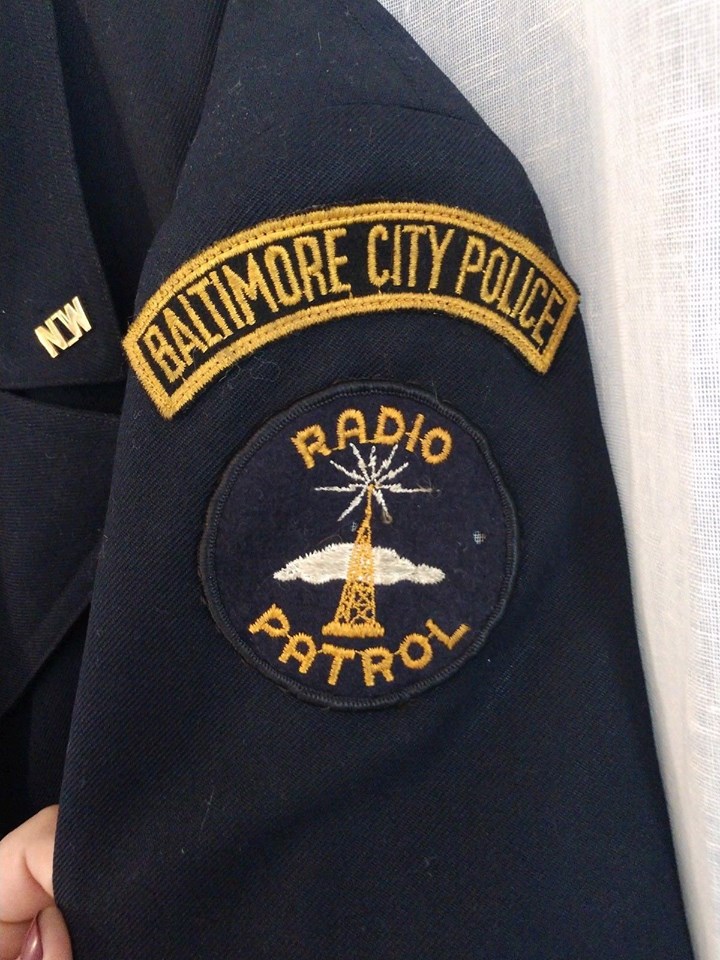


.jpg)
.jpg)


 Ken carries this badge during Breast Cancer Awareness month


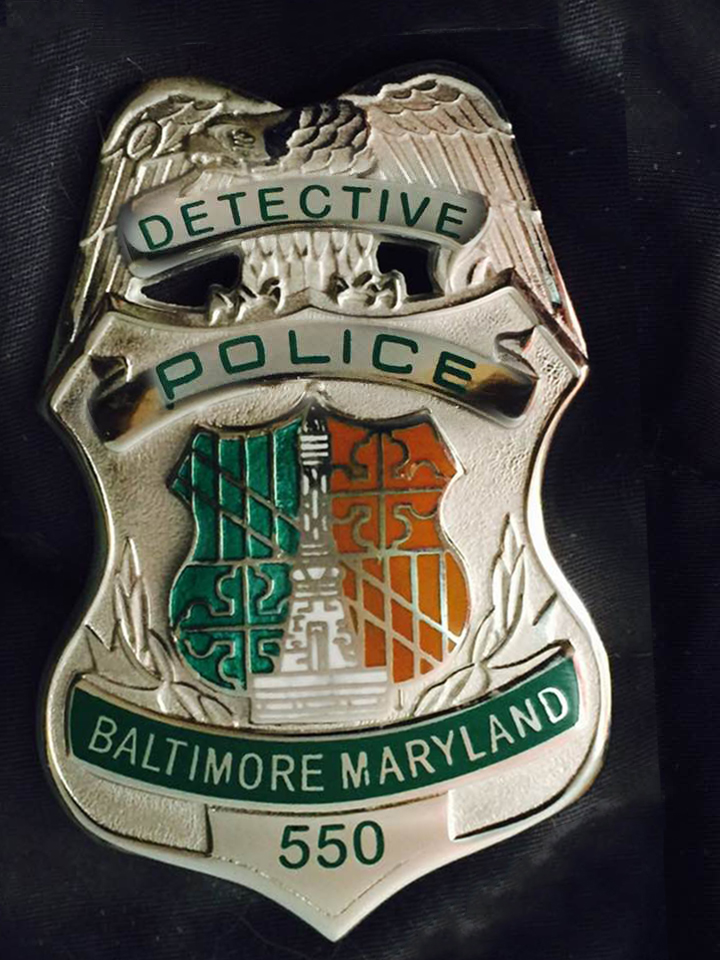
 Detective Badge Subdued #550


