Stanislav Rembski

Rembski

Stanislav Rembski

Rembski was born and raised in Sochaczew, Poland, during Czarist days. The son of a prominent interior decorator, Rembski began drawing animals as a child. He later earned an engineering degree from Warsaw Technological Institute and studied painting at the Ecole des Beaux Arts in Warsaw. At age twenty-three Rembski enrolled at the Royal Academy of Fine Arts in Berlin. While trying to avoid military service in Poland, he was captured by the German army and threatened with execution. Rembski quickly sketched the face of a guard, who invited him to his own house to hide.

After painting German nobility in the early 1920s, Rembski moved to New York, where he set up a studio in Brooklyn and became a U.S. citizen in 1929. A one-man show at Carnegie Hall in 1934 brought him wide acclaim; he painted portraits, murals, and landscapes. In 1938, he discovered Baltimore – allegedly the only city where it was not snowing while Rembski was on his way to Oklahoma to paint Osage Indian Chief Lookout. He settled in Baltimore in 1940, where he continued as a portrait painter, taught a charcoal sketch class, and wrote about art and religion. An exhibition of his portraits was held at the Baltimore Museum of Art in 1947.

During his career, Rembski painted some 1,500 portraits, including those of five Maryland first ladies, Hubert H. Humphrey, Babe Ruth, Brigham Young, and Johns Hopkins. His portraits are in museums and private collections throughout Europe, North America, and Australia. His posthumous portrait of Woodrow Wilson hangs in the Woodrow Wilson Museum in Washington, while his portrait of Franklin D. Roosevelt, commissioned by Eleanor Roosevelt, hangs in his presidential library in Hyde Park, New York. He summered in Deer Island, Maine, where he painted the local fishing scene.

On his 100th birthday, Rembski was the subject of a centennial exhibition of his work at New York’s Salmagundi Club.

redline

Stanislav Rembski, 101, renowned artist Polish-born portraitist known for precision

By Fred Rasmussen 
Baltimore Sun 

Sep 16, 1998 at 12:00 am

Stanislav Rembski, the internationally known Polish-born Baltimore portraitist, died Monday evening of cancer at Sinai Hospital. He was 101.

The prodigious Bolton Hill artist, whose work was admired for its Flemish meticulousness and vivaciousness, completed at least 1,500 oil portraits. He was the subject of a centennial exhibition -- of his work nearly two years ago on his 100th birthday at New York's prestigious Salmagundi Club.

A month before his death, he was completing commissions from his cramped second-floor studio in his rowhouse, in the 1400 block of Park Ave., where he had lived since 1948.

"He was absolutely amazing as an artist," said Ann Didusch Schuler, head of Baltimore's Schuler School of Art and also a well-known portrait artist.

Mr. Rembski's portraits are in museum and private collections throughout Europe, North America and Australia. His posthumous portrait of Woodrow Wilson hangs in the Woodrow Wilson Museum in Washington, while his Franklin D. Roosevelt portrait, commissioned by Eleanor Roosevelt, hangs in his presidential library in Hyde Park, N.Y.

"As a social portraitist, his work was exquisite. He was a very fine artist who had a wonderful style of painting," said Mrs. Schuler. "It was the fine details that he put into his paintings -- for instance, the draperies behind a subject. He was a master at this, and he realized that it was the details that counted," she said.

Sona Johnston, a Baltimore Museum of Art curator, said: "He occupies an important place in portraiture in this city."

'Important Maryland artist'

Said Dena Crosson, curator of the University of Maryland University College Arts Program, whose collection of 275 paintings are by this state's artists, "He is an important Maryland artist, and we're pleased to have him in our collection."

Portraits of five Maryland first ladies emerged from his studio -- Mrs. J. Millard Tawes, Mrs. William Preston Lane Jr., Mrs. Theodore R. McKeldin, Mrs. Herbert R. O'Conor and Mrs. Harry W. Nice. Other well-known figures include Hubert H. Humphrey, Babe Ruth, Brigham Young and Johns Hopkins, whose portrait hangs in Whites Hall, Gambrills, the birthplace of the philanthropist.

He also painted Baltimore Mayor J. Harold Grady; judges, business leaders, musicians, members of the clergy, physicians and actors.

"He certainly had a devoted following," Richard R. Harwood III, president of Purnell Galleries in Baltimore, said yesterday. "People were drawn to him because of his style and personality. He could provide a prospective client with a brilliant resume and an impressive body of work," he said.

Mr. Rembski, a dapper man standing no more than 5 feet 1 inch, with a finely trimmed mustache, goatee and hair combed straight back with a slight duck tail, was perhaps the last living embodiment in Baltimore of the artistic grandeur that vanished from Europe with the coming of World War I.

"In the neighborhood, he certainly added an exotic air and courtly manner," said Frank Shivers, a Bolton Hill neighbor, author and teacher.

Early promise

Born and raised in Sochaczew, Poland, during Czarist days, the son of a prominent interior decorator, he began drawing animals as a child. At school, his Russian drawing teacher recognized his talent and had him draw straight lines and triangles without a ruler for a year. The next year, he drew freehand circles.

He later earned an engineering degree from Warsaw Technological Institute and, at 23, enrolled at the Royal Academy of Fine Arts in Berlin, where he was exposed to the expressionist and abstract painters he had come to loathe.

Mr. Rembski, who described himself as "a painter of people," took his artistic inspiration from Leonardo da Vinci.

While trying to avoid military service in Poland, he was captured by the German army and threatened with execution. Thinking it would be his last work, he sketched a guard's face. Then, "instead of sending me out to be executed, he invited me to his own house, where he hid me in the cellar. He risked his own life. I always had the ability to draw a face in a few minutes."

After painting German nobility in the early 1920s, he left for New York, where he established a studio in Brooklyn Heights and became a U.S. citizen in 1929. A one-man show at Carnegie Hall in 1934 brought him critical acclaim.

A favorite story of his concerned how he came to discover Baltimore in 1938.

He was on his way to Oklahoma to paint Osage Indian Chief Lookout during a blizzard, and Baltimore was the only place where it wasn't snowing. So, in 1940, he settled here with his first wife, the former Isabelle Walton Everett, who died in 1980.

In an explanation of his deep affection for Baltimore, he told The Sun in an interview in the 1940s, "I would rather be Rembski of Baltimore on a visit to New York than Rembski of New York on a visit to Baltimore."

In the late 1930s, he established a summer studio at Deer Isle, Maine, and his work there showed the influence of his mentors, Leon Dabo, a disciple of James Whistler, and Edward Hopper.

Ballet before his easel

An extremely animated painter of whom it was said he moved like a ballet dancer before his easel, he was an economical artist who usually required no more than six sittings to complete a portrait. An opera fan, it wasn't uncommon for him to hum opera tunes while painting.

He also worked out compositions mentally before picking up the brush and making the first stroke.

"When I start painting, at once it is a picture -- always complete, but never finished. No matter how much work I do on it, no matter how it grows, it is unfinished. Life finishes nothing. Only death finishes," he told The Sun in an interview in the 1950s.

A deeply religious man who said the Lord's Prayer several times a day, Mr. Rembski neither drank nor smoked. Despite the passing of years, he continued to be active in the cultural and intellectual life of Baltimore.

"Art is the process of taking dust from the earth -- pigment -- and transforming it into luminous light. That is the task of the artist, of giving life and spirit to the dust of the earth," he said at the time of the Salmagundi Club exhibition.

Mr. Rembski, who was a 32nd-degree Mason, was a member of the Cosmopolitan Club, Salmagundi Club, Torch Club and Polish Heritage Association of Maryland.

A memorial service will be held at 11 a.m. Oct. 3 at St. Pius X Roman Catholic Church, 6428 York Road, Rodgers Forge.

He is survived by his wife of 17 years, the former Dorothy Marie Klein; a sister, Isabella Hamilton of California; a stepson, Dr. Norman F. Spector of Towson; a stepdaughter, Diane V. Harris of Burke, Va.; and four step-grandchildren.

Pub Date: 9/16/98

1 black devider 800 8 72

STANISLAV REMBSKI, 101, COMPLETED 1,500 OIL PORTRAITS

By The Baltimore Sun

South Florida Sun-Sentinel

Sep 17, 1998 at 12:00 am

BALTIMORE — Stanislav Rembski, the internationally known Polish-born portraitist, died Monday evening of cancer. He was 101.

The prodigious artist, whose work was admired for its Flemish meticulousness and vivaciousness, completed at least 1,500 oil portraits during his lifetime. He was the subject of a centennial exhibition of his work almost two years ago on his 100th birthday at New York's prestigious Salmagundi Club.

Mr. Rembski's portraits are found in museums and private collections throughout Europe, North America and Australia. His posthumous portrait of Woodrow Wilson hangs in the Woodrow Wilson Museum in Washington, while his Franklin D. Roosevelt portrait, commissioned by Eleanor Roosevelt, hangs in his presidential library in Hyde Park, N.Y.

Born and raised in Sochaczew, Poland, the son of a prominent interior decorator, he began drawing animals as a child. At school, his Russian drawing teacher recognized his talent and had him draw straight lines and triangles without a ruler for a year. The next year, he drew freehand circles.

He later earned an engineering degree from the Warsaw Technological Institute and, at 23, enrolled at the Royal Academy of Fine Arts in Berlin, where he was exposed to the expressionist and abstract painters he had come to loathe.

Mr. Rembski, who described himself as "a painter of people," took his artistic inspiration from Leonardo da Vinci.

While trying to avoid military service in Poland, he was captured by the German army and threatened with execution. Thinking it would be his last work, he sketched a guard's face. Then, "instead of sending me out to be executed, he invited me to his own house, where he hid me in the cellar. He risked his own life. . . . I always had the ability to draw a face in a few minutes."

After painting German nobility in the early 1920s, he left for New York, where he established a studio in Brooklyn Heights and became a U.S. citizen in 1929. A show at Carnegie Hall in 1934 brought him critical acclaim.

He is survived by his wife of 17 years, the former Dorothy Marie Klein; a sister, Isabella Hamilton of Fawnkin, Calif.; a stepson, Dr. Norman F. Spector of Towson, Md.; a stepdaughter, Diane V. Harris of Burke, Va.; and four step-grandchildren.

1 black devider 800 8 72

THIS PAGE IS MADE FOR ADMINASTRATORS OF THIS SITE IF FOUND BY ACCIDENT PLEASE LEAVE THIS PAGE AND SEAR BALTIMORE SUN ARCHIVES FOR SAME STORY. WE USE PAGES LIKE THIS IN OUR HIDEN PAGES FOR RESEARCH FOLLOW-UP DOCUMENTATION AND ASK READERS NOT TO USE THEM FOR YOUR WORK THANK YOU

Copyright © 2021, The Baltimore Sun, a Baltimore Sun Media Group publication

1 black devider 800 8 72

Donations

Donations help with web hosting, stamps and materials and the cost of keeping the website online. Thank you so much for helping BCPH. 

Paypal History Donations

1 black devider 800 8 72

POLICE INFORMATION

If you have copies of: your Baltimore Police Department Class Photo, Pictures of our Officers, Vehicles, Equipment, Newspaper Articles relating to our department and or officers, Old Departmental Newsletters, Lookouts, Wanted Posters, and or Brochures. Information on Deceased Officers and anything that may help Preserve the History and Proud Traditions of this agency. Please contact Retired Detective Kenny Driscoll.

This email address is being protected from spambots. You need JavaScript enabled to view it.

Devider color with motto

NOTICE

How to Dispose of Old Police Items

Please contact Det. Ret. Kenny Driscoll if you have any pictures of you or your family members and wish them remembered here on this tribute site to Honor the fine men and women who have served with Honor and Distinction at the Baltimore Police Department. Anyone with information, photographs, memorabilia, or other "Baltimore City Police" items can contact Ret. Det. Kenny Driscoll at This email address is being protected from spambots. You need JavaScript enabled to view it. follow us on Twitter @BaltoPoliceHist or like us on Facebook or mail pics to 8138 Dundalk Ave. Baltimore Md. 21222


Copyright © 2002 Baltimore City Police History - Ret Det Kenny Driscoll 

Replacement Baltimore Police ID Card

Replacement Baltimore Police ID Card

OLD ID CARD SGT JACK BARRICKJules NevJules Nev 2

Is it time for a new card?

To get a new or replacement/updated Retired Police ID, you will need to obtain a letter of good standing, which isn't a bad thing to have. But for the officer/detective making the ID card, it lets him know he is making it for a retired police officer and not someone's dog or best friend. 


1 black devider 800 8 72

Here are the steps:

Contact the Human Resources Section; the info is below. They will get your good standing letter. We have done this numerous times, most recently (2021) for one of our retirees who retired in 2012 and didn't get an ID card, badge, or his retirement certificate. He went out on a serious medical and was facing surgery on top of surgery, so he slipped through the cracks (which is totally wrong, but it has been resolved). Anyway, contacting Human Resources Section—we use email, and they are quick to respond. It takes a bit for the letter to come through, but they helped us get it.  

You'll need to supply them with the following:

Your Name:
Sequence number:
Address:
Position Title/Rank:
EOD - Hire Date:
RFD - Retirement Date:

1 black devider 800 8 72

Contact Information


Roberta A. Yates
Human Resources Generalist II
Baltimore Police Department, HR Section
601 E. Fayette Street | Baltimore, MD 21202
Email:  This email address is being protected from spambots. You need JavaScript enabled to view it.
Office Phone: (443) 984.9535 | Fax: (410) 385.3104

Once you have that, you'll need a digital picture of yourself wearing a solid-color button-up, collared shirt against a solid-colored wall/backdrop, preferably contrasting. The letter will come to you in the form of a PDF via email. I imagine they will mail you a hard copy also, but for fastest service, get them to email you a PDF. Then attach the letter and your digital pic and email it to Detective Caesar Goodson. I have also included his information below


1 black devider 800 8 72

Turk Id card 72

No Novelty or Family/Friends Cards

It should go without saying, but they don't make them for our dogs, wives, husbands, girlfriends, boyfriends, kids, parents, or friends of the family. I know it sounds obvious, but you would be surprised at the requests made. It’s a long story, but the days of getting a service dog ID card have come and gone. The department has become a little more strict as to how easy it is to get an ID card. As we know, our cards don't expire, but our faces don't stay young, so from time to time, maybe about as often as we might renew our driver's license, it might be good to update our retired police ID card. Given the current police climate and national security issues, they have to buckle down, but that doesn't mean they won't do them via the internet and US mail, by corresponding over the phone, and through emails. We have had several of these done this way over the last two or three years. We just have to be smart, not try to take any shortcuts, and keep things professional. We know we'll need a headshot, so make sure we don't have a hat on, sunglasses, or anything unprofessional. Wear a dress shirt, button-down with a collar, and a solid color, preferably something an officer would wear. Be mindful of our backdrop. I shot mine against a plain tan/off-white wall. I have heard guys using their shower to get a white wall without pictures, paintings, knickknacks, etc. If you can't get a professional, presentable photo on your cellphone taken by a friend, consider getting a passport photo professionally done; they only cost a couple bucks. If you live out of state, are disabled, suffer a serious line-of-duty injury that limits your mobility, or just because it is part of getting older. If it will be difficult to physically get in, use the following emails or phone numbers to try to set things up. Just make sure you obtain everything needed and stay on top of it. I worked with a lot of people down there over the years; we have had some good and some bad. Ms. Dana Bethea and Det. Caesar Goodson have both been a great deal of help in getting cards for our retirees. Given downtown parking and Covid. I would assume they would prefer working virtually as opposed to bringing people in that might be infected or could become infected. So, call them, or better, I like to write them via an email and work with them at their pace. You could ask them if it would be better if you contacted Human Resources to get your letter of good standing or if they can do it faster. 

1 black devider 800 8 72

Good luck. If you have problems, let us know. If you are given a different name or email address, please let us know so we can update the page. 


1 black devider 800 8 72

Donations

Donations help with web hosting, stamps and materials, and the cost of keeping the website online. Thank you so much for helping BCPH. 

Paypal History Donations

1 black devider 800 8 72

POLICE INFORMATION

If you have copies of your Baltimore Police Department class photo, pictures of our officers, vehicles, equipment, newspaper articles relating to our department and/orofficers, old departmental newsletters, lookouts, wanted posters, and/or brochures. Information on deceased officers and anything that may help preserve the history and proud traditions of this agency. Please contact retired Detective Kenny Driscoll.

This email address is being protected from spambots. You need JavaScript enabled to view it.

Devider color with motto

NOTICE

How to Dispose of Old Police Items

Please contact Det. Ret. Kenny Driscoll if you have any pictures of you or your family members and wish them remembered here on this tribute site to honor the fine men and women who have served with honor and distinction at the Baltimore Police Department. Anyone with information, photographs, memorabilia, or other "Baltimore City Police" items can contact Ret. Det. Kenny Driscoll at This email address is being protected from spambots. You need JavaScript enabled to view it. follow us on Twitter BaltoPoliceHist,  like us on Facebook or mail pics to 8138 Dundalk Ave.Baltimore, MD 2 21222


Copyright © 2002 Baltimore City Police History - Ret Det Kenny Driscoll 

I'd Have To Have Two Souls

"I'd Have To Have Two Souls"

Baltimore has one of the most diverse police forces in the country. So why are community relations still so bad?

Posted on February 18, 2016, at 7:08 a.m. ET

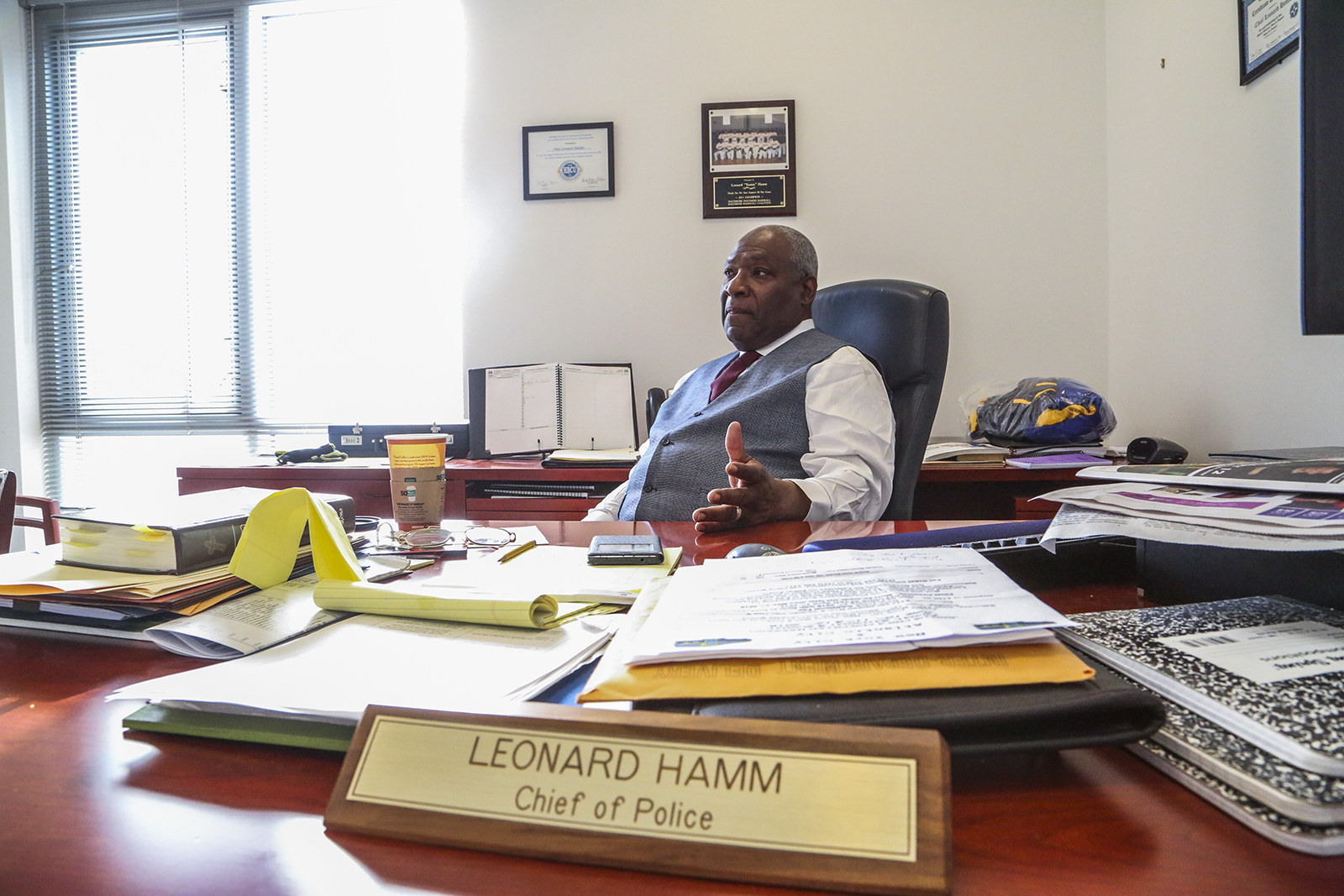
Like many of the boys in his neighborhood, Leonard Hamm learned early to be wary of the police officers — many of them black like him — who patrolled the streets of South Baltimore in the 1950s and '60s. Hamm remembered the officers as bullies, philanderers, and carousers, a largely corrupt force that rarely protected or served the people of the community.

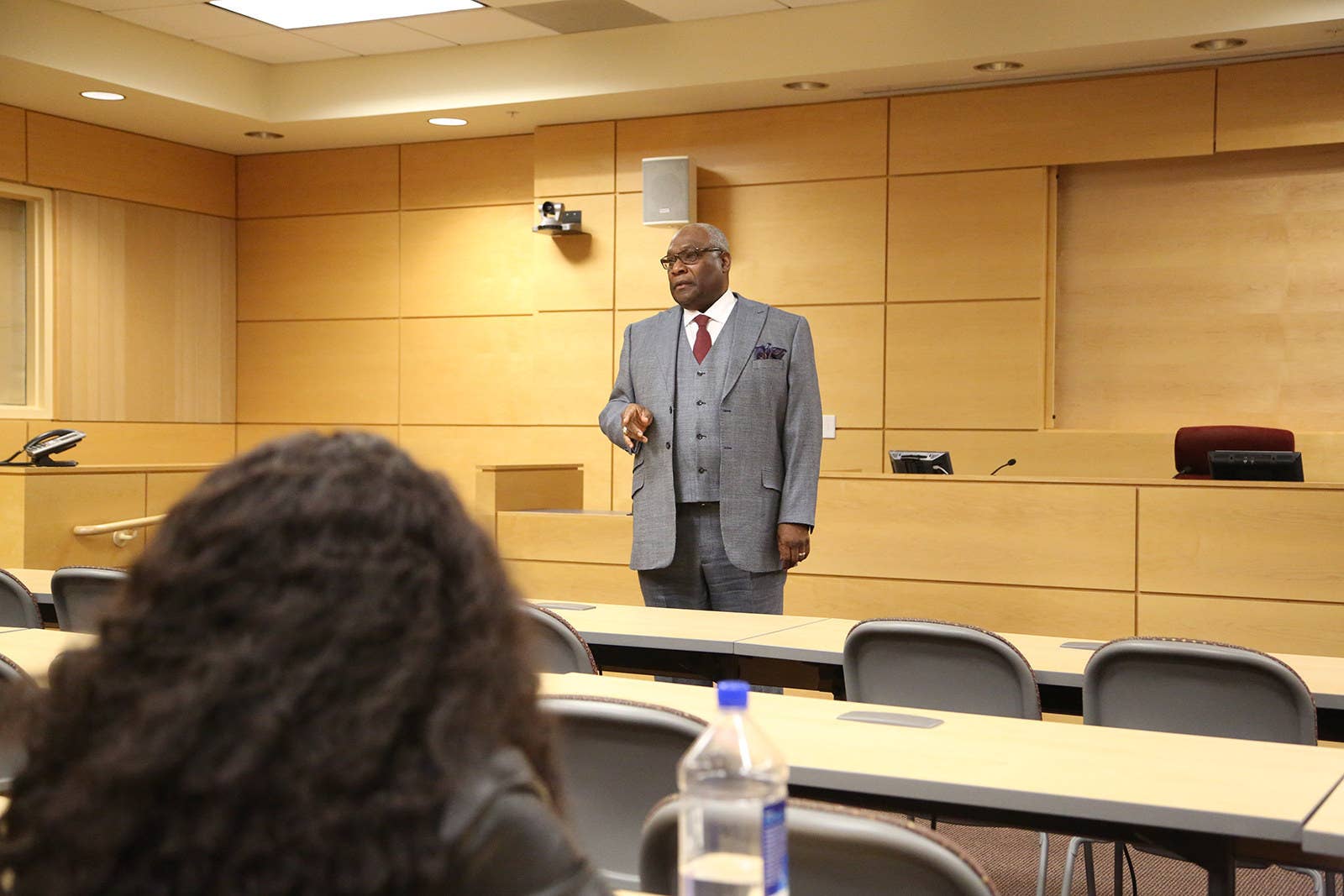
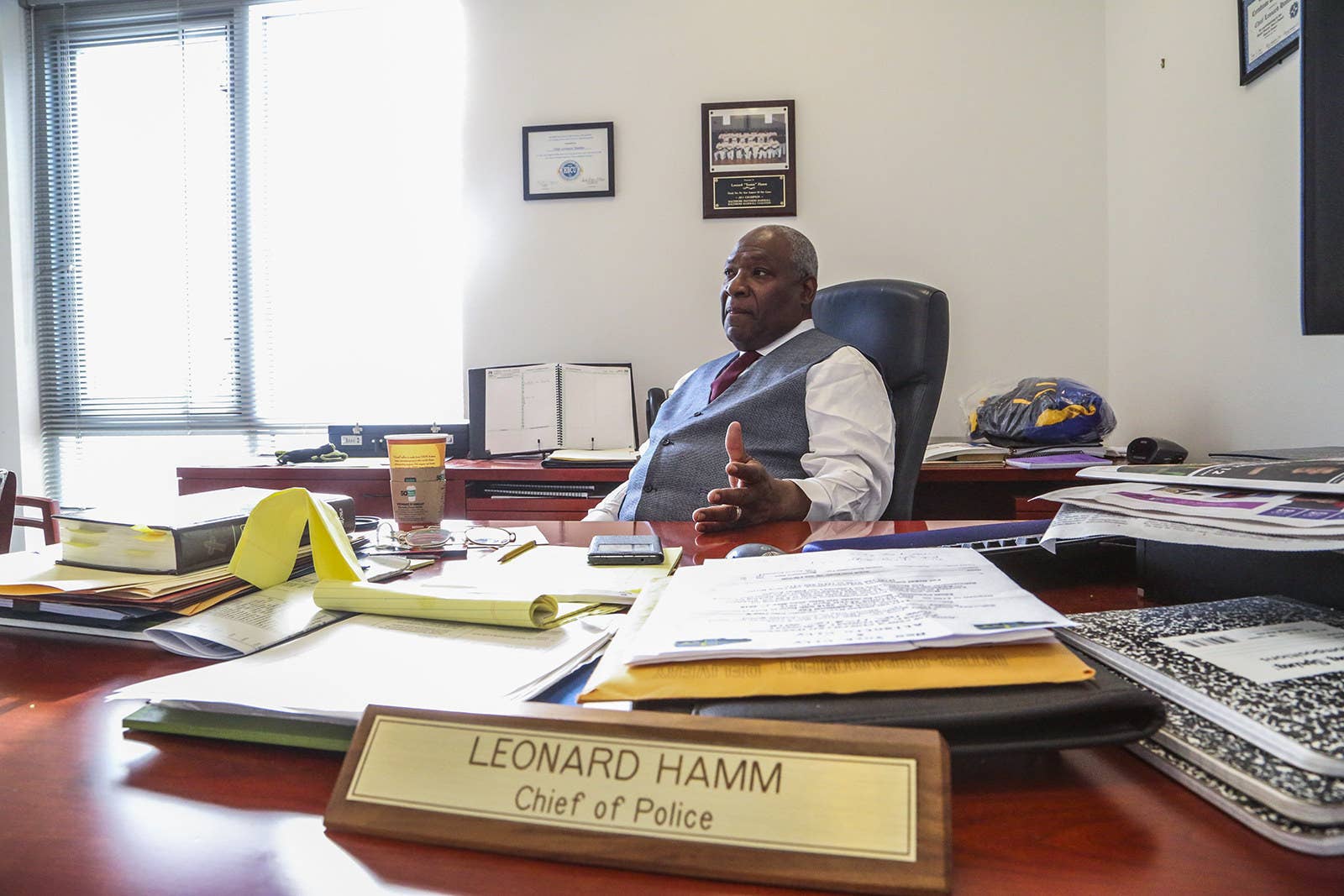
“I had no respect for police,” said Hamm, wearing a finely tailored dark-blue suit and shaking hands with nearly everyone who crossed his path on a recent afternoon at Baltimore City Hall. “I thought they used their power to the detriment of the community.”

Hamm’s suspicions were confirmed at 16, when, he said, an officer arrested him and two friends for “obstructing the path” of a sidewalk while he picked up a pair of pants from the dry cleaners. Hamm said he spent the night in jail and had to appear before a judge, whom his father successfully convinced to drop the charges. The experience only hardened his misgivings about law enforcement.

“I never really got over it,” said Hamm, then a team captain and star of City College High School’s city champion basketball team.

Hamm might have held on to that grudge for much longer if he hadn’t eventually needed a job. After graduating from college in Philadelphia and working in New York as a fabric designer, Hamm returned home in 1973 looking for a job. He knew the police department had some openings.

“I knew I would be a good hire: a black boy with a college degree who had never been in trouble,” Hamm said. “I went in looking for work, a paycheck. But I found out in the police academy that law enforcement had grabbed my heart.”

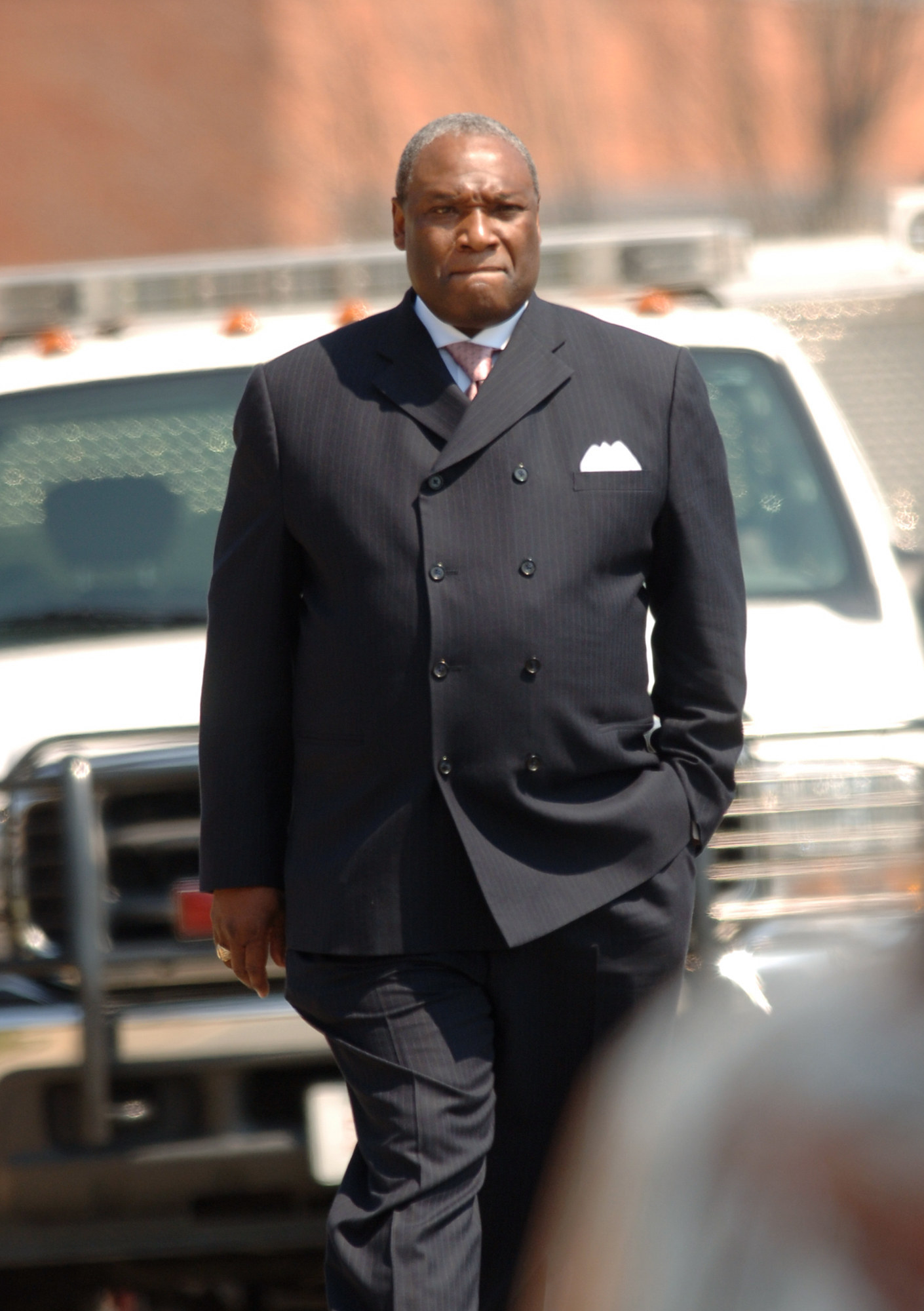
Thirty years later, after steadily rising through the ranks, including a high-profile appointment as the first black commander of the Central District, Hamm was named the police commissioner of his hometown. At 6 foot 2, broad-shouldered, plain-spoken, clean-shaven, and nattily dressed, Hamm, 66, still possesses the self-confidence of the Big Man on Campus he once was and the salesmanship of someone who’s been in leadership roles for two decades now.

 
If the purpose of community policing is to bridge divides between law enforcement and the community, in Baltimore that project has all but failed.
 

Today, Hamm is the police chief at Coppin State University, a historically black university of about 4,000 students in West Baltimore. Given his experience and position, Hamm is perfectly situated to take the gospel of policing to some of the city’s most disinterested parishioners.

Hamm’s career seems like an exemplar for what criminal justice experts call “community policing”: a theory of proactive, less antagonistic law enforcement that prizes officers with close ties to the neighborhoods where they work. The Baltimore Police Department has often signaled a renewed commitment to that philosophy, saying, “Community relationships are important, especially in difficult times” in a recent report.

And in a city where nearly a fifth of black residents are unemployed and more than a fourth live below the poverty line, a career in law enforcement — which can start at nearly $50,000 a year — has been a reliable path into the middle class in a city where few others exist. Nearly 40% of the 2,646 sworn police officers in Baltimore are black, according to a community policing report, a figure that dwarfs much larger cities like Los Angeles and Dallas.

If the purpose of community policing is to bridge divides between law enforcement and the community, in Baltimore that project has all but failed. Nearly half of residents polled in the 2013 Baltimore Citizen Survey rated police protection as “fair” or “poor,” and the authors of the OutcomeStat Conference report in September noted “negative perception of police has likely increased in the recent months due to the death of Freddie Gray.”

Despite the financial incentives for a career in law enforcement, and a sizable black presence on the force, tensions between the black community and law enforcement are as high as ever. And that leaves Baltimore’s black officers facing the difficult contradiction of being both cops and members of a community that distrusts law enforcement.

That burden was actually part of the appeal for William Porter, who dropped out of junior college and entered the police academy in 2012 hoping to restore trust in law enforcement in the same poverty-stricken neighborhoods where he grew up. Instead, many worry that the involvement of Porter and two other black officers in the April 2015 death of 25-year-old Freddie Gray, a black man who suffered a fatal neck injury in police custody, has only exacerbated the divide between Baltimore’s black neighborhoods and the black officers who patrol them. Which, accordingly, could make it more difficult to convince the children of those communities to someday don a badge and uniform themselves.

Gray’s death led to protests and, ultimately, riots in the same streets Porter had patrolled for the past three years. Porter's subsequent trial, the first for the officers charged in Gray’s death, ended with a hung jury in December. His second trial is scheduled to begin June 13.

Porter's plight perhaps offers more evidence that, despite boasting a police force that comes as close as any in the nation to representing the city it serves, community policing in Baltimore might always have its limits. In fact, it might be impossible, because the police cannot alleviate longstanding problems like joblessness and poverty, and because the institution itself remains marred by substantive — and repeated — accusations of carelessness and brutality, and the ethnic composition of the force has done nothing to change that.

“That’s what they wanted: a kid from the neighborhood, knows the neighborhood, knows the culture,” Lt. Kenneth Butler, a 30-year veteran of the Baltimore Police Department and president of the Vanguard Justice Society, the union for the city’s black officers, said of Porter. “That’s what Baltimore Police looks for. It’s a disappointment.”


Hamm joined the force in 1972, not long after a time when black officers could not patrol white neighborhoods and weren’t even assigned squad cars. The department officially integrated in 1966, but struggled with allegations of racism, and discrimination and harassment against its black officers, for years after.

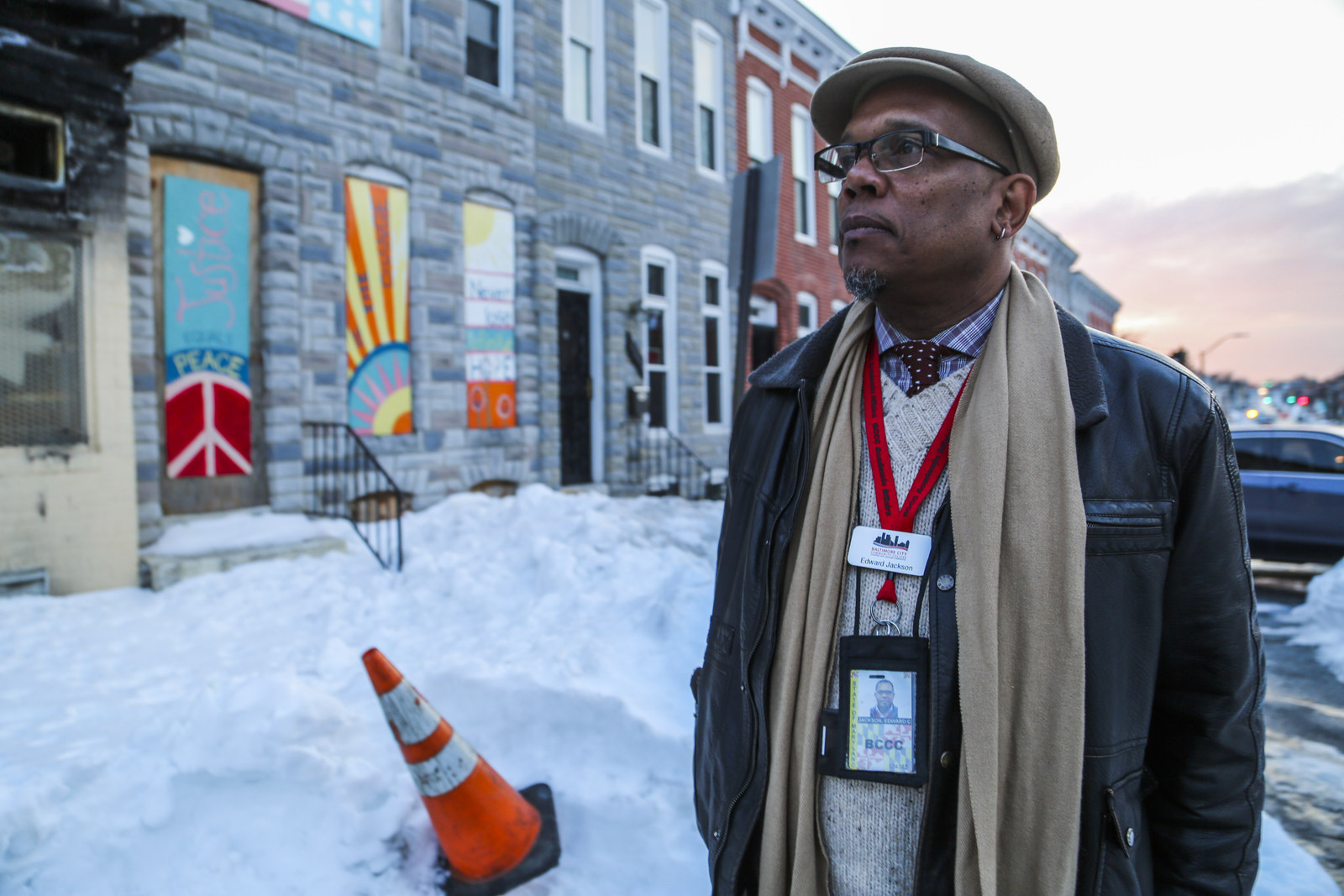
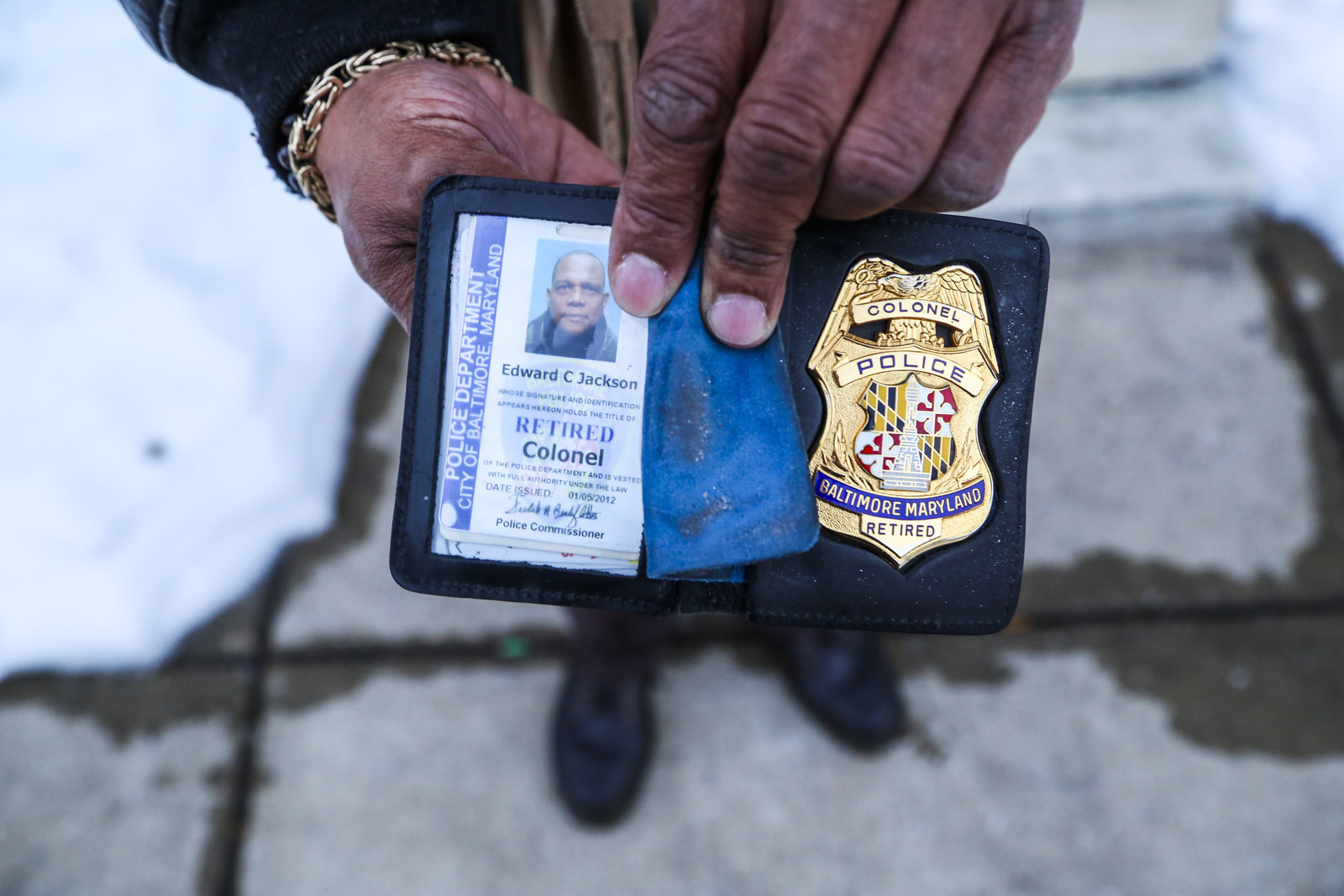
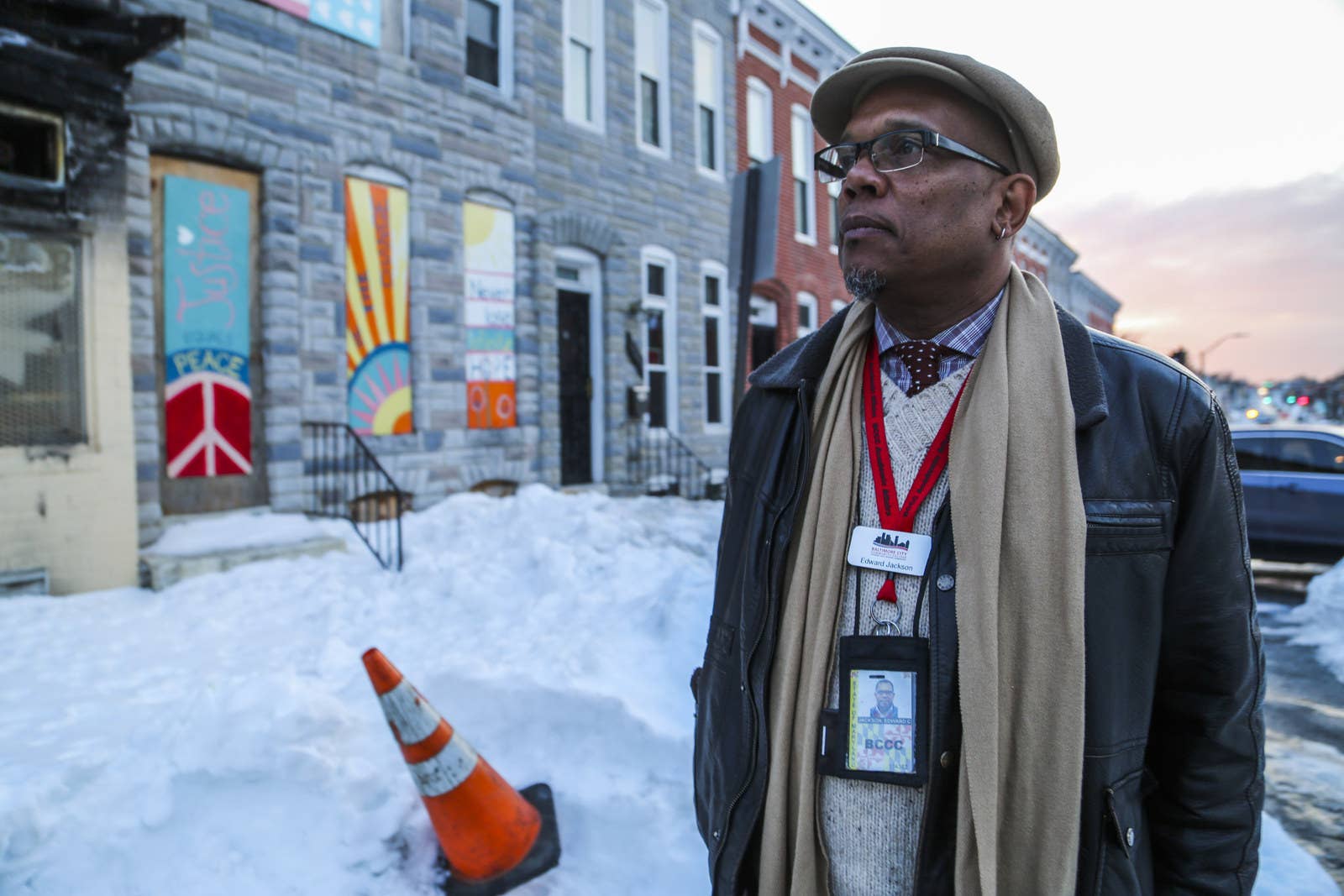
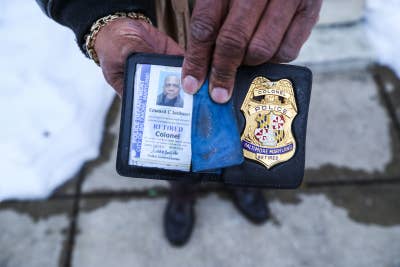
“When I first joined the police force, I realized right away that I’d have to have two souls,” said Edward C. Jackson, a black Baltimore police colonel who retired in 2004 after 22 years on the force and now teaches at Baltimore City Community College. “I had to go out and be the beacon of hope that African-Americans expect you to be and not offend the white power structure. I struggled with that my whole career, to walk that line."

This was a police force where, in the 1980s, one officer used to perform in blackface. However, the respect and support that often eluded black officers within the agency could be found in the streets and neighborhoods where they worked and lived.

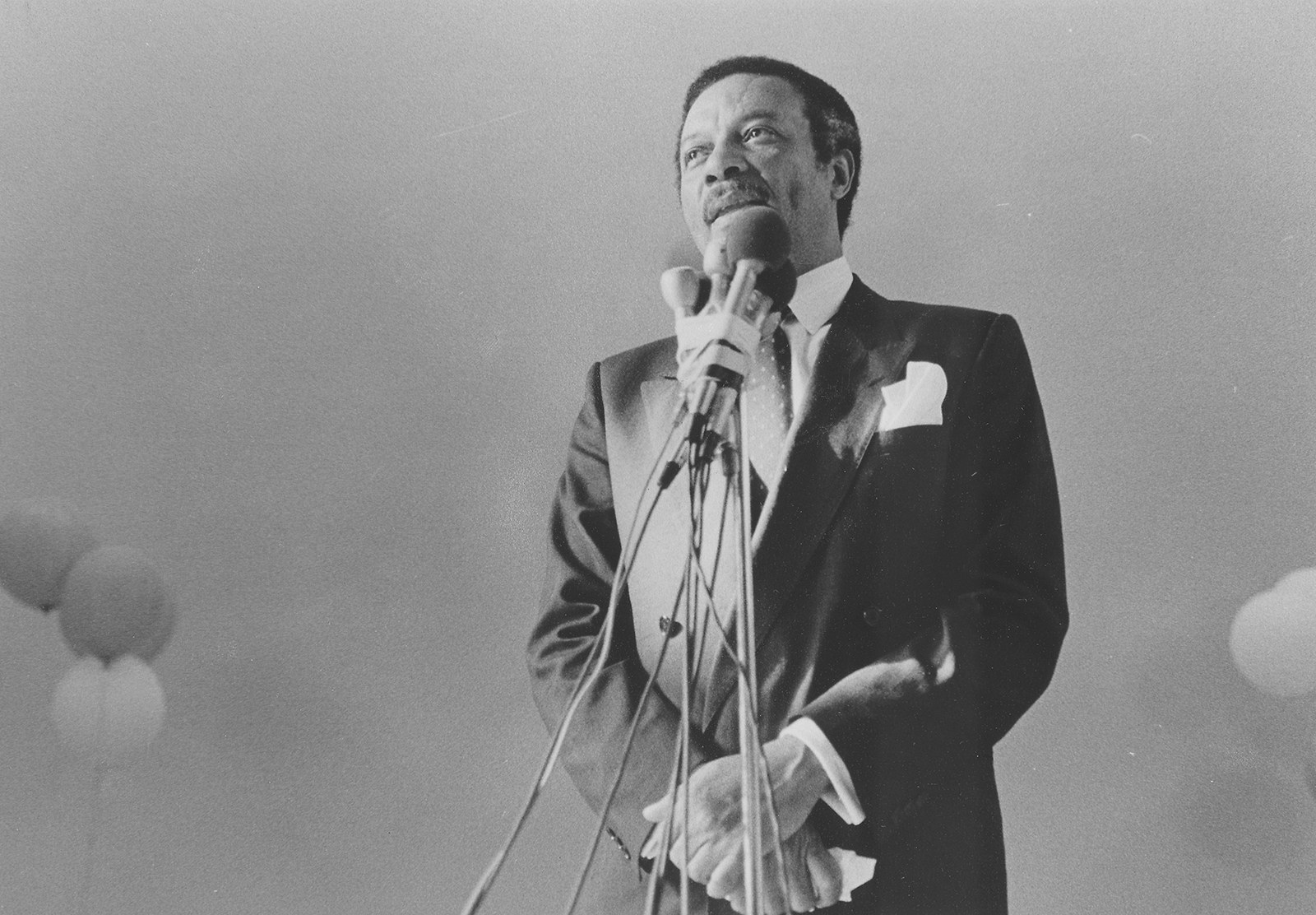
“There were still not too many high-ranking African-American police officers as I grew up in the ’60s and late ’50s,” said Kurt Schmoke, Baltimore’s first elected black mayor in 1987 and now president of the University of Baltimore. “But they were well-respected … where you thought of them as a part of, not apart from, the community.”

Hamm said he and several black officers would also regularly go play pickup basketball around the neighborhoods where they worked after they got off of their shifts. “We weren’t afraid to go back in the community,” Hamm said. “The community didn’t intimidate us. We never mistreated the community. They never had beef against us — their beef was against authority and the institutions.”

Hamm said he also earned a reputation in the department — and, as a result, in the streets — for pushing back against its entrenched culture of brutality. On his first day, Hamm recalled, he had to chastise officers who seemed eager to beat up one of the arrestees in the police van.

“If you get in there with my prisoner, I’m telling on you,” Hamm remembered telling the other officers. “I was looked at strange. But I wasn’t having it. There was resistance when I wanted to do things the right way, instead of participating in the police subculture.”

It was during this time when the department welcomed more black officers into its force. One in particular, Bishop Robinson, led the way for the others in the ’70s and ’80s, steadily rising through the ranks and gaining influence with each promotion. He also fortuitously made his climb during a time when Baltimore’s demographics shifted quickly and dramatically: Blacks went from 46.4% of the population in 1970 to 54.6% in 1980.

 
"People want to see people in charge that look like them."
 

By 1983, 12-year incumbent mayor William Schaefer, who was white, was facing criticism in his re-election campaign from opponent William “Billy” Murphy — then a judge on Baltimore’s Circuit Court and scion of a prominent black family that owned the local Afro-American newspaper chain — for not appointing a black police commissioner. Those swipes came not long after the city’s local NAACP branch called for a federal investigation into police brutality in the city.

''Why hire a mayor who wouldn't hire you?'' Murphy’s campaign literature asked of his black supporters.

Two months later, Schaefer nonetheless won the mayoral election in a virtual landslide — he earned 72% of the vote to Murphy’s 26% — and narrowly won a majority of black voters while rallying the support of many of the city’s black leaders. When Schaefer made Robinson the city’s top cop the next summer, he brushed off accusations that he’d been pressured into the appointment.

Robinson, too, avoided publicly musing on the racial implications of his promotion. "I don't share the characterization of black commissioner, I wish you would refrain from saying that. The job is not color,” he told the Baltimore Sun. But even if Robinson wouldn’t acknowledge the historical context, his appointment still resonated to black officers throughout the department.

“That motivated me to get promoted and it motivated me to get other young African-Americans promoted,” Butler said. “I didn’t realize it at the time because I was so young, but people want to see people in charge that look like them.”
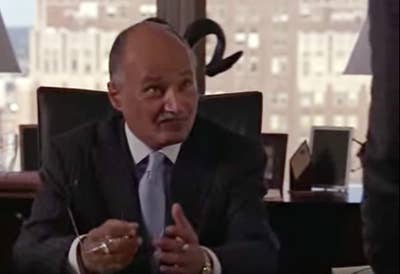


More skeptical was Murphy, who soon returned to work as a trial attorney after his failed run for mayor. “It was an inhospitable environment for black officers,” he said, noting that he’d represented officers in discrimination cases against the city several times. “There were lawsuits because of discrimination in the department. Discrimination which still persists to this day.”

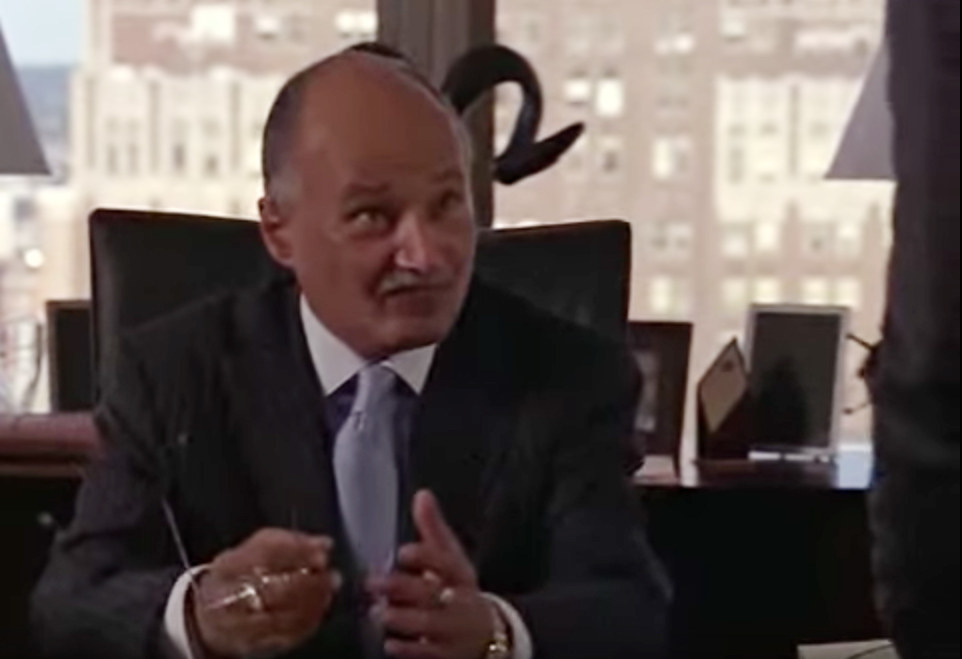
In Baltimore today, Murphy looms so large in the city that he once played himself in an episode of The Wire, the gritty HBO crime drama about the city and its institutions, from politics to the drug trade. Murphy has continued his civil rights advocacy and work in the courtroom: In September, he reached a $6.4 million settlement with the city on behalf of Gray’s family.

On the day of Porter’s mistrial, from his resplendent 23rd-floor office — boasting a panoramic view of the city’s skyline — in a skyscraper only a couple blocks away from the courthouse, Murphy applied his skepticism about the integration of the police department in much broader terms.

“It never changed the culture,” Murphy said. “If black officers are forced to conform to corrupt practices of their white colleagues, that’s not reform. That’s the antidote to reform.” He paused. Baltimore police, he said, “have never been a legitimate presence in the black community.”


Bishop Robinson remained popular locally despite being the face of an institution that was largely anathema among black residents, and failing to lower a stubbornly high homicide rate in a city known derisively as "Bodymore, Murderland."

“Bishop was a true community police officer,” said U.S. Rep. Elijah Cummings, a Baltimore native who started his political career in the Maryland General Assembly in 1983. “He made it his business to get to know a vast cross-section of Baltimore.”

Robinson even managed to win over some of his critics, who once accused him of having too cozy a relationship with the city’s white power brokers. "I had to eat my own words," Bishop Douglas Miles, then a chairman of a local interfaith group, told the Sun for Robinson’s obituary in January 2014. “The things he accomplished, the stances he took, he was a man to be respected.”

When Schaefer successfully ran for governor in 1987, he took Robinson with him to Annapolis. Robinson served as Maryland’s secretary of public safety and correctional services for the next decade.

In another bit of serendipitous timing professionally, Robinson’s legacy in his hometown benefited from sweeping socioeconomic changes across the city — and eventually around the nation.

“He left just before the crack epidemic hit Baltimore,” said Schmoke, who served as the city’s top prosecutor before succeeding Schaefer at City Hall. “He didn’t encounter the same kind of tensions that other commissioners had to deal with.”

Schmoke and the city’s police department were left to deal with a series of mounting challenges: widespread drug addiction, a spike in violent crime, and declining tax revenue as a result of decades-long white suburban flight — Baltimore’s total population declined nearly 30% from 1970 to 2000. That meant Baltimore had to slash a number of city services and programs just when its residents — now blacker and poorer than ever before — needed them the most.

“It was a situation that, as they used to say, ‘Sometimes in government, there’s more will than wallet,’” Schmoke said. “The things we wanted to do in a more positive way, we just didn’t have the money for.”

Those budget problems especially took a toll on Baltimore’s community policing efforts, chiefly their management of 27 recreation centers — dubbed Police Athletic League (PAL) centers when the department took them over in 1995 — around the city.

Police welcomed residents into those facilities, hosting tutoring, sports, and recreation programs for children and job fairs for adults. They even used them as “safe shelters” for crime witnesses who were afraid to go to police stations. The program earned so much acclaim that former Commissioner Thomas C. Frazier appeared at the White House in 1998 to promote the city's approach.

“They were the best thing that’s ever happened here,” said police Lt. Col. Melvin Russell, who now runs the department’s Community Collaboration Unit and has coordinated community outreach efforts around the city for a decade.

“The power in them is that people get to see the police force as something other than officials who arrest you and give you a ticket,” said Jackson, who was the department’s director of community relations from 2001 to 2003.
 

In his trial last month, Porter testified that he was a regular at his local PAL center while growing up in West Baltimore. It was there, Porter told jurors, that he had his first contact with police officers. “Every day it was like a camp setting,” Porter said. “They’d help me with my homework and took us to the zoo and the aquarium.”

But as the money dried up and crime started to rise, city officials moved officers out of the centers and back onto the streets. And whereas Schmoke favored drug decriminalization and was outspoken in his opposition to the “war on drugs” of the ’90s, his successor, Martin O’Malley, swept into City Hall in 1999 with a pledge to take a “zero-tolerance” approach to crime. That drew little criticism at the time, given that it’s the easiest issue to address in poor black communities and that aggressive policing often enjoys support across all kinds of constituencies.

“When Mayor O’Malley first initiated that,” Hamm said, “the community won’t admit it, but they wanted it too.”

At the height of O’Malley’s zero-tolerance campaign, in 2005, Baltimore police made a record 108,447 arrests — involving roughly a sixth of the city’s population. The ensuing drop in crime — a 37% reduction in violent crime from 1999 to 2004, though critics contend O’Malley’s methodology fudged the numbers — helped launch a political career for O’Malley that included two terms as governor and a failed Democratic presidential candidacy this year. But in Baltimore, the wages of zero-tolerance policing took its toll on a generation of young black men and created more local mistrust of the police department.

“We drew a wedge between the police department and citizens,” Butler said. “You had to lock them up because you needed the numbers.”

During his presidential run, O’Malley called for an overhaul of the nation’s criminal justice system and vowed to address overcrowding in prisons. He also disputed accusations that his policies as mayor may have sown resentment toward Baltimore police.

“When I ran for mayor in 1999, it’s not because our city was doing well,” O’Malley said during a presidential debate last month. “We were able to save a lot of lives and we did a lot of things to improve the police and the community’s relationship.”

Those claims were swatted away by Jackson, who gradually watched police vans once used to take children to PAL centers become transport vehicles for thousands of black teens and young adults headed to jail.

“Every decision you make has some kind of consequence,” Jackson said. “Baltimore is paying for it now.”
  

In November 2004, Hamm became O’Malley’s fourth pick for police commissioner in five years.

The appointment was greeted with apprehension, given all of the previous turnover. “Chronic Police Chief Turmoil Could Tarnish O’Malley’s Rising Star,” read the headline in the Washington Post the day after Hamm was named acting commissioner.

Hamm, then 55, had only recently rejoined the department. After retiring from BPD in 1996, Hamm worked in a series of law enforcement leadership positions, including as police chief for city public schools and Morgan State University. He came back to BPD in September 2004 and two months later was promoted after O'Malley fired Commissioner Kevin P. Clark.

Backing Hamm’s move to the full-time role in March 2005 was a diverse network of supporters, including Murphy, Cummings, and Kweisi Mfume, the former president of the NAACP, among many others.

“I’d heard the rumors that he might come back,” said Russell, who considers Hamm a mentor. “And I went over there and poured out my heart to him. I told him, ‘We need you. Please come back.’”

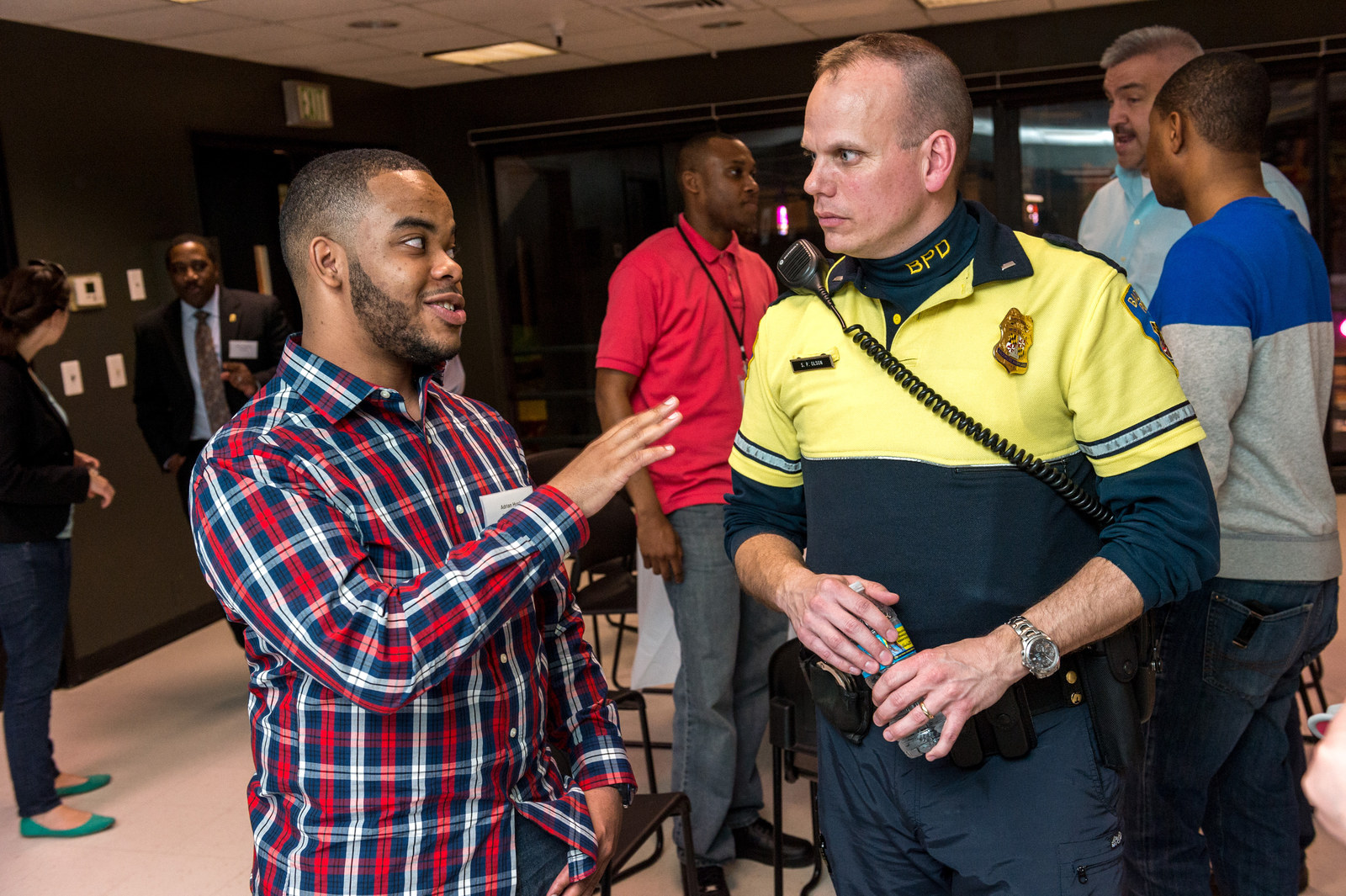
Baltimore Police Lt. Steve Olson, a shift commander in the agency’s Central District, remembered Hamm as the rare commissioner able to stay connected to patrol officers and the streets. For example, Hamm responded to the scene of an arrest in his neighborhood only hours after being confirmed as commissioner, Olson said.
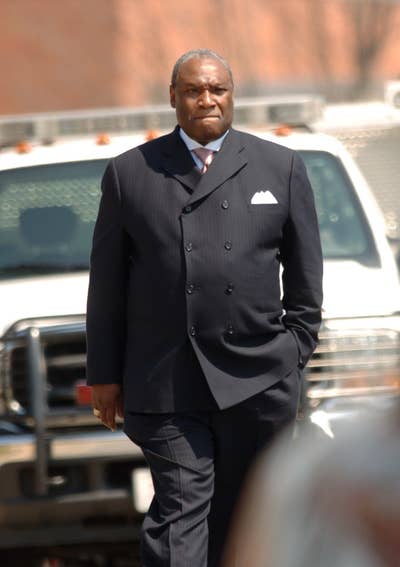
  

“The very first person who showed up was Leonard Hamm,” said Olson, who said he was attempting — and failing — to break up a fight at a house party at the time. “I’m on the ground with this young lady and this gigantic man is standing over me. He said, ‘Officer, do you need any help?’ He’s kind of legendary. He had a huge amount of respect among the rank and file that remember him.”

However, that respect had its limits. In the communities where Hamm had once lived, patrolled, and built his career, residents — in a city where black Americans were now nearly two-thirds of the population — were growing increasingly frustrated with O’Malley’s zero-tolerance policing policies.

Hamm proposed some alternatives to those zero-tolerance policies, including an outreach program for people looking for an exit from the drug trade. But with O’Malley still primarily focused on fighting crime, few of Hamm’s initiatives got the backing needed by City Hall, his friends and colleagues say.

A year into his stint as police chief, Hamm was part of a lawsuit filed by the NAACP and the ACLU over what the civil rights organizations called BPD’s “abuse of power” stemming from tens of thousands of arrests annually. Also included in the lawsuit were O’Malley and two police commissioners who preceded Hamm.

The city settled the case in June 2010, agreeing to pay $870,000, retrain officers, and issue new policies. Hamm never got a chance to implement the reforms — he was forced to resign by then-Mayor Sheila Dixon in July 2007 after homicides nearly reached the record-high rates of the 1990s and “some in the administration felt that the public had lost confidence in him,” according to the Sun.

Dixon, who’s running for mayor again this fall, said she realized soon after becoming mayor that she would need a commissioner who “was of a like mind and paid attention to all the details.”

“Commissioner Hamm was very loyal to Mayor O’Malley,” said Dixon, whose first term as mayor ended with her resignation in February 2010 after she allegedly misappropriated gift cards meant for the poor. “And I require people to work very hard. People that work for me, they see that I’m going to put in 110%. I’m not saying he’s not a great person. I just think that my expectation exceeds what I think some people can handle.”

In a poll conducted by the Sun days before Hamm’s resignation, 40% of the 601 residents polled said they felt he was ineffective, while another 35% said they didn’t know how to judge him.

“He had the title but didn’t have the authority,” Russell said.

 
"The school system, housing, families, and churches? They’re all failing. There’s no businesses. So what do you expect the police department to do?"

“It was a chance for Baltimore to be transformed by his thinking, but his ideas were never put into force,” Jackson said. “He didn’t get a fair shake to run that department. He was made the scapegoat.”

Hamm, still as prideful as ever, doesn’t accept that narrative, saying, “I don’t want you to think that was I some kind of helpless pawn being used by the politicians. That wasn’t the case.”

Now, nearly a decade removed from his time as commissioner, Hamm blames his shortcomings on inexperience dealing with the politics of the position and keeping himself at a distance from local media. “The mayors thought they were smarter than us. They had their ideas of how policing should be done and I had mine.”

He still belabors the missed chance to see through some of his proposals, many of which included more community outreach. “I went to the community and I said to them, ‘For 30 years we’ve been arrogant and stupid. I need your help,’” Hamm said.

But Hamm, who writes often of the transformational power of leadership on his blog, has also been humbled by years of watching mayors and police commissioners — and their ambitious plans — come and go.

In Baltimore, those campaign pledges and press conference promises eventually meet budget challenges, political resistance, and intractable social issues.

“The school system, housing, families, and churches? They’re all failing. There’s no businesses,” Hamm said. “So what do you expect the police department to do?”
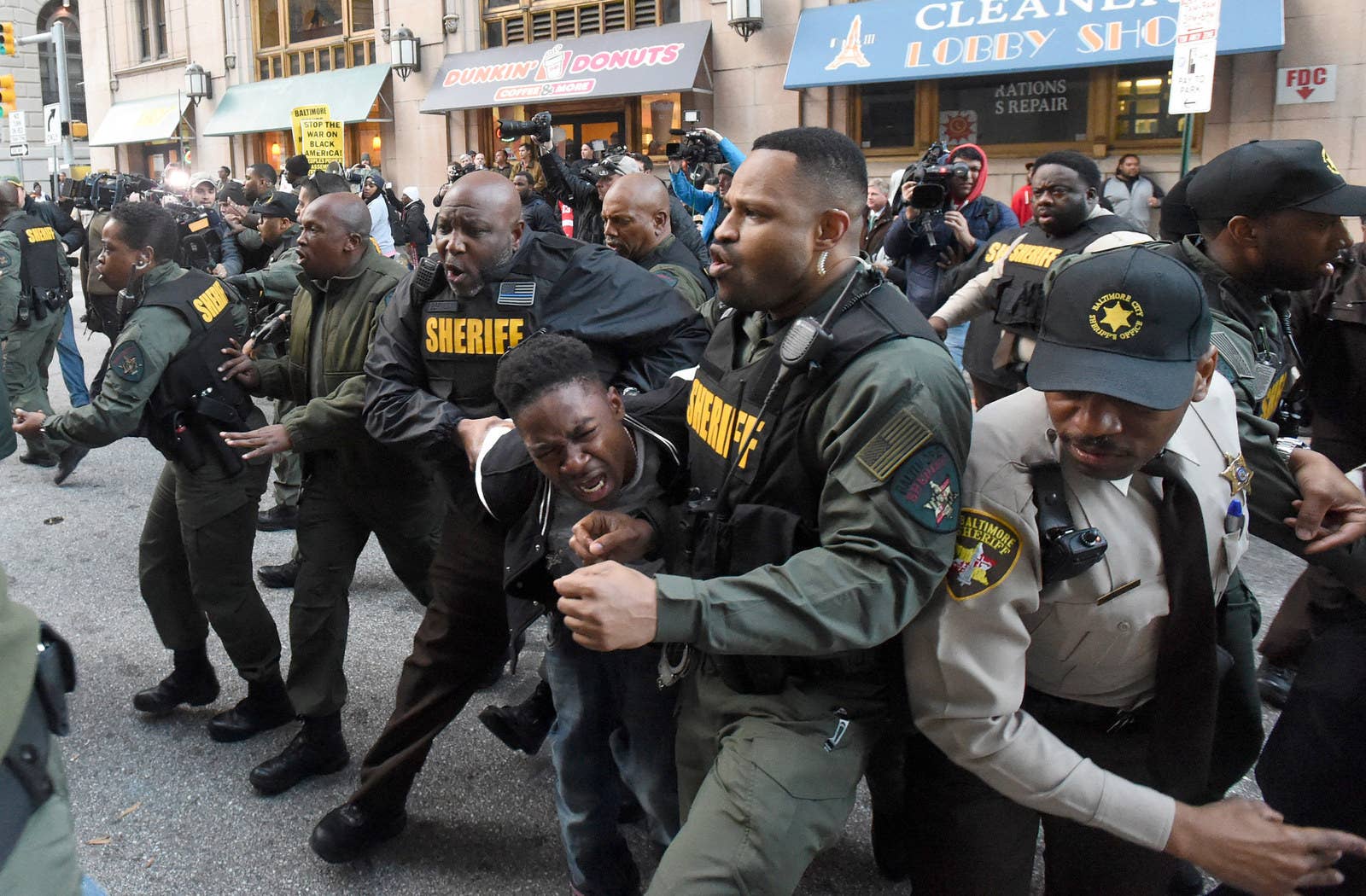
 

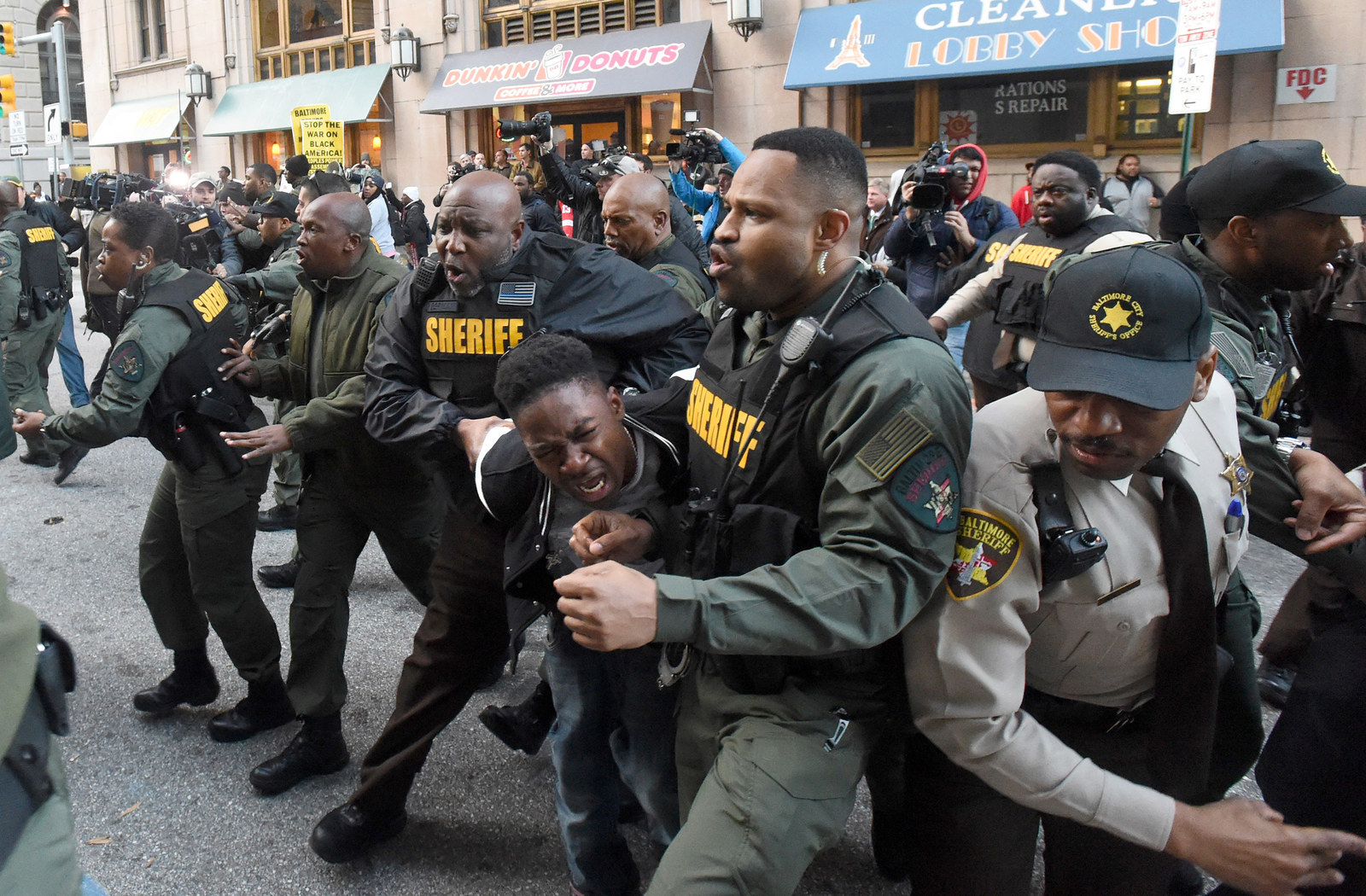
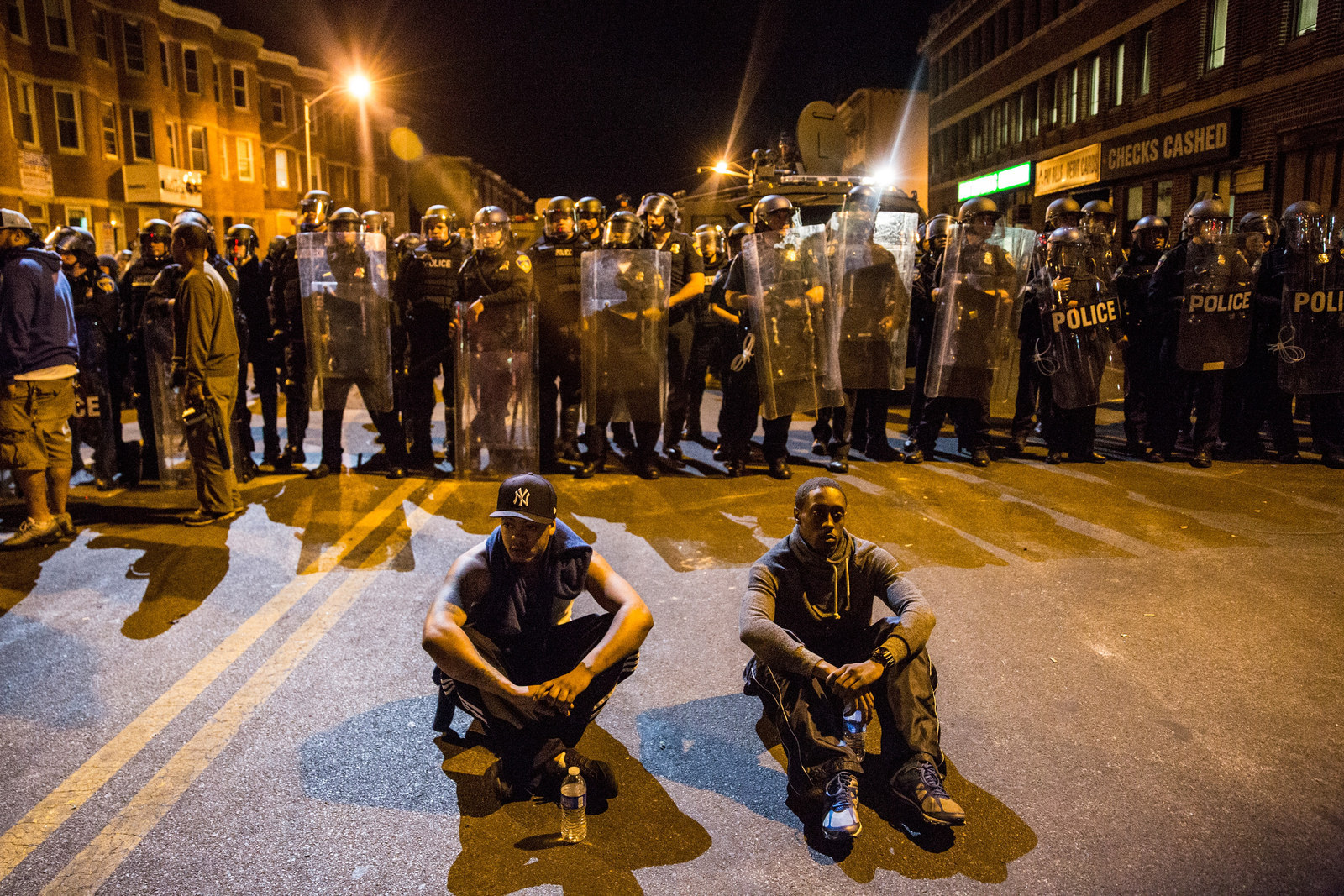
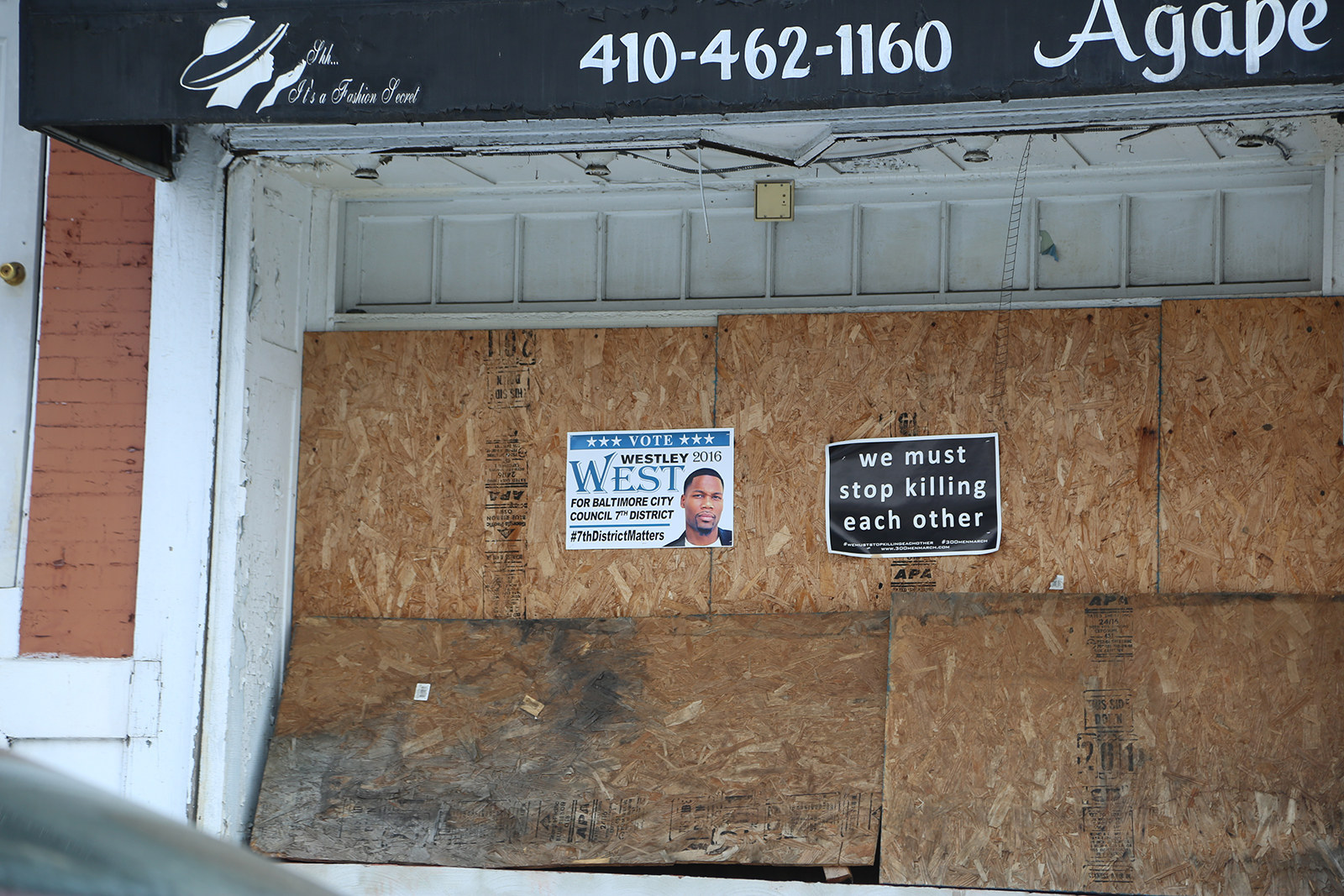
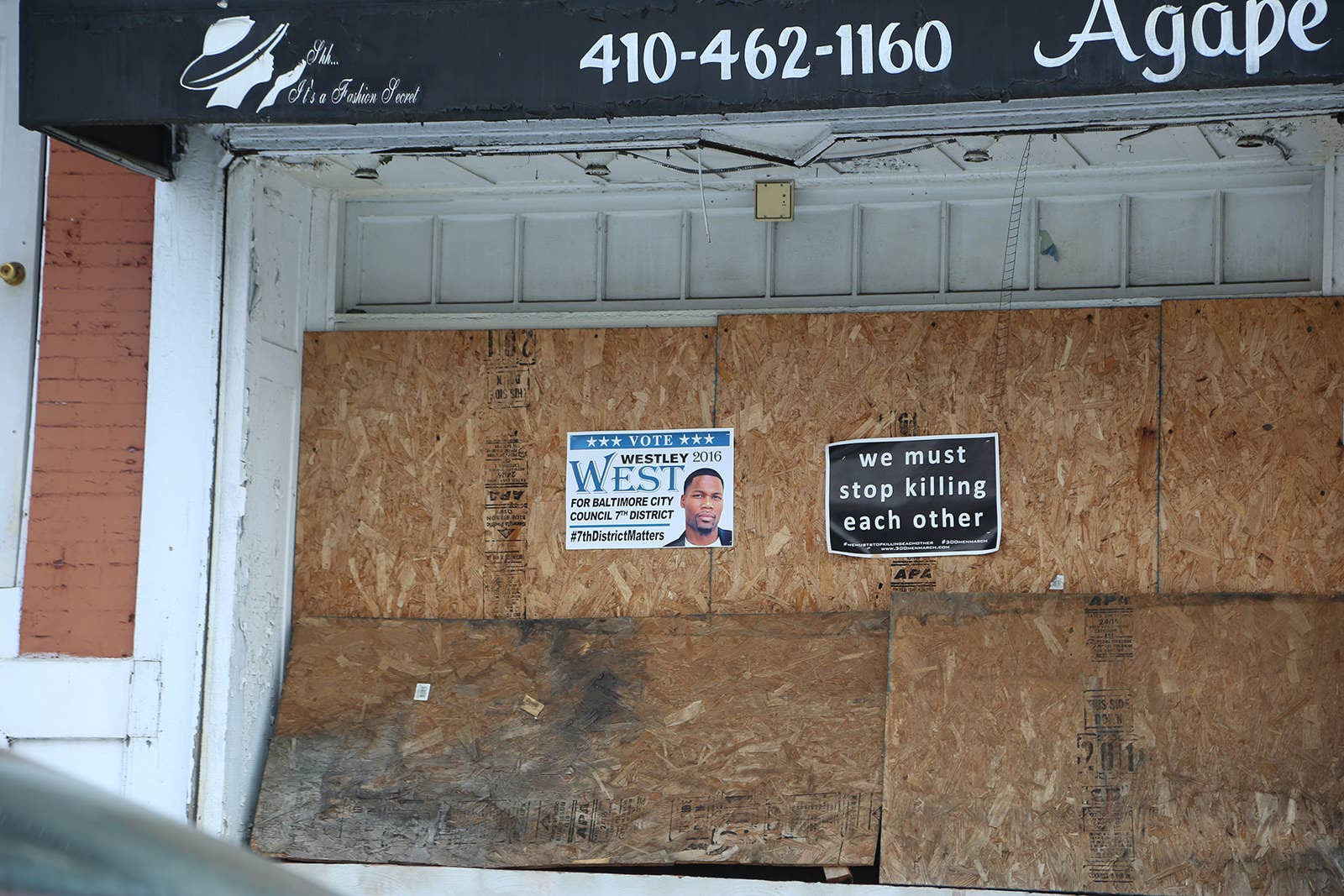
By the time activists and protesters poured into Baltimore’s streets following Gray’s funeral in late April, demonstrations against deadly police violence against young black people had already taken place in New York, Ferguson, Cleveland, and Oakland, among other cities. But few had the kind of violence or the intensity of the unrest in Baltimore, where community leaders had been warning for years of simmering resentment about racial profiling and harassment by police.

“They’ve been seen as an occupying force that looks at young black men as the enemy,” said Kim Trueheart, a local activist who regularly attends city government meetings. “People have to have some empathy to what has happened to black people in this city historically.”

Months later, a report authorized by then-Commissioner Anthony Batts titled “Lessons Learned From the 2015 Civil Unrest in Baltimore” found a litany of problems with the police response: inadequate planning, unclear arrest policies, and inadequate officer training, to name a few.

“The scale of the rioting and other unlawful action that took place during the civil unrest in Baltimore was unlike anything the city had seen since the civil unrest that occurred in 1968,” the report said, referring to the deadly riots that followed the assassination of Martin Luther King Jr. “This level of unrest and violence was not expected by city officials or the police department, but cities and police agencies should strive to be prepared for worst-case scenarios.”
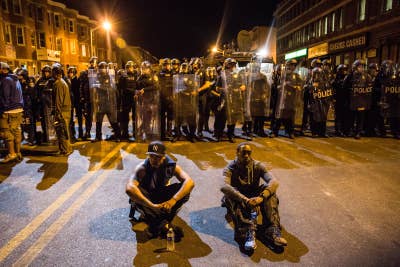
  

 At the end of the 79-page report, there was a recommendation: “BPD should enhance community outreach programs to help restore the fractured relationship with various community members,” the report said. “BPD should especially work with high school age youths to establish lines of communication and create dialogue on police and community relationships.”

Again, beefing up the number of black officers, and improving relationships with the community, is seen as the way to solve problems that are not entirely created by crime. Baltimore Public Schools recently launched a program that “aims to bridge the gap between the community and police by helping students understand the different career options within the law enforcement field,” district spokesperson Arezo Rahmani wrote in an email to BuzzFeed News. About 75 students from middle and high schools around the city are currently involved with the program.

Together, the school district and the police department have cobbled together a network of programs meant to reach children at every level of school: toy giveaways in elementary schools, sports leagues for middle schoolers, and the Baltimore Police Explorer Scouts program to identify teenagers who might make good candidates for a career in law enforcement.

“We want young people involved in the conversation to see what the job entails,” Baltimore police spokesperson T.J. Smith said. “It’s an opportunity to get more kids a little more involved in the profession.”

Yet another approach emerged from a partnership with the Inner Harbor Project, a youth-led social-justice nonprofit. Police academy cadets, officers, and even security guards now undergo a course led by local teenagers, who offer suggestions for how to best deal with young people who frequent the shops and restaurants in the area. The program comprises three lessons titled “Communication,” “Jumping to Conclusions,” and “Handling Situations With Teens.”
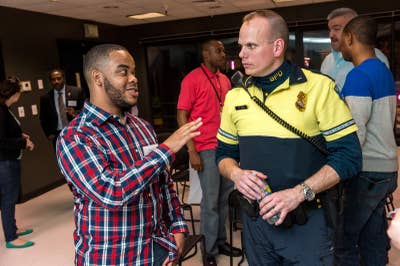
 

 During those sessions, Olson — the shift commander at the Central District — said he identified Adrian Hughes, a 19-year-old recent high school graduate from West Baltimore, as a good candidate for law enforcement.

“Not only does he have the street smarts, he’s lived in the neighborhood, he’s civic-minded,” Olson said. “Any community would be happy to have him. People want people from the community to be police officers in their own communities.”

Hughes does plan on pursuing a career in policing — just not in Baltimore. He will enter basic training in June for the Maryland Air National Guard, the air force militia for the state. Hughes said his goal is to someday serve in the military police, somewhere other than Baltimore.

Back in his neighborhood, Hughes said, his friends remain confused about his desire to become a cop — a response to their discomfort and negative interactions with police. But Hughes makes sure to let them know he’ll be in the military, not patrolling the streets of the city, where officers largely remain unwelcome in their neighborhood.

“Some people crack jokes,” said Hughes, who became interested in law enforcement while a member of the Junior ROTC program at his high school. “But that’s why I tell them about the military part first before I tell them what I’m doing in the military.”

That lingering disconnect has even some law enforcement experts resigned to the fact that, for now, police work isn’t an easy sell to young black Americans.

“We’re seeing a somewhat negative view and perception of the industry,” said Dwayne Crawford, executive director of the National Organization of Black Law Enforcement Executives. “If you ask young people about it now, we don’t sense a lot of interest in wanting to enter that field.”


Leonard Hamm likes to think of himself as a walking advertisement for life as a police officer.

"What happens is when I teach, I dress fabulously. I talk about my wonderful life,” Hamm said. “I wear $2,400 suits and alligator shoes. They see my car, they see my position. You can live well doing this stuff."

Coppin State’s campus is about a mile from Pennsylvania and North avenues, the infamous intersection where most of the confrontations between police and protesters took place following Gray’s death in April. An anchor of West Baltimore for more than a century, Coppin State has earned a reputation for training black teachers and nurses — among the few careers open to blacks in the early part of the 20th century.

And now city leaders and police officials are looking into a proposal to make Coppin State the home for the Baltimore Police Department’s academy and training center. It was an idea birthed by city council member and mayoral candidate Nick Mosby, husband of the prosecutor who filed charges against the officers involved in Gray’s death.

“This presents a unique opportunity in a very challenging time in our city’s history,” Mosby said during a recent public safety committee hearing at City Hall. “It puts our officers directly in communities that have had community-police relationship issues over the past couple of decades.”

“Right now, I’m putting together a curriculum from the book and taking it into schools,” said Hamm, whose memoir, Hamm Rules, was released in the fall. “I’m not trying to change environments anymore. I’m tired of that. I’m trying to make people strong enough to withstand any environment.”

The proposal is still in the early stages of consideration by the City Council. But the plan has the backing of a number of high-profile supporters, including Hamm and current Baltimore Police Commissioner Kevin Davis. “I look to it selfishly as a recruiting tool,” Davis said.

Still, policing experts believe it might be some time before young black Americans warm to the idea of joining their local police department. Complicating recruiting efforts, they say, is a steady drumbeat of stories about deadly police shootings of young black people around the country — stories like those of Jamar Clark in Minneapolis and Laquan McDonald in Chicago, for example. And then there’s Baltimore, where the legacy of police brutality and harassment dates back several generations, and where the specter of five more trials of Baltimore officers in the death of Freddie Gray looms large.

Jill Carter, a Democratic state delegate and attorney from Baltimore, is skeptical of the oft-repeated claim that better recruiting efforts by the police department will mean a better relationship with Baltimore’s black residents.

“We do need more homegrown black police officers,” Carter said. “But the individual is only as good as the organization and the organization needs complete reform.”

Butler said he recently tried recruiting a young black woman who was working as a security officer. “I told her, ‘You know, the police department, they’re hiring,’” Butler said. “And she said, ‘Nah. What are people around my neighborhood going to say?’ That’s prevalent in Baltimore city.” ●
 
1 black devider 800 8 72

Donations

Donations help with web hosting, stamps and materials and the cost of keeping the website online. Thank you so much for helping BCPH. 

Paypal History Donations

1 black devider 800 8 72

POLICE INFORMATION

If you have copies of: your Baltimore Police Department Class Photo, Pictures of our Officers, Vehicles, Equipment, Newspaper Articles relating to our department and or officers, Old Departmental Newsletters, Lookouts, Wanted Posters, and or Brochures. Information on Deceased Officers and anything that may help Preserve the History and Proud Traditions of this agency. Please contact Retired Detective Kenny Driscoll.

This email address is being protected from spambots. You need JavaScript enabled to view it.

Devider color with motto

NOTICE

How to Dispose of Old Police Items

Please contact Det. Ret. Kenny Driscoll if you have any pictures of you or your family members and wish them remembered here on this tribute site to Honor the fine men and women who have served with Honor and Distinction at the Baltimore Police Department. Anyone with information, photographs, memorabilia, or other "Baltimore City Police" items can contact Ret. Det. Kenny Driscoll at This email address is being protected from spambots. You need JavaScript enabled to view it. follow us on Twitter @BaltoPoliceHist or like us on Facebook or mail pics to 8138 Dundalk Ave. Baltimore Md. 21222


Copyright © 2002 Baltimore City Police History - Ret Det Kenny Driscoll 

Insight

When this site was originally started by Retired Officer William "Bill" Hackley he had 90 pages, those pages fell under the categories found in the top menu. They included - Home - Districts Heroes - Our Police - Units - History and Insight the Insight tab included thing like Final Roll Call, Retirements, About the Author, and things he had no place else, or that he felt uncomfortable putting elsewhere, his pride wouldn't let him put his own name anywhere that seemed as if he was promoting himself, or bragging about his own career. This site held 90 pages when it was given to Ken, with the help of readers, and other historians, the site is close to 1200 pages and growing.

EVER EVER EVER Motto Divder

Insight

When this site was originally started by Retired Officer William "Bill" Hackley he had 90 pages, those pages fell under the categories found in the top menu. They included - Home - Districts Heroes - Our Police - Units - History and Insight the Insight tab included thing like Final Roll Call, Retirements, About the Author, and things he had no place else, or that he felt uncomfortable putting elsewhere, his pride wouldn't let him put his own name anywhere that seemed as if he was promoting himself, or bragging about his own career. After all the site had a mission statement for remembering our fallen, our injured, and preserving our history. When he passed away he left his site to Retired detective Ken Driscoll, and Ken understood the difficulty in putting information about himself. He didn't want to come across as bragging so he had me, (his wife Patricia) make his page. I had my choice of what went in, and since I had been keeping a scrap book since Ken joined the department, it wasn't difficult to build a timeline and added pics. So anyone wanting to add info, please compile a timeline, and some pictures newspaper clippings, I'd cards, check stubs, anything at all BPD related, Ken redacts info from ID cards and or check stubs before posting, with Photoshop he can lock certain info in a way that it won't appear missing. To make it easier if we do make a dedication page for them. I also added Bobby Brown to the Insight page, and some of Ken's favorite and least favorite past leaders;, leaders that played major roles in developing some of the procedures we still use today. So if you think there is something missing on the Insight drop down, or anywhere on the site for that mater, please send us an email so we can do the research and add that info. 

Also to family members of police and retired or active police, we are not affiliated with the department, for that reason don't be angry with them for things that are, or are not on the site. Likewise don't be angry with us, often we receive messages from angry family members chastising us for not having their family on the site. The site does not have a list of names that we go through and say we like this guy or gal so we'll include them, but we never did like that hump so they will not be on our site. Truth be told most of the names you see on this site came because former partners and family members wrote us and sent pictures, equipment, etc. showing their former partner, family member or they themselves were a member of the Baltimore Police force. I wish we had a list of all police that ever on the force, I would add every name and include any and all info I have. but we can't include it if we don't have it. 

We hope you will enjoy the site and if you have info, equipment or anything that will help us preserve our Baltimore history, please feel free to contact us. we are also always looking for donations to help with costs generated by running the site. everything from stamps to have things mailed to us and to mail things out, to domain names, server space, software, etc. the list goes on and on when it comes to costs.  


1 black devider 800 8 72

POLICE INFORMATION

Copies of: Your Baltimore Police Department Class Photo, Pictures of our Officers, Vehicles, Equipment, Newspaper Articles relating to our department and or officers, Old Departmental Newsletters, Lookouts, Wanted Posters, and or Brochures. Information on Deceased Officers and anything that may help Preserve the History and Proud Traditions of this agency. Please contact Retired Detective Kenny Driscoll.

This email address is being protected from spambots. You need JavaScript enabled to view it.

Devider color with motto

NOTICE

How to Dispose of Old Police Items

Please contact Det. Ret. Kenny Driscoll if you have any pictures of you or your family members and wish them remembered here on this tribute site to Honor the fine men and women who have served with Honor and Distinction at the Baltimore Police Department.

Anyone with information, photographs, memorabilia, or other "Baltimore City Police" items can contact Ret. Det. Kenny Driscoll at This email address is being protected from spambots. You need JavaScript enabled to view it. follow us on Twitter @BaltoPoliceHist or like us on Facebook or mail pics to 8138 Dundalk Ave. Baltimore Md. 21222


Copyright © 2002 Baltimore City Police History - Ret Det Kenny Driscoll 

Retiree Benefit Information

RETIREE BENEFIT INFORMATION - Listed below is Financial benefit information that may be available for your beneficiary. These benefits vary as it depends on the coverage of each member. It is the responsibility of each RETIREE to inform his/her BENEFICIARY what benefits they are entitled to receive.


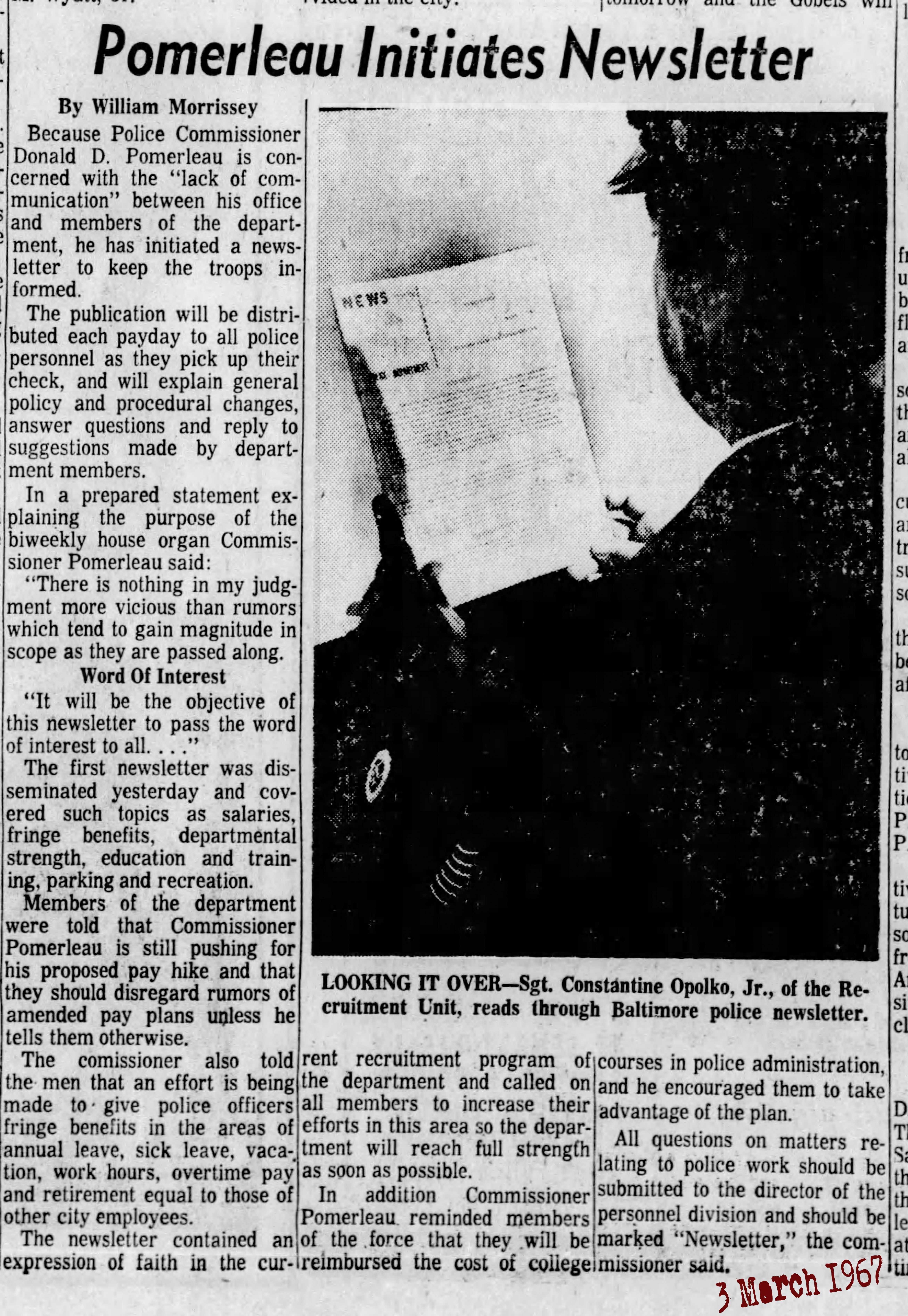
Newsletters

Newsletters

Baltimore Police Newsletters

back of No coat NYPD news about BPD traffic uniform order

 Click HERE or the article above to see full size article

Newsletter from that year PDF click HERE


Baltimore Police Newsletters


1964 Newsletter Assist an Officer

1965 Newsletter Assist an Officer

1966 Newsletter Assist an Officer

1966 Newsletter Night Patrol

1967 Newsletter Vol 1 1 to 22 March 2 1967 to December 20 1967

1968 Newsletter Vol 2 1 to 25 January 3 1968 to December 18 1968

1969 Newsletter Vol 3 1 to 20 January 1 1969 to December 31 1969

1970 Newsletter Vol 4 1 to 26 January 14 1970 to December 30 1970

1971 Newsletter Vol 5 1 to 26 January 13 1971 to December 29 1971

1972 Newsletter Vol 6 Issue 1 to 26 January 12 1972 to December 27 1972

1973 Newsletter Vol 7 Issue 1 to 26 January 10 1973 to December 26 1973

1974 Newsletter Vol 8 Issue 1 to 26 January 9 1974 to December 24 1974

1975 Newsletter Vol 9 Issue 1 to 26 January 8 1975 to December 24 1975

1976 Newsletter Vol 10 Issue 1 to 26 January 7 1976 to December 22 1976

1977 Newsletter Vol 11 Issue 1 to 26 January 5 1977 to December 21 1977

1978 Newsletter Vol 12 Issue 1 to 26 January 4 1978 to December 20 1978

1979 Newsletter Vol 13 Issue 1 to 26 January 3 1979 to December 19 1979

1980 Newsletter Vol 14 Issue 1 to 27 January 2 1980 to December 31 1980

1981 Newsletter Vol 15 Issue 1 to 26 January 14 1981 to December 30 1981

1982 Newsletter Vol 16 Issue 1 to 26 January 13 1982 to December 29 1982

1983 Newsletter Vol 17 Issue 1 to 26 January 12 1983 to December 28 1983

1984 Newsletter Vol 18 Issue 1 to 26 January 11 1984 to December 24 1984

1985 Newsletter Vol 19 Issue 1 to 26 January 9 1985 to December 24 1985

1986 Newsletter Vol 20 Issue 1 to 26 January 8 1986 to December 24 1986

1987 Newsletter Vol 21 Issue 1 to 26 January 7 1987 to December 23 1987

1988 Newsletter Vol 22 Issue 1 to 26 January 6 1988 to December 21 1988

1989 Newsletter Vol 23 Issue 1 to 26 January 4 1989 to December 19 1989

1990 Newsletter Vol 24 Issue 1 to 26 January 3 1990 to December 18 1990

1991 Newsletter Vol 25 Issue 1 to 26 January 2 1991 to December 16 1991

1992 Newsletter Vol 26 Issue 1 to 20 January 1 1992 to December 16 1992

1993 Newsletter Vol 27 Issue 1 to 7 January 1993 to December 1993

1994 Newsletter Vol 28 Issue 1 to 5 May 1994 to October 1994

1995 Newsletter Vol 29 Issue 1 to 7 January 1995 to November 1995

1996 Newsletter Vol 30 Issue 1 to 5 January 1996 to July August 1996

1997 Newsletter Vol 31 Issue 1 to 6 January 3 May 1997 to December 1997

1998 Newsletter Vol 32 Issue 1 to 6 January 1998 to November 1998

1999 Newsletter Vol 33 Issue 1 to 19 January 1999 to December 22 1999

2000 Newsletter Blue Line News Vol 34 Issue 1 to 11

2001 Newsletter Blue Line News Vol 35 Issue 1 to 7 Special Edition

2002 Newsletter Blue Lines News Vol 35 Issue 10 to 11

2003 Newsletter Blue Line News Vol 36 Issue 1 to 2

2004 Newsletter Blue Line News Vol 26 Issue 3 to 12

2005 Newsletter Blue Line 04 04 05

2005 Newsletter Blue Line 10 08 05

2005 Newsletter Blue Line News Vol 27 Issue 1 to 4

2006 Newsletter Blue Line 06 01 06 Special Edition

2006 Newsletter Blue Line 12 11 2006

2006 Newsletter Blue Line Vol 28 Issue 1 to 3 Special Edition

2007 Newsletter Blue Line Feb 2007 Special Edition

2007 Newsletter Blue Line News Vol 29 issue 1 and Special Edition

2011 Newsletter Blue Line Editions 1 to 3

2015 Newsletter Vol 1 Issue 1 to 4

2015 Newsletter Vol 1 Issue 1

2015 Newsletter Vol 1 Issue 2

2016 Newsletter Vol 2 Issue 1 to 4


Save

Save


1 black devider 800 8 72

POLICE INFORMATION

Copies of: Your Baltimore Police Department Class Photo, Pictures of our Officers, Vehicles, Equipment, Newspaper Articles relating to our department and or officers, Old Departmental Newsletters, Lookouts, Wanted Posters, and or Brochures. Information on Deceased Officers and anything that may help Preserve the History and Proud Traditions of this agency. Please contact Retired Detective Kenny Driscoll.

This email address is being protected from spambots. You need JavaScript enabled to view it.

Devider color with motto

NOTICE

How to Dispose of Old Police Items

Please contact Det. Ret. Kenny Driscoll if you have any pictures of you or your family members and wish them remembered here on this tribute site to Honor the fine men and women who have served with Honor and Distinction at the Baltimore Police Department.

Anyone with information, photographs, memorabilia, or other "Baltimore City Police" items can contact Ret. Det. Kenny Driscoll at This email address is being protected from spambots. You need JavaScript enabled to view it. follow us on Twitter @BaltoPoliceHist or like us on Facebook or mail pics to 8138 Dundalk Ave. Baltimore Md. 21222


Copyright © 2002 Baltimore City Police History - Ret Det Kenny Driscoll 

Code

CODE
1 black devider 800 8 72

POLICE INFORMATION

If you have copies of your Baltimore Police Department class photo, pictures of our officers, vehicles, equipment, newspaper articles relating to our department and/or officers, old departmental newsletters, lookouts, wanted posters, or brochures, information on deceased officers, and anything else that may help preserve the history and proud traditions of this agency, please contact retired detective Kenny Driscoll.

This email address is being protected from spambots. You need JavaScript enabled to view it.

Devider color with motto

NOTICE

How to Dispose of Old Police Items

Please contact Det. Ret. Kenny Driscoll if you have any pictures of you or your family members and wish them remembered here on this tribute site to honor the fine men and women who have served with honor and distinction at the Baltimore Police Department. Anyone with information, photographs, memorabilia, or other "Baltimore City Police" items can contact Ret. Det. Kenny Driscoll at This email address is being protected from spambots. You need JavaScript enabled to view it..Follow Follow us on Twitter @BaltoPoliceHist, like us on Facebook or mail pictures to 8138 Dundalk Ave., Baltimore, Md. 21222


Copyright © 2002 Baltimore City Police History: Ret Det. Kenny Driscoll 

1 black devider 800 8 72


1 black devider 800 8 72

without Donation

<div>
<p><img src="/images/1_black_devider_800_8_72.png" alt="1 black devider 800 8 72" width="800" height="8" style="display: block; margin: 15px auto;" /></p>
<p align="center"><span style="font-family: arial, helvetica, sans-serif; font-size: 12pt; color: #000000;"><strong>POLICE INFORMATION</strong></span></p>
<p><span style="font-family: arial, helvetica, sans-serif; font-size: 12pt; color: #000000;">We are always looking for copies of your Baltimore Police class photos, pictures of our officers, vehicles, and newspaper articles relating to our department and/or officers; old departmental newsletters, old departmental newsletters, lookouts, wanted posters, and/or brochures; information on deceased officers; and anything that may help preserve the history and proud traditions of this agency. Please contact Retired Detective Kenny Driscoll.</span></p>
<p align="center"><span id="cloak520ad4e95d6acd94aab41f2c15eec302" style="font-size: 12pt; font-family: arial, helvetica, sans-serif;"><span id="cloakdaa90d4a6314537edc6c4f7ac1e72322"><span id="cloak9d1ad1cc43c1fda21a07fab6a70fc7db"><span id="cloak9d6daf0b66a5dcd388a8221a3ac3f8da"><span id="cloak02f404f0807f98179c1ceff5c5f08fe8"><span id="cloakde5386c8178aac0d592831432a82e1ae"><span id="cloakb6b3400cce4d828f2aca1a66ff5f199b"><a href="mailto:This email address is being protected from spambots. You need JavaScript enabled to view it.">This email address is being protected from spambots. You need JavaScript enabled to view it.;/a></span></span></span></span></span></span></span></p>
<p align="center"><img src="/images/Devider_color_with_motto.png" alt="Devider color with motto" width="650" height="123" /></p>
<p align="center"><span style="font-family: arial, helvetica, sans-serif; font-size: 12pt; color: #000000;"><strong>NOTICE</strong></span></p>
<p align="center"><span style="font-family: arial, helvetica, sans-serif; font-size: 12pt; color: #000000;"><strong>How to Dispose of Old Police Items</strong></span></p>
<p style="text-align: left;" align="center"><span style="color: #000000; font-size: 12pt; font-family: arial, helvetica, sans-serif;">Please contact Det. Ret. Kenny Driscoll if you have any pictures of you or your family members and wish them remembered here on this tribute site to honor the fine men and women who have served with honor and distinction at the Baltimore Police Department.&nbsp;</span><span style="color: #000000; font-size: 12pt; font-family: arial, helvetica, sans-serif;">Anyone with information, photographs, memorabilia, or other "<strong>Baltimore City Police</strong>" items can contact Ret. Det. Kenny Driscoll at&nbsp;<span id="cloak062ce8f1e24eb2c61a43506fe6df54d1"><span id="cloak498e30278483a888bee26b838e3bc2b0"><span id="cloak3e3a4bda99c8f62b2a836372e419daeb"><span id="cloak9a380196499314981544808136432c13"><span id="cloak45a7503cf79f2c9bd62f62eb2d66e129"><span id="cloak345cedda1554a108c84e2feb8c4e81bc"><span id="cloak56a90e229d1828393b08bec4dc94f23e"><span id="cloak4c99dc8c52a9c666231bf38169ed6420"><a href="mailto:This email address is being protected from spambots. You need JavaScript enabled to view it." style="color: #000000;">This email address is being protected from spambots. You need JavaScript enabled to view it.;/a></span></span></span></span></span></span></span></span>&nbsp;follow us on Twitter&nbsp;<span class="screen-name">@BaltoPoliceHist</span>&nbsp;or like us on Facebook or&nbsp;mail pictures to 8138 Dundalk Ave., Baltimore, Md. 21222</span></p>
<div align="center">&nbsp;</div>
<p style="text-align: center;"><span style="color: #3366ff; font-size: 12pt; font-family: arial, helvetica, sans-serif;">Copyright © 2002 Baltimore City Police History: Ret Det. Kenny Driscoll&nbsp;</span></p>
</div>
</div>

Fallen Heroes 72 gallery 2 gallery https://baltimorepolicemuseum.com/en/bpd-heroes/our-fallen-heroes.html#OF-LBD

https://baltimorepolicemuseum.com/en/districts/cd#FO-01

https://baltimorepolicemuseum.com/en/districts/sed#FO-02

https://baltimorepolicemuseum.com/en/districts/ed#FO-03

https://baltimorepolicemuseum.com/en/districts/ned#FO-04

https://baltimorepolicemuseum.com/en/districts/nd#FO-05

https://baltimorepolicemuseum.com/en/districts/nwd#FO-06

https://baltimorepolicemuseum.com/en/districts/wd#FO-07

https://baltimorepolicemuseum.com/en/districts/sw#FO-08

https://baltimorepolicemuseum.com/en/districts/sd#FO-09


1 black devider 800 8 72

POLICE INFORMATION

We are always looking for copies of your Baltimore Police class photos, pictures of our officers, vehicles, and newspaper articles relating to our department and/or officers; old departmental newsletters, old departmental newsletters, lookouts, wanted posters, and/or brochures; information on deceased officers; and anything that may help preserve the history and proud traditions of this agency. Please contact Retired Detective Kenny Driscoll.

This email address is being protected from spambots. You need JavaScript enabled to view it.

Devider color with motto

NOTICE

How to Dispose of Old Police Items

Please contact Det. Ret. Kenny Driscoll if you have any pictures of you or your family members and wish them remembered here on this tribute site to honor the fine men and women who have served with honor and distinction at the Baltimore Police Department. Anyone with information, photographs, memorabilia, or other "Baltimore City Police" items can contact Ret. Det. Kenny Driscoll at This email address is being protected from spambots. You need JavaScript enabled to view it. follow us on Twitter @BaltoPoliceHist or like us on Facebook or mail pictures to 8138 Dundalk Ave., Baltimore, Md. 21222


Copyright © 2002 Baltimore City Police History: Ret Det. Kenny Driscoll 

Maryland’s Flag may be more Symbolic than you Realize

​Maryland's Flag History 
The Maryland Flag was Officially Adopted on November 25, 1904


The Maryland flag has been described as the perfect state flag, with bold colors, interesting patterns, and correct heraldry—a flag that fairly shouts "Maryland." The design of the flag comes from the shield in the coat of arms of the Calvert family, the colonial proprietors of Maryland. George Calvert, first Lord Baltimore, adopted a coat of arms that included a shield with alternating quadrants featuring the yellow and black colors of his paternal family and the red and white colors of his maternal family, the Crosslands. When the General Assembly adopted a banner of this design as the state flag, a link was forged between modern-day Maryland and the very earliest chapter of the proprietorship of the Calvert family.

Despite the antiquity of its design, the Maryland flag is of post-Civil War origin. Throughout the colonial period, only the yellow and black Calvert family colors were mentioned in descriptions of the Maryland flag. After independence, the use of the Calvert family colors was discontinued. Various banners were used to represent the state, although none was adopted officially as a state flag. By the Civil War, the most common Maryland flag design probably consisted of the great seal of the state on a blue background. These blue banners were flown at least until the late 1890s.

The Calvert family coat of arms was reintroduced in Maryland in an 1854 law that called for a new great seal based on the Calvert design. The seal created pursuant to this act contained several inaccuracies, and in 1876, the General Assembly provided for a new great seal that conformed closely to the Calvert original. Reintroduction of the Calvert coat of arms on the great seal of the state was followed by a reappearance at public events of banners in the yellow and black Calvert family colors. Called the "Maryland colors" or "Baltimore colors," these yellow and black banners lacked official sanction from the General Assembly but appear to have quickly become popular with the public as a unique and readily identifiable symbol of Maryland and its long history.

The red and white Crossland arms gained popularity in quite a different way. Probably because the yellow and black "Maryland colors" were popularly identified with a state that, reluctantly or not, remained in the Union, Marylanders who sympathized with the South adopted the red and white of the Crossland arms as their colors. Following Lincoln's election in 1861, red and white "secession colors" appeared on everything from yarn stockings and cravats to children's clothing. Federal authorities vigorously prosecuted people who displayed these red and white symbols of opposition to the Union and to Lincoln's policies.

During the war, Maryland-born Confederate soldiers used both the red and white colors and the cross-botonee design from the Crossland quadrants of the Calvert coat of arms as a unique way of identifying their place of birth. Pins in the cross-botonee shape were worn on uniforms, and the headquarters flag of the Maryland-born Confederate general Bradley T. Johnson was a red cross-botonee on a white field.

By the end of the Civil War, therefore, both the yellow and black Calvert arms and the red and white colors and botonee cross design of the Crossland arms were clearly identified with Maryland, although they represented opposing sides in the conflict. As officers and soldiers returned home after the war to resume their peacetime occupations, the greatest challenge facing the country was reconciliation. Nowhere was the problem more serious than in deeply divided Maryland, where veterans who had fought under the red and white secession colors" had to be reintegrated into a state that had remained true to the Union.

As the slow process of reconciliation took place in post-Civil War Maryland, a new symbol emerged. A flag incorporating alternating quadrants of the Calvert and Crossland colors began appearing at public events. While the design derived directly from the seventeenth-century Calvert family coat of arms, for Marylanders of the 1880s, the new banner must have conveyed a powerful message. The passage of time had gradually diminished the passions of former Rebels and Yankees, permitting them to work together once again. Now the colors they had fought under had come together as well, symbolically representing through this new flag the reunion of all the state's citizens.

Neither the designer nor the date of origin of this new Maryland flag is certain, but a banner in this form was known at least by October 1880. Flags incorporating four quadrants alternating between the yellow and black Calvert arms and the red and white Crossland arms appear in published sketches by Frank B. Mayer depicting the huge 150th birthday parade held in Baltimore that month. At the dedication ceremonies for the Maryland monument at the Gettysburg Battlefield eight years later, in October 1888, Maryland National Guard soldiers escorting Governor Elihu E. Jackson carried a sizable flag with the alternating Calvert and Crossland colors. A year later, in October 1889, the Fifth Regiment, Maryland National Guard, adopted a flag in this form as its regimental color. The Fifth Regiment thereby became the first organization to officially adopt what is today the Maryland flag.

The adoption of this new flag by the Fifth Regiment helped popularize the design. The Fifth was the largest component of Maryland's military after 1870, and it played a conspicuous part in major public events both in and out of the state. Organized in May 1867, the Fifth Regiment was the successor organization to the Old Maryland Guard, a military unit formed in Baltimore in 1859 that dissolved when most of its officers and men went south in 1861 to join the Confederate Army.

True to its heritage, the original Fifth Regiment consisted primarily of Maryland-born former Confederate officers and soldiers. The new regimental color adopted in 1889, combining the traditional yellow and black "Maryland colors" with the red and white "secession colors" in the form of a botonee cross, must have seemed especially appropriate to members of the Fifth. The colors symbolically represented what had happened to the Fifth Regiment itself in the quarter century since the Civil War. Originally denounced as a "Rebel Brigade," the Fifth had by the 1870s become Maryland's premier military organization, attracting Union veterans as well as former Confederates. From its inception, the Fifth Regiment had demonstrated through its prominent participation in public events and with its summer encampments in the north that former Confederates could be good soldiers and loyal citizens of the state and the nation.

The Fifth Regiment's new regimental color was not the only example of former Confederates perpetuating and thereby popularizing the use of the red and white Crossland colors and the cross-botonee design. The monument on Culps' Hill at the Gettysburg Battlefield commemorating the Second Maryland Infantry, CSA, carries a cross botonee on each face, and the Maryland Line Confederate Soldiers' Home, established in Pikesville in 1888, featured a large cross botonee over the main gate. Confederate veterans' organizations used the cross-button on service badges and on invitations to events they sponsored. By 1905, the Fifth Regiment had switched out the silver eagle on the flagstaff bearing its regimental color for a cross-botonee, starting a tradition that would later become a legal requirement.

In 1904, the General Assembly affirmed the popular support shown for a banner composed of alternating Calvert and Crossland quadrants by declaring it the state flag. In 1945, a gold cross botonee was made the official ornament for a flagstaff carrying the Maryland flag.

The Maryland flag, shown on a staff properly ornamented with a gold cross botonee, is therefore much more than a symbol of state sovereignty. The flag excels as a state banner because it commemorates the vision of the founders while reminding us of the struggle to preserve the Union. It is a unique symbol of challenges met and loyalties restored, a flag of unity and reconciliation for all the state's citizens.


1 black devider 800 8 72

I am not 100% sure I buy into this, but it is out there,so take a look and see what you think
Maryland’s flag may be more symbolic than you realize

Prior to the Civil War, the colors associated with the state were generally yellow and black, which were George Calvert (Lord Baltimore)‘s paternal family’s heraldic colors. His mother, Alicia Crossland, was an heiress, meaning her family was also entitled to a coat of arms. George Calvert was entitled to use either banner.

When Calvert had his own coat of arms made, it was quartered, like the Maryland flag is today, with the black and gold Calvert colors in upper left and lower right and the red and white Crossland colors on the upper right and lower left.

We doubt the connection to Confederate troops or the formation of a bond because these two family crests have been quartered since the 1600s. Furthermore, the crests themselves were vastly different in design and symbolism. It would be obvious that various troops, union or confederate, would take portions of their state seal, but that doesn't make that portion confederate or union; it is Maryland's seal.

1 black devider 800 8 72

Prior to independence in 1776, there was no official Maryland flag, but it appears flags generally used Lord Calvert’s colors with the alternating vertical bars of black and gold with a diagonal line in which the colors were reversed, probably something like the flag on the right.

In fact, today, Baltimore City still uses the Calvert banner, though with the Battle Monument on a shield in the center. This is because of Baltimore’s strong ties to the Calverts. After all, George Calvert’s title, First Baron Baltimore, is what gave the name to the city.

Even though the state of Maryland didn’t have an official flag prior to the Civil War, the yellow and black of the Calvert family was largely associated with the state.

1 black devider 800 8 72

When secessionist Marylanders went south to fight for the Confederacy in Robert E. Lee’s Army of Northern Virginia, they needed a banner that distinguished them from unionist Marylanders. They chose the Crossland banner.

After the Civil War, Marylanders needed symbolism that would help unify the state, and as a result, people started mashing up the two banners. The flag as we know it today had appeared by 1880, though some sources say the Crossland banner was at top left originally.


1 black devider 800 8 72

In 1904, the state officially adopted the current flag.

Notably, following independence in 1776 and until after the Civil War, the state flag was generally the Great Seal on a field of blue. Nearly universally, vexillologists disparage that flag today.

Maryland’s flag doesn’t just rate well amongst vexillologists for its design. It also includes hidden symbolism that helped to unify the state’s citizenry following the Civil War.

From <https://ggwash.org/view/38356/marylands-flag-may-be-more-symbolic-than-you-realize>

1 black devider 800 8 72

Maryland’s flag is one of the only U.S. flags that does not contain the color blue.

History

In 1634, Maryland was founded as a British colony by Cecil Calvert, the second Lord Baltimore. The bright gold and black design on the Maryland flag comes from the Calvert family crest. At first, only the gold and black design was associated with Maryland. The red and black design on the Maryland flag only gained popularity during the American Civil War. While Maryland officially fought with the Union during the Civil War, many Marylanders supported and fought with the Confederacy. The Crossland family crest was adopted as a symbol by those Marylanders who supported the confederacy and fought with the Army of Northern Virginia, which was led by General Robert E. Lee.

After the war, Marylanders had to reconcile with those who had fought on the opposite side of the war. Around 1865, the flag incorporated both crests. At first, the Crossland Banner appeared in the upper left quadrant, but this was swapped because of the Union’s victory. The Maryland flag as it appears today is documented to have flown as early and 1880 and was officially adopted as the state flag in 1904

Description

The Maryland state flag is the most distinctive and eye-catching U.S. state flag. The flag’s bright gold and black diagonal checkered pattern in the top left and bottom right quadrants draws your attention and contrasts starkly with the bold red and black cross pattern in the bottom left and top right quadrants.

Meaning

The flag is a combination of the family crests of the two families who founded Maryland—the Calvert and the Crossland families. The checkered pattern belongs to the Calvert family, and the red and black cross design belongs to the Crossland family.

The bold and unique Maryland flag draws both criticism and acclaim. Many non-Marylanders dislike the flag. However, the North American Vexillological Association has named the Maryland flag the 4th best flag out of 72 flags considered—just ahead of the Alaska state flag and only slightly behind Quebec’s flag.

1 black devider 800 8 72

Link To Us

If you use these flags on your own website, please provide a link back to us. Your link ensures others can find these images too. When using our black and white line drawings, a link back to the source is required. For all other flags, a link back is optional but greatly appreciated.

Simply copy the code below and insert it on pages where you display the flags. If you are not a developer, please direct your web developer to this page or provide them with the code snippet below.

Link Code: <a href="https://www.states101.com/flags" title="U.S. State Flags" target="_blank"> U.S. State Flags Provided By States101.com </a>

The Maryland flag was formally adopted on November 25, 1904. Maryland has maintained the same flag ever since. 

The Maryland flag was voted 3rd best out of 51 flags ranked by the North American Vexillological Association.

The four colors in the Maryland flag are saberoreold brick, and white (black, gold, red and white). The Maryland flag width is 1.5 times the height. The standard flag size is 3 feet by 4.5 feet.


1 black devider 800 8 72

POLICE INFORMATION

If you have copies of: your Baltimore Police Department class photo, pictures of our officers, vehicles, equipment, newspaper articles relating to our department and/or officers, old departmental newsletters, lookouts, wanted posters,  or brochures Information on deceased officers and anything that may help preserve the history and proud traditions of this agency Please contact retired detective Kenny Driscoll.

This email address is being protected from spambots. You need JavaScript enabled to view it.

Devider color with motto

NOTICE

How to Dispose of Old Police Items

Please contact Det. Ret. Kenny Driscoll if you have any pictures of you or your family members and wish them remembered here on this tribute site to honor the fine men and women who have served with honor and distinction at the Baltimore Police Department. Anyone with information, photographs, memorabilia, or other "Baltimore City Police" items can contact Ret. Det. Kenny Driscoll at This email address is being protected from spambots. You need JavaScript enabled to view it. follow us on Twitter @BaltoPoliceHist or like us on Facebook or mail pics to 8138 Dundalk Ave., Baltimore, Md. 21222


Copyright © 2002 Baltimore City Police History: Ret Det. Kenny Driscoll 

Odell’s - You Know if You Belonged 

At Odell’s, You Knew if You Belonged 

A construction fence recently went up around the old Odell’s disco palace as a renovation began on this North Avenue landmark.

The solidly built structure (it opened in 1909 as an auto showroom and dance academy) in the Station North Arts and Entertainment District, once attracted dancers and celebrities who gyrated until nearly daybreak. When the doors were finally shut on the weekends, Odell’s patrons spilled on to North Avenue.

The Odell behind its name was Odell Brock, a young Black entrepreneur who lived at the Village of Cross Keys. A graduate of Catonsville High School, who attended Morgan State University, he worked briefly for his family business, Odell’s Fuel Oil and Oil Burner Service before striking out on his own.

In 1972, he opened the Carousel, later called Gatsby’s, on Charles Street near Lafayette.

In 1976, as the disco craze was catching on, he took over what was then a Pappy’s Beef and Beer at North and Lovegrove, added dance floors and a lot more to make his Odell’s a reality.

He operated the business until his untimely death from cancer at 39 years old in 1984.

A 1979 story in the Baltimore Afro-American said that Brock relied on his extended family to run the disco.

“We have no competition in Baltimore,” Odell Brock said. “We have never ripped people off — so obviously we have to be doing something right.”

Brock used a slogan, “You’ll know if you belong” to market his venture. He had it printed on bumper stickers, keychains and matchbooks. It worked beyond all expectations.

It also attracted some of Baltimore’s colorful underworld figures.

Maurice “Peanut” King, the convicted drug lord, told how he turned heads at Odell’s as he entered the club. He traveled in a DeLorean sports car.

“He wore a $6,000 coat of seal fur,” The Baltimore Sun’s 2017 story said. “The diamonds of his pinkie ring glittered M-a-u-ri-c-e. He lit up smokes with a bejeweled Zippo. Everything about him had the sheen of wealth and elegance, even his women.”

Evening Sun reporter Linell Smith visited Odell’s in 1978. “Odell’s is the biggest, the flashiest — and probably the most sensible — discothèque in town. It’s big enough to accommodate up to 1,000 people. It’s got glittering walls of mirrored tiles, neon decorations, balloons, floors that radiate light and pink punch that bubbles in gold-colored fountains.”

The owner had a no drinking rule — liquor was not sold — and there was no food or lounge areas for conversation. It was all about dancing. Odell’s became an incubator of a subgenre of dance music.

“Around here it’s still simply called ‘Club,’ but around the world, the uptempo, chopped-up sound is known as Baltimore Club,” said a 2017 Sun article. “Luminaries like Miss Tony, K-Swift, Scottie B., Rod Lee and many others brought the minimalist music — derived from Chicago’s influential dance music known as house — to clubs like Odell’s and the Paradox [on Howard Street].

“Club continues to mutate, said veteran producer Mighty Mark, who credits Baltimore Club artists like Blaqstarr and Lil Lucky with taking the original Club sound and infusing it with more melodic elements and memorable vocals,” the 2017 article continued.

“[Club music] has traveled to different states, but Baltimore has a real gritty, grimy sound with our club music that’s really unique to us,” said Mighty Mark (born Marquis Gasque of Cherry Hill),” said in the story. “You want it to sound good, in terms of mix and quality, but then you still want to make it sound dirty, like it came from a basement.”

Diva Ultra Naté, who was a regular at Odell’s in the 1980s, told The Baltimore Sun in a 2012 interview that “Odell’s wasn’t just a club. It was a culture and a lifestyle, and if you were a part of it, then you felt like you were a part of something special. Not many clubs these days try to capture the emotional connection.”

Odell’s did not endure after the founder’s death. It was purchased by two entrepreneurs who encountered legal issues and Odell’s closed in 1992. The building has remained vacant since that time.

It is due to become the offices of a pair of nonprofits, Young Audiences of Maryland and Code in the Schools.

1992 Newspaper article -

 http://www.baltimorepolicemuseum.org/images/The_Baltimore_Sun_Fr__Jun_12_1992.jpg

 Right click above URL or click HERE to see full article

1 black devider 800 8 72

POLICE INFORMATION

If you have copies of: your Baltimore Police Department Class Photo, Pictures of our Officers, Vehicles, Equipment, Newspaper Articles relating to our department and or officers, Old Departmental Newsletters, Lookouts, Wanted Posters, and or Brochures. Information on Deceased Officers and anything that may help Preserve the History and Proud Traditions of this agency. Please contact Retired Detective Kenny Driscoll.

This email address is being protected from spambots. You need JavaScript enabled to view it.

Devider color with motto

NOTICE

How to Dispose of Old Police Items

Please contact Det. Ret. Kenny Driscoll if you have any pictures of you or your family members and wish them remembered here on this tribute site to Honor the fine men and women who have served with Honor and Distinction at the Baltimore Police Department. Anyone with information, photographs, memorabilia, or other "Baltimore City Police" items can contact Ret. Det. Kenny Driscoll at This email address is being protected from spambots. You need JavaScript enabled to view it. follow us on Twitter @BaltoPoliceHist or like us on Facebook or mail pics to 8138 Dundalk Ave. Baltimore Md. 21222


Copyright © 2002 Baltimore City Police History - Ret Det Kenny Driscoll 

Districts

Districts

How to Dispose of Old Police Items

logo

Please contact Det. Ret. Kenny Driscoll if you have any pictures of you or your family members and wish them remembered here on this tribute site to Honor the fine men and women who have served with Honor and Distinction at the Baltimore Police Department. Anyone with information, photographs, memorabilia, or other "Baltimore City Police" items can contact Ret. Det. Kenny Driscoll at   Kenny@BaltimoreCityPoliceHistory.com follow us on Twitter @BaltoPoliceHist or like us on Facebook or mail pics to 8138 Dundalk Ave. Baltimore Md. 21222.

NEWSLETTER

Subscribe now to get 100 exclusive photo & two newsletters per month