
350 Tons of Dynamite Explode in Curtis Bay

Alum Chine: 350 Tons of Dynamite Explode in Curtis Bay
Epic Disaster Shook Curtis Bay with the Impact of a Tactical Nuclear Weapon

10 August 2020
 
 
By Rik Forgo
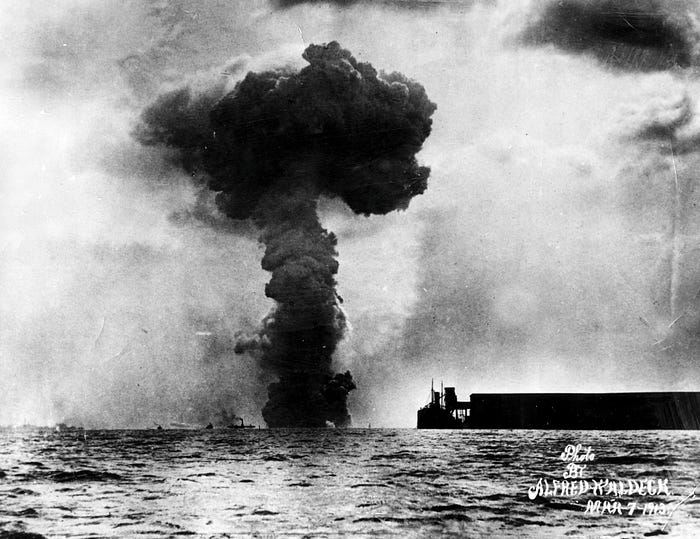
The explosion of the Alum Chine from roughly two miles away in the Patapsco River.

One of the worst worst maritime disasters in Baltimore history occurred when a stevedore aboard the British cargo steamer Alum Chine accidentally set off a blasting cap in the ship’s hold that ignited 350 tons of dynamite on Friday, March 7, 1913. The resulting fire set off a series of earthshaking explosions in the Patapsco River that killed 33 men, injured another 60, and shook buildings as far north as Philadelphia.

The tragedy was borne out of impatience, clumsiness, and quarreling among the ship’s crew and stevedores (longshoremen) who were loading the cargo. Everyone was behind schedule on that bitterly cold morning. The ship, which was scheduled to depart for Panama later that day with explosives that would be used to help carve the Panama Canal, was still 150 tons short of its contracted load. U.S. Revenue Service and Customs inspectors had been aboard to approve the cargo and had already left. The remaining dynamite crates were being brought by railroad to Curtis Bay and ferried out to the freighter via small barges to its anchorage off Leading Point, just 2,000 feet from the Quarantine Station at Hawkins Point.

There was bickering among the crew that morning, witnesses said, and the pace was lagging when the stevedore assistant foreman, William J. Bomhardt, in trying to speed up the work, carelessly jammed a bale hook into a crate storing dynamite caps. The steel hook pierced the crate, punctured one of the caps, and made a sound like a pistol shot. The noise reverberated through the hold and seconds later the crate was on fire. The adjacent dynamite crates — sitting atop mounds of coal — started to burn too. Well aware of the unstable nature of their cargo, the stevedores abandoned the ship; others aboard weren’t warned and never knew. Plumes of thick, black smoke began billowing from the hold, and within minutes, a series of three titanic explosions decimated the ship. The last explosion disintegrated the Alum Chine and the shear force of the blast leveled the tugboat Atlantic; the naval collier vessel Jason was also anchored close by and sustained serious damage. The explosion was the equivalent of 0.02 megaton blast, roughly the same explosive power of a tactical nuclear weapon.
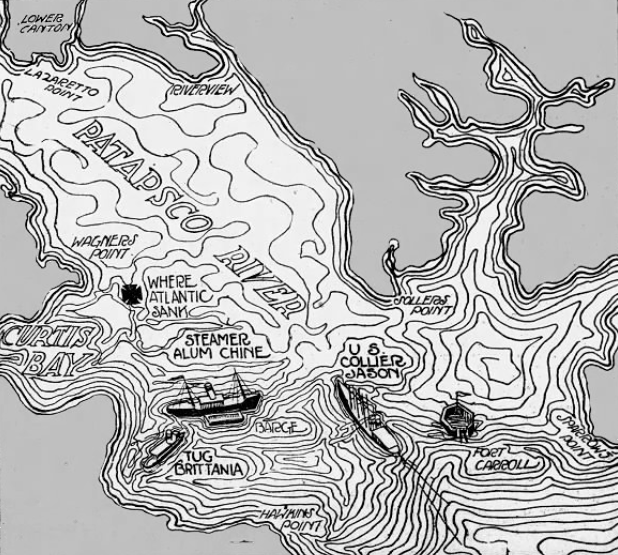
Map illustration of the Patapsco River, Curtis Bay and the placement of ships and landmarks of the Alum Chine disaster. (Baltimore Sun illustration)

The thunderous eruption shook Curtis Bay, Brooklyn, and Baltimore. Every window in every building was shattered at Flood’s Park, the popular beach resort at the head of Curtis Creek, which was roughly a mile and a half away. The blast sent shock waves up and down the Eastern Seaboard. The governor’s office in Annapolis thought it was an earthquake, and officials at the Naval Academy thought a munitions ship had exploded. When a tremor shook Dover, Delaware, the speaker of the house for Delaware’s House of Representatives paused a speech and asked if there had been an earthquake. The switchboards to the local weather bureaus lit up in Philadelphia, Harrisburg, the Susquehanna Valley, Salisbury, Easton, and St. Micheals where people pilloried staffers with questions about the phantom earthquake. Windows were shattered as far north as Havre De Grace and Aberdeen.

The Alum Chine was reduced to a burning, floating mass of timbers and steel that quickly slipped beneath the surface of the Patapsco River. Its explosion created four- and five-foot-long shards of steel and wood that became projectiles as if shot out by a cannon. Nearby ships and buildings were thrashed with debris. The Quarantine Hospital at Hawkins Point took the full brunt of the explosion. Patients and staff there had been watching the burning ship with curiosity as the billowing smoke emitting from the ship in long black coils. The sudden blast shattered all the hospital’s windows and shards of glass and debris sprayed people inside, lacerating their hands, arms, and faces. Heavy oak doors, which had been closed and locked, were blown off their hinges. The frames of some of the outbuildings were shaken off their foundations. The only room untouched by the explosions was the kitchen, so the hospital staff moved the patients there to warm them since none of the wards had windows any longer. The clock in the hospital’s main doctor’s office stopped at 10:39 a.m., which became the official time of the explosion. “It was an awful sight,” resident physician Dr. Thomas L. Richardson told the Baltimore Sun. “It looked like a cyclone had struck the grounds. The employees were running about with their heads, faces and hands bleeding. The whole place was in confusion.”

Anchored 300 feet away, the brand new U.S. Navy collier vessel Jason, which was built by the Maryland Steel Company in Fairfield, sustained more than $100,000 in damages. The Jason’s crew sent out the first distress call for the Alum Chine, then raised anchor and tried to get as far away from the burning vessel as possible. It wasn’t fast enough. The Jason’s captain ordered the crew’s firemen to start shoveling coal for its steam engines, but it became clear quickly that it would not be able to escape. Some crew members were thrown against the ship’s walls with enough force to render them unconscious. One crew member was decapitated and others were killed by projectiles. Despite the heavy damage it sustained, the Jason remained afloat and would go on to a long naval career. Six boats would respond to the Jason’s call. It would take two days to fully account for all the victims. Some who had been reported missing were never found and assumed killed in the blast or drowned.

James and Jerome Goodhues were shipping agents who worked the docks in Baltimore’s Inner Harbor, Sparrows Point, and Curtis Bay. The brothers had a gasoline launch, the Jerome, named in honor of their father, and they had dropped off two engineers to the Alum Chine earlier that morning. While preparing for their next job, they saw the smoke billowing from the ship and headed out to assist. They steered up alongside it and panicked crew members, including several shirtless, smoke-grimed firemen, jumped onto the launch. Now nearly full, the Jerome began pulling away when Howard South, a clerk with the Joseph R. Foard Company who accounted for the dynamite, screamed for the launch to come back. The Jerome backed up and South leaped 10 feet down, bellyflopping roughly onto the rail as the launch pulled away. At the helm, “Jimmie” Goodhues considered returning to the burning boat to get others, but South alerted him to the ship’s cargo and frantically urged him to speed away. The Jerome had made it 200 feet away when the first explosion occurred. Goodhues and South watched with amazement as a hoisting winch was catapulted 1,000 feet in the air alongside a severed leg. Somehow, the launch managed to avoid the spray of debris. Alongside them was Philip Berlin, the ship’s outfitter, who said that the last thing he saw before the explosion was the captain’s black retriever, who stood motionless at the bow of the ship as if carved in stone.

“I well remember that terrible day,” John W. Forrest, a steward who escaped from the Alum Chine, recounted in an essay he wrote for the Baltimore Sun in 1960. “I had just finished a cigarette in my cabin when, in mid-morning of that cold March 7, I felt a slight shudder run through the ship, and then I heard shouting out on deck. I thought the lighter [a small barge] had bumped the ship and the stevedores were quarreling, but when I went out I saw, to my horror, a lot of black smoke blowing aft.” Forrest said he raced to the engine room and shouted to the crew, “Down below there, the ship’s on fire!” After alerting what crew could hear him, Forrest jumped off the portside bridge dock into the water and started swimming frantically toward a boat he saw some distance away. Weighed down by his waterlogged clothes, he began to tire, but was unexpectedly pulled from the water by the Jerome. The Goodhues brothers then quickly turned their now-full launch around and headed toward the safety of Sparrows Point across the river.

As they sped away, thick clouds of black smoke continued belching from the ship, Forrest said. When he turned to look back, there was a terrific flash that seemed to reach the sky and a deafening explosion rung out. “It seemed to go dark as night and debris began falling all around us,” he said. “When that rain stopped there was simply nothing where the ship had been, but from her position a white-crested wave as big as a mountain was coming at us, and when it struck it lifted our little boat in the air and tumbled us all over each other, leaving us bruised, wet and numb with cold.” Forrest and the rest of the rescued men were taken ashore to a cabin and given hot coffee and dry clothes. At a hastily organized disaster recovery center called “Anchorage,” they were all reported as survivors of the explosion. The Goodhues brothers officially rescued the chief engineer, one officer and eight crew members, including Forrest, along with four stevedores.

Along with the Jerome, five other vessels responded to help those fleeing from the Alum Chine, but none more tragically than the tugboat Atlantic. As the flagship tugboat for the Atlantic Transport Company, the Atlantic and its skipper, William E. Van Dyke, were well known and respected around Baltimore’s waterways; he was born in Baltimore, spent a decade working in Curtis Bay, and lived with his wife and 11-year-old son in Locust Point. That morning, the Atlantic was anchored next to Fort Carroll near the center of the Patapsco River. Van Dyke and his first mate, Robert W. Diggs, saw the smoke engulfing the Alum Chine and opened up the Atlantic’s engines to get there quickly.

As they pulled up to the bow, a dozen men jumped aboard, stevedore foreman Bomhardt among them. Van Dyke turned the tug about and started heading away, but just as it completed its turn, two Alum Chine crewmen appeared at the bow and waved frantically. Van Dyke turned the boat around and steamed back to get them. The men climbed aboard and the Atlantic began backing away. But moments later, a solitary flare soared into the air from the burning ship and then the epic explosion rocked Curtis Bay. The Atlantic took the full force of the explosion at point-blank range. Witnesses said when the dust cleared, it was flayed down to the waterline. Crew members who had been rescued by the Atlantic jumped off the tug at the point of explosion and, being under water, some were saved from the concussive blast. Witnesses said that Van Dyke and Diggs might have survived the blast too, but were killed by the scalding water from the boat’s steam engine. Some survivors were also severely burned by the scalding water.

The aftermath was gruesome. The Baltimore Port patrol boat Lannan had the sad duty of gathering bodies from the water. Police combed the shores of Curtis Bay and Hawkins Point looking for survivors and bodies. The four remaining tugboats in the area gathered more wounded from the cold river, including survivors of both the Alum Chine and the Atlantic, and brought them ashore. The dead were taken to a makeshift morgue in a small house on the riverfront before being moved to the city morgue; the wounded were transported to St. Joseph’s and Johns Hopkins Hospitals in the city. The real tragedy of the grim day came when police were dispatched to family homes to bring the tragic news to wives and children. Most of the dead were poor stevedores of Polish descent and African Americans. Baltimore Sun reporters followed police to the Locust Point home of Captain Van Dyke, who broke the heartbreaking news to his disbelieving wife of his valor and sacrifice.

In the days that followed the disaster, those around Curtis Bay assessed the damages. The fortified structures that supported the big guns at Fort Armistead showed visible cracks from top to bottom and even extended underground; the guns were rendered useless until repairs were made several weeks later. The mine-planting building at the fort was completely destroyed and every pane of glass in the facility’s barracks was broken. Doors were ripped off their hinges with such force that many of them splintered on impact with the ground. Two boilers at the Davison Chemical Company in Curtis Bay “went off like cannons,” and the company’s towering brick smoke stack was toppled; no one was injured in either incident. The lighthouse at Leading Point had its windows shattered and doors blown open, but the beacon was not damaged and kept shining.

The shoreline at Hawkins Point was freckled with fragments of steel, rivets, and human remains. Local fishermen plucked floating fish killed by the concussive blast out of the water up and down the Patapsco River that day. Debris from the explosion was strewn across Anne Arundel and Baltimore Counties. The lighthouse inspector for Maryland’s Fifth District said the Alum Chine was found on the westerly side of the main ship channel, at the anchorage of the Quarantine Station of Leading Point on the line at Fort McHenry. It had settled at the bottom of the Patapsco River with 13 feet of water between it and the surface. Because it was in a shipping lane, it was deemed a hazard and plans were made for its removal. A gas buoy was placed over the wreck with a light that flashed red every seven seconds.

The Baltimore Harbor Board initially started an investigation, but lost a jurisdictional fight with the U.S. Army Ordinance Department, which claimed investigative powers over the transport of explosives. In press reports immediately after the tragedy, Wiliam Bomhardt, the stevedore foreman who negligently ignited the blasting cap that started the fire, attributed the fire to the spontaneous combustion of gas that had built up in the mounds of coal. In another report, he said the friction of two sticks of dynamite rubbing against each other set off the explosion. Witnesses agreed that there were mounds of soft coal throughout the hold, and that dynamite cases were stored atop piles of coal. Some thought it possible that a burning ember might have found its way into those coal piles. But the grand jury decided there was enough evidence to charge Bomhardt and he was arrested; he was released on $1,000 bail. Even as the trial began he denied culpability, insisting he was being treated unfairly. “It isn’t just,” he told reporters after he was indicted. “I was the unfortunate devil who happened to handle the box that exploded. The men who testified before the grand jury have bail hook on the brain.”

Indeed, there were sixteen stevedore witnesses who testified that Bomhardt was upset with the pace of work that morning and started the fire when he carelessly struck the crate of blasting caps with a boat hook. But the grand jury spread blame further than with just the foreman. It said there were “manifest evidence of carelessness” among all the stevedores, including the wearing of steel-spiked shoes rather than rubber shoes as required when working with dynamite. The principal officers of the stevedore company also showed an “utter ignorance” of the Inter-State Commerce Commission’s recommendations on handling explosives.

Bomhardt and the stevedores worked for the Joseph R. Foard Company and its subsidiary, the General Stevedoring Company, which operated as independent contractors. The company was sued by the owner of the Alum Chine, the Munson Line, the Maryland Steel Company, and an array of different victims for more than $500,000, but Judge John C. Rose awarded just $220,000 (roughly $5.8 million in 2020 dollars) to the various petitioners. The owners of the Alum Chine received the biggest award at $75,000 ($1.9 million in 2020), and the courts ordered “allowances” (annuity payments) to the families of victims for a period of years. Foard filed for bankruptcy immediately afterwards, so it was unclear whether anyone ever received the awards grant by the court. As for Bomhardt, there was no published evidence of a conviction or civil charges.

John Forrest, the Alum Chine steward rescued by the Goodhues brothers, was cared for in Baltimore and weeks later returned with his surviving crewmates to Liverpool, England. The voyage home was a challenge for him as he grew ill. Newspapers far and wide covered the tragedy and when the crew arrived at Newport, Monmouthshire, England, they were welcomed as heroes by a large crowd and were given a police escort to their homes. Forrest ended up in the hospital and neurological damages confined him to a wheelchair. It would take him two-and-a-half months to be able to walk with two canes, and another fourteen months to walk with just one. Two years later in 1915 he was finally able to walk unassisted.

The Goodhues brothers officially rescued between twelve and fifteen people that cold March morning. Other published reports suggested they rescued far more than they were credited with. They received medals of valor for their heroism from the British government later in 1913. Ninety-four years later in 2007 James’ granddaughter, Patricia Lee Goodhues, would appear with her grandfather’s memorabilia from the disaster on the PBS show Antique Roadshow, where she told the story of his heroism. The Carnegie Heroes Fund, a charity established by Pittsburgh steel magnate Andrew Carnegie, granted lifelong annuity payments to the Atlantic Captain Van Dykes’ wife and mother, and a smaller annuity for his son until he became of age. Diggs’ wife was presented with a silver medal honoring his bravery; four other crew members of the Atlantic were also recognized.

The Alum Chine disaster remains one of the worst disasters in Baltimore history. In the years prior to the Curtis Bay disaster the city’s dynamite shipments were managed in the heavily populated Canton district. But residents expressed concern that a disaster was looming; the city acceded to their removal requests in 1912 — just one the year before the Alum Chine explosion — and moved dynamite shipments offshore from Quarantine and Hawkins Point. Weeks after the blast the city codified that decision by formally requiring that all high explosive shipments be moved even further away from the city, requiring loading and unloading further south that the Quarantine Station. A blast of its kind would not happen again for another 25 years when an explosion in the Montebello Loch Raven tunnel killed ten and injured seven in July 1938.

This is one of many stories to be published in the upcoming book, “Brooklyn Rising,” scheduled for release in 2021.

1 black devider 800 8 72

POLICE INFORMATION

If you have copies of: your Baltimore Police Department Class Photo, Pictures of our Officers, Vehicles, Equipment, Newspaper Articles relating to our department and or officers, Old Departmental Newsletters, Lookouts, Wanted Posters, and or Brochures. Information on Deceased Officers and anything that may help Preserve the History and Proud Traditions of this agency. Please contact Retired Detective Kenny Driscoll.

This email address is being protected from spambots. You need JavaScript enabled to view it.

Devider color with motto

NOTICE

How to Dispose of Old Police Items

Please contact Det. Ret. Kenny Driscoll if you have any pictures of you or your family members and wish them remembered here on this tribute site to Honor the fine men and women who have served with Honor and Distinction at the Baltimore Police Department. Anyone with information, photographs, memorabilia, or other "Baltimore City Police" items can contact Ret. Det. Kenny Driscoll at This email address is being protected from spambots. You need JavaScript enabled to view it. follow us on Twitter @BaltoPoliceHist or like us on Facebook or mail pics to 8138 Dundalk Ave. Baltimore Md. 21222


Copyright © 2002 Baltimore City Police History - Ret Det Kenny Driscoll 

BOE approves $41 million for new helicopters and cars for Baltimore Police

BOE approves $41 million for new helicopters and cars for Baltimore Policehelicopter-dedicated-barry-wood

BOE approves $41 million for new helicopters and cars for Baltimore Police

A big round of police spending is allocated with minimal public disclosure – and no board debate

If they can reach the top of Mt. Everest, there’s no telling what they can do in the skies above Baltimore.

Today the Board of Estimates approved $18 million to buy and service three Airbus H125 helicopters – a model made famous when one of them landed on the summit of the world’s highest mountain – to replace older units of the Baltimore Police Department’s fleet of choppers.

In its final meeting of 2021, the board also allotted $23 million to a Delaware car dealer for an unspecified number of Ford Hybrid and Non-Hybrid utility “pursuit vehicles.”

The expenditures, which come in the face of calls to “defund” the police and reallocate money to social and community programs, reaffirmed the Scott administration’s push to reequip and modernize the police.

In his first budget as mayor, Scott increased police spending by $28 million – to a record $555 million – over the previous budget of Mayor Bernard C. “Jack” Young.

Scott has also allocated, over a three-year period, $50 million in federal American Rescue Plan money to expand violence reduction, youth offender and returning citizens programs.

A “Defund BPD” billboard, crafted by local graffiti artists, looms over a June 10, 2020 student protest of police brutality on North Avenue in the wake of George Floyd’s death. (Sanaa Zoë Jackson)

Little Transparency

Today’s expenditures were tucked into pages 68 and 98 of the BOE agenda, with little explanatory information other than the contract numbers and dollar amounts.

The police department and Scott’s office were asked about details of the contracts, but neither has so far responded.

At typical board meetings, the two elected officials who sit with Scott – City Council President Nick Mosby and Comptroller Bill Henry – flag items that are costly or potentially controversial.

Those items are then moved to the “non-routine” agenda for input from the city agency seeking the funds.

But today:

• Neither the helicopter nor the vehicle contract was placed in the non-routine category.

• No representative from BPD appeared to answer questions.

• Mayor Scott did not attend the meeting, and his replacement, City Administrator Chris Shorter, did not speak.

• The two expenditures were approved in a blanket voice vote where they were not distinguished from dozens of regular spending items.

• A copy of the contract, requested by The Brew, was not forthcoming and was instead “under review/redaction” today by the city law department.

Tucked on page 98 of today's BOE agenda was this description of the helicopter award.

Here is the full description of the helicopter award given in the 12/22/21 BOE agenda.

Chopper Details

The three-helicopter deal will be awarded to Davenport Aviation Inc., of Columbus Ohio.

Through an online records search, The Brew tracked down the specific copter type as an Airbus H125, which flies at a maximum of 178 mph and (outside of publicity stunts) and is limited to a 16,500-foot flight ceiling.

The list price for the helicopters is $3.4 million each, or a little more than $10 million.

The difference between that $10 million figure and today’s very specific award to Davenport Aviation – $17,926,923.23 – apparently involves parts and maintenance to be supplied by the company.

Attempts to clarify this $8 million gap with the police department and mayor’s office were unsuccessful.

One of the current chopper used by Baltimore Police. BELOW: The Airbus H125 will have twice the seating capacity, six passengers including the pilot. (BPD, globalair.com)

One of the 10-year-old choppers now used by Baltimore Police. BELOW: The new fleet will have twice the seating capacity, 5-6 passengers including the pilot.

Airbus H125 Specification Cabin

In 2012, the city purchased a fleet of four Eurocopters, known as the “Foxtrot Four,” for $9.5 million. This came after Mayor Stephanie Rawlings-Blake had threatened to ground the helicopter fleet as a cost-cutting measure.

She was quickly dissuaded by then-Police Commissioner Frederick Bealefeld, who insisted that helicopters and their extra-powerful spotlights were essential to help detect criminals running away from law enforcement, pursue dirt bikes and stolen cars, and uncover illegal caches of marijuana growing in back lots and around vacant buildings.

The first Baltimore Police choppers - small, lightweight

The city’s first choppers – small, lightweight “observational” craft – debuted in 1970 but were grounded in November 1998 following a fatal crash. Mayor Martin O’Malley reinstated the program. (BPD)

The latest helicopter purchase comes after the Scott administration terminated the so-called “spy plane” contract with Persistent Surveillance Systems last February, following a backlash by residents and a lawsuit by the American Civil Liberties Union arguing that the aerial surveillance program violated civil rights and disproportionately targeted Black residents.

Today’s police car purchase amounts to a 400% increase of an existing contract with Hertrich Fleet Services of Milford, Delaware.

The approval increases the money to be spent on specialized police pursuit vehicles from $5.7 million to more than $28 million.

The award notes that the contract is an “estimated requirement,” and that Hertrich “shall supply the City’s entire requirement, be it more of less,” through January 12, 2026.

The type of Ford Hybrid “pursuit vehicle” destined for Baltimore Police. (caranddriver.com)


Credit The Baltimore Brew - Click HERE 

1 black devider 800 8 72

POLICE INFORMATION

If you have copies of: your Baltimore Police Department Class Photo, Pictures of our Officers, Vehicles, Equipment, Newspaper Articles relating to our department and or officers, Old Departmental Newsletters, Lookouts, Wanted Posters, and or Brochures. Information on Deceased Officers and anything that may help Preserve the History and Proud Traditions of this agency. Please contact Retired Detective Kenny Driscoll.

This email address is being protected from spambots. You need JavaScript enabled to view it.

Devider color with motto

NOTICE

How to Dispose of Old Police Items

Please contact Det. Ret. Kenny Driscoll if you have any pictures of you or your family members and wish them remembered here on this tribute site to Honor the fine men and women who have served with Honor and Distinction at the Baltimore Police Department. Anyone with information, photographs, memorabilia, or other "Baltimore City Police" items can contact Ret. Det. Kenny Driscoll at This email address is being protected from spambots. You need JavaScript enabled to view it. follow us on Twitter @BaltoPoliceHist or like us on Facebook or mail pics to 8138 Dundalk Ave. Baltimore Md. 21222


Copyright © 2002 Baltimore City Police History - Ret Det Kenny Driscoll 

Jon Pease

Jon Pease

Retired Officer Jon Pease

16 Feb 2021  - Retired Police Officer Jon Pease passed away after working in his yard at his house at the age of 67. Many of us had the pleasure of working with Jon at the Central, and Southern districts. Others may have known him from his service with Springfield State Hospital, and Maryland transportation Authority. He was a giant that calmed a room just by entering, and what we in Baltimore call "Good Police" if you needed back-up and heard Jon was on the way, you knew you had genuine help on the way. There were times when I told the person I was dealing with, it might be best if he was in cuffs before my back-up arrived, because they don't like resisting an officers commands. If they knew it was Jon, they quickly complied. I was lucky, when I was 23 I joined the Baltimore Police department, I was formerly a welder, so it was a total fish out of water, but with guys like Kenny Byers, Mike Cichowicz and Jon Pease taking me under their wing to show me how to police, they were calling me a 6 month veteran very quickly and I was comfortable on the job and went on to have an excellent career, that was only possible because of the guys in that first squad. Guys Like Mike, Kenny and Jon that cared enough to help a rookie become a veteran We hope when you think of Jon you will think of old school Baltimore Police that believed in his oath to protect the public, always putting his partners, and the public's safety before his own he was one of the 99.9% or the good police everyone wanted to arrive when they were calling for help.. May he rest in peace

jon 2

jon 2jon 3Jon 4


1 black devider 800 8 72

POLICE INFORMATION

Copies of: Your Baltimore Police Department Class Photo, Pictures of our Officers, Vehicles, Equipment, Newspaper Articles relating to our department and or officers, Old Departmental Newsletters, Lookouts, Wanted Posters, and or Brochures. Information on Deceased Officers and anything that may help Preserve the History and Proud Traditions of this agency. Please contact Retired Detective Kenny Driscoll.

This email address is being protected from spambots. You need JavaScript enabled to view it.

Devider color with motto

NOTICE

How to Dispose of Old Police Items

Please contact Det. Ret. Kenny Driscoll if you have any pictures of you or your family members and wish them remembered here on this tribute site to Honor the fine men and women who have served with Honor and Distinction at the Baltimore Police Department.  Anyone with information, photographs, memorabilia, or other "Baltimore City Police" items can contact Ret. Det. Kenny Driscoll at This email address is being protected from spambots. You need JavaScript enabled to view it. follow us on Twitter @BaltoPoliceHist or like us on Facebook or mail pics to 8138 Dundalk Ave. Baltimore Md. 21222


Copyright © 2002 Baltimore City Police History - Ret Det Kenny Driscoll 

Hidden Links and Easter Eggs

Hidden Links and Easter Eggs

1000s Take Oath

10-50 Red

172 Years of Policing

39-minutes-of-terror

A Lost Tradition in Baltimore - A Cop Walking His Beat

A Quick Look at the History of Scotland Yard

badge-collection

badge-numbers

baltimore-police-buttons-chronology 

Baltimore Police Department History

Baltimore Police Service Ribbon

baltimore-police-museum

baltimore-police-officers-1st-to-go-coatless-in-public

baltimore-s-jeep-history

baltimore-the-second-capital-of-the-united-states

Bertillon System

Black Maria

blue-lines-painted-on-the-streets

bpd-sun-paper-picture

BPD Telephone Directory

broken-windows-theory

calvin-mccleese

capt-james-cadden

capt-jimmy-lyston

capt-william-forrest

Code

coatless-cops

crime-resistance-unit

custom-novelty-baltimore-police-collector-badges

david-eastman

deputy-commissioner-leo-t-kelly-jr

deputy-marshal-sam-house

detective

detective-bureau

detective-julius-neveker

detective-retired-leo-smith

directory

district-s-continued

drunk-o-meter-and-breathalyzer

edward-myers

espantoon-collection

espantoon-reference-private

Eastern

exhibits-on-loan-to-museum

fundraiser

fun-facts

gary-provenzano

general-macarthur-s-hat

gino-inocentes

good-cop-bad-cop

handcuffs-restraints

hat-and-helmet-history

history/street-lamps

history-of-fop-lodge-3

history-of-police-in-the-us

Insight

joseph-nightstick-joe-hlafka

kathleen-irwin

kenny-driscoll

ken-s-copyright-artwork

koenig

liberator-pistol-history.html

lieutenant-detective-john-e-klein

Line-of-duty-sick-and-injured-deaths

lt-bob-wilson

lt-jerry-demanss

Marshal-Jacob-Frey

maryland-tag-plate-history

mike-cichowicz

misc-pics-page-3

misc-pics-page-4

more-pics

new-department-march-1862

newsletters

nicholas-biddle

nypd-lieutenant-samuel-battle

officer-john-f-heiderman

officer-paul-levinson

out-of-state-die-cast-vehicles

parking-meter

patches-2

patrolman-anthony-monczewski

patrolman-emil-j-klaas-jr

patrolman-jim-bowen

patrolman-ronald-h-teufer-sr

patrolman-thomas-norton-sergeant-philip-j-flood

patrolman-wallace-b-therien

p-o-bobby-brown

police collections

police-rattles-whistles

p-o-walter-hogan

quick-response-team

recall-light-system

recruitment

retired-officer-jim-mitchell

retired-officer-norman-stamp

retired-sergeant-bernie-wehage

retiree-death-benefit-information

retroactive-citation-of-valor-program

robert-a-miller-jr

robert-crispens

sergeant-donald-voss

sergeant-ed-mattson

sgt-edward-thomas-weitzel

sgt-lee-rodgers

Sergeant James Robert Moog  

Sherlock Holmes London

Short_numbers_long_numbers

Sleuths Have Masked the System

statement-analysis 

taxi

The Secret History of city Slave Trade

the-1st-seal-of-baltimore

the-civil-war-s-first-dead

the-history-of-the-sun

the-police-gymnasiums-motto

the-secret-history-of-city-slave-trade

vehicle-actuated-traffic-control-box

vehicles-diecast

vice-squad-and-al-scarface-capone

voice-stress-analysis

walk-the-straight-and-narrow-path

wood-carved-police-badge

www.baltimorepolicemuseum.com


1 black devider 800 8 72

POLICE INFORMATION

Copies of: Your Baltimore Police Department Class Photo, Pictures of our Officers, Vehicles, Equipment, Newspaper Articles relating to our department and or officers, Old Departmental Newsletters, Lookouts, Wanted Posters, and or Brochures. Information on Deceased Officers and anything that may help Preserve the History and Proud Traditions of this agency. Please contact Retired Detective Kenny Driscoll.

This email address is being protected from spambots. You need JavaScript enabled to view it.

Devider color with motto

NOTICE

How to Dispose of Old Police Items

Please contact Det. Ret. Kenny Driscoll if you have any pictures of you or your family members and wish them remembered here on this tribute site to Honor the fine men and women who have served with Honor and Distinction at the Baltimore Police Department.

Anyone with information, photographs, memorabilia, or other "Baltimore City Police" items can contact Ret. Det. Kenny Driscoll at This email address is being protected from spambots. You need JavaScript enabled to view it. follow us on Twitter @BaltoPoliceHist or like us on Facebook or mail pics to 8138 Dundalk Ave. Baltimore Md. 21222


Copyright © 2002 Baltimore City Police History - Ret Det Kenny Driscoll 

Police Exhibits on Loan to Museum


EVER EVER EVER Motto Divder

Police Exhibits on Loan to Museum


06G16 001 aa 72

08F 001v 7228F16 001a 7228F16 001b 7228F16 001c 7228F16 001d 72

28F16 001e 7228F16 001f 7228F16 001g 7228F16 001h 7228F16 001i 7228F16 001j 7228F16 001k 7228F16 001L 72sgt bluePatrol Sergeant
sgt red

Motors Sergeant

28F16 001o 7228F16 001p 7228F16 001q 7228F16 001r 7228F16 001s 7228F16 001t 7228F16 001u 7228F16 001v 7228F16 001w 7228F16 001x 7228F16 001y 7228F16 001z

50MissionCrush50MissionCrush1 1111 06D16 001f 721111 08F16 001p 721131E16 001e 2 7211131E16 001i 2 7211131E16 001k 72

11131E16 001L 6 72111131E16 001k 2 721111131E16 001f 3 7212991769 10207092362330923 896943850 o13023229 266939666982948 209160937 n13886869 10207902932914681 3656266638206547957 n13912399 10208353476328432 1031484791502434164 n13925264 10207868502333938 7838279243002643562 ndoor ligtbar 72

s l1600 2

s l1600 3

26909 1297298436020 8178098 n14856203 697108863780849 4028647060457463859 o20638547 10211016713237243 3128529025478526096 n20690206 10211033667141080 481525040752290617 o20689821 10211033667181081 6599057271688611466 o

20708159 10211030897111831 3631649671144535538 n20769982 10211030897231834 5524775692414565463 n20799019 10211065780983906 7105753499398698118 n20800352 10211066153633222 7052498249308406728 n21106592 10211168868961041 7296710627795540011 n21371266 1473249522767475 5685379359907139229 nfpkitkeeper71imotorshelmet72iroom72

17457279 10209854870791908 881915646091132613 n17457396 10209854868351847 7248778690335134450 n17457760 10209854870311896 2530995538813344718 n17457980 10209854867791833 7229776205466335089 n

17458106 10209854869231869 3745181274671720777 n17498412 10209854868991863 2036312540844670822 n17498592 10209854866871810 4217416941004562451 n 117553986 10209854868511851 2838276710890061672 n17554094 10209854867271820 1741216444310975006 n17626280 10209854868311846 2756326766553826817 n17626591 10209854871471925 3183880990328125088 n17634543 10209854866791808 1405359855727194364 n17634574 10209854871551927 6133106019487707676 n19247617 10210609075246548 7983922315432634636 n19248059 10210609073126495 8178460019428830488 n19260453 10210609074086519 8573985338615314896 n19399275 10210609075166546 1217243742467393162 n19420534 10210611776674082 3525699963188165889 n

19420552 10210609069646408 8914166594370729740 n19430171 10210609076646583 5644283599641930826 nEd Stefankiewicz 1957 clas


1 black devider 800 8 72

POLICE INFORMATION

Copies of: Your Baltimore Police Department Class Photo, Pictures of our Officers, Vehicles, Equipment, Newspaper Articles relating to our department and or officers, Old Departmental Newsletters, Lookouts, Wanted Posters, and or Brochures. Information on Deceased Officers and anything that may help Preserve the History and Proud Traditions of this agency. Please contact Retired Detective Kenny Driscoll.

This email address is being protected from spambots. You need JavaScript enabled to view it.

Devider color with motto

NOTICE

How to Dispose of Old Police Items

Please contact Det. Ret. Kenny Driscoll if you have any pictures of you or your family members and wish them remembered here on this tribute site to Honor the fine men and women who have served with Honor and Distinction at the Baltimore Police Department.

Anyone with information, photographs, memorabilia, or other "Baltimore City Police" items can contact Ret. Det. Kenny Driscoll at This email address is being protected from spambots. You need JavaScript enabled to view it. follow us on Twitter @BaltoPoliceHist or like us on Facebook or mail pics to 8138 Dundalk Ave. Baltimore Md. 21222


Copyright © 2002 Baltimore City Police History - Ret Det Kenny Driscoll 

U.S. Supreme Court again protects police qualified immunity

U.S. Supreme Court again protects police accused of excessive force

By Andrew Chung

Oct 18 (Reuters) - The U.S. Supreme Court on Monday signaled that it is not retreating from its inclination to grant a legal protection called "qualified immunity" to police accused in lawsuits of using excessive force, ruling in favor of officers on Monday in separate cases from California and Oklahoma.

The justices overturned a lower court's decision allowing a trial in a lawsuit against officers Josh Girdner and Brandon Vick over the 2016 fatal shooting of a hammer-wielding man in Tahlequah, Oklahoma.

They also overturned a lower court's decision to deny a request by police officer Daniel Rivas-Villegas for qualified immunity in a lawsuit accusing him of using excessive force in 2016 while handcuffing a suspect in Union City, California.

The brief rulings were unsigned, with no public dissents among the justices in the cases, both decided without oral arguments.

The qualified immunity defense protects police and other government officials from civil litigation in certain circumstances, permitting lawsuits ONLY when an individual's "clearly established" statutory or constitutional rights have been violated.

The rulings indicated that the justices think lower courts still are denying qualified immunity too frequently in police excessive force cases, having previously chided appeals courts on that issue in recent years.

"These are not the actions of a court that is likely to end or seriously reform qualified immunity," Chris Kemmitt, a lawyer with the NAACP Legal Defense and Educational Fund civil rights group, wrote on Twitter.

A 2020 Reutersinvestigation revealed how qualified immunity, with the Supreme Court's continual refinements, has made it easier for police officers to kill or injure civilians with impunity.

In the Oklahoma case, police responded to a complaint by the former wife of the slain man, Dominic Rollice, that he was inebriated and in her garage.

Officers told Rollice they were not there to arrest him, but rather to give him a "ride out of there," according to court papers, but he refused to go with them. A lower court found that the officers then advanced on Rollice, prompting him to back up and grab a hammer that he held above his head and refused to drop.

When Rollice appeared to raise the hammer further, Girdner and Vick fired multiple times, killing him. A third officer had decided that the situation called for him to "go less lethal" by putting his firearm in his holster and using his stun gun instead.

Rollice's estate sued Girdner and Vick, accusing them of using excessive force in violation of the U.S. Constitution's Fourth Amendment prohibition on unreasonable searches and seizures. The police said they used force because they feared Rollice would charge at them or throw the hammer.

The Denver-based 10th U.S. Circuit Court of Appeals in 2020 denied the officers qualified immunity, finding that they may have unjustifiably escalated the situation. The Supreme Court on Monday declined to decide "whether recklessly creating a situation that requires deadly force can itself violate the Fourth Amendment," instead saying that no prior case had "clearly established" that the officers' actions were illegal.

In the California case, the justices ruled in favor of Rivas-Villegas for the same reason. That case involved the arrest of a man named Ramon Cortesluna at his home. Rivas-Villegas used his foot to push Cortesluna down, and then pressed his knee into the man's back while another officer handcuffed him.

The San Francisco-based 9th U.S. Circuit Court of Appeals last year ruled that Cortesluna's excessive force claim could go to trial, noting that the suspect had been prone and not resisting.

Congressional Democrats have sought to rein in qualified immunity as part of legislation to reform police practices. The House of Representatives passed a Democratic-backed bill that would eliminate qualified immunity for law enforcement, but Senate talks between Democrats and Republicans on police reform collapsed last month.

Reporting by Andrew Chung in New York; Additional reporting by Lawrence Hurley in Washington; Editing by Will Dunham

As usual people, and the press will try to turn this into a free for all allowing police to beat anyone they want. The truth of the matter is, it clearly says permitting lawsuits ONLY when an individual's "clearly established" statutory or constitutional rights have been violated. If an officer clearly violates the law, and clearly violates anyone's civil rights, that officer will be charged departmentally, criminally, and can be charged civilly. When Ken was on, an Internal Investigation could be open by anyone. So if an officer was involved in an altercation with someone and a passerby felt the officer was wrong, that passerby could go to IID and open an investigation. It was not easy on an officer, but the police like anyone, police have the same rights as any other citizen, with limited protections because they would be in court being sued for everything right, or wrong, not only wasting the courts time, but frivolous law suites would cause officers to become less likely to take the risks needed to protect us.  Today we have something Ken's police didn't have in that most agencies have body cameras. These cameras are to protect not only the public from what an officer might do, but and officer from what the public might do, or say. Look how often we hear a side of the story in the news about how an officer was rude, made comments unbecoming an officer, or was abusive and then the tape is rolled and we learn the reporting person lied. Police are human, with that we certainly have a few that should not wear the badge, but we are lucky that 99.9% of all police are good hard working men and women that want nothing more than to protect the public from the evils they see on a day to day basis. People can be cruel to each other, and without police, it would only get worse, just look at how much crime has risen, since the democratic cities have tied their hands. Still they will run toward gun shots while everyone else runs away from it, if they think they will save a life, or catch a bad guy. They put themselves in positions that would hopefully save lives, and when one defends himself, or someone else, it is scrutinized heavily as it should be, but people need to be realistic. We need to never forget the victims of crimes, we need to realize if someone is breaking the law, and decides they want to fight the police, it is a choice they made, not the police, and if our police are lucky enough to win that fight, they will then be investigated for it. Now days their body cam video will be shown, and we need to start saying, like they did when Ken was on, instead of people yelling at the police, (which they did,) but they also yelled to the suspect to give up, they understood that person was fighting the police, and the police just as anyone on this planet when attacked, will fight back. So what is excessive force, it is as easy as it sounds, it is force, that is excessive, if the suspect if fighting the officer can fight back, once the suspect stops fighting the officer also has to stop fighting, there is no parting shot, no get even punch, and once the cuffs are on, if an officer strikes the prisoner, I think everyone on the planet would agree it is cowardous. That goes for other police also, Ken never worked with an officer that felt it was OK to punch a suspect that was in handcuffs. We need to ask ourselves, if our mother was the victim of the subject the officers stopped, would we want them to let him go because he decided he wanted to resist their arrest. Then we have to ask if we were the police, and someone was fighting us, would we just let them go, or would we fight back. Obviously no one wants anyone to have to use force, but I think we all want the police to stop criminals from victimizing our neighborhoods, and this is obvious from the nearly one million, 911 calls most cities receive every year. So, we need police, we need them to do their jobs, we need to understand they have to make arrests, and we need to understand if the suspect they are arresting resists that arrest, the officer has to use force. Not all force is excessive force, and until we know the difference we need to let the courts do their thing. If we have real first hand information that we could testify to in the court against an officer, than we should go to court and testify, if we only have opinions or speculation, we need to sit on it, until we have real facts. Think of it as if you were in their shoes, would you want opinions and made up stories, or real eye witnesses. If an officer breaks the law, and there is real evidence they will be arrested and charged, just like any crime, by any criminal. We all know there are times when there is no evidence, and thank God they don't make arrests anyway, imagine if someone thought you did something and you didn't, would you want to be arrested just because everyone thinks you did it. We need to be realistic and stop hating without proof. 

These are personal notes not intended for the public - This page is not in the menus if you reached it somehow by accident, please move on as it is not intended for anyone's viewing. We have pages throughout that are for our personal use and research

1 black devider 800 8 72

POLICE INFORMATION

If you have copies of: your Baltimore Police Department Class Photo, Pictures of our Officers, Vehicles, Equipment, Newspaper Articles relating to our department and or officers, Old Departmental Newsletters, Lookouts, Wanted Posters, and or Brochures. Information on Deceased Officers and anything that may help Preserve the History and Proud Traditions of this agency. Please contact Retired Detective Kenny Driscoll.

This email address is being protected from spambots. You need JavaScript enabled to view it.

Devider color with motto

NOTICE

How to Dispose of Old Police Items

Please contact Det. Ret. Kenny Driscoll if you have any pictures of you or your family members and wish them remembered here on this tribute site to Honor the fine men and women who have served with Honor and Distinction at the Baltimore Police Department. Anyone with information, photographs, memorabilia, or other "Baltimore City Police" items can contact Ret. Det. Kenny Driscoll at This email address is being protected from spambots. You need JavaScript enabled to view it. follow us on Twitter @BaltoPoliceHist or like us on Facebook or mail pics to 8138 Dundalk Ave. Baltimore Md. 21222


Copyright © 2002 Baltimore City Police History - Ret Det Kenny Driscoll 

The Sack of Baltimore

SOB 3
The Sack of Baltimore

On this day in our Driscoll family history, 20 June 1631, Baltimore [Ireland] fell victim to a what has become known as a horrendous attack by pirates on the sleeping village of Baltimore known as "The Sack of Baltimore". At that time among the O'Driscoll family that lived in the village where a population of settlers from England who had arrived some years earlier to work the lucrative pilchard fishery under lease from the O'Driscoll chieftain, Sir Fineen O'Driscoll. Piracy was rife along the shores of West Cork, much of it of a home-grown variety; indeed the settlement's founder, Thomas Crooke, stood accused of involvement himself. However, the danger, in this case, was from much farther afield.

After the day's work for the adults and the days play for the children they all went to bed thinking it was just another night in Baltimore. However, thanks to a captive named John Hackett who was out to save his own neck he knew the original target was Kinsale, but Hackett declared the harbor there 'too hot' to enter and in return for his freedom he offered to take Reis to a defenseless village of fishermen known as Baltimore. Undetected, the pirates anchored outside the harbor no more than a musket shot from Baltimore's beaches. Late in the evening of 20 June, they launched an attack on the sleeping town and before the dawn of the next day they had begun torching the thatched roofs of the houses and carrying off with both young and old whom they took from their beds. Moving on to the main village, the pirates took more captives before musket fire and the beating of drums alerted the remaining villagers and persuaded Reis to end the raid. By that time more than 100 men, women, and children had been taken. They were herded back to the ships, that took them away from the coves of West Cork and into the slave markets of North Africa.

The raid on Baltimore, immortalized in verse by the poet Thomas Davis, was the worst-ever attack by Barbary corsairs on the mainland of Ireland or Britain. Most of the names in the official report sound English, but it is likely that there were also a few native Irish among the prisoners and quite obvious O'Driscoll's were living among the fishermen in the town that were taken. Driscoll women married settlers and took their names. So where they could they kept the public from knowing Driscoll's were also the victims of the raid, but in the poem, there is a line after stabbing an attacker to death and some say perhaps taking her own life to avoid capture. comes the line "The maid that Bandon gallant sought is chosen for the Dey:  She's safe — he’s dead — she stabbed him in the midst of his Serai!  And when to die a death of fire that noble maid they bore,  She only smiled, O'Driscoll’s child; she thought of Baltimore…" This was believed to be in reference to one of the victims who had a maiden name of O'Driscoll, fighting back to kill her attacker and then take her own life.

Initially, O'Driscoll kept the names of his family off the list. Whether it was the embarrassment that his family were taken so easily, or to prevent others from getting ideas about kidnapping his family, we'll never know. But what we do know, is that three women were recorded as having been ransomed it is unknown how many others were ransomed O'Driscoll wasn't interested in admitting his sir name were taken he certainly wasn't going to admit to paying for their return. It is unknown what happened to the kidnapped men women and children, but for many, it would have been to end their days as galley slaves or concubines in the harems of Algiers.

SOB 2

For his part, John Hackett was arrested and hanged on a clifftop outside the village.

The Sack of Baltimore has been a feeding frenzy for conspiracy theories. They generally point the finger at the rapacious Sir Walter Coppinger who had been seeking to take the village from the O'Driscolls, oust the settlers and secure it for himself. Whether by accident or by design, the pirates carried out part of Coppinger's plan for him. As in the aftermath of the raid, the surviving villagers moved further inland to Skibbereen and elsewhere in search of greater security and Coppinger's plans for the village were realized. The Sack marked the end of the 400-year reign of the O'Driscolls as overlords of Baltimore, they went from Kings and fisherman to slaves but they never gave up and eventually.

The O'Driscoll's lands once stretched over a thousand square miles between the Kenmare and the Bandon rivers, ruled over by a king O'Driscoll. By 1200 their domain was a  coastal strip between Castlehaven and Roaringwater Bay.

They built nine castles around Baltimore. Dun na Sead, the fort of the jewels, is in the village; Dun na Long, the fort of the ships, is on Sherkin Island; Dun na Oir, the fort of gold, is on Cape Clear, and the other castles of Cloghane on the island in Lough Ine, Donegal at Reengaroga, Oldcourt, Castlehaven, Ardagh and Rincolisky at Whitehall. Ruins worth seeing include Baltimore, Cape Clear, and Sherkin Island.

Fineen O'Driscoll, the Rover, was the most well-known member of the O'Driscoll clan for both good and bad that he may have done to get what he had. At the end of the 16th century, he was the lord of Baltimore. He worked for the English by confiscating Spanish ships and was knighted in 1587.

It is said that when he died, he died lonely and poor

https://youtu.be/0mC70WvEdz4

In the Thomas Davis Poem, The Sack of Baltimore Davis Speculates about the fate of one of the women captives, in this verse a young man from Brandon - a "Gallant" was due to marry a woman named O'Driscoll. But she was abducted to Algiers, where the governing Dey selected her as his serai or harem:

His O'Driscoll's fate would have been particularly grisly. In the method of execution, victims were tied to a stake and surrounded by a bonfire. The heat of which would roast them slowly, cooking them the way a pig or other food is roasted over a fire. O'Driscoll's child would have hardly had anything to smile about.

The maid that Bandon gallant sought is chosen for the Dey
She was to marry a Gallant from Brandon - was chosen by the pirate for the Dey
She's safe — he’s dead — she stabbed him in the midst of his Serai! 
She is safe - there would be no way of being safe by killing the Gov, but if she killed a pirate she would be safe for the time being… especially if the pirate went to rape her as they raped and pillaged the town.
And when to die a death of fire that noble maid they bore, 
She may have now been in her home as the rooftops were lit on fire, and burned to the ground
She only smiled, O'Driscoll’s child; she thought of Baltimore
So while she was dying, we can all agree she didn't smile, unless she lost her mind; but for the sake of Davis, let's try to find a reason she may have smiled. She could smile knowing she killed her attacker or knowing she wasn't taken as a prisoner, wouldn't be raped and was dying in her homeland of Baltimore. So while I doubt, she smiled, there were reasons to smile knowing she beat a terrible life of rape, beatings, and torture.

 It could also just be that Davis found the best words he could to make a rhyme and include an O'Driscoll in his poem. But, there was widespread belief that O'Driscolls were taken, but their names kept off the lists by Sir Fineen O'Driscoll to prevent future raids and future ransoms. 

Some say the story might be fiction as there were no cases of an Algerine Governor being stabbed by their harem slave. It has also been pointed out that there were no O'Driscoll's on the list of abductees. But, then again very few of the women taken were actually named and none of the married women named were provided with maiden names. It is not only possible but likely that one or more of the townspeople would have been an O'Driscoll and that Davis based his poem on oral tradition. There were a lot more stories told by town's people that were handed down over generations, more of those stories than stories that were recorded. Also, much of what was recorded was controlled. Davis suggests the noble young woman from Baltimore were selected as sexual playthings by rich powerful men, and he was absolutely right.

SOB 1
As for O'Driscoll killing the Governor, if it was a Governor and not a pirate than just as Sir O'Driscoll wasn't interested in announcing that his family was among those taken I am sure an Algiers Governor being killed by a slave wouldn't make front page news. But we could be reading this all the wrong way, the fire we see could have been on the night of the raid, and the life taken, could very well have been her own, smiling because she escaped capture, escaped having been raped, sold worked till death.

1 black devider 800 8 72

When Europeans Were Slaves: Research Suggests White Slavery Was Much More Common Than Previously Believed

Contactphoto:Jeff Grabmeier

Jeff Grabmeier
Ohio State News
This email address is being protected from spambots. You need JavaScript enabled to view it.
 

Editor's note (3/21/20): For an update on this story, visit:

Why is a 16-year-old book on slavery so popular now?

A new study suggests that a million or more European Christians were enslaved by Muslims in North Africa between 1530 and 1780 – a far greater number than had ever been estimated before.

In a new book, Robert Davis, professor of history at Ohio State University, developed a unique methodology to calculate the number of white Christians who were enslaved along Africa’s Barbary Coast, arriving at much higher slave population estimates than any previous studies had found.

Most other accounts of slavery along the Barbary coast didn’t try to estimate the number of slaves, or only looked at the number of slaves in particular cities, Davis said. Most previously estimated slave counts have thus tended to be in the thousands, or at most in the tens of thousands. Davis, by contrast, has calculated that between 1 million and 1.25 million European Christians were captured and forced to work in North Africa from the 16th to 18th centuries.

Davis’s new estimates appear in the book Christian Slaves, Muslim Masters: White Slavery in the Mediterranean, the Barbary Coast, and Italy, 1500-1800 (Palgrave Macmillan).

Robert Davis
Robert Davis

“Much of what has been written gives the impression that there were not many slaves and minimizes the impact that slavery had on Europe,” Davis said. “Most accounts only look at slavery in one place, or only for a short period of time. But when you take a broader, longer view, the massive scope of this slavery and its powerful impact become clear.”

Davis said it is useful to compare this Mediterranean slavery to the Atlantic slave trade that brought black Africans to the Americas. Over the course of four centuries, the Atlantic slave trade was much larger – about 10 to 12 million black Africans were brought to the Americas. But from 1500 to 1650, when trans-Atlantic slaving was still in its infancy, more white Christian slaves were probably taken to Barbary than black African slaves to the Americas, according to Davis.

“One of the things that both the public and many scholars have tended to take as given is that slavery was always racial in nature – that only blacks have been slaves. But that is not true,” Davis said. “We cannot think of slavery as something that only white people did to black people.”

During the time period Davis studied, it was religion and ethnicity, as much as race, that determined who became slaves.

“Enslavement was a very real possibility for anyone who traveled in the Mediterranean, or who lived along the shores in places like Italy, France, Spain and Portugal, and even as far north as England and Iceland,” he said.

Pirates (called corsairs) from cities along the Barbary Coast in north Africa – cities such as Tunis and Algiers – would raid ships in the Mediterranean and Atlantic, as well as seaside villages to capture men, women and children. The impact of these attacks were devastating – France, England, and Spain each lost thousands of ships, and long stretches of the Spanish and Italian coasts were almost completely abandoned by their inhabitants. At its peak, the destruction and depopulation of some areas probably exceeded what European slavers would later inflict on the African interior.

Although hundreds of thousands of Christian slaves were taken from Mediterranean countries, Davis noted, the effects of Muslim slave raids was felt much further away: it appears, for example, that through most of the 17th century the English lost at least 400 sailors a year to the slavers.

Even Americans were not immune. For example, one American slave reported that 130 other American seamen had been enslaved by the Algerians in the Mediterranean and Atlantic just between 1785 and 1793.

Davis said the vast scope of slavery in North Africa has been ignored and minimized, in large part because it is on no one’s agenda to discuss what happened.

The enslavement of Europeans doesn’t fit the general theme of European world conquest and colonialism that is central to scholarship on the early modern era, he said. Many of the countries that were victims of slavery, such as France and Spain, would later conquer and colonize the areas of North Africa where their citizens were once held as slaves. Maybe because of this history, Western scholars have thought of the Europeans primarily as “evil colonialists” and not as the victims they sometimes were, Davis said.

Davis said another reason that Mediterranean slavery has been ignored or minimized has been that there have not been good estimates of the total number of people enslaved. People of the time – both Europeans and the Barbary Coast slave owners – did not keep detailed, trustworthy records of the number of slaves. In contrast, there are extensive records that document the number of Africans brought to the Americas as slaves.

So Davis developed a new methodology to come up with reasonable estimates of the number of slaves along the Barbary Coast. Davis found the best records available indicating how many slaves were at a particular location at a single time. He then estimated how many new slaves it would take to replace slaves as they died, escaped or were ransomed.

“The only way I could come up with hard numbers is to turn the whole problem upside down – figure out how many slaves they would have to capture to maintain a certain level,” he said. “It is not the best way to make population estimates, but it is the only way with the limited records available.”

Putting together such sources of attrition as deaths, escapes, ransomings, and conversions, Davis calculated that about one-fourth of slaves had to be replaced each year to keep the slave population stable, as it apparently was between 1580 and 1680. That meant about 8,500 new slaves had to be captured each year. Overall, this suggests nearly a million slaves would have been taken captive during this period. Using the same methodology, Davis has estimated as many as 475,000 additional slaves were taken in the previous and following centuries.

The result is that between 1530 and 1780 there were almost certainly 1 million and quite possibly as many as 1.25 million white, European Christians enslaved by the Muslims of the Barbary Coast.

Davis said his research into the treatment of these slaves suggests that, for most of them, their lives were every bit as difficult as that of slaves in America.

“As far as daily living conditions, the Mediterranean slaves certainly didn’t have it better,” he said.

While African slaves did grueling labor on sugar and cotton plantations in the Americas, European Christian slaves were often worked just as hard and as lethally – in quarries, in heavy construction, and above all rowing the corsair galleys themselves.

Davis said his findings suggest that this invisible slavery of European Christians deserves more attention from scholars.

“We have lost the sense of how large enslavement could loom for those who lived around the Mediterranean and the threat they were under,” he said. “Slaves were still slaves, whether they are black or white, and whether they suffered in America or North Africa.”

1 black devider 800 8 72

POLICE INFORMATION

If you have copies of: your Baltimore Police Department Class Photo, Pictures of our Officers, Vehicles, Equipment, Newspaper Articles relating to our department and or officers, Old Departmental Newsletters, Lookouts, Wanted Posters, and or Brochures. Information on Deceased Officers and anything that may help Preserve the History and Proud Traditions of this agency. Please contact Retired Detective Kenny Driscoll.

This email address is being protected from spambots. You need JavaScript enabled to view it.

Devider color with motto

NOTICE

How to Dispose of Old Police Items

Please contact Det. Ret. Kenny Driscoll if you have any pictures of you or your family members and wish them remembered here on this tribute site to Honor the fine men and women who have served with Honor and Distinction at the Baltimore Police Department. Anyone with information, photographs, memorabilia, or other "Baltimore City Police" items can contact Ret. Det. Kenny Driscoll at This email address is being protected from spambots. You need JavaScript enabled to view it. follow us on Twitter @BaltoPoliceHist or like us on Facebook or mail pics to 8138 Dundalk Ave. Baltimore Md. 21222


Copyright © 2002 Baltimore City Police History - Ret Det Kenny Driscoll 

Baltimore police officer on life support after being dragged two blocks

'Tonight, we pray': Baltimore police officer on life support after being dragged two blocks

Baltimore police officer on life support after being dragged two blocks

Picture1 

By: WMAR Staff
Posted at 8:44 PM, Jun 28, 2022
and last updated 11:13 PM, Jun 28, 2022

BALTIMORE — A Baltimore City police sergeant is fighting to survive.

Police said an officer was attempting a traffic stop around 8 p.m. Tuesday in the 5200 block of Park Heights Avenue, got engaged with the car and was dragged two blocks.

The sergeant, whose name was not released, was taken to Shock Trauma where the officer is on life support.

"He is critically ill and on full life support," Dr. Thomas Scalea said. "Our diagnostic studies are ongoing. He will be headed to intensive care unit in the not-so-distant future."

Police said the officer was doing what he should have been doing when he stopped the car.

Commissioner Michael Harrison said that once the officer got to the stopped car, the driver hit the gas and continue to drag the sergeant before ramming into another car.

"The officer was doing exactly what we want, being out there proactive, making sure citizens are being protected, finding people who are doing harm and making sure the Northwest district is a safe place," Harrison said. "Tonight, we pray and we ask you for your prayers for one of our sergeants who is recovering, but here at Shock Trauma."

The driver took off, and has not been arrested.

Police said they are following leads from witnesses.

"We are in pursuit of leads for a suspect, and those leads are good leads. Detectives are pursuing those leads as we speak," Harrison said. "I would ask that everyone join us in their thoughts and prayers for our sergeant who is in Shock Trauma."

Baltimore Mayor Brandon Scott said the sergeant on duty was at that location on Park Heights Avenue for good reason.

"I hear a lot about what our police officers in Baltimore aren't doing and what they won't do," Mayor Scott. "What we have tonight is a sergeant who is on life support because he was doing exactly what he should have been doing. If you have ever been to the 5200 block of Park Heights, you have seen the violence there and you know exactly why he was there."

No other information was provided.

Mayor Scott asks everyone in Baltimore to keep the officer in their thoughts and prayers.

"We need everyone in Baltimore to pray for this sergeant's recovery, for his family and for the members of our department and our city," Mayor Scott said. "Put your thoughts and prayers behind this officer. We continue to have people who have no regard for anyone's life. We will find this person and bring this to justice."

Copyright 2022 Scripps Media, Inc. All rights reserved. This material may not be published, broadcast, rewritten, or redistributed.

This page is not meant for the public, it is on a hidden page within this site and is meant for site admin, as research, or file material, if you are seeing this and you are not a member of the PBD Historical Society we ask you close this page ad go visit the original authors page linked in by clicking on the picture at the top of this page. 

1 black devider 800 8 72

POLICE INFORMATION

If you have copies of: your Baltimore Police Department Class Photo, Pictures of our Officers, Vehicles, Equipment, Newspaper Articles relating to our department and or officers, Old Departmental Newsletters, Lookouts, Wanted Posters, and or Brochures. Information on Deceased Officers and anything that may help Preserve the History and Proud Traditions of this agency. Please contact Retired Detective Kenny Driscoll.

This email address is being protected from spambots. You need JavaScript enabled to view it.

Devider color with motto

NOTICE

How to Dispose of Old Police Items

Please contact Det. Ret. Kenny Driscoll if you have any pictures of you or your family members and wish them remembered here on this tribute site to Honor the fine men and women who have served with Honor and Distinction at the Baltimore Police Department. Anyone with information, photographs, memorabilia, or other "Baltimore City Police" items can contact Ret. Det. Kenny Driscoll at This email address is being protected from spambots. You need JavaScript enabled to view it. follow us on Twitter @BaltoPoliceHist or like us on Facebook or mail pics to 8138 Dundalk Ave. Baltimore Md. 21222


Copyright © 2002 Baltimore City Police History - Ret Det Kenny Driscoll 

Maryland State Police patrol along Interstate 83 inside Baltimore limits

md 137 e at i 083 1

by Tim Swift


Starting Friday, the Maryland State Police will officially begin patrolling Interstate 83 from the Baltimore County line to Fayette Street.

The troopers will handle criminal and traffic enforcement on the Jones Falls Expressway and a small portion of President Street. The troopers are part of an effort to bring more state and federal law enforcement support into the city, which is struggling with a shortage of police officers amid a rising crime rate and a competitive labor market.

Meanwhile, the Maryland Transportation Authority Police will conduct criminal and traffic enforcement along Route 295 within the city limits. The Maryland Capitol Police will assist both the state police and MDTA police along both roadways.

1 black devider 800 8 72Maryland State Police to expand enforcement on I-83

Posted at 10:52 PM, Jun 30, 2022
and last updated 10:52 PM, Jun 30, 2022

BALTIMORE — Maryland State Police will extend patrol duties on Interstate 83 from the Baltimore County line to Fayette Street in Baltimore City starting July 1.

Three law enforcement agencies in Maryland and the Baltimore Police Department agreed to provide concurrent jurisdiction over I-83 and Route 295 in Baltimore City. The three police agencies include the Maryland Department of State Police (MDSP), the Maryland Transportation Authority (MDTA) Police and the Maryland Capitol Police.

Recent Stories from wmar2news.com

Currently, Maryland State Police are responsible for calls for service on I-83 from the Pennsylvania line to the Baltimore County/Baltimore City line. Starting at midnight, Maryland state troopers from the Golden Ring Barrack will extend criminal and traffic enforcement to the end of I-83 at Fayette Street. The Maryland Department of Transportation’s Coordinated Highways Action Response Team (CHART) will provide assistance with road closures and detours.

MDTA Police will assume patrol responsibilities and conduct criminal and traffic enforcement on Route 295 within the Baltimore City limits. MDTA Police will respond to calls for service on Route 295 from Bush Street to the Baltimore County line.

The Maryland Capitol Police has been given the same enforcement authority on both roadways. They will provide concurrent law enforcement upon request by MDSP or MDTA.

1 black devider 800 8 72Maryland State Police expand traffic enforcement on JFX in Baltimore City

Updated: 11:02 AM EDT Jul 1, 2022

State troopers begin patrolling I-83 from Pennsylvania line into downtown Baltimore

Maryland State Police said troopers will patrol I-83, also known as the Jones Falls Expressway, from the Baltimore County line to its terminus at Fayette Street in downtown Baltimore.

Maryland State Police, Maryland Transportation Authority police and Maryland Capitol Police entered into an agreement with Baltimore police to patrol the JFX and Maryland Route 295 within the city limits.

Before the agreement, state troopers were only responsible for calls for service on I-83 from the Pennsylvania line to the Baltimore County/Baltimore City line.

Additionally, the Maryland Department of Transportation's Coordinated Highways Action Response Team (CHART) will provide assistance with road closures and detours, state police said.

MDTA police will patrol and conduct criminal and traffic enforcement on Route 295 within the city limits. MDTA police will also respond to calls for service on Route 295 from Bush Street to the Baltimore County line.

The Maryland Capitol Police has been given the same enforcement authority on both roadways, state police said.

1 black devider 800 8 72

Baltimore City Police Force. The first State agency to exercise police powers was the Baltimore City Police Force. Established in 1867 under a Board of Police Commissioners, the Force was elected by the General Assembly (Chapter 367, Acts of 1867). Baltimore had been developing a police force since the formation in 1784 of a night watch "very necessary to prevent fires, burglaries, and other outrages and disorders" (Chapter 69, Acts of 1784). Its police force, from 1867, was governed by a State board although jurisdiction was limited to the City. From 1900 to 1920, the Board of Police Commissioners was appointed by the Governor. After 1920, a single Police Commissioner of Baltimore City was chosen and also served on the Governor's Advisory Council. The Baltimore City Police Department remained under State governance until 1978, when the Mayor began to appoint the Police Commissioner, subject to confirmation by the City Council (Chapter 920, Acts of 1976).

In 1909, the Board of Police Commissioners of Baltimore City urged the creation of a State detective force since the Governor, the Fire Marshal, and State's Attorneys in the counties frequently sought help from Baltimore City's expert investigators. The first tentative step towards a statewide police force, however, was taken in 1914 as a corps of motorcycle officers under the Commissioner of Motor Vehicles began to enforce motor vehicle laws throughout Maryland (Chapter 564, Acts of 1914).

1 black devider 800 8 72
Personal Notes: Administrative page, in hidden page/folder, if you found this page, please exit and visit the authors page(s)
This page is for administrative use as notes, and or research for future historical references

Click HERE for original authors page

 Click HERE for original authors page 

Click  HERE for original authors page

1 black devider 800 8 72

POLICE INFORMATION

If you have copies of: your Baltimore Police Department Class Photo, Pictures of our Officers, Vehicles, Equipment, Newspaper Articles relating to our department and or officers, Old Departmental Newsletters, Lookouts, Wanted Posters, and or Brochures. Information on Deceased Officers and anything that may help Preserve the History and Proud Traditions of this agency. Please contact Retired Detective Kenny Driscoll.

This email address is being protected from spambots. You need JavaScript enabled to view it.

Devider color with motto

NOTICE

How to Dispose of Old Police Items

Please contact Det. Ret. Kenny Driscoll if you have any pictures of you or your family members and wish them remembered here on this tribute site to Honor the fine men and women who have served with Honor and Distinction at the Baltimore Police Department. Anyone with information, photographs, memorabilia, or other "Baltimore City Police" items can contact Ret. Det. Kenny Driscoll at This email address is being protected from spambots. You need JavaScript enabled to view it. follow us on Twitter @BaltoPoliceHist or like us on Facebook or mail pics to 8138 Dundalk Ave. Baltimore Md. 21222


Copyright © 2002 Baltimore City Police History - Ret Det Kenny Driscoll 


Captain Charles W. Gittings

Captain Charles W. Gittings

The Baltimore Sun Tue Sep 12 1916 police suicide 72

Captain Charles Gittings took his life on 11 September 1916 after a long illness. He had retired from the job on 18 December 1911 after a successful career. May he rest in peace

1 black devider 800 8 72

POLICE INFORMATION

If you have copies of: your Baltimore Police Department Class Photo, Pictures of our Officers, Vehicles, Equipment, Newspaper Articles relating to our department and or officers, Old Departmental Newsletters, Lookouts, Wanted Posters, and or Brochures. Information on Deceased Officers and anything that may help Preserve the History and Proud Traditions of this agency. Please contact Retired Detective Kenny Driscoll.

This email address is being protected from spambots. You need JavaScript enabled to view it.

Devider color with motto

NOTICE

How to Dispose of Old Police Items

Please contact Det. Ret. Kenny Driscoll if you have any pictures of you or your family members and wish them remembered here on this tribute site to Honor the fine men and women who have served with Honor and Distinction at the Baltimore Police Department. Anyone with information, photographs, memorabilia, or other "Baltimore City Police" items can contact Ret. Det. Kenny Driscoll at This email address is being protected from spambots. You need JavaScript enabled to view it. follow us on Twitter @BaltoPoliceHist or like us on Facebook or mail pics to 8138 Dundalk Ave. Baltimore Md. 21222


Copyright © 2002 Baltimore City Police History - Ret Det Kenny Driscoll 

How to Dispose of Old Police Items

logo

Please contact Det. Ret. Kenny Driscoll if you have any pictures of you or your family members and wish them remembered here on this tribute site to Honor the fine men and women who have served with Honor and Distinction at the Baltimore Police Department. Anyone with information, photographs, memorabilia, or other "Baltimore City Police" items can contact Ret. Det. Kenny Driscoll at   Kenny@BaltimoreCityPoliceHistory.com follow us on Twitter @BaltoPoliceHist or like us on Facebook or mail pics to 8138 Dundalk Ave. Baltimore Md. 21222.

NEWSLETTER

Subscribe now to get 100 exclusive photo & two newsletters per month
