

Baltimore's Jeep History

After reading about Derek's Father's Day weekend 2000 pilgrimage, and that he didn't have a chance to finish the final leg (following the route taken by Karl Probst and Harold Crist in 1940 as they drove the Bantam pilot model to the Army's testing location at Camp Holabird), it inspired me to go down there myself. I have always wanted to look around where the Jeeps were tested. My girlfriend used to work at Holabird and when I told her about Derek's trek, she offered to give me the grand tour. There isn't a whole lot to see at Holabird anymore (in fact if I didn't know it was once an Army base, I would have never known it wasn't always an industrial park). The major exception is that "Tank Hill" with the 3 different grades of hills that the vehicles were tested on, still survives.

The destination for this part of the trail was the Dundalk area of Baltimore, Maryland, southeast of the City of Baltimore. There are 3 roads that frame the former Camp Holabird: Broening Hwy. on the west, Holabird Ave. on the north, and Dundalk Ave. on the east. (See a map of the area, 20K GIF.)
This photo shows the intersection of Dundalk Ave. and Holabird Ave. at the northeast corner of Camp Holabird. The Bantam pilot model would have traveled through this intersection on its way to the main entrance of the base.
If you followed Dundalk Ave. further south you would run into the railroad line that used to service the base and the GM plant. In the 1940 time frame it would have been an "at-grade" crossing, but was later changed to the above-ground bridge visible in the background of the photo.
 If you turn right on to Holabird Ave. and head west, you will see a sign on the left that says "Holabird Business Park". This is the old main gain of Camp
Holabird, but the guard building and gates have been torn down -- Holabird was closed down as an Army base in the 1970's.
While a few Department of Defense agencies remained there up until the mid-1990's, the bulk of the base was sold to the city of Baltimore. The city bulldozed nearly every one of the buildings to build the industrial park.
The Guilford Pharmaceuticals building (50K JPEG) is typical of of the type of building that has replaced what used to be Camp Holabird. The former site of the main HQ building (40K JPEG) is now also home to an industrial structure.
 This is where I think the Motor Transport garages used to be, next to the rail spur. If you look at any of the old test photos such as the Bantam pilot model photos taken at Holabird, the large glass windowed garages, now torn down, will always be in the background.
The smokestacks of the Lever Brothers plant (40K JPEG) across the street on Holabird Ave can also be seen in the background of some of the Quartermaster photos taken in the 1940's. This plant is diagonal from the northwest corner of the base.
Nearby is the GM assembly plant (40K JPEG) on the other side of Broening Hwy., which dates back to the 1930's and is now making Chevrolet Astros. (The parking lot in the photo is former Army property).
 This warehouse (see a wider photo, 60K JPEG) is one of the few remaining original buildings. This building, and two parallel warehouses in pretty poor shape, are scheduled to be demolished. If you look at the door of this warehouse, it is that same exact style as you see in the Bantam pilot model photo. (The garages being 2 stories have a double door.)
Another one of the original buildings left on Holabird is the old officer's club (50K JPEG), now a VFW building.
 The vehicle testing course at Holabird has almost been destroyed, with a recreation park (along with some of the industrial park) now in its place. But one jewel remains in a hidden state: it's what the locals call "Tank Hill" (I'm not sure if this is what the Army called it). This was a hill that had three different grades. Vehicles would be tested by driving them up these slopes. Herbert Rifkind in his book on Jeep development described these hills.
When my girlfriend told me this was "Tank Hill" I didn't believe it at first. From the outside, it just looks like a clump of trees. But when you look closely and walk into the trees you see the tracks built with concrete. The rightmost track is a fairly low grade, the middle grade is steeper, and the leftmost grade is VERY steep.
 In 2007, Paul O'Sullivan sent this photo (200K JPEG) taken with the leaves off the trees so you can see the three grades. He commented, "With some detective work with Google Earth I too had to check out Tank Hill. And this time I was driving a '99 Jeep Wrangler to it! Unfortunately there was a lot of debris and some very deep water at the bottom of the hill or I too would have driven up at least the low one, and probably the middle grade one. How anyone went up the steep grade is beyond me."

This is the bottom of the hill, where there is a swampy area which looks like it may be the area where the Bantam pilot model was photographed in a swamp (70K JPEG). The swampy area now completely blocks the approach to the steepest grade.

The lowest grade hill is starting to get overgrown. Photographing is very hard since you can't get an angle where you can see most of the hill because of the trees and brush that have overgrown the track. See a photo of the top of the hill (100K JPEG), as you would be seeing it while you were driving the Bantam pilot model during its test!

This is a picture of the bottom of the medium grade hill, the exact hill you see the Bantam pilot model climbing in a photo in some of the reference books. See also what the people in the photo were looking at while they were climbing the hill (90K JPEG). I tried driving up this hill with my Chevrolet Monte Carlo and it is pretty steep. (Had to do it to say I actually drove on the hill!) Moss and mud causing my tires to lose traction stopped me from getting to the top.

This is the steepest hill. I couldn't take a photo of all of this hill since it was overgrown with trees at the bottom and there was a swamp in front of the trees. The hill is very steep and even walking up it is very hard.
When they poured the concrete, they left horizontal strips every few inches which were used for holding different types of material for testing (such as gravel, mud, etc.), to simulate different conditions. Even in its overgrown state it is pretty impressive to think that vehicles actually climbed this hill.

The vegetation was a bit more open when this photo, which can be enlarged (420K JPEG), was taken at the steepest hill in 2016.
(Note: I misplaced the rest of the message from this photographer, whom I would like to credit. -- Derek)
At the top of the third hill, embedded in the center of the track, is a large iron ring (40K JPEG). Based on the steepness of the hill, I'm sure this ring was used often!
On both sides at the top of each hill, there are railroad rails (80K JPEG) driven deep into the ground and embedded in concrete, with iron rings installed at the top. They were probably used to help winch up stuck vehicles. There are also concrete ruts on each side of the tracks (70K JPEG). I would imagine they were drainage ditches?
As you can see, other than the 3 graded hills, sadly, not much of Camp Holabird at the time the jeeps were being tested survives. The DOD agency I work at was originally based at Holabird, and it was great fun tracking down some of the older people at work and getting their recollections of Holabird. I am now researching and collecting more information. If anyone has any information, photos, items, etc. from Camp/Fort Holabird, I would love to hear from you.
Todd Paisley (
First Jeep was tested in Baltimore
William Reed submitted several photos of the first Jeep undergoing testing at the Army’s Holabird Motor Transport Depot in Baltimore, and shared an inadvertent connection his father, Bill, had with that testing. The body portion, for driver and passengers, of the first Jeeps ever made were fabricated at the York-Hoover Body Plant on Wheatfield Street in York.
The American Bantam Car Company, in Western Pennsylvania, produced the earliest vehicles, which became the Jeep; then known as ‘BRC’ for Bantam Reconnaissance Car. The Heinz History Center displays the seventh Bantam Reconnaissance Car, out of the build of 70 that were delivered to the Army during November and December of 1940. On the wall behind the “oldest surviving original Jeep” is a photo of the 49-day prototype, designated as the BRC Pilot Model.
That photo provides an excellent visual to distinguish between the earliest Bantam Reconnaissance Cars. The BRC Pilot Model, pictured on the wall and delivered to Camp Holabird on September 23rd, 1940, features a rounded-nose, rounded front fenders and extra-scallop on the sides. The build of 70 BRC vehicles, delivered to the Army during November and December of 1940, featured a rounded-nose, flat front fenders and streamlined sides.
William Reed first learned about his father’s service at Camp Holabird when his father was in his 90s. It was at a family reunion, where an uncle shared a few Army photos, found on the Internet, of an early Jeep undergoing testing at that base.
Most of the time Bill Reed was at Camp Holabird, his primary daily task was washing base and test vehicles. Following each day of testing, the test vehicles were carefully washed; to allow better inspection by engineers and mechanics, for the onset of cracks developing, loosening of parts, or the malfunction of components.
Bill Reed recalled the day he drove an officers car out of the vehicle wash area. Bill pulled out rather fast, spinning the tires, which propelled a rock into, and breaking, the windshield of the vehicle pulling in behind him; an early Jeep.
It took those Army photos of a Jeep on the test track at Camp Holabird, for his father to finally share the story of his responsibility for no windshield on the Jeep. As evident in the following photo of the Jeep powering out of the mud hole and slippery ditch section of the rugged torture test track.
The introductory photo of this post also appeared in prior YorksPast posts. William Reed used that photo to, correctly, conclude the photos passed around at the reunion were of the first Jeep, i.e. the ’40 BRC Pilot Model, since it is the only Jeep to feature all three: a rounded-nose, round front fenders and extra-scallop on the sides.
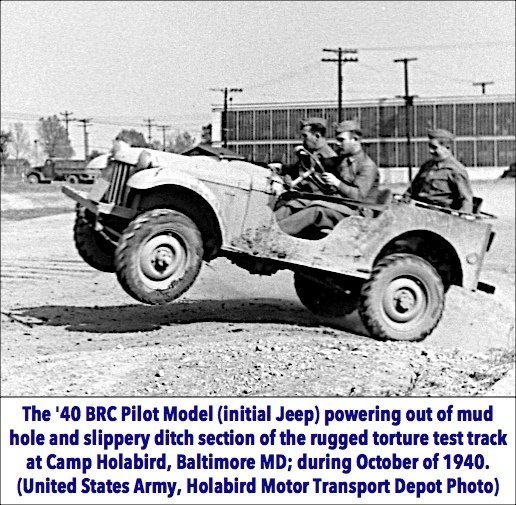
Recently William Reed was looking through a box of his dad’s photos, and saw the printouts of the photos again. He remembered his father broke the Jeep windshield a day or two after press photographers were allowed on the base to photograph several vehicles under test; including the Jeep.
William wondered if I had ever seen any of those press photos? Utilizing Newspapers.com, the earliest of those Associated Press photos appeared in the New York Daily News of October 5, 1940; which is 12-days after the BRC Pilot Model was delivered to Camp Holabird. Later an Army photo was taken from almost the same viewpoint as the following Associated Press photo.
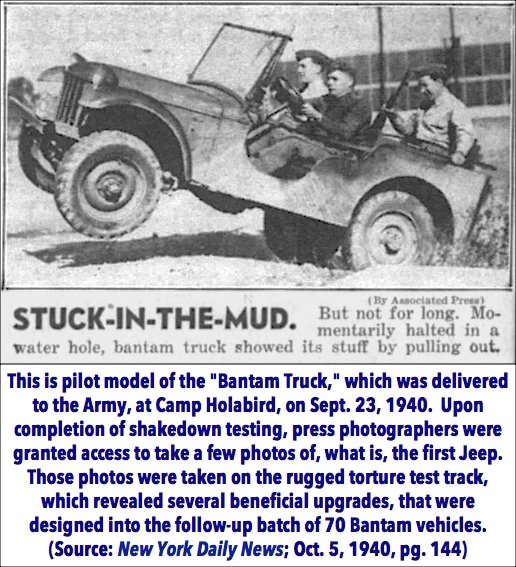
Three days before the publication of the first press photos, The Baltimore Sun contained the earliest news reports about the initial testing of the Jeep; then described as the “New Midget Truck.” Quoting the October 2, 1940 issue of The Sun, page 24.
“New Midget Truck Getting Shakedown Test At Holabird”
“A 1,000-mile cross-country road test of a new bantam motor truck will be run next week within the reservation of the Holabird Motor Transportation Depot. The run will be over a course which simulates actual road conditions—hair-pin curves, steep grades, corrugated pavements much like old-fashioned corduroy log-surfaced roads, along with mud holes and slippery ditches.”
“What army officials describe as preliminary road tests are now being run to disclose any weaknesses that might warrant a change in specifications before the manufacturer, awarded the contract for seventy of the trucks, is given the word to go ahead.”
The American Bantam Car Company, in Butler, PA, was the only company to meet the nearly impossible request by the Army; to design, build, and deliver a prototype to Camp Holabird in just 49-days.
How did Bantam do it; when bigger, better-financed companies, such as Willys and Ford, could not. It probably helped that Bantam was on the verge of bankruptcy and their plant only had a skeleton crew. It was a desperation move. Bantam relied almost entirely upon off-the-shelf parts from their previously produced Bantam Roadster and readily purchased parts. The two long-lead items had to be a custom four-wheel-drive-train and a main body designed and built to the layout.
Spicer designed and produced the custom four-wheel-drive-train, i.e. transfer case with full-float front and rear axles. Bantam produced the cowl, hood and rounded front fenders by adapting tooling from their Bantam Roadster; this produced the easily recognized rounded-nose feature.
Bantam had York-Hoover Body Corporation design and produce the custom body, from the firewall to the backend. The following is my outline sketch of the York-Hoover Body produced for the ’40 BRC Pilot Model.
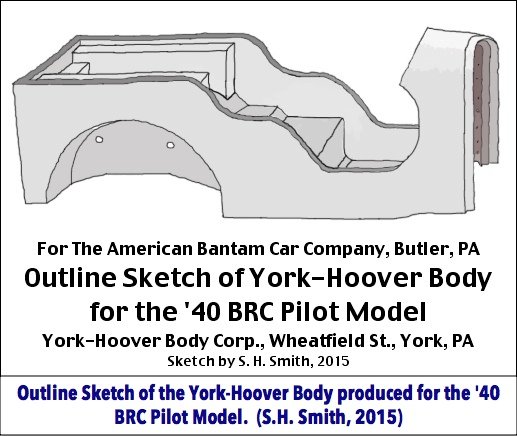
There are remembrances of a hand-made body also fabricated at the Bantam factory, in case the York-Hoover Bodies did not show up in time. Some think the hand-made body may have been used in the ’40 BRC Pilot Model; I think those chances are slim. York-Hoover Body Corporation had a good reputation for producing robust, durable truck bodies; I believe that is why Bantam selected them in the first place and why a York-Hoover Body was in the Pilot Model, that would be beat-up by the Army during performance testing.
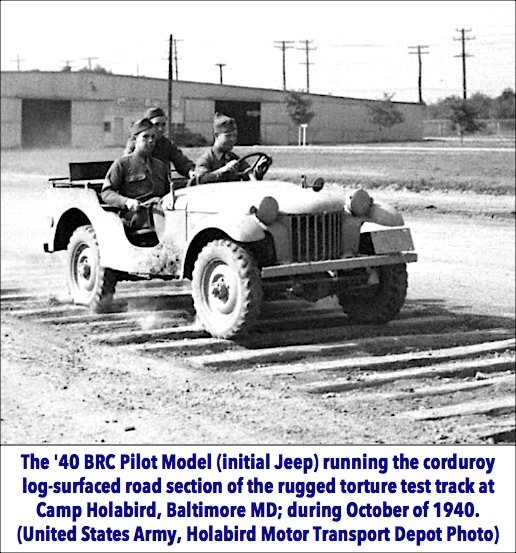
The corduroy log-surfaced road section of the rugged torture test track at Camp Holabird created the ultimate accelerated life testing; to rapidly discover weak body sections or the susceptibility of parts to looseness or break.
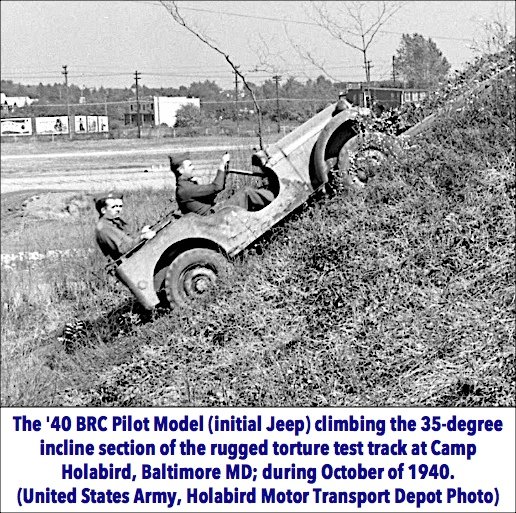
The 35-degree incline section of the test track at Camp Holabird was a consistency of performance test.
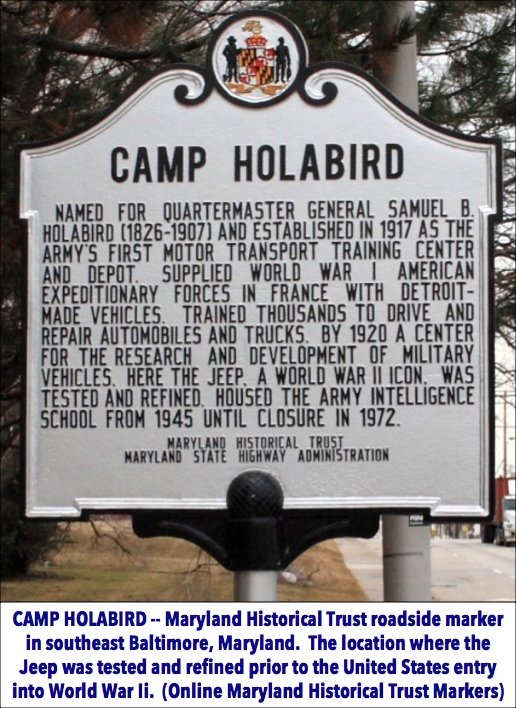
The Holabird Motor Transportation Depot was located within southeastern part of the City of Baltimore; south of Holabird Avenue, between Broening Highway and Dundalk Avenue. It was about 4-miles from the Inner Harbor and during WWII encompassed 350-acres. Most of that site is now the Fort Holabird Industrial Park.
Two other Jeep prototypes, from other manufacturers, were delivered to Camp Holabird, and although late, the Army tested them. The Willys’ prototype was delivered on November 13th, 1940 and Ford’s prototype was delivered on November 23rd, 1940. Ford had the first design with the signature flat nose, with recessed headlights; one of the key Jeep features that figured prominently in the Ford vs. Willys battle over the rights to the “Jeep brand” following WWII.
In 1941, Bantam, Willys and Ford all received contracts for 1,500 next generation “Jeep” prototypes for further evaluation and testing. York-Hoover Body Corporation had to turn down making the bodies for the 1941 Bantam “Jeeps”, due to many other production commitments. They were already making bodies for military ambulances, vans, and other supply vehicles, for the Army Signal Corps, Quartermaster Corps and the Navy.
Ultimately the Willys design won out and Ford was selected as the secondary supplier; with Ford building to the Willys design, so that all Jeeps had interchangeable parts. The American Bantam Car Company produced a few other “Jeeps” in 1941, but none thereafter.

Anyone with information, photographs, memorabilia, or other "Baltimore City Police" items can contact Ret. Det. Kenny Driscoll at
Copyright © 2002 Baltimore City Police History - Ret Det Kenny Driscoll
 https://yorkblog.com/yorkspast/wp-content/uploads/sites/4/2022/08/HolabirdB-300x294.jpg 300w" alt="" width="516" height="505" class="size-full wp-image-11571" style="box-sizing: inherit; height: auto; max-width: 100%; border: 0px; vertical-align: middle; display: block; margin-left: auto; margin-right: auto;" decoding="async" />
