

Patrolman Daniel J. Hyland
Baltimore City Park Police Department, Maryland
Remembering Patrolman Daniel J. Hyland: A Lifetime of Service Ends in Tragedy
In the annals of Baltimore's law enforcement history, few stories capture the quiet heroism and unforeseen perils of duty quite like that of Patrolman Daniel J. Hyland. At an age when many might have considered retirement, Hyland continued to serve with unwavering dedication as a member of the Baltimore City Park Police Department. His life, marked by steadfast commitment to public safety, came to a heartbreaking end on May 1, 1925, after a routine patrol in one of the city's cherished green spaces turned deadly. Hyland's story is not just one of loss but a testament to the unsung guardians who protected Baltimore's parks during a transformative era in the city's history.
Early Life and Calling to Service
Born in the mid-19th century—exact records place his birth around 1861—Daniel J. Hyland grew up in an era when Baltimore was rapidly evolving from a bustling port city into a hub of industry and culture. Little is documented about his youth, but like many of his generation, Hyland likely witnessed the city's growth firsthand, including the establishment of Druid Hill Park in 1860 as Baltimore's first major public park. Spanning over 700 acres, the park became a vital oasis amid urban expansion, attracting families, picnickers, and athletes to its winding paths, reservoirs, and monuments.
Hyland's path to law enforcement reflected the era's emphasis on community guardianship. By the early 20th century, Baltimore's parks were under the stewardship of a specialized force: the Baltimore City Park Police. Established around 1900, this dedicated unit was born out of necessity when the city's main police commissioners lacked resources to patrol expansive green areas. Empowered by city law, the Park Board recruited officers who doubled as caretakers, ensuring order in places like Druid Hill Park, Federal Hill, and Patterson Park. These "park guardians" wore distinct uniforms, carried basic equipment, and focused on preventing vandalism, mediating disputes, and safeguarding visitors—tasks that demanded both vigilance and a deep connection to the land they protected.
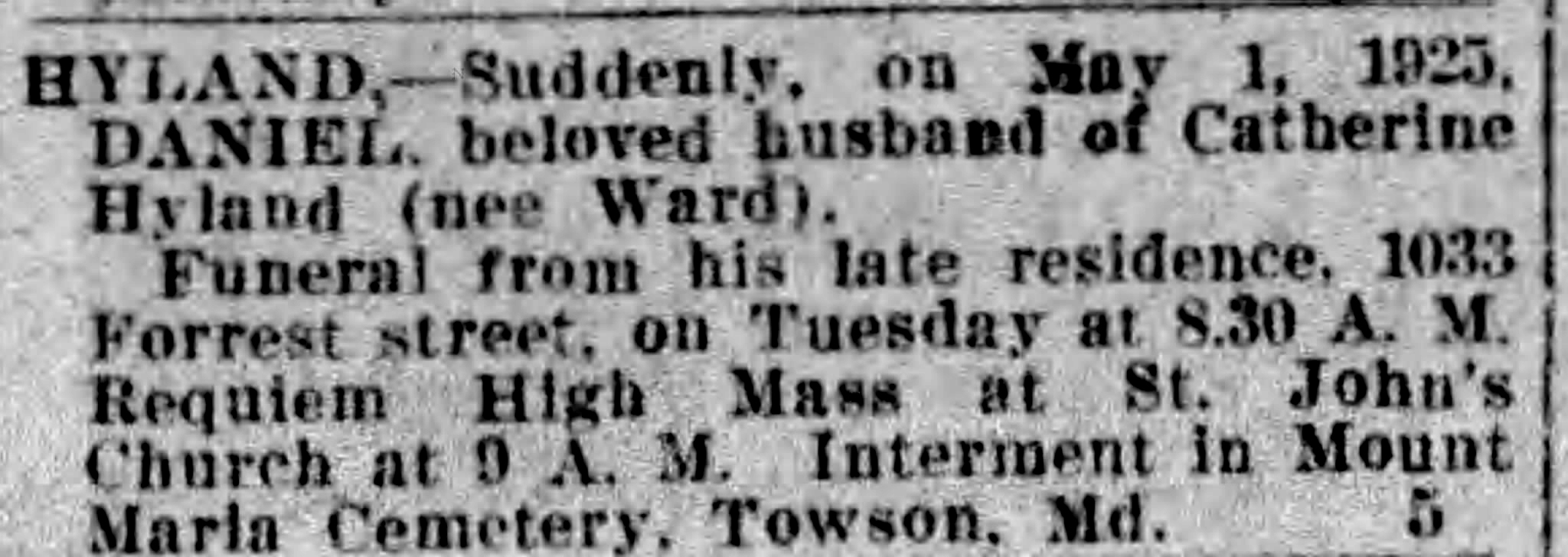
Hyland joined these ranks later in life, embodying the department's ethos of reliability and restraint. At 64 years old in 1925, he was a veteran presence, his experience a bulwark against the unpredictable nature of park patrols. Married to Catherine Hyland, who depended on him for support, Daniel's service was more than a job; it was a family anchor in a time when economic stability often hinged on such public roles.
The Fateful Night: Duty in Druid Hill Park
Druid Hill Park, with its serpentine roads and dense foliage, was a jewel in Baltimore's crown but also a challenging terrain for officers. Nicknamed the "People's Park," it hosted baseball games, concerts, and Sunday strolls, drawing thousands weekly. Yet, as automobiles proliferated in the 1920s—Baltimore's streets teeming with Model Ts and early trucks—the risks escalated. Speeding drivers, poor lighting, and narrow paths turned idyllic evenings into hazards.
On the night of April 30, 1925, Hyland was performing one of his customary rounds along Mountain Pass, a curving roadway within the park. It was around 11:30 p.m., the air cool and still under a spring moon. As a night watchman, Hyland's duty was to walk the route, ensuring no loiterers disturbed the peace or vehicles posed threats to late-night wanderers. The park's quiet amplified every sound—the crunch of gravel underfoot, the distant hum of the city.
Tragedy struck without warning. An automobile, navigating the dark curve at excessive speed, lost control. The vehicle veered off the highway, overturned, and slammed into Hyland with devastating force. The impact hurled him to the ground, leaving him critically injured. Eyewitness accounts and subsequent investigations described a chaotic scene: the car's driver, disoriented and possibly inexperienced with the park's twists, had failed to negotiate the turn. Hyland, ever the dutiful officer, had no time to react.
Rushed to a nearby hospital, Hyland clung to life through the night. But the injuries—severe trauma from the collision—proved too grave. He succumbed the following afternoon, May 1, 1925, at the age of 64. His death marked a somber milestone, coming just months after another Park Police officer, Patrolman John E. Harris, met a similar fate in the same park, struck down by a learner driver's car. These back-to-back losses highlighted the era's growing dangers, prompting calls for stricter vehicle regulations in public spaces, including bans on novice drivers.
Aftermath and a Widow's Resolve
News of Hyland's passing rippled through Baltimore's police circles and the park-loving community. The Baltimore City Park Police, a tight-knit force of about 100 officers, mourned one of its elders. Funeral arrangements were handled with the solemnity befitting a fallen hero, though specific details of the service—likely held at a local church or park pavilion—reflect the department's modest means.
Catherine Hyland, left without her husband's support, faced immediate hardship. In the years following, she pursued a claim against the city and possibly the driver's insurance, citing Daniel's role as sole provider. Court transcripts from the Maryland State Archives reveal her testimony: dependent on his earnings at the time of death, she sought compensation for the void left by his absence. These records underscore the human cost beyond the badge—the families fractured by line-of-duty losses in an age before robust survivor benefits.
The incident also fueled broader reforms. The Park Police's close collaboration with the Baltimore City Police Department intensified, with shared radio communications and joint responses to incidents. Yet, it would take decades for full integration; the Park Police remained autonomous until 1961, when it merged with the main force under Governor J. Millard Tawes, absorbing 118 officers and extending BPD jurisdiction over all parklands.
Legacy: Honoring a Quiet Sentinel
Today, Patrolman Daniel J. Hyland is remembered on the Officer Down Memorial Page (ODMP), a national tribute to the 23,000+ law enforcement officers who gave their lives in service. His entry stands as a stark reminder of the vulnerabilities even seasoned veterans face. Inducted into the Baltimore Police Department's Hall of Fame posthumously, Hyland's name endures alongside other pioneers who patrolled Baltimore's green frontiers.
Druid Hill Park, now home to the Maryland Zoo, conservatory, and vibrant cultural events, still echoes with Hyland's legacy. Modern visitors—jogging the paths he once walked or picnicking under the same oaks—owe a debt to officers like him, who ensured these spaces remained sanctuaries. In an era of rising traffic fatalities (over 20,000 nationwide in 1925 alone), Hyland's death amplified the call for safer roads, influencing local ordinances that protected pedestrians in public areas.
Daniel J. Hyland's story transcends statistics; it humanizes the badge. A man in his twilight years, choosing duty over ease, he embodied the Park Police's creed: protect the peace, preserve the beauty. As Baltimore's parks thrive into the 21st century, let us pause at Mountain Pass and reflect—not on the accident that claimed him, but on the lifetime of vigilance that defined him. In the words of a contemporary eulogy, often echoed in police memorials: "He died as he lived—serving others."
This article draws on historical records from the Officer Down Memorial Page, Maryland State Archives, and Baltimore Police Museum archives to honor Patrolman Hyland's service.


More Details
| Name | Description |
|---|---|
| End of Watch | 1 May, 1925 |
| City, St. | Druid Hill Park |
| Panel Number | N/A |
| Cause of Death | Auto Accident |
| District Worked | Park Police |

POLICE INFORMATION
We are always looking for copies of your Baltimore Police class photos, pictures of our officers and vehicles, newspaper articles relating to our department and/or officers, old departmental newsletters, old departmental newsletters, lookouts, wanted posters, and/or brochures, information on deceased officers, and anything that may help preserve the history and proud traditions of this agency. Please contact retired Detective Kenny Driscoll.

NOTICE
How to Dispose of Old Police Items
Please contact Det. Ret. Kenny Driscoll if you have any pictures of you or your family members and wish them remembered here on this tribute site to honor the fine men and women who have served with honor and distinction at the Baltimore Police Department. Anyone with information, photographs, memorabilia, or other "Baltimore City Police" items can contact Ret. Det. Kenny Driscoll at
Copyright © 2002 Baltimore City Police History: Ret Det. Kenny Driscoll
