


The Auditor Trap
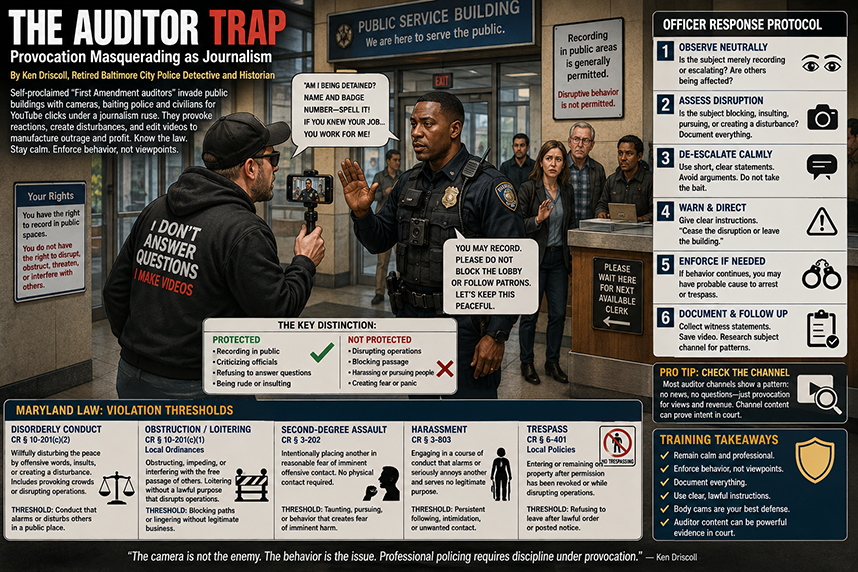 Provocation Masquerading as Journalism
A Police Training and Response Guide for Managing Provocative “First Amendment Auditors”
By Ken Driscoll, Retired Baltimore City Police Detective and Historian
The rise of self-described “First Amendment auditors” has created a new challenge for law enforcement, courthouse security, municipal employees, and even ordinary citizens conducting business in public buildings. While legitimate journalism and constitutional recording rights remain protected under the First Amendment, many modern “auditor” channels operate less like investigative reporting and more like staged confrontation entertainment designed to generate online revenue through outrage, humiliation, and provoked reactions.
These encounters are not accidental. They are often carefully engineered productions meant to create viral content. The objective is rarely information gathering. The objective is emotional escalation.
Many auditors enter government buildings with cameras already recording and immediately begin searching for emotional responses from employees, civilians, or police officers. They commonly demand names and badge numbers in an aggressive tone, refuse simple requests for cooperation, intentionally argue semantics, and repeatedly state phrases like:
-
“You don’t know the law.”
-
“If you knew your job…”
-
“I don’t answer questions.”
-
“Am I being detained?”
-
“Spell your name.”
-
“You work for me.”
-
“You’re violating my rights.”
When ignored, some escalate by targeting civilians instead of officers. Citizens conducting ordinary business may become nervous or frightened when cameras are thrust into their faces in confined spaces. Auditors frequently exploit those reactions for content, mocking fear or frustration while encouraging confrontation. In some cases, they intentionally create crowd disturbances, impede movement through lobbies or hallways, or follow retreating individuals to provoke stronger reactions.
The camera itself is not the problem. The conduct surrounding it often becomes the issue.
Understanding the Real Objective
Most professional journalists gather information, interview subjects, verify facts, and publish news reports intended to inform the public. By contrast, many auditor channels contain:
-
No investigative reporting
-
No public records analysis
-
No civic education
-
No balanced commentary
-
No news publication structure
Instead, their content overwhelmingly consists of:
-
Reaction compilations
-
Police confrontations
-
“Owned” videos
-
Edited emotional exchanges
-
Clickbait thumbnails
-
Monetized outrage content
Officers should understand this distinction clearly: the goal is frequently to provoke an emotional mistake on camera.
The officer who becomes angry often becomes the thumbnail.
Constitutional Reality: Recording Is Generally Protected
Police training must begin with constitutional restraint. Courts have repeatedly affirmed that individuals generally possess a protected right to record public officials performing duties in public spaces.
Cases such as Glik v. Cunniffe established that recording police in public is ordinarily protected activity.
This means:
-
Recording alone is not a crime.
-
Verbal criticism of police alone is not a crime.
-
Refusing casual conversation alone is not a crime.
-
Being rude, arrogant, or insulting alone is usually not criminal.
Officers who misunderstand this create unnecessary liability.
However, constitutional protections are not unlimited shields against otherwise unlawful conduct. Recording rights do not erase criminal statutes involving harassment, obstruction, threats, assault, disorderly conduct, or trespassing.
The key legal distinction is conduct versus content.
Police must enforce behavior neutrally, not viewpoints emotionally.
The “Auditor Trap”
Provocative auditors often rely on several predictable tactics:
1. Emotional Triggering
The auditor attempts to embarrass or anger officers publicly in hopes of generating a reaction suitable for YouTube monetization.
Common tactics include:
-
Repeating insults
-
Interrupting commands
-
Talking over officers
-
Mocking appearance or intelligence
-
Demanding repeated badge identification
-
Pretending confusion over simple lawful instructions
The officer who argues emotionally loses operational control immediately.
2. Manufactured Crowds
Auditors frequently choose confined public buildings where emotional reactions naturally attract attention:
-
DMV offices
-
Libraries
-
Courthouses
-
Police lobbies
-
Permit offices
-
Schools
-
Post offices
As arguments develop, crowds form. Once crowds gather, normal operations become disrupted.
This becomes important legally.
3. Targeting Civilians Instead of Police
Some auditors intentionally shift attention toward ordinary citizens because civilians are more likely to react emotionally than trained officers.
Examples include:
-
Following frightened customers
-
Recording children near entrances
-
Blocking hallways while filming reactions
-
Pursuing retreating individuals verbally
-
Mocking fearful responses
Once behavior shifts from observation into intimidation, harassment, or obstruction, legal thresholds may emerge.
Maryland Criminal Statutes Commonly Implicated
Disorderly Conduct — Maryland CR § 10-201
Maryland disorderly conduct statutes may apply when conduct intentionally disturbs public peace or disrupts lawful public operations.
Potential indicators include:
-
Loud confrontational yelling
-
Creating hostile crowd reactions
-
Blocking service counters
-
Interfering with pedestrian flow
-
Escalating verbal confrontations in confined buildings
-
Refusing repeated lawful directions tied to public safety or operations
The key factor is not criticism of police. The issue is willful public disturbance.
An officer should articulate:
-
What disruption occurred
-
How operations were affected
-
Who became alarmed
-
What warnings were issued
-
How the subject escalated after warnings
Body camera footage becomes critical evidence here.
Obstruction or Hindering Passage
When individuals intentionally position themselves to interfere with public movement or operations, obstruction-related statutes or local ordinances may apply.
Examples include:
-
Blocking lobby entrances
-
Preventing access to counters
-
Standing deliberately in traffic paths
-
Creating crowd bottlenecks for reactions
-
Refusing lawful movement requests tied to safety
Again, officers must focus on behavior, not filming.
A person quietly recording from the side of a hallway is very different from someone intentionally obstructing movement to provoke conflict.
Second-Degree Assault — Maryland CR § 3-202
Many officers mistakenly believe assault requires physical contact. Under Maryland law, assault may include intentionally placing another person in reasonable fear of imminent offensive contact.
Potential examples:
-
Aggressively pursuing frightened civilians
-
Cornering retreating individuals
-
Advancing while taunting
-
Using threatening proximity or gestures
Statements such as:
-
“Why are you scared?”
-
“Run away then.”
-
“Not so tough now?”
may become relevant when paired with aggressive pursuit behavior.
Context matters enormously.
The question becomes whether a reasonable person would fear imminent offensive contact under the circumstances.
Harassment — Maryland CR § 3-803
Persistent alarming behavior directed at unwilling individuals may cross into harassment territory.
Potential indicators:
-
Continuing pursuit after requests to stop
-
Repeated intimidation of employees
-
Following retreating civilians
-
Repeatedly targeting the same person
-
Conduct clearly intended to alarm rather than gather information
Documentation of repeated warnings becomes important.
Trespassing
Public buildings remain public forums for legitimate business purposes, but many government facilities still maintain lawful behavioral restrictions.
Once an individual:
-
materially disrupts operations,
-
refuses lawful directives,
-
or interferes with building functions,
administrators may revoke permission to remain.
Officers should ensure:
-
warnings are clear,
-
instructions are lawful,
-
and removal is behavior-based rather than viewpoint-based.
The Importance of Neutrality
The strongest officers in these encounters are usually the calmest officers.
Auditors thrive on visible anger.
The ideal officer response is often:
-
brief,
-
professional,
-
unemotional,
-
repetitive,
-
and highly documented.
Avoid:
-
sarcasm,
-
legal debates,
-
ego contests,
-
threats,
-
or profanity.
Never try to “win” the argument on camera.
The operational goal is lawful resolution, not verbal victory.
Recommended Officer Response Protocol
Step 1: Observe Without Escalating
Determine:
-
Are they merely filming?
-
Are they disrupting operations?
-
Are civilians becoming alarmed?
-
Are exits or counters being blocked?
-
Are they following unwilling individuals?
Do not assume criminal conduct simply because cameras are present.
Step 2: Begin Documentation Immediately
Activate:
-
body cameras,
-
lobby cameras,
-
witness collection,
-
supervisor notifications if needed.
Narrate observations clearly:
-
“Subject is blocking the service counter.”
-
“Multiple citizens appear alarmed.”
-
“Subject has ignored requests to stop following patrons.”
Detailed articulation defeats edited online narratives later.
Step 3: Use Calm, Limited Communication
Effective phrasing includes:
-
“You may record.”
-
“You may not block the entrance.”
-
“Please step away from the counter.”
-
“Do not follow patrons.”
-
“Keep the walkway clear.”
Avoid debating constitutional law roadside-style.
Never argue YouTube legal theories.
Step 4: Issue Clear Warnings
Warnings should be:
-
specific,
-
lawful,
-
and behavior-focused.
Example:
“You are free to film, but if you continue obstructing this lobby or alarming patrons, you may be subject to arrest for disorderly conduct or trespassing.”
This distinction is critical.
Step 5: Enforce Quietly and Professionally
If probable cause develops:
-
avoid crowd theatrics,
-
avoid emotional statements,
-
avoid retaliatory language.
The cleaner the arrest, the stronger the case.
Investigative Value of Auditor Channels
An overlooked training point is the evidentiary value of the auditor’s own content.
Many channels unintentionally establish:
-
motive,
-
intent,
-
behavioral patterns,
-
monetization goals,
-
prior conduct,
-
and editing manipulation.
Patterns may include:
-
repeated confrontational titles,
-
selective edits,
-
staged thumbnails,
-
prior removals from buildings,
-
encouragement of public confrontation.
Channel evidence may rebut claims of legitimate journalistic intent when the actual conduct demonstrates deliberate provocation.
Subpoenaed full-length footage can become extremely valuable in court.
Training Recommendations for Departments
Departments should incorporate dedicated auditor-response scenarios into annual legal update training.
Recommended drills include:
Scenario-Based Role Play
Train officers to:
-
withstand verbal insults,
-
avoid emotional escalation,
-
maintain command presence,
-
and articulate conduct-based violations clearly.
Camera Discipline Training
Teach officers:
-
assume constant recording,
-
avoid side comments,
-
narrate observations professionally,
-
and maintain consistent demeanor.
Building Coordination
Coordinate with:
-
courthouse staff,
-
library administrators,
-
municipal offices,
-
and security personnel
so all parties understand:
-
lawful recording rights,
-
lawful behavioral restrictions,
-
and trespass procedures.
Final Operational Principle
The greatest mistake officers make with provocative auditors is treating every encounter like a personal challenge.
The greatest mistake auditors make is believing a camera immunizes unlawful conduct.
Neither belief is correct.
Professional policing requires discipline under provocation. Courts consistently favor officers who:
-
remain calm,
-
issue lawful warnings,
-
document behavior carefully,
-
and enforce statutes neutrally.
The camera is not the enemy.
The behavior is the issue.
And the officer who understands that distinction usually wins both the street encounter and the courtroom afterward.

POLICE INFORMATION
We are always looking for copies of your Baltimore Police class photos, pictures of our officers, vehicles, and newspaper articles relating to our department and/or officers; old departmental newsletters, old departmental newsletters, lookouts, wanted posters, and/or brochures; information on deceased officers; and anything that may help preserve the history and proud traditions of this agency. Please contact Retired Detective Kenny Driscoll.

NOTICE
How to Dispose of Old Police Items
Please contact Det. Ret. Kenny Driscoll if you have any pictures of you or your family members and wish them remembered here on this tribute site to honor the fine men and women who have served with honor and distinction at the Baltimore Police Department. Anyone with information, photographs, memorabilia, or other "Baltimore City Police" items can contact Ret. Det. Kenny Driscoll at
Copyright © 2002 Baltimore City Police History: Ret Det. Kenny Driscoll
