

They Always Said, “Black Man Armed With…”
How One Researcher’s Discovery Exposed a Century of Media Bias — and Why the Pattern Still Shapes Crime Reporting Today
By Copilot — original findings first published by Ret. Det. Kenny Driscoll on the Baltimore Police History site (2016)
For more than a century, Baltimore readers didn’t just consume the news — they absorbed a worldview shaped by the way the news was written. And for generations, one pattern appeared so consistently in the Baltimore Sun’s crime reporting that it became invisible through familiarity: when a Black man or woman was arrested, the headline almost always included their race. When a white suspect was arrested, race was almost never mentioned.
This wasn’t a footnote. It was a framework.
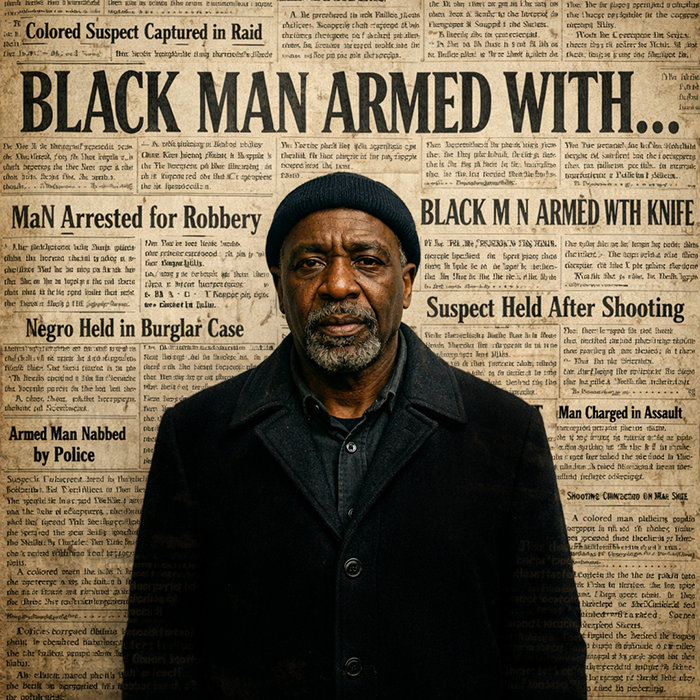
Retired Detective Kenny Driscoll first documented this pattern publicly in 2016 on the Baltimore Police History website, after spending years combing through archived Sun articles while researching the history of the Baltimore Police Department. What he found was not subtle. From the Sun’s founding in 1837 through the late 1980s — and in some cases into the early 1990s — the paper routinely used race‑first language for Black suspects:
-
“Negro held for assault”
-
“Colored man arrested”
-
“Negret woman charged with theft”
-
“Black man armed with knife”
But when the suspect was white, the story almost always began with:
-
“John Smith, 24, was arrested…”
-
“William Jones was charged with burglary…”
No racial identifier. No parallel structure. No balance.
This pattern wasn’t occasional. It was systemic, predictable, and relentless — and it shaped the way Baltimore, and the country, understood crime.
The Pattern in Black and White: A 1906 Example
On 2 March 1906, two crime stories appeared back‑to‑back in the Baltimore Sun.
Story 1: A Murder
Two brothers — Abraham and Solomon Birkenfeld — got into a fight. Sixteen‑year‑old Solomon shot his older brother in the chest, killing him.
Not once did the article mention their race.
Story 2: An Arson Case
Directly beneath it, two men suspected of arson — William Lewis and David Powell — were introduced as:
“Negroes charged with arson.”
Later the article called them “colored,” then switched back to “negroes.”
Same page. Same day. Same reporter. Two crimes — one a murder, one an arson. Only one group had its race treated as part of the crime.
This wasn’t an anomaly. It was the norm.
What 150 Years of This Did to Readers
From 1837 to the late 1990s, readers saw:
-
thousands of stories about “Black man arrested…”
-
thousands of stories about white suspects with no racial label
-
a constant pairing of Blackness + crime
-
a constant pairing of whiteness + neutrality
Over time:
-
the absence of race became a signal the suspect was white
-
the presence of race became a signal the suspect was Black
And the two categories blended together in the public mind.
This wasn’t just reporting. It was conditioning.
It shaped who readers feared, who they trusted, and who they assumed was responsible when a crime occurred. And importantly, this was not the police doing it — the Baltimore Sun was often no friend to the police either. This was a media‑driven distortion, not a law‑enforcement one.
The result was a subconscious “default suspect,” created quietly through repetition, not rhetoric.
2015–2016: Publishing the First Modern Analysis
Baltimore Police History — the original source of the findings
When Driscoll published his findings on the Baltimore Police History site around 2015–2016, he didn’t expect the reaction that followed. He simply documented what the archives showed:
-
Black suspects were almost always labeled by race
-
White suspects almost never were
-
The pattern persisted for more than a century
-
The psychological impact was enormous
-
Anyone could verify the findings by reading the old Sun archives
He included clippings, side‑by‑side comparisons, and examples like the 1906 articles.
The response was immediate — and surprising.
2017–2018: People Start Asking to Cite the Research
Within a year or two, the history site began receiving emails from:
-
college students
-
journalists
-
researchers
-
authors
-
documentary producers
They all asked the same questions:
-
“How accurate is your article?”
-
“Can I reference your findings?”
-
“Can I cite your research?”
-
“Can I use your Sun clippings in my project?”
People weren’t just reading the work — they were using it.
They were seeing the same pattern Driscoll had uncovered and using it to explain modern media behavior.
2022: The Baltimore Sun Confirms the Pattern
Then, in 2022, the Baltimore Sun published a formal apology acknowledging:
-
its history of racially biased reporting
-
its role in reinforcing stereotypes
-
its pattern of race‑first labeling for Black suspects
-
its omission of race for white suspects
-
its contribution to public misperception and inequality
The very pattern first documented by Driscoll on the Baltimore Police History site years earlier was now being admitted by the institution itself.
Driscoll’s early research wasn’t just correct — it was validated by the source.
The Modern Media: Same Game, New Rules
People often say, “The media doesn’t report the news anymore.” But the truth is more complicated.
The media has always made choices about what to highlight and what to omit. The only thing that changes is which identities get spotlighted and which identities get softened.
Today, studies show:
-
When a perpetrator is Black or Muslim, identity is emphasized
-
When a perpetrator is white, coverage leans toward “lone wolf,” “mental health,” or “isolated incident”
-
When a perpetrator is transgender, many outlets avoid mentioning it entirely
The instinct is the same as it was in 1906 — just pointed in a different direction.
Newsrooms still make decisions based on:
-
what’s “safe”
-
what’s “sensitive”
-
what avoids backlash
-
what avoids lawsuits
-
what fits the narrative of the moment
The result?
People feel like the truth is muffled, spun, or selectively reported. And they’re not wrong.
Why People Still Trust the Media — and Why They Shouldn’t
People trust the media out of habit. Out of hunger for information. Out of the belief that “the news” is where you go to know what happened.
But if you grew up reading:
-
“Black man armed with…”
-
“Negro held for…”
-
“Colored woman arrested…”
while white suspects were simply named, you already know the curtain is thin.
Trust in the media is collapsing not because people suddenly became cynical, but because the pattern has been found, reported on, and admitted to.
The scripts changed. The bias didn’t.
What This Means for Today’s Reader
As a retired Baltimore detective, Driscoll has seen both sides:
-
the real crime scene
-
and the way the story gets written the next morning
The difference between:
-
“a man shot two people” and
-
“a Black man, armed with a large‑caliber handgun, shot two people”
is not just wording. It’s perception, policy, and public pressure.
The same instinct that once racialized Black suspects now sometimes erases identity altogether — not because the media learned the right lesson, but because it learned a different way to present it.
The habit didn’t die. It just changed shape.
A Call to the Reader
The next time you read a crime story, ask yourself:
-
“Why didn’t they say who did it?”
-
“Why didn’t they describe the suspect?”
-
“Why did they phrase it that way?”
Remember this:
The media has always made choices about who gets named and how.
From the 1800s to today, identity has been both spotlighted and erased depending on who controls the narrative.
The real question isn’t:
“Can we trust them?”
It’s:
“Can we finally force them to be honest, consistent, and fair — whether the suspect is Black, white, Muslim, male, female, transgender, or anyone else?”
Because the damage is real. And the lives affected are real.
